Disclosure: Some links in this post are affiliate links. As an Amazon Associate I earn from qualifying purchases, at no extra cost to you. Learn more
Specs are compiled from manufacturer listings and verified buyer reviews and can change over time — please confirm the key details on the product page before buying.
For most kitchens, the Work Sharp MK2 is the one to buy. It shapes an edge in minutes without you holding a steady angle by hand, and 4.5+ stars across 8,000+ owners backs that up. The rest of the list splits into three jobs. Belt-driven sharpeners grind a fresh edge. Diamond-wheel pull-through machines (machines you pull the blade through) refresh an edge fast. Compact countertop units tuck into a drawer. Match the machine to your blade types and the choice gets simple.
This guide is built by comparing the manufacturers’ published specifications and the patterns across verified customer reviews, so you get each pick’s real strengths and trade-offs instead of marketing spin.
Some units grind a whole new bevel onto a tired blade, while others only touch up what is already there. That single difference decides whether a machine can rescue a drawer full of neglected knives. It is the split that shapes this best automatic knife sharpener breakdown.
Top Picks


How To Choose The Best Automatic Knife Sharpener
An automatic sharpener saves you from the hardest part of hand sharpening: holding a knife at one fixed angle for hundreds of strokes. These machines do that holding for you. The catch is that belt, wheel and rod machines remove metal in different ways. Match the machine to your blades before you match it to your countertop.
Belt abrasives versus diamond wheels versus ceramic rods
A flexible abrasive belt wraps itself around the blade as it spins, so it can shape a brand-new edge along the whole length of the knife. That is what the Work Sharp machines do, and it is why they can revive a knife that has gone blunt for years.
Diamond wheels are the hardest cutting surface here. They cut fast and hold their shape, but a fixed slot only cuts at one preset angle. Ceramic rods are for the finishing pass — they polish a sharpened edge smooth rather than removing metal.
Why the angle preset matters more than the motor
A knife only gets sharper if the sharpener grinds at the angle the blade was made with. Most household knives leave the factory at roughly 20 degrees per side, which is why so many machines here preset that number for you.
Thinner Asian-style blades and some fillet knives sit closer to 15 degrees. Garden shears and axes want a far blunter edge. A machine with adjustable angles handles that spread; a single-angle model does not. Pull a dull blade through too shallow a slot and you thin the edge rather than sharpen it.
The stages and what each one is for
A two-stage machine grinds, then hones. A three-stage machine adds a polish pass, and that final step is what separates an edge that feels sharp from one that slices cleanly. Five-stage setups on paper add refinement steps, but the grit you use matters more than the number of slots.
Blade types and the serrated question
Serrated bread knives, scissors, and ceramic blades are the three things a basic pull-through slot usually cannot handle. If those live in your kitchen, check the spec sheet before you buy. Several picks here name serrated blades and scissors specifically; others are built for straight edges only.
Mess, storage, and the daily-use reality
Sharpening throws off metal dust. A magnetic collection tray or a dust box keeps those shavings off your counter and out of your drawers — a small feature you will notice every time you use the machine.
Footprint decides whether the unit lives on the counter or in a drawer. Belt sharpeners tend to be heavier and want a dedicated spot; the compact wheel units store away easily. Be honest about whether you will leave it on the counter or bury it in a drawer.
Side-by-Side Comparison
| Model | Best For | Sharpening System | Abrasive | Weight | Amazon |
|---|---|---|---|---|---|
| Work Sharp MK2★ Best Overall | Reviving neglected blades | 2-speed belt, adjustable angle | Flexible abrasive belts | 1.12 ounces | Amazon |
| Narcissus S867-2Best Value | Knives, scissors and ceramic blades | Dual slot (coarse + fine) | Diamond wheels | 1.7 pounds | Amazon |
| Presto 08800 EverSharpMost Trusted | Simple two-stage home sharpening | 2-stage, fixed guides | Sapphirite wheels | 3 pounds | Amazon |
| Ceelpeopar 3-Speed | Speed control on a budget | 3-stage, 3 speeds | Diamond + ceramic rod | 1.7 pounds | Amazon |
| DSkiley 3-Stage | Beginners who want a fixed 20° | 3-stage, preset 20° | 100% diamond wheels | 2.4 pounds | Amazon |
| Work Sharp E2 | Drawer storage in a busy kitchen | Guided slot, auto-shutoff | Double-sided abrasives | 16 ounces | Amazon |
| Work Sharp WSCMB Combo | Pocket knives and field use | Belt + ceramic hone | Flexible abrasive belts | 1.2 pounds | Amazon |
| Presto 08810 Professional | Thick, thin and Santoku blades | 3-stage, blade-thickness selector | Sapphirite + ceramic wheel | 5.1 pounds | Amazon |
| Homly 3-Stage | Quiet operation on a big blade collection | 3-stage, spring angle guides | 100% diamond abrasives | 3 pounds | Amazon |
| Chef’sChoice 15XV | Converting edges to a 15° Trizor | 3-stage EdgeSelect | 100% diamond + flexible polish | 4.2 pounds | Amazon |
Detailed Reviews
1. Work Sharp MK2 Electric Knife Sharpener
Our pick — 4.5+★ from 8,000+ verified ratings; the strongest balance of quality and price.
The belt-driven workhorse that rebuilds an edge instead of just touching one up
If your knives have gone properly dull — the kind where a tomato fights back — this is the machine that fixes it. The MK2 runs flexible abrasive belts over a spinning motor, and a belt wraps itself around the blade as it turns. That is a different job from a fixed slot dragging across a steel wheel. It grinds a fresh edge along the whole length of the knife, tip included, and the fixed edge guide holds the angle so you do not have to.
Two speeds give you real range here. The slower setting handles everyday kitchen knives and gives you more control; the faster one brings the power for heavier grinding on lawnmower blades, axes, and garden tools. Comparison shopping is easy once you see the dimensions: this unit measures 7.02″L x 2.26″W x 1.27″H, while the Presto 08800 EverSharp sits at 9.9″L x 7.2″W x 4.8″H. The Work Sharp takes up a fraction of the counter, and at 1.12 ounces of recorded item weight it is dramatically lighter than the Presto’s 3 pounds — so it goes in a toolbox without a second thought.
Hundreds upon hundreds of owners single out how well the MK2 works, and nearly as many praise how easy it is to use. Knives come off the belt shaving-sharp in minutes, not the half hour a whetstone (a flat sharpening stone you hold by hand) demands. Buyers report it plainly: “Upgraded from original model after 10+ years of reliable use. MK2 is far easier to use with no skill needed; accurate blade guide produces perfect burr and razor-sharp edges in minutes (~10 pulls on grinder belt, 10 on fine belt).” You get 20/25-degree angle options and P80, P220 and 6000 grit belts (grit means abrasive coarseness), so you can start coarse and finish fine.
The honest trade-off is the belts themselves. Durability draws mixed feedback, and some owners find the abrasives wear out with steady use — budget for replacements as consumables, the same way you would for any belt machine. It also throws metal dust, so pick a dedicated spot and brush the grinder down afterward. There is a 3-year warranty behind it, and it is designed, engineered, and calibrated in Oregon.
Where the MK2 earns its keep
- Belts conform to the blade and sharpen to the very tip
- Two speeds cover kitchen knives and heavier tool grinding
- Handles serrated knives, scissors, axes and garden tools
- Compact 7.02″L footprint and a 3-year warranty
What to plan around
- Belts are consumables and wear with regular use
- Dust needs a dedicated area and a cleanup brush
- Not for anyone who wants the ritual of a whetstone
Buy this one if: you have a mix of kitchen knives and outdoor tools and want one machine that handles both.
Think twice if: you sharpen daily in a commercial kitchen — the belt replacements will add up faster.
2. Narcissus S867-2 Diamond Electric Knife Sharpener
A three-in-one that handles the ceramic blade and the kitchen scissors too
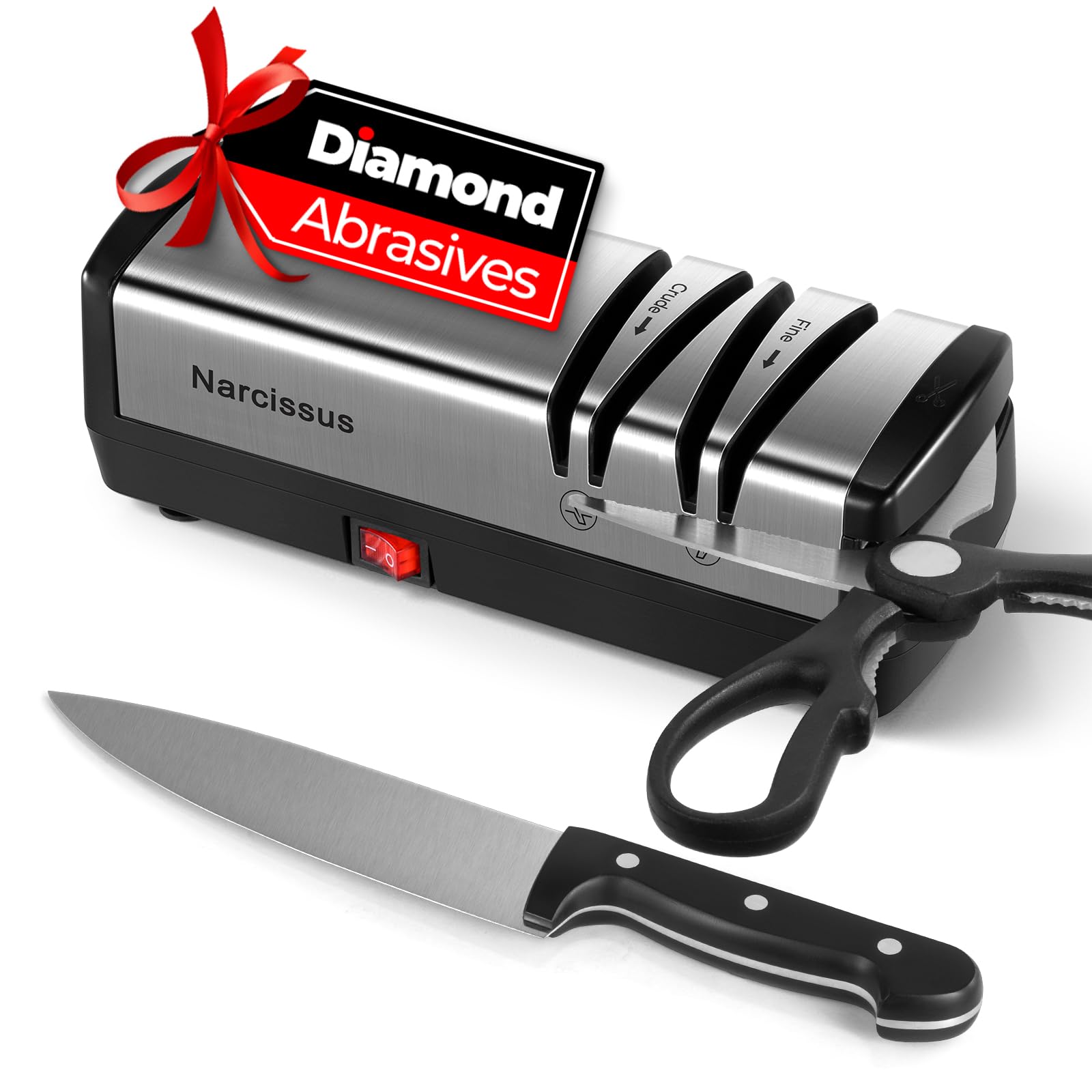
Most pull-through machines stop at straight steel. The Narcissus S867-2 does not. It runs diamond sharpening wheels (abrasive discs coated in diamond grit) through a dual-slot system: a coarse slot to bring a dull blade back, and a fine slot to polish off the burr (the rough lip left on a sharpened edge). It is built to take straight, serrated and ceramic knives plus scissors. If your kitchen has a ceramic blade or a pair of shears that has gone blunt, that spread is the reason to look here.
The workflow is genuinely quick. You insert the knife at an angle, keep it against the outer wall, and pull from outside to inside two to five times per slot. Diamond is the hardest cutting surface in this lineup, so it cuts fast rather than grinding away slowly. The 100-240V wide voltage design also means it travels with you.
Stability gets attention in the design: a lower center of gravity and four anti-slip foot pads keep the unit planted, and the ergonomic handle makes the pull easier to control. It weighs 1.7 pounds against the Presto 08800 EverSharp’s 3 pounds, so it lifts off the counter and into a drawer without effort. At 8.2″L x 2.9″W x 2.7″H it stores small. The caveats are real but small in scale — one unit that arrived as a gift unit failed to power on and was refunded, and a couple of owners noted the price felt high for non-professional use. The 12-month replacement policy and 24-month after-sales service cover that risk.
A frequently-used blade came back transformed: “Sharpened a frequently used knife with 15-20 passes per side plus ~10 on fine side; result amazing.” Fifteen minutes gets a whole kitchen’s knives done, which is the everyday win here.
The real draw: diamond wheels plus ceramic and serrated support in a unit lighter than most of the fixed-slot competition.
The honest limit: the fine slot polishes rather than reprofiles, so a badly neglected blade wants more passes than a fresh one.
Reach for this if: your drawer holds ceramic or serrated blades and you want one compact unit for all of them.
Look elsewhere if: you need to reshape a heavily damaged edge — a belt machine does that job better.
3. Presto 08800 EverSharp Electric Knife Sharpener
The two-slot classic that made razor edges a household routine
Presto has been selling this design for long enough that it has become the default kitchen sharpener in a lot of homes, and 4.5+ stars across more than 18,000 owners says the formula still lands. The idea is as simple as it gets: two slots, precision blade guides that hold the knife at the right angle, and Sapphirite wheels — the same ultra-hard material used in professional sharpening shops. You draw the blade through each slot a few times and you are done.
Stage one grinds a precisely angled edge; stage two hones and polishes it. Set-up is quick enough that nobody dreads it, and the machine works on most any non-serrated blade — kitchen knives and sport knives alike. It runs on 120 volts and is built to North American electrical standards, with a 1-year limited warranty. At 9.9″L x 7.2″W x 4.8″H it wants a real spot on the counter rather than a drawer, and at 3 pounds it stays put when you pull a blade through.
Quality is the aspect owners praise most by a wide margin, with sharpness and value close behind. Old, tired knives come back looking and cutting like new, and the edge holds for a long stretch rather than fading in a week. It also turns sharpening into a two-minute chore instead of a project.
The limitation to accept: this is a fixed two-stage machine built for non-serrated blades at one preset angle. Serrated bread knives and scissors need a different tool. For straight-edge kitchen steel though, it is the low-fuss benchmark.
The one for you if: you want the simplest possible routine on straight-edge kitchen knives and a machine that has proved itself over years.
Not for you if: serrated blades or garden tools are part of your sharpening list.
4. Ceelpeopar Professional Electric Knife Sharpener
Three motor speeds and two grind angles, all readable on a small screen
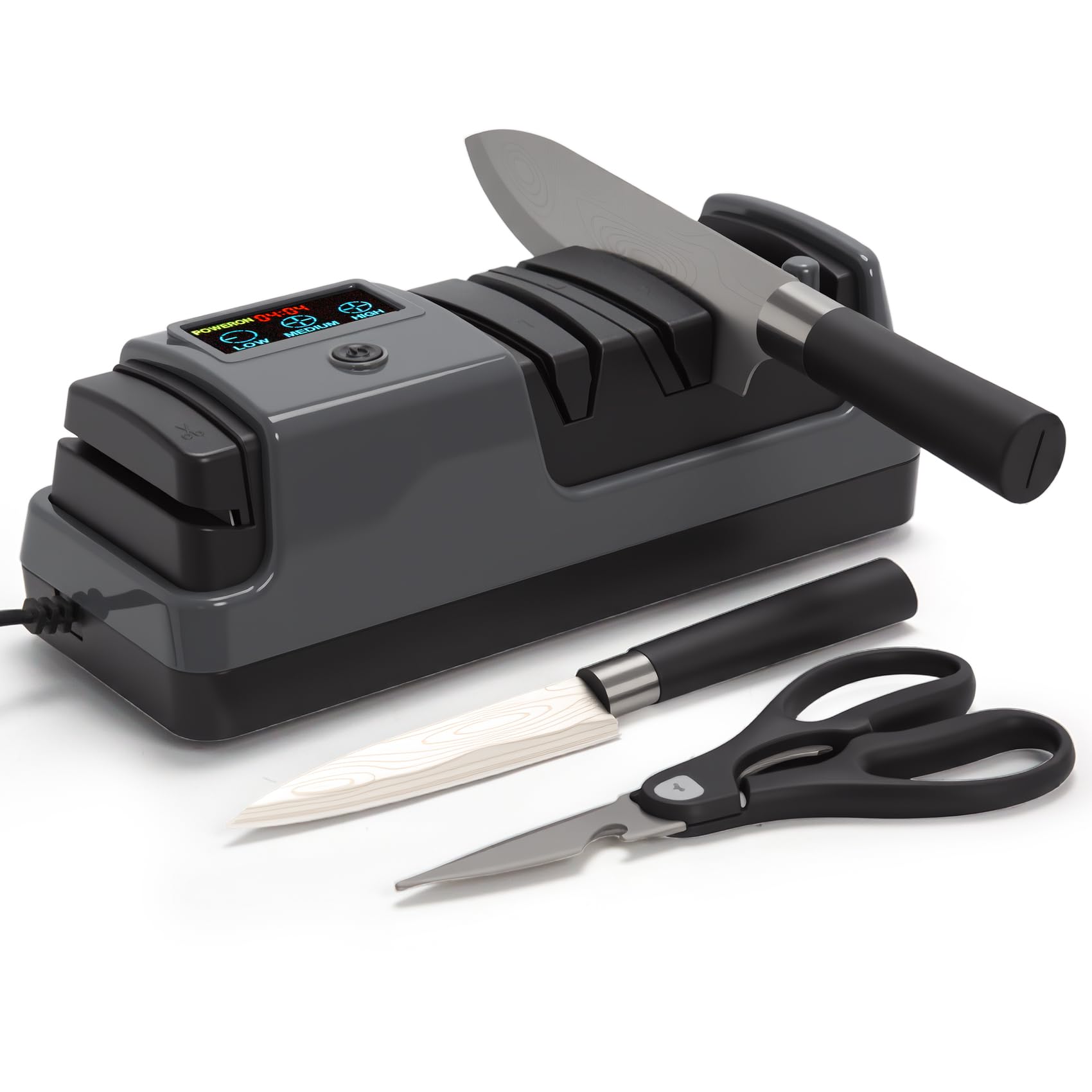
Very few sharpeners in this lineup let you pick the motor speed. This one does, and it puts the setting on an LCD display so you know exactly what you selected. Three thousand RPM suits fine and serrated blades, four thousand RPM is the everyday kitchen setting, and five thousand RPM is for very dull or high-hardness blades. Most pull-through machines give you no speed control at all.
The grinding side is three stages: 300# and 600# diamond wheels rebuild and refine the edge, then a 1000# ceramic rod polishes it — and that rod is removable so you can reach special shapes. The variable-angle design sharpens at 22.5° for standard knives or 32.5° for garden shears and small axes. Matching the angle to the blade’s factory edge is what keeps you from grinding a knife thinner than it should be.
Sharpening performance is the clear strong suit here — well over three dozen owners point straight at how well it sharpens, with sharpness the next most-praised trait. The built-in magnetic chassis collects the metal dust as you work, and the tray lifts out so you wipe it clean instead of chasing shavings around the sink. It measures 9.8″L x 4″W x 3.5″H and weighs 1.7 pounds, so it stores without a fight.
The fair warning is the motor over the long haul: durability on that part draws mixed and occasionally negative feedback, so this is a machine for regular home use rather than a hard-work commercial kitchen. For the occasional big sharpening session, it does the job well.
Why it stands out: the speed dial and the two-angle design give you choices the fixed-slot machines never offer.
What to keep in mind: the ceramic polishing rod is the finishing pass — skip it and the edge feels sharp but slices rough.
Pick this if: you sharpen a varied collection and want to dial the machine to each blade.
Pass if: you want a buy-once machine for daily commercial volume.
5. DSkiley 3-Stage Electric Knife Sharpener
The preset-angle machine for anyone who has never sharpened a knife before
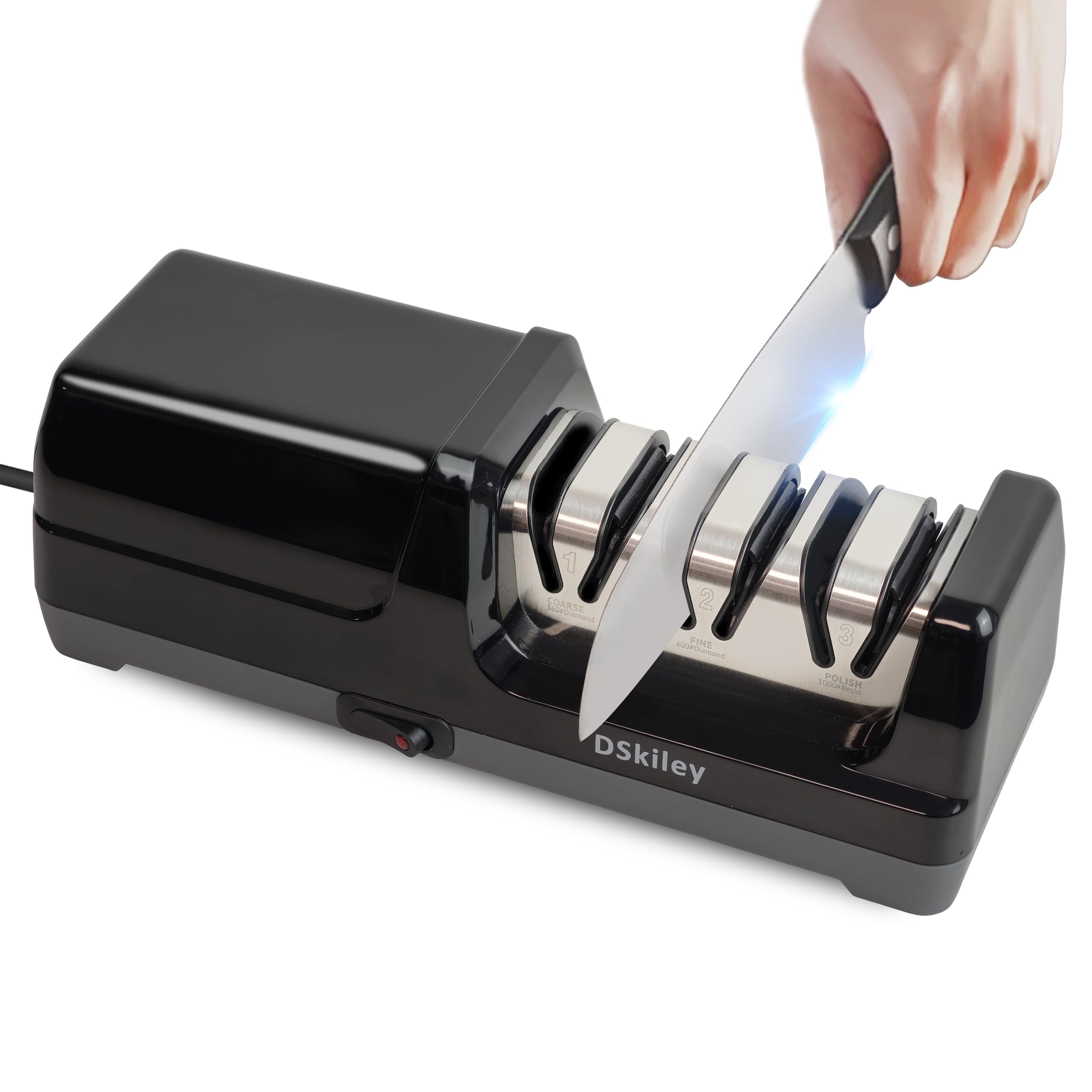
The whole pitch here is that you cannot get the angle wrong. A built-in 20° angle guide holds the blade at a fixed chef-recommended tilt through all three stages — repair, sharpen, polish — so a first-timer gets a consistent edge without learning to feel the bevel. For a home cook who just wants sharp knives back, that removes the part people get wrong.
It runs 100% diamond wheels across those three stages and draws on a standard 110V U.S. supply. A non-slip pad keeps the unit from sliding across the counter while you pull, and a powerful motor is described as delivering smooth sharpening without overheating or slowing down. The magnetic collector pulls the metal shavings in as you work, so cleanup is a wipe rather than a scrub. It measures 12″L x 4.92″W x 4.8″H and weighs 2.4 pounds.
Sharpening performance is what carries it — well over a hundred owners call out how well it sharpens, with quality the next most-praised trait. Results show up fast: dull knives come back super sharp in minutes, and beginners report no trouble at all. Sturdy build and a stable stance keep it planted through the pass. It ships in gift-ready packaging and carries a 1-year replacement warranty.
The one thing to know before you start: not every knife fits. About seven in ten of one owner’s knives took a clean edge, but the rest had handles that blocked part of the blade from reaching the sharpener. Check that your handle sits clear of the slot before you count on a full drawer getting done.
What makes it easy
- Fixed 20° guide removes the guesswork for beginners
- Three stages cover repair, sharpening and polishing
- Magnetic collector keeps shavings out of the drawer
- Non-slip pad holds the unit steady during the pull
What to check first
- Handles that overhang the blade can block the slot
- Built for non-serrated household knives only
- Single 20° angle — no adjustment for thinner Asian-style blades
The right buy for: a home cook with standard straight-edge knives who wants sharp results on the first try.
The wrong buy for: anyone whose knives have deep bolsters or heavy handles that sit right at the edge.
6. Work Sharp E2 Electric Kitchen Knife Sharpener

The one that disappears into a drawer between sharpening sessions
Counter space is the quiet reason people stop using a sharpener. This unit answers that directly. Its small footprint tucks into a kitchen drawer or cabinet, and it weighs just 16 ounces, so it lifts out and goes back without effort. The design also includes practical cord storage, which keeps the cable from tangling the drawer shut.
In use it is as hands-off as the category gets. There is no angle to hold and no skill required — the electric motor and guided design do the work. It sharpens chef, santoku, paring, utility and serrated kitchen knives, so the whole block gets covered. One detail worth knowing: it includes an auto-shutoff that stops the motor once the edge is sharp, and that short run time is exactly what prevents over-sharpening a blade you only needed to touch up.
Ease of use is what carries the reputation here — far and away the most-praised trait, with sharpness right behind. Knives that have sat dull for decades come back razor-sharp with minimal effort, which is why it gets recommended to people who have never owned an electric sharpener. The case opens up for cleaning and the discs are reversible and replaceable, so metal dust has somewhere to go.
The catch is what it will not do. It works best on smaller, thinner knives — a large Japanese chef’s knife is a stretch, and ceramic blades are off the table. A couple of owners also wanted more than one angle option. For the standard kitchen block, though, it is the easiest to live with.
The everyday win: auto-shutoff and guided slots mean you cannot leave a knife on the abrasive too long.
The honest ceiling: thin and small blades are where it shines — big heavy chef’s knives get a less even pass.
Go with this if: your kitchen is small and you want a sharpener that lives in a drawer, not on the counter.
Skip if: a large Japanese chef’s knife or ceramic blade is your main daily cutter.
7. Work Sharp WSCMB Combo Knife Sharpener

A belt-and-hone combo built for pocket knives as much as kitchen blades
This is the sharpener that goes in the truck, the tackle box, or the hunting pack. It uses the same flexible abrasive belt approach as the MK2. The belt conforms to any blade and cuts a convex edge (a rounded edge profile that slices better and holds longer than a flat-ground one). A tapered fine-grit honing rod (a thin rod for touch-ups) handles cleanup passes and reaches large and small serrations.
The fixed sharpening guide keeps the angle repeatable, so ten blades in an evening all come out consistent. The honing rod is the quiet hero: a built-in guided ceramic bar is what makes the final refinement easy, and even someone bad with whetstones can get a pocket knife shaving-sharp. The unit weighs 1.2 pounds and measures 7″L x 5″W x 4.5″H, with a 1-year warranty covering workmanship and design (abrasives excluded).
Quality is the standout ask-and-answer for owners — something north of two hundred sing it out, with sharpening performance right behind. It puts a razor edge on a knife fast, and one owner clocked six knives in fifteen minutes. Hunters like it for field work, and the whole thing is small enough to live in a bag until you need it.
Now the fine print. The included belts are aggressive, and a few owners find them heavy enough to leave deep grooves. Buy a spare belt pack in a finer grit and finish by hand if you want a refined edge. There is also only one sharpening angle, so thin Asian blades are not its target. For hunting knives and pocket folders, though, it is the balance.
Built for: hunters, campers and pocket-knife collectors who want a belt sharpener they can carry.
Not built for: a single angle and aggressive stock belts make it clumsy on delicate thin kitchen blades.
8. Presto 08810 Professional EverSharp Electric Knife Sharpener

The three-stage upgrade that adjusts to blade thickness, hunting knives included
Where the two-stage Presto uses one guide setting, this one lets you dial the guide to the blade itself. A thickness selector has three positions — thick for hunting knives, medium for chef’s knives and standard kitchen knives, and thin for fillet and paring blades. That is a meaningful step up if your drawer holds knives of very different builds, and it is why this model also handles Santoku shapes.
It adds a third stage and finishes with an extra-fine-grit ceramic wheel that hones the blade to a razor edge and polishes it smooth. The Sapphirite wheels handle the grinding work, and the blade guides keep the angle locked so it stays a no-guess process. It runs on 120 volts and carries a 1-year limited warranty. Size is the thing to plan for: 18.43″L x 11.25″W x 2.18″H at 5.1 pounds, so this wants a permanent spot rather than a drawer.
It is the most expensive of the Presto line here because of that extra stage and the selector, and the payoff is a sharper finish. Owners call it effective at producing excellent edges and appreciate that it beats the cost of sending knives out for professional sharpening — a few minutes per knife and you are through the whole set.
What it will not solve: this is a straight-edge machine. Serrated blades want a different approach, and the fixed three stages mean you cannot dial in a custom angle for a delicate Japanese knife. For thick-bladed and mixed-thickness kitchens, it is the standout.
What you get for the extra stage
- Thickness selector adapts the guide to thick, medium and thin blades
- Third stage fine hones with an extra-fine-grit ceramic wheel
- Sharpens Santoku and sport knives, not just chef’s knives
- Built to North American electrical standards with a 1-year warranty
What it costs you in practice
- 18.43″L footprint wants a countertop home, not a drawer
- Fixed straight-edge stages, no serrated support
- Heaviest Presto here at 5.1 pounds
Best matched to: kitchens with a mix of thick hunting knives, chef’s knives and thin paring blades.
Less suited to: anyone with serrated bread knives or a tight countertop.
9. Homly Professional Electric Knife Sharpener

Three diamond stages with a quiet motor and a spring guide that holds the angle
This one is built around a flexible spring guide rod, which keeps the blade at an ideal angle through the whole stroke. That matters because a fixed slot only works if your blade enters straight, and a spring guide makes room for a little human wobble. Stages one and two use 100% diamond abrasives to sharpen and hone; stage three polishes and finishes the edge.
The design keeps the noise low — a quality owners notice, with a noise-level aspect drawing positive feedback. It also runs 120 volts and carries a 2-year manufacturer warranty plus what Homly calls lifetime customer service within 15 hours. The body is 12.2″L x 4.8″W x 4.8″H and weighs 3 pounds — a desktop unit that wants a home on the counter or in a cabinet. Wear a light hand: too much pressure or too slow a pull can put a big indent near the handle, so practice on an old knife first.
Quality is what wins people over here — the largest positive cluster by far, with effectiveness right behind. Owners reach for it every few months and find the edge holds, and even a fish filet knife comes out better than new. A couple of owners have reported scratches from the guide, so keeping the blade moving through the pass is the trick. The motor’s feel under sustained load draws mixed notes, which in practice means this is a home unit, not a commercial workhorse.
One owner got a bit carried away and paid for it: “Works very well cut myself 2x didn’t feel a thing so it sharpens well.” That is as good a verdict on sharpness as you will find, and a reminder to move deliberately on the first blade.
Why it works: the spring guide tolerates a little wobble, and diamond wheels across three stages handle a full knife block without slowing.
One warning: pressure control is on you — a slow, heavy pass can dent the blade near the handle.
Your pick if: you want a quiet three-stage machine and have a dozen knives to keep in shape.
Pick differently if: you sharpen in a commercial kitchen and need a motor built for that load.
10. Chef’sChoice 15XV EdgeSelect Electric Knife Sharpener
The machine that turns a 20-degree factory blade into a 15-degree slicing edge
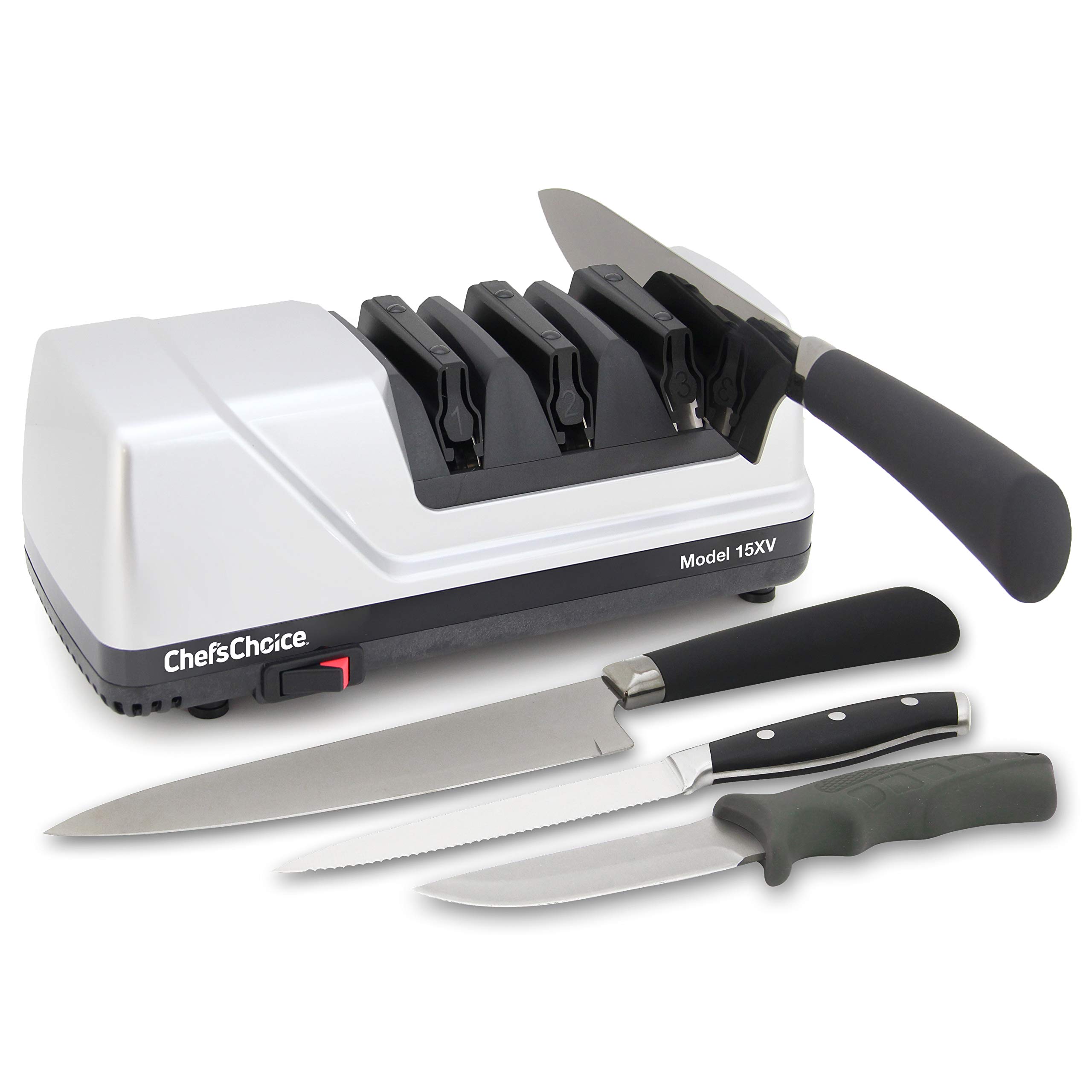
This is the most serious sharpening tool on this list, and it does something the others do not: it converts. Household knives leave the factory at roughly 20 degrees per side. The 15XV grinds them down to the sharper 15-degree Trizor XV profile, combining a durable Trizor edge with an ultra-sharp 15-degree bevel. The result is a knife that glides through food rather than pushing through it.
The spec that surprises people is speed. First-time sharpening takes approximately one minute; resharpening is approximately 10 seconds. Patented flexible spring guides adjust automatically to keep the angle accurate, and the on/off switch is about as simple as controls get. Stage 1 and 2 are plated with 100% diamond abrasives to sharpen and hone; stage 3 uses a patented flexible abrasive system to polish. It measures approximately 10″L x 4.25″W x 4.25″H and weighs 4.2 pounds, and carries a 3-year limited warranty.
Effective is the theme: knives come back with a serious edge — enough to cut through paper cleanly — and the instructions for different blade types are thorough enough to follow without prior experience. It handles straight-edge and serrated blades both, which the pull-through units generally do not.
The trade-off is size and adaptation time: converting an edge from 20 degrees to 15 degrees is a one-time process and the manual expects you to work through it patiently. Once done, the 10-second resharpening is the payoff — this is a sharpener you will keep for years, and it is the priciest option here because it is the most capable.
Why it takes the premium slot
- Converts 20-degree factory edges to a 15-degree Trizor XV edge
- Resharpening takes approximately 10 seconds
- Handles straight-edge and serrated blades with three stages
- Patented flexible spring guides adjust the angle automatically
The trade-offs to accept
- Converting an edge is a one-time, patient process
- 4.2 pounds and a 10-inch footprint want a permanent home
- Premium cost relative to the entry-level units on this list
The best buy for: someone who wants a sharper 15-degree edge on good knives and does not mind a one-time conversion.
Not the best value for: budget kitchens where a basic touch-up machine already covers the need.
Know the Specs
Grit: What the Numbers Mean
Grit tells you how aggressive an abrasive is. A low number like 300# cuts fast and removes metal; a high number like 6000# refines and polishes. That is why multi-stage sharpeners work in order — coarse first to shape the edge, fine last to smooth it. Trying to sharpen a dull knife on a fine grit takes forever; finishing a shaped edge on a coarse grit leaves it rough.
Belt sharpeners let you swap grits freely, which is the main versatility advantage over fixed-slot machines. Fixed wheels give you a preset sequence and no choices.
Angle and Why Your Blade Suffers
The angle is the tilt of the blade against the abrasive, measured per side. Standard household knives sit around 20 degrees; thinner Asian-style blades sit around 15 degrees; garden shears and axes want a blunt 32.5 degrees. A sharpener grinding at the wrong angle thins the edge or fails to reach the bevel at all.
That is why the adjustable machines here — the MK2, the Ceelpeopar, the Presto 08810, the Chef’sChoice 15XV — are worth their price. Fixed-angle units are simpler and fine for standard kitchen knives, but they cannot serve a mixed drawer.
Belt, Wheel or Rod: Which Wears Out
Belts are consumables — they wear with use and must be replaced. That is the trade-off for a conforming surface that follows the blade. Diamond wheels hold their shape far longer because diamond is the hardest abrasive used in consumer sharpeners, but they need cleaning. Ceramic rods are the finishing tool and last a long time but do not remove much metal.
Look at what comes in the box and plan replacements into your budget. A sharpener that costs little but demands constant belts can end up costing more than a fixed-abrasive machine.
Debris, Dust and Cleanup
Sharpening produces metal shavings, and they go everywhere if you let them. Magnetic collection trays and dust boxes pull the shavings into a removable container so cleanup is one wipe rather than a full counter scrub. A removable tray is the difference between a sharpener you use monthly and one you avoid.
The Chef’sChoice, Ceelpeopar, DSkiley and Narcissus all include some form of collection tray. Belt machines need a dedicated area and a brush, since dust clings in the belt housing.
Common Questions
Will an electric sharpener work on serrated bread knives?
Can an electric sharpener sharpen ceramic knives?
How do I know if my knives are 15-degree or 20-degree blades?
Is a belt sharpener better than a diamond wheel sharpener?
Do I have to replace the abrasive belts or discs on these sharpeners?
Can I sharpen scissors on an automatic knife sharpener?
Will using an electric sharpener damage my knife blade over time?
How long does sharpening take with an electric machine?
What voltage do these sharpeners need?
Do I need a magnetic dust tray on my sharpener?
Which automatic knife sharpener is best for a professional kitchen?
The Bottom Line
For most kitchens the best automatic knife sharpener is the Work Sharp MK2. Its flexible belts grind a fresh edge along the whole blade at an angle you cannot get wrong. If your drawer holds ceramic or serrated blades, the Narcissus S867-2 covers all of them. And if you want the sharpest possible finish on good knives, the Chef’sChoice 15XV converts a standard 20-degree edge to a 15-degree Trizor and resharpens in approximately 10 seconds. Its 4.5+ stars across 14,000+ owners is a strong signal that people keep using it.
How we choose
We do not accept paid placement. Every pick is matched to a real buyer and a real use-case; we do not hands-on test units.
Sources
Specifications: manufacturer listings and product documentation. Review insights: verified customer reviews, as of October 2026. Pricing: not shown on this page (it changes often); check the current price via the retailer link.
As an Amazon Associate, Aappliancez earns from qualifying purchases. This does not affect which products we feature.