Disclosure: Some links in this post are affiliate links. As an Amazon Associate I earn from qualifying purchases, at no extra cost to you. Learn more
Specs are compiled from manufacturer listings and verified buyer reviews and can change over time — please confirm the key details on the product page before buying.
If you want music, calls, and directions without anything jammed into your ears, audio sunglasses put the speakers right in the temples of a normal-looking pair of shades. The catch is that “audio sunglasses” now covers two very different things: pure open-ear speakers with no camera at all, and smart glasses with a built-in camera plus the speakers. That single difference decides which pair is right for you, and it is the first thing this guide sorts out.
This guide is built by comparing the manufacturers’ published specifications and the patterns across verified customer reviews, so you get each pick’s real strengths and trade-offs instead of marketing spin.
You will see the exact speaker setup, battery numbers, lens protection, and water rating for each pair, plus who each one actually suits. Below are the picks that hold up for real daily wear, so you can find the right audio sunglasses without guessing.
Top Picks


How To Choose The Best Audio Sunglasses
You get music without blocking your ears. An audio sunglass is a normal-looking frame with tiny speakers built into the arms (the temples), so sound plays out loud near your ears instead of sealing inside them. That means you hear your podcast and the car behind you at the same time. But the same design causes the two most common complaints: leak, meaning nearby people can hear your audio, and thin bass, because a speaker sitting a centimetre from your ear cannot move air the way an earbud can.
Open-ear speakers versus earbuds
You stay aware of traffic, bike bells, and coworkers because open-ear speakers sit outside the ear canal and push sound toward it through a small channel or “sound director.” Nothing enters your ear. The trade-off is that a loud room or highway wind can drown out a borderline speaker. If your day is mostly quiet, almost any open-ear frame sounds fine. If you work near machinery or ride on fast roads, look for directional sound technology and a bass booster tube, which both appear in the value-tier options below, and expect to still want a volume-booster app in heavy noise.
Lens protection: UV400 and polarization
UV400 means the lens blocks light down to 400 nanometres — the full UVA and UVB band — so your eyes are shielded from the part of sunlight that does long-term damage. Polarization is the second layer: it filters glare bouncing off water, asphalt, and windshields, which is what makes a fishing trip or a long drive comfortable instead of squinty. Several pairs here carry both, and the blue-tinted polarized versions cut haze on bright open water. A photochromic (light-adaptive) lens goes a step further and darkens as the sun strengthens, so the same frame works indoors and outside without swapping. Owners of one pair here report their transition tinting can be slow or subtle, so treat that feature as a convenience rather than a guarantee.
Battery, water rating, and the fit trap
You need to read the listed numbers carefully because charging time and battery life vary widely. One value pair lists 2.5 hours to charge, another runs to 10 hours of play time, and one camera pair lists 220mAh with up to 12 hours of music. The water rating is what separates a frame you can sweat in from one you cannot: IPX5 handles splashes and light rain; IP66 adds dust protection. Fit matters as much as specs — an adjustable nose pad and flexible ear hooks can be the difference between “comfortable all day” or “too small.” Check the temple and bridge shape before you commit, because frames rarely adjust the way a pair of regular glasses can.
Side-by-Side Comparison
| Model | Best For | Audio Type | Battery | Water Rating | Amazon |
|---|---|---|---|---|---|
| Meta Ray-Ban Glasses, Skyler★ Best Overall | Everyday style and hands-free capture | Open-ear speakers + camera | Varies by use | — | Amazon |
| OhO Open Ear Smart GlassesBudget Champion | Comfortable all-day audio wear | Open-ear speaker | 10 hours play time | Waterproof listed | Amazon |
| Lucyd Armor Smart Safety Glasses | Job-site wear where earbuds are banned | Open-ear speaker | — | ANSI Z87.1 rated | Amazon |
| AI Smart Glasses with Camera, 4K EIS | Travel, translation, and steady video | Open-ear speaker + 4K camera | 290mAh | IP66 | Amazon |
| Refurbished Ray-Ban Meta (Gen 1) Skyler | Hands-free recording on a budget | Open-ear speaker + camera | — | — | Amazon |
| Bluetooth Audio Sunglasses: Polarized UV400 | Entry-level sport and commuting audio | Open-ear speaker | 220mAh, 60 hours standby | IPX5 | Amazon |
| Smart Glasses with Camera and Bluetooth, HD Video | Theme parks and casual POV footage | Open-ear speaker + HD camera | 220mAh, up to 12 hours music | IP66 | Amazon |
Detailed Reviews
1. Meta Ray-Ban Glasses, Skyler
Our pick — 4.0+★ from 1,000+ verified ratings; the strongest balance of quality and price.
Classic wayfarer looks with open-ear audio and a camera that shoots hands-free.
If you want sunglasses that look completely normal on your face while quietly giving you music and a camera, this is the pick to beat. The design is the headline — a classic wayfarer silhouette in Skyler that reads as a plain pair of shades to everyone around you, and that disguise is why it tops the list. Meta pairs open-ear speakers in the temples so your audio plays toward your ears without sealing them, and the built-in camera lets you grab a photo or video without pulling out your phone. It carries 4.0+ stars from 1,000+ owners, and the crowd consensus is that it simply works as everyday eyewear first and a gadget second.
What wins people over is the look. Style and appearance dominate the feedback, and the transition lens option earns strong marks from owners who want one frame for indoors and out. The open-ear speakers get called surprisingly good for how small they are, which is the whole promise of this category delivered in a brand-name frame. If you wear these for commutes, walks, and casual outings, the combination of normal-looking sunglasses plus hands-free photos is genuinely hard to match.
Here is the honest catch: the fit runs small for some wearers, and the battery life is the most debated point — feedback ranges from “amazing” to around three hours depending on how much you lean on the camera and speakers. The functionality and value-for-money verdicts are both mixed, which makes sense for a premium frame. Sweat and moisture near the ports deserve respect, so dry the frames after a hard workout rather than leaving them damp in a case.
What Earns The Top Spot
- Looks like a regular pair of sunglasses, so nobody clocks the tech
- Open-ear speakers sit in the temples for music and calls without blocking your ears
- Built-in camera grabs photos and video hands-free
- Transition lens option covers indoor and outdoor wear
Where It Gives Ground
- Fit leans small — try before you commit if you have a wide face
- Battery life swings with how heavily you use the camera and speakers
- Moisture near the ports needs managing after sweaty sessions
- Premium-tier spend for a mixed value verdict
Wear it if: you want the best-looking all-rounder and will actually use the hands-free camera.
Steer away if: your priority is long battery life or a specific small fit.
2. OhO Open Ear Smart Glasses
10 hours of open-ear play time in a flexible, phone-thin frame.
You get music that runs all afternoon, making this the endurance pick for commuting, cycling, and long days. It lists up to 10 hours of battery — the longest plain play time in this lineup — plus a volume up-and-down button and forward/back skip controls right on the frame, so you are not digging for your phone. The polarised UV400 lens blocks glare and the full UVA/UVB band, and the open-ear speaker system is the real deal at this tier, letting you listen and keep your ears open to the road. It comes with a lithium-polymer cell and a flexible, phone-thin unisex frame.
The quality and comfort of the build are the things people rave about most. It is light in the way a normal pair of sunglasses is light, which is the highest compliment a frame like this can get. Buyers report it as the best pair they have tried against the pricier analogue, and the tint and colours on the lens earn particular praise. If you want one frame that plays music all day, rains on your face, and does not look like a gadget, this is the one that keeps earning its keep.
The trade-off is sound quality versus earbuds, and a bit of leak that lets people near you hear your audio. On the connectivity front, these are charged by a Micro USB connector, not a modern reversible port. One owner found their pair stopped charging after light use, so look after the cable and the charge port.
The frame wins: flexible, phone-thin, and light enough that owners call it comfortable in the same breath as the audio.
The honest limit: open-ear audio that leaks a little and a Micro USB charge port are the two places it trades down — fine for the money, note if privacy or a modern connector matters to you.
For all-day listeners: the 10-hour battery and on-frame controls suit commuters, cyclists, and anyone who wants music running without a charge every afternoon.
Not for you if: you need EDM bass or a sealed, private listen.
3. Lucyd Armor Smart Safety Glasses
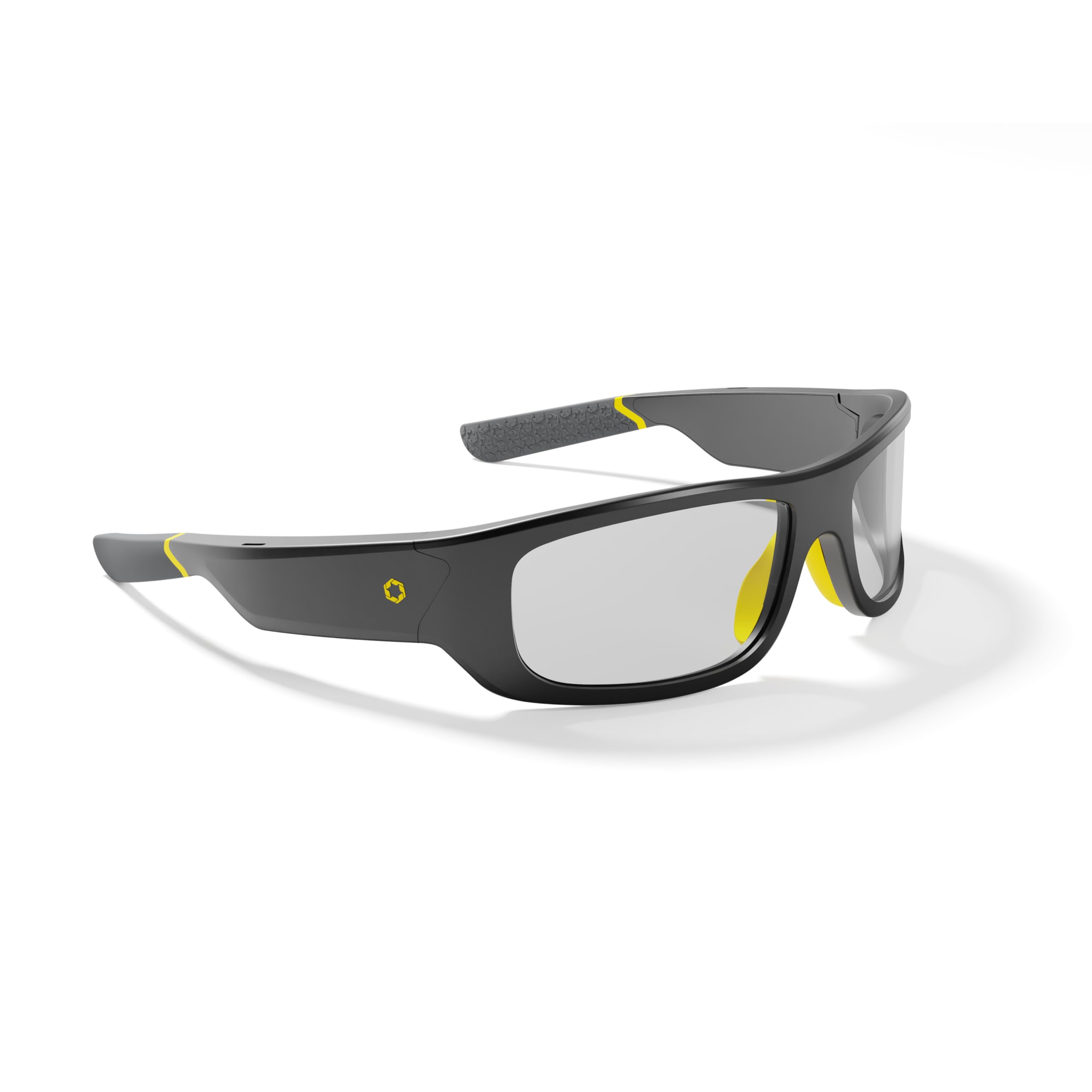
ANSI Z87.1 safety eyewear with open-ear speakers and a mic for calls on the job.
You get hands-free audio even where earbuds are banned. This pair is built for exactly that situation. It carries an ANSI Z87.1 rating — the recognised impact-protection standard for safety eyewear — in a TR90 frame, and the light-adaptive (photochromic) lenses fade from clear indoors to shaded in sunlight so one frame covers the whole shift. Open-ear speakers and a microphone handle calls and music without blocking the sounds of a busy site, which is the safety argument for choosing audio glasses in the first place.
The quality of the build and its versatility are what owners admire — the dual indoor/outdoor lens behaviour and the convenience of calls on the job get the most credit. Owners working long shifts report the smart element feels comfortable and stays put on the head without a lanyard, and the AI connection and call clarity both land well. If you spend your day in safety glasses and want a bit of audio without breaking the rules, this fills a role nothing else in this list quite does.
Sizing the downside honestly: this is the most premium pair here, and the sound is a mixed bag — several owners find the volume fine and clear in quiet, but too quiet against garage noise or wind. One owner reported the right speaker crackling and then stopping, and a few flag lens scratches and darkening that falls short of expectation. It is not designed for a gun range or a very loud environment, so keep your expectations anchored to a normal job site rather than a rock concert.
Where it’s smart: the Z87.1 rating, the adaptive lens, and the open-ear mic combine into a frame that is functional safety eyewear first and a headset second.
The premium cost of entry: you pay the most in this lineup for that safety rating, so make sure the job site actually needs it before you commit.
Built for: tradespeople and anyone whose workplace requires rated safety eyewear with hands-free audio.
Look elsewhere if: you spend most of your day in quiet rooms — the volume ceiling that suits a site will feel modest there.
4. AI Smart Glasses with Camera, 4K EIS, Real-Time Translation
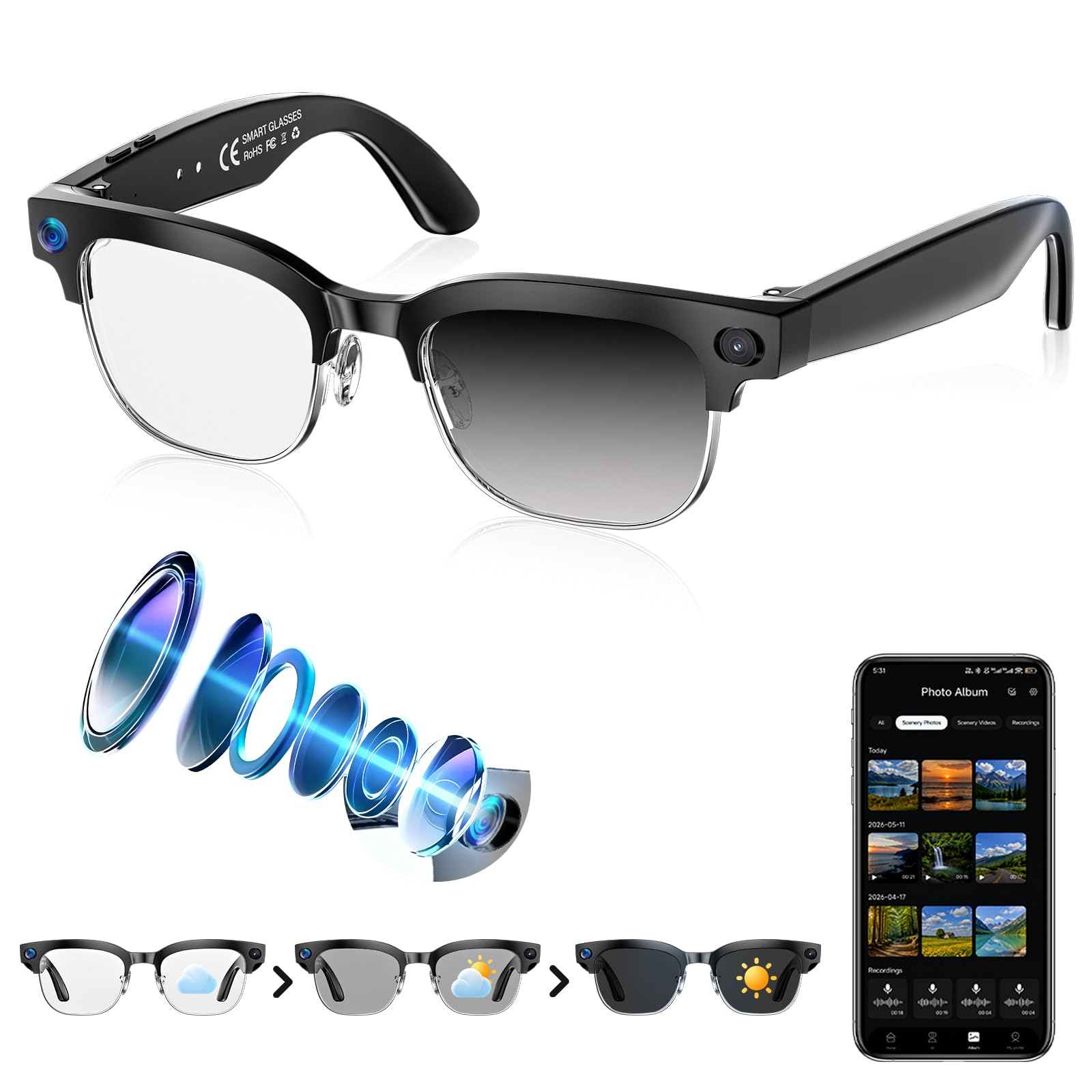
A 35g frame with a 4K EIS camera and real-time translation in 139+ languages.
For trips abroad and content you want to capture hands-free, this is the feature-packed choice. The headline is a built-in 4K camera with EIS stabilisation — that is electronic image stabilisation, which smooths out the shake in handheld footage — so walking, cycling, and travel clips come out steady. It also carries real-time translation across 139+ languages through the built-in AI assistant, which is the standout tool for anyone navigating a country where they do not speak the language. Open-ear speakers handle music and calls, noise-reduction microphones sharpen your voice on the line, and the whole thing weighs 35g with photochromic lenses that respond to changing sunlight.
The frame also earns its keep for daily wear: owners describe it as looking like regular glasses, comfortable outside, and delivering clear, sharp 4K video. It pairs easily via the app, and the photochromic tint darkens with continued sun exposure to cut eye strain. The battery is a 290mAh lithium-ion cell with IP66 protection against sweat, rain, and dust, so it survives an active travel day as a companion device. For a value-to-feature ratio on the camera side, it is genuinely competitive, and the design keeps it discreet when you are out in public.
What to weigh before buying: the translator is described as handy but not flawless — one owner found the English-Spanish translation hit or miss, and always-listening mode drains the battery quickly. Recordings run about 12 minutes of video when connected and as little as 3 minutes unconnected, so longer shoots need a power backup. The app is the only transfer route (no third-party apps), open-ear audio leaks to people nearby, and ambient noise can drown it out. None of that is a reason to skip it, but it is a reason to buy it for the camera and translation, not for sealed, private audio.
Why Travellers Pick It
- 4K EIS-video smooths handheld footage on the move
- 139+ language real-time translation for cross-border travel
- Light 35g frame with photochromic lenses for indoor and outdoor wear
- IP66 protection against sweat, rain, and dust
The Realities To Accept
- Translation is helpful but not always accurate — treat it as an aid
- Always-listening mode drains the battery fast, and unconnected recording is short
- Transfer is app-only and slow
- Open-ear audio leaks and fades in noisy places
A camera-first buy: best for travellers, vloggers, and anyone who wants steady 4K capture plus translation in one frame.
Not the one if: your only reason to buy is private, sealed music playback.
5. Refurbished Ray-Ban Meta (Gen 1) Skyler

Gen 1 Ray-Ban Meta in a refurbished Skyler frame, with the same look and camera.
If you want the hands-free recording that makes Meta glasses special but you are not reaching for a brand-new pair, this first-generation model is the practical route. It is the same Skyler silhouette and the same open-ear speaker system, with a camera for photos and video and a design that reads as an ordinary pair of shades. Owners describe it as well-made and worth the money, and the look is the standout quality — it walks into any room without looking like a device. The value-for-money feedback skews positive for a frame in this tier and build.
The everyday wins are the same as its new sibling: comfort over long wear, easy pairing, good photo and video quality, and the hands-free recording that makes it convenient for capturing moments without reaching for a phone. Some buyers even use it for travel — one owner found the built-in features helpful for navigating a foreign country. If you want the Meta experience as a refurbished option that still earns its keep, this is a sensible entry point into the world of camera glasses.
There is one big caveat to hold onto: this is a first-generation refurbished unit and owners mention the frames are not built to tolerate water or sweat well. One reviewer noted the mic port taking on sweat and losing its audio in under a month, with no repair option in their case, so treat these as dry-weather frames and be mindful around the ports. The verdicts on functionality are mixed, so avoid the pair if you want a workout companion or a swimming-pool frame — that is simply not what a first-gen refurbished unit is for.
Why it earns a spot: the design, comfort, and hands-free capture come through strongly, and the refurbished value sweetens the deal for anyone wanting Meta glasses on a lighter commitment.
Respect the port: sweat and moisture near the microphone opening are the failure point buyers warn about — this is not a wet-weather or workout pair.
Ideal for: the buyer who wants the Meta look and camera without the full new-pair commitment, in dry everyday use.
Skip if: you sweat heavily or plan to wear them near water — the mic port is the weak link.
6. Bluetooth Audio Sunglasses, Polarized UV400 with Speakers
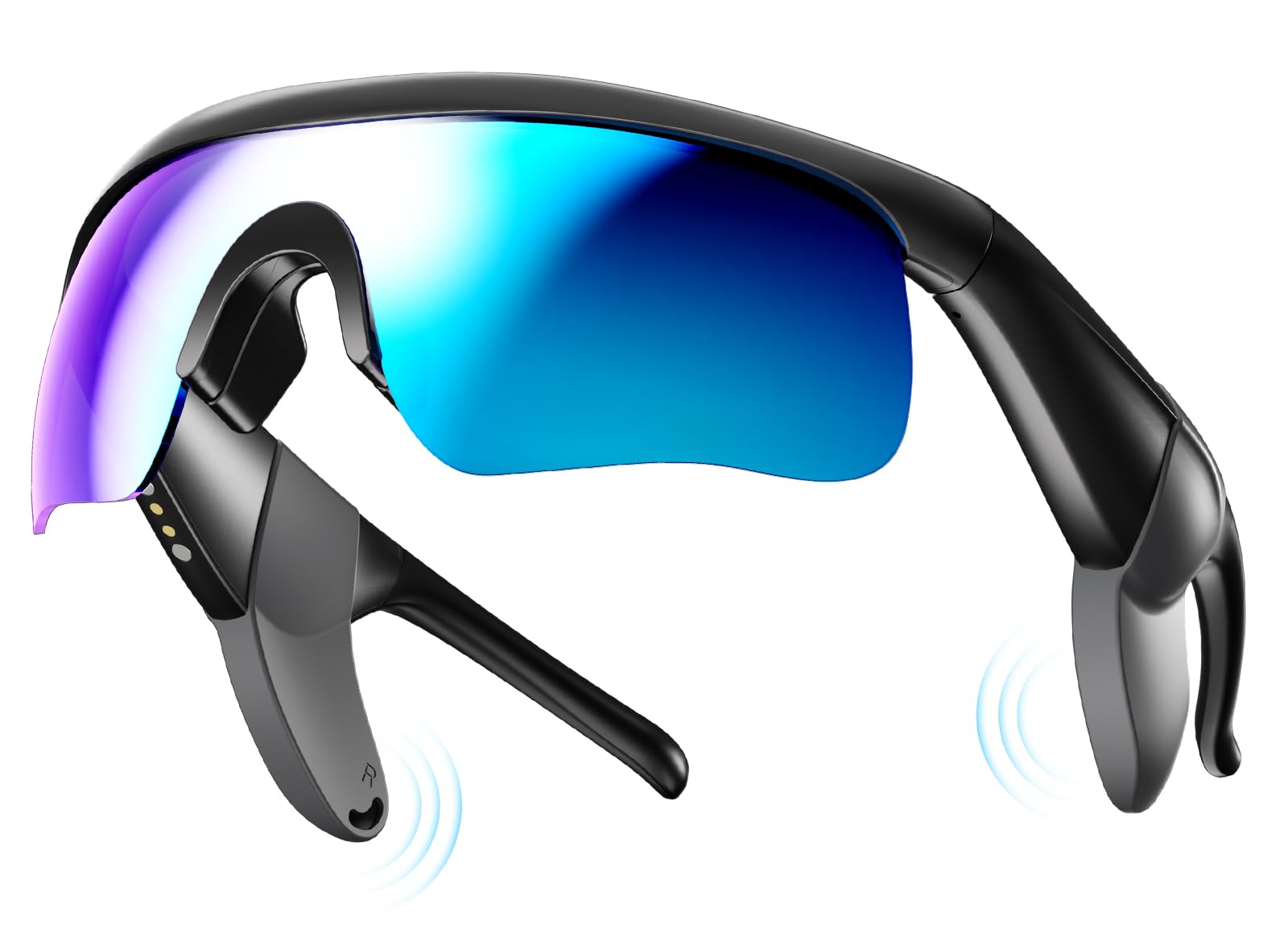
Open-ear audio with a 20-250Hz bass boost and polarized UV400 blue lenses.
You get a dedicated audio frame for cycling, running, or driving without the smart-glasses price tag. Start here. The audio is the lead — a 20-250Hz bass extension tuned for the low end, dual speakers, and an air-tube bass booster push the sound toward your ear through a directional channel, and 220mAh of lithium-ion runs 60 hours on standby with a 2.5-hour charge. The polarised UV400 lenses block the full UVA/UVB band and cut glare, and the blue-tint version boosts contrast and depth perception for clearer vision in bright, open conditions. You get Bluetooth pairing with both iPhone and Android, and the physical button on the frame wakes voice control for calls and navigation on the move.
For a pair at this tier, the sound quality is the standout — owners call it better than they expected against far pricier sports frames, and the ear channels bring audio right up to the ear canal. The frame is rated IPX5, which means it shrugs off splashes and light rain, and the temples auto-power-off when folded, so the battery does not drain in a bag. For running, base running, cycling, and driving, the combination of comfortable polarised sports frames with a bass-tuned speaker is the exact brief for anyone who wants music while they move and still wants to hear a bike bell.
The honest limits: bass is adequate for pop and podcasts but not for heavy EDM or hip hop, and the sound directors (the small rubber pieces that aim audio at your ear) can come loose with use. The charge is by a proprietary magnetic cable rather than a standard connector, so keep track of it. One owner reported their pair stopped taking a charge within a couple of months, so protect the charge port and handle the frame carefully. It also lacks a volume control on the frame, so you will mix your volume on the phone instead.
The sport brief delivered: bass-tuned open-ear audio, polarised glare control, and an IPX5 shell that stays comfortable through a run or a ride.
What to baby: the proprietary charging cable and the snap-on sound directors are the two parts most likely to go missing or loosen, and there is no on-frame volume.
Made for movement: cyclists, runners, drivers, and anglers who want music and calls while staying tuned to their surroundings.
Pass on it if: you expect bass-heavy EDM punch or a standard charging connector.
7. Smart Glasses with Camera and Bluetooth

An HD camera and open-ear speakers for one-click POV clips without your phone.
If you want the hands-free camera experience at an entry-level commitment, this is the budget pick. It carries a built-in high-definition camera for one-click photos and videos, open-ear speakers for music and calls, and a “Hey Cyan” AI voice assistant you wake to control playback and volume. The battery is a 220mAh cell rated for up to 12 hours of continuous music, backed by magnetic fast charging and a 7-day standby, and it holds an IP66 water rating against splashes, sweat, light rain, and dust. The high-quality polarised UV400 lens blocks the full UVA/UVB band and cuts glare for outdoor use.
You buy it for the camera, and the clearest sign of what it is for is a buyer reporting storing 105+ photos and videos in a single day out at the theme parks. The frame uses a lightweight ergonomic TR90 build — that is a flexible, resilient material often used in sports frames — with ear-leg covers for security, and the app glitch that some owners hit on day one often settles down after setup. For a day out, a commute, or a hike where you want to capture from your own eyes without holding up a phone, it does the job for the money.
The trade-offs are real but sized to the price: the fit, mostly, and a “Hey Cyan” app that needs WiFi to import your media, plus a battery that some owners find does not hold its charge the way they hoped. The camera is also built into one side of the frame, so pointing it means turning your head rather than catching something out of the corner of your eye. The functionality and value verdicts sway in your direction if you keep expectations modest, and dip if you expect the polish of a top-tier camera glove.
Budget camera idea: for theme parks, casual vlogging, and POV footage, the hands-free capture and the IP66 shell do the job they are designed for.
The app route: transferring via WiFi-only “Hey Cyan” app is the friction point — this is not the frame for you if you want a slick one-tap files experience.
Buy it for: casual, budget-first hands-free capture and open-ear audio in an everyday frame.
Keep looking if: you need reliable all-day battery and smooth app transfer.
Understanding The Specs
Open-ear speaker and sound-director design
An open-ear speaker pushes sound toward your ear canal instead of sealing inside it. Two technical details decide whether it sounds good: the speaker position and the sound director, a small channel or rubber piece that guides audio at your ear. Good directional design also limits leak so people nearby do not hear your call, though most open-ear frames will leak some audio at high volume. A claimed bass extension below 100Hz means the frame is tuned to give more low end, which most open-ear frames lack.
Battery life and charge time
Two numbers matter: play time and charge time. Play time of 10 or 12 hours of music means you can wear them through a full day and a commute; 60 hours of standby means the frame holds charge when parked in a bag. Charge time of 2.5 hours is typical. Magnetic chargers snap on quickly but add a part to keep track of, and proprietary cables can leave you stuck if you lose the original.
UV400, polarization, and photochromic lenses
UV400 blocks sunlight down to 400 nanometres, covering the full UVA/UVB band. Polarization filters glare bouncing off water and roads, which is why a polarised lens is the one to choose for driving, fishing, and cycling. A photochromic (light-adaptive) lens changes darkness with the sun, so it works indoors and out in one frame — handy, but customers note the tint can be slow or subtle on some pairs.
Water and dust ratings
An IPX5 rating handles splashes and light rain, so it shrugs off sweat and a passing shower. An IP66 rating adds dust protection — the first digit is dust, the second is water. Neither means you can swim in them or shower with them, and moisture creeping into the microphone or charge port is the single failure point reviewers point out across this category, so dry the frame after heavy sweat.
Common Questions
Do audio sunglasses work with an iPhone and an Android phone?
Can people around me hear what I am playing on open-ear speakers?
Are audio sunglasses actually waterproof enough to wear in the rain?
How long does the battery actually last on audio sunglasses?
Will the glasses fit my face if I have a wide head or a small one?
Do the camera models need WiFi and a phone to move my photos off them?
Are audio sunglasses better than wireless earbuds for running and cycling?
What is the difference between Z87.1 safety glasses and normal audio sunglasses?
Can I replace the lenses or the sound directors if they get damaged?
The Bottom Line
For most people the best audio sunglasses pick is the Meta Ray-Ban Glasses, Skyler, because it delivers the everyday sunglasses look with open-ear audio and a camera that actually gets used. If your priority is all-day audio without a smart-glasses premium, reach for the OhO Open Ear Smart Glasses — its 10-hour battery and comfortable frame are the value standouts here. And if you spend your day on a job site that bans earbuds, the Lucyd Armor Smart Safety Glasses carry the Z87.1 rating that makes them the right tool. Whichever you choose, keep the microphone and charge ports dry, and these frames will keep playing all day.
How we choose
We do not accept paid placement. Every pick is matched to a real buyer and a real use-case; we do not hands-on test units.
Sources
Specifications: manufacturer listings and product documentation. Review insights: verified customer reviews, as of October 2026. Pricing: not shown on this page (it changes often); check the current price via the retailer link.
As an Amazon Associate, Aappliancez earns from qualifying purchases. This does not affect which products we feature.