Disclosure: Some links in this post are affiliate links. As an Amazon Associate I earn from qualifying purchases, at no extra cost to you. Learn more
Specs are compiled from manufacturer listings and verified buyer reviews and can change over time — please confirm the key details on the product page before buying.
If your upstairs turns into a sauna every afternoon, the fix is almost never a bigger air conditioner — it is getting the trapped heat out of the attic first. A hot attic radiates down through your ceiling all day, and no amount of cooling upstairs can outrun it. The right exhaust fan or whole-house fan moves that air out, and the picks below are the ones worth your money.
This guide is built by comparing the manufacturers’ published specifications and the patterns across verified customer reviews, so you get each pick’s real strengths and trade-offs instead of marketing spin.
You will see wall-mount shutters, gable units, roof-mounted solar fans, and full whole-house fans, each matched to a different home and budget. The biggest mistake is buying on airflow alone — your intake venting has to keep up, and that is where most installs quietly fail. Below is the honest breakdown of the best attic ventilation system for real homes.
Top Picks


How To Choose The Best Attic Ventilation System
Attic heat is a ventilation problem, not a cooling problem. Warm air stacks up under the roof deck, and without an exit path it radiates straight down through your ceiling into the rooms below. The fan moves the hot air out; the intake vents let cooler outside air in to replace it. Both halves have to work.
Match the airflow number to your attic size
Airflow is measured in CFM, short for cubic feet per minute — simply how much air the fan pushes in a minute. A small crawlspace or utility closet needs very little. A large open attic or a sealed garage needs a lot. If you buy far more airflow than your intake can feed, the fan starves for air and underperforms no matter what the box claims.
Gable, roof-mount, wall, or whole-house
A gable-mount fan sits in the triangular vent at the end of your roof and needs no roof cutting. A roof-mount fan sits on the roof itself, which suits homes where gable mounting is impractical. A wall-mounted shutter exhaust fan pulls air straight through an exterior wall, and its shutters close when it is off to keep weather out. A whole-house fan is a different job entirely — it pulls air through your living space and out the attic, cooling the rooms you actually sit in.
Controls decide how often it actually runs
A thermostat turns the fan on when the attic hits a set temperature and off when it cools. A humidistat does the same for moisture. Some units add app control so you can watch attic temperature from your phone. Whichever you pick, confirm the thermostat cable reaches where you want it, because a short cable is a common install headache.
Side-by-Side Comparison
| Model | Best For | Airflow (CFM) | Blade Size | Mount Type | Amazon |
|---|---|---|---|---|---|
| iLiving 24″ Wall Mounted Exhaust Fan★ Best Overall | Large attics, barns, and workshops | 4244 cfm | 24 inches | Wall Mounted | Amazon |
| AC Infinity AIRTITAN T3Compact Pick | Crawlspaces and small closets | 120 cfm | — | Mountable | Amazon |
| Cool Attic CX2500 Gable MountBest Value | Gable venting with no roof cuts | 1650 cfm | 14 inches | Gable Mount | Amazon |
| Quietcool AFG SMT PRO-2.0 | Smart app control for gable vents | 1945 cfm | 8.25 inches | Gable (Plug and Play) | Amazon |
| iLIVING 20″ Shutter Exhaust Fan | Warehouses and large garages | 3368 cfm | 20 inches | Wall Mount | Amazon |
| AC Infinity AIRLIFT T14 | Greenhouses and garage exhaust | 1513 cfm | 14 inches | Wall Mount | Amazon |
| VEVOR 42W Solar Attic Fan | Roof-mount solar cooling | 2800 cfm | 22 inches | Roof Mount | Amazon |
| OmniPV Solar Hybrid Attic Fan | Solar with AC backup | 2100 cfm | 11.8 inches | Roof Mount | Amazon |
| Quietcool QC CL-3100 RF | Whole-house evening cooling | 3126 cfm | — | Ceiling Mount | Amazon |
Detailed Reviews
1. iLiving 24″ Wall Mounted Exhaust Fan
Our pick — over 4.5★ from 850+ verified ratings; the strongest balance of quality and price.
The big-block mover that turns a barn-sized attic into a breeze in minutes.
If your attic, barn, or workshop is the size of a small house, this is the one to beat. Its 24-inch aluminum blade pushes 4244 cfm — that is cubic feet per minute, the volume of air it shifts each minute — and it covers a stated 6200 square feet of area. For comparison, the AirTitan T3 below moves 120 cfm, so this fan is in a completely different league for raw air movement.
The motor is fully enclosed, thermally protected, and permanently lubricated, which means fewer service trips. It runs on standard 120 volts at 1/4 HP, 2.65 amps, and 1050 RPM. The shutters are high-grade aluminum built to shrug off moisture and heat, and the whole fan mounts flat to a wall with no roof cutting. Pair it with the iLIVING speed controller (sold separately) if you want to dial the pace up and down.
What owners consistently come back to is the sheer amount of air it moves for the size — buyers report it clears dust and smoke quickly and holds up in large barns. The recurring note is the louver flaps: they are light and can rattle, and one buyer had to add a small steel weight to quiet one down. That is a minor tuning job, not a defect, and it does not change the fact that this is a workhorse. The power cord is not included, so plan for that on install day.
Where it earns its keep
- 4244 cfm of airflow covers a stated 6200 square feet
- Corrosion-resistant aluminum shutters and enclosed motor
- Variable speed ready with the optional controller
- Weather-resistant build for year-round garage and shed use
Worth knowing before you buy
- Power cord is not included
- Louver flaps are light and can rattle until you dampen them
- Speed controller sold separately
Grab it for: oversized attics, barns, and workshops where you need volume, not subtlety.
Look elsewhere if: you want remote or app control from the start — this relies on manual button control unless you add the controller.
2. AC Infinity AIRTITAN T3 Ventilation Exhaust Fan
A six-inch whisper-quiet fan that brings weather-proofing and smart scheduling to tight spaces.
This is built for the spaces a big fan cannot reach: crawlspaces, basements, and small utility closets. It measures 1.81 inches deep by 6.3 inches wide by 6.3 inches tall, so it tucks into a joist bay without a fight. Airflow is 120 cfm, and owners routinely report it moves more air than the rating suggests — Owners mention measuring 128 to 133 cfm on their own units against the 75 cfm they called adequate.
The headline feature is the controller. It handles temperature, humidity, and VPD programming (VPD is vapor pressure deficit — a grower’s measure of how much moisture the air can still absorb), plus timers, cycles, and scheduling. Minimum speed is adjustable, and you can connect over WiFi through the app to pull climate data and set automation. The frame is heavy-duty anodized aluminum with an IP-55 rating, meaning the fan is highly resistant to liquids and dust — good news for damp crawlspaces.
The device earns high marks for build quality and quiet operation, though the interface trips a few people up. A buyer or two found the programming tricky — factory test triggers can run the fan unexpectedly until you clear them, and the timer only counts down rather than up. Worth watching: the mode has to be set to Auto for your triggers to actually fire, or On and Off will override them. Install is straightforward, and one controller does a lot for the money.
What makes it tick: humidity and temperature control in a six-inch footprint is the reason this exists, and the IP-55 housing means it survives where a bare fan would corrode. Owners compare it favorably to traditional exhaust fans after living with it.
Best for: a damp crawlspace or utility closet that needs monitored humidity and quiet running.
skip it if: you want to set it and walk away without reading the manual — the trigger logic rewards a patient setup.
3. Cool Attic CX2500 Gable Mount Power Attic Ventilator
The gable-mounted classic that cools an attic without cutting a single hole in your roof.
Gable mounting is the whole appeal here. This fan sits in the triangular vent at the end of your roof, behind existing louvers, so there are no holes in your roof deck and no roofline changes. It moves 1650 cfm — well under the iLiving 24″ fan above, but enough to cool a stated 2500 square feet of attic. It uses a 14-inch blade on a galvanized steel frame with a thermally protected motor rated at 3 amps, 115 volts, and 60 Hz at 0.03 static pressure.
Customers note feeling the difference fast. One buyer logged a two-degree bedroom drop within a day of install, and another measured the attic falling from over 140°F to roughly 100°F. The fan runs on a thermostat, installs easily with no roof cutting, and buyers call it sturdier once mounted than the flimsier units at big-box stores.
The known quirks are small. The thermostat cable is short, so you may need to extend it, and there is no humidistat — fine in dry climates, less ideal where winter moisture matters. A faint hum can reach the room below unless you mount it on a plywood base with rubber spacers, which most owners do. A blade occasionally arrives rubbing the housing seam, fixed by adding fender washers between the housing and the mount arm to re-center the motor.
The honest trade: no humidistat and a short thermostat cable are the two things owners wish were different. Neither stops the fan from doing its core job well.
Pick this when: you have a gable vent and want real attic cooling without touching the roof.
Think twice if: you need humidity sensing built in — this one is temperature-only.
4. Quietcool AFG SMT PRO-2.0 Smart Attic Fan for Gable Vents

A plug-and-play gable fan with app smarts and a two-speed motor built for humid climates.
You get a cooler, quieter attic without hiring an electrician. The two-speed PSC motor (a permanently split capacitor motor — the type that runs cooler and quieter than a basic shaded-pole motor) moves up to 1945 cfm on high while drawing 120 watts, so it clears a hot attic fast without spiking your power bill. It plugs into a standard outlet with no wiring to run, which is why it suits a first-time DIY job so well.
You can check and control your attic from your phone. The app shows your attic temperature live, auto-shuts the fan at a set temperature, and offers three settings plus a winter mode. Reviewers point out it handles hot, humid summers well, pulling attic humidity down fast, and it stays silent overnight even above a master bedroom. A Fire Safety Sense shut-off adds another layer of confidence.
The one split in feedback is the smart controller itself. Some owners love the app; a few prefer a plain manual thermostat and find the controller overkill. That is a preference gap, not a flaw — the fan hardware under it is well-built and the two-speed motor moves strong air on high. Worth noting: you will want an outlet in the attic, since one owner needed an electrician to add one.
What buyers rave about
- Up to 1945 cfm on high at only 120 watts
- Plug and play — no wiring required
- Two speeds plus a winter mode
- Fire Safety Sense shut-off and app temperature view
The honest gripes
- A few owners would rather have a manual thermostat than the app
- Bluetooth connectivity draws mixed feedback
- Needs an attic outlet, which may mean an electrician
Suits you if: you want gable-vent cooling you can monitor and schedule from your phone.
Pass if: you dislike app-based controls and want a simple dial — the manual-thermostat crowd may find it fussy.
5. iLIVING 20″ Wall Mounted Shutter Exhaust Fan

Industrial-grade air movement with built-in thermal control — no roof, no fuss, just a wall outlet.
This one brings its own thermostat. The included Thermospeed controller handles variable speed and temperature regulation in a range from 32 to 130°F, so it cycles itself on and off without extra parts. The fan itself runs 3368 cfm through a 20-inch aluminum blade on a galvanized steel frame, drawing 2.2 amps at 115 volts and 1/5 horsepower at 980 RPM. It carries a stated coverage of up to 5000 square feet.
Owners describe real temperature drops. One buyer watched it pull a 12,500-cubic-foot workshop from 94°F down to 83°F in about 45 minutes. Another had the shutters pull a workshop door closed, proof of its 3368 cfm pull. It is UL listed, the motor is permanently lubricated, and the pulley-free direct drive means fewer moving parts to wear. Noise stays under 69 dB.
The shutter flaps are the recurring topic. They are light, and a few owners added small weights or magnets to make them close more firmly when the fan is off. In high wind over 50 mph, the gravity shutters can leak, and insects may slip through the gaps. It also wants secure framing to avoid rattle — wood strips around the mount quiet it down well.
The high point: the built-in Thermospeed controller is a genuine convenience — most rivals make you buy a separate thermostat or accept a fixed speed.
Set expectations on: the lightweight dampers. Expect to fine-tune them for a snug seal and less flutter.
Made for: large garages, greenhouses, and workshops that want thermostat-driven airflow without extra gear.
Ask yourself first: can you frame it securely? A loose mount is where the rattle complaints come from.
6. AC Infinity AIRLIFT T14 Shutter Exhaust Fan

A 14-inch shutter fan built for climates that need watching, not just moving air.
This is a control-first fan. It moves 1513 cfm through a 14-inch aluminum blade on a powder-coated steel frame that measures 16.93 inches deep by 16.93 inches wide by 8.1 inches tall. The environment controller ties into a WiFi app for programs, alarms, notifications, and live climate data, and the shutters close automatically when the fan stops, sealing the opening against weather and pests.
What owners praise most is the quality and quiet running — the fan moves a lot of air for its size and stays quiet enough outside the house to go unnoticed. It installs simply, and greenhouses are a common home: shoppers say it holding optimal growth conditions with programmable temperature thresholds, like switching off below 40°F. One controller can run up to four devices.
The controls are where opinions split. Some find them intuitive, others find the setup fiddly. A quirk worth knowing: below about 60% speed, the louvers can chatter, and owners sometimes add an actuator to stop it. The power cords and cables are also on the short side for longer runs. If you are using it to control attic humidity, plan for adequate intake venting — the same airflow math applies here as everywhere.
The smart-control angle: the app plus auto-closing shutters is the reason to choose this over a plain 14-inch fan, and the low top-end noise is a real comfort win.
Reach for it if: you are running a greenhouse or a hot garage and want app-monitored temperature and humidity thresholds.
Know going in: you will want to lengthen the cords and possibly add a louver actuator to keep the flaps quiet at low speeds.
7. VEVOR 42W Solar Attic Fan, 2800 CFM Smart Roof Vent
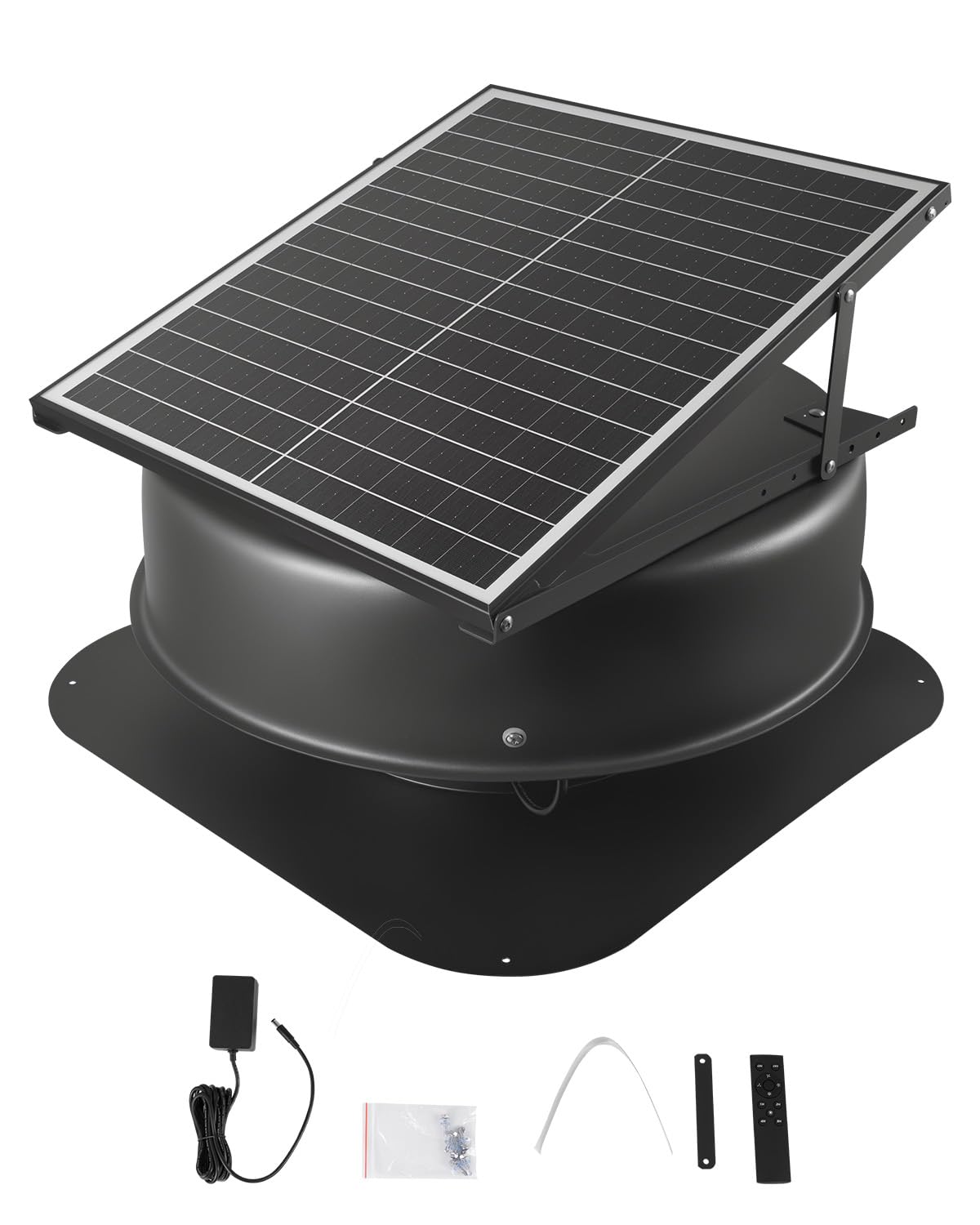
A solar roof fan that keeps working after dark by switching to electric power.
This one runs on sun most of the day and then switches to electric at sunset, so the attic keeps venting around the clock. The 42W solar panel uses an MPPT regulator (maximum power point tracking — it squeezes the most power from changing sunlight) feeding a brushless DC motor that moves up to 2800 cfm. A 22-inch blade sits inside an angled panel with multiple adjustable angles to catch the sun. It suits both metal and masonry roofs.
The engineering details are more thoughtful than most solar fans. The integrated temperature and humidity controller keeps conditions steady, a smoke detection function shuts the fan off automatically when smoke is sensed, and the remote works from up to 9.75 metres away. The temperature control kicks the fan on above 26°C and off below it. Buyers report the fan does not activate until the attic hits around 80 degrees, and they see about a 20-degree attic temperature difference.
Living with it takes a small adjustment. Because it is solar, the fan can spring to life the moment you open the box in sunlight — so plan to have the remote in hand to switch it off if needed. The panel is built to shrug off hail and weather, which is the reassurance you want on a roof you rarely visit.
Why it stands out
- 2800 cfm from a 42W MPPT solar panel
- Switches solar to electric at sunset for 24/7 venting
- Built-in temperature, humidity, and smoke controls
- Adjustable panel angles and weather-resistant build
Before you commit
- Solar fan can start unexpectedly in sunlight — keep the remote handy
- Roof-mount install needs comfort working on a roof
The pick for you if: you want solar-powered attic cooling that does not quit when the sun goes down.
Hold off if: you are not comfortable on a roof — this mounts through the roof deck, not a wall or gable.
8. OmniPV Solar Hybrid Attic Fan
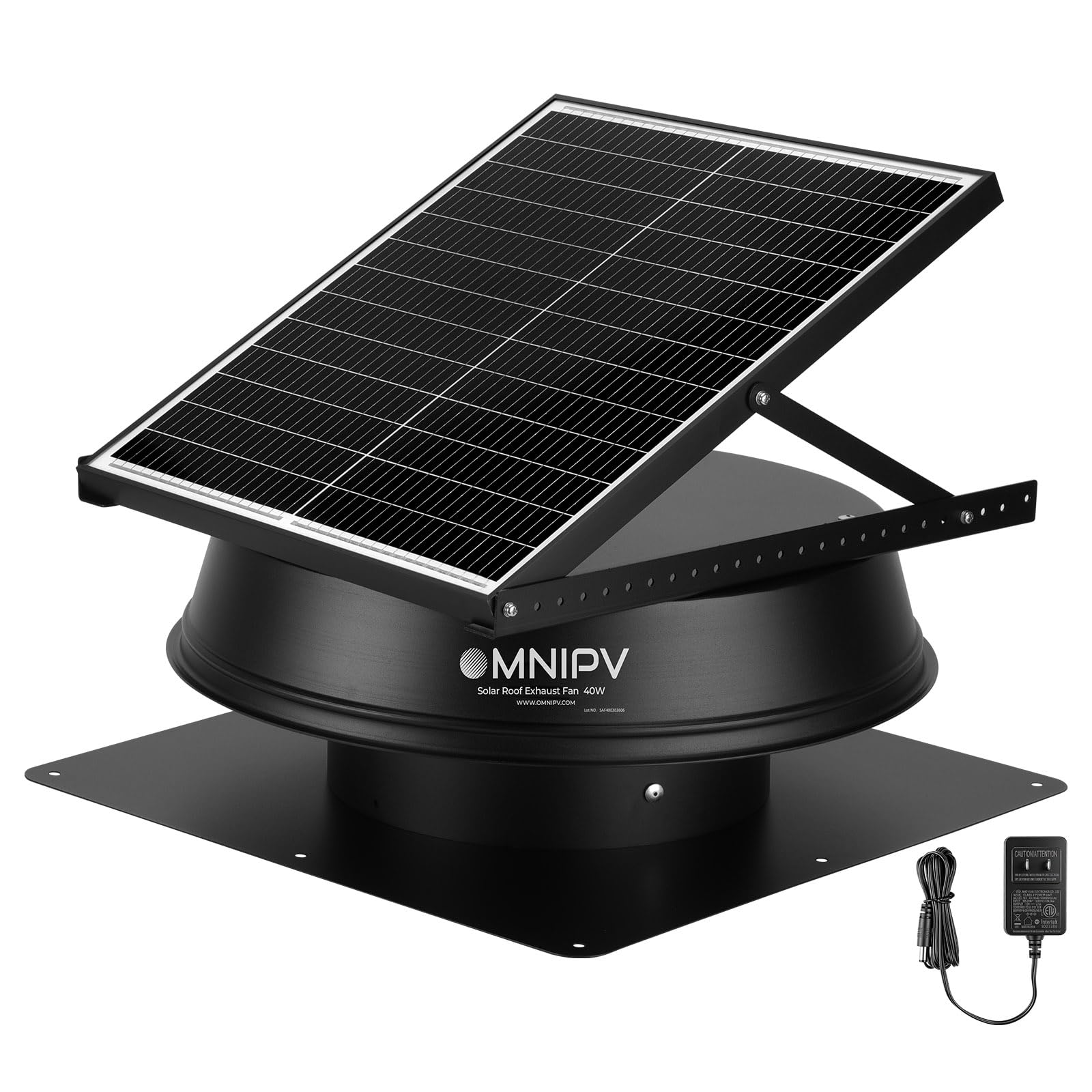
A solar fan with an AC backup that keeps the air moving when the clouds roll in.
The hybrid setup is the selling point. A 40W solar panel drives a brushless DC motor that moves up to 2100 cfm through an 11.8-inch plastic blade, but an included AC adapter fills in when solar output fades. The aluminum-alloy body resists ultraviolet light, oxidation, and corrosion, which matters near coastal air. A built-in thermostat handles the switching — it turns on above 75°F and shuts off below that, so it manages itself.
Owners buy this mostly for the running-cost angle, and it delivers on that. With the solar panel doing the work and no electric drain during the day, Owners mention reduced electricity bills and a noticeable drop in attic air temperature. A garage install is a common use, and the fan cuts the heat there too. It is quiet enough that owners say they cannot hear it running inside at all.
There is one design detail to check on arrival. The roof deck plate sits on a lip under one inch, and a buyer who received a unit with the deck plate detached worried the low lip could allow water leaks in heavy storms. The unit also shipped damaged on the sides in that case, and it was returned. Worth inspecting the flashing and lip before install. The thermostat also stops the fan in cold weather by design, so remove the sensor if you want it to run in cooler months.
The value story: solar power for the daytime and an AC cord for backup is a sensible pairing, and it suits roofs that stay sunny most of the day.
Check on arrival: confirm the deck plate and flashing are intact, since the low mounting lip needs a clean, well-sealed install to be weather-tight.
Good fit for: sunny roofs where you want solar savings plus a backup cord for cloudy stretches.
Weigh carefully if: you need the fan to run through cold weather — the thermostat is set to stop it, and you would need to remove the sensor.
9. Quietcool QC CL-3100 RF Classic Advanced Whole House Fan

A ceiling-mount whole-house fan that cools the rooms you live in, not just the attic.
This is a different kind of tool. Instead of only venting the attic, it pulls air through your living space and pushes it up and out, cooling the whole home on a breeze. It moves 3126 cfm on high and 2847 cfm on low with a 299-watt PSC motor on high and 256 watts on low, and covers a stated 1610 square feet. That makes it the airflow champion for open living areas — the headline number buyers tune into.
The install is friendlier than it looks. The motor head hangs from the attic rafters and needs only a small ceiling cut-out measuring 14 inches by 22 inches for the intake grille, with no framing or joist-cutting and a typical one to two hour install. It fits 16 or 24 on-center. A damper box with R5 damper doors insulates the home from the attic in colder seasons, and it needs 4.17 sq ft of net free attic venting to work properly. Window locks are included for safety while it runs.
Owners install it and immediately notice the difference. Buyers describe it creating a cross breeze no window arrangement could manage, and they can switch off the AC in the evenings when outside air is cool. The wireless RF control kit with a glass wireless switch includes up to a 12 hour countdown timer, and the ten-year warranty backs the motor. One honest caveat: the ten-year warranty and high marks come from a smaller pool of early owners, so the long track record is still being written.
The case for it
- 3126 cfm on high cools a stated 1610 square feet
- Plug-and-go install with a small 14 x 22 inch cut-out
- R5 damper doors insulate the home in colder seasons
- Wireless RF control with a 12 hour countdown and 10 year warranty
Before you buy
- Needs 4.17 sq ft of net free attic venting to perform
- Hang time from a smaller owner base — less long-term field data
It is for you if: you want to cool the whole house with evening air and cut back on air conditioning.
Not your fit if: your attic intake venting falls short of 4.17 sq ft — the fan cannot cool what it cannot feed.
Know the Specs
CFM (Cubic Feet Per Minute)
CFM is the volume of air a fan moves each minute — the single number that tells you how much cooling muscle you have. A small crawlspace fan like the AirTitan T3 moves 120 cfm, while a whole-house fan like the QC CL-3100 RF moves 3126 cfm. More cfm means more air, but only if your intake vents can supply it. Size the fan to your space, then make sure the air has somewhere to come from.
Control Type: Thermostat, Humidistat, and App
A thermostat starts the fan at a set temperature and stops it when things cool down. A humidistat does the same for moisture — important in humid or coastal climates. App control lets you watch attic temperature and adjust settings from your phone, which is handy for setting thresholds like switching off below a certain temperature. Whichever you choose, decide based on how hands-on you want to be.
Mount Type
Where the fan sits changes both the install and the look. Gable-mount fans tuck into the end vent and need no roof cuts. Wall-mount shutter fans pull air straight through an exterior wall. Roof-mount fans sit on the roof deck, so they suit homes where gable or wall mounting will not work. Whole-house fans mount in the ceiling to cool living space. Match the type to your structure first, then compare specs.
Net Free Venting and Intake
A fan is only as good as the air it can draw. Net free venting is the open area of your intake vents — soffit, gable, or other lower openings — that lets outside air replace the hot air you push out. The QC CL-3100 RF, for example, calls for 4.17 sq ft of net free attic venting. If your intake is clogged or too small, the fan strains and you lose cooling. Clear the soffits and size the intake before you install.
Common Questions
How much CFM do I need for my attic?
Do I need intake vents for an attic fan to work?
What is the difference between a gable fan and a whole-house fan?
Can a solar attic fan run at night?
How does the thermostat on an attic fan work?
Will an attic fan cut my air conditioning costs?
How noisy is an attic fan inside the house?
What size fan blade do I need for my attic?
Do I need an electrician to install an attic fan?
How long do attic fans usually last?
The Bottom Line
For most attics and workshops, the winner is the iLiving 24″ Wall Mounted Exhaust Fan — its 4244 cfm moves more air than anything else here, and its aluminum build takes the weather year-round. If you want app-controlled gable cooling that you can watch from your phone, reach for the Quietcool AFG SMT PRO-2.0. And for cooling the rooms you actually live in with evening air, the Quietcool QC CL-3100 RF is the one to mount. Whatever you pick, clear your intake vents first — the strongest fan in the world starves for air without them.
How we choose
We do not accept paid placement. Every pick is matched to a real buyer and a real use-case; we do not hands-on test units.
Sources
Specifications: manufacturer listings and product documentation. Review insights: verified customer reviews, as of October 2026. Pricing: not shown on this page (it changes often); check the current price via the retailer link.
As an Amazon Associate, Aappliancez earns from qualifying purchases. This does not affect which products we feature.