Disclosure: Some links in this post are affiliate links. As an Amazon Associate I earn from qualifying purchases, at no extra cost to you. Learn more
Specs are compiled from manufacturer listings and verified buyer reviews and can change over time — please confirm the key details on the product page before buying.
For most attics, the right buy is an interlocking panel system you screw straight into the joists. The best-balanced option right now is the Attic Dek Flooring Storage System — it carries up to 250 pounds per panel, needs no cutting, and slots between the joists you already have. The plastic pallets further down this page are a different tool for a related job: they lift bins and boxes off bare floor and away from damp. Pick the one that matches what you are actually trying to do up there.
This guide is built by comparing the manufacturers’ published specifications and the patterns across verified customer reviews, so you get each pick’s real strengths and trade-offs instead of marketing spin.
Below you will find how joist spacing, load rating, and panel access dictate which system fits your space, plus honest notes on where each option flexes underfoot. Use this roundup of attic flooring to match a deck to your joists, your weight, and how often you actually climb up there.
Top Picks


How To Choose The Best Attic Flooring
The one thing that decides everything else up there is your joist spacing. Stick a tape measure across two neighbouring joists and write the number down before you buy anything. A panel built for 24-inch spacing can wobble badly on a tighter grid, and a panel sized for a narrow gap leaves gaps you did not plan for.
Measure joist spacing first, not last
Joist spacing (the distance between the wooden beams your ceiling sits on) is often 16-inch on-center in older homes and frequently 24-inch in newer ones. Quite a few attics are neither — the spacing drifts across a single attic. The 24 x 16 inch Attic Dek panels are described by owners as fitting perfectly over attic joists in both cases. That is partly because the five prefabricated screw holes let you line up on whatever joist is actually there, rather than where you assumed it would be.
Read the weight rating as a total, not a target
A 250-pound-per-panel rating sounds enormous until you work out that your body weight plus a stack of plastic totes is the real number pressing down. Attic Dek states up to 250 pounds per panel while their construction removes the risk of sagging joists, and the plastic-pallet option is meant for static loads of stored goods rather than a person walking on it. Match the rating to how you use the space, not to the biggest number on the box.
Keep the insulation breathing
Solid sheets of plywood seal off insulation and can trap moisture underneath. The grid design used across the pallet-style options lets air pass through, and the Attic Dek panels carry vents described as letting insulation breathe — worth checking your climate before you zip the space up tight.
Side-by-Side Comparison
| Model | Best For | Panel Size | Weight Rating | Pieces Included | Amazon |
|---|---|---|---|---|---|
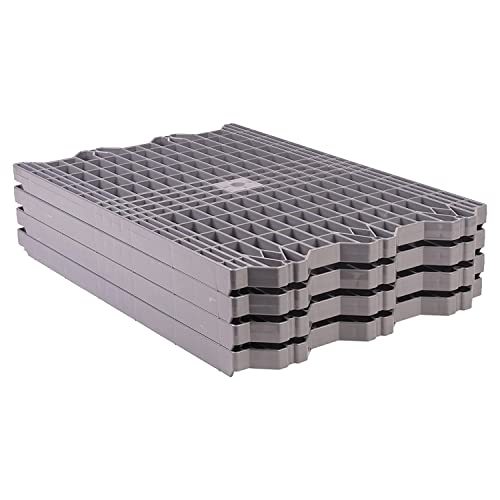
| 8 Pcs Plastic Pallets, 23.6 x 15.8 x 3.9 Inch★ Best Overall | Bin storage, large floor | 23.6 x 15.8 x 3.9 in | — | 8 pallets | Amazon |
| Attic Dek Flooring Storage SystemAlso Great | Walkable attic deck | 24 x 16 x 1.13 in | 250 lb per panel | 4 panels | Amazon |
| USA Sealing 350904 Attic Dek Flooring | Interlocking small sections | 24 x 16 x 1.13 in | 250 lb per tile | 4 panels | Amazon |
| KOKORACKER Overhead Ceiling Rack | Lifting storage off the floor | 4 x 4 ft platform | 250 lb | 1 rack | Amazon |
| GADFISH Garage Ceiling Lift Rack | High ceilings, big loads | 4 x 4 ft platform | 350 lb | 1 rack | Amazon |
| 6 Packs Lightweight Plastic Pallets | Damp basement and shed floors | 23.6 x 11.8 in | — | 6 pallets | Amazon |
| 4 Packs Plastic Pallets, 19.7 x 11.8 x 3.9 Inch | Elevating boxes cheaply | 19.7 x 11.8 x 3.9 in | — | 4 pallets | Amazon |
Detailed Reviews
1. 8 Pcs Plastic Pallets
Our pick — 4.5+★ from 150+ verified ratings; the strongest balance of quality and price.
Eight interlocking risers that turn a bare attic floor into a raised, breathable grid for bins.
This is the quantity play. You get eight HDPE plastic pallets (HDPE is a tough, moisture-resistant plastic) at 23.6 x 15.8 x 3.9 inches each. They connect without hardware so you can cover a long run of floor in one pass. Buyers report the set holds steady under load: “Each one is holding at least 200lbs and doesn’t seem to be an issue.” That makes it a straightforward way to lift box after box off a cold, damp surface rather than resting them on it.
The engineering here is simple and it works. High-density plastic resists wear and handles both heat and cold without complaint, and the breathable grid design allows air to move underneath while adding friction so stacked items do not slide. When the set is not in use, the pallets nest into each other and take up far less room — a real benefit in a space you are already trying to reclaim. Eight in the box means far less left-covering than a four-pack.
Two things to size up before you commit. The pallets measure 23.6 x 15.8 inches — several buyers pictured them larger — so sketch your floor plan and count how many you actually need. Then check they are not too tall for the space; at 3.9 inches they raise bins clear of a damp floor, which is the point, but a low-clearance attic loses that height. The set weighs 25.1 pounds in total, which also hints at how substantial these are to haul up.
Coverage read: Eight pallets mean you can build a continuous raised deck across a decent floor area without ordering twice.
The size caveat: The panels are genuinely compact at 23.6 x 15.8 inches, so count your square footage carefully before hitting order.
Right for you if: you want to lift a large collection of boxes off a damp attic or basement floor quickly.
Not the one if: you plan to walk on the surface — these are risers for stored goods, not a deck.
2. Attic Dek Flooring Storage System, 4 Panels Included – Black
Five pre-drilled holes per panel mean no tape measure, no saw, and no plywood wrestling match.
This is the one to buy if you want to walk across your attic this weekend instead of planning a carpentry project. Each panel measures 24 x 16 x 1.13 inches and is designed to sit across your joists, held by five prefabricated screw holes. So you position it over the timber that is actually there rather than cutting board to fit. The maker describes setup as a 15-minute job even for a homeowner who has never done this before. The panels are light enough to carry up a ladder one at a time.
What wins people over is how it handles the awkward bits. Tapered ribs help the panel seat between joists and vents, and two notches on each side of the board are shaped to hold wiring so you are not pinching cables underfoot. The open grid also lets insulation breathe, which solid plywood cannot do. Two useful notches per panel and a 250-pound rating per tile add up to a deck that feels like part of the house.
Here is the honest trade-off, and it comes up again and again: the deck has some spring underfoot on 24-inch on-center joists, and the included screws strip if you drive them hard. Fit your own decking screws and run the drill slowly. The panels also arrive as four to a pack, which rarely covers a whole attic — plan on more than one box if you want the walkway to run end to end. It averages 4.0+ stars across 300+ ratings, with reviewers praising the no-cut, screw-in installation above all.
What earns its place
- Five holes per panel line up with real-world joists — no cutting, no measuring
- Tapered ribs seat between joists and vents, and side notches route wiring cleanly
- Each panel supports up to 250 pounds and the grid lets insulation breathe
- Light enough to carry up a ladder and fit through a small attic hatch
Where it asks for patience
- Flexes underfoot on 24-inch spacing — add support if you are over 150 pounds
- Supplied screws strip easily; drive slowly or swap in your own
- Four panels rarely cover a full attic, so budget for repeat packs
Go with this if: you want a walkable deck over an unfinished joist bay without touching a saw.
Think twice if: your joists are 24-inch on-center and you plan to carry heavy bins across — add a 2×4 brace underneath first.
3. USA Sealing 350904 Attic Dek Flooring
The same deck concept, but the panels click into one another so the walkway holds together.
Same footprint as the top pick — 24 x 16 x 1.13 inches per panel, four to the pack, 250 pounds per tile — with one meaningful difference. These panels carry interlocking tabs, so the boards tie together into one surface rather than sitting as separate islands. That matters when the joists are not perfectly spaced, which is the norm in a house that has settled. Builders who fit it describe the tabs as forgiving even when the timber underneath is slightly out of true.
Easy installation is what owners talk about most, and they mean something specific: the panels are light enough to carry up a ladder in one hand. An owner who walks on them daily at about 165 pounds reports barely any bend underfoot. The open design also keeps insulation visible and reachable, so you can still top it up later. For value it stacks up fine — the panels are graded for residential use and the material is a plastic blend including polycarbonate and ABS (two tough plastics).
The catch, in plain terms, is the screw kit and the coverage. Supplied screws have a habit of losing their heads if you lean on the drill, and the four-panel count will not floor a big attic. Also measure your joist spacing before you order, because a few owners found theirs sat wider or narrower than expected and had to improvise. Expect to buy a second pack and your own fasteners and this stays a tidy, sorted solution.
Build quality read: The interlocking tab detail is the difference-maker — it lets panels square up with uneven joists, which is exactly where a first-timer gets stuck.
What to plan around: Order extra screws and a second pack up front, so a half-finished walkway does not stall your weekend.
Reach for this if: your attic joists are uneven and you want the panels locked into a single surface.
Look elsewhere if: you are decking a sprawling attic on a tight plan — the four-panel count runs short fast.
4. KOKORACKER Overhead Garage Storage Rack
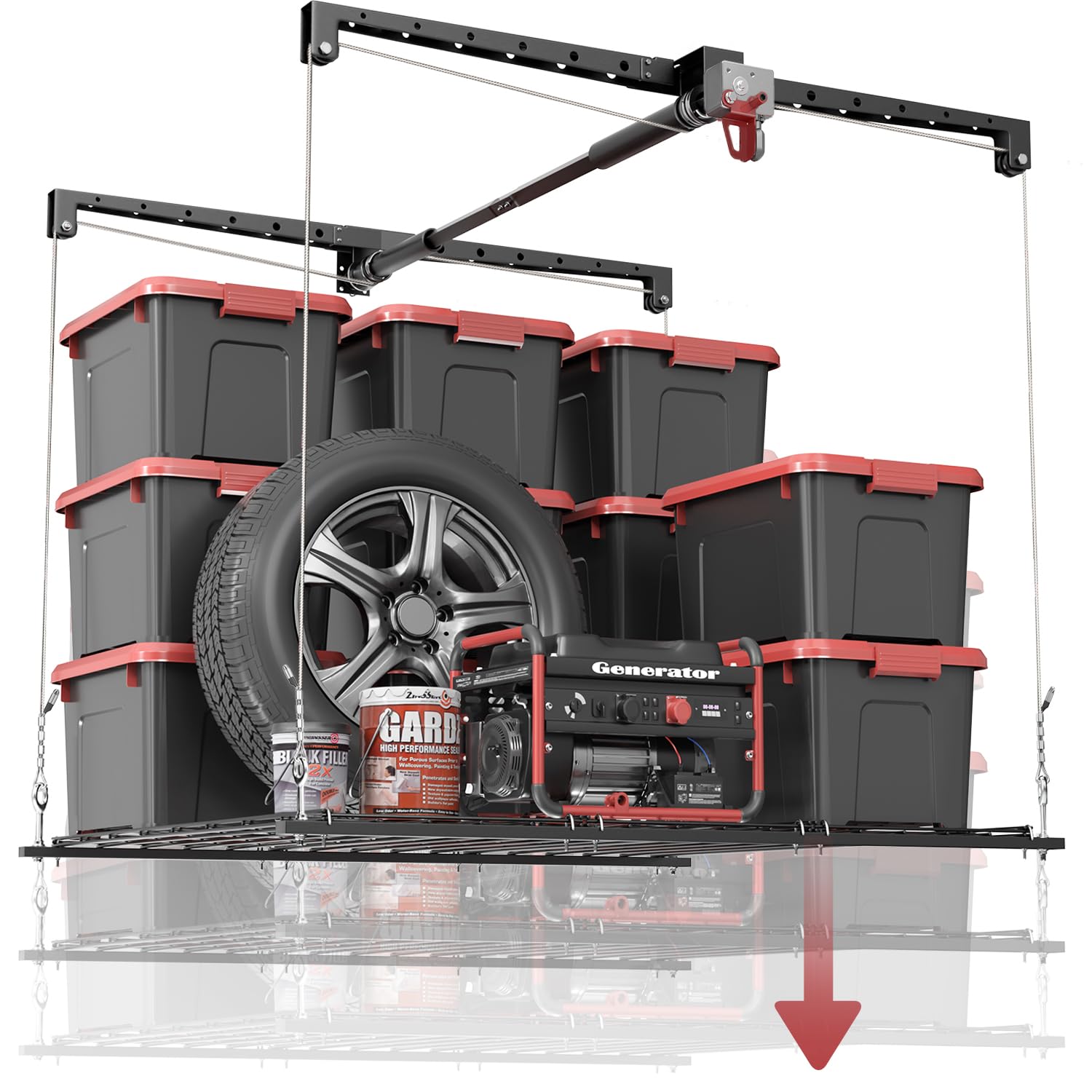
For attics with no headroom at all: store the boxes overhead and lower them when you need them.
If your attic is a crawlspace you can barely kneel in, decking the floor is not the answer — lifting storage to the ceiling is. This 4×4 foot metal rack mounts to joists and drops down roughly 144 inches from the ceiling on a cable system, so bins come to you instead of you climbing to them. It is rated for 250 pounds and suits ceilings up to 12-14 feet, which puts it in a different class from the walkable panels above.
What owners appreciate most is how the frame lets them use the whole height of the garage without ladders. The platform is driven by a drill — one owner raised a 150-pound load with a 20-volt drill and found a 180-pound load needed an electric drill — so a strong cordless gets the job done. An added manual lock holds the frame in place once it is up. Since the deck is a grated platform, fitting a 3/4-inch plywood base stops small items dropping through, which is a detail worth copying.
The catch is that the mechanism wants care and the platform is not a floor. Owners otherwise happy with this unit still warn that the retraction system overheats or jams if you run the drill fast — slow and steady wins. One described the platform as flexing under a heavier load than feels comfortable. Budget two people and a couple of hours for installation, and plan joist alignment with a laser level rather than by eye.
Best use case: Seasonal totes, camping gear, and anything you want off the floor but reachable without a ladder.
Be honest about the lift: A drill at slow speed works well; a heavy load and a fast drill is where the mechanism struggles.
Choose it when: your garage ceiling is tall and your attic is too cramped to deck.
Pass on it if: you need something you can walk on — this is a shelf that travels, not a floor.
5. GADFISH Garage Ceiling Lift Storage Rack, 85″ Height, 4×4 Ft
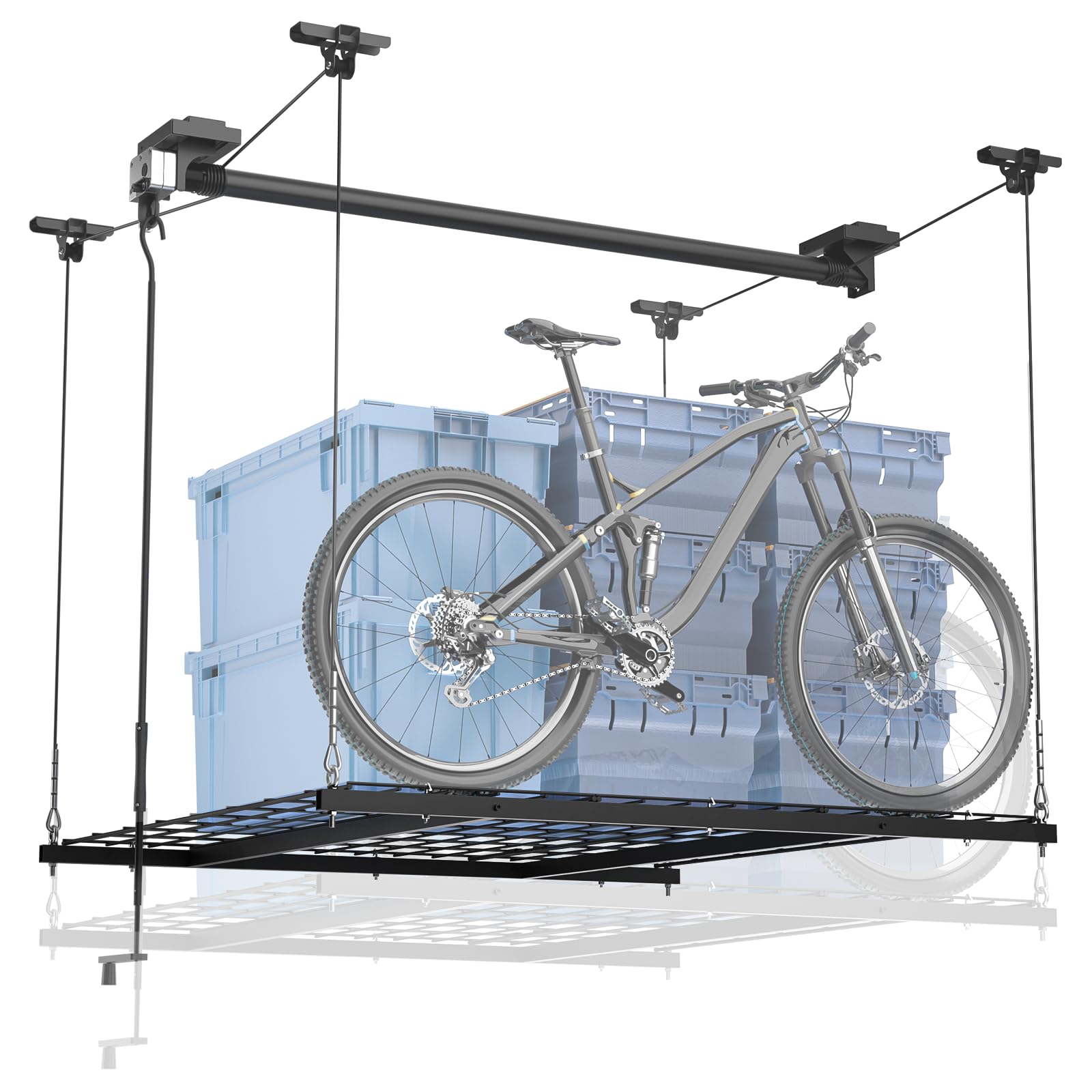
The heaviest rating on this page, paired with the shortest cable drop of the two lift racks.
Where the rack above is built for tall ceilings, this one is built for weight. GADFISH rates this 4×4 foot metal frame at 350 pounds and spreads that load around a reinforced perimeter, so the platform stays level instead of tipping as you raise it. The steel cable reaches up to 85 inches from ceiling to rack, which suits most garages but will not descend to the floor of a very tall one — measure your clearance before ordering.
Its best feature is the lift itself. A dual-cable ceiling mount anchors the frame on two sides, and the manufacturer describes that arrangement as cutting the shaking you get from a single-point hoist. A locking latch holds the frame at whatever height you stop at, and the hand crank works either manually or with a power drill. Owners make good use of that: the recurring story is getting seasonal boxes off the garage floor and back up again without a ladder.
Assembly is where opinions split. Two people can follow the supplied template and get it up, but one owner needed six to eight hours working alone. A second found the fasteners incomplete and threads on the cable eye-bolts damaged from the start — worth inspecting everything before you start drilling into a ceiling. The 350-pound figure is also best read as a ceiling, not a daily target; loads closer to 150 pounds are where cranking starts to feel heavy by hand.
Why it earns a slot
- Dual steel cables anchor two sides of the frame instead of one point
- Locking latch pins the platform at the height you want
- Works with the supplied hand crank or a power drill
- 350-pound capacity is the highest load rating here
What to go in knowing
- Installation is slow — plan on two people and several hours
- Inspect the eye-bolts, threads, and fastener count before assembling
- 85-inch cable drop limits how low the platform reaches
- Hand cranking a heavy load takes real effort
Buy it for: a garage with sturdy joists, standard height, and a lot of heavy seasonal gear to get off the floor.
skip it if: your ceiling is unusually tall — the 85-inch drop will not reach where you want it.
6. 6 Packs Plastic Pallets

Six thin low-profile pads that weigh next to nothing and click together to fit the floor you have.
At 7.45 pounds for the whole six-pack, this set is easy to carry up a ladder one piece at a time — and that portability is the whole point. Each pallet is 23.6 x 11.8 inches and the modular system lets you add or remove pieces to match the floor shape. It is a smart choice for a damp basement or shed corner where you just need boxes and hay off the ground.
Owners describe them as “Very light weight but seem sturdy. Not thick so be sure they meet your needs. The panels hold their shape while the load is stationary, but they come apart easily if you drag something across an uneven floor. For a fixed layout under stored goods, it is a non-issue. For a walkway you shift around, it is the deciding factor.
The honest limit is thickness. These are a fraction of the depth of the eight-pack set above, so they suit lighter loads — one buyer uses them for hay and greenhouse plants and says plainly that they would not pile much weight on. One critical owner calls the 1000-pound rating optimistic for panels this thin. Plan around a low-profile, low-load job and this set does exactly that.
Where it shines: Six pieces at 7.45 pounds total is the lightest, handiest way to get a damp floor covered quickly.
The lock note: They slip rather than snap, so keep the layout static or brace the outer edges.
Worth it if: your attic or basement floods occasionally and you want boxes sitting above the waterline.
Give it a miss if: you need a heavy, walkable surface — these are thin risers for lighter loads.
7. 4 Packs Plastic Pallets
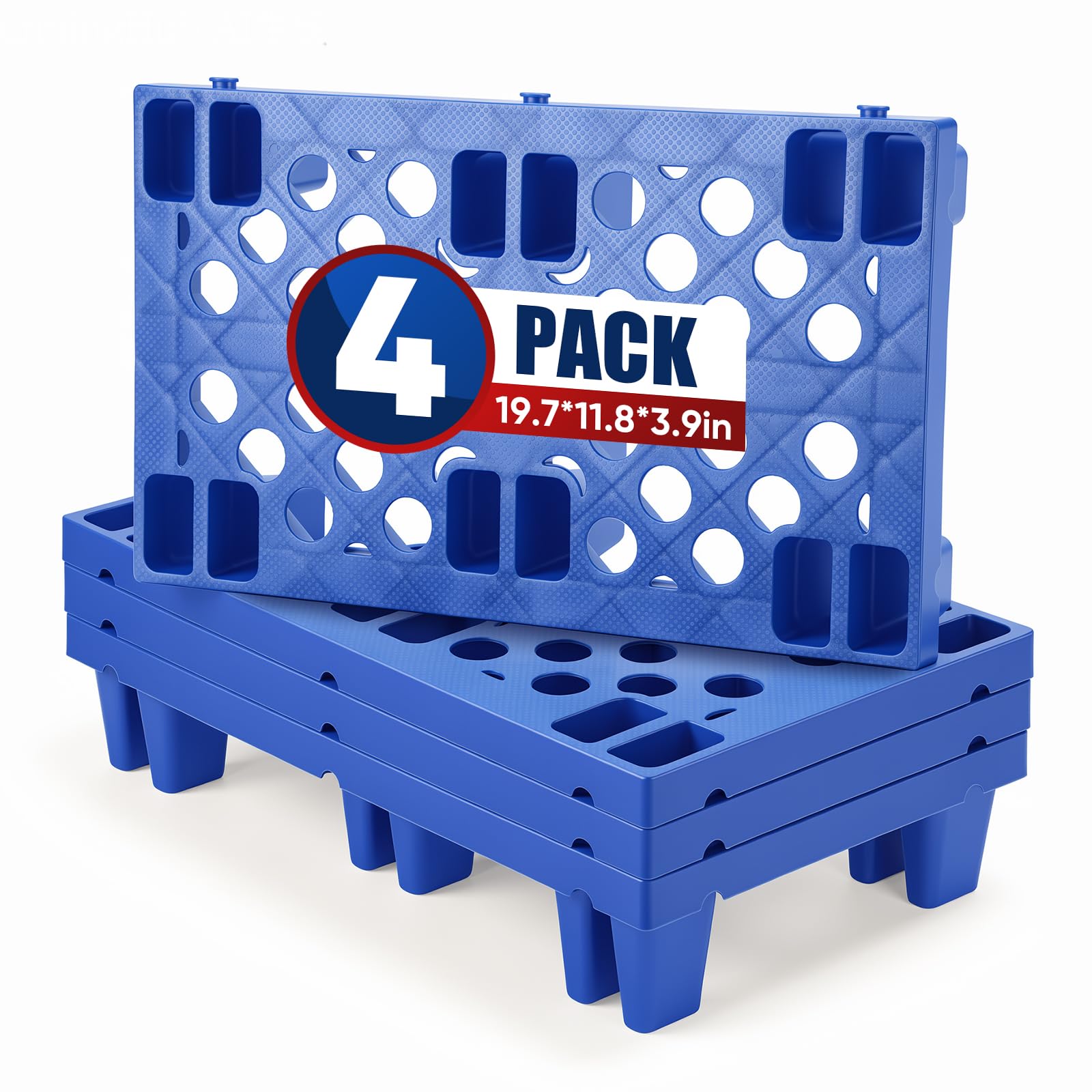
A four-pack of open-mesh risers built with eight legs to spread the load on a flat floor.
Four pallets at 19.7 x 11.8 x 3.9 inches, made from high-density polyethylene with a reinforced grid on top and eight legs underneath. That leg count is the spec to notice: the weight sits on eight contact points rather than a few, which is why these feel stable on a solid floor. The 3.9-inch height lifts boxes and supplies clear of a damp garage, basement, or attic surface, and the open mesh lets air pass through underneath.
The connectors are built into the edges, so you can join several into a larger platform without any tools. For light duty use that is plenty. Owners count versatility and sturdiness as the big wins, with pet crates, duck pathways, and simply getting items off concrete coming up repeatedly. One buyer reports, “The pallets drain well and are great. They’re strong, about an inch off the ground and work nicely.”
Where this set falls short is anything structural. The panels are hand-laid rather than snapped, so they shift if the floor is uneven, and they are too flexible to span gaps or carry concentrated weight. If you want a permanent walking surface over joists, buy the Attic Dek panels at the top of this page instead — this set is for elevating stored goods, not for standing on. Note that four panels cover a limited footprint, so two packs is the realistic order for a full attic run.
Solid reasons to pick it
- Eight legs spread weight evenly across a flat floor
- Open mesh surface allows air to move underneath stored items
- Edge connectors join pallets into a wider platform without tools
- Light enough to reposition and nest for storage
Limits worth knowing
- Panels lie together rather than locking, so they shift on uneven ground
- Thin construction is too flexible to bridge gaps or act as a deck
- Four panels only cover a small floor area
Pick it for: cheap, simple elevation of boxes, bins, and supplies off a damp floor.
Not for: spanning joists or supporting any real foot traffic.
Know the Specs
Joist Spacing and Panel Size
Joist spacing is the distance from the centre of one ceiling timber to the centre of the next, and it usually lands at 16 or 24 inches. The panel you choose has to land on those timbers — that is why the 24 x 16 inch boards here fit so well. Measure across two joists before ordering and write the number down. If your spacing drifts mid-attic, the interlocking tab design on the USA Sealing panels handles variance better than a fixed-hole board.
Load Rating in Pounds
A per-panel figure such as 250 pounds describes how much a single board is designed to hold. Do not read it as a suggestion to load that much — a person walking with a stack of bins is the real-world number. Panels rated 250 pounds per tile with reinforced grid structure handle that comfortably on 16-inch spacing. On wider 24-inch spacing, add a 2×4 underneath and use your own decking screws for confidence.
Common Questions
Will these panels fit between 16-inch and 24-inch joists?
Can I walk on plastic pallets in the attic?
Do attic flooring panels block insulation from breathing?
How much weight can a single attic deck panel hold?
Should I use the screws that come in the box?
How long does installation take?
Is a ceiling storage lift better than decking the attic floor?
Will plastic pallets hold up over the winter in a cold attic?
How do I know how many panels to buy?
The Bottom Line
The deck-and-riser aisle depends on one question: are you standing on it, or stacking boxes on it? For standing, the Attic Dek Flooring Storage System earns the top slot — five pre-drilled screw holes per 24 x 16 inch panel, 250 pounds of load rating, and side notches that keep wiring clear of your feet. If the attic floor is hopeless and the garage has the height, the KOKORACKER rack brings the storage to you instead. And for simply getting a basement’s worth of boxes up off damp concrete, the eight-pallet set is the biggest and most able lift in that category.
The Attic Dek panel system holds 4.0+ stars across 300+ ratings, and reviewers credit that score mostly to how fast the panels go down. That speed is exactly the hurdle that stops most people from sorting their attic at all.
How we choose
We do not accept paid placement. Every pick is matched to a real buyer and a real use-case; we do not hands-on test units.
Sources
Specifications: manufacturer listings and product documentation. Review insights: verified customer reviews, as of October 2026. Pricing: not shown on this page (it changes often); check the current price via the retailer link.
As an Amazon Associate, Aappliancez earns from qualifying purchases. This does not affect which products we feature.