Disclosure: Some links in this post are affiliate links. As an Amazon Associate I earn from qualifying purchases, at no extra cost to you. Learn more
Specs are compiled from manufacturer listings and verified buyer reviews and can change over time — please confirm the key details on the product page before buying.
Radon is a colorless, odorless gas that seeps up through your foundation, and the only way to know your home’s level is to measure it. What you actually want is a detector that gives you a trustworthy number fast, without mailing a canister to a lab and waiting weeks. That is what this shortlist covers: seven at-home units that read your air continuously, so you can spot a problem and act on it.
This guide is built by comparing the manufacturers’ published specifications and the patterns across verified customer reviews, so you get each pick’s real strengths and trade-offs instead of marketing spin.
Below you’ll find plug-in monitors, battery portables, and rechargeable units, each weighed on speed to first reading, tracking history, and how easy the display is to read. Every home deserves a real number, and the right at home radon test kit gives you one without the lab bill.
Top Picks


How To Choose The Best At Home Radon Test Kit
A radon detector’s spec sheet tells you its range, not your basement’s level — only a placed, running unit reveals that. A unit that reads 0.09 to 1,000 pCi/L tells you nothing about your specific foundation until you place it, close the windows, and let it run. Weigh how the unit performs once it’s placed, closed-window, in your own space.
Speed to first reading versus long-term accuracy
A fast first reading comes from a sensor that samples quickly, which is why the Ecosense EB100 shows a number in 10 minutes. A slower unit like the LifeBasis and HOUND models takes 6 hours before its first result appears. A fast first number is fine for a quick scan, but radon swings with weather and time of day, so the long-term average is your real baseline.
Short-term versus long-term tracking
Most detectors show a rolling short-term average alongside a long-term average. The short-term figure helps you see whether opening a window or fixing a fan is working within hours. Compare the long-term average, not the short-term one, against the 4 pCi/L action level. Pick a unit that displays both averages plus a history log, so you read trends instead of a single snapshot.
Power source and placement
A plug-in monitor like the Ecosense stays put and never needs charging, but it loses its data when unplugged. A battery or rechargeable unit is portable, so you can move it from basement to bedroom, but you have to remember to top it up. Either way, place it about 50 cm above the floor, away from damp corners and under 85% humidity.
Side-by-Side Comparison
| Model | Best For | Power | First Reading | Tracking Range | Amazon |
|---|---|---|---|---|---|
| Ecosense EB100★ Best Overall | Fast plug-in checking | Corded electric | 10 minutes | Real-time to long-term | Amazon |
| CRADTEC Digital Radon Detector IIIBest Value | Budget-friendly value | 3 AAA batteries | ~24-hour monitor | Short & long-term | Amazon |
| LifeBasis (6H, Rechargeable) | Long 504-day history | Rechargeable (Type-C) | 6 hours | 24h to 504 days | Amazon |
| AEGTEST HOUND-1011 | Portable travel use | Rechargeable (USB-C) | 6 hours | 6H to 504 days | Amazon |
| LifeBasis (0-500 pCi/L) | Simple daily checks | 3 AAA batteries | 24 hours | Short & long-term avg | Amazon |
| AEGTEST HOUND-1085 | Whole-home tracking | Rechargeable (45-day) | 6 hours | 6H to 504 days | Amazon |
| LifeBasis LRN-07 | Long-term averaging | Battery powered | 24 hours | Up to 1-year average | Amazon |
Detailed Reviews
1. Ecosense EB100 Radon Detector
Our pick — 4.0+★ from 700+ verified ratings; the strongest balance of quality and price.
The instant-reader — a fresh number every ten minutes without a smartphone or a lab in sight.
You get a radon number 10 minutes after you plug this in. The EB100 uses patented ion chamber sensor technology (a sealed chamber that samples the air inside it and counts charged radon particles) to deliver a first reading in 10 minutes, then fresh measurements every 10 minutes after that. It holds 4.0+ stars across 700+ owners, and what wins people over is how little effort it takes: you plug it in, and it starts telling you numbers. No pairing, no app, no account.
You can watch your radon trend over time, not just a single snapshot. The full-size digital display shows real-time, daily, weekly, monthly, and long-term averages, so you can see the number climb in cold weather or drop when you open a window — a pattern buyers report noticing as levels shift with weather and even laundry. The ion chamber measures in pCi/L (picocuries per liter, the standard radon unit), and it carries an audible alarm you can set above a level like 4, so it will chirp when it matters. Unlike the battery portables further down, this one never needs a charge, but it also loses its stored data when unplugged.
The catch is portability and power. It runs on corded electric, so you’ll want a spot near an outlet, and the manufacturer itself cautions that running it off a portable battery can affect measurement accuracy. A few buyers also hit a faulty adapter from the start, though the customer service response drew praise for a quick replacement. One practical trick owners rely on: leave it plugged in for hours before trusting a reading, because it needs time to settle.
What buyers keep coming back to
- First reading in 10 minutes, refreshed every 10 — faster than any 6-hour unit here
- Real-time, daily, weekly, monthly, and long-term averages on one clear display
- Adjustable audible alarm and no smartphone required
The trade-offs to weigh
- Corded power only; unplugging clears the stored data
- Accuracy can drift when run on a portable battery
- Occasional faulty adapter on arrival
Made for: the homeowner who wants a trustworthy number today, from a fixed spot near an outlet.
Think again if: you want to carry the same unit to a rental or a neighbor’s place — the cord ties it down.
2. CRADTEC Digital Radon Detector III
The entry point that skips the inspector fee and runs on three AAA batteries.
You can run a first radon check yourself without hiring anyone. The CRADTEC runs on three AAA batteries, so you can set it down anywhere and move it when you want to test another room. A real buyer quote from the listing sums up the appeal: “I think the reading is reliable because it monitors the radon level for 24hrs before showing it.” That 24-hour settle is deliberate — it lets the sensor gather enough air before it commits to a number.
The display is the part that feels above its tier. It uses tempered glass with a 300 DPI resolution (that’s the pixel density — higher means sharper text), so the short- and long-term figures are crisp from across the room. A blinking alarm flashes when levels surge so you won’t miss a spike. One tip worth knowing: reset the device before you start a fresh test so it doesn’t carry over old averages.
Be clear-eyed about the accuracy picture, though. This is the model where readings can feel noisy — the review data shows some owners convinced and others unsure after watching figures swing across several days. It’s a solid spot-checker and a way to see if you have a problem worth chasing, not a substitute for a professional measurement when you need certainty.
Where it shines: a clean, readable glass display, simple setup, and no inspector appointment — a low-risk way to get your first look at basement numbers.
The honest limit: treat its readings as a signal, not a verdict. If the number comes back high, confirm with a professional test before you spend on mitigation.
Reach for this if: you want a battery unit to leave in a spot and check back on, without a big outlay.
Look elsewhere if: you need lab-grade certainty and nothing less will do.
3. LifeBasis Rechargeable Radon Detector

A long-memory unit that logs every six hours and keeps the receipts for 504 days.
The LifeBasis is built for long-haul tracking: a data point every 6 hours, held for 504 days. It stores a data point every 6 hours and holds up to 504 days of history — that’s over a year of readings — across 10 independent sets, all visible on the 2.0-inch TFT color screen. A semiconductor sensor measures from 0.09 to 1,000 pCi/L, with the first reading at exactly 6 hours and hourly updates after. The rechargeable battery runs up to 45 days with the screen off and tops up over Type-C in 3.5 hours.
Its real value is pattern-spotting: peak, average, and 24-to-96-hour history on one screen. The screen tracks peak, average, and historic data from 24 to 96 hours, so you can see a rise before it becomes a problem. Color-coded bars shift green to orange to red as levels climb, paired with an audible buzzer you can set to your local threshold. As one buyer put it, tracking over time is what confirmed a real issue: “I was able to confirm there was a radon problem without having to hire an expert.”
The one thing to watch is the occasional glitch. A handful of owners mention spurious high readings — numbers spiking into the hundreds that clear on a reset — and one found the display hard to interpret in a damp basement. Treat an outlier as a prompt to reset and re-check, not a reason to panic. And keep an eye on the charge; the recommendation is a top-up roughly every few months.
The standout: 504 days of stored history and a color display make this the best tool here for watching trends over a full season.
Handle with care: occasional spurious spikes mean you should confirm any alarming reading with a reset and a second look.
Best for: the data-minded homeowner who wants months of trend lines instead of a single number.
Worth noting: it needs a periodic recharge, and the display can be fussy in a humid crawlspace.
4. HOUND-1011 Portable Radon Detector for Home
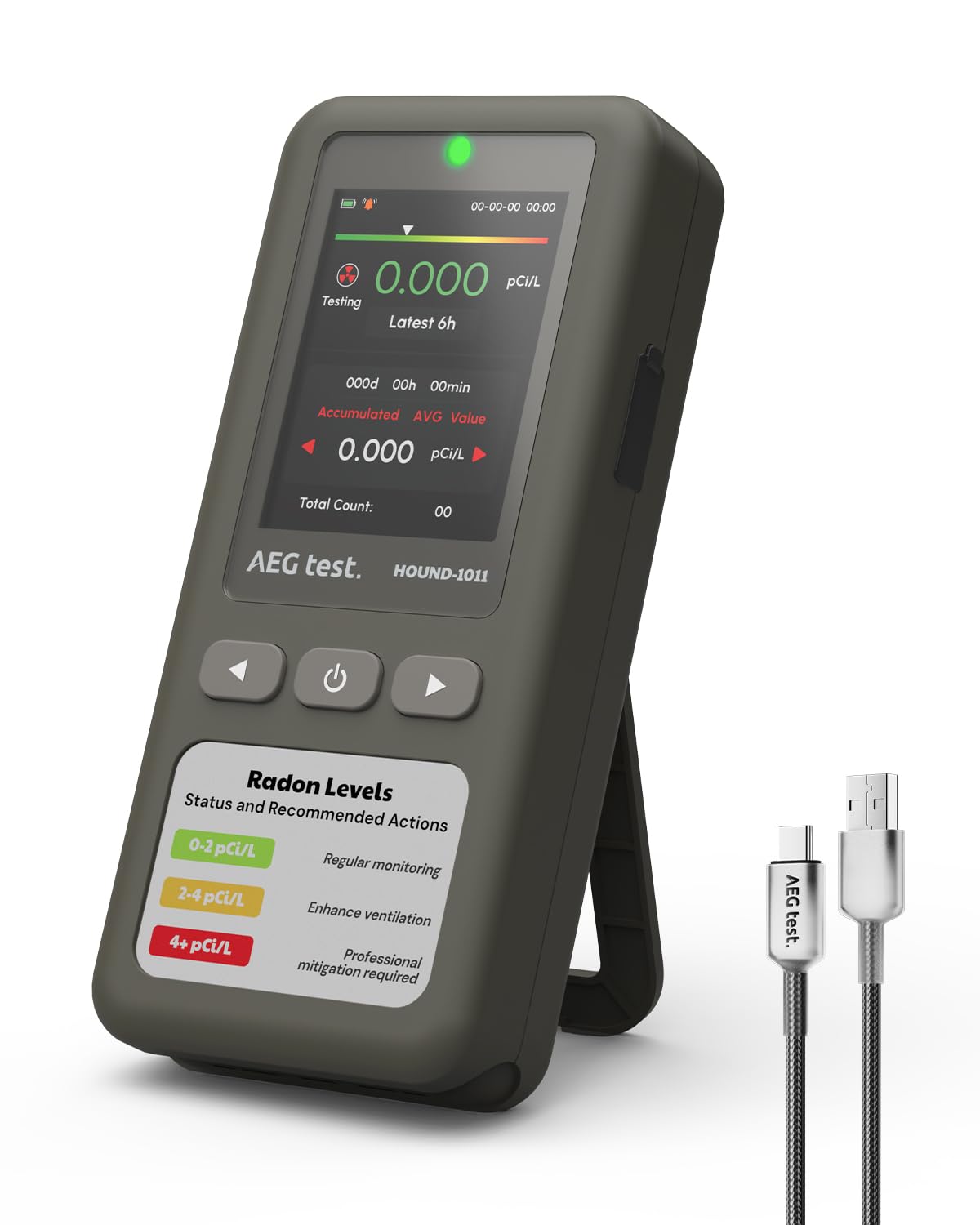
The one you can slip in a bag and loan out — pocket-sized radon tracking that travels.
Not everyone wants a detector bolted to one basement wall, and the HOUND-1011 is the answer to that. It’s small enough to move room to room, or hand to a neighbor, running on a built-in battery that lasts up to 45 days in sleep mode. A high-precision semiconductor sensor measures from 0.09 to 1,000 pCi/L, with a first result in 6 hours and hourly updates, and it logs data across timeframes from the past 6 hours out to 504 days.
The LCD shows the past 6H/24H/48H/72H/96H at a glance, and the unit recharges over USB-C. A few owners like that it arrived fully charged and ran past a week before needing a top-up, and that the high-level alarm fired within about half a week when it mattered. The menu is straightforward, and the Eco setting lets you mute the alarm so it won’t wake you at night.
One quirk to plan around: humidity can throw the sensor off, so keep it clear of damp air — placing a dehumidifier well away from it helps. And note this is a portable meter, so its readings are for spotting a problem on the move, not for a fixed long-term baseline the way a plugged-in monitor provides.
Travel-ready: pocket-sized, USB-C rechargeable, and a 45-day sleep-mode battery make it the easiest here to carry and loan.
Watch the air: humidity interferes with readings, so keep it out of steamy corners.
Choose it if: you want to check several spaces — or a friend’s place — without buying a unit for each.
Pass if: you want a permanent, always-on monitor fixed in one room.
5. LifeBasis Portable Radon Tester

A no-fuss battery unit with a big screen and a reading in about a day.
If you’d rather not fiddle with charging cables or apps, this LifeBasis keeps it simple. Pop in the included 3 AAA batteries and it runs continuously with low power draw, showing a large digital readout you can scan from across the room. The first measurement appears after 24 hours of operation — slower than the 6-hour units, but the trade-off is a unit that just sits there and does its job. It measures across a 0-500 pCi/L range and shows both short-term and long-term averages, so you can compare today’s number against the rolling trend.
The accuracy angle is where owners differ. The review pages lean heavily toward “accurate” as the headline impression, with the numbers tracking regional averages and problem areas sensibly. One owner found the unit landed within roughly 0.20 pCi/L of a high-precision brand-name monitor over a span of weeks. But accuracy is not unanimous — an occasional unit arrives miscalibrated and needs an exchange. Test it against a known result if you can, and give it a full two weeks before drawing conclusions.
Setup calls for keeping doors and windows closed beforehand, placing it above 50 cm from the ground, and staying under 85% humidity.
Simple wins
- Large screen, battery-powered, no app or pairing needed
- Short- and long-term averages side by side
- Consistent readings for many owners, close to regional norms
What to know before you buy
- First reading takes about 24 hours
- An occasional miscalibrated unit needs exchanging
- No app, graphs, or data export
Good fit for: the homeowner who wants a set-it-and-check-back battery unit with a clear big display.
Not for: anyone who needs a same-day number or app-linked graphs.
6. HOUND-1085 Radon Detector for Home, Basement & Nursery
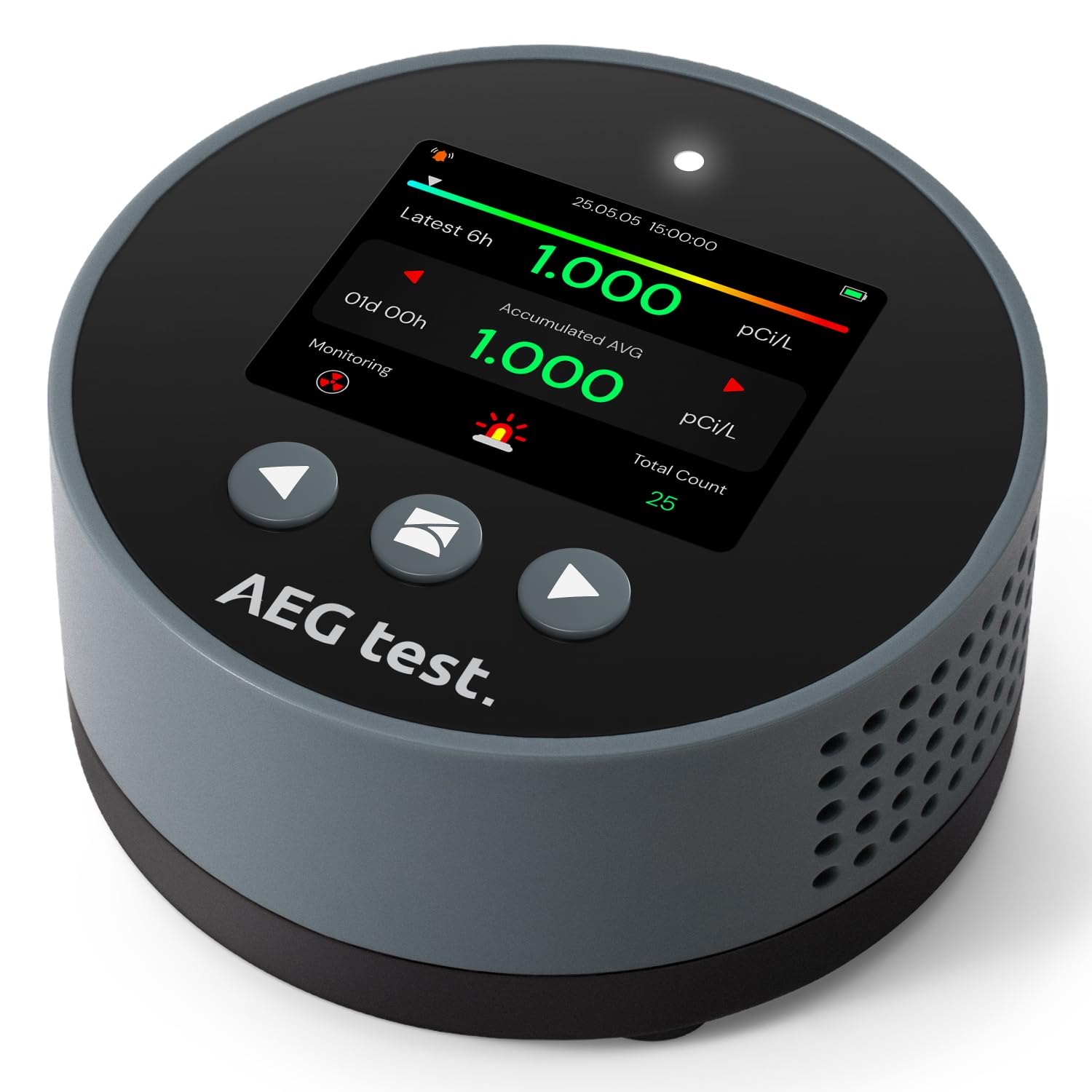
Palm-sized, rechargeable, and built to move from basement to nursery without missing a beat.
For tracking a whole home, the HOUND-1085 pairs a high-accuracy semiconductor sensor with a triple-vent design that speeds up how fast radon diffuses into the unit. The first reading lands in 6 hours, with automatic hourly updates after that. It recharges in 3.5 hours and then runs over a month of continuous monitoring, so you can carry it between floors without hunting for an outlet. The display shows timeframes from 6/24/48/96 hours out to 504 days of history, logged every 6 hours.
Alarms are both audible and visual, with color-coded bars and a customizable sound alert, so you’ll know when levels rise. A buyer who fixed a ventilation fan reported the number dropping fast — from 6.2 to 0.6 — right after the fix. Functionality is what owners praise most; the unit simply does what it claims. It’s also small and light enough that moving it around is no chore.
The honest caveat is accuracy consistency over time. Some owners find the readings right on, while others are less sure after months of use, and one reports the device drifting after about a year. There’s also a learning curve — the menu is not for everyone. Treat its numbers as a strong signal and confirm anything alarming with a second measurement.
Why it earns the premium spot: fast 6-hour readings, 504-day history, and a rechargeable build you can move between rooms make it the most flexible long-term tracker here.
Fair warning: accuracy consistency is mixed over long periods and the interface isn’t fully intuitive.
Best for: families who want one portable unit to sweep the basement, living room, and nursery.
Skip if: you need the simplest possible interface and nothing else.
7. LifeBasis LRN-07 Radon Detector
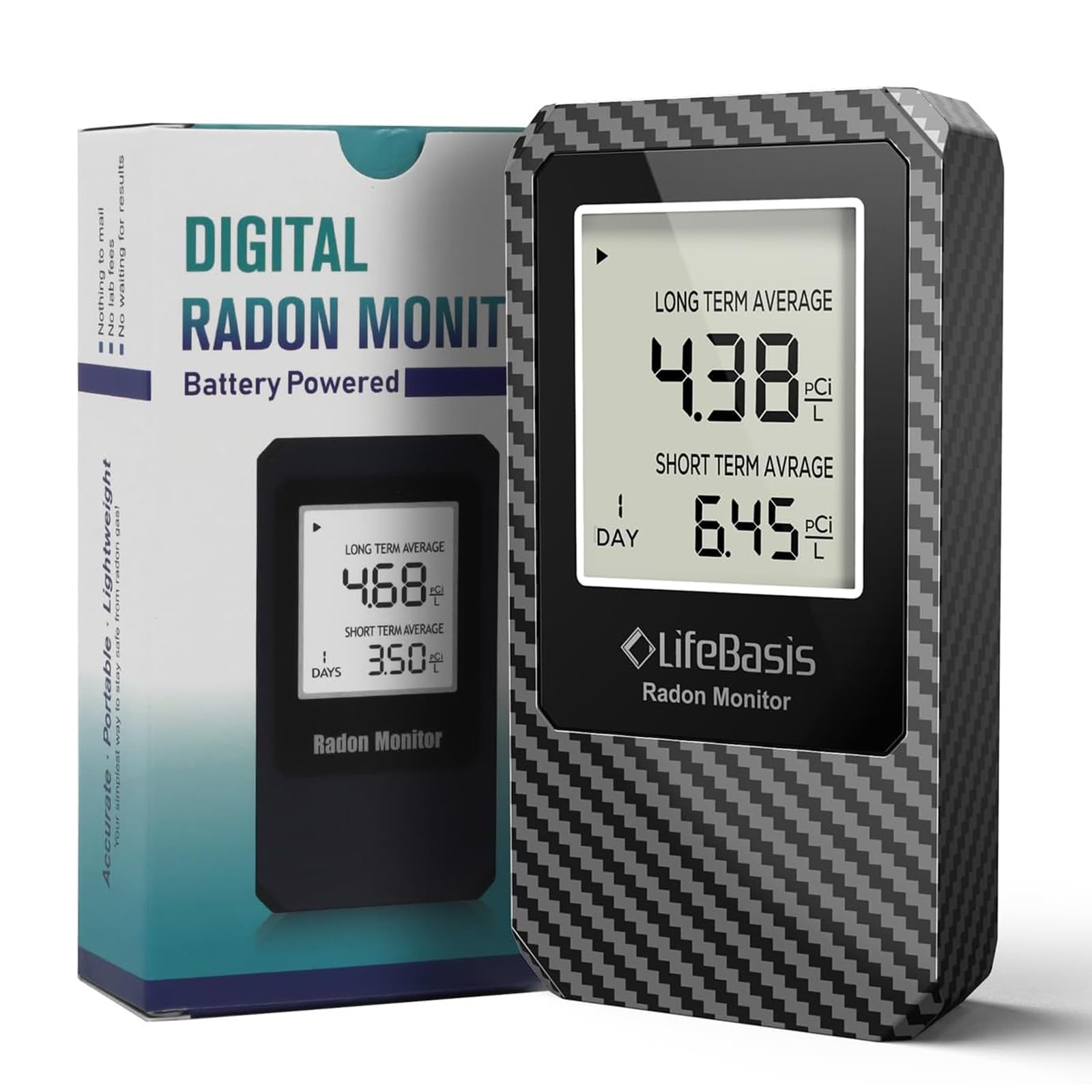
Built for the patient reader who wants a year-long average before acting.
This LifeBasis leans into one idea: the longer you measure, the more reliable the result. It shows a long-term average (up to one year), a last-day average updated hourly, and a last-7-day average, all on a large screen. It’s battery-operated with low power draw, and the case comes in a carbon fiber color. Like its sibling above, the first measurement appears after 24 hours, so it rewards patience.
You get readings owners find dependable over time. Customers note one buyer cross-checked against a mailed lab test and got closely in line — close enough for spot checks and for watching a mitigated home stay stable, though not for pinpoint precision. As one reviewer noted, it caught high levels and prompted action: “Same reading as another detector I bought. Worth the money because it got our landlord to put in a Radon mitigation system.”
There are two things to plan for. It has no app, graphs, or data transfer, so what you see on the screen is all you get. And a rare unit is miscalibrated from the start — if the numbers look off against a known test, exchange it. Placement above 50 cm from the floor and a closed-window room give the cleanest readings.
For the long game: a one-year averaging window with day and week figures makes it a dependable trend-watcher for a mitigated home.
The catch: no app or graphs, and the occasional miscalibrated unit — validate early if you can.
Pick it if: you want a simple, screen-only unit that averages over months and stays put.
Think twice if: you want app tracking or a same-day number.
Know the Specs
pCi/L and Bq/m³
These are two ways to measure the same thing — how much radon is in your air. pCi/L (picocuries per liter) is the unit most US homeowners see, while Bq/m³ (becquerels per cubic meter) is the metric equivalent. Some detectors let you switch between them, which is handy if you’re comparing against a foreign report or guidance. The number itself is a concentration, so a higher reading means more radon in that space. You don’t need to convert anything yourself — just pick a unit and watch the trend.
Ion Chamber vs Semiconductor Sensor
Two sensor types show up here, and they affect how a unit behaves. An ionization or ion chamber sensor (like the one in the Ecosense) samples air in a sealed chamber and delivers readings quickly — that’s why it can show a first number in 10 minutes. A semiconductor sensor (used in the LifeBasis and HOUND units) is often smaller and more portable but usually needs a settle period of a few hours before its first result. Neither is automatically better; the trade-off is speed versus portability.
Common Questions
How long should I run an at-home radon detector before trusting the reading?
What is a safe radon level and when should I worry?
Do I need a plug-in monitor or can a battery unit work just as well?
Why does my reading change so much day to day?
Where should I place my detector in the house?
Can a home detector replace a professional radon test?
What is the difference between pCi/L and Bq/m³ and which should I use?
Will running a dehumidifier or fan skew my reading?
How often do I need to recharge a portable radon detector?
The Bottom Line
For most homes, the winner is the Ecosense EB100, because it delivers a real number in 10 minutes and keeps refreshing it every 10 minutes after — the fastest, simplest way to know where you stand today. If you want months of trend history you can look back on, grab the LifeBasis 6H rechargeable and its 504-day log. And for checking several rooms or a friend’s place, the portable HOUND-1011 slips in a bag and runs up to 45 days in sleep mode. Whichever you pick, measure long enough to see the trend, then act on it.
How we choose
We do not accept paid placement. Every pick is matched to a real buyer and a real use-case; we do not hands-on test units.
Sources
Specifications: manufacturer listings and product documentation. Review insights: verified customer reviews, as of October 2026. Pricing: not shown on this page (it changes often); check the current price via the retailer link.
As an Amazon Associate, Aappliancez earns from qualifying purchases. This does not affect which products we feature.