Disclosure: Some links in this post are affiliate links. As an Amazon Associate I earn from qualifying purchases, at no extra cost to you. Learn more
Specs are compiled from manufacturer listings and verified buyer reviews and can change over time — please confirm the key details on the product page before buying.
If you cannot yet finish a single clean pull-up, you need a machine that lifts part of your body weight for you. That help comes from a weighted pad, a band, or a counterweight (a stack of weights that pulls up as you pull down). That is the whole point of an assisted pull up machine, and it is also where most cheap towers quietly fail. Below you get the eight stations worth your floor space, sorted by what actually holds up under a heavy, moving human: frame steel, base width, and whether the assist mechanism still works smoothly after a few hundred reps.
This guide is built by comparing the manufacturers’ published specifications and the patterns across verified customer reviews, so you get each pick’s real strengths and trade-offs instead of marketing spin.
Most buyers obsess over the max weight rating and ignore the tubing thickness and base footprint — yet those two determine whether the tower rattles during dips. This breakdown covers frame gauge, assistance type, and real height ranges so you can pick the Best Assisted Pull Up Machine for your ceiling and your bodyweight.
Top Picks

How To Choose The Best Assisted Pull Up Machine
An assisted pull up machine is a freestanding tower with a mechanism that carries part of your body weight so you can complete pull-ups, dips, and leg raises before you can do them unassisted. The single question that decides everything is this: how does it help you up? A plate-loaded counterweight, a pneumatic rod, a resistance band, or a sponge pad each changes how your reps feel. Get that wrong and you will fight the machine instead of your own body weight.
Frame steel and the wobble question
The number that quietly separates a keep-forever tower from a return is tubing wall thickness. A 2mm steel frame simply holds less flex than a 1.5mm frame at the same load, which is why one station can feel bolted down while another shivers. Heavier unit weight usually tracks with thicker steel too — a station that weighs around 60 pounds or more tends to plant better than a skeletal one.
Base footprint and floor type
Width at the feet does more anti-tip work than any marketing claim. An H-shaped base spreads force across a wide patch of floor, while a narrow footprint concentrates it. If you train on hardwood or tile rather than a concrete garage slab, look for rubber non-slip feet or suction cups, because bare steel on a smooth floor slides.
Height range versus your ceiling and your frame
Check two numbers before you buy: the tower’s top height and your own reach. A station that tops out low forces taller users to bend their knees at the bottom of a pull-up, which ruins the movement. Adjustable settings are just as important for households with mixed heights, so one tower fits a tall adult and a shorter partner without rebuilding it.
Side-by-Side Comparison
| Model | Best For | Max Load | Assist Mechanism | Height Range | Amazon |
|---|---|---|---|---|---|
| XMARK XM-4437.2 Commercial VKR★ Best Overall | Gym-grade core and dip work | — | Twin dip and push-up handles | — | Amazon |
| Pooboo 450LB Adjustable Power TowerEasiest Setup | Fastest setup for beginners | 450 lbs | Vertical knee raise pads | 71.4″ to 84.9″ | Amazon |
| DONIUZ Multi-Function Power TowerHighest Capacity | Mixed-height households | 660 lbs | Backrest and elbow pads | 74.8″ to 87″ | Amazon |
| KINGKANG Assistive Power Tower | Beginners needing a lift | 450 lbs | 70 LBS pneumatic assist | 68.5″ to 83″ | Amazon |
| Sportsroyals Free Standing Pull Up Bar | Band-assisted progression | 440 lbs | Folding assisted pad | 64.56″ to 87.01″ | Amazon |
| FLYBIRD Extra Large Power Tower | Heavier users and core work | 800 lbs | Seated leg raise station | 9 settings | Amazon |
| JOROTO Foldable Pull Up Dip Station | Small apartments | 450 lbs | Foldable frame with kid bar | 40.4″ to 82.8″ | Amazon |
| Pooboo Power Tower with Cable Machine | Full-body cable training | 450 lbs | 16-position cable pulley | 80.7″ tall | Amazon |
Detailed Reviews
1. XMARK Knee Raise Dip Stand
Our pick — 4.5+★ from 500+ verified ratings; the strongest balance of quality and price.
A commercial VKR station with a heavy-duty steel frame that stays planted under dips and knee raises.
The XMARK earns its spot by doing one job with genuine gym character: it is a commercial vertical knee raise station with a dip stand and push-up station, not a pull-up tower. The frame is heavy-duty steel with a grey scratch-resistant powder coat, so it survives bare feet and tossed shoes without showing every scuff. Builders of the vertical knee raise segment generally notice the high-density vinyl cushions first: sweat and tear resistant, double-stitched in red, and clearly a step up from the foam pads that crush flat in a season.
What earns it the top slot is the way it feels under load. Owners consistently describe it as a machine that looks bolted to the floor, which is the whole reason it edges the DONIUZ tower here — a lifetime warranty and a 500+ review, 4.8-star track record versus a 600+ rating 4.5-star station with a stability line owners call mixed. The twin dip handles are spaced for comfort, and the push-up handle grips were modified to run the entire length of the bar, a small change that removes the awkward “half-on-the-bar” feeling mid-set.
Getting it standing takes patience: the sealed, labeled part bags and included hardware make the job clean, though builders commonly report a one-and-a-half to two-hour first assembly, with the most common stopper being a slightly misaligned bolt hole that can be worked around with a little patience. It is also a specialist, not a swiss army knife — no all-in-one pull-up bar, no built-in assistance band. Its purpose is core and dip strength, and it delivers exactly that.
What owners rave about most
- Commercial-grade steel mainframe with scratch-resistant powder-coat finish
- High-density sweat and tear resistant vinyl cushions with double-stitched seams
- Ergonomically-spaced twin dip handles plus full-length push-up grips
- Skid-resistant rubber feet that protect hardwood floors
- Lifetime warranty backing
Where it asks for patience
- Two-hour assembly is common and a bolt hole may need light persuasion
- No pull-up bar or band-assist built in; it is a dip and knee raise specialist
Buy this if: you want commercial-gym intensity for core, dips, and push-ups and you have floor space and a partner for assembly.
Look elsewhere if: you need a full pull-up tower with a band assist built into one frame.
2. Pull Up Bar Power Tower 450LB
11 height levels from 71.4″ to 84.9″ and a 10-to-20-minute assembly.
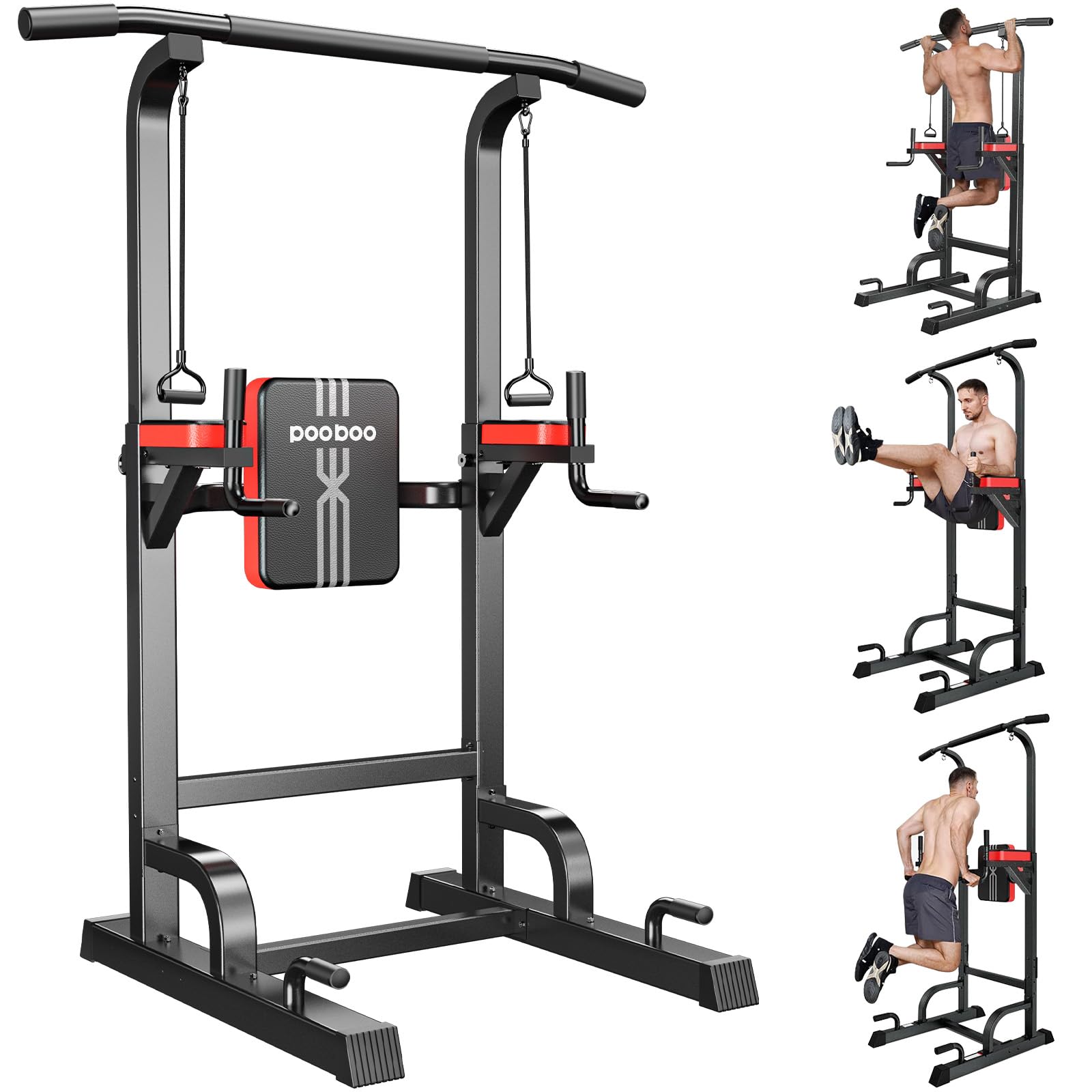
Pooboo built this tower around one idea: get you training the same afternoon. The instructions use labeled, numbered parts, and the published guide estimates a 10 to 20 minute build — a huge contrast with the XMARK’s two-hour session. It then serves the whole house, because 11 height levels span 71.4″ to 84.9″ and a 7-position backrest adjusts for taller adults and shorter users alike. At 450 lbs capacity with a 41.73″ extended H-shaped base and four enlarged non-slip feet, it holds the ground it stands on.
Exercise variety keeps it earning its corner. You can stack pull-ups, chin-ups, dips, push-ups, and vertical knee raises on the same station, and bonus elastic resistance bands are included to add assist or extra resistance. That said, its footprint is the widest of the towers here — the 41.49″ by 43.5″ base needs genuine floor clearance — and the build time depends on following a manual that even suggests two people.
Two things land with stable owners: the adjustments are quick and the unit feels like a permanent piece of the home gym once set. For a first tower or a family machine where the goal is simply to keep moving, it is the friendliest entry point on the list.
Fit and finish: 450 lbs capacity, 60 lbs bare weight, and alloy steel throughout, with a 12-month warranty for confidence.
Winner for families: the 11-level height spread plus a 10 to 20 minute assembly make it the pick when several people share one station.
Know before you buy: it eats the most floor space of the group, so measure first.
3. DONIUZ Power Tower
2mm steel tubing, a 660-lb capacity, and a 74.8″ to 87″ height range for tall users.
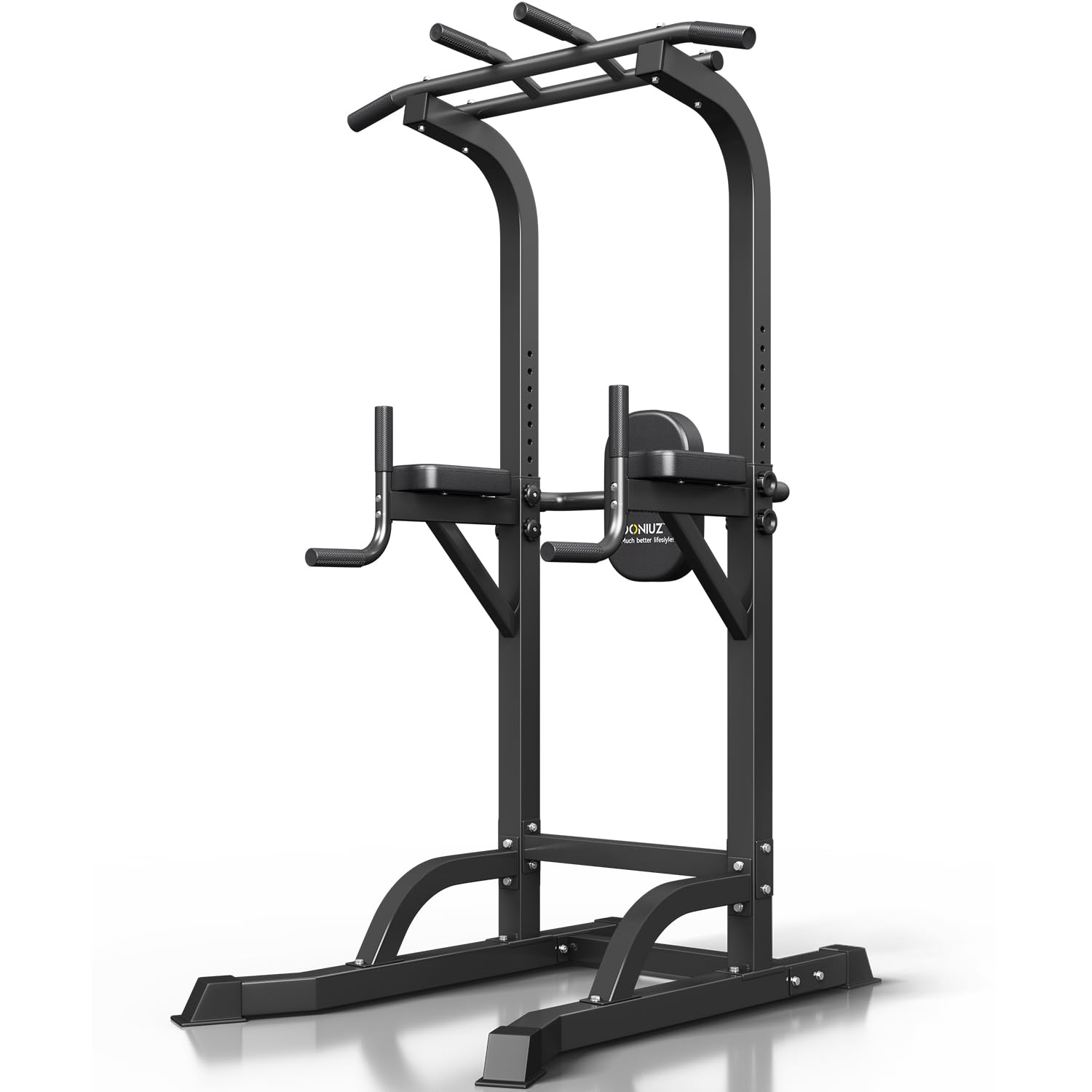
Two numbers tell you who this is for. The steel tubing gets 2mm thickness with a corrosion-resistant coating, and the whole tower carries a 660 lbs capacity — the highest rating in the group short of the FLYBIRD’s 800 lbs, and well ahead of the 450 lb towers above and below it here. Builders repeatedly try to flex the uprights and report none, with a wide curved base and triangular bracing doing the anti-tip work. On hardwood, the bottom suction cups grip rather than skate.
The pull-up frame carries wide, neutral, and close grips, and the dip bars sit at a width that suited owners without shoulder strain. A 74.8″ to 87″ height spread covers a 6’2″ spouse and a shorter partner — as buyers report, “multiple height locking notches fit a 178cm user and shorter partner.” The factory also nudges you onto a flat concrete floor instead of carpet, since carpet defeats those cups.
The trade-off to know is stability confidence. The recurring theme is that owners feel movement during pull-ups or dips on some floors — most likely on carpet or a slick surface where the suction and bracing cannot do their job. Anchoring the base with weight plates solves it for most, and a flat hard floor removes it entirely. Get the placement right and this is a hefty, family-ready station rather than a folding toy.
The honest caveat: a small number of very short users want padding near the close grip, since the widest grips suit taller frames — measure your reach against the bar before committing.
Best for tall users: if you are 6’0″ or taller, the 87″ ceiling height and multi-grip bar design suit you where shorter towers do not.
Skip if: your floor is carpeted or glossy tile — this tower wants a hard, flat surface to feel solid.
4. KINGKANG Assistive Power Tower

The only tower here with a 70-lb pneumatic assist that lifts part of your bodyweight.
Assisted pull-ups have different answers, and KINGKANG picked the cleverest one. Its tilting station runs on pneumatic rods and wheels rather than ropes, and the 70 lbs auxiliary function carries that much of your bodyweight while you learn the pull-up movement. For a beginner who cannot yet finish a rep, that mechanical lift is the entire reason to buy this over a plain tower. The 6-gear height range of 68.5″ to 83″, plus 4 hand-position lengths, means you can dial in the setup as you grow stronger rather than rebuying.
The build is carbon steel with a scratch-resistant coating, anti-tilt base, and a 450 lbs max, and it stands a compact 39″ by 27″ at the base — a fifth of the floor space the Pooboo demands. Six height gears and four hand positions give more adjust range than the entry-level towers. The foam elbow pad is a comfort win for longer sessions, and it can even be placed flat to assist reps.
Structure is where it plays it safe. Ownership signals are split between owners who call it sturdy and a handful suspecting the frame feels lightweight at the top end. The safe read: this is a light-use at-home assist companion, best for average-weight users and beginners working toward their first clean rep, not a 250-lb powerlifter’s dip stand. If your goal is to build up to unassisted pull-ups from zero, that lift is the point.
The beginner advantage
- 70 LBS pneumatic assist lifts bodyweight for unassisted beginners
- 6 height gears (68.5″ to 83″) plus 4 hand-position lengths
- Compact 39″ by 27″ base saves floor space
- Foam elbow pad and flat-laying mat for core work
Weight and use limits
- Owners at higher bodyweights report wobble on the pull-up bar
- No printed assembly guide inside some boxes
Best first machine: it is the one to pick if you cannot yet do a single pull-up and want mechanical help closing the gap.
Then upgrade later: heavier, stronger lifters should look at a steelier tower down the list.
5. SPORTSROYALS Free Standing Pull Up Bar
A folding sponge pad plus a resistance band adjustable from 22 to 88 lbs.
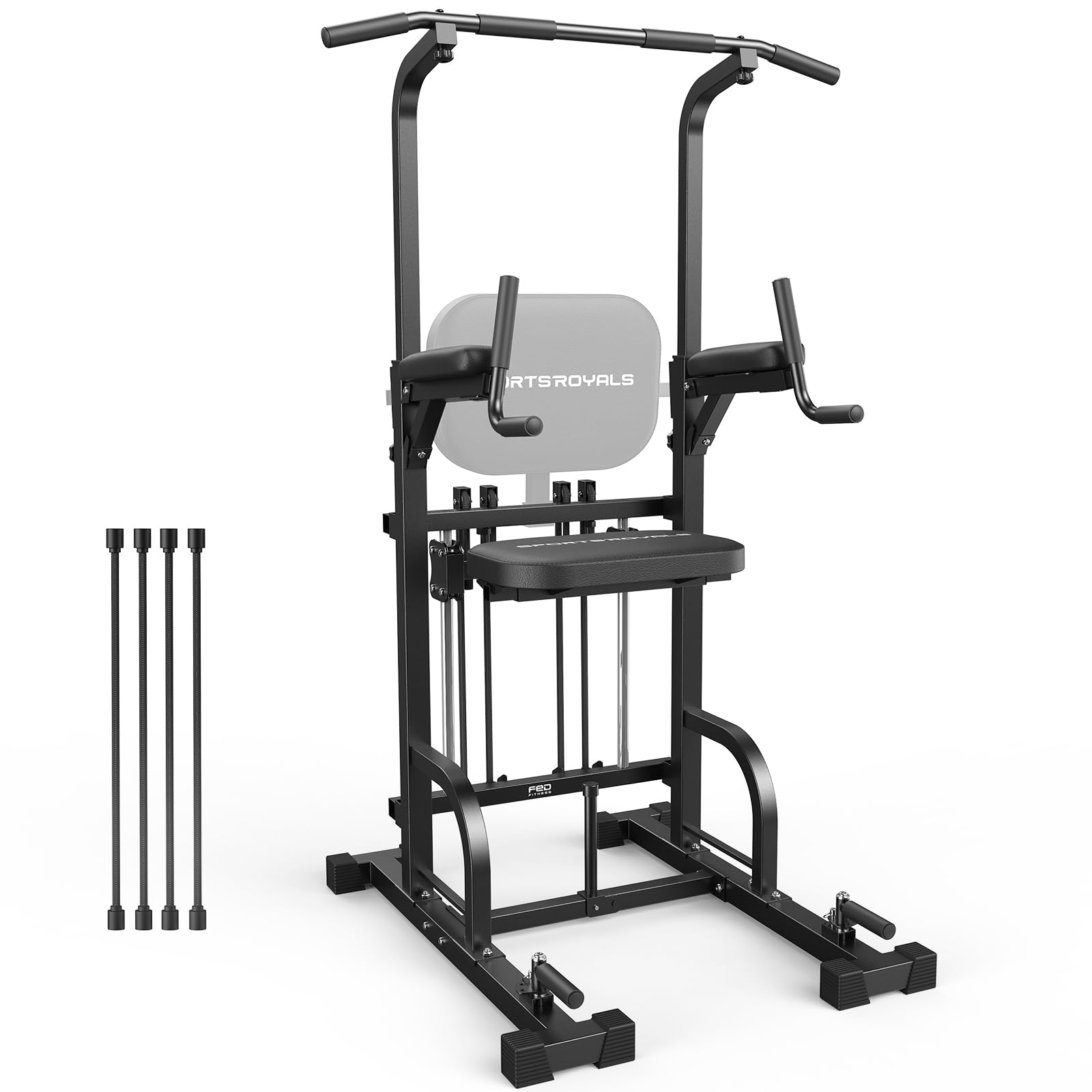
Two assist systems live inside one frame on the Sportsroyals. A high-density sponge assisted pad folds forward to fight your bodyweight during pull-ups, then folds back to become a backrest — one cushion doing double duty. The included resistance band adds 22 lbs to 88 lbs of support, and the broad range is the reason you can start light and dial assistance down as strength builds. A 39.7″ H-shaped base with 8 rubber non-slip support points and a 440 lbs load keeps all of it planted.
Height flexibility is genuinely wide here: 6 levels from 64.56″ to 87.01″, armrests from 15.75″ to 18.11″, and push-up handles that rotate 45 degrees. The ergonomic armrests tilt inward 10 degrees so your elbows do not slide off when you sweat, and the frame uses commercial steel — with the added detail that tubing runs 2mm thick against 1.5mm on lighter towers, a difference a 185-lb user confirms as wobble-free.
Where it can frustrate is the assisted mechanism’s smoothness. Some owners find the assist action jerky and note it does not always return to the top on its own, which matters if you relied on it to reset between reps. The instruction booklet also draws complaints — small diagrams and inconsistent base-assembly advice. Treat the assist as a helpful partner rather than a perfect counterweight.
Cross-check: Sportsroyals offers more adjust points than the KINGKANG, with 6 heights to 87″ against a 83″ ceiling and a broader band range (22-88 lbs) than any fixed pad.
Best for: anyone who wants a single band-and-pad system that can be tuned lighter or heavier as their pull-up strength grows.
Pass if: you need an assist that snaps back smoothly on its own every single time.
6. FLYBIRD Extra Large Power Tower

A 104.5-lb tower rated to 800 lbs, the heaviest frame in this lineup.
FLYBIRD went heavy, and the numbers show it: this XL tower weighs 104.5 lb, with FLYBIRD claiming more than 2× the steel of a typical 47 lb basic tower, and it is rated to 800 lb — the highest load in this lineup by a wide margin, double the 440-450 lb towers elsewhere. The footprint tells the same story: a wider, outward-flaring Π-shaped base plus 4 non-slip feet spread the force of every rep, with extra cross-bracing woven through the frame. On paper and on the floor, this is the one that does not move.
The training menu is broad too. Seated leg raises, pull-ups, dips, inverted rows, push-ups, and ab-crunch variations all sit on one station, and a loadable core station accepts weight plates or resistance bands so you can progressively overload. If you are a bigger user, that 800 lb headroom matters — it means the tower is rated well above bodies many home models cap out on. Abs and core owners tend to notice the seated leg raise position, which supports your body from below so your arms only balance rather than carry your full weight.
Adjustability runs deep: 9 height settings, 4 dip-handle positions, and 12 foot-bar positions fit users up to 6’6″. Two practical quirks: it ships in two boxes that may arrive separately, and the footprint the 104.5 lb heft demands is real. It is a permanent piece, not a folding one — but if you want the strongest frame here, that is the tradeoff.
Best for: heavier and taller users — the 800 lb rating and 6’6″ fit leave margin no other tower here matches.
Not for: anyone short on floor space, since the 104.5 lb build and wide base need room to live permanently.
7. JOROTO Foldable Pull Up Dip Station
A 2mm steel tower that folds to a 41.5″ footprint for closet storage.
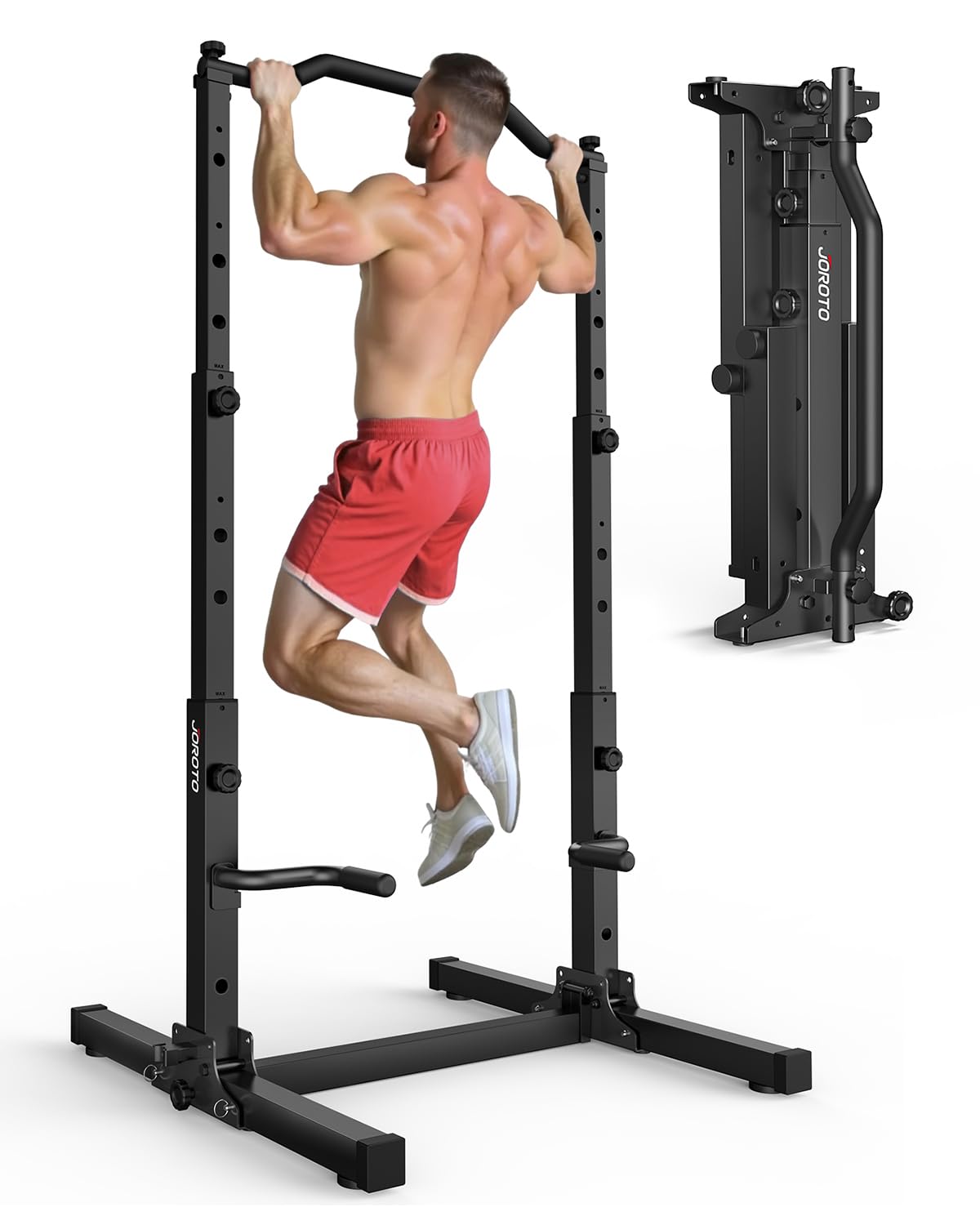
If your “gym” lives in a studio apartment, this is the clever answer. The JOROTO’s collapsible base folds down to a compact 41.5″ footprint — it is made from 2mm heavy-duty steel yet folds and stows for wall or closet storage, and you can even slide it into a car trunk and take it outdoors. It tops out at 450 lbs capacity and covers pull-ups, chin-ups, dips, vertical knee raises, and push-ups, so the compact form still does a full-body menu. Ownership tends to rave about how well it folds and how much space it reclaims.
Height settings are the widest game in this lineup too. The top bar runs 4 height levels from 40.4″ to 82.8″ — the lowest and highest spread here — while the dip bars carry 7 adjustments, plus a built-in kid’s pull-up bar so the tower grows with the family. There are built-in leveling knobs to calibrate the base against an uneven floor.
The catch is the height ceiling for tall users: owners at 6’1″ report bending their knees at the bottom of a full-height pull-up, which is not JOROTO’s fault but worth knowing if you are tall. Assembly and disassembly take real time (the folding frame is also 29.48 kg, so moving it is an effort rather than easy), and a few owners dislike the grip options for muscle-up practice. For its intended buyer, though — anyone with limited floor space — those are minor.
Space-saver verdict: the folding frame, 450 lbs capacity, and 7 dip-bar adjustments fit apartment life better than any permanent tower.
Pick this if: your training area doubles as your living area and you need to reclaim the floor after every session.
Think twice if: you are taller than about 6’0″ — you will be bending your knees at full height.
8. Pull Up Bar Power Tower Cable Machine

A pull-up tower with a built-in 16-position cable pulley for flyes and rows.
The wildcard of the group, and the reason to look past conventional towers. Pooboo built the pull-up bar and a cable pulley system into one frame, so the station handles not just pull-ups and dips but cable flyes and rowing-style cable rows — moves no fixed tower here can claim. The cable section offers 16 height positions and the pull-up backrest adds 4 levels, so users of different sizes switch without the fixed-height frustration. And it all holds a tight 11.65 sq ft footprint, minimizing the floor demand despite the extra gear.
The base is 48.4-in long and X-shaped, spreading force wider than the JOROTO’s foldable frame — a shape meant to keep you steady under cable rows and pull-ups alike. It carries 450 lbs capacity and self-assembles from plastic-sealed labeled parts against an inclusion, with assembly running about an hour. The build is metal throughout and the whole unit weighs 110 pounds, so it is a rooted machine rather than a storable one.
The honest limits: it is the heaviest permanent fixture to install and move, and the fixed rack-style frames it stands alongside do not fold. Assembly wants two people per the instructions. If you want a single station that covers everything from pull-ups to cable rows without buying two machines, this is the pick.
Why the cable machine changes the math
- Combined pull-up bar and cable pulley system in one frame
- 16 cable height positions plus 4 pull-up backrest levels
- Just 11.65 sq ft footprint — highly space efficient
- 48.4-in X-shaped base spreads the load wider than standard bases
What it demands
- 110 lbs and no folding parts make it a stationary install
- Assembly needs two people and about an hour of work
Best for: anyone whose home gym needs both pull-ups and cable-based back and shoulder training in one frame.
Not for: renters or anyone who has to move equipment regularly — at 110 lbs it stays put.
Know the Specs
Assist type
The assist mechanism is how the tower helps you up. A pneumatic rod, like KINGKANG’s 70 lbs auxiliary function, physically lifts part of your bodyweight — best for a beginner who cannot yet do a rep. A resistance band, like the Sportsroyals’ 22 to 88 lbs band, stretches less as you rise and forces you to add your own strength sooner. A folding sponge pad, like the Sportsroyals’ 2-in-1 design, is the simplest assist and needs the least maintenance.
Max load rating
The rated capacity is the total weight the frame is tested to hold, and it is a proxy for how much margin the steel has. Ratings here run from 440 lbs to 800 lbs, and a higher number usually means thicker tubing and a heavier unit — but only if the base is wide enough to use that capacity. A 660 lb rating on a narrow base can still feel shaky without anchoring.
Tubing and steel gauge
Steel thickness, measured in millimeters, decides how much a frame flexes under load. The towers here range from 1.5mm to 2mm tubing, with 2mm frames like the Sportsroyals and JOROTO staying rigid where thinner steel shivers — especially under a heavier user. Thicker steel almost always means a heavier unit weight, which is a sign of a substantial frame rather than a marketing number.
Height range and footprint
These are the two measurements that decide whether a tower fits your room and your body. The top-bar range stretches from 40.4″ up to 87″ depending on the model, and a low ceiling forces taller users to bend their knees. Base width and depth come as a matched pair with that range — the widest here is the Pooboo 41.49″ by 43.5″, the narrowest the JOROTO at 41″ deep when folded flat.
Common Questions
What is an assisted pull up machine and how does it help a beginner?
How much weight can these power towers actually hold?
Will a free standing pull up bar fit under a normal ceiling?
Is a folding power tower as stable as a fixed one?
What is the difference between a resistance band assist and a pneumatic assist?
Can two people share one of these assisted pull up machines?
How long does assembly usually take on these stations?
Do I need to anchor a power tower to keep it from moving?
Does a power tower with a cable machine replace two separate machines?
What steel thickness should I look for in a home power tower?
The Bottom Line
For most homes, the assisted pull up machine that earns its spot is the XMARK Commercial VKR because its commercial steel frame, double-stitched cushions, and lifetime warranty make it the sturdiest long-term core and dip investment here — the crowd favorite at 4.5+ stars across 500+ owners. If your goal is getting your first assisted pull-up with mechanical help, reach for the KINGKANG Assistive Power Tower and its 70 lbs pneumatic lift. And when one frame has to cover pull-ups and cable rows in a small space, the Pooboo Cable Machine Tower is the one to reach for.
How we choose
We do not accept paid placement. Every pick is matched to a real buyer and a real use-case; we do not hands-on test units.
Sources
Specifications: manufacturer listings and product documentation. Review insights: verified customer reviews, as of October 2026. Pricing: not shown on this page (it changes often); check the current price via the retailer link.
As an Amazon Associate, Aappliancez earns from qualifying purchases. This does not affect which products we feature.