Disclosure: Some links in this post are affiliate links. As an Amazon Associate I earn from qualifying purchases, at no extra cost to you. Learn more
Specs are compiled from manufacturer listings and verified buyer reviews and can change over time — please confirm the key details on the product page before buying.
The quick answer: the HyeFlora hanging daisy basket is the safest first buy for most porches, because it arrives assembled enough to look full and the silk blooms hold their color through hot sun. If you want a pair of matching floor pieces instead, the Grooy cedar balls or the Aokiie boxwood trees are the two you should weigh against each other, and the Boston ferns lower down are for anyone who wants a big, draping green shape by the front door.
This guide is built by comparing the manufacturers’ published specifications and the patterns across verified customer reviews, so you get each pick’s real strengths and trade-offs instead of marketing spin.
Below you will find the sun-fade and salt-air details that decide whether a fake shrub survives a second summer. Here is how to spend wisely on the best artificial plants for outdoors.
Top Picks


How To Choose The Best Artificial Plants for Outdoors
The trouble with buying fake greenery for a porch is that the photo shows a perfect, sunny, magazine porch and your porch is a wind tunnel with an hour of direct afternoon sun and a downspout dribbling on the corner of the planter. You need to match three things to your own space: how much sun the spot actually gets, how much wind hits it, and how much lifting you are willing to do.
Sun and fade resistance come first
Ultraviolet light is what bleaches a fake leaf. Look for the words “UV resistant” or “fade resistant” spelled out in the listing, then understand that this is a treatment, not a guarantee. Silk daisies in a hanging basket behave differently from dense polyethylene topiary in full sun. A shaded covered porch is the easiest home for any of these. A sizzling south-facing stoop is the hardest, and you should expect color to soften over seasons no matter what the label says.
Wind, weight, and the tip-over problem
A fake tree is mostly air and plastic, which means it will catch a gust and go over if the base is light. The taller the piece, the more the planter matters. Two of the picks here deal with this head-on: one uses a water-fillable ballast bag inside a hollow planter, and another ships with a sturdy pot the maker specifically contrasts against flimsier ones. For a hanging basket, chains matter too, because the hanging point is the only thing holding the whole arrangement up.
How much fluffing you are signing up for
Almost every one of these arrives compressed in a box, so branches and fronds need pulling outward and shaping. A few minutes is normal. Some pieces need a systematic pass to avoid bare gaps, and one fern here needs a little patience with a spray of 96 fronds. Fluffing is not a defect, it is part of the assembly, and knowing that up front saves a lot of disappointment.
Scale: measure your doorway before you fall for the photo
Faux greenery is judged by how it sits against a door frame or in a planter, so height and spread matter more than any other number. A 3.5ft tree beside a standard door reads as a balanced accent. A 4ft tree reads as a sentry. A basket that spreads to 50 inches needs a wide porch, not a narrow step. Measure the gap you want to fill and buy to that measurement, not to the styling in the picture.
Side-by-Side Comparison
| Model | Best For | Stated Height | Items Included | Material | Amazon |
|---|---|---|---|---|---|
| HyeFlora Hanging Daisy Basket★ Best Overall | Covered porch hooks and railings | 19″ overall | 1 basket | Silk | Amazon |
| Grooy Cedar Topiary BallsTop Performer | Planter boxes beside a sunny door | 24″ | 2 trees | Plastic (PE) | Amazon |
| Aokiie Boxwood Topiary Trees | Step planters and walkway accents | 23.9″ | 2 trees | Plastic (PE) | Amazon |
| FOREST PRINCE Boston Fern | Big draping shape in a ground pot | 26″ | 1 bundle, 96 fronds | Silk | Amazon |
| Dkaltm Boston Fern | Porch and sunroom colour | 26″ | 1 bush, 95 branches | Silk | Amazon |
| Mavis’s Diary 4ft Cedar Set | Front doors that need symmetry | 48″ | 2 trees with planters | Plastic, Polyethylene | Amazon |
| colorspec 3.5ft Boxwood Set | Decorating for holidays and events | 42″ | 2 trees with pots | Polyethylene | Amazon |
Detailed Reviews
1. HyeFlora Artificial Faux Hanging Plants Flowers Basket
Our pick — 4.5+★ from 1,000+ verified ratings; the strongest balance of quality and price.
The hanging basket that turns a bare porch hook into a full, colourful daisy display.
Start with what you actually hang it from. The arrangement measures 15.7″ x 15.7″ x 19″ (length, width, height) once assembled, and the white basket underneath it is 12″ x 12″ x 5.9″, so the basket is close to a foot across and reads as a proper planter rather than a tiny decorative cup. The chain runs 13.78 inches, which matters because a short chain keeps the flowers up near the hook where they are easy to reach, but gives you less drop than a deeper basket. For a typical porch hook at eye level, that is about right.
The blooms are silk, and the listing spells out UV and fade resistance — the spec that decides whether a hanging basket survives a sunlit porch. What wins people over here is the look. Neighbours and passers-by treat these as real flowers, and the basket survives the ordinary domestic grilling of heavy rain, hot sun, and a season’s worth of weather without washing out. Owners who hang three along one porch rail report the daisy color holding through a southern summer. Silk also means the petals move in wind, so the arrangement does not sit there stiff like plastic.
Assembly is the honest part. You get a basket, foam, and a generous bundle of stems, and you push them in yourself. Expect roughly half an hour on the first one while you figure out how the chain should sit so the basket hangs level rather than tilted. The foam and stems give you enough material to build a full shape, but the arrangement is only as full as the effort you put in. If you want something you can unbox and hook up in ninety seconds, this is not that.
What earns it the top spot
- Silk daisy blooms that keep their color through a full summer of sun and rain.
- Basket, foam, and stems included, so the whole arrangement comes in one box.
- 13.78-inch chain and 12″ x 12″ basket give it a real hanging presence.
- No watering, which is the whole point of a porch that gets forgotten on busy weeks.
The parts you have to work for
- You build the arrangement yourself, and chain alignment has to be fiddly to avoid a lean.
- Stems need firming up separately, and the front-row petals on a silk piece are the first to loosen.
Reach for this if: you have hooks, railing brackets, or a porch beam and want instant color without a planter.
Look elsewhere if: you want zero assembly or a piece that needs no chain balancing at all.
2. Grooy Cedar Topiary Ball Trees
Two matching cedar balls with ground spikes, built to fill planter boxes that keep killing real plants.
The pair measures 16″D x 16″W x 24″H, and those extra inches over the 19-inch HyeFlora basket are the difference between a hanging accent and a floor-standing shape. You get two of them, each with a black ground spike, so you can either drop the spike into soil or stand the ball inside a planter. The material is polyethylene (a dense, hard-wearing plastic), which is why these hold their form better than silk in weather.
Buyers with full-sun planter boxes that had been killing every living thing they planted are the ones who love these most. The cedar look is believable enough that people walk past and assume they are growing. Straight from the start they look compressed, but a few minutes of pulling the branches outward restores the shape, and the leaves and stems are flexible enough to straighten without cracking.
There is a real catch on longevity. The listing promises fade and damage resistance, but buyer reports on these cedar balls split both ways. Some cedar balls last a summer and beyond; others shed pieces and fade in partial sun within a month. Size is the other honest note: several owners find the balls slimmer than the advertising photos suggest, and one described them as looking better at night with fairy lights added than under direct daytime scrutiny. Treat them as a strong sunny-porch choice with a durability question hanging over the second season.
Best use case: two identical balls beside a door or in built-in step planters where you want symmetry without the fuss of two different designs.
What to plan for: heavy enough to need gravel in the pot for indoor use, so buy a planter with some weight to it rather than a hollow decorative one.
The smart buy: a matching pair with spikes for anyone replacing dead planter-box shrubs.
The trade-off: durability and fullness vary unit to unit, so treat this as a seasonal piece rather than a decade-long install.
3. 24″ Artificial Eucalyptus Tree

A two-pack of rose boxwood trees that stand tall in a pot and shrug off rain.
These stand 24″ tall, made up of 17.3 inches of leaves and stem on top of a 6.7-inch spike, and they weigh 3.5 pounds each, so they have enough heft to sit in a pot without wobbling. The dimensions land at 17.7″D x 17.7″W x 23.9″H. The leaves are 100% new polyethylene, which the listing says resists rain, sun, and UV without decay or a chemical smell — worth knowing beside a doorway or play area. They arrive as two separate packs, so you can place one either side of a step.
Quality is what people talk about most with these, followed closely by how real they look, and the compliment count in the reviews backs that up. They get mistaken for live boxwood, and they hold their color rather than bleaching. For a sunny built-in step planter where real plants fried, these have been the replacement that finally worked. Installation is simple: push the spike in, fluff the ball, and done. A little shaping at unboxing is what makes them look thick rather than thin, and the fluffing is straightforward.
Two honest notes. Some owners find the trees noticeably smaller than the picture implied, so measure your pot’s opening and the height you want before ordering. And the purple flower detail has a known habit of dropping a few petals during the first fluff — it is cosmetic, but if a tidy walkway matters to you, shake them out over a bin before placing them.
The selling point: 3.5 pounds of PE boxwood per tree, which is what keeps them stable in a planter and believable at a doorway.
Who this suits: anyone dressing two sides of a walkway or step who wants matched pairs and does not mind a short fluff session.
Worth grabbing: the two-pack for a symmetrical front-step look, since you get both trees in one purchase.
Check first: the finished height against your doorway, because these read as medium-size accents rather than tall sentinels.
4. FOREST PRINCE 50″ Artificial Boston Ferns
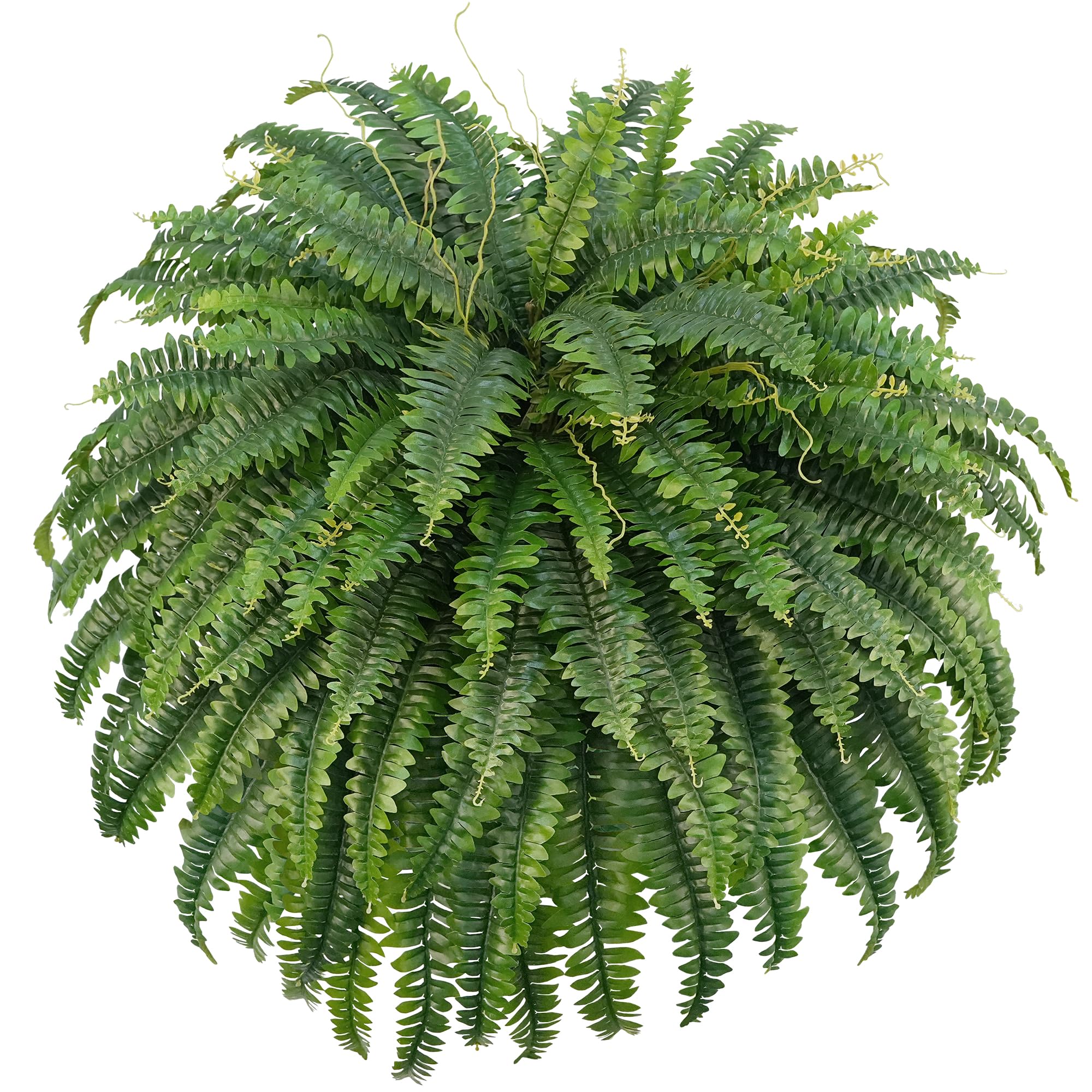
The fern that arrives bigger than you expected and passes for a real one by the front door.
This is a single bundle, 26 inches tall, with 96 fronds and large leaves reaching up to 22.44 inches. Spread out from the middle, the bouquet reaches 50 inches across, which is the number that decides where it goes. That is a wide, drooping shape, so it wants a big ground pot by a doorway rather than a small wall bracket. The leaves are a mix of silk and plastic, and the listing says the whole thing is UV resistant and washable, which means a wipe or a rinse is all the upkeep it needs.
Realism is the thing that sells these, and it is what owners talk about most. These fern fronds fill a pot properly, hold a natural green, and come through repeated rain storms without looking beaten down. Someone replacing real ferns that needed buying again every year called this the direct swap that ended the cycle. For a front-door pot or a hanging planter, it draws the compliments.
The one thing to know before you buy is that the fake new-growth shoots are the giveaway — they read as plastic up close, so trim them away if you are fussy about close inspection. Size is also slightly variable, with some arriving a little smaller than the listing implies. Indoors it is a harder sell than out on a porch where nobody is nose-to-frond with it.
Why it earns its place
- 96 fronds and a 50-inch spread give it real visual weight in a pot.
- Silk and plastic mix holds color and survives rain storms.
- No styling needed at setup beyond a quick fluff.
What to watch for
- The plastic new-growth shoots are obvious up close and worth trimming.
- Actual size can come in under the listed spread.
Best fit: a wide front-step pot or a large hanging planter that needs a full, low, draping shape.
Second thought: if you plan to bring it inside, the plastic shoots will bother you more than they do outdoors.
5. Dkaltm 49″ Artificial Boston Fern, Outdoor Faux Plant

A 95-branch silk fern that goes from box to planter in a little over ten minutes.
The shape is the pitch here: 26 inches tall with 95 branches, spreading to a 49-inch diameter when you open it out from the middle, and it weighs in at 1.8 pounds. Compare that to the FOREST PRINCE above and the math is close — 95 branches versus 96 fronds, 49 inches versus 50 — so the real decision is which one’s look you prefer, not which is bigger. This one does not include a planter, so budget for one.
What people rave about is how convincing it looks. The fronds have a varied, deep green with subtle brown tips that read as real growth, and the wire inside each frond lets you bend and shape them where you want. Once shaped, the wired fronds hold their arch through a Florida summer and a full season on a front porch. The listing gives it ten minutes of shaping, more if you are particular.
The catch is stability. It is top-heavy once the fronds spread, and one owner found the spread landed nearer 35-36 inches than the claimed 49, so it wants a firm planter and a bit of potting weight in the base. Put it in a proper pot and it stays put; stand it loose inside a light pot and a gust will lay it flat.
Look and feel: silk fronds with a wired spine, so you shape the arch and it holds rather than falling back into the box shape.
Setup reality: ten minutes of arranging and a pot with weight are the two things that separate a great result from an average one.
Worth the spot: a heavy, wide planter on a porch where you want a dramatic single fern.
Think twice: if you want to move it around often, because the top-heavy shape punishes a light pot.
6. Artificial Cedar Trees 4ft 2-Pack

The 4ft cedar pair that thinks about wind before you do, with water ballast built in.
Here is the differentiator: each tree comes in a 16.14-inch tall, 8.66-inch square black tapered planter, and that planter uses a square support lid to hold a cement inner pot above the base. You can add 5.5 pounds with the transparent 2.5L water bag, plus optional sand or gravel, for up to 15 pounds of low-set ballast. That is a deliberate answer to the tip-over problem that plagues lighter faux trees. The full tree stands 48 inches tall and weighs 16.5 pounds.
The cedar detail is where these earn their keep. The listing cites 0.2mm precision leaf veins, a three-layer natural green gradient, and a textured cedar-inspired trunk, and the result is believable enough that people stop and assume they are evergreens. The foliage is UV resistant and rated for a range from -20°F to 120°F, which is the claim to hold onto if you get real winters. Setup is three to five minutes: unpack, fluff, place. No tools.
Now the honesty. Size and fullness are mixed — some find them tall enough, others find them not as dense as the pictures, and the planter itself is the weak link, being light plastic that can tip or arrive with a crooked tree set in it. Branches are more fragile than expected and can shed when handled roughly. The box is heavy, so returns are a hassle. None of that stops the look from working; it just means you should treat the included planter as a shell and consider weighing the base.
The clever engineering
- Up to 15 pounds of ballast via the included water bag plus optional sand or gravel.
- Rated from -20°F to 120°F, so the color claim covers real cold snaps.
- 48-inch height and 16.5-pound weight give each tree presence at a doorway.
- Three to five minute setup with no tools.
Honest limits
- Fullness varies, and the included planter is light plastic rather than a hardy pot.
- Branches are fragile, and the heavy box makes a return a chore.
Go for it: on a windy, exposed front step where symmetry and wind-proofing both matter.
Plan around: the flimsy planter — swapping in a heavier one or adding sand is the obvious fix.
7. 3.5ft Topiary Trees Artificial Outdoor Set of 2

The boxwood pair you can decorate for Christmas, a wedding, or just a quiet front step.
These come in at 3.5ft, 42 inches tall and 42 inches across the listed dimensions, at 15 pounds for the set. The maker’s clear selling point is the pot — a sturdy, beautiful pot that the listing contrasts directly against flimsier ones that fall over. That is the right priority for an outdoor set, because a light pot plus a tall tree equals a fallen tree. Polyethylene foliage keeps the color green year-round, and there is no watering, mowing, or upkeep.
The versatility is real. This is the one on the list designed to be dressed up: ribbon for a party or wedding, bells and stars for Christmas, and the maker markets it for whichever occasion you have in mind. Because it is plain boxwood, you can style it yourself rather than living with a pre-made seasonal look.
The reviews on this one are rougher than the rest of the list, and the honest read is that quality control varies. The recurring themes are trees arriving with a flattened top, bent or broken limbs, and pots that rattle or go unstable. A few owners found theirs too light for a breezy spot. New stock is much safer than a pre-owned return, and if yours arrives bent, the branches do straighten with some patience. The durability story, in short, is the weak spot — not the look.
What it does well: a decoratable 42-inch boxwood pair with a pot the maker stands behind as sturdier than the flimsy standard.
What to check on arrival: open the box the day it lands and check the top shaping and the pot’s footing before you put it on a visible step.
Pick it for: seasonal styling and a pair you can dress up differently each year.
Weigh the risk: this set has more misses than the others, so inspect it promptly and be ready to use the return window.
Know the Specs
Silk Versus Polyethylene (PE)
Silk is fabric, and it behaves like fabric: soft, colorful, and able to move in a breeze, so it makes flowers and fern fronds look alive. It is the material to choose for a hanging basket or a fern you want to drape. Polyethylene is a dense plastic, and it holds a fixed shape better, which is why boxwood and cedar topiary use it. For a sunny, windy porch where shape matters, PE wins. For color and softness, silk wins.
What “UV Resistant” Really Means
The label means the makers added a treatment that slows ultraviolet damage. It does not mean the color is guaranteed for years. A shaded porch is easy on any of these. A hard sun-facing spot will eventually soften the color, and the honest way to read the label is “resists fading,” not “will never fade.” If sun is relentless, planters with dense foliage and a matte finish tend to hide softening better than bright daisy petals.
Ballast, Spikes, and Keeping It Upright
A fake tree is mostly air, so the base does the work. Spikes are for planting directly into soil. Pots are for standing on a step, and a pot needs weight — sand, gravel, or a water-fillable ballast bag. A tall, light tree on an exposed step will go over in the first real gust; a weighted one will not. This is the single most overlooked spec in the category, and it costs a few dollars to fix.
Common Questions
Will silk hanging flowers fade in direct afternoon sun?
Do I need rocks or sand in the pot for a faux topiary tree?
How long does it take to assemble a fake fern or flower basket?
Can I leave artificial plants outdoors all winter?
Why do some topiary trees arrive flat or sparse?
How much sun can polyethylene boxwood take?
Do faux plants attract bees or insects?
Can I hang a faux fern basket from a porch ceiling hook?
How do I clean an outdoor artificial plant?
Is a 4ft faux cedar better than a 3.5ft topiary for a front door?
The Bottom Line
For most porches, the winner is the HyeFlora hanging daisy basket because it gives you color and fullness on a hook with no watering and proven summer-sun resistance. If you would rather dress two sides of a doorway, grab the Aokiie boxwood set for a heavier, stable pair. And for a big draping fern by the front door, the Dkaltm 49-inch fern is the one to reach for. The real nudge: start with the piece that fits the spot you already have — a hook, a pot, or a step — because the wrong size on the wrong porch is what makes buyers regret a faux plant more than the plant itself.
How we choose
We do not accept paid placement. Every pick is matched to a real buyer and a real use-case; we do not hands-on test units.
Sources
Specifications: manufacturer listings and product documentation. Review insights: verified customer reviews, as of October 2026. Pricing: not shown on this page (it changes often); check the current price via the retailer link.
As an Amazon Associate, Aappliancez earns from qualifying purchases. This does not affect which products we feature.