Disclosure: Some links in this post are affiliate links. As an Amazon Associate I earn from qualifying purchases, at no extra cost to you. Learn more
Specs are compiled from manufacturer listings and verified buyer reviews and can change over time — please confirm the key details on the product page before buying.
If you keep asking people to repeat themselves at dinner, or you turn the TV up until the whole house complains, an over-the-counter neckband device is a simpler first step than a specialist visit. A neckband hearing device solves the biggest annoyance of tiny in-ear aids: you can’t lose something that hangs around your neck. The list below covers eight rechargeable neckband and behind-the-ear options, sorted so the strongest all-rounder sits first and the pricier models come later.
This guide is built by comparing the manufacturers’ published specifications and the patterns across verified customer reviews, so you get each pick’s real strengths and trade-offs instead of marketing spin.
You’ll see where a device streams TV sound straight from a remote microphone, where Bluetooth calls come in, and where a plain rechargeable pair simply amplifies voices better. Every pick here is over-the-counter, so no prescription is needed — the real question is which one matches your hearing loss. Here is my working shortlist of the best around the neck hearing aids.
Top Picks


How To Choose The Best Around the Neck Hearing Aids
The first thing to understand is that these devices are not all the same animal. Some hang a speaker-free band around your neck with earbuds on wires, and some drop a small amp behind each ear with a lanyard to catch it. A neckband suits someone who misplaces small objects; a behind-the-ear pair suits someone who wants a discreet fit and will use the lanyard.
Neckband versus behind-the-ear
A neckband sits on your shoulders and pushes sound into earbuds, so nothing touches the inside of your ear canal for long stretches. That helps if your ears get sore or itchy from in-ear tips. It also means you can drop the band on a table and find it instantly. A behind-the-ear pair sits lighter on the head and hides more discreetly, but each unit is small enough to misplace — which is why the models that include an anti-lost lanyard matter more than they sound.
How much amplification you actually need
Amplification is measured in decibels, written dB. That number tells you how much louder the device can push sound, and it decides whether the unit fits mild or moderate hearing loss. A device rated up to 50dB with noise cancellation covers mild to moderate loss, while a plain amplifier with no stated dB figure suits mild loss only. If a friend with mild loss says a cheap amplifier worked fine, that doesn’t mean it will work for a family member with steeper loss.
Where the microphone sits changes everything
The biggest complaint about any hearing device is background noise. A device with a wireless remote microphone lets you place that mic near the person talking or next to the TV speaker, so the sound arrives clean instead of picking up the fridge hum. Range matters here: one model in this list reaches up to 60 feet, while another reaches about 20 yards. If you mostly struggle with TV, a remote mic you can set by the speaker beats every other feature here.
Charging and running hours
Rechargeable units save you from hunting for button batteries, but the numbers vary widely. Some run around 20 hours per charge, some closer to 29, and one advertises up to 50. Then there’s the charging case: a case that holds several extra charges means a week of use without finding an outlet. Check both numbers, because “hours of use” and “hours of backup” are not the same thing.
Side-by-Side Comparison
| Model | Best For | Stated Run Time | Wireless Remote Mic | Bluetooth | Amazon |
|---|---|---|---|---|---|
| Nova Hearing Aids (iBstone)★ Best Overall | First-time users who want an anti-lost lanyard | 100 hrs working per stated 1.5-hr charge | — | — | Amazon |
| Flaygo RechargeableMost Discreet | Discreet in-canal wear with a charging case | Up to 16 hrs per charge; case 110+ hrs | — | — | Amazon |
| MEDca Neckband BluetoothBluetooth Bargain | TV and phone streaming on a neckband | Up to 45 hrs standby | — | Yes | Amazon |
| CEMHO Neckband 4-Mode | Scene modes plus Bluetooth in one band | More than 29 hrs hearing time | — | Yes | Amazon |
| Neosonic NW10 Pro | Moving room to room with a remote mic | Up to 50 hrs per charge | Yes, up to 20 yards | — | Amazon |
| Neosonic NW20 | Separate left and right volume control | 20 hrs per charge (mic 10 hrs) | Yes, up to 60 feet | — | Amazon |
| Vivtone Lucid508 | The 94-year-old who needs auto on/off | 25 hrs; case adds 125 hrs backup | — | — | Amazon |
| ELEHEAR Beyond | App control and 50dB amplification | 20 hrs per charge; 100 hrs with case | — | Yes, app control | Amazon |
Detailed Reviews
1. Nova Hearing Aids for Seniors Adults (iBstone)
The lanyard-and-case combo that keeps a small aid findable in a house full of cushions.
Nova’s pitch is built around one number pair: a 1.5-hour fast charge that carries you to 100 hours of working time, plus a drying case that pulls moisture out of the aids while they sit. For you, that means a nightly routine where the aids go in the case, come out dry, and never need a fresh pack of button cells. The maker also claims an 80% reduction in background noise, the figure that decides whether a spouse’s voice or the air conditioner wins.
What wins people over is build quality — the charger and the aids themselves feel solidly made, and the documentation that arrives with them is unusually thorough. Sound clarity is the runner-up strength, and feedback control is the specific thing buyers keep mentioning. As owners put it: “I’ve had ones from an audiologist and these comparatively are much better performing with less feedback!” The raised button is a small but real touch, because it resists the accidental volume taps that plague flush controls.
Here is the catch you should weigh. The seller is upfront that these are amplifiers rather than full hearing aids, and the noise-reduction chip is the weakest link — TV sound can dip when appliances kick on, and the three modes don’t shift the sound much. Volume also cycles rather than jumping straight to a level, so dialing in your setting takes a few presses. The soft pull cords and the nine pairs of tips mean most people can find a no-whistle fit, but it takes patience with the dome sizes.
Where it earns its keep
- Anti-lost lanyard plus a drying case — a small aid that is hard to misplace and comes out moisture-free
- 1.5-hour charge for a stated 100 hours of working time, so charging is a quick weekly chore
- Nine pairs of soft tips give most ear shapes a path to a fit without whistling
- Raised control button cuts down the accidental volume changes common on flush designs
Where it asks for patience
- The maker classifies it as an amplifier, not a full hearing aid — set expectations there
- Noise reduction struggles when appliances clash with TV audio, and the three modes sound similar
- Cycling through volume steps rather than jumping to a preset gets tedious
The right first step: Buy it if you want an affordable, well-built amplifier with a lanyard and a moisture-drying case, and you mostly need louder, clearer voices at home.
The honest limit: If your loss is steep or you need real noise suppression in a busy restaurant, the amplifier design will fall short of a dedicated aid.
2. Flaygo Rechargeable Hearing Aid with 16-Channel Chips
Sixteen-channel processing crammed into a shell that sits deep enough to disappear.
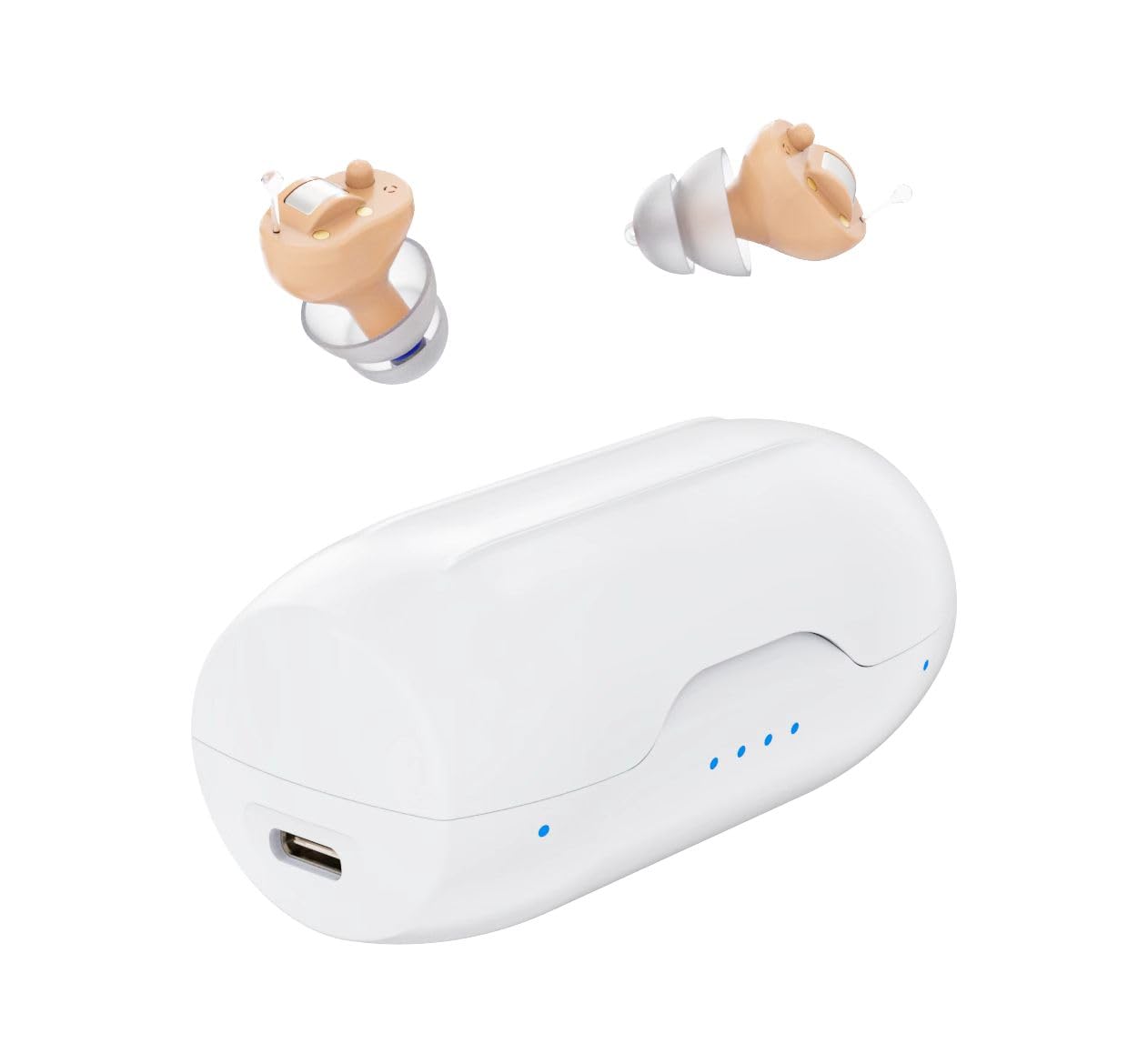
Flaygo leads with the wearer’s biggest social worry: being noticed. These sit deep in the ear canal, so they’re barely visible, and the ergonomic curve is shaped to follow the canal itself. The 16-channel digital chip is the engine behind the sound — more channels means the chip can treat separate slices of the frequency range differently, which is why speech comes through cleanly while rumble gets pushed down. A single charge runs up to 16 hours and takes 1-2 hours to top up, and the case holds 110+ hours of use on its own, which covers up to 7 days away from an outlet.
Where the Flaygo earns its keep is the automatic behavior. The aids switch on 15 seconds after you seat them properly and switch off when removed, so there’s no fumbling for a tiny switch. The chip does the noise-reduction work without you picking a mode, which matters for anyone who doesn’t want to learn a menu. As buyers report: “Wife’s left-ear loss: big-brand quoted –4000/ear; Flaygo arrived in 3 days.” After tip fitting, the adjustable sound was clear enough that shouting stopped.
The catch is fit, and it’s the thing to think hard about. These are among the smallest aids on the market, which is wonderful for discretion and unforgiving on ear canals that run narrow or oddly shaped. Small silicone tips can leave some wearers sore after hours, and one complaint centers on the volume wheel sitting right on the outside of the shell — push the aid in, and you turn it up. If your ear canals are on the small side, plan on experimenting with the supplied tips before you judge the sound.
What the fit demands: The smallest-in-class shell is a genuine advantage for anyone self-conscious about wearing an aid, and the automatic on/off plus the case’s 110+ hours make daily use nearly hands-free. Budget time for tip-swapping, because the same compactness that hides the aid also makes a loose fit obvious.
Reach for this if: You want the least visible option on the list and you’re willing to test a few tip sizes to lock in a firm seal.
Look elsewhere if: Your ear canals are small or your fingers are arthritic — a neckband with a big control frees you from both problems.
3. MEDca Rechargeable Bluetooth Neckband Hearing Amplifier
A soft neckband that streams the TV and takes calls, with three buttons and nothing else to learn.
The MEDca solves the problem nobody talks about with in-ear amplifiers: losing one. The band rests on your shoulders with the earbuds clipped together to stop tangling, so the whole thing sits where you left it and comes back on in one motion. Bluetooth connectivity is the real draw — pair it with your TV, phone, or tablet and the audio streams hands-free, which turns a hearing amplifier into something closer to a pair of wireless headphones. A 2-hour charge covers up to 45 hours of standby, and a digital LED display shows you the battery level so you aren’t guessing.
Operation is refreshingly simple. There are only three controls: plus and minus for volume, and a caret button to change modes, with Bluetooth pairing handled once. The noise-reduction function targets crowded rooms like restaurants and busy outdoor spaces. Earbuds in three sizes ship in the box, along with ear wings for a firmer hold and a cleaning tool, so you can experiment until the fit settles. The band itself is soft and flexible, which is why the hard-of-hearing relatives in the reviews took to it quickly.
The trade-off is honest and specific: the band is bulky compared to a bare pair of earbuds. One user found the mic picks up clothing rustle when it rubs against a collar, and the audio has a slightly reverb-heavy quality that not everyone tolerates. A buyer also found their unit shipped with a single right microphone rather than true stereo, which is worth checking on arrival. The Bluetooth does work with modern phones — one owner paired it cleanly to a Galaxy S23 Ultra — but treat the streaming as a bonus rather than a hi-fi experience.
Best for: Anyone who wants TV and phone audio piped straight through a device that never goes missing, with almost no learning curve.
Think twice if: You dislike anything heavy around your neck or you need stereo-quality music playback rather than clear voices.
4. CEMHO Neckband Hearing Aid with Bluetooth and 4 Scene Modes

Three microphones pick up sound from every direction while the band keeps it all on your shoulders.
The CEMHO packs an omnidirectional pickup — three built-in microphones working together to catch sound around you — inside a soft neckband. That matters because a single forward-facing mic loses whoever is speaking at your side. You get more than 29 hours of hearing time on a 2-3 hour charge, and the band doubles as a Bluetooth earphone for calls and music. Four scene modes let you pick a setting for a quiet room, a crowd, or the TV, all from the same set of controls.
Owners who compare it against pricier hardware come away surprised. The engineering and adjustability hold up against aids costing many times more, clarity stays clean at the volume levels people actually use, and the unit shrugs off drops. There’s an easy on/off switch for loud environments like motorcycles and power tools, which is the kind of practical touch you only appreciate after you have needed it. Soft, skin-friendly ear domes ship in multiple sizes, so most wearers find a comfortable pair without a struggle.
Two weak points are worth knowing about. The magnetic charging disk is the recurring sore spot — it’s proprietary and the included cord is short, which is awkward for anyone with limited mobility. Call answering also takes practice: you tap to switch into Bluetooth before a second press takes the call. And the volume ceiling is modest; if your loss is significant, this device amplifies rather than restores. It’s a comfortable, well-built companion for mild to moderate loss, not a replacement for a tuned aid.
What you actually gain
- Three microphones pick up sound from all directions, so the person at your side gets heard too
- More than 29 hours of hearing time per 2-3 hour charge covers several days of casual use
- Four scene modes plus Bluetooth calls and music, all on one band
- Soft neckband and multiple dome sizes make all-day wear comfortable
What to plan around
- The magnetic charging disk is proprietary and the cord is short
- Answering a call requires two taps — one to switch modes, one to answer
- Volume tops out early, so steeper hearing loss will want more gain
It suits: Someone who wants one band for the TV, the phone, and a chat at the kitchen table, with comfort that holds up over a long day.
It won’t suit: Anyone who needs high gain or a charging cable long enough to reach across a bedside table without an extension.
5. Neosonic NW10 Pro Neckband Hearing Amplifier

The one that lets you put the microphone on the table and leave the TV whisper-quiet.
Neosonic’s party piece is a separate wireless microphone you can set down near the speaker, up to 20 yards away. That single design choice changes how a hearing device works in practice: instead of amplifying the whole room, you amplify the one voice or speaker you care about. The neckband unit itself runs up to 50 hours per charge and the remote mic lasts 10 hours per charge, so a full day out is covered with headroom. Both pieces recharge, so there’s no battery drawer to maintain.
Effectiveness is what wins people over, and it’s the number that dominates the feedback. Owners compare it favorably to dedicated hearing aids for clarity, and the remote mic is the feature most often singled out. One user who tried five TV amplifiers rated this the best for sound and convenience, carrying the mic between televisions and setting it near any speaker. Someone else reported it handled their conductive hearing loss where far pricier aids had failed. That kind of praise comes from owners comparing it against aids costing far more, not from the spec sheet.
The catch is durability and fit consistency. A few units have failed early or lost their earbud grip, and magnetic earbuds can feel loosely secured with slack in the wire. The mic-based design also means it suits a soundbar without an aux output rather than every setup, and the remote mic has been known to pick up room chatter along with the target voice. Treat the 50-hour claim as reachable when you’re not streaming constantly, and you’ll be pleased rather than disappointed.
Where it shines: The remote mic is genuinely the most useful item on this list for TV watching — set it by the speaker, let the wearer keep volume low, and move it between rooms without rewiring anything. The up-to-20-yard range means you can be across the living room and still catch every word.
Where it stumbles: Early failures and loose earbud seating recur in the feedback, and the mic can grab background chatter when the room is busy.
Buy if: TV and conversation in a shared room are the main problem, and you want a movable mic that helps without raising the volume for everyone else.
Hold off if: You need a device that survives rough handling or you can’t live with a slightly fiddly earbud fit.
6. Neosonic NW20 Rechargeable Hearing Amplifier

Left and right ears get their own dial, because hearing loss rarely runs perfectly even.
The NW20 is the upgraded sibling of the NW10 Pro, and the upgrade that matters most is the split volume control. You can set the left ear and the right ear independently, which is exactly what someone with one worse ear needs. The wireless remote microphone reaches up to 60 feet using 2.4G wireless technology — a dedicated wireless link rather than Bluetooth, which is why the sound arrives without the crackle that Bluetooth can introduce. The neckband amplifier runs 20 hours per charge, and the microphone runs 10 hours per charge.
The neckband shape is the other big selling point, and it’s why these devices make sense for a caregiver buying for a parent. Sound shines here — TV audio comes through clearly, voices stay crisp, and owners mention it works better than traditional aids for their needs. The band takes the load off the ear canal so all-day wear is comfortable, and the magnetic earbuds keep the wires from dangling loose. There’s also a USB-C charging port, which is one less proprietary cable to lose.
Two issues are worth flagging honestly. Battery life splits the feedback, with some owners getting a full day and others finding it won’t hold a charge. And the durability of the controls is the weaker area — one unit’s mode button stopped after three uses, which matters because the mic mode is what makes the TV feature work. The ergonomic redesign and better materials over the previous model help, but these are still compact electronics. Treat them with care and they’ll survive; toss them loose in a bag and they won’t.
Why it fits uneven loss
- Left and right volume adjust independently, so one stronger ear doesn’t drown out the other
- Up to 60 feet of wireless mic range — more than the 20 yards on the NW10 Pro
- 2.4G wireless link keeps TV and conversation audio clear of Bluetooth static
- Neckband takes weight off the ear canal, so it stays comfortable for a full day
Why it needs gentle handling
- Battery life reports split between full-day and short charge retention
- Button durability is the weak spot, and the mic mode depends on it
- 20 hours per charge for the band is shorter than the 50-hour NW10 Pro
Pick this one when: One ear is noticeably worse than the other and you want to tune each side separately without paying for a fitted aid.
Pass if: You need the longest battery on the page — the NW10 Pro goes up to 50 hours where this runs 20.
7. Vivtone Lucid508 Rechargeable Hearing Aids
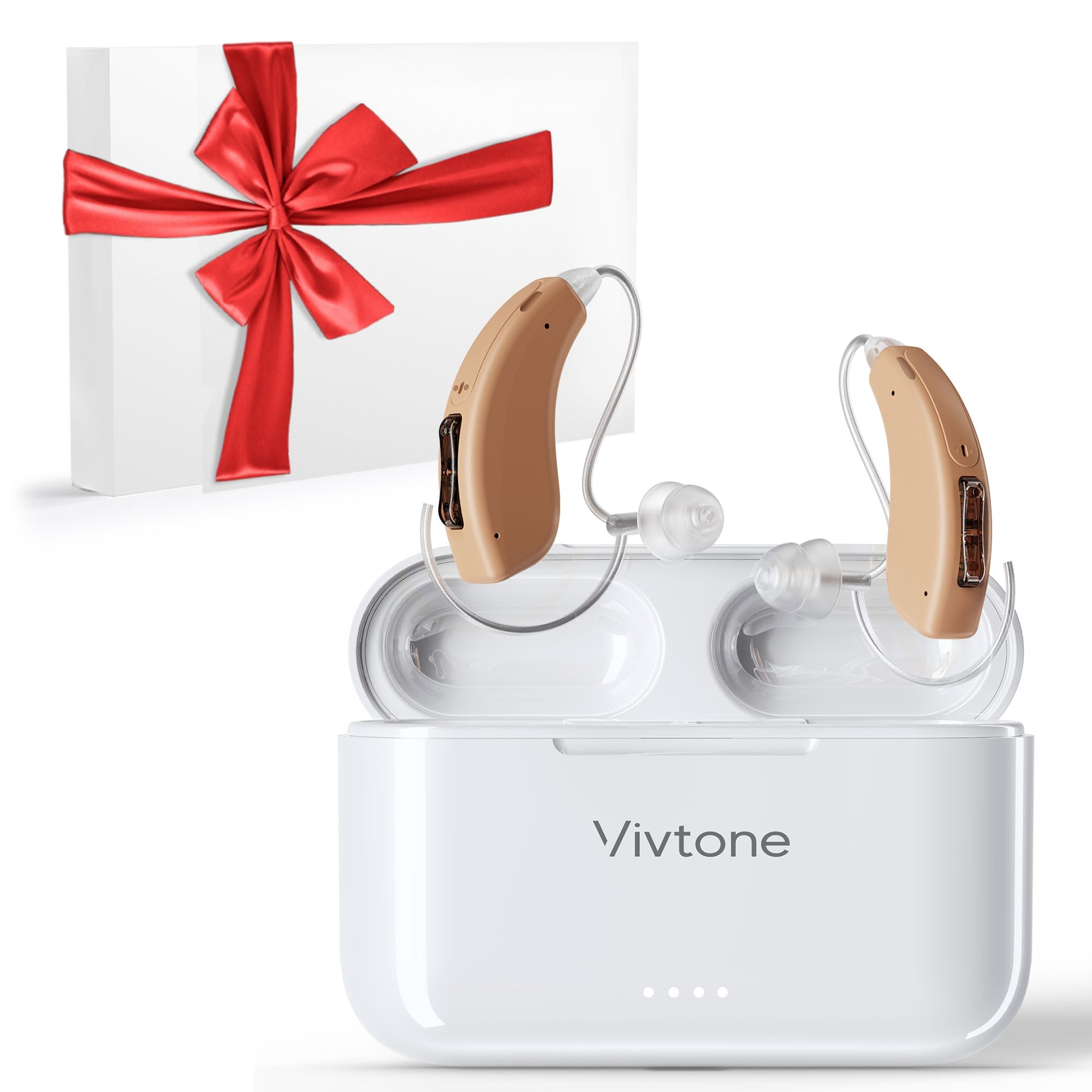
Lift it out of the case and it’s on — put it back and it’s off, with nothing to remember.
For the person who cannot reliably work a tiny switch, the auto on/off is the whole story. Take the aid out of the case and it powers up; drop it back in and it powers down and starts charging. Peak sound gain reaches up to 41dB, which the maker targets at mild to significant hearing loss. A full charge takes 2 hours and runs 25 hours, and the recycling case charges both units four times over for 125 hours of backup power. There are also quiet and noisy modes plus a tinnitus masking mode for when ringing in the ears needs covering.
Easy use is the theme across the feedback, and it’s why this one lands well with families buying for an elderly parent. One buyer’s 94-year-old mother worked it without help and called the sound perfect. Another notes these are their second Lucid 508, praising the auto on/off and the easy maintenance. The charging case holds enough juice to leave the aids in for days at a stretch, which means fewer late-night rescue missions to find an outlet. Customer support also earns its keep — when a unit stopped charging after a few days, a rep walked through a fix and followed up.
Where it asks for a fair evaluation: this is straightforward amplification, not a fitted aid. If you need individual frequencies tuned to your audiogram, a specialist can do that and this cannot. At higher volume the sound can clip, and a couple of users found the reproduction quality short of what they hoped. It’s the right tool for simple amplification and the wrong tool for anyone chasing a fine-tuned audiologist experience — exactly what the maker positions it as.
The senior-friendly read: A case that powers the aids on and off for you is worth its weight in argument defused, and 125 hours of backup power means a week away without charging anxiety. The 41dB gain covers mild through significant loss, which is a wider range than most amplifiers promise.
The match: An older parent who needs the device to think for them, and a family that doesn’t want to become tech support.
Not the match: Someone whose loss needs frequency-by-frequency tuning, or who wants a genuinely commercial-grade hearing aid rather than straightforward amplification.
8. ELEHEAR Beyond OTC Hearing Aids, 50dB

Fifty decibels of gain you tune from your phone, with a case that tops up four more charges.
The ELEHEAR Beyond is the most tech-forward pick here, and the headline spec is 50dB of amplification with VocClear AI behind it — the maker claims it boosts speech clarity by 17% and cuts background noise by 24dB. Those kinds of claims are best read as the maker’s positioning rather than a measured result. What is concrete: four scene modes switched from the ELEHEAR app, adjustable volume, frequency and directionality from the phone, nine dome sizes, and up to 20 hours of runtime per charge plus four more charges in the case for 100 hours total. A 15-minute top-up buys 6 hours, which covers an unexpected outing.
The app is the differentiator: you adjust volume, frequency and directionality from a screen instead of a hidden button. You adjust what you hear from a screen instead of pressing a button on a hidden housing, and profiles let you save different environments. Bluetooth pairing is straightforward on modern phones, and the range reaches about 30 feet in practice. The dome assortment is generous enough for sensitive ears and comfortable under glasses for a full day. Owners describe these as true aids rather than mere amplifiers, and the ability to shape the sound to your environment is why.
Two honest limits frame the decision. The app offers only a brightness/deeper slider rather than a full equalizer, so you can’t hand-tune frequency bands the way an audiologist would. And feedback is the recurring annoyance — a faint ringing that others may hear but you cannot, which is hard to troubleshoot on your own. The Bluetooth range is listed at up to 40 feet but real-world tests land nearer 30, so keep it in mind if you stream from another room.
What makes it the tech pick
- 50dB of amplification with AI speech-boosting, aimed at mild to moderate loss
- Four scene modes plus volume, frequency and directionality adjusted from the app
- 100 hours total with the charging case, and a 15-minute top-up buys 6 hours
- Nine dome sizes make a comfortable fit across sensitive ears and glasses
What to know before ordering
- The app has only a brightness slider, not a full equalizer for fine tuning
- Feedback can set in and is audible to others without being audible to you
- Real-world Bluetooth range runs shorter than the listed maximum
Built for: Someone comfortable with a smartphone who wants to shape the sound and save profiles for different rooms.
Hard sell for: Anyone who’d rather not touch an app — the Vivtone and Nova picks run without any phone involved.
Know the Specs
Decibel gain
Decibels (dB) measure how much louder the device can push sound, and that single number tells you who the aid is built for. A device rated up to 50dB handles a wider spread of hearing loss than a plain amplifier with no stated figure. Pay attention to how the maker words it, too — some sell a “hearing amplifier” and openly say so, while others describe a full hearing aid. Both can help, but the amplifier will fall short if your loss runs steep.
Running hours versus backup power
These are two different promises and buyers confuse them constantly. “Hours of use” is how long a single charge lasts in your ear. “Backup power” is what the charging case adds on top across several recharges. A device rated at 25 hours with a case that holds four more charges gives you a week of use; a device rated 50 hours with no case gives you two long days. Read both numbers before deciding which one suits your routine.
Wireless remote microphones
A remote mic is a small separate unit you place near the person talking or the TV speaker, and it beams that sound to your ears cleanly. This beats a built-in mic in a noisy room, because the device isn’t trying to sort your voice from the room. Range varies — some mics work across a room, some reach 60 feet. Check the range against how you actually use the device, then check the mic’s own running hours, since the mic battery is separate from the band’s.
Fit and ear canal shape
A bad fit is the most common reason a hearing aid ends up in a drawer, and ear canals differ enormously in width and curve. A deep in-canal design hides well but punishes small or oddly shaped canals. A neckband or behind-the-ear design with soft domes forgives more shapes. Look at how many dome sizes ship in the box — one set of nine or ten gives you far more chances of a pain-free seal than a three-size kit. A firm seal is also what stops the whistling that feedback creates.
Common Questions
Is a neckband hearing amplifier the same thing as a hearing aid?
How many hours will a neckband device actually run per charge?
Will a neckband device stop the whistling feedback I’ve had with in-ear aids?
Can I connect one of these to my TV without raising the volume for everyone else?
What does decibel amplification mean for matching my level of hearing loss?
How do I stop losing a small hearing aid around the house?
Are these rechargeable models better than ones that use button batteries?
How long does it take to get used to wearing one all day?
Does a Bluetooth model like the NW10 Pro work if I just want TV sound, no phone?
What is the main difference between the Neosonic NW10 Pro and NW20?
The Bottom Line
The best around the neck hearing aids for most families is the Nova Hearing Aids from iBstone, because the anti-lost lanyard, drying case and 1.5-hour fast charge solve the two most practical problems first: losing the aids and keeping them dry. If TV is your main fight, reach for the Neosonic NW10 Pro and its up-to-20-yard remote mic so the rest of the room keeps the volume down. For a parent who needs the device to think for itself, the Vivtone Lucid508 auto-powers on when lifted from its case — and if you want to shape the sound from an app, the ELEHEAR Beyond is the pick with a phone in the loop. Whichever you choose, test it in the room where you actually struggle to hear before the return window closes.
How we choose
We do not accept paid placement. Every pick is matched to a real buyer and a real use-case; we do not hands-on test units.
Sources
Specifications: manufacturer listings and product documentation. Review insights: verified customer reviews, as of October 2026. Pricing: not shown on this page (it changes often); check the current price via the retailer link.
As an Amazon Associate, Aappliancez earns from qualifying purchases. This does not affect which products we feature.