Disclosure: Some links in this post are affiliate links. As an Amazon Associate I earn from qualifying purchases, at no extra cost to you. Learn more
Specs are compiled from manufacturer listings and verified buyer reviews and can change over time — please confirm the key details on the product page before buying.
You want a cinema-sized picture, but you have no wall to put it on. The best AR glasses for movies solve that by pairing a bright Micro-OLED display (a tiny, high-contrast screen that projects a huge virtual image in front of your eyes) with plug-and-play USB-C video (one cable carries the picture from your phone or laptop). The RayNeo Air 3s is the best balance of picture, audio, and price here: a 201-inch virtual screen at 120Hz, TÜV SÜD flicker-free and low blue light certification, and the largest owner base of the group at a mid-range price.
This guide is built by comparing the manufacturers’ published specifications and the patterns across verified customer reviews, so you get each pick’s real strengths and trade-offs instead of marketing spin.
Every pick below runs on the same simple idea: you plug a USB-C cable into your phone, laptop, or handheld and the glasses put a giant private screen in front of your face. The trick is knowing which panel, refresh rate, and brightness level actually matters for films — which is what this guide sorts out.
Top Picks


How To Choose The Best AR Glasses for Movies
Think of these glasses as a private television you wear. They have no room to fill and no wall to hang anything on, so the whole experience rides on a handful of numbers and one compatibility question. Get those right and a two-hour film feels like a theater. Get them wrong and you are staring at a blurry, shaky rectangle.
Screen size and field of view
The advertised screen size, whether 118 inches or 500 inches, is a projection based on how far the virtual image appears to sit from your eyes. What you actually perceive is governed by the field of view, measured in degrees. A wider field of view generally feels more cinematic, while a narrower one keeps text sharper and the image more contained.
Brightness and contrast
Brightness is measured in nits, and higher nits help the picture hold up when you are not in a dark room. Contrast matters just as much for films, because deep blacks are what make dark scenes look rich rather than washed out. Micro-OLED panels are chosen precisely for that reason.
Refresh rate and image stability
A 120Hz refresh rate means the display redraws the image many times a second, which smooths fast motion in action scenes. Separately, 3DoF head tracking keeps the virtual screen anchored in space so it does not swim around when you move your head, while a follow mode simply locks the screen to your face.
Compatibility and power
These glasses carry no internal battery for the most part, so they draw power from whatever you plug them into, and they need a USB-C port that supports video output. Confirm your phone or handheld offers that before you buy.
Side-by-Side Comparison
| Model | Best For | Virtual Screen | Refresh Rate | Audio | Amazon |
|---|---|---|---|---|---|
| VITURE Luma Pro★ Best Overall | Sharpness on the road | 152″ | 120Hz | Harman Audio | Amazon |
| RayNeo Air 3sAlso Great | Everyday movie nights | 201″ | 120Hz | Dual opposing acoustic chamber | Amazon |
| XREAL One ProTop Performer | Widescreen immersion | 171″ | 120Hz | Sound by Bose | Amazon |
| XREAL 1S | Commuters and travelers | Up to 500″ | 120Hz in 3DoF | Sound by Bose | Amazon |
| RayNeo Air 4 Pro | HDR cinematic color | 201″ | 120Hz | Four speakers by Bang & Olufsen | Amazon |
| VITURE Luma Ultra | Hands-free spatial viewing | 152″ | 120Hz | Harman Audio | Amazon |
Detailed Reviews
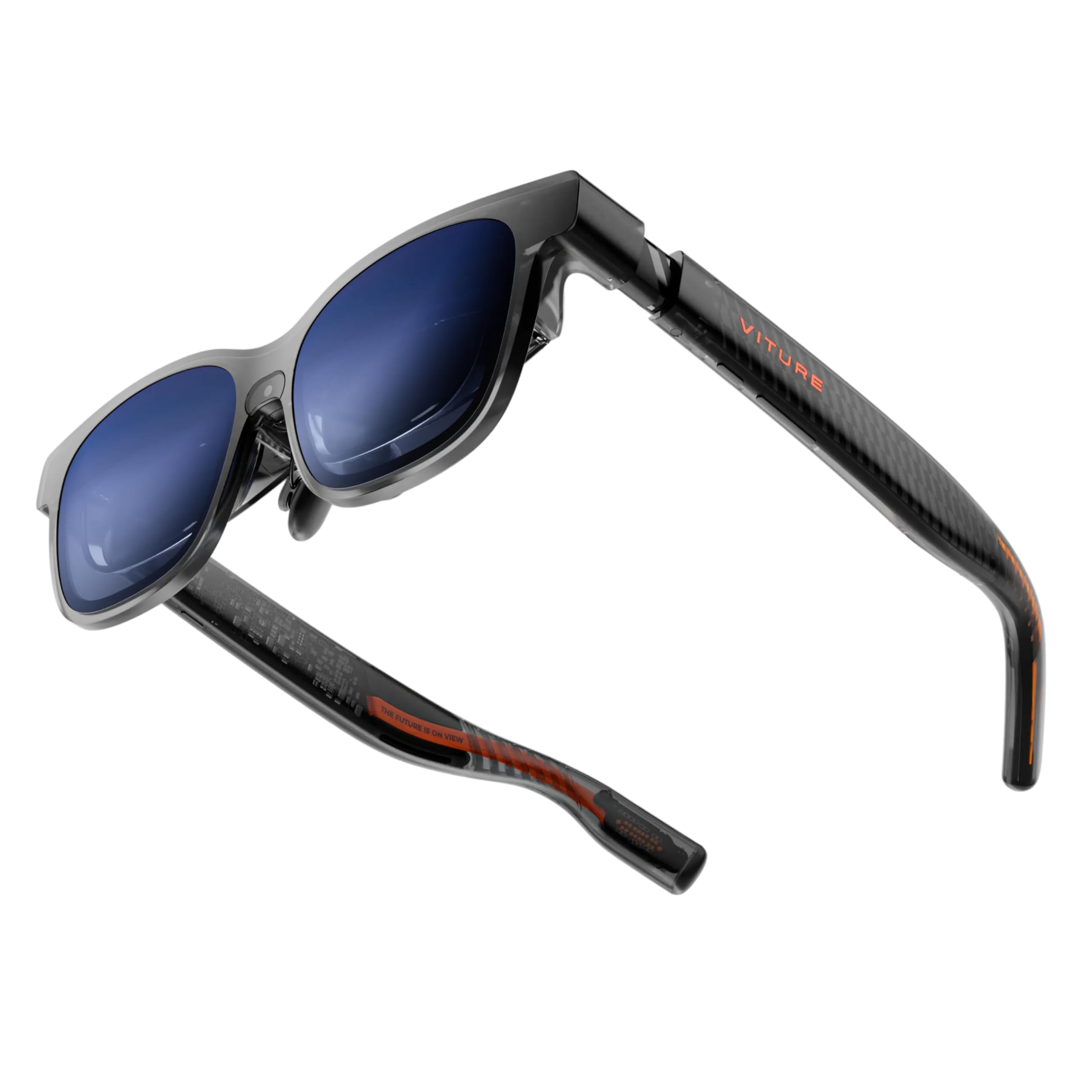
1. VITURE Luma Pro XR/AR Glasses
Where crisp text and bright color beat sheer size
Owners describe the picture here as the clearest on the page, and the numbers back the reputation. The Luma Pro pushes a 152-inch virtual screen at 1200p resolution, which VITURE claims delivers clarity sharper than its own Pro model, with color accuracy rated at DeltaE <2. Text is razor-sharp, which matters if you toggle between a film and something with on-screen subtitles or menus.
Brightness hits 1000 nits, and 120Hz keeps motion smooth. The glasses weigh 2.79 ounces, light enough to forget you are wearing them, and built-in myopia adjustment up to -4.0D lets nearsighted viewers skip prescription inserts entirely. Audio comes from Harman’s engineers, and VITURE offers the Luma Pro in two IPD sizes — Regular at 64.0±6.0mm and Large at 68.0±6.0mm — so you should have a formal eye exam to pick the right one. An electrochromic film darkens the lenses on demand with one tap.
There is no built-in chip for features like side view or anchor mode, so those arrive only through the companion apps, and one buyer felt the value suffered because reaching XREAL-style features means buying VITURE’s neckband separately. The magnetic connector cord also drew a complaint for being awkward when you recline. Picture quality is what owners praise most, appearing in 90+ reviews, just ahead of adjustability and comfort at 39 each.
Where it wins: 1200p resolution and 1000 nits make this the sharpest, brightest small-screen experience on the list, ideal for subtitled films and daylight viewing.
Picture-first buyers, this is yours: you want the crispest panel and adjustable focus for your eyes.
One caveat: the smart modes live in apps rather than the glasses, so expect some learning curve.
2. RayNeo Air 3s AR/XR Glasses
The crowd favorite that turns a cramped seat into a 201-inch screen
This is the pair to buy if you want the biggest, best-established movie experience for the least fuss. RayNeo’s HueView panel throws a 201-inch virtual image with 98% DCI-P3 color coverage, a color-accuracy rating of ΔE <2, 200,000:1 contrast, and 145% sRGB vibrancy, so skin tones and dark scenes stay faithful while you watch.
The 120Hz refresh rate smooths panning shots, and the audio runs through what RayNeo describes as the world’s first dual opposing acoustic chamber (two speakers facing each other to deepen bass). For long movie sessions, OptiCare’s 3840Hz DC and PWM dimming cuts flicker, and the panel carries TÜV SÜD Low Blue Light and Flicker-Free certification. RayNeo suggests a 10-minute break after every 30 minutes of use.
Compatibility is where a buyer needs to be careful. The Air 3s needs a USB-C video source, and it draws power from that device rather than carrying its own battery; Apple’s Lightning port needs an adapter, and older iPhones are not compatible at all. Netflix is unsupported and shows error 10065, while Prime Video, Apple TV, essential+, Hulu and VLC all play fine. One buyer summed it up plainly: the audio is fine but they preferred their AirPods Pro 2.
Why movie lovers put it first
- 201-inch HueView virtual screen with 98% DCI-P3 color and ΔE <2 accuracy, so dark scenes stay rich instead of washed out
- 120Hz refresh rate keeps action sequences fluid and lag-free
- Functionality is the trait owners praise most, appearing in 150+ reviews, followed by display quality at 87
- TÜV SÜD Low Blue Light and Flicker-Free certification for long movie sessions
The honest catches
- Value for money, connectivity and screen size all draw mixed reactions rather than uniform praise
- No internal battery, so it drains the phone or laptop you plug it into within hours
- Netflix is unsupported and returns error 10065; Lightning iPhones need an adapter
Your best bet if: you watch on USB-C phones, laptops and handhelds and want the most proven 201-inch movie screen on this list.
Look elsewhere if: you stream everything on Netflix or own an older Lightning iPhone — the compatibility limits will bite.
3. XREAL One Pro AR Glasses
The widest window on this list, with the screen pinned in space
If you want the picture to feel like a real cinema wall rather than a floating rectangle, the math here favors XREAL. The One Pro runs a 57° field of view — the widest of the glasses on this page — projecting a 171-inch virtual screen that its maker says mirrors watching a giant display from four meters away. Compare that with the 52° field of view on both the VITURE Luma Pro and the XREAL 1S, and the One Pro simply shows you more of the frame at once.
Underneath sits XREAL’s self-developed X1 spatial computing chip, which delivers native 3DoF tracking at 3ms motion-to-photon latency (the delay between moving your head and the image catching up). The practical payoff is a screen that stays put while you shift in your seat. A 120Hz refresh rate, up to 700 nits of brightness, electrochromic dimming you control with a tap, and sound tuned by Bose round out the hardware. Sony’s 0.55-inch Micro-OLED panel supplies the image.
Two sticking points are worth knowing before you buy. The display draws mixed feedback, with some owners calling it sharp and others finding edges blurry until they reposition the glasses on their face. And there is no diopter adjustment, so if you wear glasses you will want the prescription lens frame that ships in the box (lenses not included). The fit itself is generous: two IPD sizes cover roughly 70% of face widths, with a range of 59.5–70.5mm on the standard model.
What the panel buys you: a 57° field of view and 171-inch virtual screen deliver more cinematic real estate than the 52°/152-inch VITURE Luma Pro, which matters most on widescreen films.
Worth the premium for: buyers who prioritize the widest possible view and rock-solid 3DoF anchoring over text sharpness.
Think twice if: you need reading-glasses-free clarity — there is no built-in diopter adjustment here.
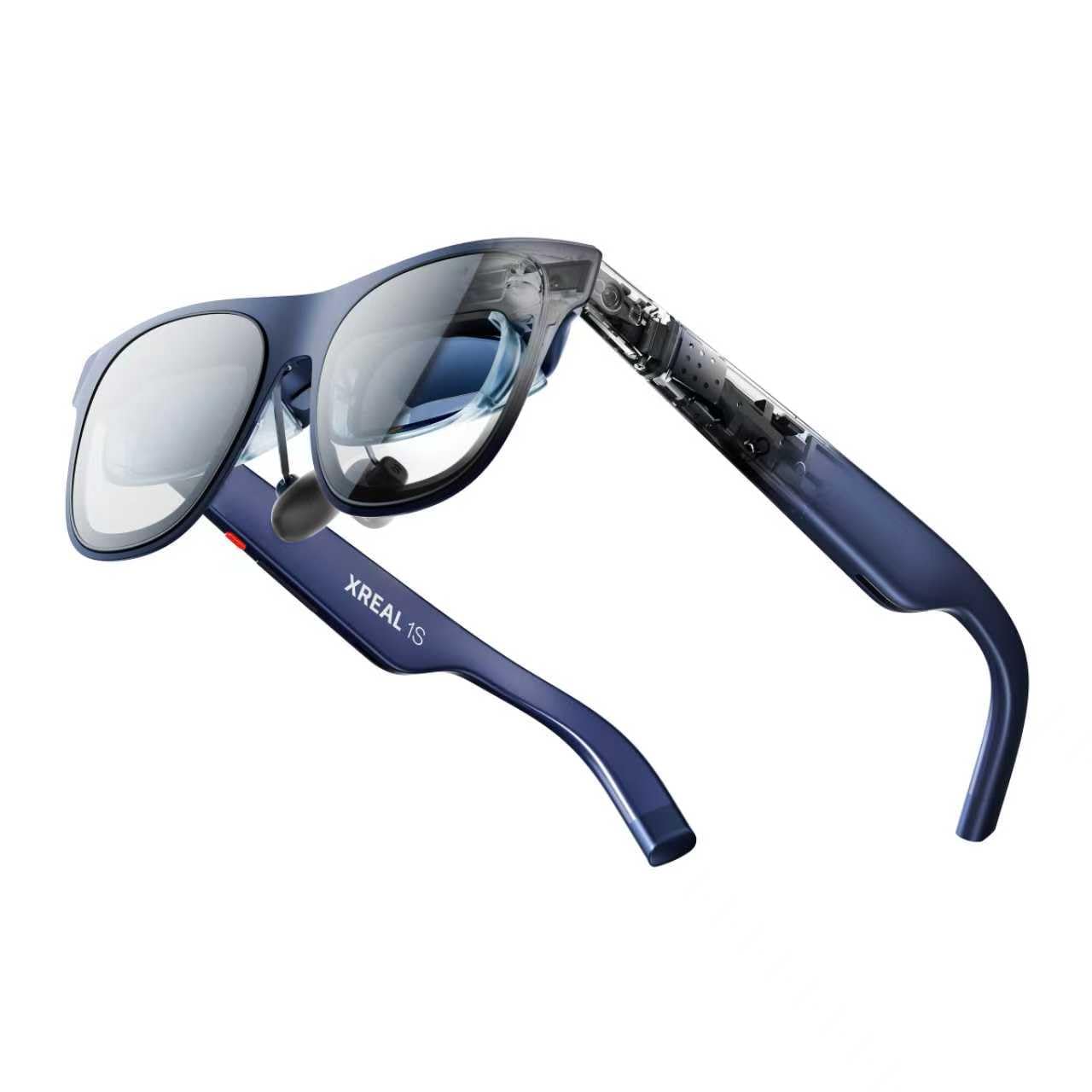
4. XREAL 1S AR Glasses
A 500-inch virtual screen with zero setup and no apps
The headline number for movie night is the screen, and the XREAL 1S claims up to 500 inches — the largest projection on this list by a wide margin over the 152-inch VITURE pair. It runs the X1 chip for native 3DoF spatial viewing, which means no companion apps or account required: you connect to any USB-C DP-enabled device and the picture appears.
Owners who commute say the screen stays anchored rock-solid while you move, and the display refreshes at 120Hz in 3DoF mode with a 90Hz global rate to reduce flicker and blur. The panel is color-tuned unit by unit, and the redesigned optical engine boosts clarity by 9%. Audio is tuned by Bose, real-world weight sits at 0.08 kg, and the IPD range of 59.5–70.5mm is built to suit most faces. XREAL says it covers roughly 95% of users.
The catch, and it is a real one, is that there is no diopter adjustment, so anyone with a prescription needs insert lenses. Owners repeatedly report anchor drift in 3DoF mode — the screen slides left or down during long sessions and needs recalibration. Quality is the trait owners praise most, appearing in 100+ reviews, with real 3D tracking a distant second at 33.
Reach for this if: you travel or commute and want the biggest virtual screen with the least setup.
Not the pick if: you rely on 3DoF anchoring to stay perfectly fixed over long sessions.
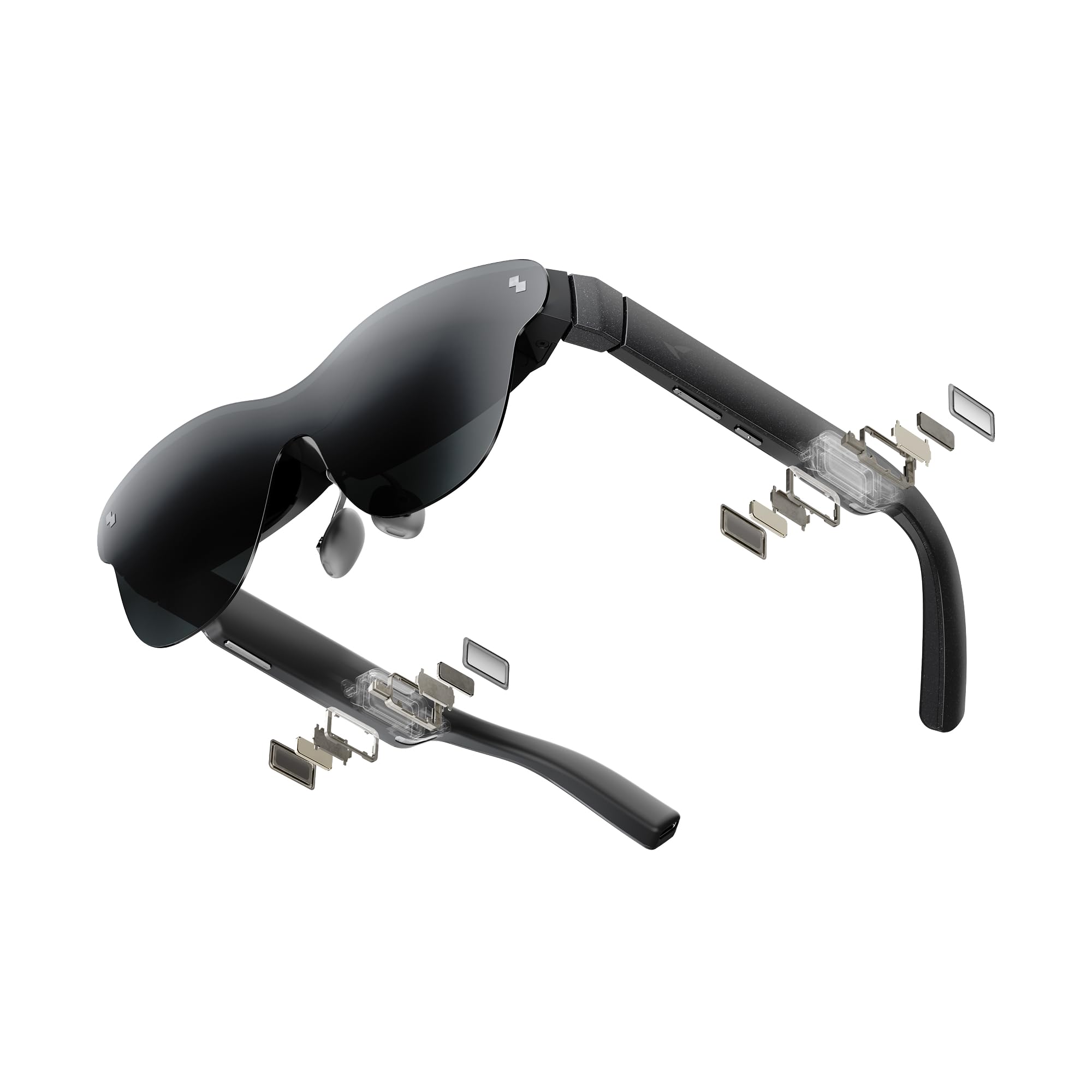
5. RayNeo Air 4 Pro AR/XR Glasses
The first HDR10 display you can wear, tuned for film color
HDR10 is the standard format for high-dynamic-range movies, and this is the only pair on the list that carries it. The result, on a 201-inch virtual screen, is over 10 billion colors with brighter highlights and richer blacks than a standard LCD-style panel — exactly the two things cinephiles notice first in a dark film.
A Vision 4000 chip, co-developed with Pixelworks, upscales ordinary SDR (standard dynamic range, the everyday format most streaming uses) into HDR in real time while sharpening color and motion. Refresh runs at 120Hz, the field of view is 46 degrees, and maximum resolution reaches 2160 x 2160. Audio is supplied by four speakers tuned by Bang & Olufsen for 360-degree sound, with an optional Sound Tube that pipes audio toward your ears. There is also real-time 2D-to-3D conversion on supported iPhone models.
The most important thing to know is the fit. The interpupillary distance is fixed at roughly 63mm, and owners whose eyes sit wider report cross-eye and strain that nose-pad tweaks did not fix. There is also no spatial anchoring, so the screen follows your head rather than staying pinned, and some find that causes eye fatigue during long sessions.
Why it stands out for movies: HDR10 and the Vision 4000 upscaler deliver the most film-accurate color of any pair here, and the 120Hz refresh keeps motion clean.
Made for cinephiles: HDR10 on a 201-inch screen with Bang & Olufsen audio is the strongest movie-first combination here.
Skip if your eyes sit wide apart: the fixed ~63mm interpupillary distance leaves no adjustment for a wider face.
6. VITURE Luma Ultra AR Glasses
 Check Price on Amazon
Sony’s newest micro-OLED panel in the brightest movie-first build here
At 1500 nits, this is the brightest pair on the list, and it is powered by Sony’s latest micro-OLED display. VITURE says those panels cut power consumption by 35%, which is what lets the brightness climb without overheating the frame and also puts less strain on the phone or neckband feeding it power. The image spans a 152-inch virtual screen at 1200p resolution, at a 120Hz refresh rate, over a 52° field of view.
What separates the Luma Ultra from its cheaper sibling is spatial awareness. A triple-camera system adds front RGB and dual depth cameras for high-precision 6DoF tracking and hand-gesture interaction, with zero drift claimed when paired with a VITURE Pro Neckband. Built-in myopia adjustment runs up to -4.0D, three swappable nose pads are included, and an electrochromic film darkens the lenses at a tap. Display quality is the trait owners praise most, appearing in 80+ reviews.
Be clear about what you are buying. The 6DoF and hand-gesture features look toward proprietary accessories rather than working from the start, and the SpaceWalker software has a steep learning curve. Some Android buyers report limited compatibility and trouble with the 2D-to-3D app, which works across a smaller set of approved apps. Text-arm fatigue after a few minutes also surfaced as a comfort gripe.
What earns its premium
- 1500 nits, the brightest panel here, from Sony’s latest micro-OLED with 35% lower power draw
- Triple-camera 6DoF tracking and hand gestures when paired with the Pro Neckband
- 1200p resolution at 120Hz and 52° FOV
- Up to -4.0D built-in myopia adjustment and three included nose pads
What to plan around
- Full 6DoF and gesture features require proprietary accessories, not out-of-the-box operation
- SpaceWalker software has a steep learning curve and limited approved apps
- The controller’s arms tire quickly for some users
Built for gadget lovers: brightest display and true spatial tracking for those willing to learn the ecosystem.
Not the simplest buy: the smartest features need extra gear, so a plug-in-and-watch viewer will not use half of it.
Know the Specs
Micro-OLED and contrast
Micro-OLED is a tiny panel with individual light-emitting pixels, which lets it turn pixels fully off for true blacks. For movies this matters most in dark scenes, where a lower-contrast screen shows grey mush instead of shadow detail.
Brightness in nits
Nits measure how bright the picture looks. A screen rated up to 1500 nits holds up better when you are watching in a lit cabin or near a window, while a dimmer panel tends to look washed out in daylight.
3DoF versus 6DoF
3DoF tracks your head’s rotation and keeps the screen at a steady distance, so it follows your face. 6DoF adds position tracking so the screen can be pinned to a fixed spot in the room, which usually needs extra cameras or accessories to work.
USB-C video output
Most of these glasses carry no battery and take both video and power from one USB-C cable. Your device must support video out over that port — often called DisplayPort Alt Mode — or you will need an adapter for HDMI and older phones.
Common Questions
Will these AR glasses work with my phone for watching movies?
Do I need a separate battery to power the glasses?
Can I wear these over my prescription glasses?
Is 120Hz refresh rate important for watching movies?
What is the difference between 3DoF and 6DoF for movie watching?
Why do some of these glasses get warm or overheat?
Do these glasses show your screen to people around you?
Will Netflix and other streaming apps play on these glasses?
Can I use these glasses for gaming as well as movies?
How far should the virtual screen appear from my eyes?
The Bottom Line
For most people, the ar glasses for movies winner is the RayNeo Air 3s because it pairs a 201-inch HueView screen at 120Hz with the largest real-world track record on the list. If the widest, most cinematic window matters most to you, the XREAL One Pro and its 57° field of view leads that pack. And if you prize the sharpest, brightest panel with built-in focus adjustment, the VITURE Luma Pro fits the bill. The top pick earns its place on both image quality and the sheer number of satisfied owners, making it the safest place to start.
How we choose
We do not accept paid placement. Every pick is matched to a real buyer and a real use-case; we do not hands-on test units.
Sources
Specifications: manufacturer listings and product documentation. Review insights: verified customer reviews, as of October 2026. Pricing: not shown on this page (it changes often); check the current price via the retailer link.
As an Amazon Associate, Aappliancez earns from qualifying purchases. This does not affect which products we feature.