Disclosure: Some links in this post are affiliate links. As an Amazon Associate I earn from qualifying purchases, at no extra cost to you. Learn more
Specs are compiled from manufacturer listings and verified buyer reviews and can change over time — please confirm the key details on the product page before buying.
Oncoming headlights can leave you squinting, blinking hard, and slowing down on roads you know well. The fix is a light yellow-tinted lens with an anti-reflective coating that softens the brightest part of the beam — not a darker lens. A dark lens makes night driving worse because it cuts the light you actually need. Every pick below is built around that light-yellow-plus-AR idea.
This guide is built by comparing the manufacturers’ published specifications and the patterns across verified customer reviews, so you get each pick’s real strengths and trade-offs instead of marketing spin.
A yellow tint won’t brighten an unlit road. And glare perception varies from driver to driver. What it does do is soften the edge of an oncoming high beam so you keep your eyes on the road. That is exactly the job these ar coating glasses for night driving picks are chosen to do.
Top Picks

How To Choose The Best AR Coating Glasses for Night Driving
Night driving glasses are not sunglasses in a different colour. They live or die on one balance: letting enough light through to keep the road sharp, while cutting the harsh spike of a headlight or streetlamp. Too dark and you lose the road; too little tint and the glare wins.
Lens tint: light yellow, not deep amber
A pale yellow tint raises contrast on a dim road without swallowing light — so lane markings stay readable on an unlit stretch. Deep amber or brown lenses look dramatic in the box, then leave you hunting for those markings. Look for a lens described as a light or balanced yellow tint, because that is the one that keeps the road visible while it tames the bright bits.
Yellow shifts the colour of the world, so LED headlights read yellow instead of blue-white. That shift is the point: the harsh short-wavelength blue-white is what makes your eyes water.
Anti-reflective coating versus polarization
An anti-reflective (AR) coating is a thin layer on the lens surface that stops light bouncing back off the glass. Its job is the halo that gathers around a bright light, so a headlight reads as a cleaner disc. Polarization is a filter inside the lens that blocks light arriving at one angle — the glare that comes off wet asphalt or a windshield. The two do different jobs, and semi-polarized lenses are a middle path that keep natural depth cues intact while still trimming some glare.
Will they fit over your glasses
If you wear prescription specs, fit is the spec that sinks the most purchases. A fit-over frame needs your own frame to be narrower and shallower than the outer glasses. Measure the widest and highest part of your frames before ordering, so the night glasses sit flat instead of perching. If your frames sit outside the stated fit window, the night glasses will perch, gap at the bottom, and leak light exactly where you don’t want it.
Weight and the pressure points
You wear these for an hour or more at a stretch, so a 26-gram frame keeps the bridge of your nose from aching on a long haul. Pay attention to the nose pad material too. Rubber pads grip well but can start to feel intrusive after a while, while a simple soft pad is easier over a longer drive.
Side-by-Side Comparison
| Model | Best For | Lens Tint | Lens Type | Frame | Amazon |
|---|---|---|---|---|---|
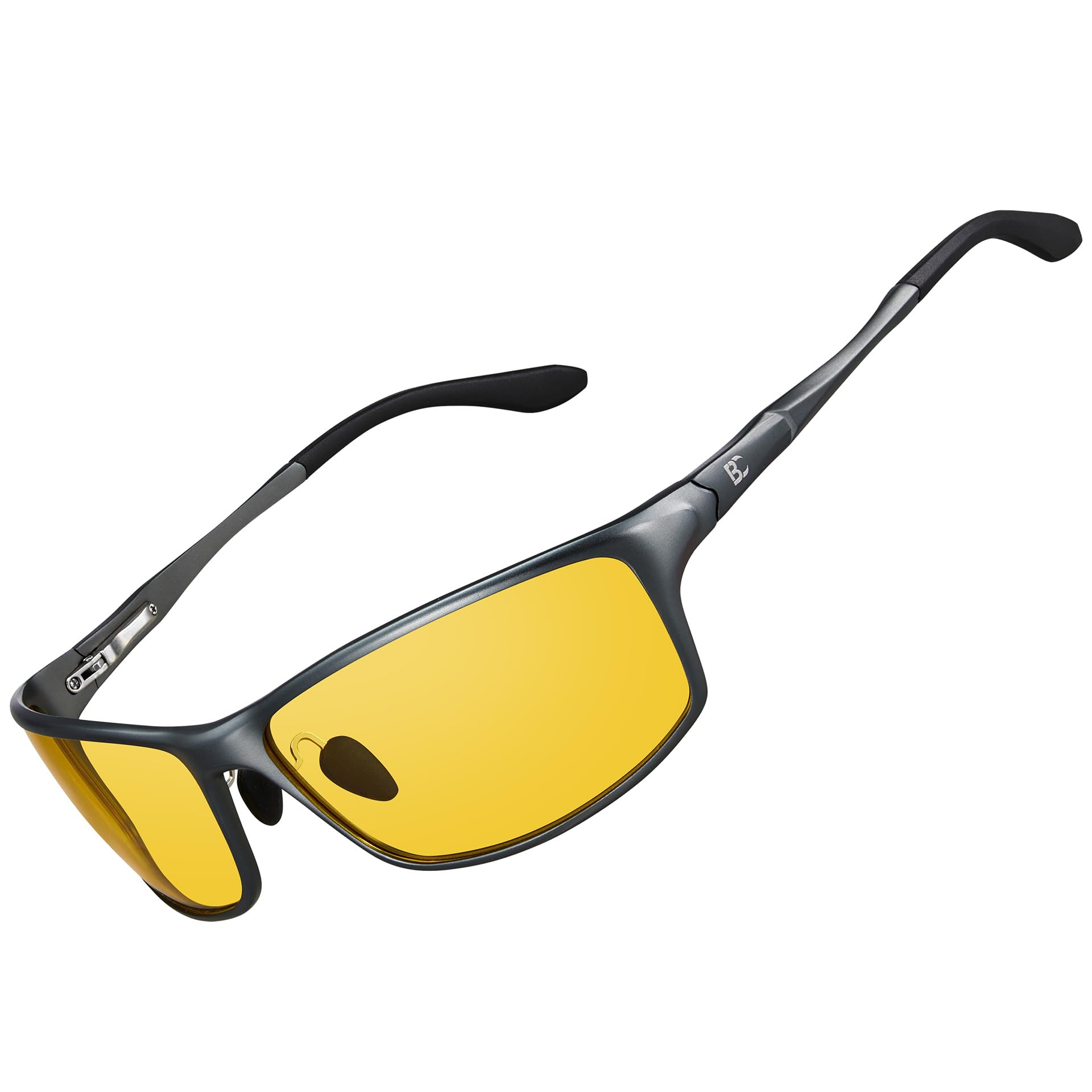
| BLUPOND Set of 2 Day and Night★ Best Overall | One kit for day and night driving | Copper (day) and Yellow (night) | Polarized, semi-polarized night lens | Aluminum-magnesium alloy, 26g | Amazon |
| BIRCEN Night Vision GlassesBest Value | Metal-frame look on a budget | Yellow | TAC lens | Al-Mg metal, spring hinge | Amazon |
| CAXMAN Fit Over | Wearing over prescription glasses | Yellow | Polarized side shields, oleophobic coating | Wrap-around fit-over | Amazon |
| Illumin VECTOR | Fog, mist, and bad-weather driving | Light yellow | Anti-reflective coating | Scratch-resistant, non-slip | Amazon |
| SOXICK Night Driving Glasses | Adjustable nose piece fit | Yellow | TAC polarized, UV400 | Bendable nose piece | Amazon |
| BLUPOND Knight Visor | Long-haul and city bus driving | Yellow | Polarized, 7-layer composite, UV400 | Aluminum-magnesium alloy, 26g | Amazon |
| Eagle Eyes NIGHT-LITE FitOns | Wearing over prescription frames | Yellow | Anti-reflective coating | Fit-over, wrap-around | Amazon |
Detailed Reviews
1. BLUPOND Set of 2 HD Day and Night Driving Glasses
Our pick — 4.0+★ from 900+ verified ratings; the strongest balance of quality and price.
Two pairs in one box, so your daytime lenses never crowd out your night ones.
You get both ends of the day in one box, and that’s why this set takes the top spot: a grey-tinged copper polarized pair for daylight and a yellow semi-polarized pair for after dark, plus a visor clip to hold whichever pair you’re not wearing. No swapping lenses in the dark, no second case to remember.
The night lens sits on an aluminum-magnesium alloy frame (a metal mix that keeps the frame rigid without bulk). The whole pair weighs 26 grams, light enough that you forget it’s on during a two-hour drive. Both lenses are semi-polarized with an anti-glare coating — a deliberate choice. Full polarization would block too much light at night, so semi-polarization keeps the road bright and still takes the spike off a headlight.
Reviewers talk about lens quality more than anything else, and the yellow pair consistently gets credit for making street signs readable while the copper pair handles sun glare. Fit is the other recurring theme: reinforced hinges and integrated nose pads suit a wide range of face shapes, and people re-buy the set after passing their first pair to a partner. The honest catch is durability on the arms — buyers report a small number of the earliest sets had earpieces snap, so the steel-arm replacement is the version you want. Ask before you order if that matters to you.
What earns its place
- Day and night coverage in a single purchase, with individual cases, cloths, and a visor clip.
- 26-gram aluminum-magnesium frame with reinforced hinges — light on the nose on long drives.
- Semi-polarized yellow night lens cuts headlight glare while keeping enough light to read the road.
- Shatterproof lenses with a protective scratch coating, so daily handling does not ruin them.
Where to look closely
- Glare reduction varies from person to person — the maker is upfront that results depend on your eye anatomy.
- A minority of early frames had arm breakage; the steel-arm version is the sturdier one.
- The copper day lens is a modest step up from ordinary sunglasses rather than a dramatic one.
Reach for this if: you want one purchase that covers the commute home and the drive back in daylight, without juggling two brands.
Think twice if: you only ever drive at night — the daytime pair is half the value, and a single night lens would stretch further.
2. BIRCEN Night Vision Glasses for Driving
A metal-frame night lens for the driver who wants the look without the outlay.
A spring hinge and a shaped nose pad on an Al-Mg (aluminum-magnesium) metal frame are what put these on the list at the entry end of the range. That’s the same material family the pricier picks use, so they feel more substantial in your hand than the price suggests. The TAC lens (a multi-layer plastic lens sold for its impact resistance) carries the yellow anti-glare tint.
Owners describe the fit as the surprise: the lenses and frame wrap around your eyes well, they don’t pinch at the temples, and they stay put over hours behind the wheel rather than minutes. Some buy a second pair rather than share one. Glare from early-morning and post-rain driving is where the yellow tint does its most visible work. One customer put it plainly: “These do cut down the glare when driving in the early morning hours.”
There is a limit worth knowing. A yellow lens shifts colour rather than removing every bright source, and for some people that shift is all they get. Wearers with replacement lenses after eye surgery report no meaningful reduction. That’s a fit question, not a defect: this is a lens for softening ordinary headlight flare, and if your glare comes from a medical lens implant, no yellow tint will fix it.
Why it lands on the list: a metal frame with a spring hinge, a TAC yellow lens, and a fit that stays put for a full drive — it covers the basics at the entry end of the range.
The realistic ceiling: clarity is the trait that splits opinion, so treat these as a glare softener rather than a vision improver — the road gets calmer, not sharper.
Best-matched to: a daily commuter who leaves in the dark and wants a metal-frame pair that doesn’t slide down their nose at every bend.
Not the one for: anyone expecting a yellow lens to solve glare after cataract lens replacement.
3. CAXMAN Night Driving Glasses Fit Over Your Glasses
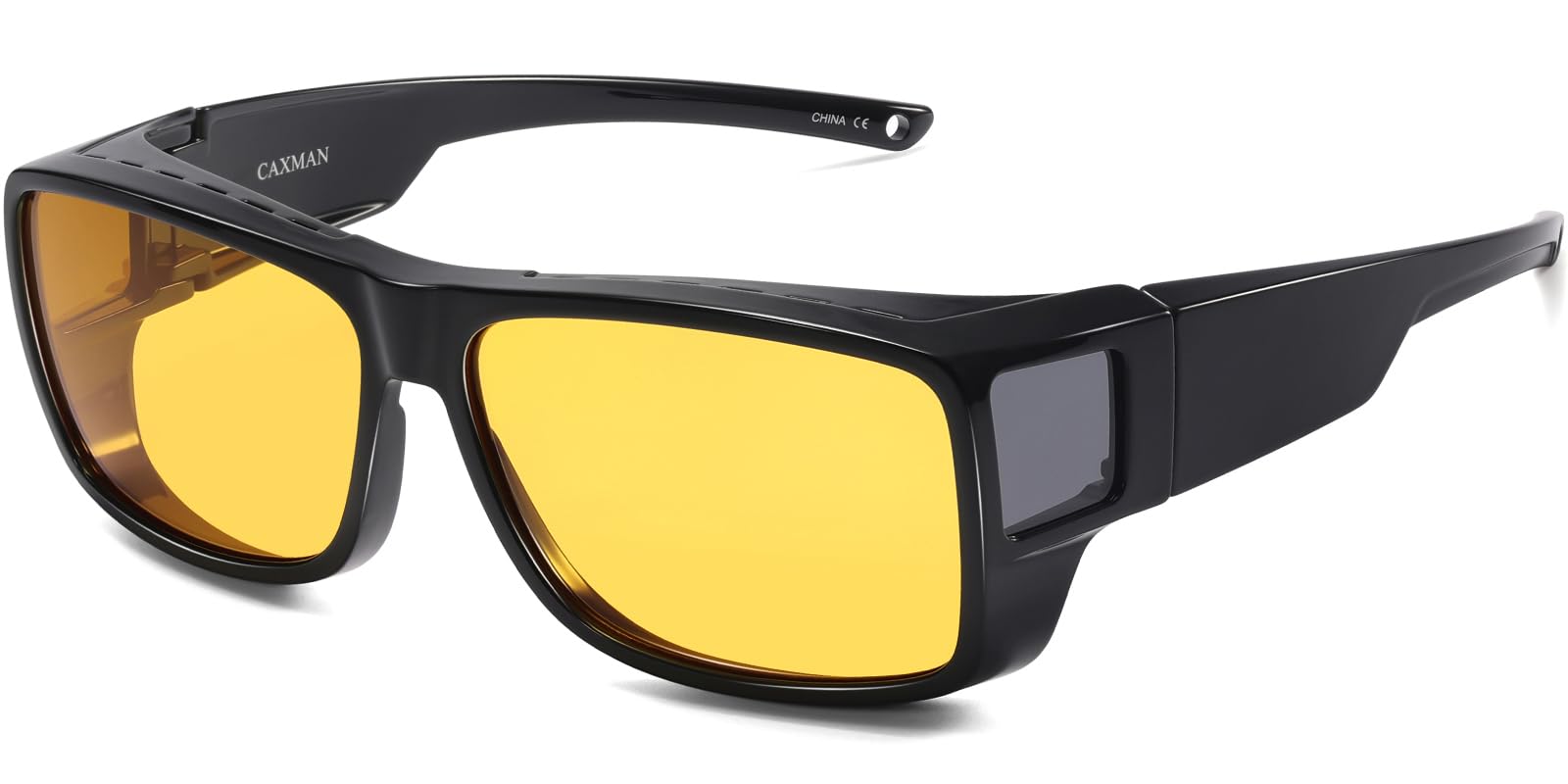
Built to slot over the prescription frames you already wear, with polarized side shields.
If your glasses are a permanent part of your face, you keep them on and slide these over the top. CAXMAN states the numbers plainly: it fits frames under 142mm wide and under 44mm tall. Measure both before you order, because missing either figure means light leaks in at the bottom edge. The polarized side shields then block peripheral light from the side window and the wing mirror without narrowing your view forward — exactly the light that catches you unaware on a wet motorway.
The yellow tint does the contrast work in fog, rain, dusk, and overcast conditions. An oleophobic coating (a surface layer that repels skin oils, so fingerprints wipe away instead of smearing) keeps the lenses clean when you handle them at a service station.
Reviewers praise the glare cut from oncoming vehicles most — the reason most buyers stick with them — with build quality close behind. One commercial driver sums up the outcome: the yellow lens “ended years of avoiding night driving due to LED glare.” The honest trade-off is the tint itself. A handful of buyers dislike how yellow everything looks, and a few feel the price is steep for a fit-over. That reaction is personal, not a build flaw — but if coloured vision bothers you, this will bother you.
The measured view: a fit-over design with usable stated dimensions, polarized side shields, and a coating that keeps oil off the lens — practical details rather than decoration.
Where it asks something of you: measure your existing frames accurately first, because a fit-over only works when it actually fits over.
The obvious choice when: you wear prescription glasses every day and want to keep them on while you drive.
Pick something else if: you want an unobtrusive tiny frame — this is a wide wrap-around that sits outside your face.
4. Illumin VECTOR Night Driving Glasses

The bad-weather specialist: rain, mist, and fog are where this yellow lens earns its keep.
Rain and fog are harder on your eyes than a clear night, because everything bright turns into a smear — and the anti-reflective coating here goes at that halo directly, which is why it outshines the BIRCEN pair in drizzle. The tint is deliberately light yellow; the maker states it avoids the over-darkening of old heavy amber lenses.
Reviewers praise the glare reduction above all, with one framing repeated across the pages: these don’t help you see further, they stop the bright light from hurting. Drivers describe keeping their eyes on the road instead of flinching away from a bad high beam, and the tint is gentle enough that a pair gets used on a sunny day too. A second big theme is comfort and grip — non-slip frames, scratch-resistant, light enough for a long drive.
Two real caveats. The fit is the most split topic on this model, and the curved earpieces in particular squeeze some head shapes — so if you’re between sizes, factor that in. And a small number notice a faint double image around each bright light, a known quirk of this lens style that settles for most people but doesn’t for everyone.
Why drivers keep them in the car
- Anti-reflective coating targets halos, not just brightness — useful in fog, mist, and rain.
- Light yellow tint avoids the over-darkening of heavy amber lenses, so the road stays visible.
- Non-slip, scratch-resistant frame stays where you put it over a long drive.
- Comes in a gift box, which makes it a straightforward present for a night-shift worker.
What a buyer should weigh
- Fit draws the most mixed response of any trait on this model, especially the curved earpieces.
- A faint ghost image around very bright lights shows up for some wearers.
- Direct oncoming high beams on a two-lane road still get through — this softens, it does not black out.
Fits the driver who: commutes through mist, drizzle, and motorway spray and wants the halos gone more than the colour changed.
Worth passing on if: you have a wide head and already find narrow frames pinch — the curved arms here are the recurring fit note.
5. SOXICK Night Driving Glasses
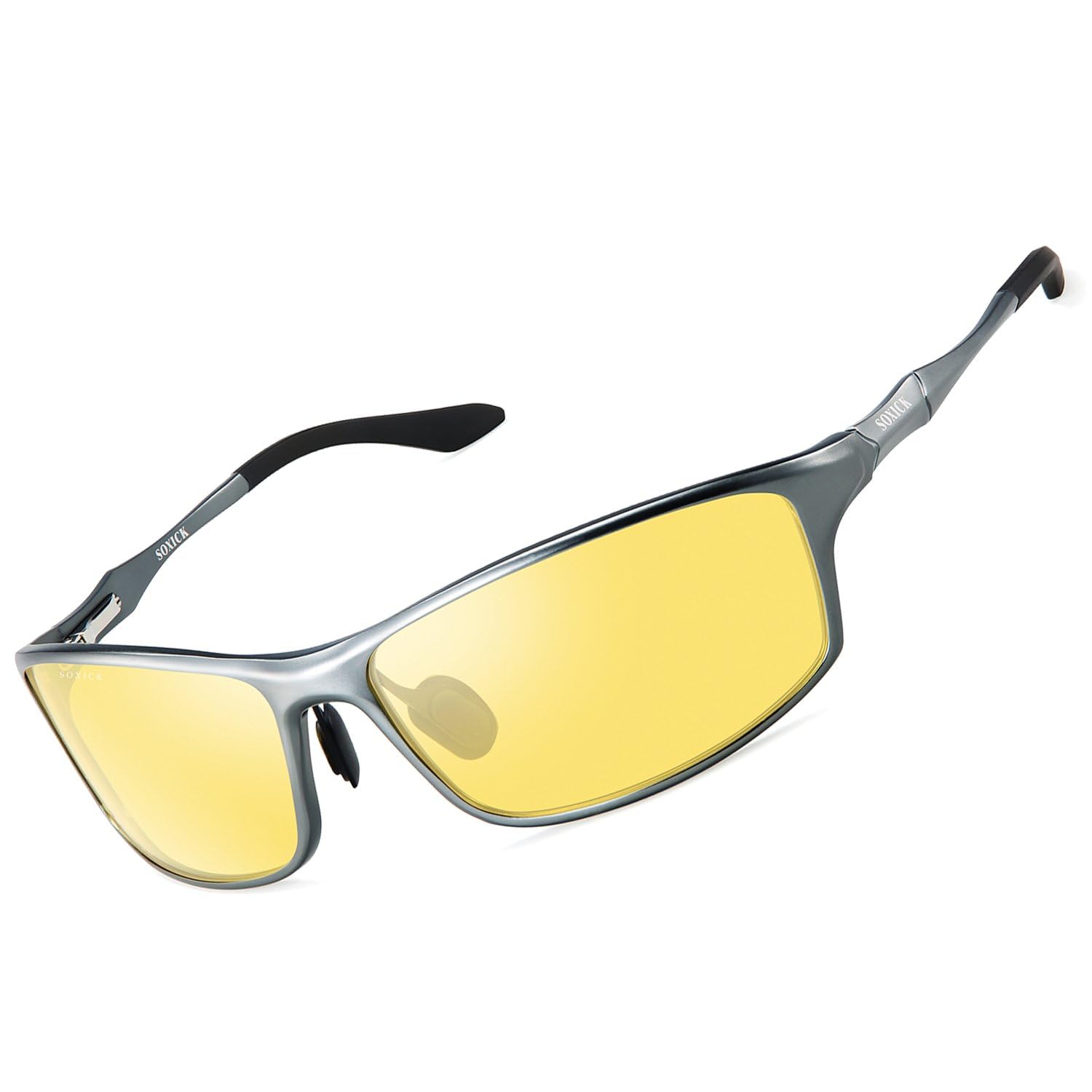
The nose piece bends to your face, which is a small thing that fixes a big fit problem.
Most night glasses give you one shape and hope it suits you. This frame bends instead: a bendable nose piece lets you tune the seating until the lenses sit where you want them, so they stop sliding at every bend in the road.
The lens underneath is a TAC polarized build, layered with UV400 protection — the coating standard that blocks ultraviolet light up to 400 nanometres. The tint does the usual yellow contrast lift for headlights and LED street lamps. It ships in a hard case that several buyers describe as genuinely sturdy rather than an afterthought.
Buyers notice the fit and build most, and the glasses hold up as everyday wear rather than a drawer item. The realistic limit is that LED headlights are brutal — even here, the harshest white lights turn yellow and still glare. Verdicts also split on the toughest cases, with a few wearers seeing no change at all. This model carries the lowest rating count on the list, so weigh that before you buy.
What you actually get: a polarized TAC lens with UV400 protection, a hard case, and a frame you can physically shape to your nose.
Set your expectation here: the most punishing LED high beams still come through bright; this is a comfort improvement, not a shield.
Worth choosing when: every frame you try slides or presses, and you want to bend the fit into place yourself.
Look at the fit-overs instead if: you need glasses that sit over prescription lenses — this is a standalone frame.
6. BLUPOND Knight Visor Day/Night Driving Glasses

A seven-layer polarized lens on a 26-gram metal frame, sold as a full kit.
A 7-layer composite lens that complies with UV400 (the standard for blocking ultraviolet rays) is what earns this pair its near-top spot. It sits on a shatterproof polycarbonate surface over an aluminum-magnesium alloy frame with reinforced hinges and a scratch-resistant coating, and the whole thing weighs 26 grams. This is the same Knight Visor lens family as the set at the top of the list, here as a single day-and-night pair with the accessories bundled in.
The semi-polarized build is what separates it from the cheaper yellow lenses. Semi-polarization is a deliberate compromise: full polarization kills more glare but flattens depth perception and can make dashboard screens unreadable, while semi-polarized keeps the natural cues you need to judge distance at speed. For long-haul and city bus driving, that is the right trade. The kit itself is generous — EVA case, screwdriver, pouch, microfiber cloth, and a car visor clip, in a gift box.
The one caution is real and worth stating plainly: this lens style can split bright light into an apparent second source in the corner of your vision. Owners mention that for one driver the ghosting was unnerving enough to stop using them, though most wearers never see it. Test these on a quiet road first if a stray light in your peripheral vision would rattle you.
The build argument: a 7-layer UV400 lens, a metal frame with reinforced hinges, a scratch coating, and 26 grams of weight — the hardware justifies its place near the top of the range.
The honest asterisk: semi-polarized means glare control is partial by design, and the split-light effect is a rare but genuine complaint.
Built for: professional and long-distance drivers who want depth perception kept intact and a full kit in the bag.
Give it a miss if: you want maximum glare blocking above all else — the semi-polarized lens is tuned for balance, not maximum darkness.
7. Eagle Eyes NIGHT-LITE FitOns Night Driving Glasses
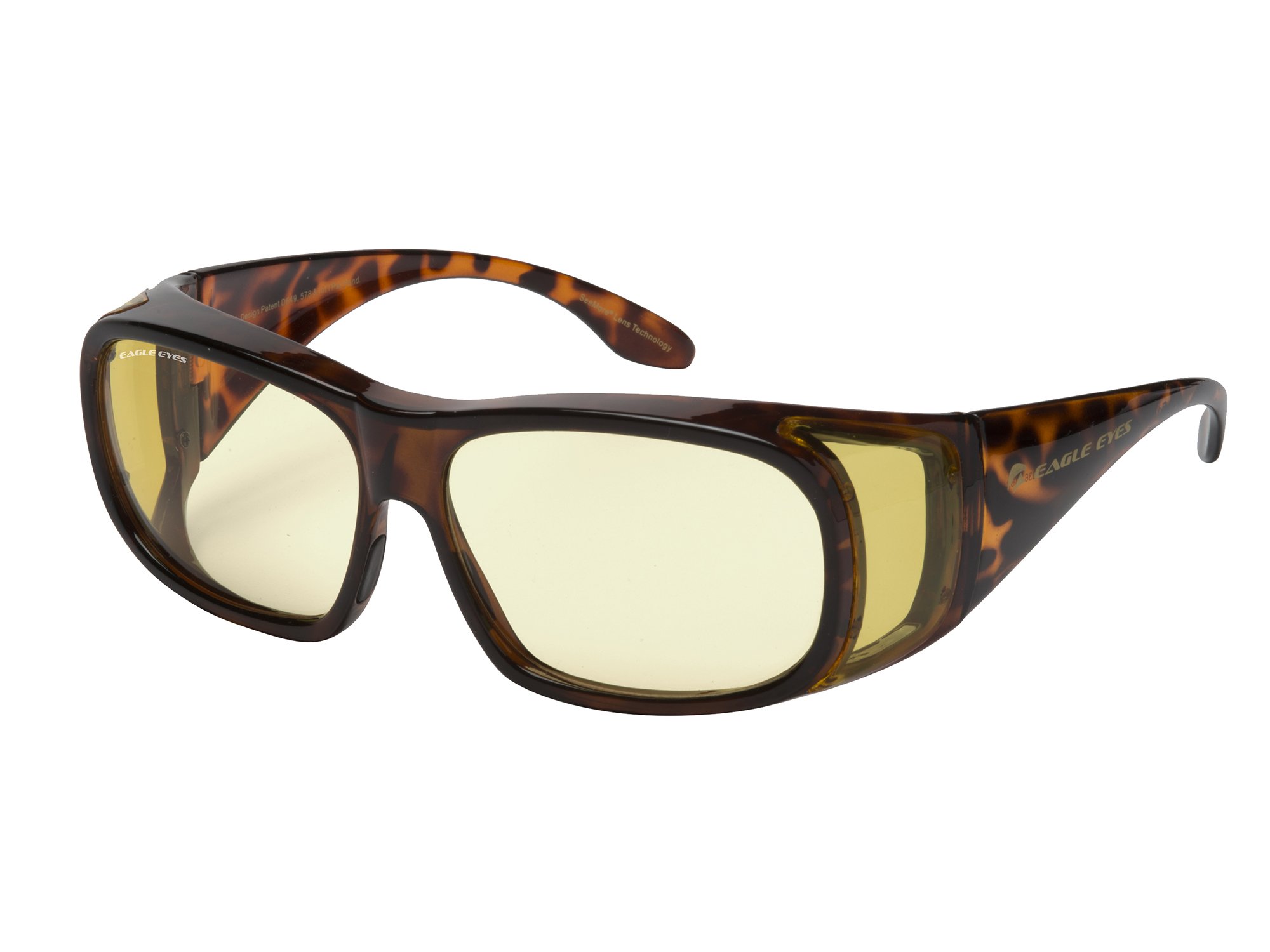
A wrap-around fit-over that softens headlights and brightens the road at dusk.
Thick wrap-around frames block light from the side and top as well as the front, so low sun stops cutting across the lens. Eagle Eyes pairs that shape with the NIGHT-LITE lens, which carries an anti-reflective coating to soften the harsh edge off oncoming lights and billboards.
These shine brightest not in full darkness but in the murky middle — cloudy afternoons, twilight, and a wet road at dusk. Owners describe the road brightening and the headlight glare easing at the same time, which is a useful combination for the drive home in winter. Reading road signs through them while wearing your own prescription frames underneath also works, which is the whole reason to buy a fit-over in the first place.
The split here is honest and you should size it that way. Glare reduction is the most discussed topic on this model, and it is a genuinely mixed bag. Reviewers describe it as impressive for some and close to nothing for others, with a senior driver finding them useful in low light but ineffective in true night conditions. Comfortable fit and good coverage are consistent, though, and customers note the seating runs loose on a small head — a snugger head shape will get more from these. If you need a lens that is strong on a fully unlit road, this is not the pair to bank on.
What sells it
- Wrap-around fit-over design with thick frames that block side and overhead light.
- Anti-reflective coating softens oncoming cars, streetlights, and billboard glare.
- Works over prescription frames while keeping road signs legible.
- Particularly good at brightening a dim road at dusk and under cloud cover.
The fine print
- Glare reduction is the most divided topic — results range from strong to barely noticeable.
- Fit runs loose on smaller heads, and the frame can slide down the nose.
- For deep night driving on an unlit road, expectations should stay modest.
Made for: the glasses-wearer who wants a wrap-around shield that brightens twilight without lifting their prescription frames.
Better to look elsewhere if: you have a narrow face or small head — the loose fit is the recurring note on this frame.
Know the Specs
Anti-Reflective (AR) Coating
A thin layer on the lens surface that stops light bouncing back off the glass. Its job is the halo and the smear around a bright source — the reason a headlight looks like a fuzzy star instead of a clean disc. It works alongside the tint rather than replacing it, which is why the best picks pair both.
Polarization and Semi-Polarization
Polarization is a filter inside the lens that blocks light arriving at a particular angle — the glare bouncing off wet asphalt or a windscreen. Full polarization blocks the most but can flatten your sense of distance. Semi-polarization is a middle setting that keeps natural depth cues while still cutting the worst of the flare.
UV400 Protection
UV400 means the lens blocks ultraviolet light up to a wavelength of 400 nanometres. In plain terms, it covers the range that damages your eyes over years of sun exposure. It says nothing about how dark the lens is, so a light-tinted pair can still carry full UV400.
Fit-Over Frame Dimensions
On a fit-over pair, the only numbers that matter are the width and height of your own frames. The outer glasses need to be wider and deeper than the inner pair, or light sneaks in at the edge. Measure the widest and highest part of your existing frames, then compare against the stated limits.
Common Questions
Do night driving glasses actually work?
Will yellow tinted glasses help with LED headlights?
Can I wear night driving glasses over my prescription glasses?
Are polarized lenses safe for night driving?
Should I use dark sunglasses at night instead?
How do I clean anti-reflective coated lenses without damaging them?
Do night driving glasses help with astigmatism?
Why do some drivers see no difference with night glasses?
Can I use night driving glasses in the rain and fog?
Do night driving glasses help with daytime glare too?
The Bottom Line
For most drivers, the ar coating glasses for night driving winner is the BLUPOND Set of 2 because it covers both ends of the day in one purchase, with a semi-polarized yellow night lens on a 26-gram metal frame. If you wear prescription glasses behind the wheel, the CAXMAN Fit Over is the one to measure against your own frames, with polarized side shields and stated fit limits you can check in advance. And for fog, mist, and motorway spray, the Illumin VECTOR is tuned for the halos that bad weather throws at you.
One last honest point before you click buy: every lens here behaves a little differently on a different face and a different pair of eyes. Start with the semi-polarized BLUPOND if you want the safest bet, give it a week of real drives, and judge it on your own commute rather than on any product page.
How we choose
We do not accept paid placement. Every pick is matched to a real buyer and a real use-case; we do not hands-on test units.
Sources
Specifications: manufacturer listings and product documentation. Review insights: verified customer reviews, as of October 2026. Pricing: not shown on this page (it changes often); check the current price via the retailer link.
As an Amazon Associate, Aappliancez earns from qualifying purchases. This does not affect which products we feature.