Disclosure: Some links in this post are affiliate links. As an Amazon Associate I earn from qualifying purchases, at no extra cost to you. Learn more
Specs are compiled from manufacturer listings and verified buyer reviews and can change over time — please confirm the key details on the product page before buying.
Your apartment kitchen is small, your doorway is narrow, and the last fridge you bought barely squeezed into the corner and then froze the lettuce. The fix isn’t a bigger fridge — it’s a 21- to 24-inch-wide model sized to your alcove and door swing. This guide covers nine apartment-size refrigerators and shows you exactly which ones keep food cold evenly, which quiet down at night, and which give you a real freezer instead of a tiny ice cube bin.
This guide is built by comparing the manufacturers’ published specifications and the patterns across verified customer reviews, so you get each pick’s real strengths and trade-offs instead of marketing spin.
A compact fridge works in a tight kitchen only if its footprint, defrost type, and noise level match how you actually use it. Three things decide that: capacity (how much food it holds), defrost type (whether you thaw ice buildup by hand or the fridge does it), and noise level (how loud it hums near your living area). The right apartment size refrigerator gets all three right for your footprint.
Top Picks

How To Choose The Best Apartment Size Refrigerator
Most people buying a compact fridge obsess over the cubic-foot number printed on the box. The number that actually causes problems is the depth behind it and whether the door can swing open in your galley. Measure the depth and door-swing clearance first, then pick the cubic-foot rating.
Measure the door swing, not just the gap
A fridge marked 21.3 inches wide still needs room for the door to open past 90 degrees so you can pull out the crisper drawer. Reversible doors let you flip the swing to whichever side clears your counter. On a tight galley, that flip is often the difference between a usable fridge and a daily annoyance.
Decide whether you can live with manual defrost
Frost-free models cycle air through the freezer to stop ice building up, so you never chip out a frozen block. Manual-defrost units ask you to empty and melt the freezer now and then. Frost-free skips the scraping; manual defrost has fewer parts that can fail.
Watch for the capacity-versus-layout mismatch
A 10 cu. ft. fridge with four door bins and a full-width crisper holds more real groceries than one with the same rating and thin shelves. Shelf count, door bin count, and a dedicated vegetable drawer matter more than the headline number. Count the door bins and confirm a full-width crisper before you buy.
Side-by-Side Comparison
| Model | Best For | Capacity | Defrost Type | Annual Energy | Amazon |
|---|---|---|---|---|---|
| Upstreman 11.6 Cu.Ft. | Best overall for small families | 11.6 cu. ft. | Frost Free | 310 kwh | Amazon |
| Upstreman 7.7 Cu.Ft. | Quietest daily driver | 7.7 cu. ft. | Manual Defrost | 346 kwh | Amazon |
| Frigidaire EFR753 | Retro look on a budget | 7.5 cu. ft. | Manual | 378 kwh | Amazon |
| BANGSON 7.1 Cu.Ft. | Bottom-freezer convenience | 7.1 cu. ft. | Manual Defrost | — | Amazon |
| BLACK+DECKER BDA10LAS | Flexible door swing | 10 cu. ft. | Frost Free | 297 watts | Amazon |
| Frigidaire Retro 9.2 | Vintage style statement | 9.2 cu. ft. | Manual Defrost | 400 kwh | Amazon |
| BLACK+DECKER BR1000HS | Tightest footprint in 10 cu. ft. | 10 cu. ft. | Frost Free | 297 kilowatt hours per year | Amazon |
| EUHOMY 7.4 Cu.Ft. | Tiny-kitchen freezer split | 7.4 cu. ft. | Manual | 376 kilowatt hours per year | Amazon |
| Cucina Magica 8.5 cu.ft | Lowest listed daily electricity | 8.5 cu. ft. | Manual | 365 kwh | Amazon |
Detailed Reviews
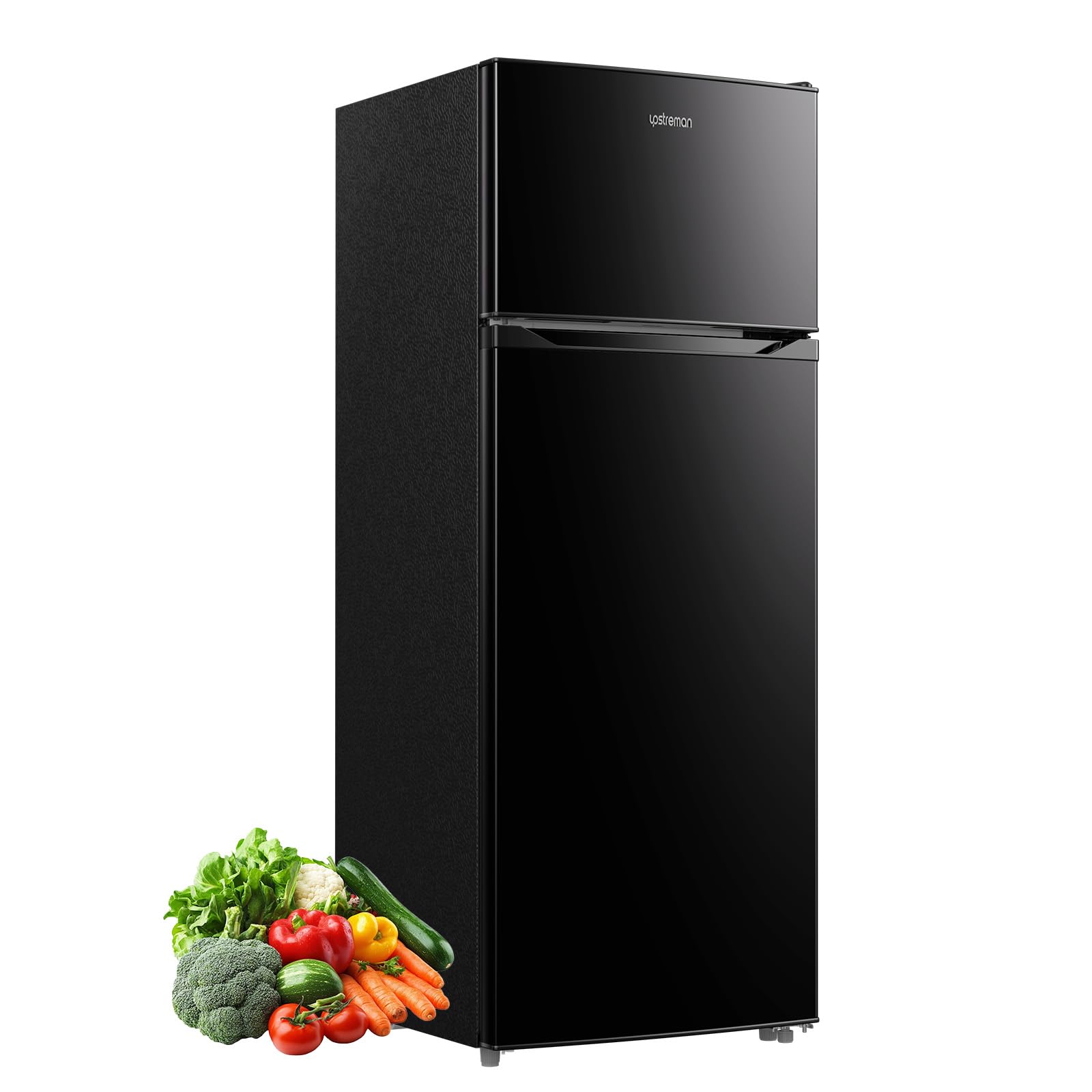
1. Upstreman 11.6 Cu.Ft. Double Door Refrigerator
The big-capacity pick that still calls itself an apartment fridge — and actually earns it.
This is the one to buy if you need a real refrigerator, not a dorm box. The total is 11.6 cu. ft., split into an 8.4 cu. ft. fresh section and a 3.2 cu. ft. top freezer — enough for two people doing a full grocery run. The frost-free auto-defrost system (it cycles cold air through the freezer so ice never builds up) means you skip the chisel-and-pan defrost ritual entirely.
Performance is the whole story here — it is the thing buyers rave about most, and the reason this fridge lands at the top. Owners say it holds temperature rock-solid whether it is crammed full or nearly empty, including the freezer. Setting it up matters: let it sit upright before you plug it in, and the frost-free cycle does the rest.
Run-cost math favors it too. The 310 kwh annual energy figure is lower than the Frigidaire Retro 9.2’s 400 kwh, even though this unit holds 11.6 cubic feet against that model’s 9.2 cubic feet. In plain terms, you get more space for less electricity over a year. It earned ENERGY STAR, and the maker puts average daily cost at about fifteen cents.
What Makes It Stand Out
- 11.6 cu. ft. total with a real 3.2 cu. ft. freezer for a genuine frozen-food supply
- Frost-free auto-defrost means no manual scraping ever
- 310 kwh annual rating beats the larger-capacity feel of smaller rivals
- Reversible door and adjustable shelves let you fit it into odd corners
Where It Asks Something Of You
- At 28.7″ deep and 59.5″ tall, measure your alcove before ordering — this is not a counter-depth unit
- No freezer light, so a battery-powered motion light is a sensible add-on
Buy it if: you want the most capacity and food-storage flexibility in a unit that still fits an apartment kitchen, and you want to skip defrosting forever.
Think twice if: your only slot is shallow — the 28.7-inch depth needs real clearance behind it.
2. Upstreman 7.7 Cu.Ft. Refrigerator with Freezer
For a studio where the fridge sits two feet from your bed, this is the one that disappears into the background.
The number to note is 39dB — the manufacturer’s stated noise level, which is about the volume of a quiet library reading room. That matters in a studio, a converted garage, or any space where the kitchen is also the living room. The 7.7 cu. ft. total splits into a 6.2 cu. ft. fresh zone and a 1.5 cu. ft. freezer, with five door shelves and a crisper drawer on hand for organization.
What wins people over beyond the quiet is the sheer practicality of the layout — performance and small-space sizing come up again and again in owner feedback. The 21-inch-wide, 21-inch-deep, 56-inch-tall footprint slots into spots a full-size unit would never reach, and the reversible door lets you flip the swing to match your counter run.
Honest caveat: this unit needs manual defrost, and the freezer runs cold — set the dial too high and items touching the back wall will freeze. Keep the dial at a moderate setting and give food a little breathing room, and it behaves. Annual energy lands at 346 kwh, with the maker quoting about twelve cents a day.
The daily reality: quiet enough to forget it’s running, cheap to run at 346 kwh a year, and small enough to fit where a full-size fridge simply cannot go.
Reach for this if: your kitchen doubles as your living space and you want a fridge you can hear yourself think next to.
Look elsewhere if: you hate defrosting — this one asks you to do it manually.
Know the Specs
Capacity (Cu. Ft.)
This measures usable volume inside — fresh section plus freezer. An apartment-size fridge typically runs from roughly 7 to 11.6 cubic feet. Capacity tells you how many grocery bags fit, but layout matters just as much: door bins and a crisper drawer stretch what a smaller rating feels like in daily use.
Defrost Type: Frost Free vs Manual
Frost-free models circulate air through the freezer so ice never builds up; you never defrost. Manual-defrost units ask you to empty and melt the freezer periodically. Frost-free means no scraping; manual defrost has fewer parts that can fail.
Annual Energy (kwh)
This is the manufacturer’s stated yearly electricity draw. Lower numbers mean a cheaper running cost over twelve months. Compare this figure across models rather than relying on star labels alone, since it reflects actual usage patterns in the rating.
Noise Level (dB)
Stated in decibels, this tells you how loud the compressor runs. Around 39dB is quiet enough for a studio. Higher values may be noticeable in an open-plan apartment, especially at night when ambient sound drops.
Common Questions
How wide does an apartment size refrigerator need to be to fit a galley kitchen?
Is frost-free better than manual defrost for a small fridge?
Can an apartment size refrigerator fit under a standard counter?
How long should I let a new refrigerator sit before plugging it in?
Do apartment size refrigerators come with a real freezer?
Why does my freezer freeze food solid on one setting and not enough on another?
How much does an apartment size refrigerator cost to run?
Can I put an apartment size refrigerator in an RV or camper?
Does a reversible door really help in a small kitchen?
What is the difference between an apartment fridge and a mini fridge?
The Bottom Line
For most people, the apartment size refrigerator winner is the Upstreman 11.6 Cu.Ft. because it gives you real two-person capacity, a true 3.2 cu. ft. freezer, frost-free operation, and the lowest annual energy figure in this round at 310 kwh. If you want the quietest daily driver, the Upstreman 7.7 Cu.Ft. runs at a stated 39dB and fits a 21-inch-wide slot. And if you need a bottom-freezer layout in a tight footprint, the BANGSON 7.1 Cu.Ft. puts the freezer down low where you don’t have to bend for the fresh food.
How we choose
We do not accept paid placement. Every pick is matched to a real buyer and a real use-case; we do not hands-on test units.
Sources
Specifications: manufacturer listings and product documentation. Review insights: verified customer reviews, as of October 2026. Pricing: not shown on this page (it changes often); check the current price via the retailer link.
As an Amazon Associate, Aappliancez earns from qualifying purchases. This does not affect which products we feature.