Disclosure: Some links in this post are affiliate links. As an Amazon Associate I earn from qualifying purchases, at no extra cost to you. Learn more
Specs are compiled from manufacturer listings and verified buyer reviews and can change over time — please confirm the key details on the product page before buying.
Anti-seize is cheap insurance against the worst kind of car repair: the bolt that snaps off in the hole. A thin smear on threads keeps steel, aluminum, stainless and titanium from welding themselves together over years of heat, salt and vibration. The trick is picking the right base metal for the job, because nickel, copper, graphite and PTFE compounds do different work at different temperatures. Below you’ll find the pick that suits each job, from exhaust manifolds to boat rigging.
This guide is built by comparing the manufacturers’ published specifications and the patterns across verified customer reviews, so you get each pick’s real strengths and trade-offs instead of marketing spin.
The differences that matter most come down to base metal and heat ceiling, not brand name. That is exactly how the picks below are ordered, and it is the same logic you can apply to any anti-seize lubricant you pick up off a shelf.
Top Picks


How To Choose The Best Anti-Seize Lubricant
Start with the temperature the part will actually see, then pick the base metal. An exhaust manifold bolt and a garden hose fitting live in completely different worlds, and one compound rarely serves both well. Get those two things right and the brand barely matters.
Match the base metal to the metal you are joining
Nickel-based compounds are built for stainless steel, titanium and nickel alloys, and they are the pick when copper contamination must be avoided. Copper-based compounds handle spark plugs threaded into aluminum heads, brake caliper pins and exhaust hardware. Silver graphite blends sit in the middle and cover general assembly work. Using a copper compound where the maker warns against copper is the one mistake that actually costs money.
Read the heat ceiling, not the marketing line
A temperature rating tells you the highest heat the compound tolerates before it breaks down. Nickel-based formulas reach up to 2400 degrees Fahrenheit, copper and graphite blends often top out near 1600 degrees Fahrenheit, and marine PTFE pastes are built for saltwater rather than exhaust heat. If your part runs hotter than the ceiling, the compound cooks off and the bolt seizes anyway.
Decide between brush-top, tub and aerosol
A brush-top bottle gives you controlled placement on a thread with almost no waste. A tub or can suits shop use where you apply with your own brush or a toothpick. An aerosol sprays fast and covers wide surfaces, but overspray lands on everything nearby. For most home garage work the brush-top format is the most forgiving.
Side-by-Side Comparison
| Model | Best For | Base Metal | Heat Rating | Size | Amazon |
|---|---|---|---|---|---|
| Permatex 77124 Nickel Anti-Seize★ Best Overall | Stainless and titanium exhaust work | Nickel | 2400 °F | 8 oz | Amazon |
| Liqui Moly LM 508Top Performer | Toolbox staple for spark plugs and brakes | Lithium | -31 °F to 2012 °F | 100 g | Amazon |
| Versachem 13010Spark Plug Pick | Spark plugs in aluminum heads | Copper | — | 8 oz | Amazon |
| Loctite Silver Anti-Seize | General automotive assembly | Graphite / silver | 1600 °F | 8 oz | Amazon |
| GreaseCo Copper Anti-Seize | Brake pins and cams | Copper | — | 8 oz | Amazon |
| Permatex 81464 Aerosol | Fast coverage on wide surfaces | Aluminum, copper, graphite | -80 °F to 1600 °F | 12 oz can | Amazon |
| Never-Seez NSBT-8 | Shop-grade general purpose | Copper powder / aluminum | — | 8 fl oz | Amazon |
| Loctite 299175 Marine Grade | Weather-exposed fasteners | Steel | -20 °F to 2400 °F | 8 oz | Amazon |
| Ultra Tef-Gel | Stainless-to-aluminum boat hardware | PTFE | — | 4 oz | Amazon |
Detailed Reviews
1. Permatex 77124 Nickel Anti-Seize Lubricant, 8 oz.
Our pick — 4.5+★ from 800+ verified ratings; the strongest balance of quality and price.
Nickel is the choice when heat climbs past what copper can handle and copper itself is the enemy.
If you are working on exhaust manifold bolts, muffler clamps or tailpipe assemblies, this is the one to reach for. It holds together up to 2400 degrees Fahrenheit — hot enough that the exhaust system is no longer a factor in whether the compound survives. It is also built for stainless steel, titanium and nickel alloys, and it is the pick when copper contamination must be avoided. On a stainless or titanium exhaust stud, copper can cause trouble the nickel base simply dodges.
The 8 oz can goes a long way because you use so little per fastener. What wins people over is how clean it spreads — no separation, no streaking, and the included brush puts a light, even coat right where you want it. A thin film on an oxygen sensor thread does the job; keep it off the sensor tip and ease off the torque since the compound lowers friction.
The trade-off is the can itself. Several buyers report the container arrives well short of full, which is a packaging complaint, not a performance one — the compound is dense and a thin smear goes far. For everything else, the 2400 degrees Fahrenheit ceiling makes this the safest bet on the list for hot, stressed metal.
Where it earns its place
- Holds up to 2400 °F — exhaust manifolds, tailpipe joints and muffler clamps stay removable.
- Nickel base is safe where copper contamination is off-limits.
- Built for stainless steel, titanium and nickel alloys — the metals most prone to galling.
- Includes a brush for controlled, thin application on threads.
- An 8 oz can lasts a home DIY a very long time.
What to know before you buy
- The can often arrives only partly filled, which is a sourcing complaint, not a formula one.
- Overkill on lower-heat fasteners like valve cover bolts where a copper blend would do.
Top of the pile if: you are fighting heat on stainless or titanium — exhaust studs, manifold bolts, tailpipe hardware, anything copper would contaminate.
Reasonable to pass on: low-temperature work where the nickel premium buys you nothing.
2. Liqui Moly LM 508 Anti-Seize Compound, 100 g
A 100 g tube that lives in every toolbox and quietly does spark plugs, brake pads and lug bolts.
This one is the working mechanic’s answer — a lithium-based compound rated from -31 degrees Fahrenheit to 2012 degrees Fahrenheit, so it covers both winter wheel changes and hot engine bay work. The 100 g tube fits in a toolbox drawer and the sheer tiny amount you use per fastener means it lasts years. The thing everyone raves about is adhesion: it clings where you put it instead of migrating across the garage floor.
The other job it does well is quiet. A thin layer on the back of a brake pad kills squeal without the gummed-up caliper or glued-in pad you get from glue-style anti-squeal pastes. On a boat spark plug thread or a car lug bolt, the compound comes back off cleanly. That is the test that actually matters — the bolt still turns out a year later.
The honest catch is consistency. You do need to knead the tube before use, because the compound separates somewhat as it sits. Werk it in with your fingers and it goes back to a uniform paste. For the price and the coverage across spark plugs, brake calipers and general assembly, that is a fair trade.
what separates it: it quiets squealing brake pads and still keeps the caliper free, because it is a lithium compound (a lithium-based grease) rated from -31 °F to 2012 °F. That range covers a frozen winter morning and a glowing-hot brake rotor alike.
One thing to plan for: knead the tube before each use — the compound separates slightly in storage.
Reach for this if: you want one tube that handles spark plugs, brake pad backs, lug bolts and general assembly, and you don’t mind kneading it.
Look elsewhere if: you need a compound designed for stainless or titanium exhaust temperatures and copper contamination is a concern.
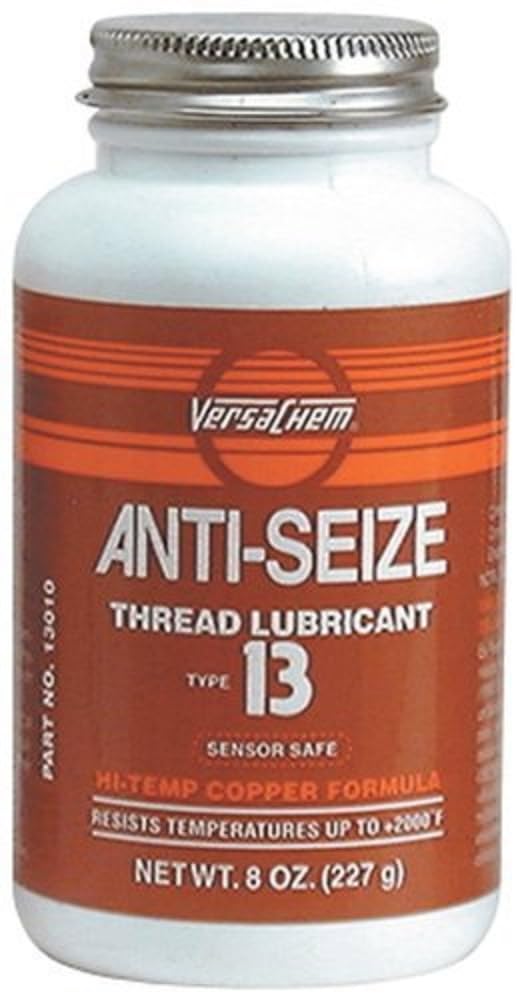
3. Versachem 13010 Anti-Seize Thread Lubricant
Built for spark plugs screwed into aluminum heads, where galling turns a tune-up into a nightmare.
A spark plug threaded into an aluminum head is the classic galling scenario — two dissimilar metals, high heat, and a thread that strips if you force it. The Versachem formula is a high-temperature semi-synthetic grease carrying micro-fine copper flakes plus rust and corrosion inhibitors, and that is exactly what keeps an aluminum thread intact. It is also non-flammable and rated for electrical conductivity, which makes it fair game on battery terminals and ground points.
The brush-top bottle is the format to want here. You get a controlled dab on the plug threads with almost no waste, and the copper spreads further than you expect. A little goes a very long way — one dab per plug covers the job, which is why an 8 oz bottle lasts so long.
Fair warning that is not a formula flaw but a copper fact: the stuff travels. One user put it memorably — you touch a microscopic drop and find it three days later. Paper towels and gloves are your friends. Cold-weather mechanics also note it frees a frozen snowblower shear pin bolt, which is the sort of rescue work copper anti-seize earns its keep doing.
What makes it handy
- Copper flake formula suits spark plugs in aluminum heads — galling and thread stripping stay away.
- Non-flammable and electrically conductive, so battery terminals and ground points are fair game.
- Brush-top bottle puts a controlled dab exactly where you need it.
- Rust and corrosion inhibitors built into the compound.
- A little dab covers a lot of thread.
Where it will test you
- Copper paste migrates — it will end up somewhere you didn’t plan on.
- Keep it clean off the tip of an oxygen sensor when it is used on sensor threads.
Best fit for: anyone who wrenches on spark plugs, snowblower shear pins or electrical terminals and wants a controlled brush-top application.
Not the tool for: stainless or titanium exhaust work where copper contamination has to be avoided.
4. LOCTITE Silver Anti-Seize Lubricant, 8 oz Brushtop Bottle

A graphite and metallic-flake blend that stays put through heat, cold and a coastal salt air.
This is the general-purpose bottle most home garages end up reaching for. Loctite fortifies the compound with graphite and metallic flake, so it won’t evaporate or harden in extreme cold or heat, and it protects up to 1600 degrees Fahrenheit. The maker recommends it for spark plug threads and electrical connections, and its graphite base suits steel-to-aluminum joints in damp weather. Live on a coast and the salt air will tell you quickly which compounds hold up.
The brush-top bottle goes on cleanly with the applicator and you get the same dollop-economy as the rest — a thin smear per fastener covers the job. It works on hand nozzles and hose ends you plan to take apart later, and it handles regular-duty threads with no drama.
The one limit buyers mention is quantity: bottles often arrive only partly filled. The compound itself is fine — the short fill is a sourcing quirk. And keep it on regular-duty applications, because some folks find it hard to source this size at local shops, which makes the bottle you do get that much more valuable.
The value read: a graphite-and-flake compound protecting to 1600 °F, with a brush-top bottle that lets a little smeared thin go a long way.
Worth knowing: the bottle can arrive partially filled, and the 8 oz size is harder to find on a local shelf than you’d expect — so buy once and use it sparingly.
Good grab if: you want one general-use bottle for spark plug threads, electrical connections and everyday assembly in damp or salty air.
Better to skip if: you need a nickel or copper base for hot exhaust or dissimilar-metal marine hardware.
5. GreaseCo Copper Anti-Seize Lubricant, 8 oz Brush-Top

Calcium-sulfonate grease with a copper kick, aimed straight at brake pins and cam assemblies.
Brake caliper pins live a rough life — water, steam, road chemicals, extreme pressure and constant expansion and contraction. This compound is a calcium-sulfonate thickened grease fortified with copper, which the maker shaped specifically for brake pins and brake cams under exactly those conditions. Its dry-film of protective solids reduces galling, seizing, welding and carbon fusion on brake pins and cams. That dry film is why you need less torque to break a fastener loose later.
The brush-top applicator is included and it does the job. The one gripe is that the brush runs small — on larger brake hardware you’ll spend a little extra time getting coverage, but you still get there. Beyond brakes, the compound covers spark plugs, exhaust manifold bolts, lug nuts, battery terminals and gaskets, which makes it a versatile bottle for one purchase.
Where it earns trust is in harsh weather. It resists water and corrosion, so marine and salted-road applications are in its wheelhouse. On a 2010 Dodge Ram 1500’s spark plugs, a user put it plainly: it works great. The honest limit is the small brush and the copper base itself — on stainless or titanium where copper is a problem, choose the nickel formula instead.
What you gain
- Calcium-sulfonate grease with copper — purpose-built for brake pins and cams.
- Dry-film protective solids reduce the torque needed to break a fastener loose.
- Water and corrosion resistant, so marine and salted-road use holds up.
- Also covers spark plugs, exhaust bolts, lug nuts and battery terminals.
What to plan for
- The application brush is small — larger brake hardware takes a little longer to coat.
- Copper base rules it out where copper contamination must be avoided.
Made for: brake jobs and salt-belt or marine hardware where water and corrosion are the daily enemy.
Hands off if: you are working stainless or titanium and copper contamination is a real risk.
6. Permatex 81464 Anti-Seize Lubricant, 12 oz. Aerosol Can

Spray-on anti-seize that reaches awkward places, rated from well below freezing to 1600 degrees Fahrenheit.
An aerosol changes how you apply anti-seize, and that is either a feature or a headache. This one runs from -80 degrees Fahrenheit to 1600 degrees Fahrenheit and blends aluminum, copper and graphite for salt, corrosion and moisture resistance. It is thinner than the brush version, so it flows into tight spots and covers wide surfaces fast. If your target is a rusted lawn tractor axle that keeps seizing the rear wheel, a spray can gets there without a brush.
The chemical warning is the real reason to read the label. The manufacturer explicitly prohibits use on wheel lug studs — wheels must be torqued dry — and that instruction is on the can for a reason. Use it on anchor pins, u-bolts, spring bolts, hinges, gears and rollers instead, and clean wheel studs with a wire brush before torquing to spec.
Now the messy part. Spraying anti-seize is hard to aim, and it lands on more than your target — nearby surfaces, the floor, your hair. That is the trade-off for the speed and the reach. A couple of buyers also report the can arrived without a nozzle, though a spare from any spray can fits. If you can aim carefully and accept the overspray, the 12 oz can covers a lot of ground.
Where it shines: a 12 oz aerosol rated -80 °F to 1600 °F that flows into tight spots and covers wide surfaces in seconds.
The real caution: read the label before you spray — the maker prohibits use on wheel lug studs, and this stuff overshoots the mark easily.
Pick this up if: you want speed and reach on lawn tractor axles, hinges, gears or rollers, and can control a spray pattern.
Steer clear if: you need precise thin-film placement on spark plug or lug threads — go brush-top for that.
7. Never-Seez NSBT-8 Silver Gray Anti-Seize Compound, 8 fl. oz.

The silver-gray can that has outlived generations of toolboxes, and still earns its spot.
Never-Seez is one of those products you inherit. The copper-powder and aluminum compound is compatible with stainless steel, titanium, magnesium and other hard metals, and it is a regular-grade formula built to minimize parts replacement costs by keeping joints dissolvable. The stiff brush top aids application on a thread. The 8 fl oz can is large and lasts a very long time for the home mechanic — the sort of purchase where you expect to hand the can to the next owner.
The application story is simple: easy in, and later easy out. Anyone who has snapped a nut off a rusted bracket knows the value of being able to back a bolt off cleanly a year down the road. On a Cub Cadet PTO clutch replacement, it came recommended over a general-purpose penetrant because it actually protects the part instead of temporarily freeing it.
Own up to the trade-off: it is messy and stubborn to clean off hands, and it’s easy to over-apply. Use a little, wipe the excess, and keep paper towels within reach. Beyond that, this is a workhorse general-purpose compound, not a specialty marine or oxygen-sensor formula.
Why it earns its reputation
- Copper and aluminum compound works across stainless steel, titanium and magnesium.
- Stiff brush top puts a controlled dollop on the thread.
- 8 fl oz can lasts a very long time for home use.
- Joints break free cleanly even after years of exposure.
What you’re accepting
- Messy and hard to clean off hands — plan on paper towels and gloves.
- Easy to over-apply, so a little dab is the right dose.
The one to get if: you want a general-purpose can that will sit in the toolbox for years and handle rusted fasteners across most metals.
Not your answer if: you need a purpose-made marine or stainless-to-aluminum corrosion fighter.
8. Loctite 299175 Marine Grade Anti-Seize Paste, 8 oz Can
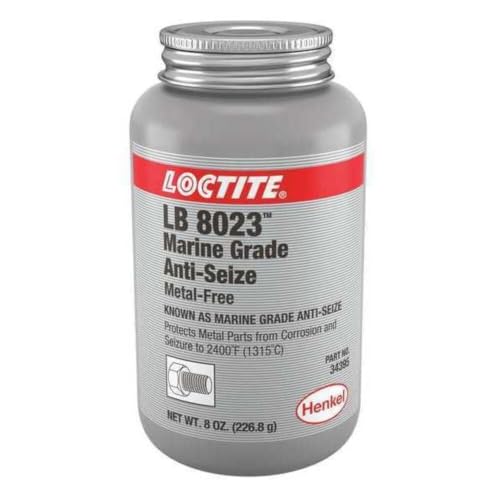
Marine grade on the label, 2400 degrees Fahrenheit on the spec — weather and heat in one can.
Two numbers set this can apart from its stablemates: a 2400 degrees Fahrenheit heat ceiling and a -20 degrees Fahrenheit cold floor, in a formula the maker labels marine grade. That is a rare combination — a compound that protects metal from corrosion and seizure through both weather and high temperature. Fasteners, pipe joints, water pump flanges, gaskets and pulp-and-paper-mill equipment are all in its recommended use, and the steel compatibility keeps it grounded for hard metal work.
The field reports back the weather claim up. On wet, weather-exposed parts, more than one buyer rates it above the silver-colored pastes. A garden hose manifold that always fought coming off in the fall comes off with a smear of this on the threads. On a wood stove door and a truck bed rack it does the same job — keeps a bolt turning when you need it to.
The honest complaint is the container. The brush comes clumped and the cap can break off, and the stuff is messy by nature. If you edge excess lube off on the rim before you apply, you keep it clean. That is a small handling tax on a compound whose 2400 degrees Fahrenheit ceiling covers serious heat.
top-tier heat range here: one can handles salt spray and searing heat, with marine-grade protection rated from -20 °F to 2400 °F. That means a boat trailer hub and an exhaust manifold bolt both stay protected.
The everyday annoyance: the included brush clumps and the cap can break, so wipe the rim clean before you apply and treat the can gently.
Worth the pick if: you need weather protection and high-heat coverage on fasteners, pipe joints, gaskets or water pump flanges in one product.
Not for you if: you want a clean, no-fuss brush and are working only moderate temperatures.
9. Ultra Tef-Gel Anti-Corrosion Lubricant, 4 oz Tub
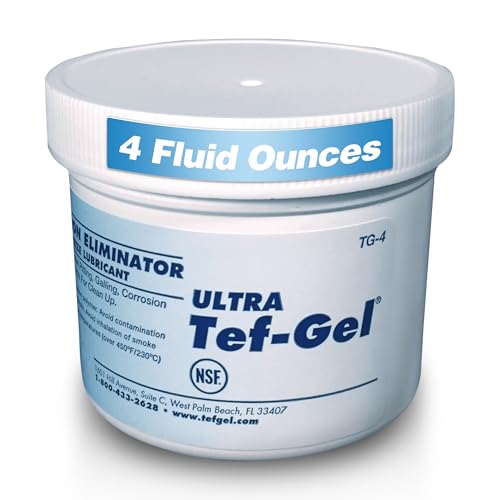
PTFE paste for the stainless bolt threaded into an aluminum spar that you never want to snap.
This is a different animal from the metal-flake compounds: a PTFE-based paste aimed squarely at galvanic corrosion between dissimilar metals, and at stainless hardware in saltwater. Compatible with stainless steel, it protects against rust and galvanic corrosion, prevents galling, and stays effective in both salt and fresh water. It also carries a food-grade rating, meaning it is safe for incidental food contact in food processing equipment — a rare credential on this list.
The 4 oz tub is small on purpose: a toothpick’s worth on a thread is enough, so one tub lasts a long time. If you have snapped stainless bolts out of aluminum hardware, this is the pick for you. It breaks the galvanic circuit — the electrical path between two unlike metals that drives corrosion — which is exactly where metal-flake pastes fall short on wet, dissimilar-metal joints.
The trade-off is cost and consistency. It is the priciest tub here, and pricing is a common point of contention, though the tiny dose per application stretches it. It also feels sticky to apply, and it is not a high-heat compound — this is for boat lift bolts, sailboat rigging and aluminum-to-stainless interfaces, not a glowing exhaust manifold.
Why boaters keep buying it
- PTFE formula blocks galvanic corrosion between stainless steel and aluminum.
- Waterproof through salt and fresh water — built for boat hardware and rigging.
- Food-grade rating for incidental food contact.
- A tiny dot per thread means a 4 oz tub lasts a long time.
What you give up
- The highest price of the group.
- Sticky to apply, and not a high-heat compound for exhaust work.
Buy it if: you own a boat and need stainless, aluminum and alloy hardware to come apart after saltwater exposure.
Leave it if: you need a high-heat compound for exhaust components or a general automotive anti-seize.
Know the Specs
Heat ceiling in degrees Fahrenheit
The highest temperature a compound tolerates before it breaks down. Nickel-based formulas go up to 2400 degrees Fahrenheit, which covers exhaust manifolds and turbo hardware. Copper and graphite blends typically top out near 1600 degrees Fahrenheit. Match the ceiling to your part or the compound cooks off and the bolt seizes anyway.
Base metal and contamination risk
Nickel, copper, graphite, lithium and PTFE each behave differently on a thread. The critical rule is contamination: some oxygen sensors and stainless exhaust systems call for a copper-free compound, which is where a nickel formula earns its keep. Copper anti-seize is the right pick for spark plugs in aluminum heads and for brake pins.
Galling and dissimilar metals
Galling is when two metals cold-weld under pressure and strip their threads. It happens most often when steel meets aluminum or stainless. A thin film of anti-seize between steel and aluminum or stainless keeps them from fusing, so the fastener turns out instead of snapping in the hole.
Form factor and dose
Brush-top bottles give controlled placement on a thread with minimal waste. Tubs suit shop use with your own applicator. Aerosols spray fast but overshoot. In every form, a tiny dose per fastener is the right amount — a thin smear goes further than a dollop and leaves less mess to clean up.
Common Questions
What is anti-seize lubricant actually for?
Should I use nickel or copper anti-seize on exhaust manifold bolts?
Can I use anti-seize on wheel lug nuts?
How much anti-seize should I apply per bolt?
Does anti-seize affect torque when I tighten a bolt?
Can I use copper anti-seize on an oxygen sensor thread?
Will anti-seize stop a bolt from rusting on a boat?
How long does a can or tube of anti-seize last?
Is silver anti-seize better than copper?
Is anti-seize messy to work with?
The Bottom Line
For most home garages, the anti-seize lubricant winner is the Permatex 77124 Nickel Anti-Seize because its 2400 degrees Fahrenheit ceiling and nickel base cover both the hottest exhaust work and the metals that hate copper. If you want one everyday tube for spark plugs, brake pads and general assembly, the Liqui Moly LM 508 does the job across -31 to 2012 degrees Fahrenheit. And if you are protecting stainless-to-aluminum hardware from saltwater corrosion, the Ultra Tef-Gel is the one built for the job.
How we choose
We do not accept paid placement. Every pick is matched to a real buyer and a real use-case; we do not hands-on test units.
Sources
Specifications: manufacturer listings and product documentation. Review insights: verified customer reviews, as of October 2026. Pricing: not shown on this page (it changes often); check the current price via the retailer link.
As an Amazon Associate, Aappliancez earns from qualifying purchases. This does not affect which products we feature.