Disclosure: Some links in this post are affiliate links. As an Amazon Associate I earn from qualifying purchases, at no extra cost to you. Learn more
Specs are compiled from manufacturer listings and verified buyer reviews and can change over time — please confirm the key details on the product page before buying.
If you want the short answer: the La Roche-Posay Cicaplast Gel B5 is the one most people should buy, because it protects a healing scar while it closes and feels weightless doing it. Below that, the right pick depends on one thing — whether your scar is still fresh or already years old. Fresh surgical, laser, or stitch lines want a protective gel. Old, darkened, raised marks want a silicone layer or a niacinamide formula that works on color. That single split decides almost everything here.
This guide is built by comparing the manufacturers’ published specifications and the patterns across verified customer reviews, so you get each pick’s real strengths and trade-offs instead of marketing spin.
You will see what each formula actually contains, how it feels on skin, and where it falls short. By the end you will know exactly which tube belongs in your bathroom cabinet — and that is the whole point of this breakdown of the anti-scar lotion shortlist.
Top Picks

How To Choose The Best Anti-Scar Lotion
The biggest mistake people make is buying one tube for every scar on their body. A scar that is three weeks old is still rebuilding tissue. A scar that is five years old has finished rebuilding and now only has color and texture left to work on. Those two jobs need different ingredients, and no single formula is strongest at both.
Match the formula to the age of the scar
For a fresh line — surgery, stitches, a laser session — look for a protective gel that holds moisture in while the skin closes. Glycerin and panthenol are the workhorses here, because they pull water into the surface and keep the barrier calm. Something like 21% glycerin with 5% panthenol tells you the formula is built for hydration rather than color correction.
For an older mark that has gone dark or raised, you want either a silicone layer or a brightening ingredient. Silicone works by sitting on the surface as a thin sheet that holds moisture against the scar. Niacinamide works on the look of discoloration. Neither one does much for a wound that is still open, so timing matters more than brand loyalty.
Check the texture before anything else
Here is the honest part most listings skip: the best formula in the world is useless if you stop applying it. A scar cream goes on at least twice a day, sometimes three times, for weeks. If it pills under your clothes, stains a collar, or leaves a shine on your face, you will quietly quit. Fast-drying and non-greasy are not luxury features — they are why you keep applying it for weeks.
Also check whether the product carries sun protection. UV exposure is one of the things that darkens a scar over time, so a formula with SPF 30 built in saves you a separate step on any scar that sees daylight.
Side-by-Side Comparison
| Model | Best For | Size | Key Ingredient | Texture | Amazon |
|---|---|---|---|---|---|
| La Roche-Posay Cicaplast Gel B5★ Best Overall | Fresh scars still healing | 1.35 oz | 21% Glycerin + 5% Panthenol | Non-greasy gel | Amazon |
| Mederma Scar Serum for Old ScarsBest for Old Scars | Old, darkened marks | 1 Fl Oz | Niacinamide + Vitamin E | Non-greasy serum | Amazon |
| Medical Grade Silicone Scar Gel | Surgical and raised scars | 1.7 oz | Silicone, fragrance-free | Fast-drying | Amazon |
| Mederma Scar Cream Plus SPF 30 | Scars exposed to sun | 40g | Cepalin + SPF 30 | Cream | Amazon |
| Rejuvaskin RejuvaSil Silicone Gel | Face and under makeup | 15ml | 97% Liquid Silicone + Vitamin C | Clear, water-resistant | Amazon |
Detailed Reviews
1. La Roche-Posay Cicaplast Gel B5 1.35oz
Our pick — 4.5+★ from 1,000+ verified ratings; the strongest balance of quality and price.
The protective layer you want on a scar that is still closing, not yet fading.
Start with what is actually in the tube, because this formula is unusually transparent about it. You get 21% glycerin, an ingredient that pulls water into the skin surface, alongside 5% panthenol, which is the soothing partner that calms a barrier that has been disrupted. Madecassoside and a mineral complex of copper, zinc, and manganese round it out. Hyaluronic acid and La Roche-Posay thermal spring water carry the hydration. Nothing here is trying to bleach a mark lighter — the whole job is protection while skin heals.
That makes it the right call for a very specific moment: a line that is weeks old, not years. It is tested post-procedure, post-stitches, and post-laser, so it is built for skin that has just been through something. The gel texture is the part that wins people over — it sinks in without the greasy film that makes people stop using a cream. It also sits at 3.21 ounces total, which is 5.1 times the weight of the RejuvaSil tube further down this list, so you are getting a noticeably bigger supply for a product you apply several times a day.
The catch is worth naming plainly. This is not a fading product, and if your scar is a decade old and brown, this gel will hydrate it and do very little for the color. It is also a gel, so on a raised scar it will not give you the occlusive silicone sheet effect that the dedicated silicone picks do. Buy it for the healing window, and understand that you may want a different formula once that window closes.
What earns its place on top
- 21% glycerin plus 5% panthenol gives a genuinely hydrating, barrier-focused formula for fresh scars
- Gel texture absorbs without grease, so twice-daily use does not feel like a chore
- Tested post-procedure, post-stitches, and post-laser — built for skin that just went through trauma
- Generous 1.35 oz tube for a product you reapply through the day
Where it stops short
- No brightening or fading ingredient, so old discolored scars see little change
- No SPF, so a scar in daylight still needs a separate sunscreen
- Gel rather than silicone, so it will not flatten a raised scar the way a silicone layer can
Reach for this if: your scar is new, still healing, or sitting on skin that feels tight and irritated after a procedure.
Look elsewhere if: your mark is old and dark — a niacinamide or silicone formula does that job better.
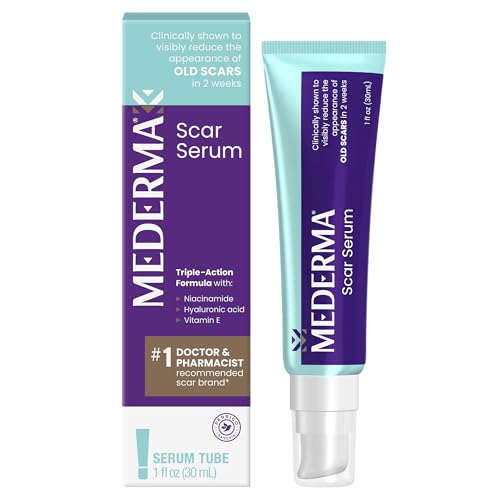
2. Mederma Scar Serum 1 Fl Oz
Aimed squarely at the scar you gave up on years ago.
Most scar products quietly assume you are treating a wound from last month. This one does the opposite — it is built for marks that are six months or older, and the instructions say so directly: apply twice daily for 8 weeks. The formula leans on niacinamide, vitamin E, and hyaluronic acid, a trio that hydrates the surface, works on the look of discoloration, and smooths texture rather than sealing a wound shut.
What owners talk about most is the visible change in how the scar looks, and the value holds up alongside it — the serum is one of the more affordable ways to treat an old mark consistently for two months. The non-greasy finish keeps coming up too, and it matters here because a serum you wear twice a day for eight weeks has to disappear into the skin. The bottle is compact at 5.5 x 1.5 x 1.25 inches, which makes it easy to keep on a nightstand where you will actually remember it.
The honest limit is patience. Eight weeks of twice-daily application is the real commitment, and a serum that works on color is not going to do much for a scar that is raised and thick — that is a silicone job. If you want something that visibly changes a years-old dark mark, this is the formula built for exactly that, and it is the most affordable way to make the attempt.
The eight-week bet: a niacinamide serum aimed at discoloration on scars six months or older, applied twice daily for a stated 8-week course, at a price that makes the full run easy to justify.
The honest trade-off: the timeline is not flexible. Stop at three weeks and you have not really tested it, and a raised or thickened scar is outside what this formula is designed to change.
Pick it when: your scar has finished healing and what bothers you is the color, not the texture.
Think twice if: you want results in a fortnight — this one asks for two months of consistency.
3. Medical Grade Silicone Scar Gel for Surgical Scars, 1.7oz
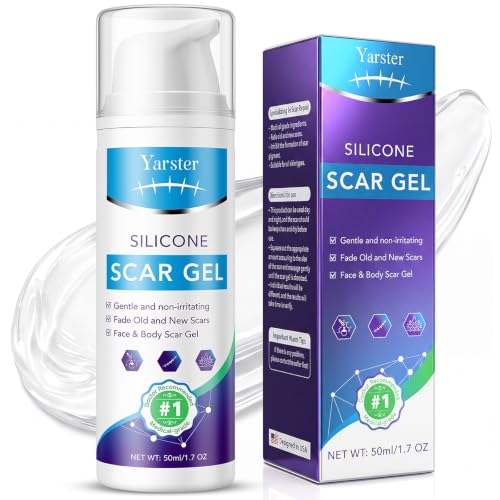
Silicone that dries down and stays put on a surgical line without a sheet.
If you have ever tried a silicone sheet on a knee or a shoulder, you know the problem — it peels, it bunches, it will not follow a joint. This gel takes the same idea and makes it flexible. It forms a breathable, invisible shield over the scar that mimics the skin’s own barrier, and it is 100% fragrance-free, paraben-free, and oil-free, which matters on a C-section line or anywhere on the face.
Effectiveness is the thing that carries this product, and the quality of the formula sits right behind it. The fast-drying finish is what makes daily use realistic: it stays put without staining clothes, so you are not planning your wardrobe around your scar treatment. It also targets the itch and discomfort of sensitive scar tissue, a complaint most scar gels ignore. At 1.7 ounces you get a solid supply for a product applied thinly.
Here is where it sits differently from the Cicaplast gel above — this one is designed to flatten and soften a raised scar, while that one is designed to protect skin that is still healing. So it is the better tool for a mature surgical scar and a worse tool for a wound that has not closed. The one thing to plan for is patience with the format: a thin layer needs reapplying through the day to keep that shield intact.
The joint-friendly advantage: a silicone gel that conforms to knees, elbows, and the face where a flat sheet cannot, drying fast enough to wear under clothes without transfer.
What to expect: a clean fragrance-free, oil-free, paraben-free formula that works on raised and hypertrophic scars — but not on an open or freshly stitched wound.
Suits you if: you have a surgical, burn, or acne scar that is raised and you want silicone without the sheet.
Pass if: your scar is still an open healing line — protection, not flattening, is what that stage needs.
4. Mederma Scar Cream Plus SPF 30 40g

The one that handles the sun problem most scar creams quietly ignore.
UV light is one of the reasons a scar darkens over the years, and almost no scar product deals with it. This cream folds SPF 30 sunscreen into the formula, so the scar you are treating is also shielded from the exposure that darkens and discolors it. The base is Cepalin botanical extract, which the brand says penetrates skin to support moisture retention and collagen production; the label calls for at least three applications a day.
Scar protection is what this one is known for, and quality sits alongside it — buyers report it in the context of post-surgery recovery, where protecting a fresh line from sun is the daily battle. One detailed account describes a 20-year-old brown mark on a leg that faded dramatically after use. A separate account of a knee replacement describes applying two to three times a day, keeping the area covered, and seeing the scar look less severe after four weeks.
The trade-off is real and it is cost, which is the one place this formula draws complaints. It is the priciest pick here, and the routine is heavier than the others — at least three applications daily, eight weeks on new scars and three to six months on existing ones, plus reapplication at least every two hours in direct sun. That is a lot of cream and a lot of remembering. The upside is that you drop a separate sunscreen step entirely, which for a scar on your face or hands is a genuine simplification.
Why the SPF changes things: a Cepalin-based scar cream with SPF 30 built in, so sun protection and scar care happen in one application instead of two.
The commitment it asks: at least three applications a day, eight weeks for new scars and three to six months for existing ones — this is the most demanding routine on the list.
Best for: a scar in a sun-exposed spot — face, hands, arms — where fading and UV defense need to happen together.
Not ideal if: you want the lowest-effort routine, since three daily applications is the baseline here.
5. Rejuvaskin RejuvaSil Silicone Gel 15ml
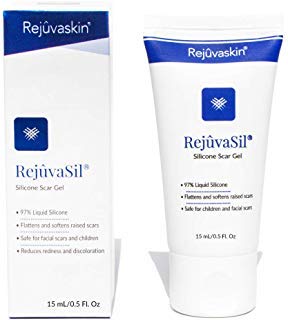
A clear silicone layer thin enough to disappear under makeup.
The number that defines this one is 97% — that is the share of the formula that is liquid silicone, and it dries into a thin, flexible layer across the skin. On top of that sits vitamin C, an antioxidant, plus squalane, so the gel is doing surface smoothing while an antioxidant works alongside it. It is clear, odorless, and non-greasy, and it is labeled non-comedogenic, meaning it is formulated not to clog pores — which is the reason it can go on a face scar and not just a knee.
Reviews focus on effectiveness, and one recurring case is a scar from nose stitches that improved with use. The wearability is the quiet selling point: it is water-resistant, dries quickly, and is designed to sit invisibly under makeup or sunscreen. It is also hypoallergenic, free from added fragrance and parabens, and made for all skin types.
Now the part you need to weigh. This is 0.63 ounces, versus 3.21 ounces for the Cicaplast gel — a genuinely small tube, and its package footprint of 3.43 x 1.18 x 1.18 inches reflects that. For a face scar where you use a tiny dot per application, that is workable. For a large body scar, you will run through it fast. On top of that, the listing describes the formula in two slightly different ways, once as silicone with vitamin C and squalane and once with emu oil added, so check the current ingredient panel if emu oil is something you want to avoid.
Where it shines: a 97% liquid silicone gel with vitamin C and squalane that dries clear, water-resistant, and non-comedogenic — the rare scar product designed for a face you still put makeup on.
The size reality: at 0.63 ounces it is a small tube, sized for spot use on a face or small scar rather than a broad area.
Choose it for: a facial scar or a small mark where invisible, makeup-friendly wear is the deciding factor.
Skip it for: a large body scar — the tube is too small to cover real ground economically.
Know the Specs
Glycerin and Panthenol
Glycerin is a humectant — it draws water into the top layer of skin. Panthenol is the soothing partner that calms a disrupted barrier. When you see a formula listing 21% glycerin and 5% panthenol, it is telling you the job is hydration and protection rather than color correction. That is what a scar still in its healing window needs most.
Liquid Silicone Percentage
Silicone works by forming a thin layer over the scar that holds moisture against the surface. A formula that is 97% liquid silicone dries into a flexible, breathable shield. Higher silicone content tends to mean a clearer, thinner film, which is why silicone gels suit the face and joints where a flat silicone sheet will not stay put.
Niacinamide
Niacinamide is a form of vitamin B3 used for the look of uneven tone. In a scar product it is aimed at dark, discolored marks rather than raised ones. It appears alongside hydrators like hyaluronic acid and vitamin E, because a scar that has finished healing still needs moisture while the color work happens.
SPF in a Scar Cream
UV exposure is one of the things that darkens a scar over time. A scar cream with SPF 30 sunscreen built in protects the mark while you treat it, which removes a separate step from your routine. The label standard for a formula like this is reapplication at least every two hours in direct sunlight.
Common Questions
Should I use a silicone gel or a cream on a surgical scar?
How long before I see a difference on an old scar?
Can I wear makeup over a silicone scar gel on my face?
Does a scar cream with SPF replace my sunscreen?
Is silicone gel better than silicone sheets?
Can I use these on a C-section scar?
Will a scar lotion work on acne marks and discoloration?
What does non-comedogenic mean on a scar gel?
How much product do I actually need per application?
Can I switch products as my scar changes?
The Bottom Line
For most people, the winner among the anti-scar lotion options is the La Roche-Posay Cicaplast Gel B5, because 21% glycerin and 5% panthenol protect a scar through the healing window that decides how it looks later. If your scar has already healed and the color is what bothers you, the Mederma Scar Serum for Old Scars is built for exactly that with niacinamide, and its 8-week course is the most affordable way to commit to it. And for a scar that sees daylight — a face, hand, or arm — the Mederma Scar Cream Plus SPF 30 folds sun protection into the routine so you are not juggling two products.
The one thing worth doing today: pick the formula for the stage your scar is actually in. Fresh and healing calls for protection. Old and dark calls for niacinamide or silicone. Get that match right and you will keep applying it long enough to see a difference.
How we choose
We do not accept paid placement. Every pick is matched to a real buyer and a real use-case; we do not hands-on test units.
Sources
Specifications: manufacturer listings and product documentation. Review insights: verified customer reviews, as of October 2026. Pricing: not shown on this page (it changes often); check the current price via the retailer link.
As an Amazon Associate, Aappliancez earns from qualifying purchases. This does not affect which products we feature.