Disclosure: Some links in this post are affiliate links. As an Amazon Associate I earn from qualifying purchases, at no extra cost to you. Learn more
Specs are compiled from manufacturer listings and verified buyer reviews and can change over time — please confirm the key details on the product page before buying.
If your glasses fog the moment you step inside, pull up a mask, or walk into a cold rink, the fix is a coating treatment you apply yourself — not a new pair of lenses. The five products below all do that job in different ways: a waxy buff-on balm, a peel-and-wipe packet, a spray for helmet visors, and a screwless reader frame whose blue-light filter cuts glare on screens. Pick the format that fits where you actually get fogged.
This guide is built by comparing the manufacturers’ published specifications and the patterns across verified customer reviews, so you get each pick’s real strengths and trade-offs instead of marketing spin.
Every option here is safe on coated lenses, but they differ sharply in how long the effect holds and how much buffing they demand. Here is the honest breakdown of the anti reflective coating for glasses formats that actually hold up in daily use.
Top Picks


How To Choose The Best Anti Reflective Coating for Glasses
Fogging happens when warm, moist air hits a cold lens and condenses into droplets. An anti-fog treatment works by leaving a thin film that spreads that moisture into a flat sheet instead of beads. The film is only as good as the way you apply it, so the format matters as much as the formula.
Paste or balm versus spray versus wipe
A paste is rubbed on and buffed off, and a tiny amount goes a long way — it suits someone who can prep their glasses at home and let the film set. A spray is faster and reaches into helmet visors and goggle frames, but the thin coating wears off faster and needs topping up. A pre-moistened wipe is the simplest of all: tear, wipe, done, with no bottle to carry. Wipes tend to leave a slight film, so most people follow with a dry cloth.
Why “safe on coated lenses” is the line to read first
Your glasses almost certainly carry an anti-reflective coating already — the thin multi-layer film that cuts glare and lets more light through. An abrasive cleaner or a harsh solvent can strip or cloud that coating permanently. Look for a formula described as non-abrasive and safe on coated lenses, and avoid paper towels or synthetic cloths when you buff, since they can scratch as surely as grit does.
How long the effect actually lasts
No treatment here is permanent. The film survives a few washings, then thins out and needs another pass. If you wear glasses under a mask all day or ride in cold weather, expect to reapply more often than someone who only fights fog on the ski hill. Judge a product by how it behaves on its third day, not its first.
Side-by-Side Comparison
| Model | Best For | Format | Volume / Count | Lens Safety | Amazon |
|---|---|---|---|---|---|
| EK World Wide Cat Crap Paste 3-Pack★ Best Overall | Home prep and storage | Buff-on paste | 3-pack, 1.76 oz total | Safe on coated lenses | Amazon |
| Optix Clear Guard Anti Fog Lens WipesBest for Travel | Pocket and travel | Pre-moistened wipe | 100-count | Alcohol-free, non-abrasive | Amazon |
| Muc-Off Premium Anti-Fog Treatment | Helmets and goggles | Spray | 32 ml | Micro-thin clear coating | Amazon |
| EK USA Cat Crap Anti-Fog Balm 2-Pack | Single-lens touch-ups | Pocket balm | 0.5 oz, 2-pack | Safe on all lens coatings | Amazon |
| Anti Glare Blue Light Reading Glasses | Screen glare and readers | Framed eyewear | 14 g frame + lens | Blue light blocking | Amazon |
Detailed Reviews
1. EK World Wide CAT Crap Paste 3-Pack
Our pick — 4.5+★ from 250+ verified ratings; the strongest balance of quality and price.
Three tins of buff-on paste that fight fog on every lens you own, from ski goggles to phone cameras
A 3-pack of paste tins gives you a countertop tin for the bathroom, one for the car, and one for the gear bag — which is why this earns the top slot. It is a wax-style compound you rub on, let set, and buff clear. Each tin weighs in at a 1.76-ounce lot across the three, so it is a real supply, not a sampler.
What wins people over here is the mileage. Buyers report one tin lasts about a year of heavy use, and a sealed tin keeps for several years, though it dries slightly once opened. That thickness is the trick: a small dab spreads across both lenses, so you are not chasing fog on a fresh application every morning.
The honest catch is that the paste helps rather than fully wins. In humid or genuinely cold conditions it pushes fog back, but a hard shift can still catch you out on a lens. It is also fussier than a wipe — you apply it at home in a warm, dry room, buff it completely, and let it cure. As buyers put it, it “does help with fogging but doesn’t totally eliminate.”
What carries the pick
- 3-pack format means a tin for the car, one for home, one for the bag
- Paste format spreads far — a small dab covers both lenses
- Formula is non-abrasive and safe on anti-reflective and polarized coatings
- Handles ski and cold-weather fog without repeated daily reapplication
What to keep in mind
- Needs a warm, dry application and a full buff — not a wipe-and-go
- Reduces fog rather than ending it in the worst humidity
- Tins dry slightly once opened, so store them sealed
Reach for this if: you want a multi-tin supply to prep glasses, goggles and optics at home before heading out.
Look elsewhere if: you want to defog on the sidewalk in ten seconds — the pre-moistened wipes below suit that better.
2. Optix Clear Guard Anti Fog Lens Wipes
A hundred sealed wipes that live in a glovebox or pocket and defog a lens on the spot
Each wipe in this 100-count box is individually sealed and pre-moistened, measuring a generous 5 x 6 inches — larger than many standard lens wipes. That sizing means one packet cleans both sides of a pair of glasses or a face shield without a second wipe. It is alcohol-free, so it does not hit you with a harsh solvent smell and it is gentle on premium lens coatings.
These shine in the situations where a bottle is a nuisance. People run them on glasses under a mask, on safety glasses, and on camera lenses, and the thick fibers pull off fingerprints and face oil without tearing mid-wipe. The smell is notably mild compared with heavier mask wipes, so you are not airing anything out afterward.
The recurring trade-off is a light film. Several owners find they need to follow up with a dry microfiber cloth to clear the last streaks, and the anti-fog film is a freshener rather than a full lens cleaner. Per-wipe cost also runs higher than bulk wet wipes, which is the price of the mess-free portability. If you want zero follow-up buffing, a buff-on paste is the smoother route.
Where it fits best: the glovebox, the gym bag, the camera case — anywhere you need a defog without carrying a bottle and cloth. It cleans and lightly protects in a single pass, which is exactly the point of a sealed packet.
What it is not: a streak-free single-step solution. Budget one dry buff at the end and treat it as a fog reducer, not a magic eraser for smudged lenses.
Pick this when: portability and speed beat perfection — sealed wipes you can toss anywhere.
Pass if: you can’t stand a second cloth pass after cleaning and want a formula that buffs clean in one go.
3. Muc-Off Premium Anti-Fog Treatment 32ml
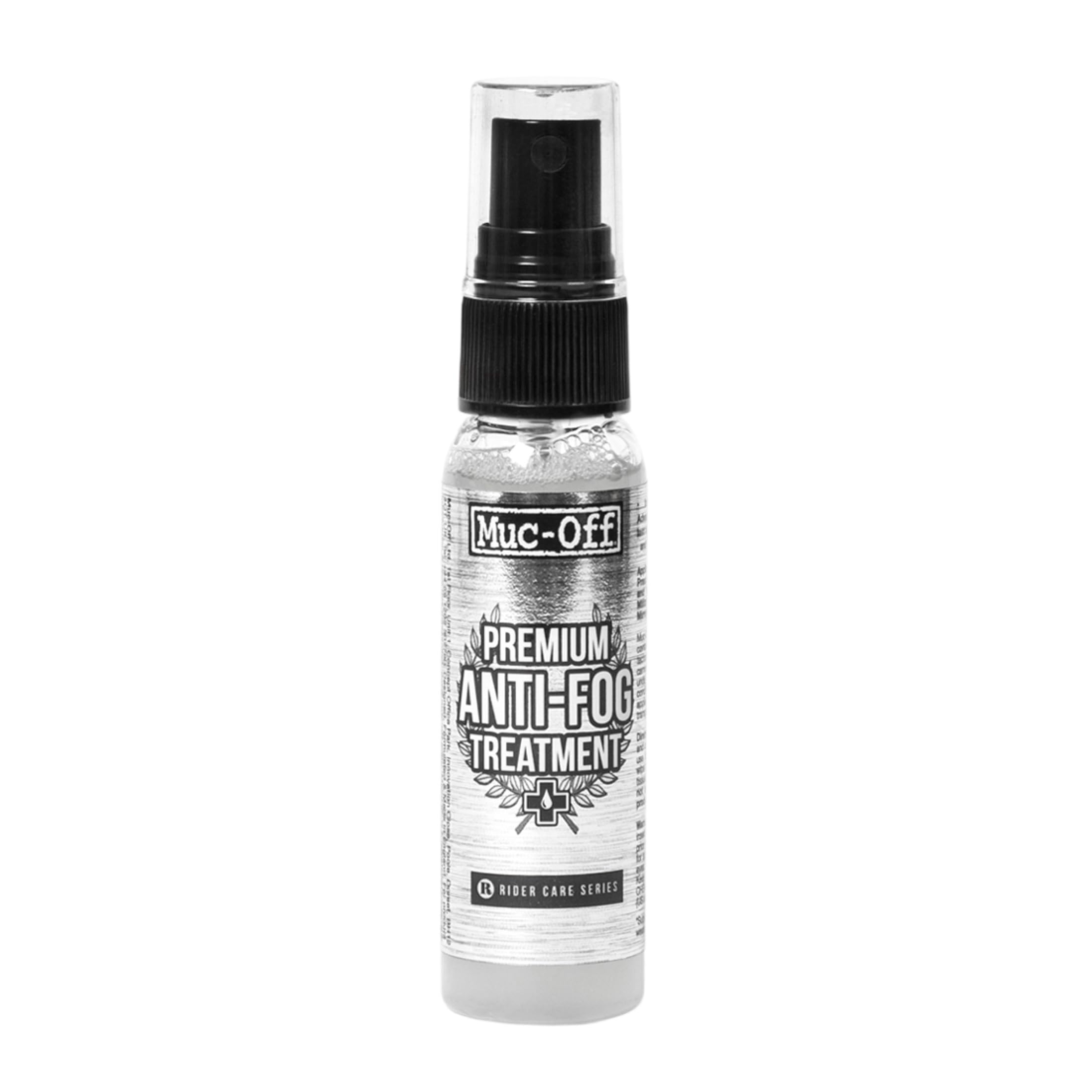
The rider’s spray — it lays a clear micro-thin film a helmet visor actually notices
A 32 ml spray bottle, silicone-free and biobased, that mists a transparent micro-thin coating over a visor or goggles. The format is the draw: it gets into curved visors and goggle frames where a paste dab is awkward. One motorcyclist rode a 45-mile enduro in 7 to 75°F weather and reported his prescription polycarbonate glasses stayed clear the whole run, even when pulled off at stops.
Effectiveness is what people celebrate most, far and away the most-cited point in its favor, with build quality close behind. For helmet wearers running cold commutes without a Pinlock insert, this is the practical anti-mist layer. Citrus scent, non-slip finish, and the small bottle rides easily in a jacket pocket.
Now the part you have to plan around: the coating thins out fast under harsh use. The coating fades after a couple of rides, and cold-weather commuters re-spray roughly twice a week. Fog removal drew mixed feedback — strong in most situations, weaker in genuinely humid or rainy conditions. The reapplication need is the real cost of the spray format, so if you want set-and-forget, a buff-on paste lasts longer.
Why riders keep this in a jacket
- Spray reaches visor and goggle curves a dab can’t cover evenly
- Kept glasses clear through a 45-mile ride in 7–75°F
- Silicone-free, biobased formula with a light citrus scent
- 32 ml bottle fits a pocket for on-the-go top-ups
The upkeep it asks for
- Fades after a few rides; cold-weather commuters re-spray twice weekly
- Mixed results in heavy humidity or rain
- Not the pick for set-and-forget use; it wants a reapplication routine
Made for: motorcyclists, MTB riders and goggle wearers who will happily re-spray a couple of times a week for a clear visor.
Not the fit if: you want one application to hold for weeks — reach for the paste pick above instead.
4. EK USA Cat Crap Anti-Fog Lens Cleaner Balm 2-Pack

Two pocket-sized tins of waxy balm that slip into a bag and clean as well as they clear fog
This is the two-tin set: a 0.5-ounce balm in each, small enough to ride in a pocket. The wax cream does double duty. Owners use it to strip grease and smears off eyeglasses and phone screens, then buff it in as a slick layer that keeps dust and lint from clinging and makes a plain water rinse work better. On mirrored finishes and coated lenses it is described as safe.
Where it earns its place is the application ritual. Work a tiny amount in with a microfiber or pure cotton cloth — never paper or a synthetic — in circles from the center, keep off the lens edge crevices, let it sit, then buff. Applied that way, the film survives several water washings, so one 0.5-ounce tin lasts a long time.
Set expectations on the fog side. This balm reduces fog rather than erasing it, and it is picky about technique. The payoff for the fuss is a compact balm that also protects and cleans, not just defogs — best suited to someone who will take a minute to apply it right.
The upside that earns the tin: a 0.5-ounce balm that cleans, protects against dust, and adds a slick no-fog layer, all in a pocket-carry size. It pairs naturally with a microfiber cloth in a glasses case.
Get the technique down and it behaves; rush it and you’ll see the haze.
Worth it for: the tidy, carry-anywhere tin that also cleans and dust-guards the lens between treatments.
skip it if: you want fog gone in one swipe — this one rewards patience with the buff.
5. Blue Light Blocking Reading Glasses 1.00

The screwless reader that answers glare at the source — the lens itself, not a film you reapply
Every other pick treats the lens; this one replaces the problem lens with a blue-light-blocking reader that fights screen glare at the source. Frame and lens together weigh just 14 grams, so on the face it all but disappears. It comes in a run of magnification strengths from +1.00 through +4.00, and the build uses an interlocking hinge instead of screws — the small parts that most often loosen and drop a pair of glasses apart.
The comfort details push it past generic readers. Silicon tips on the temples hold the frame when you look down, and a clip on the arm lets it hang from a pocket. The integrated nose piece leaves no bridge mark, and the flexible temples hold their grip through constant on and off. It is the pick for long reading sessions at a computer or e-reader, where glare and eye strain are the battle rather than cold-weather fog.
Two honest limits. There is no fog treatment in this frame — it is eyewear, not a coating, so someone fighting mask fog or ski-goggle mist needs one of the treatments above. And a few owners mention the rubber ear sleeves can catch hair, and that the flexible clip is the most fragile spot, so treat the temple arm gently. Get the magnification right and it is the lowest-fuss answer to screen glare here.
What makes it easy to wear
- Just 14 g for frame plus lens, so it barely registers on your face
- Screwless interlocking hinge that won’t loosen the way screws do
- Silicon temple tips add grip and stop the slide when you look down
- Temple clip lets it hang from a pocket between reads
Where it falls short
- No fog treatment at all — it blocks glare, not mist
- Rubber ear sleeves can tug at hair
- The pocket clip is the part most likely to give first
Best suited to: screen-heavy readers who want glare relief and a featherweight frame that won’t slip or creak.
Think twice if: your real complaint is fog on cold lenses — that calls for one of the treatments, not a new frame.
Know the Specs
Buff-on paste vs spray vs wipe
The format decides how much upkeep you sign up for. A paste is worked in and buffed, and the film survives several washings — best for someone who preps at home. A spray lays a thinner micro-thin coating that reaches curved visors but fades after a few uses under harsh cold, so it wants regular top-ups. A pre-moistened wipe is the fastest of the three and needs no bottle, but it usually leaves a slight film that you finish with a dry cloth.
Coating safety and treatment duration
Your lenses already carry an anti-reflective coating, a thin multi-layer film that cuts glare. A non-abrasive, alcohol-free formula protects that film; an abrasive cloth or harsh solvent can cloud it for good. On duration, treat any anti-fog treatment as a thin temporary layer — it thins out after a few wipe-and-wash cycles and gets reapplied. Buff-on pastes and balms typically outlast sprays between passes, which is the trade-off for the extra buffing step.
Common Questions
Will an anti-fog paste damage my existing anti-reflective coating?
Why does my glasses fog return so quickly after treatment?
Is a spray better than a paste for helmet visors?
Do the pre-moistened wipes leave streaks on my glasses?
How long does one tin or bottle actually last?
Can anti-fog treatment go on sunglasses with mirrored lenses?
Do blue light reading glasses replace an anti-fog treatment?
What is the right way to apply a buff-on paste?
Do the fog treatments stop fog entirely in wet, humid weather?
The Bottom Line
For most people buying an anti reflective coating for glasses, the EK World Wide Cat Crap Paste 3-Pack wins — a multi-tin supply that buffs on at home and holds through several washings, with a formula safe on anti-reflective lenses. If you need to defog on the go, the Optix Clear Guard wipes go anywhere in a sealed packet. For helmet visors and cold rides, the Muc-Off spray is the one to reach for — and if screen glare is what actually bothers you, the screwless 14-gram blue-light readers attack it at the lens rather than with a film.
How we choose
We do not accept paid placement. Every pick is matched to a real buyer and a real use-case; we do not hands-on test units.
Sources
Specifications: manufacturer listings and product documentation. Review insights: verified customer reviews, as of October 2026. Pricing: not shown on this page (it changes often); check the current price via the retailer link.
As an Amazon Associate, Aappliancez earns from qualifying purchases. This does not affect which products we feature.