Disclosure: Some links in this post are affiliate links. As an Amazon Associate I earn from qualifying purchases, at no extra cost to you. Learn more
Specs are compiled from manufacturer listings and verified buyer reviews and can change over time — please confirm the key details on the product page before buying.
Most anti-inflammatory books get bought, skimmed, and shelved while you still stand in the kitchen wondering if sweet potatoes are allowed. The fix is to pick the format first — a wall chart you glance at while the pan heats beats a 400-page book you never open. So the laminated Nonlae three-chart set is the pick most people should start with: it puts the eat-this, avoid-that list on your fridge, not in a spine you have to crack. The cookbooks below are for the nights you actually feel like cooking, and a couple are worth owning. The rest depends on how much reading you want to do before you change a single meal.
This guide is built by comparing the manufacturers’ published specifications and the patterns across verified customer reviews, so you get each pick’s real strengths and trade-offs instead of marketing spin.
One decision explains most of what separates these five picks: chart, meal plan, or reference book. A chart answers “can I eat this?” in about two seconds. A meal plan tells you what to cook. A reference book explains why food and inflammation connect at all.
Top Picks
How To Choose The Best Anti-Inflammatory Diet Book
Page count feels like value, and it is the wrong thing to shop for. You are not buying paper — you are buying a system you will use on a Tuesday night when you are tired and hungry. A short book you open twice a week beats a 400-page reference you open once.
Decide between a chart, a plan, and a reference
Three formats, three jobs. A laminated food chart (a wipe-clean sheet you mount on the wall) answers “can I eat this?” in about two seconds. A meal-plan cookbook walks you through a set number of weeks, so you never have to decide what is for dinner. A reference book explains how food and inflammation connect in the first place. Most beginners do best with the chart plus one cookbook.
Look at how the food lists are organized
Grouping is what makes a list usable. The good ones split foods into eat freely, eat in moderation, and avoid. One long alphabetical column means you spend more time searching than eating. Laminated sheets also survive kitchen splashes — paper lists get greasy and torn within a month of daily use.
Check whether nutritional details are included
If you track sodium, calories, or serving sizes, check before you buy. Recipe-focused cookbooks often skip the numbers entirely; reference-style guides tend to include them. Neither approach is wrong on its own. But a cookbook missing the calorie counts you rely on will frustrate you fast.
Match the wording to how you cook
Beginner-friendly books use short ingredient lists and simple techniques. Some guides also flag which recipes suit specific needs, like diabetes or joint-focused eating. Read a sample page if you can. If the instructions assume you already know what a “slow simmer” looks like, that tells you who wrote it for.
Side-by-Side Comparison
| Model | Best For | Format | Pages | Item Weight | Amazon |
|---|---|---|---|---|---|
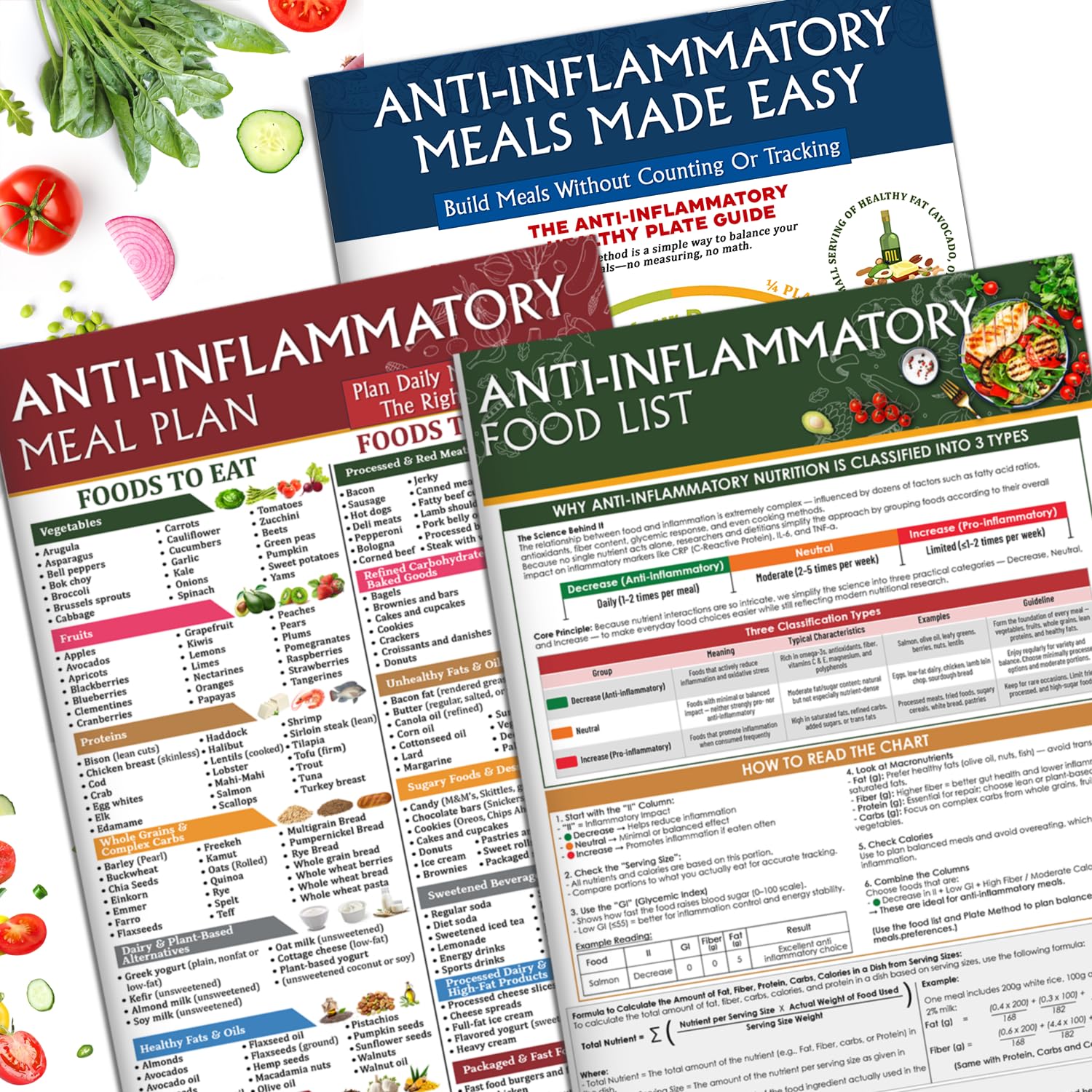
| Nonlae Set 3 Anti-Inflammatory Food Charts★ Best Overall | Fridge-and-wall quick reference | Laminated chart set (3 items) | — | 0.12 kg | Amazon |
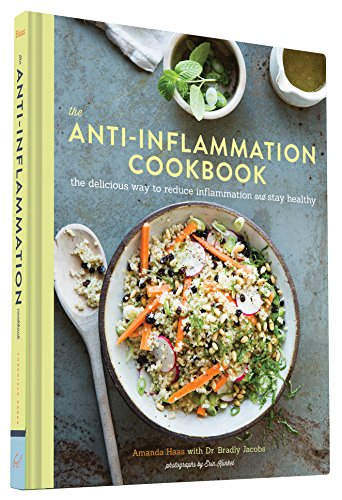
| The Anti-Inflammation CookbookTop Performer | Everyday recipe cooking | Cookbook (Illustrated) | 192 pages | 1.51 pounds | Amazon |
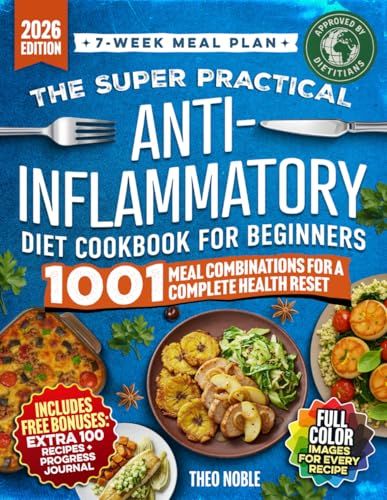
| The Super Practical Anti-Inflammatory Diet Cookbook for Beginners | Structured 7-week beginners | Meal-plan cookbook | 109 pages | 9.6 ounces | Amazon |
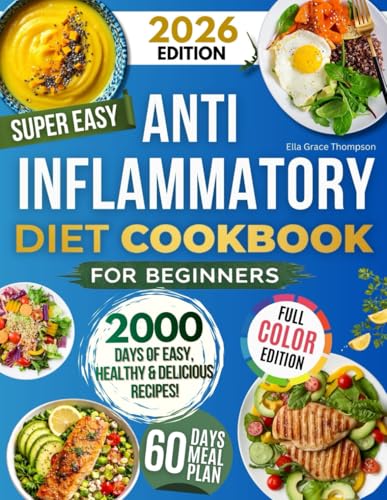
| Super Easy Anti-Inflammatory Diet Cookbook for Beginners | 60-day plan on a budget | Meal-plan cookbook | 82 pages | 7.8 ounces | Amazon |
Detailed Reviews
1. Nonlae Set 3 Anti-Inflammatory Food Charts
Our pick — 4.5+★ from 300+ verified ratings; the strongest balance of quality and price.
Three laminated charts that answer “can I eat this?” before the pan gets hot.
This takes the top spot because it answers the question you ask most often — “is this allowed?” — in about two seconds, without opening anything. The set is three separate charts: foods to eat, foods to avoid, and the grocery staples worth buying. It measures roughly 8.3 by 11.7 inches folded, so it fits a standard kitchen wall or the front of a binder without taking over the fridge.
Each panel holds more than the size suggests. Buyers describe tri-fold laminate sheets loaded with calories and meal suggestions, and the most-praised quality by a wide margin is simply that the charts are informative. One panel covers joint-focused eating and gout-friendly choices. That is the detail separating this from a generic “healthy foods” poster you could find anywhere.
The honest catch is complexity in spots. There are plenty of menu options, and a few read as more involved than a beginner wants on a weeknight. Value-for-money impressions also run mixed among buyers. If you want recipes instead of a lookup sheet, the Anti-Inflammation Cookbook farther down gives you 192 pages of them. But buyers report these charts remove the need to search every single food before trying it — and that daily lookup chore is what quietly kills most new diets.
What earns the top spot
- Three laminated charts covering eat, avoid, and grocery staples
- Folded size of 8.3 x 11.7 inches — wall or binder friendly
- Angle-coated polyurethane cover and matte finish that wipes clean
- Joint and gout-focused panels most food charts skip
Where it asks more of you
- Some meal suggestions read as too involved for a first week
- Value-for-money impressions run mixed among buyers
- It is a reference, not a meal plan — you still plan your own week
Best for: anyone who wants the food list visible in the kitchen rather than index-searched in a book.
Look elsewhere if: you want someone to hand you a finished weekly plan and tell you exactly what to cook each night — the meal-plan cookbooks cover that job better.
2. The Anti-Inflammation Cookbook
192 pages of recipes people keep cooking long after the diet enthusiasm fades.
It is the strongest recipe book here because it gives you 192 pages against the 82 pages of the Super Easy beginners book — more than double the recipe room. It also weighs 1.51 pounds versus that thinner book’s 7.8 ounces, and the paper feels like it belongs in a kitchen rather than a nightstand.
Recipe quality is what people rave about. The specific wins are practical: clear instructions, make-ahead components (steps you can finish early in the week) that fit a busy schedule, and enough variety that you are not eating the same bowl five nights running. Breakfast is where it has converted people — the breakfast bowls replacing cereal come up repeatedly, and one buyer reports losing 14 lbs on the meal plans. Many recipes list substitute ingredients too, useful when a particular vegetable does not agree with you.
Two things to know before you buy. Nutritional information is thin: buyers wish basic calorie and serving-size details were printed alongside the recipes. If you track numbers, that gap will annoy you. The recipe list also leans on ingredients that can be harder to source — one reviewer framed it bluntly as needing a well-stocked grocery nearby. This is your pick if you already cook most nights and want the inflammation angle folded into food you actually want to eat.
Why seasoned cooks pick it: the recipe range and clear instructions carry this one, and the make-aheads turn a Sunday session into weekday dinners.
What to accept going in: you will likely still want the calorie and serving-size numbers the book leaves out.
Reach for this if: you cook regularly and want inflammation-friendly meals that taste like food, not a restriction list.
Think twice if: you are brand new to cooking and want someone to tell you exactly which night to make which dish.
3. The Super Practical Anti-Inflammatory Diet Cookbook for Beginners
A seven-week plan that removes the “what do I eat tonight” decision entirely.
Seven weeks of meals, laid out week by week, is what earns this a spot — you never assemble a schedule yourself. Done-for-you shopping lists come with it, so the grocery trip stops being guesswork. It is Book 1 of 2 in The Anti-Inflammatory Lifestyle series, so there is a follow-on if the format clicks.
The content earns its keep too. The most-praised quality is how comprehensive the recipe spread is, and buyers credit the grocery lists and meal-prep tips with saving real time. Batch-cooking shortcuts are built in throughout — that is the difference between a plan you follow for two weeks and one that survives a busy month. Recipes are labeled so you can find the ones suited to whatever you are managing, and buyers widely call the recipes easy to follow and genuinely good tasting.
The recurring trade-off is shopping volume. Several owners mention that many recipes call for a long ingredient list, so your cart gets heavier than you expect going in. At 109 pages and 9.6 ounces it sits between the thin 82-page beginner book and the 192-page cookbook, and it measures 8.5 x 0.25 x 11 inches — flat on a counter while you cook. Pick this if you want the decisions handled and will actually shop from a list; if a long ingredient list per recipe is what makes you quit, this is not the one.
The case for the 7-week format
- 7-week meal plan takes weekly decisions off your plate
- Done-for-you grocery lists and batch-cooking shortcuts
- Recipes labeled for specific dietary needs
- Lies flat at 8.5 x 11 inches while you work
The realistic friction
- Long ingredient lists mean bigger, pricier grocery runs
- Independently published, so no polished publisher formatting
Pick this one: if you want the decision-making handled for you and will actually shop from a list.
Not your pick if: a long ingredient list per recipe is the thing most likely to make you quit.
4. Super Easy Anti-Inflammatory Diet Cookbook for Beginners
The thinnest book here, but it still hands you a 60-day plan.
At 7.8 ounces and 82 pages, this is the lightest option in the roundup — and it still hands you a 60-day meal plan. If you read on the couch or carry your cookbook to work, that portability is the whole reason to choose it over the heavier Super Practical book above.
The structure walks you from education into recipes for every meal, snacks included, then closes with the 60-day plan. Buyers single that flow out as the book’s best feature. Recipes carry difficulty-rating stars, so you can see at a glance how much effort a dish needs, and most land on the easy end. Ingredient variations are printed alongside the recipes — the kind of flexibility that keeps a beginner from abandoning a dish halfway through.
The caveat is flavor range. Several cooks note that a number of dishes land on similar flavor profiles, so it is not the book for someone who needs every night to taste different. It works best as the budget-friendly entry into the category: easy, portable, and plenty of instructions for a first-timer.
Why it fits beginners: the 60-day plan plus difficulty stars means you always know what you are getting into before you start cooking.
The honest limitation: repeated flavor profiles across dishes will wear on anyone who wants more variety week to week.
Suits you if: you want a light, easy-to-carry cookbook with a long laid-out plan and simple recipes.
skip it if: you cook the same cuisine often and need each recipe to taste distinctly different.
5. Anti-Inflammatory Diet For Dummies

Four hundred pages for the reader who wants to understand the why, not just the what.
If you want the reasoning, not just the rules, the 400 pages are the point. This is the heavyweight in both senses: 400 pages and 2.31 pounds, comfortably the biggest and thickest book here, and the 2nd edition means the material has been through a revision. Where the charts and cookbooks tell you what to do, this one explains how food and inflammation relate in the first place — the background beginners usually skip and later wish they had read.
The informational chapters pull people in more than they expect. Buyers describe a complete book of anti-inflammatory dieting information, and the detail is strong enough that readers who intended to skim end up going cover to cover. It pairs the explanation with recipes, which readers call a genuine bonus rather than filler, and the language stays plain throughout — the For Dummies format explains the science without assuming prior knowledge.
One fair warning: a few cooks have questioned which foods are included, so treat the food lists as a starting point to cross-check rather than the final word. At 2.31 pounds it is also not a book you hold up while cooking. Use it as a read-and-reference companion to one of the cookbooks above rather than your countertop guide. Think of it as the background reading that makes the other four make sense.
What the pages buy you
- 400 pages across an updated 2nd edition
- Plain-language explanations of how food and inflammation connect
- Includes recipes as a practical bonus
- Readable cover-to-cover, not just a lookup book
Worth knowing upfront
- 2.31 pounds — too heavy for countertop use while cooking
- Some included food choices are questioned by buyers
The reader’s pick: for anyone who wants to understand the reasoning behind the diet before changing their plate.
Not the one for: cooks who want a take-it-to-the-stove book — grab a cookbook for that job.
Know the Specs
Format — chart, cookbook, or reference?
Format decides how you will actually use the product, so check it first. A laminated chart is a two-second lookup mounted on the wall or slotted into a binder. A meal-plan cookbook walks you through a set number of weeks with shopping lists attached. A reference book explains the reasoning behind the diet. Most beginners do best with a chart plus one cookbook — a chart for the daily “can I eat this?” check and a cookbook for the cooking itself.
Print length — what the page count really buys you
A page count tells you how much is inside, not what kind of inside it is. A 192-page cookbook is mostly recipes. A 400-page reference book is mostly explanation with recipes attached. An 82-page beginners book is a plan and a compact recipe set. Read the page count alongside the format, not instead of it — a longer book is only better if you wanted more of whatever that book is full of.
Item weight — the detail you feel every day
Weight matters more than people expect until they own the book. Something light in the hand is easy to hold, carry, and prop open; a heavier volume tends to live on a shelf instead. If you plan to cook from it in the kitchen or bring it to the store, favor the lighter options. If it is a read-at-the-desk book, weight barely matters.
Meal plan and grocery support
A built-in meal plan — whether it runs 60 days or 7 weeks — kills the nightly “what now?” decision. Shopping lists do the same for the grocery trip, so you buy what the plan calls for instead of guessing. If you have quit diets in week one before, this is the feature to weigh heaviest.
Common Questions
Do I need both a food chart and a cookbook, or will one do?
How long does it take to see results from an anti-inflammatory diet?
Is a laminated chart better than a paper one for kitchen use?
What is the difference between recipes labeled for diabetics and general anti-inflammatory recipes?
Do these cookbooks include calorie counts and serving sizes?
Can I follow an anti-inflammatory diet if I have arthritis or gout?
How many ingredients do these recipes typically call for?
Is a thick reference book worth it for a complete beginner?
Will a 60-day meal plan or a 7-week plan suit a beginner better?
Do the charts and books come in a form I can carry to the grocery store?
The Bottom Line
For most people starting out, the anti-inflammatory diet book winner is the Nonlae Set 3 Anti-Inflammatory Food Charts, because a laminated eat-and-avoid list on your wall does more for weeknight decisions than any book you have to open and search. It also settles a family member’s “can I eat this?” question without a lecture. If you would rather cook from recipes, the Anti-Inflammation Cookbook offers the widest recipe range of anything here at 192 pages. And if you want the whole weekly plan handed to you, the Super Practical Anti-Inflammatory Diet Cookbook for Beginners lays out seven weeks with the shopping done for you.
One practical tip before you spend a thing: buy the format that matches how you already live, not the thickest one on the shelf. Buy a 400-page reference when you wanted a fridge chart and it becomes a 400-page paperweight. All five picks follow the same eat-freely, eat-in-moderation, avoid structure, so any of them moves you in the right direction.
How we choose
We do not accept paid placement. Every pick is matched to a real buyer and a real use-case; we do not hands-on test units.
Sources
Specifications: manufacturer listings and product documentation. Review insights: verified customer reviews, as of October 2026. Pricing: not shown on this page (it changes often); check the current price via the retailer link.
As an Amazon Associate, Aappliancez earns from qualifying purchases. This does not affect which products we feature.