Disclosure: Some links in this post are affiliate links. As an Amazon Associate I earn from qualifying purchases, at no extra cost to you. Learn more
Specs are compiled from manufacturer listings and verified buyer reviews and can change over time — please confirm the key details on the product page before buying.
Your turntable, your old DVD player, your PS2 — they all speak analog, and your soundbar only listens in digital. An analog to digital audio converter is the little box that translates between them. The trick is buying one that actually outputs the sample rate your gear expects. Get that wrong and you get silence, buzz, or a signal your speakers simply refuse to play.
This guide is built by comparing the manufacturers’ published specifications and the patterns across verified customer reviews, so you get each pick’s real strengths and trade-offs instead of marketing spin.
Every box here is unidirectional, meaning the signal only travels one way, so you need to buy for the direction you actually want. That single fact is why so many first-time buyers end up returning the wrong unit.
Top Picks

How To Choose The Best Analog to Digital Audio Converter
The first thing to settle is direction. Every unit on this list takes analog sound in and sends digital sound out. None of them work backwards. If you are trying to run a modern digital source into an old analog amplifier, you need the opposite box, and no amount of cable swapping will fix that.
Match the sample rate to your receiving device
The sample rate is how many audio snapshots per second the converter takes, measured in kilohertz (kHz). Most inexpensive units lock in at 48 kHz. Some gear, especially older digital speakers and certain AV receivers, will only accept exactly that. Buy a converter that outputs something different from what your device expects and it will simply stay silent. This is the single most common reason a “dead” converter turns out to be fine.
Check the audio format your source can send
These converters handle PCM only, which is the plain uncompressed stereo format. A surround format like Dolby Digital or DTS carries extra channels this box cannot pass through. The fix is usually a setting on your TV or player: switch the audio output to PCM or LPCM and turn the surround format off. Do that first, before you decide the unit is faulty.
Plan for power and cable length
Every box here needs its own power, mostly over a USB cable. What that cable plugs into matters — a computer USB port is a notorious source of buzz. And check what cables actually ship in the box, because a short included optical cable can be the difference between a two-minute install and another order.
Side-by-Side Comparison
| Model | Best For | Output Sampling Rate | Inputs | Housing | Amazon |
|---|---|---|---|---|---|
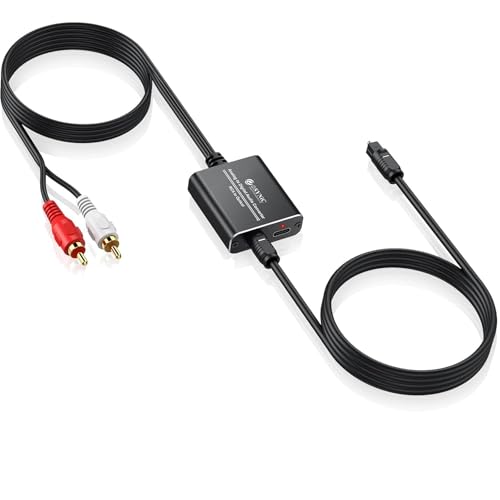
| eSynic Professional 7ft Long RCA to Optical Audio Converter★ Best Overall | Retro consoles and turntables into a soundbar | PCM only | RCA L/R | Aluminum Alloy | Amazon |
| LiNKFOR Analog to Digital Audio ConverterBest Value | Turntable into a soundbar with cables included | 48 kHz | RCA L/R | ABS | Amazon |
| PROZOR Analog to Digital Audio Converter | Record player into a modern Samsung soundbar | 48 kHz | RCA L/R | Plastic | Amazon |
| Hdiwousp Analog to Digital Audio Converter | Wide sample-rate matching across mixed gear | 8-96 KHz | RCA or 3.5mm Jack | Aluminum | Amazon |
| VPFET Analog to Digital Audio Converter | Projector and turntable-to-soundbar duty | 32K, 44.1K, 48K | RCA or 3.5mm AUX | Aluminum | Amazon |
| J-Tech Digital Premium Quality RCA L/R Analog Audio to Optical SPDIF/Coaxial Converter | Adding analog gear to digital-only speakers | 48 kHz | L/R RCA and 3.5mm | Plastic | Amazon |
Detailed Reviews
1. eSynic Professional 7ft Long RCA to Optical Audio Converter
Our pick — 4.5+★ from 100+ verified ratings; the strongest balance of quality and price.
The retro revivalist that wakes up a PS2 or a turntable without a single driver install.
If you have a drawer full of RCA cables and a soundbar with one lonely optical hole, this is the box that closes the gap. It takes the red-and-white analog signal and hands it out as Toslink optical — a cable that carries audio as pulses of light instead of electrical voltage. There is no software to install and no menu to hunt through on the converter itself. Plug in the cables, plug in power, and the LED tells you it is awake. The eSynic kit advertises 10 items in the package against the single item you get with the LiNKFOR unit below it.
The numbers behind the sound are genuinely stout for the money. Total harmonic distortion is rated under 0.01%, so the box adds almost no audible grit to a vinyl or console signal. Signal delay is listed at under 2 milliseconds, low enough to keep a game console in lip-sync with your TV. The included kit is a full 7-foot RCA run, which is the difference between reaching the shelf behind your amp and not. The aluminum alloy housing also means it shrugs off the heat of an enclosed media cabinet better than a plastic shell would.
Where it stumbles is specificity. It supports PCM only, so a TV still set to Dolby Digital will hand it a signal it cannot use and you will hear nothing at all. Recording from a computer’s analog output into a portable minidisc recorder is where this unit draws its bluntest criticism — one buyer’s condensed review reports that route failed outright, then worked fine once they rerouted through a Bluetooth receiver instead. In plain terms: it is brilliant at feeding a soundbar or AV receiver, and fiddly at feeding an oddball recorder. As owners put it, this is “Perfect for adding my turntable to my Bose soundbar” — and that Bose-and-soundbar job is exactly the lane it wins.
What Buyers Keep Coming Back For
- Under 0.01% THD, so it adds almost no audible grit to a vinyl or cassette signal
- Sub-2ms delay keeps games and movies in sync with the picture
- Aluminum Alloy body handles the heat inside a closed media cabinet
- A full 7-foot RCA cable run is included
The Catch Worth Knowing First
- PCM only — Dolby and DTS signals simply will not pass through
- Not bi-directional, so it cannot send digital back out to an analog amp
- Power adapter is not included; you supply the 5V/1A supply yourself
Reach for this if: you are pulling a turntable, DVD/VCR player, PS2, Wii, or vintage stereo into a modern soundbar or AV receiver.
Look elsewhere if: your source is a computer feeding a portable recorder — that specific route drew the harshest feedback on this unit.
2. LiNKFOR Analog to Digital Audio Converter
One box, both cables included, and no soldering of a turntable setup required.
The pitch here is simple: it drops into an existing hi-fi stack without a shopping trip. The RCA cable is built right into the housing at 3.6 feet, so there is no separate lead to lose behind the shelf. It ships with a 3-foot optical cable and a USB power cable in the same package. For someone converting a turntable, TV, or CD player to a soundbar, the box arrives ready. The sound it produces checks out too — it outputs uncompressed two-channel PCM at a 48 kHz sampling rate, the standard target most soundbars in this class are happy to accept. Connecting a pre-amp’s RCA output into this unit and running optical out to a Samsung soundbar is a route that owners describe as working and sounding fantastic.
Where the value case gets complicated is durability and consistency. The plastic ABS shell is the lightest build on this list, and it is a Toslink-only design — there is no coaxial output for a receiver that would prefer one. The package also lists a tighter included set than the eSynic kit up top, shipping a single item rather than the ten-piece bundle that unit arrives with. That gap is note if you are counting what comes in the box against what you pay.
The honest headline is that this is a unit where performance lands mixed. Quality is the thing buyers single out for praise, but a segment of buyers report it delivering nothing at all, or introducing distortion in the vocal range, and some find it pricier than the competition. Electrical interference is the other recurring note — a stray buzz that swells if you touch the cable or stand near it, which points at shielding rather than a dead unit. If your rig sits close to other powered gear or a mess of cables, give this one a second thought. If your setup is clean and quiet, the built-in cabling convenience is a genuine win.
Cleanest setup story: the built-in 3.6-foot RCA cable plus the included 3-foot optical and USB cables mean no extra purchases to get running on day one.
The electrical caveat: the unit’s own feedback flags buzzing under interference, so keep it clear of the spaghetti behind your TV and use a wall adapter rather than a computer port.
Best fit: a tidy turntable-to-soundbar conversion where every cable needs to be in the box already.
Skip if: your gear sits in a tangle of powered cables, or you need a coaxial output rather than optical.
3. PROZOR Analog to Digital Audio Converter
Built for the vinyl revivalist who owns a modern Samsung soundbar and refuses to stream.
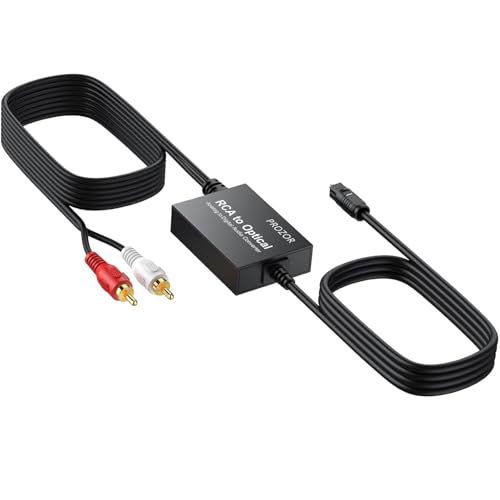
Turntable-into-soundbar is the job this box was clearly designed around, and it does that job without complaint. The RCA cables and the optical cable are integrated into one unit, so the whole conversion lives on a single small piece of hardware instead of a knot of loose leads. Installation is a plug-and-play affair — no drivers, no app. The signal path is uncompressed two-channel PCM at 48 kHz, which is precisely what a soundbar expects to see. The payoff for a listener is a wired connection instead of Bluetooth, and owners who have made that switch describe the difference in warmth and body as clearly audible.
What owners talk about most is simply that it does what the listing says. The recurring report is a record player feeding a modern soundbar and surround system with a setup that takes minutes, a sound described as crisp, and no buzz or feedback creeping in. Using it with speakers that carry surround sound is another common success story. It is a converter that disappears into the rack and never asks for attention again.
Two things to hold in mind. The housing is plastic, and a minority of feedback describes it as cheaply made — a reasonable note, not a universal one. The bigger technical constraint is format: it supports PCM and LPCM only, so any Dolby Digital, DTS 5.1, or Dolby-AC3 signal in the chain needs switching off at the source before this unit will pass audio through. Forget that step and you get a silent system and a suspicion the box is broken. Almost every “dead on arrival” report on a converter like this traces back to a source still set to a surround format.
Tidy by design: the RCA and optical cables are built into the unit itself, so nothing extra has to live behind the shelf.
Set it once: switch your TV or player output to PCM or LPCM before you judge this converter — that one menu setting decides whether it plays or stays mute.
Who this is for: anyone wiring a record player into a modern soundbar for a wired, no-Bluetooth listen.
What it won’t do: pass a Dolby or DTS surround signal, and its plastic shell is the least premium-feeling build here.
4. Hdiwousp Analog to Digital Audio Converter
The sample-rate chameleon that talks to old and new gear on the same shelf.
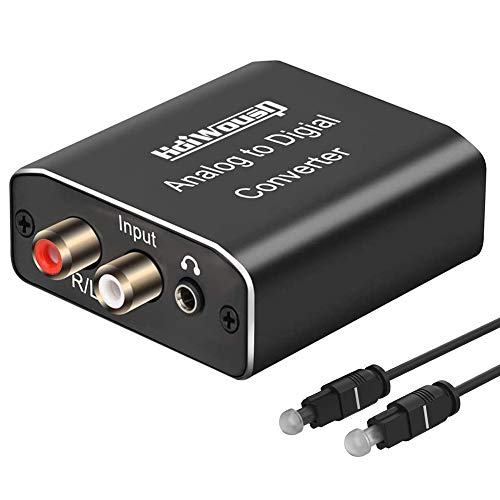
Here is the number that separates this box from almost everything else on the list: an 8-96 KHz output sampling rate, plus support for uncompressed two-channel LPCM. Where the 48 kHz units above lock into one speed, this one covers a wide band, and that matters if you own digital gear that is fussy about the rate it receives. It also takes two kinds of input — RCA or a 3.5mm jack — so a phone, laptop, or MP3 player can feed it just as easily as a turntable. On top of that, it pushes out digital coaxial and Toslink optical at the same time, so two destinations get fed from one conversion.
The build leans practical. The aluminum frame is there for durability and better heat dissipation than plastic, which keeps it stable in a warm cabinet. Owners who have used it for TV-to-soundbar conversion and for turntable-to-soundbar conversion both report it doing the job quickly. The aluminum body also comes up as the reason it runs quiet — solid-state operation with no mechanical noise to introduce.
Two friction points show up. The included optical cable, in some hands, has not fit the adapter or the soundbar, forcing a switch to a cable the buyer already owned. And the power indicator LED is described as bright enough to be distracting in a dark room, so it is worth positioning it facing the wall. That sample-rate range is the strong argument for this one: if you have a mixed pile of digital speakers and receivers from different eras, the flexibility of 8-96 KHz is more useful than any single-rate unit can be.
Range for days: 8-96 KHz output covers the fussiest digital speakers and older receivers alike.
Two inputs, two outputs: RCA or 3.5mm jack in, coaxial and Toslink optical out simultaneously.
Small annoyances: the bundled optical cable has not fit every setup, and the power LED is bright in a dark room.
Ideal owner: someone with a mixed collection of digital gear that expects different sample rates.
Think twice if: you want the cable situation sorted straight from the box — you may end up using your own optical cable anyway.
5. VPFET Analog to Digital Audio Converter

The box that finally gets a Sonos-only optical input talking to a projector’s AUX output.
Projector owners know the specific misery this unit solves: the projector only offers an AUX output, the soundbar only offers an optical input, and the two refuse to meet. This converter bridges that gap with an RCA or 3.5mm AUX input on one side and digital coaxial plus Toslink optical output on the other, both at once. Supported output rates span 32K, 44.1K, and 48K, giving it a little more latitude than a fixed 48 kHz unit. It comes with an optical cable in the box, and the aluminum housing is designed to spread heat and cut electrical noise. There is no software to install — it recognizes the incoming audio format on its own.
Functionality is the strong suit. Owners mention hooking it up and getting a clean conversion straight away, whether the source is a turntable, a projector, or a TV. The aluminum body is the reason it runs without audible interference in most setups, and no volume control is needed since you adjust the level at the source. The one operational rule to internalize is the order of operations: unplug the power before you connect the audio cables. Plug them in while it is live and you will hear a humming noise.
The catch is a power-related one worth respecting. Feeding the unit from a computer’s USB port has been reported to introduce unwanted noise; a separate wall adapter clears it up. There are also reports of units that functioned for a while and then failed, and some accounts of ground noise being pulled in from the TV source itself, which lowering the TV volume resolves. It also will not work with Bluetooth speakers and does not offer bi-directional conversion. Set up correctly with clean power, though, this is a reliable bridge between mismatched gear.
Why It Fits the Awkward Setup
- RCA or 3.5mm AUX in, coaxial and Toslink optical out together
- 32K, 44.1K, and 48K output rates cover more devices than a fixed 48 kHz box
- Aluminum housing for heat dissipation and noise resistance
- Optical cable included, no software needed
Where It Asks You to Be Careful
- Powering from a computer USB port can introduce audible noise
- You must unplug power before connecting audio cables or a hum follows
- Some long-term reports note the unit stopping after a period of use
The right buyer: a projector or turntable owner whose only digital speaker input is optical.
The one rule: power it from a wall adapter, not a laptop port, and connect your audio cables while it is unplugged.
6. J-Tech Digital Premium Quality RCA L/R Analog Audio to Optical SPDIF/Coaxial Digital Converter with 3.5mm Jack Support

The one that can feed two digital destinations at once, which almost nothing else here does.
If you need to send one analog source to both an optical and a coaxial digital input, this is the box that does it. It accepts L/R RCA stereo and a 3.5mm jack on the input side, then pushes out to Toslink and coaxial digital simultaneously. It is designed to add an analog source to a device that only has digital inputs, and it does that with a claimed 48 kHz output sampling frequency. It also ships with free lifetime technical support and a one-year manufacturer warranty. Small footprint, too — under three inches wide, so it tucks behind a soundbar without competing for shelf space.
The sound is where this unit earns its place. Owners describe excellent build, zero noise, and a wide frequency response. When you want to add an analog source to a device with only digital inputs, this converter handles the job without drama. The clean, quiet operation is the reason it holds a spot here despite the compromises below.
That said, the 48 kHz claim has a flaw a careful buyer should know. One owner ran it on an Onkyo TX-SR707 AV receiver and a scope and measured 96 kHz output instead of the advertised 48 kHz. That means it can fail with a digital speaker that only accepts exactly 48 kHz, even though that is the rate it claims to deliver. The plastic enclosure is also lightweight, and the power adapter has an unusually small, non-standard tip, so a replacement brick is hard to find. Know your receiving gear’s accepted rate before you buy.
Strongest sound review: sound quality is the pick’s standout trait, with zero-noise operation, full frequency response, and dual optical/coaxial output that most rivals lack.
The fine print: the actual output rate has registered as 96 kHz rather than the listed 48 kHz in at least one tested setup, and the power tip is a non-standard size.
Pick this if: you need one analog source feeding both coaxial and optical inputs, or you value the one-year warranty and lifetime support.
Move on if: your digital speakers accept exactly 48 kHz and nothing else — that mismatch is this unit’s known soft spot.
Know the Specs
Sample Rate (kHz)
The sample rate is how many audio snapshots per second the converter takes, measured in kilohertz. A converter that outputs 48 kHz is sending the digital audio equivalent of a fast, steady flip-book, and most soundbars in this class expect exactly that speed. Some units stick to 48 kHz, while others offer a wider range like 8-96 KHz or 32K, 44.1K, and 48K. Match the converter’s output rate to what your receiving gear needs. Feed a speaker a rate it does not accept and it stays silent.
PCM vs. Surround Formats
PCM is the plain, uncompressed stereo format these converters are built to handle — one clean stream for left and right. Dolby Digital, DTS, and Dolby-AC3 are surround formats that add extra channels, and an analog-to-digital converter of this type cannot pass them through. The practical step for any buyer is doing nothing more than switching the TV or player’s audio output setting to PCM or LPCM, and turning the surround mode off. That one setting is usually the difference between working sound and silence.
Common Questions
Can an analog to digital audio converter also go the other way?
Which output sample rate should I pick for my soundbar?
Why does my TV’s audio not come through the converter?
How long will an analog to digital audio converter last?
Why does my converter buzz or hum?
What cables come in the box with each converter?
Can I use an analog to digital audio converter with my turntable?
Why is there a lag or delay in the audio from my converter?
What is the difference between the Hdiwousp and the VPFET converters?
Can I power these converters from my TV’s USB port?
The Bottom Line
For most people, the analog to digital audio converter winner is the eSynic Professional 7ft Long RCA to Optical Audio Converter because it nails the RCA-to-optical job with a full 7-foot cable run, an aluminum body, and sub-2ms delay. If you want the widest sample-rate flexibility for mixed digital gear, grab the Hdiwousp Analog to Digital Audio Converter. And for a projector or turntable feeding a soundbar with an optical-only input, the VPFET Analog to Digital Audio Converter is the one to reach for. Whichever you pick, set your source to PCM first — that one menu step decides whether any of them plays.
How we choose
We do not accept paid placement. Every pick is matched to a real buyer and a real use-case; we do not hands-on test units.
Sources
Specifications: manufacturer listings and product documentation. Review insights: verified customer reviews, as of October 2026. Pricing: not shown on this page (it changes often); check the current price via the retailer link.
As an Amazon Associate, Aappliancez earns from qualifying purchases. This does not affect which products we feature.