Disclosure: Some links in this post are affiliate links. As an Amazon Associate I earn from qualifying purchases, at no extra cost to you. Learn more
Specs are compiled from manufacturer listings and verified buyer reviews and can change over time — please confirm the key details on the product page before buying.
If you or someone you love has stopped following conversations, or turned the TV up past comfortable, an analog hearing aid can bring back the simple relief. These devices amplify sound the old-fashioned way, with a simple volume dial and no apps, pairing, or mode menus to fight through. Below are the four strongest analog and analog-style options, matched to who each one actually suits.
This guide is built by comparing the manufacturers’ published specifications and the patterns across verified customer reviews, so you get each pick’s real strengths and trade-offs instead of marketing spin.
You will see exactly how each unit fits, charges or takes batteries, and handles background noise, because those three details decide whether a device sits in a drawer or lives in your ear. My breakdown of the best analog hearing aid picks cuts straight through the specs that actually change daily life.
Top Picks

How To Choose The Best Analog Hearing Aid
Three things decide whether an analog aid works for you: how it sits on your ear, how you keep it powered, and how much volume control you want. Get the fit, the power source, and the volume control right and the aid becomes part of the morning routine. Get any of the three wrong and the aid ends up in a drawer.
Fit and ear tips decide everything
A behind-the-ear (BTE) aid hangs a small tube over your ear and pushes sound through a tip seated in your canal. If the tip is the wrong size, the aid slips out or squeals with feedback. Look for a set that ships with several ear tip sizes so you can swap until the seal is snug.
Battery style versus rechargeable case
Some units take small button-cell batteries you replace, while others run on a lithium-ion cell you recharge in a case. Replaceable batteries mean no charging routine but a steady supply on hand; a rechargeable case means plugging in but no battery hunting. Pick the power source you will actually maintain: a spare pack of button cells in the drawer, or a charger on the nightstand.
Volume control you can work by feel
Slide switches and continuous volume knobs let you adjust without looking, which matters for anyone whose fingers are stiff or whose eyesight makes tiny buttons hard. Digital menu systems and paired apps add steps. For a first-time wearer, a single dial or slide switch gets used every day; a menu of programs often does not.
Side-by-Side Comparison
| Model | Best For | Fit Type | Power Source | Controls | Amazon |
|---|---|---|---|---|---|
| HTMengt Retro 2500 Desk Phone★ Best Overall | Landline calls with a hearing-friendly handset | Desk phone handset | No external power needed | Large injected buttons | Amazon |
| Manzelun GM-105 Rechargeable | All-day wear with a recharge case | Behind-the-Ear | Rechargeable case or cable | Slide switch and volume knob | Amazon |
| BLJ BTE Invisible Amplifier | Discreet everyday amplification | Behind-the-Ear, in-canal receiver | Product-specific batteries | Programs and volume levels | Amazon |
| TrueEQ Analog Hearing Aids | Pure analog sound, no apps | Behind-the-Ear with tubing | Size 13 batteries | Volume dial | Amazon |
Detailed Reviews
1. HTMengt Retro Traditional Landline Phone
Our pick — 4.0+★ from 500+ verified ratings; the strongest balance of quality and price.
The desk phone that keeps a landline familiar for ears that struggle with cell phones.
Not every hearing problem starts with an ear aid. Plenty of households need a phone that a hard-of-hearing parent or grandparent can actually answer and hear clearly on. The HTMengt Retro 2500 does exactly that job. It is a corded analog desk phone with a hearing-compatible handset and large buttons, built on a metal base and ABS shell (the same tough plastic used in a lot of household gear).
The details that matter here are practical. The handset cord runs 144 inches, and the straight extension line adds another 180 inches, so you can move around the table and still talk. It works without any external power, which means it keeps working during a power cut. The red indicator flashes on an incoming call, and the classic metal bell rings out loud. For a senior who has used a landline for decades, this feels like home rather than a new gadget to learn.
The trade-offs are real. Some buyers report the ringer volume comes up short — as one owner put it, “Ringer could be a little louder.” A few also find the red light does not always flash as expected, and the phone feels lighter than the heavy old models of the past. Those are preferences rather than failures, but worth knowing before you buy.
What carries the day
- Works with different telephone systems without an adapter, so landline, Magic Jack, and fax setups all play nice
- Large injected buttons and a comfortable ear cup suit seniors or anyone new to a cell phone
- Twice-injected build on a metal base holds up in demanding home, school, or hotel use
Where it pulls up short
- Ringer and lighting feedback split buyers; do not count on the loudest ring in the house
- At 2.1 pounds it feels lighter than the vintage phones it imitates
Reach for this if: you want a landline that a hard-of-hearing family member can hear on and answer without a learning curve.
Look elsewhere if: you need a true in-ear hearing device rather than a phone handset that amplifies sound.
2. Hearing Aids for Seniors Rechargeable

A rechargeable pair with a case that keeps you topped up all week.
If you want a rechargeable pair that slots into an existing routine, the Manzelun GM-105 makes the strongest case. Each aid weighs 5.5 grams, and the flexible ear hooks sit behind the ear. The included charging case can top up both aids up to four times over before it needs a wall outlet. The maker rates the runtime at approximately 25 hours of continuous use, so a full day of errands, TV, and conversation is covered without a scramble for power.
The controls are designed for people who do not want to look at a screen. A slide switch turns the aid on, and a continuous volume knob lets you dial in the exact level you want. There is also a double noise cancellation feature that the maker says cuts background noise in real time. Buyers describe it as a genuine help. The package also includes five pairs of earphone tips, two cleaning brushes, and a booklet on wearing and adapting to the device.
The catch is worth naming plainly. Noise handling splits opinion. Some wearers hear better overall while finding the background sound gets louder rather than quieter. Fit is also a matter of ear tip trial and error. A few find the aid larger than expected, or needing a moment to settle into place. Give yourself a few days to adjust, as the maker’s guide and the general buyer consensus both suggest.
Why it earns the pick: The charging case that fills both aids four times over, plus the approximately 25-hour runtime, means you go days between trips to the outlet. The five pairs of ear tips give you room to find a seal that holds.
Why some hesitate: The noise reduction does not filter out every background sound. You may still need patience while your ears and fingertips get used to the fit.
The case for most homes: A rechargeable pair with a portable charging case and five ear tip sizes, made for all-day wear with no batteries to buy.
Worth knowing first: Background noise is not fully cancelled, and finding the right tip size takes some trial and error.
3. BLJ Hearing Aid for Seniors Adults

For the wearer who wants the aid to vanish behind the ear.
Some people put off a hearing aid simply because they do not want anyone to see it. The BLJ BTE amplifier is built around that concern. The receiver tucks down inside the ear canal while the microphone sits behind the ear, a design that keeps the visible parts small. The maker says this layout also greatly reduces the chance of feedback whistling.
Where this one goes beyond basic amplification is its digital side. It carries a 6-channel digital processor with layered noise reduction, and you get 3 programs plus 11 volume levels to match different listening situations. So a quiet chat and a noisy room can each get their own gain. A 30-day return window and a 1-year warranty are included, which is a fair cushion for a device you need to hear before you trust.
Honesty matters here. Buyer feedback is mixed, and a couple of themes are worth flagging. Some find it takes real effort to program and adjust, to the point where one buyer’s husband gave up. Others report shorter working life than they hoped. The upside is that the sound itself draws praise from those who stick with it, and the discreet profile is the reason many choose it in the first place.
The compelling part
- Slim behind-the-ear build with an in-canal receiver for a look that stays close to invisible
- 6-channel digital processor with layered noise reduction for clearer, more natural sound
- 3 programs and 11 volume levels let you adapt to rooms and situations
The honest limits
- Programming takes patience; a few buyers found it hard to set up even with the manual
- Some report the unit lasts less time than expected
Best suited to: wearers who care most about keeping the aid discreet and want adjustable programs and volume levels.
Think twice if: you want the simplest possible on-and-off control, or you need a device you can set once and forget.
4. TrueEQ Analog Hearing Aids
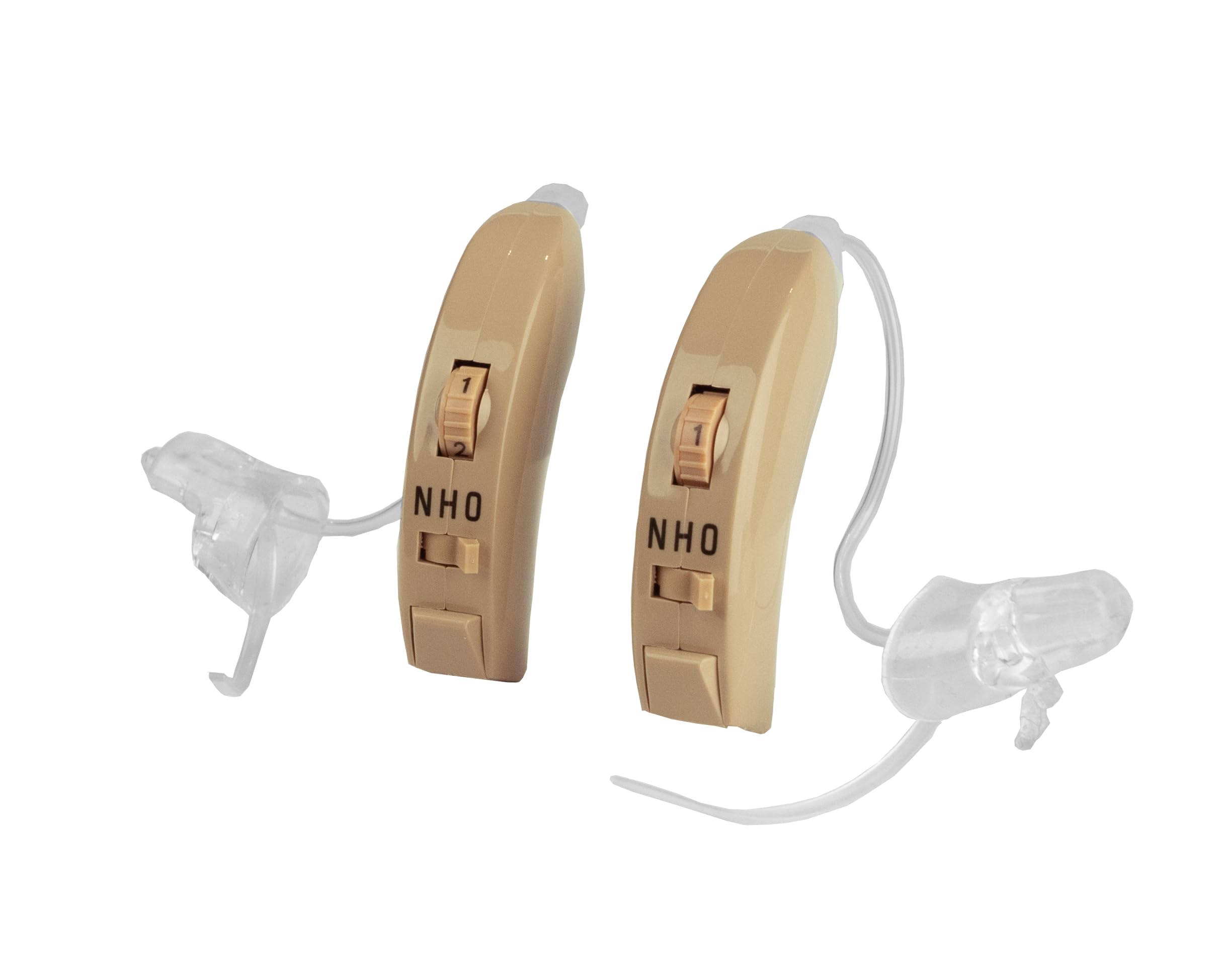
Analog sound, a volume dial, and nothing else to learn.
This is the pick for anyone who tried a digital aid and felt the sound came out robotic or processed. The TrueEQ is analog through and through, which the maker says delivers pure, natural sound without digital distortion or artificial processing. That is the whole pitch, and it is a strong one for listeners who miss how voices and music used to sound.
Simplicity is the second win. There are no apps, no Bluetooth pairing, and no modes to cycle through. You turn it on, adjust the volume, and go. The pair comes with multiple ear tips to fit most ear shapes, plus lightweight tubing for all-day comfort. It runs on widely sold size 13 batteries, and the maker describes the runtime in weeks rather than hours. For someone who wants zero charging routine, that removes a daily chore.
One warning holds for any analog aid: background noise gets amplified right along with voices. New wearers describe a short mental adjustment period as their ears learn to tune out the extra sound. There is also the mechanical side of the design. Some wearers with limited hand dexterity find the battery holder fiddly, a fair note for a device with a small compartment.
The analog advantage: No digital processing means no artificial tone. Voices come through the way your ears remember them, and the volume dial is the only control you need to think about.
What to plan around: All sounds are amplified equally, so busy rooms will be louder. Expect a brief adjustment period and a compact battery holder that asks for steady fingers.
Made for: the listener who wants genuine analog sound and the simplest possible routine, with size 13 batteries and no apps.
Not the match if: you want active noise reduction or app-based adjustment to filter a noisy room.
Know the Specs
Behind-the-ear (BTE) fit
A BTE aid sits behind the ear with a tube running over the top and a tip resting in the canal. This layout keeps the electronics off the ear canal itself, which many wearers find more comfortable for long sessions. It also lets the maker offer multiple ear tip sizes. A snug tip holds the aid in place and helps prevent the whistling feedback that comes from sound leaking back out.
Analog versus digital processing
An analog aid amplifies incoming sound directly, so voices arrive with their natural tone intact. A digital aid converts sound into data and processes it first, which can add noise reduction but may introduce a processed edge. For listeners sensitive to that artificial tone, analog is the calmer choice. The trade-off is that analog amplifies everything equally, background noise included.
Battery style and runtime
Replaceable button cells mean you keep a supply on hand and never wait on a charger, while a rechargeable case keeps the aid topped up between outings. Runtime on a rechargeable model depends on your volume setting and how long you wear it each day, so a spare battery or a portable case is a sensible safety net either way.
Volume and program controls
Controls range from a simple dial to slide switches to multi-programs with a range of levels. The more adjustment you want, the more useful a program system becomes. For first-time wearers, a single dial or slide switch gets used daily because the adjustment is intuitive rather than remembered.
Common Questions
Is an analog hearing aid better than a digital one?
Will background noise get louder with an analog aid?
How do I stop a behind-the-ear aid from whistling?
What is the difference between size 13 batteries and a rechargeable case?
Can I wear a behind-the-ear aid with glasses?
How long does a hearing aid battery last?
Do I need a smartphone app to adjust these hearing aids?
Is a landline phone with a hearing-compatible handset a substitute for a hearing aid?
How long does it take to adjust to a new hearing aid?
Can I return a hearing aid if the fit does not work?
The Bottom Line
For anyone who wants an actual hearing device and not just a clearer phone line, the TrueEQ Analog Hearing Aids earn the top spot. The pure analog sound meets the people who felt digital aids came out processed, and the size 13 batteries mean no charger to remember. If you would rather skip replaceable batteries, the Manzelun GM-105 brings a charging case that tops up both aids several times over. And for a household that needs a dependable landline a hard-of-hearing parent can hear on, the HTMengt Retro 2500 is the one to reach for. The right analog hearing aid is the one whose ear tips seal your canals and whose power routine you will actually keep.
How we choose
We do not accept paid placement. Every pick is matched to a real buyer and a real use-case; we do not hands-on test units.
Sources
Specifications: manufacturer listings and product documentation. Review insights: verified customer reviews, as of October 2026. Pricing: not shown on this page (it changes often); check the current price via the retailer link.
As an Amazon Associate, Aappliancez earns from qualifying purchases. This does not affect which products we feature.