Disclosure: Some links in this post are affiliate links. As an Amazon Associate I earn from qualifying purchases, at no extra cost to you. Learn more
Specs are compiled from manufacturer listings and verified buyer reviews and can change over time — please confirm the key details on the product page before buying.
If you want the safest sound-per-dollar pick in this group, buy the ELAC Debut 2.0 B6.2 first. It draws the most consistent praise of any pick here, and its warm, non-shouty balance flatters budget amps. Below you will find nine speakers — some built and assembled in the United States, some just designed here — sorted by what each one actually does well, so you can match the speaker to your room instead of to a marketing badge.
This guide is built by comparing the manufacturers’ published specifications and the patterns across verified customer reviews, so you get each pick’s real strengths and trade-offs instead of marketing spin.
If you have ever bought a speaker that sounded thin at home, you already know the room matters as much as the driver. What follows breaks down tweeter type, woofer size, cabinet bracing, and how each cabinet behaves near a wall. Every pick here works for a two-channel music setup or a surround system, though only some are actually built in the USA.
Top Picks


How To Choose The Best American Made Speakers
Start with the room, not the badge. A speaker that sounds dull and shut-in on a bookshelf can open up completely on a stand two feet from a wall. Before you read a single spec, measure the wall you plan to put it against and note whether that wall is shared with a neighbor.
The tweeter decides the top end
A tweeter is the small driver that handles high frequencies — cymbals, strings, and the breath in a vocal. A cloth dome tweeter (a soft fabric dome) tends to sound relaxed and forgiving on bright recordings. A horn-loaded tweeter (a small horn that spreads the sound) is far more sensitive, so it plays loud on very little power but can sound forward in a hard room.
Woofer size and where the speaker sits
The woofer is the bigger driver that moves air for bass and midrange. A 6.5-inch woofer moves more air than a 5.25-inch one, which usually means deeper bass — at the cost of a bigger cabinet. Ported cabinets (they have an opening that lets air escape) give more low end but need breathing room. Sealed cabinets are more forgiving when you must push a speaker close to a wall.
Passive or powered
Passive speakers need a separate amplifier or receiver to make sound. Powered speakers have the amplifier built in, so you plug them into the wall and connect a source directly. If you already own a receiver, buy passive. If you want fewer boxes and fewer cables, buy powered — but check which inputs it offers before you commit.
Side-by-Side Comparison
| Model | Best For | Woofer | Type | Tweeter | Amazon |
|---|---|---|---|---|---|
| ELAC Debut 2.0 B6.2★ Best Overall | Best overall sound for the money | 6.5 inches | Passive, 2-way bass reflex | 1-inch cloth dome | Amazon |
| SVS Prime BookshelfHome Theater Pick | Home theater surrounds and fronts | 6.5 inches | Passive, sealed midrange compartment | 1-inch aluminum dome | Amazon |
| MartinLogan Motion 15iDesktop Detail | Desktop and surround detail | 5.25 inches | Passive, hybrid driver | Folded motion tweeter | Amazon |
| Klipsch The Three Plus | Turntable and TV in one box | 5.25 inches | Powered 2.1 stereo | Dual 2.25-inch full range | Amazon |
| MartinLogan Motion 35XTi | Two-channel music detail | 6.5 inches | Passive, 2-way | Folded motion tweeter | Amazon |
| Edifier S2000MKIII | Big powered sound, no receiver | 5.5 inches | Powered, tri-amped | Planar diaphragm | Amazon |
| Edifier S1000W | Multi-room streaming | 5.5 inches | Powered, Wi-Fi and Bluetooth | Titanium dome | Amazon |
| Audioengine HD6 | Living-room all-in-one with wood | 5.5 inches | Powered, built-in DAC | 1-inch silk dome | Amazon |
| Klipsch Heresy IV | Long-term vinyl and low-volume listening | 12 inches | Passive floorstanding, horn-loaded | Horn-loaded | Amazon |
Detailed Reviews
1. ELAC Debut 2.0 B6.2 Bookshelf Speakers (Pair)
Our pick — 4.5+★ from 2,500+ verified ratings; the strongest balance of quality and price.
A front-ported 6.5-inch bookshelf pair that sounds like a much bigger investment.
This is the pick for anyone building a first real stereo in a small-to-medium room, and it earns the top slot for one reason above all: it is the most consistently liked speaker in this whole group. What wins people over is the midrange and bass — a warm, full, non-shouty presentation that takes the edge off bright recordings. The guts are a 1-inch cloth dome tweeter (a soft fabric dome that handles the highs) and a 6.5-inch aramid fiber woofer (a stiff woven cone for bass and mids). ELAC rates the response up to 35,000 Hz, which means the top end carries well past what most ears can hear — useful if you stream hi-res files.
The front-firing ports are the quietly practical part. Because the bass opening points forward instead of backward, you can push these close to a wall or drop them into a bookshelf without the bass turning muddy. That is a real advantage over the rear-ported boxes in this list, which need air behind them. The cabinets use thick MDF (a dense engineered wood board) and are internally braced, so they resist the cabinet rattle that muddies bass at higher volume.
The catch is that these are not plug-and-play. They sound tight and a little closed-in for the first while, and owners consistently describe them opening up after hours of play — one detailed write-up called the soundstage narrow at first and noticeably wider after roughly 30 hours, adding depth and instrument separation. On a bright amp they can lean dark, so a punchy amplifier suits them better than a warm one. They also do not come with rubber feet, and a couple of buyers report a slight wobble on hard floors.
What scores with owners
- Sound quality is the runaway favorite trait of this pair — 643 buyers call it out as the reason they are happy.
- Value lands second, with 362 owners saying the sound outstrips what they spent.
- Front-firing ports let you place them against a wall or on a shelf without ruining the bass.
- A 6.5-inch aramid woofer and braced MDF cabinet give it weight and a solid, deadened knock.
Where it asks for patience
- It needs break-in time before it sounds its best — plan on several hours of playing.
- Volume response is the one split topic, with 70+ buyers rating it mixed.
- No rubber feet in the box, so a hard floor can leave it sitting slightly uneven.
Start here if: you want a passive pair for a small room and already own an amp or receiver.
Budget a subwoofer: bass is defined and clean, but deep movie rumble still wants help.
2. SVS Prime Bookshelf Speaker (Pair) — Piano Gloss Black
A surround-system workhorse that drops into a home theater without fighting your room.
If your goal is a 5.1 system rather than a two-channel shrine, this is the more natural fit. The 6.5-inch woofer here is bigger than the 5.25-inch driver in the MartinLogan Motion 15i, and SVS mounts it in its own sealed compartment so the midrange stays clean instead of getting muddied by the bass. The tweeter is a 1-inch aluminum dome — a light, stiff metal dome that stays crisp when you push the volume, which matters for dialogue and effects.
The crossover is worth a plain-English note. A crossover is the circuit that splits the signal between tweeter and woofer, and SVS uses its own SoundMatch 2-way design to smooth that handoff. In practice you get stable imaging, meaning voices and instruments stay anchored in place on screen rather than drifting. Owners run these as front left and right channels and as surrounds behind the couch, and the consensus is that they blend rather than announce themselves.
The honest snag is labeling. At least one buyer points out that the Piano Gloss Black version was listed as a single speaker at the time of purchase even though the listing says pair — so confirm exactly what you receive before you order, especially if you are filling two surround positions.
Where it shines: a dedicated cabinet for the midrange and a metal dome tweeter make this a stable, dialogue-clear surround speaker for TV and film.
Check the listing: the “pair” wording on the gloss finish has been a source of confusion for at least one buyer, so verify the quantity in the title and details.
Reach for this if: you are assembling a surround system and want a front or rear speaker that stays composed under movie dynamics.
Look elsewhere if: you want to hear it before you buy — the review base here is small compared to the ELAC above, so you are leaning on the spec sheet more than on crowd wisdom.
3. MartinLogan Motion 15i Bookshelf Speaker
A 5.25-inch desktop speaker whose folded motion tweeter keeps vocals clean at arm’s length.
Buy this one when your listening happens at a desk, not across a living room. The 5.25-inch woofer is the smallest of the passive speakers here, and owners describe the bass as punchy through the midrange rather than room-shaking — which is exactly right for a computer setup at arm’s length. The tweeter is a folded motion design (a pleated diaphragm that pushes air faster than a conventional dome), and it is the reason people keep coming back to this line for clarity.
The surround crowd likes it too. Buyers run it behind the couch alongside MartinLogan electrostatic fronts and report that it blends into the system and keeps voices natural without getting harsh when the volume climbs. Setups with far more power than needed still come out clean, so you have headroom to spare.
Two things to know up front. It is sold as a single speaker, so a stereo pair means two orders — that catches people out. And this model is on its way out, which owners mention openly, so stock can be a moving target.
What you are really buying: a folded motion tweeter and a 5.25-inch hybrid-driver cabinet — a compact, clear speaker that suits close listening and surround duty.
Order twice: the listing is for one speaker, not a pair, so budget and plan for two if you want stereo.
Suits you if: you sit close, you value vocal clarity over thunder, or you need a surround speaker that fades into the mix.
Keep looking if: you want floor-shaking bass from a bookshelf — this one wants a subwoofer for that.
4. Klipsch The Three Plus Bluetooth Speaker

One walnut box that plays your records, your TV, and your phone without a receiver.
This is the pick for someone who wants fewer boxes, not more. It is a 2.1 stereo system with the amp built in, running dual 2.25-inch full-range drivers alongside a 5.25-inch high-excursion woofer — the woofer is the driver that does the low-end work, so one box covers bass and treble. What owners talk about most is sound quality, and the theme that runs through the reviews is that it beats expectations for a tabletop unit.
Where it separates itself from the passive picks above is convenience. Phono/RCA inputs let you plug a turntable straight in, so your records play without a separate phono stage or amplifier. Bluetooth 5.3 reaches up to 40 feet from the source, and USB-C handles playback plus reverse charging. There is an optical input and a Klipsch Connect App for EQ and saved presets. The real wood veneer and tactile knobs are why it earns its spot on a shelf instead of hiding behind a couch.
The one recurring gripe is Bluetooth pairing — some connections take patience, including one buyer whose phone took hours to link up. Internet streaming is not built in either, so if you want AirPlay or a native network app, plan on adding a small streamer through its inputs.
The convenience win: a built-in amp, a phono stage, Bluetooth 5.3 with 40 feet of range, and USB-C reverse charging in a single walnut cabinet.
Where it can frustrate: Bluetooth connectivity is the mixed spot in its feedback, and there is no built-in internet streaming, so edge cases need a workaround.
Buy this for: a bedroom or living-room setup where one box has to cover vinyl, TV, and phone streaming.
Pass if: you demand native AirPlay 2 or app-based streaming from the start — this one wants a streamer added.
5. MartinLogan Motion 35XTi Bookshelf Speaker

A 6.5-inch folded motion bookshelf that surfaces background details you missed in familiar tracks.
Step up from the 15i and you get a 6.5-inch woofer instead of a 5.25-inch one, and the difference shows up as heft in the low end without losing the clarity MartinLogan is known for. Owners describe a neutral balance tipped toward treble and midrange, and several say they hear small background noises they had never noticed in familiar tracks — the kind of resolution that makes you replay an album front to back.
Where it beats its cheaper sibling most clearly is refinement at higher volume. The recurring line in the feedback is that it stays clean and free of listening fatigue over long sessions, which is the opposite of the bright, tiring sound some horn designs give you. Pair it with a good amplifier and the imaging stays locked in. If you have been running a modest box, this is the speaker that makes the amp upgrade feel worth doing.
Here is the real caveat: it is sold as one speaker, so a stereo pair doubles your outlay — and a couple of owners mention the bass, while surprisingly good for two-channel music, still wants a subwoofer for movie effects. There is also a finish note: at least one buyer preferred the look of the earlier 35xt.
Why the extra money: a 6.5-inch woofer and folded motion tweeter deliver imaging and top-end detail that hold up next to far pricier boxes.
The fine print: single-speaker pricing means a pair costs twice the listed figure, and movies still want a dedicated subwoofer.
For the detail seeker: you listen to two-channel music seriously and want a speaker that rewards a good amp.
Different tool if: you are outfitting a home theater — this one is happiest with a subwoofer added for effects.
6. Edifier S2000MKIII Tri-Amped Bookshelf Speakers — 130W
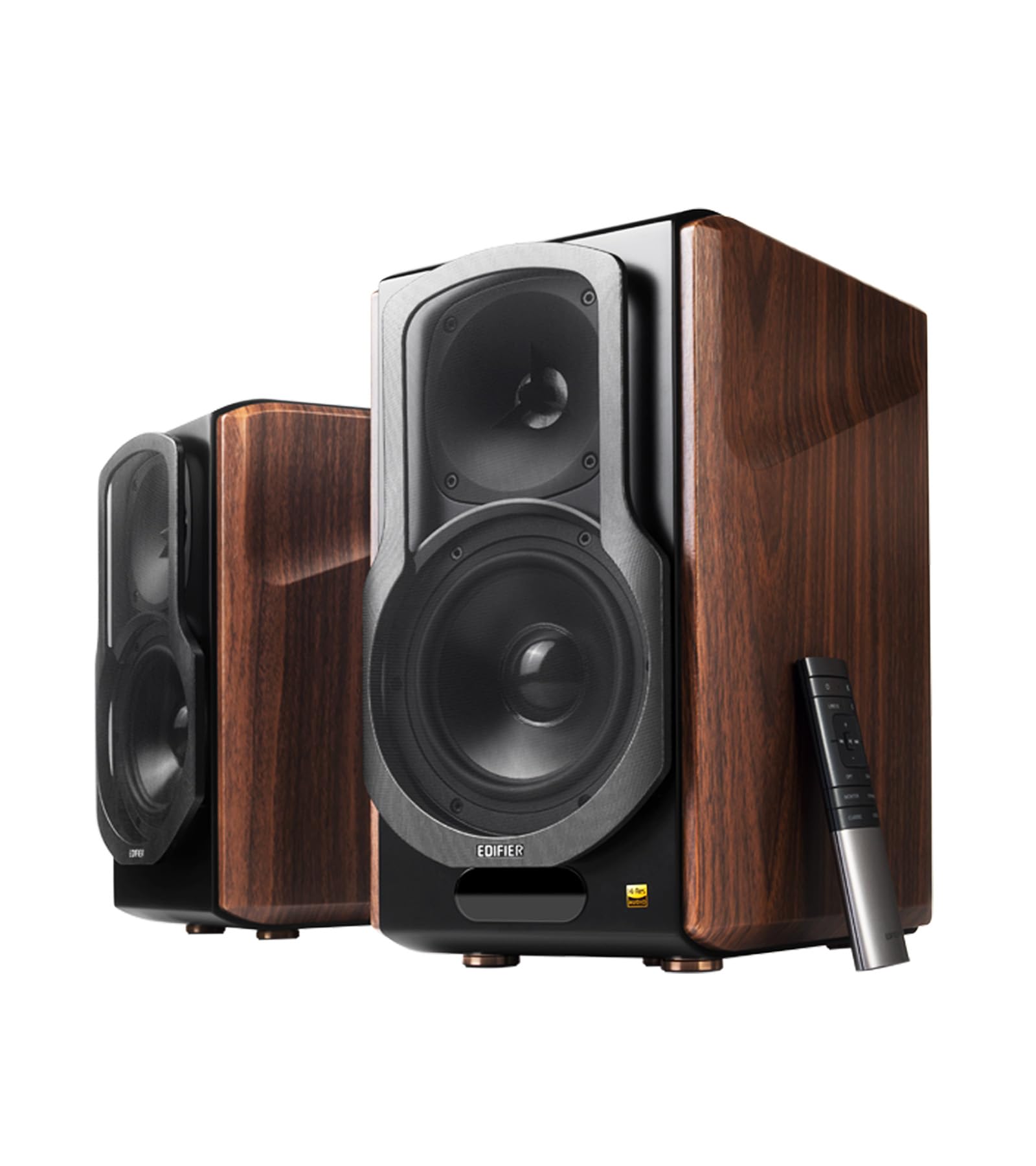
A 130W tri-amped powered pair with 5.5-inch woofers that runs without a receiver.
This is the pick for someone who wants a finished system, not a project. It is a tri-amped powered pair (three amplifiers per side handle the drivers separately) with planar diaphragm tweeters and 5.5-inch woofers, rated at 130W. The result, judging by the feedback, is bass with real weight — owners describe a fullness that grows with the volume knob instead of just getting louder, and several say they never felt the need to add a subwoofer.
The connectivity is unusually generous for a powered pair: Bluetooth 5.0 with aptX HD decoding for higher-quality wireless audio, plus line-in, optical, and coaxial inputs so your TV, turntable-with-preamp, or computer can all stay plugged in at once. There is an included wireless remote and an LCD display, and the cabinets feel dense enough that people compare their weight favorably to lighter competitors.
The one thing to plan for is placement. This is a nearfield-friendly speaker that rewards tuning — customers note it comes alive past a certain volume and with a little space from the wall and a slight toe-in toward the seat. If you expect plug-and-play at low background levels, it may disappoint. The remote is also a weak point, with a couple of buyers calling it flimsy and hard to read.
What earns the praise
- Sound quality leads the way — 211 owners point to it as the standout trait.
- Value comes second, with 80 buyers saying the sound outpaces the outlay.
- Bluetooth 5.0 with aptX HD plus optical, coaxial, and line-in keep several sources connected.
- Planar diaphragm tweeters and 5.5-inch woofers deliver bass with real body.
Where it needs tuning
- It wants placement care — wall distance and toe-in matter more than usual.
- The remote is the least-loved part, with 30+ buyers rating it mixed.
- No dedicated subwoofer input, so adding one later is more awkward.
Worth it if: you want a finished powered pair that fills a room with no receiver in sight.
Think twice if: you want a subwoofer-friendly system or you play mostly at whisper volume.
7. Edifier S1000W WiFi Audiophile Active Bookshelf Speakers

A 120W powered pair with Wi-Fi, AirPlay 2, and multi-room grouping for music across the house.
If you want to group speakers into more than one room, this is the pick in this list built for exactly that. It is a powered 120W RMS pair with 5.5-inch drivers that connects to your home Wi-Fi and supports AirPlay 2, Spotify Connect, and Alexa voice commands. Group two or more and you can play the same track across rooms or set up a stereo pair in one — the app handles the grouping, and no separate receiver enters the picture.
The streaming spec that matters is Hi-Res support: it handles a signal sample rate up to 24-bit/192kHz, which is the headroom for lossless and high-resolution files. Optical, coaxial, RCA x2, Bluetooth 5.0, and AUX are all on deck, so a TV, a turntable with a preamp, and a phone can live side by side. Owners describing the sound use words like tight bass and crisp highs, and several say the room-filling output is the surprise.
The one honest hurdle is Wi-Fi setup. It sticks to the 2.4GHz band, and newer Android phones have had trouble with the initial connection — the workaround buyers share is to pair first with an older 2.4GHz phone, then the app works on the newer device. Once it is on the network, the reports settle down. If your turntable needs a phono stage, note that you bring your own.
The network advantage: Wi-Fi with AirPlay 2, Spotify Connect, and Alexa, plus multi-room grouping and 24-bit/192kHz Hi-Res support.
The setup snag: Wi-Fi pairing is 2.4GHz-only and has tripped up owners on newer phones, so expect a few minutes of patience on first install.
Built for you if: you want music in several rooms and voice control without a rack of gear.
Not for you if: you want a simple plug-in-and-play wired setup and dislike app-based configuration.
8. Audioengine HD6 Powered Bookshelf Speakers — Walnut

Furniture-grade walnut with a DAC inside — a system that hides its complexity.
This is the pick for the person who wants a real stereo in a living room without a component rack. It is a powered pair with a built-in 24-bit DAC (a converter that turns digital files into analog sound so detail survives the trip), custom 5.5-inch woofers, 1-inch silk dome tweeters, and an analog amplifier. Bluetooth aptX HD reaches up to 100 feet, and optical, RCA, and 3.5mm inputs let you plug in a TV, a turntable with a preamp, a gaming console, or a streamer.
The cabinet is the part you will notice first. Handcrafted real wood veneer with aluminum trim and magnetic grilles gives it the look of furniture rather than gear, and the veneer is not just cosmetic — it helps damp the cabinet so it does not ring. Owners talk about how it fills a medium room and how the finish reads sharp in a living space. There is a 3-year warranty and U.S.-based customer support behind it.
Two honest notes. It can sound flat and underwhelming fresh from the start, and the consistent advice is to give it a long break-in — some run pink noise overnight for dozens of hours — before it opens up. And at high volume on bass-heavy material it can distort, so if chest-thumping impact is the goal, plan on adding a subwoofer.
What sells it: a built-in 24-bit DAC, aptX HD Bluetooth, optical and RCA inputs, and a real wood cabinet — a full system in two boxes.
Patience required: the sound is reported as flat until it is broken in, and very loud bass-heavy playback can run out of clean headroom.
Pick this if: you want a handsome, clutter-free stereo that handles TV, streaming, and vinyl with one pair of speakers.
Do not pick it if: you plan to run it at high volume on bass-heavy tracks and refuse to add a subwoofer.
9. Klipsch Heresy IV Floorstanding Speakers

Built to order in Hope, Arkansas — a horn-loaded floorstander with a rear port.
This is the most literal answer to the American-made question in this list. Klipsch designs and assembles the Heresy IV in the USA, and its cabinets are handcrafted to order in Hope, Arkansas, a practice the company says has run for over 50 years. The panels use book-matched wood veneer — mirror-image slices from the same timber — so the left and right speakers look like they were cut from one board. If the provenance matters to you as much as the sound, this is the pick.
The engineering change that defines this generation is the rear port. For the first time in the Heresy line there is a ported opening at the back, and Klipsch rates it as improving low-frequency extension by almost 10Hz. In plain terms, that is more usable bass from a horn-loaded floorstander than the design historically delivered. A horn-loaded tweeter is a tweeter set into a small horn that spreads sound efficiently, which is why the Heresy plays easily at low volume — owners describe a full, present sound even with the dial turned down.
The room note is real. Reviewers point out the bass is on the lean side at low volume until you add subwoofers, and the rear port means you want a little space behind the cabinet. There is also a 10-year factory warranty in the spec sheet, which is the kind of long view you take with a speaker you plan to keep for years.
The American-made case: designed and assembled in the USA with cabinets handcrafted to order in Hope, Arkansas, plus book-matched veneer and a 10-year factory warranty.
The trade-off: a rear port needs breathing room, and the bass is described as thin at low volume unless you run subwoofers.
It is your speaker if: proven provenance, long-term build quality, and a horn-loaded sound you can listen to at low volume are what you are after.
skip it if: your room is tight against the wall behind the speakers, or you want deep bass at whisper levels without subs.
Know the Specs
Driver size in inches
The driver is the cone that moves air. A 6.5-inch woofer moves more air than a 5.25-inch one, which usually means deeper bass — and a bigger cabinet. A 12-inch woofer in a floorstander moves the most air of all and plays loud with almost no amplifier effort. A 12-inch woofer can overwhelm a small room with bass, so match driver size to the space. Match size to the room, and add a subwoofer if the cabinet cannot reach the low notes you want.
Power, passive versus powered
Passive speakers need an amplifier or receiver to drive them, so check the amp’s power rating against the speaker’s needs. Powered speakers have the amplifier built in and plug straight into the wall, so you skip the receiver but lose the flexibility to swap amps later. A powered rating like 120W RMS tells you how much power the built-in amp can deliver continuously, while 130W on a tri-amped pair spreads that across three amplifiers per side.
Common Questions
Do I need a receiver for a passive bookshelf speaker pair?
Can I use a bookshelf speaker on its side for a surround channel?
How far from the wall should a ported speaker sit?
Do the MartinLogan speakers come as a pair?
How do I hook up a turntable to a Klipsch The Three Plus?
Wired or Bluetooth sound — is there really a difference?
Do I need a subwoofer with bookshelf speakers?
Is Hi-Res audio support worth paying for?
Which speakers are actually built in the United States?
How much break-in time should I expect?
The Bottom Line
For most rooms, the strongest start remains the ELAC Debut 2.0 B6.2 — front-firing ports that forgive a tight wall, a 6.5-inch aramid woofer, and the most consistent praise of any pick here. If you are building a home theater and want a speaker that stays calm during explosions, the SVS Prime Bookshelf is the natural partner. And if the American-made story is the reason you clicked, the Klipsch Heresy IV backs it up with cabinets handcrafted to order in Hope, Arkansas and a 10-year factory warranty. The one honest nudge: the ELAC is the safest blind buy in this group, so if you cannot audition anything first, start there.
How we choose
We do not accept paid placement. Every pick is matched to a real buyer and a real use-case; we do not hands-on test units.
Sources
Specifications: manufacturer listings and product documentation. Review insights: verified customer reviews, as of October 2026. Pricing: not shown on this page (it changes often); check the current price via the retailer link.
As an Amazon Associate, Aappliancez earns from qualifying purchases. This does not affect which products we feature.