Disclosure: Some links in this post are affiliate links. As an Amazon Associate I earn from qualifying purchases, at no extra cost to you. Learn more
Specs are compiled from manufacturer listings and verified buyer reviews and can change over time — please confirm the key details on the product page before buying.
The hardest part of painting aluminum is not the painting — it is getting the paint to stay once the weather turns. Bare aluminum forms a thin oxide skin almost instantly, and ordinary paint slides off that slick surface within a season. So the real question is which coating actually bonds hard enough to survive rain, sun, and salt spray. The five picks below cover the full spread: splash-on touch-up pens, heavy marine topside enamel, a rust-converting primer, and a caliper-grade ceramic aerosol — each one earning its place for a different job.
This guide is built by comparing the manufacturers’ published specifications and the patterns across verified customer reviews, so you get each pick’s real strengths and trade-offs instead of marketing spin.
Aluminum resists rust but not wear, which is why the right coat depends entirely on the surface and the abuse it takes. Here is how to match each formula to the metal you are actually coating, from a dock-side scratch to a sun-baked trailer frame, in this breakdown of the best aluminum paint.
Top Picks


How To Choose The Best Aluminum Paint
Aluminum is a strange surface for paint. It does not rust the way steel does, but its oxide layer is so smooth that a cheap coat will peel in sheets instead of wearing away gradually. That single fact explains why a marine enamel and a caliper aerosol can share this list even though they never touch the same object.
Match the formula to the surface, not the color
For hulls, trailers, doors, and gutters exposed to weather, an oil-based topside enamel is the traditional path — it levels out smooth and holds gloss. For brake calipers, rotors, and engine-adjacent metal, you need a ceramic resin that shrugs off heat. A rust converter is a different animal again: it chemically converts existing corrosion into a paintable surface, so you are not painting over loose flake that will lift later.
Dry to touch is not dry to handle
A can that says dry-to-touch in an hour or two is telling you when dust stops sticking — not when you can bolt the part back on or walk on the deck. Full cure is a longer window, and every formula here rewards patience. Apply too soon and the coat slides, bubbles, or scratches off under a thumbnail.
Thin coats beat thick coats every time
Multiple light passes give the solvent time to flash off between layers. One heavy coat traps solvent underneath, and that trapped solvent is what causes the wrinkling and slow-cure complaints that show up on any metal coating. Two or three thin passes, spaced by the maker’s stated interval, is the pattern that holds.
Side-by-Side Comparison
| Model | Best For | Finish | Dry Time | Format | Amazon |
|---|---|---|---|---|---|
| Rust-Oleum Marine Topside Semi-Gloss Navy Blue★ Best Overall | Hulls, tubs, and weathered exterior metal | Matte (semi-gloss name) | 1 hour | Can, liquid | Amazon |
| Paint Saint Airtight Touch-Up ContainerSmartest Accessory | Storing and dispensing touch-up paint | Any painted surface | — | 13 fl oz canister | Amazon |
| SENVEN Boat Paint Touch Up Pen | Scratches and chips on small metal | High-gloss | 2 hours | 30 ml pen | Amazon |
| VHT Caliper Paint, Gloss, Cast Aluminum | Brake calipers, rotors, and hot metal | Gloss | 4 hours | 11 oz aerosol | Amazon |
| 2-in-1 Rust Converter & Metal Primer | Rusted steel, iron, and farm equipment | Matte | 24 hours | 35 fl oz liquid | Amazon |
Detailed Reviews
1. Rust-Oleum Marine Topside Semi-Gloss Navy Blue Boat Paint
Our pick — 4.5+★ from 7,500+ verified ratings; the strongest balance of quality and price.
The oil-based enamel that levels itself smooth and holds its gloss through salt, sun, and scrub brushes.
If your aluminum sits outdoors — a pontoon seat, a dock ladder, a trailer panel — this is the coat that does the heavy lifting. It is an oil-based formula that flows out flat and covers up to 100 sq ft per can, so one tin handles a good-sized project without a second trip. Drying to the touch in as little as 1 to 2 hours lets you get a second pass down the same afternoon, and the finish resists abrasion and extreme weather while adding UV protection so the color does not chalk out.
What wins people over is the finish itself — it lays down looking like new and keeps that shine instead of going dull after a month of sun. Owners stretch it well past the boat: fiberglass showers, RV tubs, garage doors, gutters, even interior doors. You can thin it and shoot it through a sprayer, or roll and brush it on, and it wipes clean once cured. Expect to re-coat after a few years of hard marine exposure; the enamel is durable, not permanent.
The catch is patience during cure, and it is a real one on this oil-based coating. Give each coat a full week to harden before you judge adhesion or put the surface back in service — several buyers learned that a three-day cure was simply not enough on a slick plastic tub, then watched the same paint lock down hard and tight after a week and a half. As the review pages put it: “Works well, but give it a week per coat to dry.” Plan the job around that window and the results hold.
What earns it the top spot
- Covers up to 100 sq ft per can with a smooth, level finish
- Dry to the touch in as little as 1 to 2 hours between coats
- UV and abrasion resistance keeps gloss on outdoor metal and fiberglass
- Works on boats, tubs, doors, gutters, and trailers — not just hulls
Where it asks more of you
- Oil-based formula needs strong airflow and a painting mask
- Full cure rewards a full week per coat before hard use
- Not the pick for brake calipers or heat-cycling parts
Reach for this if: you are coating anything that faces weather — hulls, trailers, tubs, or gutters — and want a gloss that stays put.
Look elsewhere if: you need a coat on a hot part or a fast turnaround the same day.
2. Paint Saint
Not paint at all — the airtight canister that keeps your leftover aluminum coat fresh and ready for a one-minute touch-up.
Here is the problem nobody talks about: your best aluminum paint dries out in the original can long before you need it again. This 13 fl oz container solves that by sealing a built-in brush inside a silicone-gasket canister with a metal closing ring. Pour in your leftover paint, screw the ring down, and the brush bristles stay soft instead of hardening into a brick. No washing, no rinsing — you open it, dab, and close it again.
The brush itself is a 1″ x 3″ synthetic with a stainless steel ferrule, built to hold plenty of paint in one dip so a small nick does not turn into a full brush-and-tray setup. It ships with stainless steel mixing balls and an aluminum ring, and the body is thick ABS plastic that shrugs off drops. Property managers and DIY folks both lean on it for baseboards, wall nicks, and small metal touch-ups where dragging out a gallon can feels absurd.
The honest downside is a little paint management on your part. Fill it past the outside fill line and the inner wiping notch sits above your paint level, which means careful pouring — as one buyer put it, “you have to be careful or it drips paint.” Some also report the top can cement itself to the canister if paint gets into the threads, so wipe the rim before you seal. Neither issue is a dealbreaker; both are about treating the seal with respect.
The real value: it turns a stored half-can of aluminum enamel into a grab-and-go touch-up kit that stays usable between projects.
Small caveat: this is a dispensing container, not paint — pair it with whichever coating above you actually use on your metal.
Best for: anyone who keeps leftover paint for spot fixes and is tired of dried-out brushes and skin-topped cans.
Skip if: you paint from the original can in one go and never need to store a batch.
3. SENVEN Boat Paint Touch Up Pen High-Gloss Marine Grade

The pocket-sized pen for chips, scratches, and gouges where hauling out a full can would be overkill.
For a ding on an aluminum jon boat, a scuffed pontoon panel, or a scratch on a deer stand ladder, this 30 ml pen is the right size and the right tool. The water-based acrylic goes on high-gloss with a built-in brush, so there is no tray, no roller, and no cleanup beyond recapping. It is labeled for aluminum, wood, fiberglass, and metal, and once dry it resists UV, chemicals, and abrasion. Two coats spaced 2 hours apart give the cleanest surface.
The quick-dry spec is where this one pulls ahead of the marine enamel in a hurry: the pen touches dry in 2 hours versus the Rust-Oleum’s 1 hour, but its real advantage is scale — you are not opening a quart for one nick. Effectiveness is what buyers praise most about this pen, and it earns that by simply covering the damage. It goes on jet black and blends cleanly; Owners who touched up black car rims with it report the repair still blends with the original paint a year later.
Where it falls short of the enamel above is durability and body — the acrylic is thinner than expected, so a single pass on a deep gouge will not cut it. Expect to build up two or three light coats, and let the 2-hour interval do its job between them. The gloss stays bright, but a heavy scuff on a high-traffic hull will want the thicker topside coat instead.
Who it clicks with: the owner who spots a scratch, grabs the pen, fixes it in ten minutes, and puts it back in the glovebox.
The trade-off: thin paint means extra coats on deeper damage — plan for two or three passes.
Pick it for: small metal and fiberglass repairs on boats, trailers, and gear where a pen-sized dose does the whole job.
Leave it if: you are refinishing a large panel and need real coverage in one pass.
4. VHT Caliper Paint, Gloss, Cast Aluminum
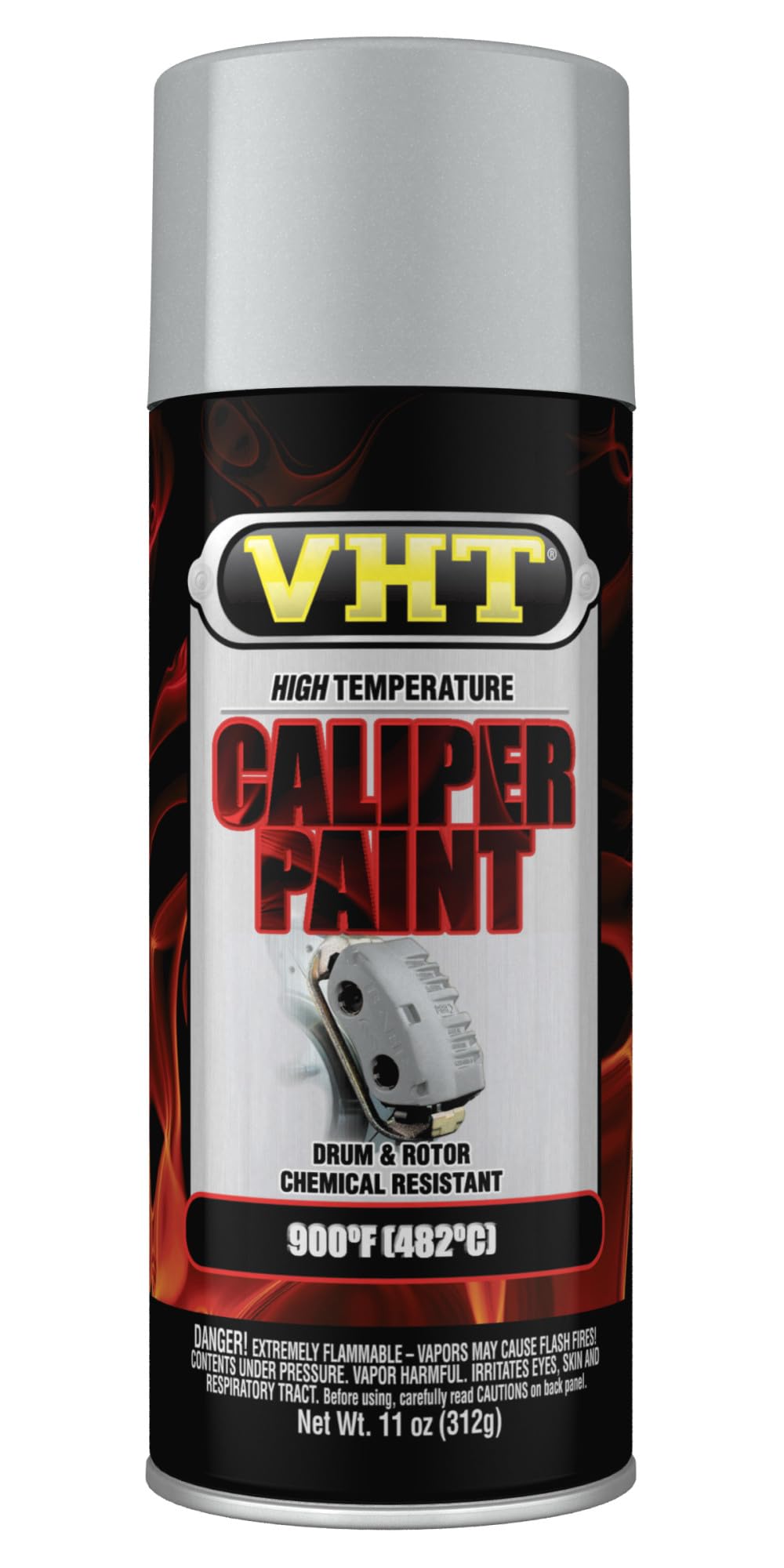
Cast-aluminum caliper paint built with ceramic resins that hold up to 900° F without losing gloss.
Some aluminum parts get hot enough to cook a regular coat right off. This 11 oz aerosol solves that with ceramic resins rated to resist heat up to 900° F, so brake calipers, rotors, and drums keep their finish after hard stops. The gloss cast-aluminum color mimics a bare machined part, and the finish resists chipping, chemicals, and brake dust. You get 15 to 20 sq ft per can, which is plenty for a full set of calipers and then some.
The application rhythm is friendly and fast. Dry to the touch in about 30 minutes, handle-ready in 1 hour, and full surface cure around 4 hours if you let it sit. The EZ Touch conical nozzle lays an even fan without spitting, and light-to-medium coats build that near-factory look. The coat tolerates heavy-handed passes, and an optional clear coat adds extra shine. Daily driving and heat from normal braking finish the cure.
The recurring gripe is color consistency on some shades — a can labeled a single hue can land slightly off, so if you order multiple cans for one project, blend before you spray. And a couple of owners note the finish can chip if roughly handled, so use care around sockets and wrenches. These are edge cases, not the norm; Most buyers report the finish holding up for a year or more of use.
Why hot-metal owners choose it
- Ceramic resins resist heat up to 900° F
- Dry to touch in 30 minutes, handle in 1 hour
- Covers 15 to 20 sq ft per can — enough for a caliper set
- Resists chipping, chemicals, and brake dust
What to watch
- Shade can vary slightly from can to can on some colors
- Can chip if roughly handled around tools
- Strong solvent odor means good ventilation matters
Best fit for: DIY brake jobs and aluminum parts that bake in engine heat and need a glossy, dust-resistant coat.
Not the pick if: your metal never sees heat and you only need a simple touch-up.
5. 2-in-1 Rust Converter & Metal Primer

The converter that turns loose rust into a paintable surface and skips the separate primer step.
When your aluminum is bolted to steel that has already bloomed with rust — a trailer frame, a farm gate, a set of rain gutters — painting over the flake just seals in failure. This 35 fl oz water-based formula does both jobs at once: it converts existing rust into a stable, paintable surface and acts as the primer, so no sanding and no separate primer are needed. It is labeled for steel, iron, aluminum, and more, and it dries to a matte chalkboard grey-black.
Heat resistance tops out at 350° F, which clears engine bays and brake parts while leaving the really hot stuff to the VHT above. It resists UV, chemicals, and abrasion without a topcoat, and at under 400 sq ft per gallon, one bucket covers a lot of small trailer and gate repairs. Cleanup is water, and the low-VOC, water-based formula keeps indoor work bearable. The finish lands as a matte chalkboard grey-black, which reads as honest primer rather than a show finish.
Rust resistance is the honest split here. On lightly rusted steel it goes on with no prep and holds well; on heavy flake, scrape the loose stuff and build two coats or you will see rust creep back through. The included little brush is genuinely useless, so bring your own applicator. Also respect the 72-hour window after opening and don’t rub or scrape the coat once it dries — those are the rules that keep the conversion intact.
The standout: a low-VOC, water-based two-in-one that saves you an entire step on rusted metal and covers a lot of ground per bucket.
One honest limit: it needs two to three thin coats and a little prep on heavy rust — this is not a one-dab fix.
Choose it when: the surface is corroded and you want a converter plus primer in a single water-cleanable formula.
Choose the enamel instead if: your metal is clean aluminum that just needs a weather-facing topcoat.
Know the Specs
Coverage per can
Coverage is the square footage one can or bucket will coat at the maker’s recommended film thickness. It is the number that tells you whether one purchase finishes the job or leaves you short mid-project. A 100 sq ft can handles a boat topside; a 15 to 20 sq ft aerosol covers a set of calipers; a bucket rated under 400 sq ft per gallon stretches across a lot of small farm or trailer repairs. Buy to your surface area, not to the fear of running out.
Heat rating
Heat rating is the temperature a cured coating can survive without blistering or flaking. It matters on any metal near brakes, engines, or exhaust, because a standard enamel will fail there while a ceramic-resin product holds. A 900° F caliper rating covers brake parts; a 350° F converter rating handles engine bays and general outdoor metal. For hulls, doors, and trailers, heat rating is irrelevant — weather resistance is what counts.
Dry to touch vs full cure
Dry to touch is when dust stops sticking — not when the paint is hard. Full cure is when the coating reaches its final hardness and chemical resistance. An enamel that dries in 1 to 2 hours may still want a full week before heavy use. A caliper aerosol dries in 30 minutes but continues curing under brake heat. Respect the gap between the two, and most adhesion complaints never happen.
Formula base
Oil-based enamels level out smooth and hold gloss but need airflow and a mask. Water-based acrylics dry fast, clean up with water, and smell far less. Ceramic-resin aerosols bake into a tough film that resists heat and chemicals. Each base is a trade-off between finish quality, cure speed, and how pleasant the job is to actually do. Match the base to the environment you will be painting in.
Common Questions
Will ordinary paint stick to bare aluminum?
How long should I wait between coats of aluminum paint?
Can I spray aluminum paint instead of brushing it?
Do I need a primer under aluminum paint?
Is aluminum paint safe for brake calipers?
How do I keep leftover aluminum paint from drying out?
Will aluminum paint work over rusted steel?
How long does aluminum paint last outdoors?
Does the gloss in aluminum paint fade over time?
Can I use aluminum paint indoors?
The Bottom Line
For most people facing weathered aluminum and wanting one coat that holds its gloss, the winner is the Rust-Oleum Marine Topside Semi-Gloss Navy Blue — it covers up to 100 sq ft, dries fast between coats, and resists UV and abrasion across hulls, trailers, tubs, and doors. If you want a small, precise repair instead of a full refinish, grab the SENVEN Boat Paint Touch Up Pen. And for corroded steel or iron that needs the rust stopped before anything else, the 2-in-1 Rust Converter is the one to reach for. Whichever job you are facing, matching the formula to the surface and giving the cure its full time is what separates a coat that lasts from one that peels.
How we choose
We do not accept paid placement. Every pick is matched to a real buyer and a real use-case; we do not hands-on test units.
Sources
Specifications: manufacturer listings and product documentation. Review insights: verified customer reviews, as of October 2026. Pricing: not shown on this page (it changes often); check the current price via the retailer link.
As an Amazon Associate, Aappliancez earns from qualifying purchases. This does not affect which products we feature.