Disclosure: Some links in this post are affiliate links. As an Amazon Associate I earn from qualifying purchases, at no extra cost to you. Learn more
Specs are compiled from manufacturer listings and verified buyer reviews and can change over time — please confirm the key details on the product page before buying.
The fastest way to end up with a sagging, rippling screen is to buy mesh without checking two things first: your frame groove size and the actual width you need. Get those right and a screen replacement is a genuinely simple afternoon job. Get them wrong and you will be re-cutting material you already paid for.
This guide is built by comparing the manufacturers’ published specifications and the patterns across verified customer reviews, so you get each pick’s real strengths and trade-offs instead of marketing spin.
Fiberglass kits suit most homes because they cut with ordinary scissors and shrug off sunlight for years, while stainless steel mesh is the answer when pets, squirrels, or birds keep punching holes in the same window. Below you will find the strongest options for aluminum and screening, sorted by what each one actually does best.
Top Picks

How To Choose The Best Aluminum and Screening
Get three numbers right and your screen project goes smoothly: the groove width in your frame (the channel that holds the spline), the finished width of the opening, and the height. Nail all three and the rest is technique. Miss one and you will be cutting twice.
Match the spline to the groove, not to the kit
The spline is the rubber cord that presses the mesh into the channel around your frame. It has to be slightly fatter than the channel to grip. A 0.14-inch spline will not hold mesh in a frame cut for a 0.175-inch groove, and forcing it just leaves the edges loose. Measure your groove with a ruler before ordering, and if you are unsure, pick a kit that ships two spline diameters so you have a spare size on hand.
Fiberglass or stainless steel
Fiberglass is the standard choice for most homes. It cuts with scissors, will not rust, and the mesh lets light through while keeping insects out. Stainless steel wire mesh is the upgrade when something is actively damaging your screens. It is heavier, it needs shears or tin snips rather than a household knife, and it costs more, but it stands up to claws, teeth, and beaks that shred ordinary mesh.
Measure the opening, then subtract for the frame
Cut your mesh slightly wider than the visible opening so it tucks into the groove. For a full frame build, subtract roughly an inch and a half per measurement to account for each corner, and shorten the height just a touch more when top retainer clips are involved. Measuring every window individually beats trusting that they are all the same size.
Side-by-Side Comparison
| Model | Best For | Material | Mesh Size | Weight | Amazon |
|---|---|---|---|---|---|
| Window Screen Replacement Kit 48in x 158in Fiberglass★ Best Overall | Whole-house screen refreshes | Fiberglass | 48 x 158 in | 1.41 lb | Amazon |
| MD Building Aluminum Screen Frame KitFrame Builder | Building a frame from scratch | Aluminum and vinyl | 36 x 36 in frame pieces | 0.3 kg | Amazon |
| Window Screen Replacement Kit 8-in-1 48in x 118in | Sliding and patio doors | Fiberglass | 48 x 118 in | 1.7 lb | Amazon |
| 304 Stainless Steel Mesh Roll 36in x 200in | Pet and rodent damage | 304 stainless steel | 36 x 200 in | 2.94 lb | Amazon |
| KISKIS 304 Stainless Steel Woven Wire Mesh | Vents, cages, and odd gaps | 304 stainless steel | 60 x 300 cm | 15.5 oz | Amazon |
Detailed Reviews
1. Window Screen Replacement Kit Width:48in Length:158 Fiberglass
Our pick — 4.5+★ from 850+ verified ratings; the strongest balance of quality and price.
Almost five yards of fiberglass screen and every tool you need in one box.
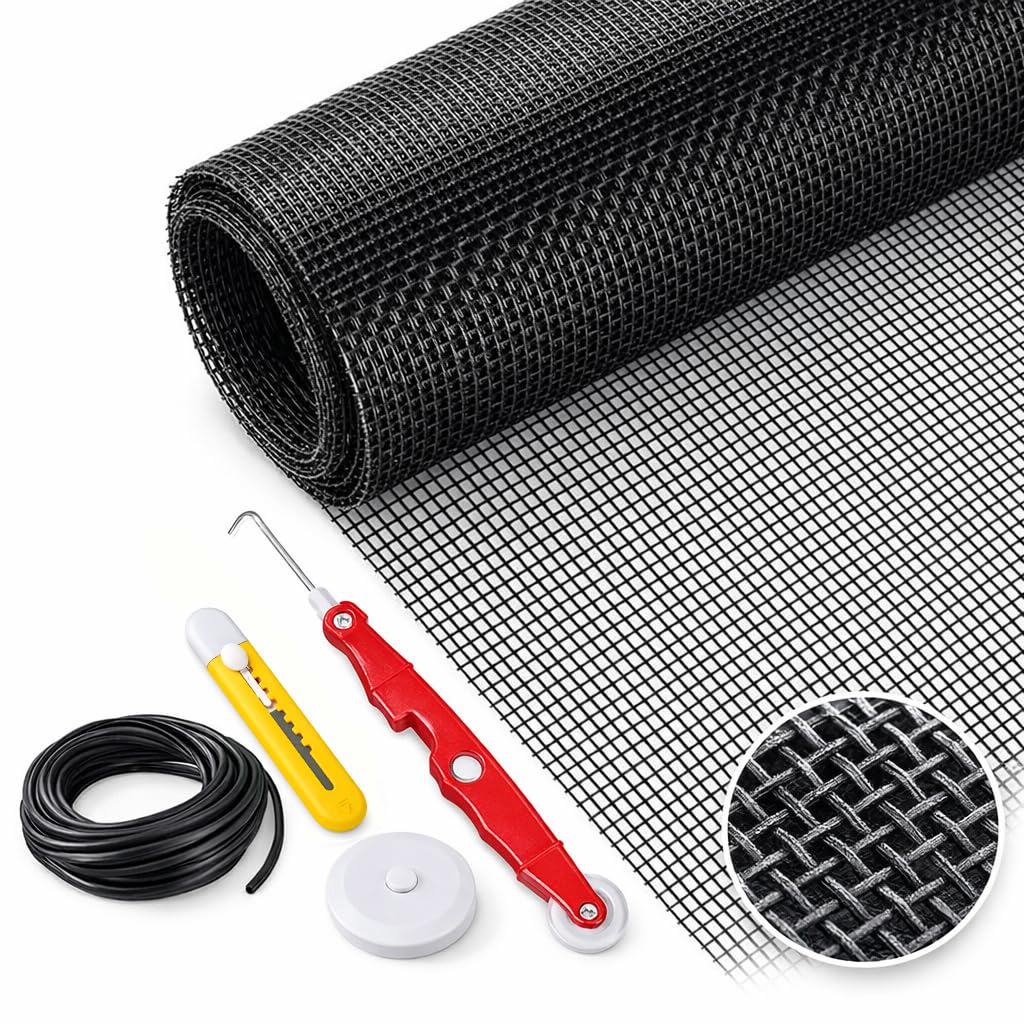
This is the kit to buy if you are redoing more than one screen and do not want to source parts separately. The roll covers 48 by 158 inches, which is enough material for several windows or two full door screens depending on how you cut it. Everything else comes in the box: screen, spline, and the utility tools for pressing mesh into the frame.
What buyers bring up most is simply that nothing is missing — the kit arrives complete, and the value reflects that. Owners have used it to replace screens that had been on the house for four decades, and the fiberglass itself is described as durable, easy to work with, and visually indistinguishable from the original mesh once installed. In practice, this is the difference between a job you finish in one sitting and a job that stalls while you wait on a spline order. The fiberglass is UV resistant and rated for up to five years of sun exposure.
The catch is the spline. It measures roughly 0.14 inch, which is too thin for frames cut for a 0.175-inch groove — so check your channel before you commit. The single-wheel roller can also nick the mesh if you press too hard, and the fold in the packaging leaves creases that disappear after installation rather than before.
What Buyers Praise
- Arrives complete — screen, spline, and tools all in one box
- 48 x 158 inches of material covers several screens in a single purchase
- Fiberglass is UV resistant and rated for up to five years of sunlight
- Creases from folded packaging relax after installation
Where It Falls Short
- Supplied spline is about 0.14 inch — too thin for frames with a 0.175-inch groove
- Single-wheel spline tool can cut the screen if you push too hard
- Included knife is basic; a larger utility knife handles the cuts better
Made for multi-screen jobs: buy this if you have several windows or a couple of doors to re-screen and want one box to cover all of them.
Check your groove first: if your frame channel measures around 0.175 inch, plan on buying a thicker spline separately.
2. MD Building Aluminum Screen Frame Kit, White, 5/16in x 36in x 36in
Aluminum and vinyl frame pieces for building a fresh screen from the ground up.
Replacement mesh does nothing for you when the frame itself is bent, cracked, or missing. This kit solves that half of the job — four cut-to-size aluminum frame pieces in a white finish, plus the vinyl spline, corner pieces, pull tabs, and springs that hold the whole thing together. You cut each piece to your opening with a hacksaw.
The quality of these parts is the thing that stands out, and assembly is a job most people finish inside an hour. Buyers have used it for odd-size windows that no standard frame fits, and for basement windows where they bought extra corner pieces and got more frames out of one kit than expected. The corners are solid on both sides rather than hollow, which reviewers contrast favorably with other brands. As buyers report on the measuring side: “Example: 28″x29″ window needs two pieces at 26.5″ and two at 27.375″; subtract 1.5″ per measurement (each corner 3/4″), plus ~1/8″ shorter for height (not width) for top retainer clips.”
Two things to know going in. The screen cloth is not included — this is frame hardware only, so order mesh separately. And the aluminum is on the thin side. Most builds come out completely sturdy, but the frame has no rigidity bracket or bar behind it, so longer spans can flex. Packaging could also be better; the occasional piece shows up dented.
Solid corners, thin stock: the corner pieces are the strong point here — solid on both sides rather than hollow, which makes the assembled frame easier to square up.
Order mesh alongside it: the kit stops at frame hardware, so add screen cloth and a roller to the same order.
Go with this if your frame is the problem, not just the mesh — bent or broken frames, or a window size no stock screen matches.
Look elsewhere if you only need fresh mesh over an intact frame; a fiberglass kit does that job without the cutting and assembly.
3. Window Screen Replacement Kit, 8-in-1 DIY Screen Door Repair Kit

Two spline sizes in one box, which is the detail most screen kits forget.
Here is the spec that matters: this kit ships spline in both 0.157 inch and 0.14 inch. Those are the two diameters most residential screen frames are built around, so you are covered whether your door channel is the wider or narrower standard. That single inclusion removes the most common reason a weekend screen job stalls.
You get a mesh roll that measures 48 by 118 inches with a standard 18 x 16 grid (18 openings per inch one way, 16 the other) — a weave fine enough to keep mosquitoes and debris out while still letting daylight through. It is flame-retardant and thick enough to resist the kind of clawing that ruins thin mesh in a house with cats or dogs. Installation runs about 25 to 35 minutes per door based on how owners actually use it, and the tool lineup is unusually thorough: a spline removal hook for pulling old cord out, a steel bearing roller for pressing new spline down, a nylon roller for positioning and smoothing, a utility knife, and a measuring tape.
At 1.7 pounds it carries 0.29 pounds more material than the 1.41-pound fiberglass kit above, and that extra shows up as more roll to work with for sliding and patio doors. Bear in mind that the creases and the roll length are tuned for doors rather than small windows, so you may end up with offcuts.
Two splines, zero guesswork: the dual 0.157-inch and 0.14-inch splines mean you do not have to measure your groove and hope — one of the two will fit standard residential frames.
A full tool roll, not a token one: the steel roller presses spline, the nylon roller smooths mesh, and the hook strips old cord, so the whole door job stays in one box.
The one for entry doors: if you are re-screening a sliding door, patio door, or French door, the 48 x 118-inch roll and dual splines are sized for exactly that.
Overkill for a single window: for one small window frame, a smaller kit leaves you less leftover mesh to store.
4. 304 Stainless Steel Mesh Window Screen Roll 36″ x 200″

Steel mesh for windows that something keeps chewing through.
If you have replaced the same screen three times because of a dog, a cat, or a squirrel, fiberglass is not the answer. This roll is 304 stainless steel — the same family of steel used where corrosion resistance matters — and it takes claws, teeth, and beaks that shred ordinary mesh. It arrives as a 36 by 200-inch roll, and at 2.94 pounds it is noticeably heavier than the fiberglass rolls on this list, which is exactly the point.
Owners use it far beyond the obvious. It has gone up on catios, where the small mesh discourages cats from climbing the walls. It has been fitted on garden apartment windows that take a beating from lawn equipment. It stops squirrels from gnawing through screens and birds leave it alone instead of pecking holes the way they do with spun fiberglass. Stab-resistant gloves come in the box because the cut edges of raw wire mesh are genuinely sharp.
The honest trade-off is handling. Stainless wire is harder to cut and harder to keep flat than fiberglass — scissors and knives struggle, and tin snips do the job properly. Trimming also throws small shards, and an occasional roll arrives with an uneven factory end that eats into your usable length. Budget more time for this one, and wear the gloves.
Why It Wins on Durability
- 304 stainless steel resists corrosion and stands up to claws, teeth, and beaks
- 36 x 200 inches of roll is enough to repair several windows
- Survives major storms without damage
- Stab-resistant gloves included for handling sharp cut edges
The Handling Tax
- Much harder to cut than fiberglass — tin snips are the right tool, not a knife
- Trimming produces small metal shards you need to sweep up
- An occasional roll arrives with an uneven factory end, cutting into usable length
Built for problem windows: this is the pick when animals are the reason your screen keeps failing, not sunlight or age.
Set aside extra time: cutting and handling steel mesh takes longer than fiberglass, so plan a slower install.
5. KISKIS 304 Stainless Steel Woven Wire Mesh, 60X300CM24X118INCH

The catch-all roll for vents, cages, and every gap you never planned to fix.
This is not a screen kit and it does not pretend to be one — it is a 24 by 118-inch sheet of 304 stainless steel woven wire that handles the jobs a standard screen roll cannot. Crawl space vents, cabinet fronts, animal cages, fan guards, fireplace screens, foundation vents, gutter guards, garden mesh. If you have an odd opening and a pair of snips, this covers it.
The weave is even, tight, and fine enough to keep mosquitoes and dirt out, which is why it turns up in places you would not expect. It does not rust or rot in sunlight. One owner used a section to build a suction strainer for a fire department grass rig, reasoning that it would not corrode and was fine enough to keep debris out of the water supply. Another spent three weeks trying to seal a shop roof against mice and squirrels before cutting and screwing this mesh over every gap — that solved it.
Weigh the flexibility carefully. It is a pliable mesh, not a rigid panel, so if you need something that holds a flat shape under its own weight, this will disappoint you. It also ships rolled into a tube, and it arrives with sharp edges, so open it away from bare hands. Cutting requires heavy scissors or wire cutters, and a cordless drill will shred it.
Not a screen, a material: treat this as raw metal cloth — cut-to-shape stock for vents, cages, guards, and gaps rather than a window kit.
Where it surprises people: owners keep finding new uses because the fine weave blocks insects and dirt without corroding, and the 24 x 118-inch sheet leaves plenty left over after the first job.
Keep it on the shelf: this is the roll for homeowners and property managers who fix vents, cages, and gaps as they appear and want one material on hand.
Wrong tool for a window frame: if you need mesh with spline and a roller for a standard screen, a dedicated kit is the better call.
Know the Specs
Spline Diameter and Frame Groove
The spline is the rubber cord that wedges the mesh into the groove running around your screen frame. Its diameter has to match that groove. A 0.14-inch spline is built for narrower channels, while 0.157 inch suits the wider standard used on many sliding and patio doors. Pressing an undersized spline into a wide groove leaves the mesh loose at the edges, so measure your channel before ordering. Buying a kit that includes both diameters removes the guesswork entirely.
Mesh Grid and Material
The grid number describes how many openings the weave has across a set distance. An 18 x 16 grid is the common standard for window and door screens — fine enough to block mosquitoes and small debris while still letting light and air through. Material decides how the mesh behaves: fiberglass cuts with household scissors and resists rust, while 304 stainless steel wire is heavier, needs snips or wire cutters, and holds against claws, teeth, and beaks that damage softer mesh.
Common Questions
How do I know if a 0.14-inch spline will fit my screen frame?
Is fiberglass or stainless steel mesh better for a house with pets?
Can I cut stainless steel screen mesh with regular scissors?
How much mesh do I need for a standard window?
What tools should come in a screen replacement kit?
Does the MD Building frame kit include the screen cloth?
Will my fiberglass screen creases disappear after installation?
How long does a stainless steel wire mesh screen last?
Can wire mesh be used for anything besides windows?
Is aluminum frame better than wood for a screen frame?
The Bottom Line
For most homes, the best all-round answer is the Window Screen Replacement Kit 48in x 158in Fiberglass because it arrives complete with mesh, spline, and tools, and the 48 by 158-inch roll is enough to redo several screens in one go. If you are building a screen from the ground up — bent frame, odd size, nothing stock fits — the MD Building Aluminum Screen Frame Kit gives you cut-to-size aluminum pieces with solid corners, just remember the mesh is sold separately. And when animals are the reason your screens keep failing, the 304 Stainless Steel Mesh Roll is the one to reach for — heavier to install, but it holds where fiberglass gives out. Whatever you pick, measure your groove before you order, and the job will go the way these owners describe it: straightforward, and cheaper than paying someone else to do it.
How we choose
We do not accept paid placement. Every pick is matched to a real buyer and a real use-case; we do not hands-on test units.
Sources
Specifications: manufacturer listings and product documentation. Review insights: verified customer reviews, as of October 2026. Pricing: not shown on this page (it changes often); check the current price via the retailer link.
As an Amazon Associate, Aappliancez earns from qualifying purchases. This does not affect which products we feature.