Disclosure: Some links in this post are affiliate links. As an Amazon Associate I earn from qualifying purchases, at no extra cost to you. Learn more
Specs are compiled from manufacturer listings and verified buyer reviews and can change over time — please confirm the key details on the product page before buying.
If you or someone you care for sits in a wheelchair for hours a day, the cushion is not a comfort accessory — it is the thing standing between skin and a pressure sore. An alternating pressure cushion cycles air between cells so no single spot on your bottom stays pinched long enough to break down. Below you get seven cushions with their real air-cell design, weight limits, battery life, and the honest trade-off each one carries.
This guide is built by comparing the manufacturers’ published specifications and the patterns across verified customer reviews, so you get each pick’s real strengths and trade-offs instead of marketing spin.
You will see what actually separates one air cushion from another — cell height, inflation method, runtime — and where each one falls short. Here is a straight comparison of the best alternating pressure wheelchair cushion options for everyday seated relief.
Top Picks

How To Choose The Best Alternating Pressure Wheelchair Cushion
The single question that decides everything: does the cushion move air on its own, or do you pump it once and hope the pressure stays spread? A static air cushion is a balloon you sit on. An alternating cushion runs a small pump that inflates and deflates sections in turn, so the contact point under your body keeps changing.
Alternating versus static air
Alternating cushions use a powered pump to cycle air between cells on a timer — the listings here run cycles measured in minutes, and one offers 10, 15, and 20 minute choices. That cycling is what buys rest time for skin that cannot take constant load. Static cushions depend on you or a caregiver re-inflating and repositioning, which is fine for short sitting but easy to neglect during a long day.
Cell height and immersion
Cell height is how tall each air pocket stands, and it decides how far your body sinks in. A higher cell — 4 inch cells and a 5 inch profile both appear in this list — lets the bony points of the pelvis sit deeper between cells rather than on top of them. Shorter interconnected cells, like the 3 inch outer and 2.8 and 2.6 inch inner cells on one model, trade some immersion for postural stability so your thighs do not tuck inward.
Power: battery versus USB
A rechargeable pump is what lets the cushion keep working on a bus, in a clinic, or across a long visit. Runtime in the listings ranges from a stated 8 hours up to 12 hours, and one cushion runs off a 5V 2A USB supply so a power bank can keep it going. If the person using it cannot flip a switch themselves, a timed pump that cycles without input matters more than raw battery size.
Fit, weight limit, and the cover
Seat width is the first measurement to check — a cushion that overhangs or shifts sideways defeats its own purpose. Weight capacity on these ranges from 150 kilograms to 500 lbs, and the wide spread matters for bariatric chairs. Look at the cover too: a removable, washable, fluid-resistant cover is the difference between a wipe-down and a full clean when incontinence happens.
Side-by-Side Comparison
| Model | Best For | Air System | Power | Seat Size | Amazon |
|---|---|---|---|---|---|
| ProHeal High Profile 20 x 18★ Best Overall | Deep immersion for existing sores | Dual-valve static air, 4″ cells | Hand pump, no battery | 20″L x 18″W | Amazon |
| YUNYEUNG Electric InflatableBest for Travel | Travel with a power bank | 40 mosaic air packs, dynamic cycle | USB 5V 2A, 25-min cycle | 18.9″L x 18.1″W | Amazon |
| Makrozoia 17″ TPU Cushion | Light travel and office chairs | Adjustable static air, TPU | Included pump, no battery | 17″L x 17″W x 2.75″H | Amazon |
| ProHeal 18 x 16 Interconnected | Postural support on a standard chair | Interconnected 3″ cells | Included pump, no battery | 18″ x 16″ | Amazon |
| Tairibousy Alternating Pneumatic | Low air loss with a waterproof cover | 4 alternating units, static modes | Rechargeable, up to 12 hours | 17″L x 17″W x 5″H | Amazon |
| Vive Alternating Pressure Pad | Wide and bariatric wheelchair seats | 5 alternating cells, 3+ modes | Rechargeable, 8 hours | Fits 18″ and wider | Amazon |
| MobiCushion Pneumatic Air Pillow | All-day outdoor use with quiet controls | Alternating cells, static mode, 5 levels | Rechargeable lithium, up to 12 hours | 17″L x 17″W | Amazon |
Detailed Reviews
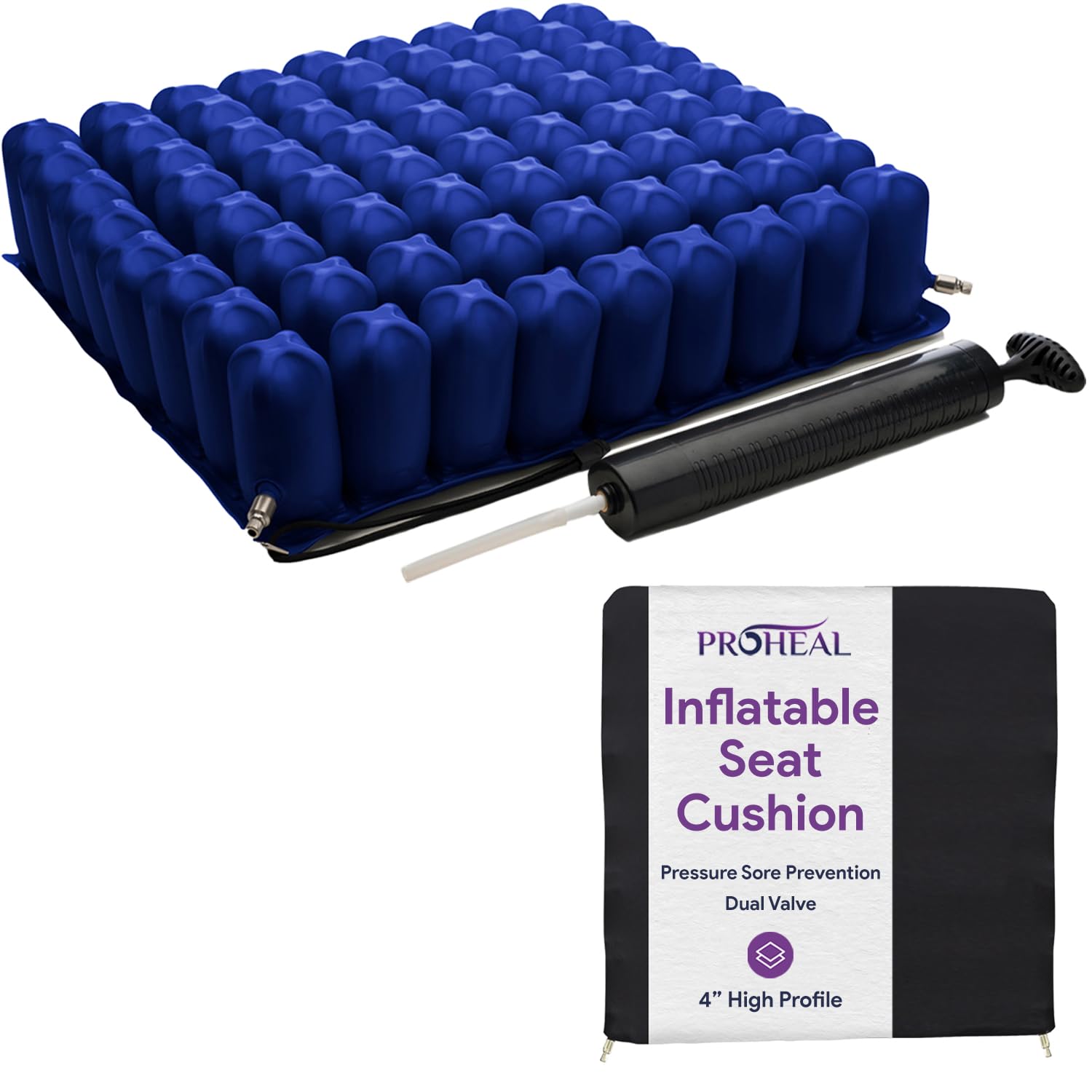
1. ProHeal Inflatable Wheelchair Seat Air Cushion 20″ x 18″
Our pick — 4.0+★ from 200+ verified ratings; the strongest balance of quality and price.
Four-inch air cells that let a sore bottom sink in instead of sitting on bone.
This is the cushion for skin that is already breaking down, not just for comfort. The 4 inch cell height creates deep immersion, meaning your body settles down between the air pockets rather than resting on top of them. ProHeal builds it to redistribute pressure across a larger contact area, and the two independent valves let you inflate the left and right sides to different levels so a lopsided posture still gets even support.
The kit is complete in a way most listings are not: dual valve cushion, hand pump, patch repair kit, and a breathable nylon cover that comes off for washing. A non-skid bottom and safety straps hold it to the chair instead of letting it slide forward as you transfer. Weight capacity is 500 lbs and the cushion is latex free, which matters when skin sensitivity is the whole reason you are shopping.
The honest catch is setup. With two valves and free-floating air, balancing the cushion takes patience — a buyer expecting a plug-and-play pad may fight it before it feels right. There is also no spare cover sold with the unit, so when the nylon cover is in the wash the cushion sits bare. What wins people over is effectiveness above all, and with a 5 year manufacturer warranty behind it you have a long runway to get the fill level dialed in. It is the highest-rated pick here at 4.0+ stars across 200+ ratings, a strong showing for a cushion this fussy to adjust.
Where it earns its top spot
- 4 inch high cells give deep immersion for pressure redistribution
- Independent dual valves let you level the two sides separately
- 500 lb capacity with a 5 year manufacturer warranty
- Full kit: pump, nylon cover, patch repair kit
What to plan around
- Balancing the two valves takes time and patience
- No replacement cover sold separately for wash day
- Static air, so it needs re-inflating rather than cycling on its own
Reach for this if: you want the deepest immersion and a complete kit for a chair that stays home.
Plan around: the dual-valve balancing — expect to spend a session tuning the fill before it feels right.
2. YUNYEUNG Electric Inflatable Wheelchair Cushion
Runs off a power bank, so an airport layover never leaves the motor dead.
The clue is in the power source. This cushion draws from a 5V 2A USB supply through a 1.5 metre cable, so a pocket power bank keeps it inflating and deflating in the air or on a plane seat. That is a genuinely different proposition from a built-in battery you have to remember to charge before you leave the house. Inside, 40 mosaic air packs split across two sets of airbags run a dynamic cycle that inflates and deflates to move pressure off the muscles and nerves.
Size fits most body types at 18.9″L x 18.1″W, slightly narrower front to back than the ProHeal high-profile above, and the pump has been repositioned so you are not sitting on it. Folding it down makes it portable enough for outings and long business trips. Maximum carrying capacity is 150 kilograms, and it works on office chairs and standard wheelchairs alike.
Be clear about what it does and does not do. When switched on it inflates and deflates all rows together on a 25 minute cycle, not in true alternating sections, so it cycles the whole surface rather than resting one side while loading the other. The pump is audibly louder than a single-pump design, and the off timer is the most repeated gripe — the machine stops after a set of 25 minutes and needs a hand to restart it. If the person in the chair cannot reach the switch, that is a real daily friction point.
Who it fits: frequent travelers who already carry a power bank and want a cushion that folds flat and goes into a bag. The size step from the ProHeal is small on paper — 18.9″L x 18.1″W versus 20″L x 18″W — but it makes this one easier to slip into a wheelchair pouch.
What to weigh: the 25-minute auto-shutoff and the louder pump. Both are trade-offs the listing openly accepts in exchange for the repositioned pump and the bigger, body-conforming surface.
Go here if: trips and power banks are part of the routine and you want the cushion to fold and travel.
Think twice if: nobody is available to restart it each time the 25 minute cycle ends.
3. Makrozoia Air Cushion for Pressure Sores, 17 Inch
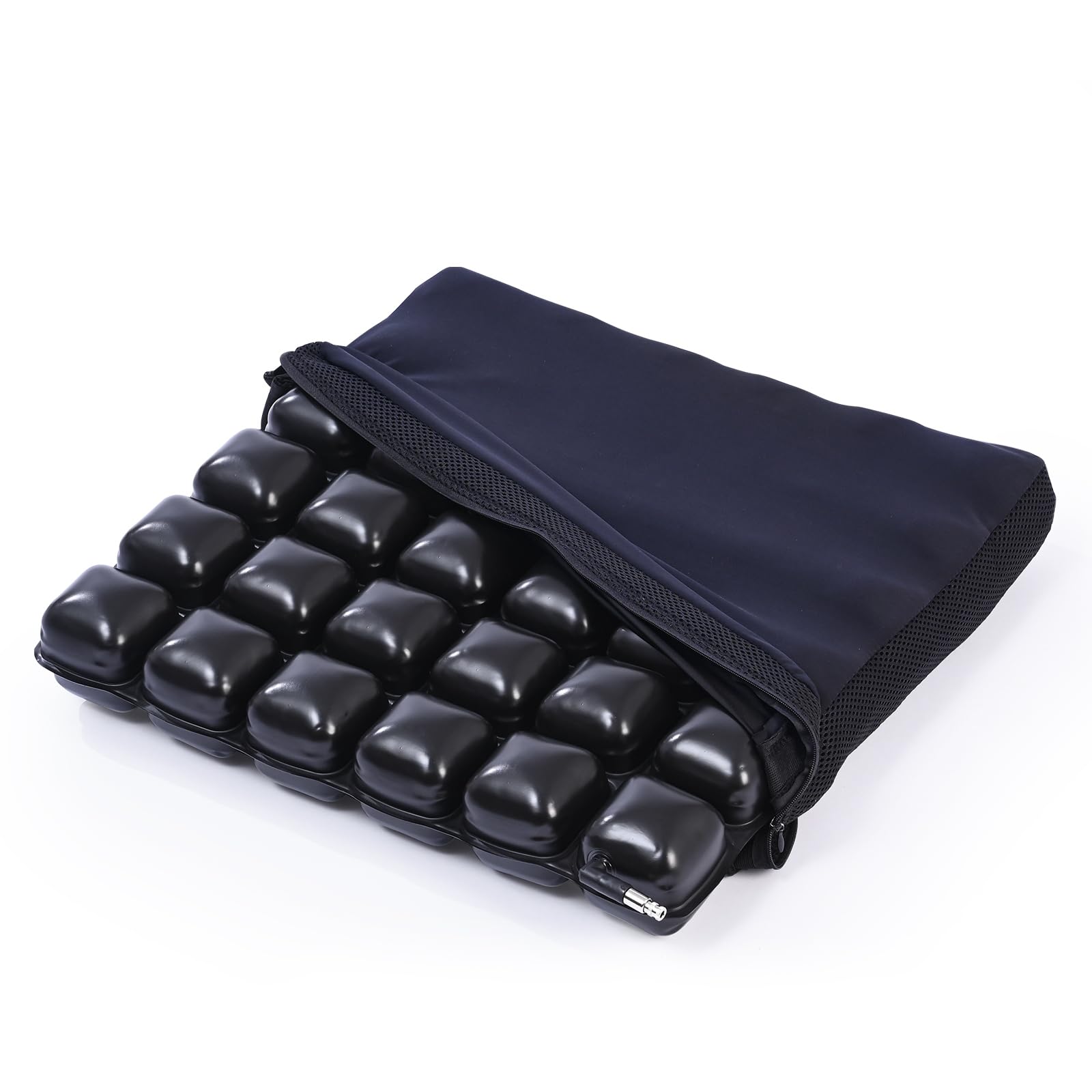
The 17-inch square that folds into a wheelchair pouch and comes back out for the car.
For a cushion that has to move between a wheelchair, an office chair, and a car seat, this 17″ x 17″ x 2.75″ square is built to be carried. It folds down for storage in a bag or a wheelchair pouch, and a pump comes in the box so you can inflate it anywhere rather than hunting for an outlet. The outer shell is TPU — thermoplastic polyurethane, a flexible rubber-like plastic that resists tearing better than PVC and does not carry the same plastic odor.
Firmness is yours to set. Add air for a firmer, more supportive feel or let some out for a softer surface, which is the kind of control that suits a cushion shared between two people or one whose comfort shifts through the day. At 17 inches it is a compact footprint, so check your seat pan before ordering if you ride a wide chair.
Air retention is the thing to watch on any static air cushion, and this one has it in both directions — most units hold air with zero leaks and stay sealed, while some arrive unable to hold air at all and go back. That split is worth knowing before you commit. What it does well is the simple job: one caregiver bought it for a father with recurring sores on his bottom and found it helpful alongside pillows while he was up in a chair. The TPU shell is machine washable when it needs a clean.
Best use case: short sitting stints, secondary chairs, and travel where a full powered system is overkill. It handles a wheelchair, a car seat, and a desk chair with the same square of air.
The trade-off: it is static air, so pressure only shifts when you or a caregiver adjust the fill — it will not cycle on its own the way the powered picks here do.
Pick this if: you want a light, foldable square that can follow the person from chair to car to office.
Look elsewhere if: you need continuous pressure changes without anyone touching the valve.
4. ProHeal Inflatable Wheelchair Seat Cushion, 18 x 16 x 3″
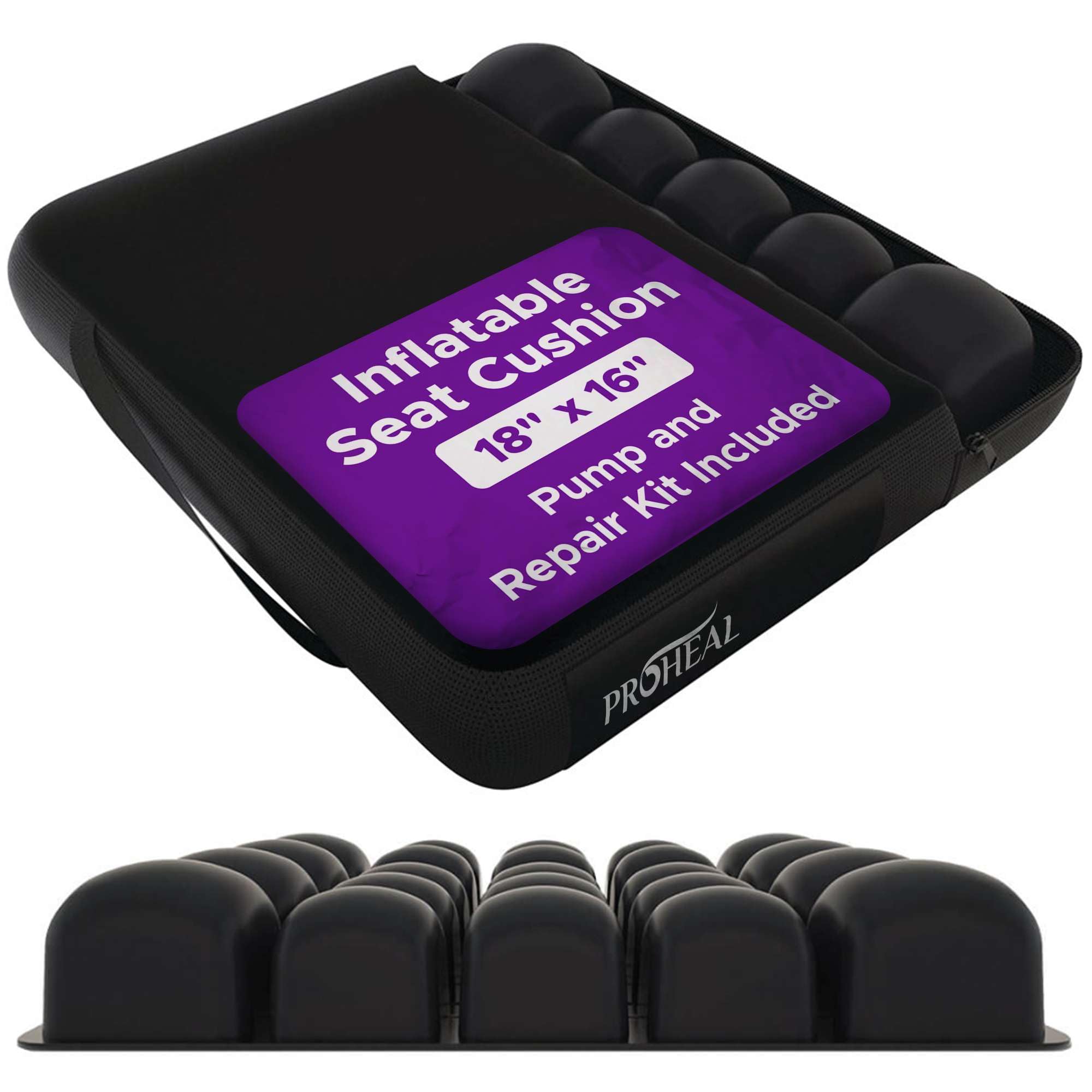
Cells of three different heights, shaped to stop your thighs rolling inward.
Most air cushions are a uniform field of pockets. This one is not — the outer cells stand 3 inch tall while the inner cells sit at 2.8 inch and 2.6 inch, a graduated layout that gives you stability at the edges and softer support toward the middle. That variation is deliberate postural engineering: it keeps you from sliding and stops the thighs from tucking in as the day wears on.
At 18″ x 16″ it is a mid-size pad, smaller than the 20″ x 18″ ProHeal up top but sized for a standard chair pan. The cover is a high grade stretch nylon in a waffle pattern, removable and machine washable, which makes cleanup a laundry cycle rather than a scrub. Weight capacity is 315 lbs, and the pump and repair kit come included.
Here is where it divides opinion. Buyers with a fractured tailbone report sitting past the half-hour mark again, and the air cells let you shift weight by leaning. But the valve is fussy — you have to fully open it to fill, and the whole thing takes a while to pump up, with one buyer noting it does not hold air over the long haul and goes flat. That inconsistency in air tightness is the real risk here, not the comfort. The bubble design does deliver all-day relief for many, but if a leak shows up early, use the warranty.
The shape argument: graduated cells at 3″, 2.8″, and 2.6″ set this apart from flat static pads — it steadies posture as well as relieving pressure, which matters for anyone who tends to slide.
The valve reality: inflating is a chore and air retention is uneven across units, so test it in the first weeks and watch for a slow flat.
Choose it for: a standard 18 x 16 chair where you want posture held steady, not just pressure off.
Caveat to hold: the pump-and-open-valve routine is slow, and a leak in the first months means a warranty call.
5. Tairibousy Alternating Pressure Wheelchair Cushion

Four alternating units and a waterproof cover for the incontinence days nobody plans for.
The core of this one is the cycling: four alternating units pump air in and out on a timer, and you choose the rhythm — 10, 15, or 20 minutes — to change where the support lands. That is real alternating pressure, not a static fill, and it is the feature that earns the cushion its place next to the powered picks above. In static mode you get three firmness levels from soft to hard, so the cushion works whether the person needs a full cycle or a steady surface.
The rechargeable pump carries up to 12 hours of continuous run time and weighs nothing much — it rides in a waterproof bag hung on the back of the wheelchair. The 17″ x 17″ x 5″ profile is tall, with a firm foam base and inner thigh support that holds posture and stops the thighs drawing in. Weight capacity is 300 lbs. The cover is stretch polyurethane over waterproof PVC, designed to be wiped or dried with a towel when a patient is incontinent — a small detail that saves a lot of grief.
The honest limit is longevity. One buyer is on their second unit because the first lasted only 7 months, and a wheelchair user with MS found the air did not move well and the surface uncomfortable to sit on. Those reports sit against others who say it does exactly the job when someone is bed-bound and needs to sit up without the bottom getting sore. Treat the 12 hour battery and the cycle settings as the draw, and go in knowing the pump is the part that decides how long the whole unit survives.
What stands out: true alternating cycles in 10, 15, and 20 minute steps, three static firmness levels, and a waterproof PVC-backed cover that handles incontinence without ruining the day.
What to expect: the pump is the weak link over the long run — if durability is your top priority, weigh that against the cheaper static cushions here.
Suits: caregivers who need a waterproof surface and selectable cycle timing on a 300 lb chair.
Heads up: the air pump lifespan is the gamble — expect to plan for replacement rather than assume years of service.
6. Vive Alternating Pressure Pad for Wheelchairs

Built for chairs 18 inches and wider, so nothing shifts under a heavier frame.
Wide and bariatric chairs are where most cushions fail, and this one is sized to them. It fits seats 18 inches and wider, including standard, bariatric, and transport wheelchairs, and the fit is meant to stay stable without sliding as the chair moves. Five alternating cells keep air flowing under the body while you sit, and the rechargeable pump carries 8 hours of alternating support per charge. The pump runs quietly and supports up to 220 pounds.
The cover is waterproof and removable for cleaning, which on a mobility cushion is less a luxury than a necessity. Two hooks let you hang the pump on the back of the seat, and you get 3+ modes to choose from. One note from the maker worth reading before you rely on it: do not use it while the cord is plugged in, because that will degrade the battery over time.
Comfort is the split here, and it splits honestly. One caregiver of a family member with scoliosis and MS reported the soreness gone after a month and less upper-body fatigue, with the battery outlasting the stated 8 hours across two days. A caregiver reported that a 95-year-old mother’s existing pressure sores healed and no new ones formed. Against that, some find the pad hard with little give and no perceptible air movement, and if that is your experience the unit is not doing its job — that is a fit mismatch, not a universal flaw. The pump also nudges some users forward in the seat; turning the cushion lengthwise solves it.
Why it holds its place
- Fits 18 inch and wider seats, including bariatric and transport chairs
- Rechargeable with 8 hours of alternating support per charge
- Waterproof removable cover for easy cleaning
- 3+ modes with an ultra-quiet pump
Before you order
- Rated for 220 lbs, below several picks here
- Hard, unyielding feel on some units with little air movement
- Pump placement can tilt the seated body forward
Best match: bariatric or wide chairs where seat fit and cover hygiene come first.
Know going in: the 220 lb rating and the firm feel mean lighter users with sensitive skin may prefer a softer immersion cushion.
7. MobiCushion Alternating Pressure Wheelchair Cushion 17″ x 17″

Five comfort levels, a mute button, and a battery monitor that tells you before it quits.
If you want the most controllable cushion on this list, start here. It runs a consistent cycle of alternating low air pressure through its cells, with five comfort settings and a static mode for when you want a steady surface instead. A pressure sensor works with the touchpad to keep the fill intuitive rather than guesswork, and the control panel shows visual and audible status plus fault indicators. There is a mute button, so the beeps do not have to fill the room at night.
The rechargeable lithium battery gives up to 12 hours on a charge, and a battery monitor tells you when it is charging, full, or running low — along with a low-pressure warning. The pad is 17″ x 17″ and weighs 16 ounces. A solid foam base with medial thigh support holds posture and prevents thigh adduction, and the 4-way stretch cover is fluid resistant, low shear, and vapor proof. You can run it from a wall outlet at home or on battery outdoors.
What buyers keep coming back to is the pressure relief itself: one buyer ran it day and night on an immobile wife’s recliner to reduce Stage 1, 2, and 3 pressure sores, and another kept a 120 lb wheelchair user’s bottom as sore-free as a non-electric ROHO. The caveats are real but manageable. Functionality over time is the mixed element — one unit worked for a few months and then would not power on at all, so the electronics are the piece to watch. The on-off button is stiff and the hose is short, both small ergonomic snags rather than deal-breakers.
The case for it: five comfort levels, three cycle behaviors, a mute, and a battery readout give this more fine control than any other pick — useful when one setting does not suit every hour of the day.
The catch: more electronics means more that can fail; a unit that stops powering on after a few months is the risk you accept for the extra control.
Ideal for: long outdoor days and anyone who wants to dial in the exact fill and silence the alerts.
Avoid if: you want the simplest possible cushion with the fewest electronic parts that can quit.
Know the Specs
Alternating versus static air
An alternating cushion uses a pump to inflate and deflate sections in turns, changing where your weight rests every few minutes. A static cushion holds one fixed fill you adjust by hand. Alternating is the better match for long sitting and skin at risk; static is lighter, quieter, and needs no power, which suits shorter stints and travel.
Cell height and profile
Cell height decides how far your body sinks in. Taller cells, like the 4 inch and 5 inch profiles here, let the bony points sit deeper between pockets for more immersion and lower peak pressure. Shorter interconnected cells trade some of that for stability and posture, which matters if sliding or thigh tucking is the problem.
Battery runtime and power source
Rechargeable pumps here run from a stated 8 hours up to 12 hours. A USB cushion on a 5V 2A supply turns any power bank into runtime, which is practical for travel. Longer runtime means more of a day out before you need an outlet, but a timed auto-off can matter more if the user cannot restart it.
Weight capacity and seat size
Check two numbers before ordering: the cushion’s weight rating, which ranges from 150 kilograms to 500 lbs across this list, and its width against your chair’s seat pan. A cushion rated below the user’s weight will bottom out and stop relieving pressure, and one that overhangs the seat will shift under transfers.
Common Questions
Will an alternating pressure cushion help if there is already a pressure sore?
How long does the rechargeable pump run on a single charge?
Do I need a powered cushion or is a static air cushion enough?
How do I know what size cushion fits my wheelchair?
Can I use an alternating pressure cushion in a car or office chair?
What weight can these cushions support?
How do I clean a cushion when incontinence is a concern?
Why do some alternating cushions have an auto-shutoff timer?
How long should an alternating pressure cushion last?
Is an alternating pressure cushion better than a memory foam or gel cushion?
The Bottom Line
If you are buying one cushion for everyday wheelchair sitting, the ProHeal High Profile 20 x 18 is the pick — 4 inch cells for deep immersion, independent dual valves to level each side, a 500 lb capacity, and a full kit with pump, cover, and repair patch. Its higher score of 4.4 stars sits above the MobiCushion’s 4.0 despite the MobiCushion carrying more ratings, so the strongest overall record belongs to the ProHeal. For travel where a power bank is always on you, the YUNYEUNG folds and runs from USB. If you need true alternating cycles with a waterproof cover, the Tairibousy delivers them on a 12 hour battery. And when seat width and hygiene are the deciding factors, the Vive pad fits chairs 18 inches and wider.
How we choose
We do not accept paid placement. Every pick is matched to a real buyer and a real use-case; we do not hands-on test units.
Sources
Specifications: manufacturer listings and product documentation. Review insights: verified customer reviews, as of October 2026. Pricing: not shown on this page (it changes often); check the current price via the retailer link.
As an Amazon Associate, Aappliancez earns from qualifying purchases. This does not affect which products we feature.