Disclosure: Some links in this post are affiliate links. As an Amazon Associate I earn from qualifying purchases, at no extra cost to you. Learn more
Specs are compiled from manufacturer listings and verified buyer reviews and can change over time — please confirm the key details on the product page before buying.
If you are teaching a child to connect the letter A to the sound it makes, the fastest route is letting their hands pull a tiny apple out of a box and match it to the letter — not flashcard drilling. That is exactly what alphabet sounds teaching tubs do. This guide compares the hands-on sets teachers and homeschooling parents actually keep coming back to, so you can pick the one that fits your table, your space, and your learners.
This guide is built by comparing the manufacturers’ published specifications and the patterns across verified customer reviews, so you get each pick’s real strengths and trade-offs instead of marketing spin.
Some sets are built for a full classroom circle, some slot onto a kitchen wall, and some live in a single portable case. What separates the strong sets from the weak ones is how well the format fits the way you teach. Match the format to your setup: grab-box tubs for a preschooler, a wall chart for a circle, magnetic tiles for a homeschool table.
Top Picks


How To Choose The Best Alphabet Sounds Teaching Tubs
Alphabet sounds teaching tools split into three shapes: grab-box tubs of real mini objects, wall pocket charts, and magnetic tile kits. Each one fixes a different teaching problem, so the first choice is not brand — it is which shape fits the way you actually sit down and teach.
Count your learners first
A single-child homeschool table needs different materials than a kindergarten classroom with six working stations. Sets come sized for one student up to a six-student group, and a kit built for a group usually ships with more trays, more mats, and more tiles. Buy for the number of children you teach now, not a hoped-for group later.
Look at how many activity mats or cards come in the box
Cards and mats are what keep a tool useful after the first week. Some pocket charts pack over 90 activity cards covering uppercase, lowercase, tracing, and chants, while leaner versions give you the letters and stop there. More cards means you can rotate tracing, chants, and matching instead of repeating one drill.
Check whether cards store on the unit
Built-in storage matters once you are tracking 182 loose cards. Charts with pockets built into the base save you from hunting for the letter of the week five minutes before circle time, and they end the ziplock-bag shuffle at the end of a lesson.
Weight and mountability decide where a set can live
A full classroom tile set can weigh close to nine pounds, which is fine on a table but not on a hook. Wall charts rely on sticky hooks or grommets, and some owners end up buying stronger hooks than the ones included. Decide whether your tool lives on a table, a wall, or in a carry case before you buy.
Side-by-Side Comparison
| Model | Best For | Teaching Format | Pieces Included | Group Size | Amazon |
|---|---|---|---|---|---|
| hand2mind Advancing Phonics Word Work Small Group Set★ Best Overall | Small-group phonics stations | Magnetic trays and tiles | 6 trays, 672 tiles, 30 mats | Up to 6 students | Amazon |
| JoyCat Mystery Alphabet Box 26PCSPreschool Favorite | Preschool grab-and-match play | Mystery box with mini objects | 26 miniatures, 2-sided board | 1 to small group | Amazon |
| The Phonics Machine Learning Pad | Independent phonics practice | Electronic sound pad | 60 double-sided quiz cards | 1 student | Amazon |
| Joyreal Alphabet Learning Pocket Chart | Circle-time wall lessons | Wall pocket chart | 182 pieces | Whole group | Amazon |
| Auchq All About Letter Pocket Chart | Letter-of-the-week routines | Nylon wall pocket chart | Over 90 activity cards | Whole group | Amazon |
| Torlam Alphabet Learning Pocket Chart | Door-hung homeschool learning | Over-the-door chart | 104 pieces | Whole group | Amazon |
| JoyCat 265 Phonics Magnetic Letter Tiles | Collaborative word building | Magnetic tiles with folders | 265 tiles, 3 folders | Up to 3 learners | Amazon |
Detailed Reviews
1. hand2mind Advancing Phonics Word Work Small Group Set
Our pick — 4.5+★ from 250+ verified ratings; the strongest balance of quality and price.
Six magnetic trays and 672 tiles turn letter sounds into a hands-on station for a whole small group.
Here is the set built for teachers running phonics stations, not one-on-one tutoring. You get six magnetic dry-erase activity trays, 672 magnetic grapheme tiles in six sets of 112, and 30 double-sided dry-erase activity mats in six sets of five. That is enough working material for six students to build, blend, and segment words at the same time without waiting on a shared pile of letters. The tiles are color-coded to separate consonants, vowels, hearts, and blank tiles, so a child can see a vowel pattern without you explaining it.
Weighing 8.73 pounds, this is the heaviest pick here — far more substantial than The Phonics Machine Learning Pad at 1.8 pounds. That weight comes from the six trays and hundreds of tiles, which is the point: it is a station you set up and leave, not something you toss in a bag. The frames double as the storage system. Lay a mat on the tray, and the rim holds every tile in place so nothing rolls onto the floor mid-lesson. The included activity guide covers blending, sound matching, word building, and spelling across the five double-sided mats per set.
The reviews describe a tool that becomes a daily routine rather than a novelty. As buyers report, one teacher bought them for a 2nd grade classroom and found they “managed to last an entire school year with weekly use,” which is the durability test most classroom sets fail. Owners also confirm the trays move from whole-group modeling straight into small-group tactile work, and parents note the set supports word ladders and board-game style practice. Between that build and the sheer material count, this is the pick that holds up under constant hands.
What earns it the top spot
- Six full student stations — 6 trays, 672 tiles, 30 mats — so a group works in parallel with no waiting.
- Color-coded consonants, vowels, hearts, and blank tiles make sound patterns visible at a glance.
- Tray rims keep tiles contained, which kills the dropped-tile scramble that derails word-building lessons.
- Built to survive weekly classroom use across a full school year.
Where it asks something of you
- At 8.73 pounds it stays where you put it — this is a table setup, not a travel kit.
- You are investing in six sets of materials even if you only ever teach one child.
Settle on this when: you run small-group phonics stations or a SPED/ESE class and need enough trays and tiles for several students at once.
Think again if: your teaching space is a kitchen table for one child — you will be storing a lot of unused trays.
2. JoyCat Mystery Alphabet Box 26PCS
Pull a mini zebra from the mystery box and match it to Z — beginning sounds become a game.
The mystery box format is the cleverest teaching trick in this whole lineup. Kids reach inside, pull out one of 26 miniatures, and match it to the right letter on the double-sided board printed with uppercase on one side and lowercase on the other. Because the objects are physical and hidden, the reveal itself holds attention in a way a flat flashcard never will. Everything packs back into the storage box afterward, and the whole thing measures 7.2 x 7.2 x 7.4 inches — compact enough to travel.
Each language object measures about 2 inches across and is made of sturdy plastic sized for little hands — including a 2-year-old’s. The set covers animals, fruits, and everyday vocabulary from A all the way to Z, building early word knowledge while the child practices the letter sounds. The double-sided board lets one child sort independently or two children take turns, and the turn-taking angle is a real bonus for a group of two or three.
The trade-off is build feel, and it is worth being clear-eyed about. The plastic miniatures are made for pulling out and placing, not for rough pretend play, and the box itself is smaller than some buyers picture. That said, this is a toy that lands with toddlers — one grandparent’s verdict from the review pages: “BOUGHT FOR OUR 2 YEAR OLD GRANDDAUGHTER, SHE LOVES IT.”
The grab factor: A 2-inch object a child can hold, hide, and reveal teaches more about beginning sounds than any printed card — because the hand does the remembering.
Fair warning: These are small, easy-to-grab pieces built for placing, not for hard play, so keep heavier pretend sessions to other toys.
Reach for this if: you have a toddler or preschooler who learns by touching and needs a portable, tidy sound game that packs away in seconds.
Look elsewhere if: you want a wall-mounted tool for a whole classroom circle rather than a tabletop box.
3. The Phonics Machine Learning Pad

An electronic pad that quizzes a child through 720 sound questions and corrects errors on the spot.
This is the only powered pick here — a screenless electronic pad with 60 double-sided quiz cards and 720 phonic and letter sound questions. It talks through American English audio, so a learner sees the spelling pattern and hears the matching sound at the same time. The quizzes run in 13 steps, starting with single letter sounds like a, b, and c, then progressing through short and long vowel sounds, consonant digraphs, trigraphs, diphthongs, the bossy R, silent letters, and irregular phonics. For a child who needs audio reinforcement to lock in a sound, that progression does the drilling for you.
It weighs 1.8 pounds and measures 2.5 x 9 x 7 inches, built to sit flat on a desk or be stored on a shelf. That makes it the lightest and most portable pick here — far lighter than the 8.73-pound hand2mind set. It runs on AAA batteries, so there is no cable to manage, and the quiz cards slot into the pad for the child to work through independently. This is the pick for the independent practice slot in a routine: the child works alone, the pad corrects the mistake, and the parent handles something else for a few minutes.
One honest limit worth knowing before you buy: it plays and asks, but it does not listen back. A child can answer out loud and the pad will not respond to what was said — it only moves on when no response is registered. The slider for advancing cards is stiff and takes some hand strength, so a younger or less dexterous child may need help. Those two points are the trade-offs of the electronic format, and knowing them in advance keeps expectations realistic.
Where it shines: 720 sound questions across 13 progressive steps, with audio that reinforces the pattern being learned.
Where it stops short: The pad cannot hear a spoken answer, and the card slider is stiff — plan on helping a 5-year-old with either.
Best fit for: a child ages 5 to 11 who benefits from hearing sounds pronounced aloud and can practice independently for short bursts.
Not the pick if: your learner still needs adult-guided, hands-on sound play — the hands-on tubs here will serve better.
4. Joyreal Alphabet Learning Pocket Chart

An extra-large wall chart with 182 pieces that turns the whole alphabet into a circle-time lesson.
If your children sit in a semicircle and learn from a wall, this is the chart built for that exact scene. It packs 182 pieces into one set: 104 word cards, 26 letter cards, 26 tracing cards, 26 alphabet chants, and 3 sticky hooks. Seven different activities live on a single chart, covering lowercase and uppercase recognition, handwriting tracing, chants, beginning sounds, and matching letters.
The surface is the standout engineering here. The chart has a write and wipe surface, and every flash card carries a laminated layer that acts as a dry-erase surface without leaving residue — so a child can trace, wipe, and try again with a dry-erase marker. The display pockets on each side are made from durable transparent PVC film (a clear plastic sheet), which is what keeps letters visible after months of daily handling. And storage is built in: every card stashes right on the chart, so you are not opening a bin every morning to find the letter of the week.
The main thing to check before you commit is the letter set. Some units arrive with tracing cards missing or duplicated in place of the correct capital letters — a mix-up that shows up as a gap in the alphabet rather than a shortfall in quality. Pop the pieces out of their sheets and lay them out against the chart before you frame the box for recycling. The customer service line on the box has handled missing-piece requests quickly for owners.
What it does beautifully: 182 pieces, seven activity types, and an extra-large 35 x 27 inch layout that keeps the whole alphabet in one visible place for group learning.
The one check to run: Lay out the letter and tracing cards when the chart arrives — a small number of sets ship with a duplicate standing in for a missing capital letter.
Choose it for: a preschool or homeschool wall where a group learns together and every child needs to see the letters clearly.
Skip it when: you teach one child at a small table — a portable box or tray set will get more use per square foot.
5. Auchq All About Letter Pocket Chart
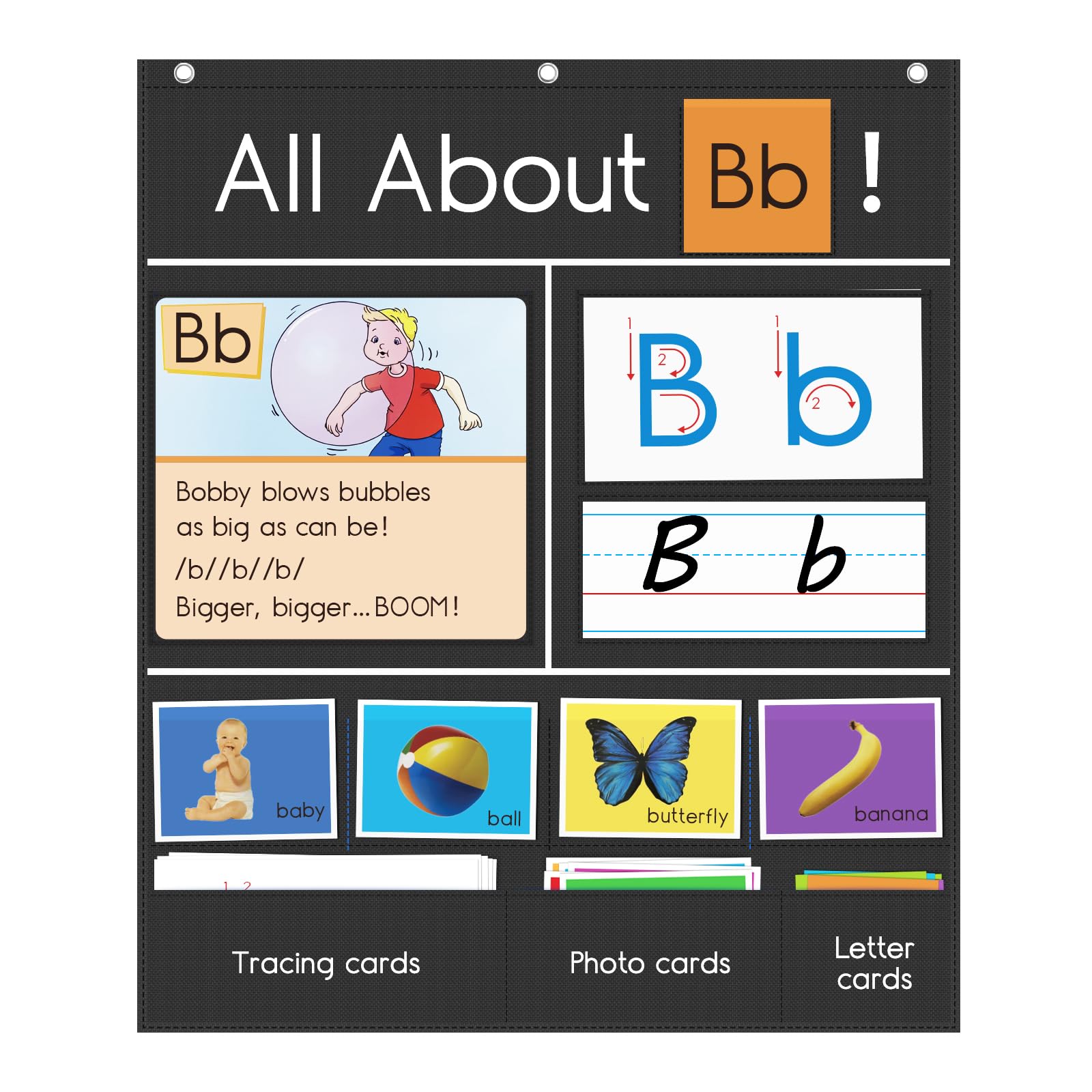
A sturdy nylon chart that runs the letter-of-the-week routine from chant to tracing in one spot.
The routine is the product here. This 35 x 27 inch nylon chart is built around letter-of-the-day or letter-of-the-week teaching, and it comes with over 90 activity cards that let you hit each letter from several angles in one sitting — chants for sound identification, full-color photo cards for sound recognition, and tracing cards for handwriting. The write-and-wipe surface and laminated tracing cards mean children can run a finger over the letter first, then a dry-erase marker over it, building the movement before the muscle memory sticks.
It weighs 2.77 pounds and hangs by grommets, so setup is genuinely quick — the hardest part is popping the cards off their sheets, which owners note does take some time on day one. Once it is up, the daily sequence runs itself: chant the letter, hear it, write it, spot the picture words that start with it. Having the whole routine on one board is what lets a child refer back to the letter across the week instead of seeing it once and moving on.
The honest caveat is durability of the pieces themselves — the nylon chart is solid, but a few of the cards feel lighter than the board they sit in, and a small number of sets have arrived with a card or two missing. It is a card-quality and completeness question, not a chart-quality one.
What the routine buys you
- Over 90 activity cards circling one letter from chant, photo, and tracing angles.
- Grommet hanging plus write-and-wipe surface, so setup is minutes and cleanup is instant.
- Built-in card storage keeps the week’s materials on the chart, not in a drawer.
- Held engagement in practice — families using it as a daily morning tool report kids eager for the letter of the week.
The small print
- Cards ship unseparated — budget a session to pop them off the sheets before day one.
- A minority of sets arrive with a card or two missing; a couple of owners find the cards lighter than the chart.
The right call for: a preschool, kindergarten, or homeschool circle that runs one letter a week and wants every activity visible on a single board.
Not your fit if: you prefer freeform play over a structured daily letter routine — the format wants consistency to earn its keep.
6. Torlam Alphabet Learning Pocket Chart

Hangs right over a standard door — letters get learned where the family already walks past.
Where the other wall charts want dedicated wall space, this one uses the back of a door most homes already have. The Torlam chart hangs from 4 over-the-door hooks, and owners confirm it fits a standard door while still allowing the door to close. It comes with 104 pieces: 104 word cards, 26 letter cards, 26 tracing cards, and 26 alphabet chants — seven activities that cover uppercase and lowercase, vowels and consonants, tracing, chants, beginning sounds, and known words. Three pockets sit at the bottom of the chart for storing and sorting cards on the spot.
The surface twins the write-and-wipe and laminated-card setup you want in a heavy-use chart: kids write on the chart itself, and every flash card has a dry-erase layer that wipes clean. The display pockets are transparent PVC film, which is what keeps the letters legible after repeated use. That combination — door mount, write-and-wipe, laminated cards — makes this the easiest one to live with in a normal home. You hang it once and it becomes part of the room.
Two completeness points to know going in. The set ships with 104 cards rather than the full complement some buyers expect, and the tracing cards are sized for the chart’s pockets — if a card does not drop in flush, it is a fit question rather than a defect. A few buyers also report individual cards missing on arrival, so piece-check your box before it goes out with the recycling.
The differentiator: Over-the-door mounting with 104 pieces and seven activity types, so you teach from the door rather than clearing wall space.
Know this: Check the tracing cards against the pockets early, and count the letter cards on arrival — a handful of sets have shipped short.
Buy it because: you want letters in the flow of the house — hung on a door, in sight, ready every time a child walks past.
Pass if: you have a dedicated classroom wall and want a chart built to hang flat against a fixed surface.
7. JoyCat 265 Phonics Magnetic Letter Tiles
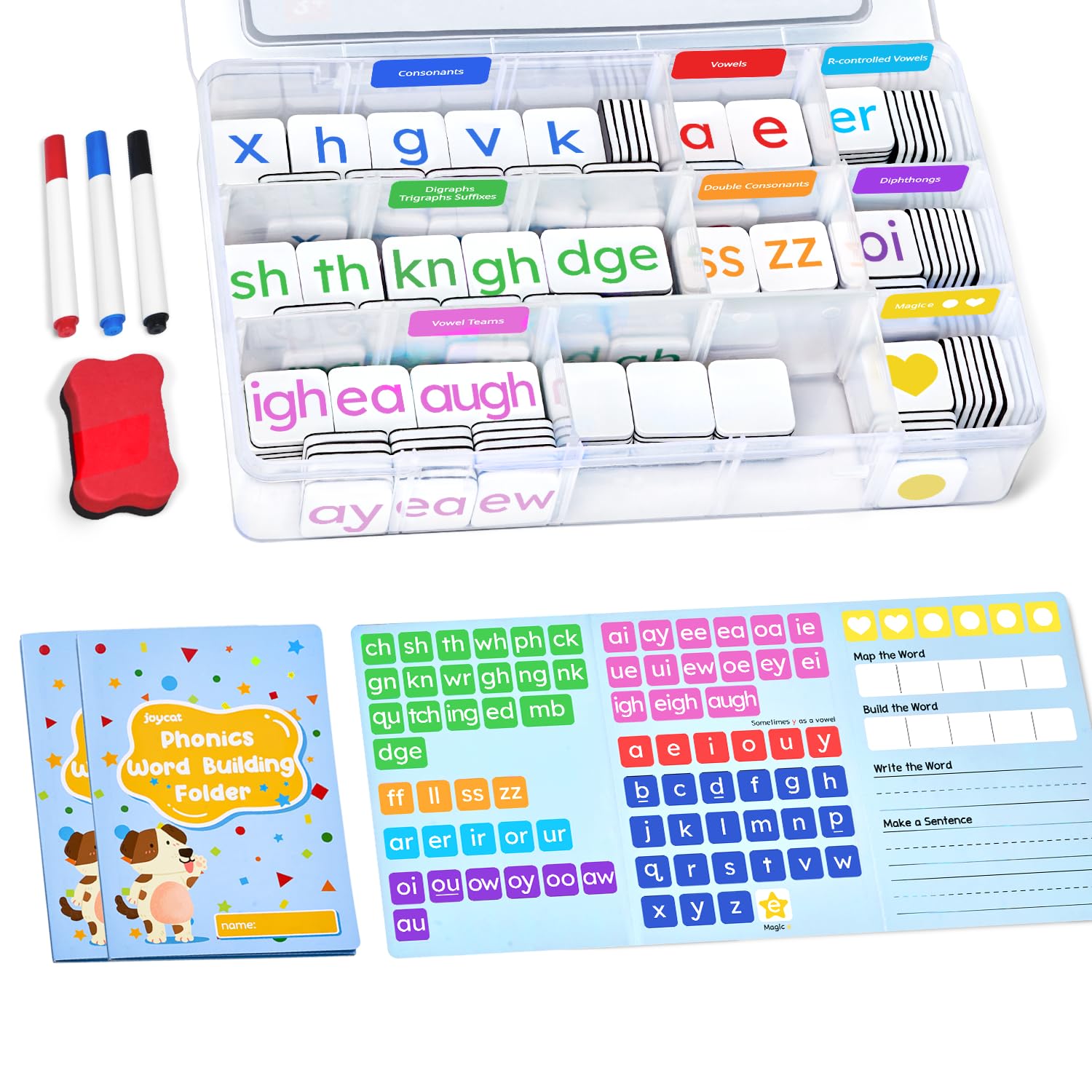
249 color-coded magnetic tiles across three folders — enough for a small group to build real words.
This set solves the group-sharing problem with folders instead of trays. You get 3 word-building folders, 249 phonics tiles in a strategic color system, 16 blank tiles, and 3 dry-erase markers — the whole kit counts 265 tiles plus the 3 folders. Vowels, consonants, and special tiles all carry their own color, so a child can spot a vowel pattern without you pointing it out. The tiles are magnetic, so they stay put on the folder instead of sliding around the table mid-word.
The dual surface is what makes this useful beyond spelling drills. The folders work as a magnet board and a dry-erase surface at the same time, so a learner can place the tiles for the word and then write the word beside them. That pairing does two things at once: it builds the spelling and it reinforces the sound-to-letter mapping audio learners rely on. The 16 blank tiles let you add sounds or sight words specific to your learner, which is what turns a general set into an individual plan. Everything packs into the sturdy carry case for quick setup and instant cleanup.
Strong magnets are the hallmark here — the tiles hold where a child puts them, which is why this kit works on a lap, a table, or a folder. The trade-off is capacity: with 249 tiles across three folders, this set serves up to about three learners working at once. If you teach a full class of six, the hand2mind six-tray set at 672 tiles covers more students at once.
What works
- 249 color-coded tiles plus 16 blank ones — vowels, consonants, and specials visually separated.
- Magnetic hold keeps tiles in place, so words stay built instead of scattering mid-lesson.
- Three folders let a small group build words side by side without one pile being shared.
- Dry-erase surface adds writing practice right beside the tile work.
Where it caps out
- Three folders cap the simultaneous learners at about three — not the tool for a six-student station.
- 249 magnetic tiles is a lot of small pieces to keep sorted in the case.
Go with this if: you teach one to three children and want magnetic word building with writing practice built into the same folder.
Hold off if: you need materials for a full small group of six at once — the bigger tray set covers that better.
Know the Specs
Grapheme and phonics tiles
A grapheme tile (a single written symbol standing in for a sound) is the unit that makes these kits work — one tile equals one sound pattern, so a child builds a word by placing the sound, not by drawing the letter freehand. The stronger kits ship with vowels, consonants, and special tiles in separate colors, which lets a learner see the vowel before you say a word about it. Blank tiles are the wildcard piece — they let you add the sounds your particular reader is stuck on, turning a fixed set into an individualized one.
Write-and-wipe and laminated surfaces
A write-and-wipe surface is a chart or mat you can write on with a dry-erase marker, then wipe clean for the next child — no paper, no reprinting. Laminated flash cards carry the same coating, which is why a card survives being traced over week after week without the print wearing through. The surface is the feature that separates a wall chart you will use daily from one you will stop using by week two.
Mini objects and beginning sounds
For a 3-year-old, a small plastic apple pulled from a box teaches the A sound in a way no flashcard can. The mini object gives the sound a physical anchor — the child holds the thing, hears the sound, and matches it to the letter. The plastic composition matters here: look for pieces substantial enough to grip but sized for small hands, and treat them as matching pieces, not as heavy-play toys.
Card counts and group size
The card and piece counts are the clearest guide to who a set is built for. A six-tray, 672-tile kit is sized for a small group working in parallel. A 249-tile kit across three folders serves up to about three learners. A 104-card wall chart is aimed at a whole group sharing one board. Match the count to your real headcount — more pieces do not help if you are teaching one child, and too few folders stall a group.
Common Questions
What age is right for alphabet sounds teaching tubs?
How many pieces do I need for a small group?
Do these sets teach letter names or letter sounds?
Can I use a wall chart in a homeschool room instead of a classroom?
What is the difference between grapheme tiles and alphabet flash cards?
How do I keep hundreds of small pieces organized?
Will a pocket chart hold up to daily classroom use?
Do I need batteries for any of these phonics tools?
Is a magnetic tile set better than a pocket chart?
What should I check on a new set when it arrives?
The Bottom Line
The best alphabet sounds teaching tubs for most people is the hand2mind Advancing Phonics Word Work Small Group Set, because six trays, 672 tiles, and 30 double-sided mats let a whole small group work at once, and the tray rims keep every tile contained — the feature that makes it usable all year, not just on week one. If you have a toddler who learns by grabbing and matching, the JoyCat Mystery Alphabet Box turns beginning sounds into a hands-on game. And for a wall-based circle-time routine, the Joyreal Alphabet Learning Pocket Chart brings the whole alphabet into view with 182 pieces and a write-and-wipe surface.
Before you commit, match the format to your real setup: table tray for a small group, grab box for a preschooler, wall chart for a circle, tile folder for a homeschool table.
How we choose
We do not accept paid placement. Every pick is matched to a real buyer and a real use-case; we do not hands-on test units.
Sources
Specifications: manufacturer listings and product documentation. Review insights: verified customer reviews, as of October 2026. Pricing: not shown on this page (it changes often); check the current price via the retailer link.
As an Amazon Associate, Aappliancez earns from qualifying purchases. This does not affect which products we feature.