Disclosure: Some links in this post are affiliate links. As an Amazon Associate I earn from qualifying purchases, at no extra cost to you. Learn more
Specs are compiled from manufacturer listings and verified buyer reviews and can change over time — please confirm the key details on the product page before buying.
Your freezer fails quietly. A door sits ajar overnight, a breaker trips while you are at work, or a compressor just gives up, and the first sign is a puddle and a ruined roast. A freezer alarm solves that by watching the temperature and texting you the moment things drift. The picks below cover every situation, from a kitchen fridge to a cabin freezer with no WiFi at all.
This guide is built by comparing the manufacturers’ published specifications and the patterns across verified customer reviews, so you get each pick’s real strengths and trade-offs instead of marketing spin.
Your freezer fails in one of a few ways: the power dies, the router drops, or the door stays open. How the alert reaches you decides which alarm you should buy. Below are the practical differences that matter, plus a full breakdown of the best alarm for freezer setups for a kitchen, a garage, or an off-grid cabin.
Top Picks
How To Choose The Best Alarm for Freezer
The one question that decides everything is how the alert gets to your phone. Every other spec is secondary to that. If your router stays up, a WiFi unit is cheap and easy. If the power itself is what fails, you need a cellular unit that keeps working when the house goes dark.
Cellular versus WiFi: pick your failure mode
A WiFi freezer alarm talks to a hub through your home router. That is fine for a normal fridge, but a router dies in a blackout — exactly when a freezer is most at risk. A cellular alarm carries its own SIM card (a chip that connects to a mobile network), so it keeps sending texts even with no power and no internet at the house. That matters for a cabin, a garage, or any freezer you leave for weeks.
Probe accuracy and the anti-false-alarm delay
The probe is the metal-tipped cord that sits inside the freezer and reads the actual air. Accuracy is written as a plus-or-minus figure, like ±0.9°F, meaning the reading can be off by that much at most. Tighter is better for catching a slow warm-up early. Just as important is an alarm delay: it makes the unit wait a few minutes before alerting, so opening the door for a bag of peas does not set off your phone.
Getting the cable past the door seal
A wired probe has to get inside the freezer somehow. Thin flat cables slide between the door gasket and the frame and let far less cold air escape than a round cord. If your alarm sits outside a chest freezer with no cable at all, the sensor needs enough wireless range to reach through the lid — and thick steel doors can weaken that signal.
Side-by-Side Comparison
| Model | Best For | Connection | Accuracy | Battery | Amazon |
|---|---|---|---|---|---|
| Necto Cellular Monitor★ Best Overall | No-WiFi rooms and blackouts | Cellular (4G LTE) | — | 3-day rechargeable | Amazon |
| MOCREO H5Lite-MS2DBest Value | Kitchen fridge and freezer | WiFi (2.4GHz) | ±0.9°F | 2 years (AAA) | Amazon |
| GoveeLife H5108 2-Pack | Two freezers on one app | WiFi + Bluetooth | ±0.9°F | AAA (included) | Amazon |
| MOCREO H5Pro-LS1D | Long range and wet rooms | WiFi or Ethernet | ±0.9°F | 2 years (AAA) | Amazon |
| SensorPush HTP.xw | Precision logging, one sensor | Bluetooth | 0.1° | 1–2 years (CR2477) | Amazon |
| YoLink X3 2-Pack Kit | Deep freezers and walk-ins | LoRa (via hub) | ±0.54°F | Up to 5 years | Amazon |
| MarCELL Cellular Monitor | RV and remote freezers | Cellular (Verizon) | — | Lithium-Ion backup | Amazon |
Detailed Reviews
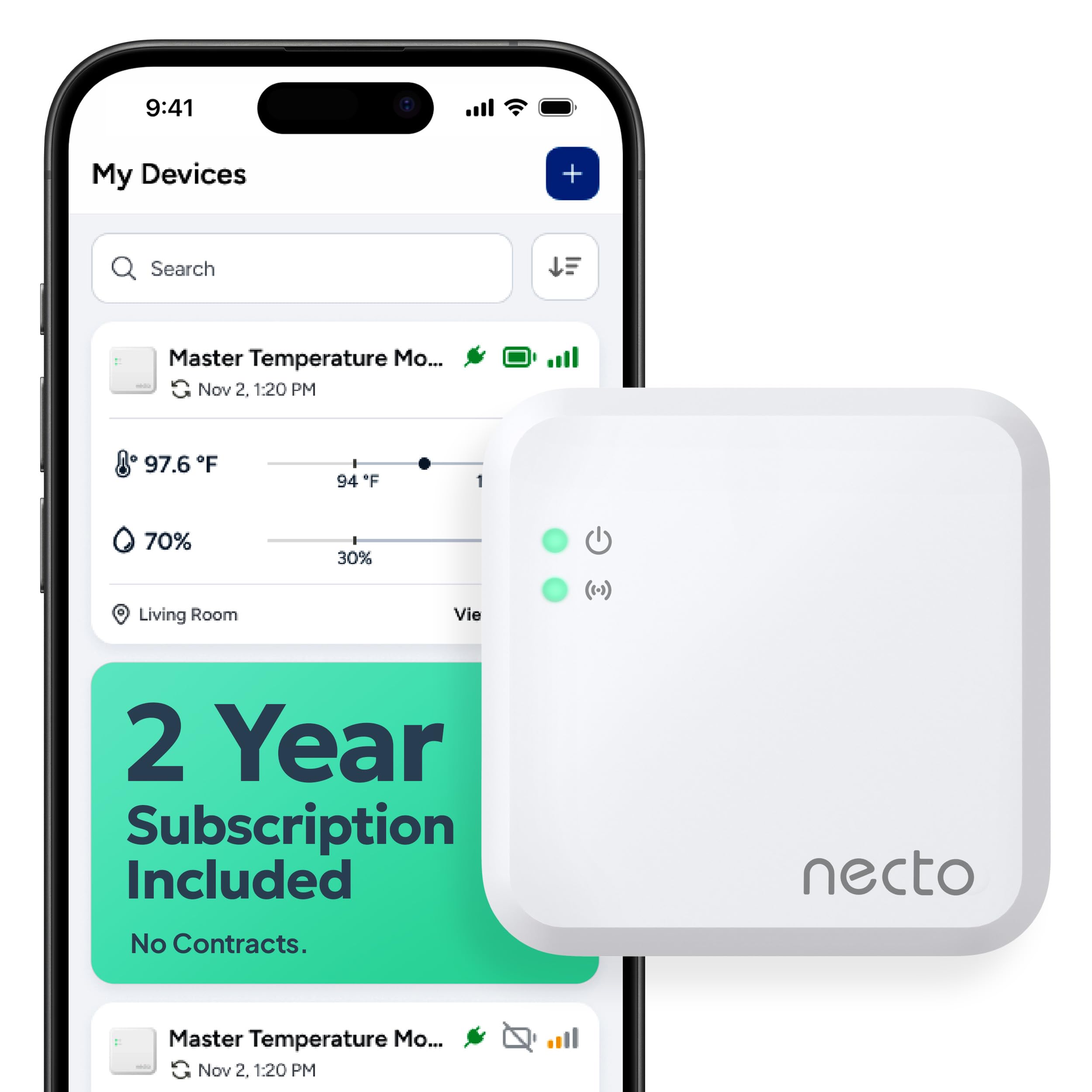
1. Necto Cellular Temperature Monitor
Our pick — 4.5+★ from 500+ verified ratings; the strongest balance of quality and price.
The freezer guard that keeps texting even when your power and router are both dead.
Here is the problem with most cheap alarms: they talk to your home WiFi, and your WiFi dies in a blackout. The Necto sidesteps that entirely. It runs on a built-in 4G LTE cellular connection with a multi-network SIM card, so it reports temperature, humidity, and power loss straight over the mobile network. Two full years of that service are bundled in, and after that you renew from the app. That is why it holds the top spot: it is the only pick here that keeps alerting through a blackout.
The readings come from an industrial sensor that samples every 10 seconds, with the latest value pushed to the online portal every 10 minutes and stored on the servers for 1 year as a downloadable CSV file. You set high and low thresholds for both temperature and humidity, and add up to 5 contacts who each get unlimited text and email alerts. A 3-day rechargeable battery keeps it alive through an outage, and it pings you if that battery runs low or the device drops off the network.
Setup takes minutes: activate through the app, plug it into any standard wall outlet, and it is watching. The buyer consensus is that the readings track close to a home thermostat and that the alerts land instantly when temps cross your line. Owners who run it in patrol vehicles, RVs, and kennels lean on the fact that it keeps reporting with the vehicle off, and the portable 2.15-ounce body moves between spots without fuss. The catch is the upfront cost and the ongoing subscription after year two — it is the most expensive way to watch a freezer, and it only makes sense if you actually need the cellular safety net.
Where it earns its keep
- Runs on cellular, so it alerts through a power cut and with no WiFi at the location
- Two years of 4G LTE service included with no contract
- Watches temperature, humidity, and power loss in one 3-in-1 unit
- 10-second sampling with 1 year of downloadable data
What to weigh first
- Costliest pick here, plus a renewal fee once the included service ends
- 3-day battery means a long outage eventually drains it
Reach for this if: your freezer lives somewhere without dependable WiFi, or losing power is the very scenario you fear.
Think twice if: a router-backed alarm is enough for your kitchen and you would rather not carry a subscription.
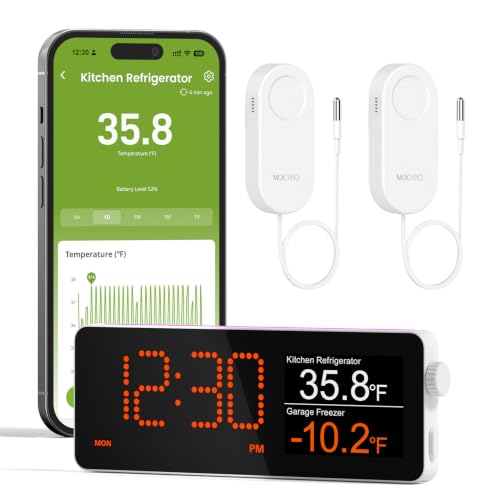
2. MOCREO WiFi Freezer Thermometer Alarm
Two freezer probes, a desk hub with a screen, and no subscription — the smart pick for most kitchens.
This MOCREO kit bets on simplicity and coverage, where the Necto above gambles on cellular. The H5Lite hub is a small LCD screen (a display panel) that shows the clock, each sensor’s temperature, trend charts, alerts, and even the weather. So you can read a freezer’s condition without opening the door and letting cold air out. Two wireless thermometer probes come in the box, and one hub talks to up to 30 sensors across a maximum open-air range of 230ft (about 70m). That is enough to cover a kitchen fridge, a chest freezer, and a garage unit at once.
What wins most people over is the value for money. There is no subscription fee, and you get three alert routes: app push, email, and an 80dB hub alarm (about as loud as a busy street) that you can now silence from the app. A Hub Offline Alert also flags a power outage. The 0.9mm ultra-thin flat probe cable threads between the door seal to reduce cold-air leakage and frost, so the seal still closes tight. Readings come in at ±0.9°F across a -40°F to 158°F range, so a deep-freeze reading stays accurate. Each sensor runs up to 2 years on three AAA batteries and warns you when it drops below 10%. It also handles Alexa voice queries, and it needs 2.4GHz WiFi only.
Owners put this to work in pole barns, garages, and multi-freezer kitchens, and the recurring note is that you need about a week of data to set your alert thresholds sensibly, because normal defrost cycles swing the temperature. A few find the sensors can lose connection, so site the hub with a clear path to each probe. For anyone with a conventional router and no blackout fears, this is the most coverage per dollar on the list.
Coverage champion: two probes and one hub covering up to 30 sensors beats the single-sensor YoLink kit on room to grow, while its 80dB alarm gives you a in-room siren the glass-front GoveeLife lacks.
The one caveat: 2.4GHz WiFi only, and it needs a week of readings before your thresholds are dialled in.
Best fit: a normal home with reliable WiFi and more than one cold appliance to watch.
Not the one: an off-grid cabin where the router is the part that fails.
3. GoveeLife WiFi Refrigerator Thermometer 2-Pack

The twin-probe kit for a fridge and freezer pair, with a delay that mutes your own door-opening noise.
The single handiest feature here is the anti-false-alarm delay: the alarm waits 1-10 minutes before it notifies you, so grabbing milk does not light up your phone. Both probes run a ±0.9°F accuracy across a -40° to 158°F band with a 2-second refresh, and each one is fixed in a holder that keeps the cable tidy inside the freezer. The gateway takes up to 10 sensors, so you can add more as your appliances grow, and it runs on 2.4GHz WiFi only.
The 2-pack split covers your most common setup: one probe in the fridge, one in the freezer. Each has a magnet and a lanyard, so it also drops into a fish tank or hot tub. Monitoring is free with no subscription, and you get 2 years of data storage to review or export. The app alerts you on your phone wherever you are, but note plainly that the device itself does not sound an alarm. Owners lean on it for garage freezers and reach for the low-temp alerts to sleep easy. The low-temp false-alarm issue under -4°F during normal compressor cycles has been addressed in firmware.
It is the cheapest way to watch two cold boxes at once, and that is its whole pitch. The trade-off is that alerts live only in the app — no hub beep and no probe siren, so a phone that is off or out of coverage means no alert. Against the MOCREO above, you give up the loud 80dB hub in exchange for a second probe and a lower cost. Keep the frost clear where the cable passes the seal, and it stays accurate.
Why two probes win here
- Two sensors in the box for fridge plus freezer at once
- 1-10 minute anti-false-alarm delay kills door-opening false alerts
- ±0.9°F accuracy with a fast 2-second refresh
- No subscription, plus 2 years of stored data to export
What you give up
- App-only alerts — no built-in hub sound
- Needs the gateway powered and on 2.4GHz WiFi to report remotely
Lock it in if: you own a fridge and a freezer and want both covered on one app for the least spend.
Walk on by if: you want an audible siren in the room, not just a phone notification.
4. MOCREO WiFi Remote Thermometer

A 1/3-mile wireless reach that puts a detached garage or shed freezer on your phone.
Distance is the headline here. The H5Pro hub uses a long-range wireless protocol (a low-power radio link) to talk to up to 100 sensors at an open-air range of up to 1640ft (about 1/3 mile). Each LS1 probe is IP66 splash-proof (sealed against water spray), built for humid spots like a fridge, a well house, or a near-freezing shed. The hub also gives you an LCD dashboard for historic data, alarms, clock, weather, and calendar. It connects to your network by Ethernet or 2.4GHz WiFi, so you can hardwire it where WiFi is weak.
Two probes ship in the box, both feeding readings of ±0.9°F across -4°F to 131°F, and each runs up to 2 years on three AAA batteries. You get three alert routes — app push, email, and a 95dB hub beep — plus “Power Outage,” “WiFi Disconnect,” “Low Battery Alert,” and “False Alarm Prevention” settings. It also stores 2 years of data as a downloadable CSV, all with no subscription. Buyers praise it for putting an accurate read on garage freezers in deep cold, and the display is bright enough to double as a clock.
The catch is physical, not technical: the manual tells you to keep the probes out of fully enclosed metal containers like commercial walk-in coolers or very thick freezer doors, because the steel blocks the wireless signal. For a home chest freezer or a garage fridge it is ideal; for a walk-in, you would want a wired-probe unit like the MOCREO H5Lite. This is your pick when the freezer sits far from the house and you want a strong signal plus a loud in-room alarm.
The selling point, plainly: a 95dB hub alarm and a 1640ft radio reach make it the strongest combination for a detached cold-storage room.
Fit note: the wireless probe and thick steel doors are not friends — a walk-in cooler needs a cabled probe instead.
Pick this for: a garage, shed, or second building where the freezer is far from your router.
Pass if: your freezer lives inside a commercial-grade steel walk-in.
5. SensorPush HTP.xw Temperature
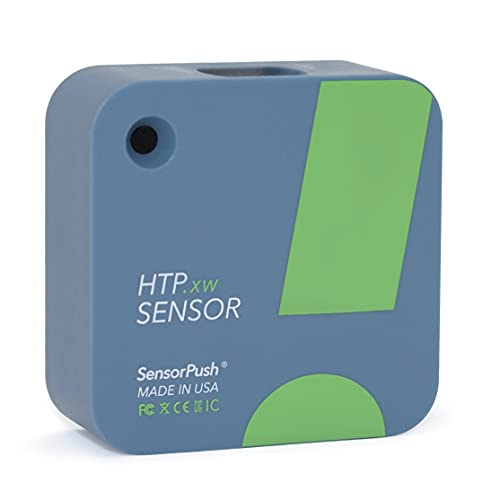
The accuracy obsessive’s choice — a tiny Bluetooth logger that also reads heat index and dew point.
This is a different animal from the WiFi kits. The HTP.xw is a single splash-resistant Bluetooth sensor that records air temperature, relative humidity, heat index, barometric pressure, dew point, and VPD (vapour pressure deficit, a dry-air measure growers watch). Accuracy is the tight 0.1° figure, it holds 30 days of on-board data plus unlimited in-app storage, and it runs 1-2 years on a CR2477 coin cell in typical conditions. It is ideal for a freezer or fridge, a humidor, an attic, or a wine cellar — anywhere you care about the number itself.
What wins people over is the sheer reliability and precision. Owners who keep several units side by side find they track each other closely, and it happily communicates from a freezer through steel and stud walls at short range. It is also a U.S.-made device with in-house support. The honest limits: it is Bluetooth only, so the data shows in the app when you are within about 100m line of sight. You need the separately sold G1 WiFi Gateway for remote alerts and cloud storage. And at this price for a single sensor, you are paying for accuracy, not coverage.
Who it is for: the buyer who wants a precise, dependable log of one critical space and can add the G1 gateway later if remote alerts matter.
Bookkeeping caveat: no gateway in the box, so out-of-range access and remote push alerts require that add-on purchase.
A match if: you value pinpoint readings and a long data history over multiple probes.
Look elsewhere if: you need instant remote alerts from the start without buying a gateway.
6. YoLink X3 Outdoor Thermometer Hygrometer Kit

Two probes, a hub, and a 5-year battery rated for the punishing cold inside a chest freezer.
Freezers are brutal on batteries, and the X3 is built to shrug that off. Each sensor carries an exceptional 5-year battery rating and will keep logging temperature and humidity even when it loses its hub, thanks to built-in offline data capture. The accuracy reads ±0.54°F with humidity at ±3% RH across a -22° to 140°F range. The kit includes the hub, and it runs on the long-range LoRa YoLink protocol, so the signal carries across a big house or a commercial space where ordinary WiFi drops off.
You get push, email, and SMS alerts with no subscription, plus IFTTT and Alexa integration (Alexa answers temperature only). It also samples on a 5-minute interval and keeps professional-grade history for review. Buyers who run it in restaurant walk-in freezers report the signal pushing through metal doors, and its battery life in freezer cold keeps drawing praise. Set it up in minutes through the free app and it stays put, low-maintenance.
The one honest limit is refresh speed: it prioritises battery life, so readings can run 20-30 minutes stale during a fast temperature swing. That is fine for catching a door left open or a failing compressor, but it is not a live display. If you want minute-by-minute numbers, the faster-refreshing GoveeLife suits better; for long-haul freezer protection with almost no battery upkeep, this is the standout.
Why freezer owners love it
- Up to 5-year battery handles the cold without constant swaps
- LoRa long range reaches across a home or a walk-in
- ±0.54°F accuracy with SMS, email, and push alerts
- Offline logging keeps data even when disconnected from the hub
The trade-off
- Readings can lag 20-30 minutes during rapid swings
- Needs the included hub in range to report remotely
The one for you: a large, cold, hard-to-reach freezer where you want years of battery life and long-range signal.
Not quite: a setup where you want the freshest possible reading at every moment.
7. MarCELL Cellular Temperature Monitor
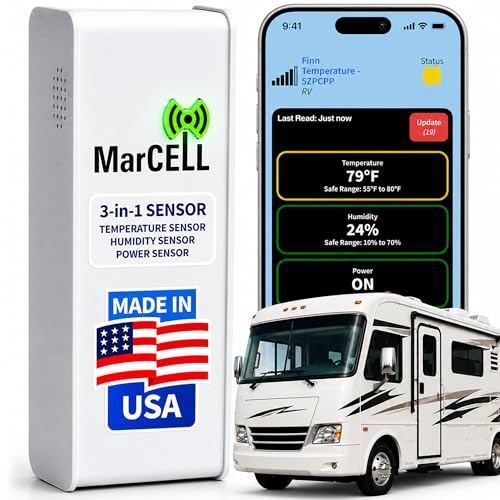
Built for the RV crowd: it uses cell signal so it survives a campground power cut.
If your freezer lives in a camper or a second home, WiFi is often the thing that fails first. The MarCELL runs on the Verizon cellular network instead, so it keeps reporting in a power outage where a WiFi unit would go dark. You get continuous monitoring of temperature and humidity with alerts sent by text, call, or email when levels hit critical or power is lost. Readings refresh on the website or app roughly every 15 minutes after the first read, and you can pull up historic data anytime.
The buyer consensus among RV owners is that setup is genuinely quick, and the power-loss notification arrives right away — the thing pet owners care about most when they leave a dog behind. It monitors humidity accurately, and you set your own upper and lower limits. The plan that keeps it live starts around a modest monthly rate, which is the real cost to weigh; it is a subscription device, and that is unavoidable because it runs on a cellular network.
Two practical notes from living with it: it defaults to email alerts, so set it to text if that is how you want to be reached, and it auto-re-enables itself after a shutdown and power restore. For a house with solid WiFi, the MOCREO H5Lite is simpler and needs no plan. But for an RV without its own internet, this is the device that matches the job, and owners build real confidence leaving a pet alone with it running.
The core advantage: cellular alerts mean the campground blackout never blinds you, which no WiFi probe on this list can claim.
Set it up right: switch the alerts to text on day one, or you will miss power-loss notices buried in email.
Right for: RVs, campers, and second homes with cell signal but no reliable internet.
Overkill for: a kitchen freezer already covered by a home router and a WiFi alarm.
Know the Specs
Probe accuracy (±°F)
Accuracy is how close the probe’s reading sits to the true temperature, written as a plus-or-minus figure. A ±0.9°F probe can be off by just under a degree; a ±0.54°F probe tighter still. Tighter accuracy means you catch a slow warm-up sooner, before a door left ajar turns into a lost batch of food.
Anti-false-alarm delay
This is a short wait — often 1-10 minutes — before the alarm fires. It exists so opening the door to grab something does not trigger your phone. Set it too short and you get nuisance alerts; set it too long and you hear about a real failure a little later.
Cellular versus WiFi alerts
A WiFi unit talks through your home router, which dies in a blackout. A cellular unit carries its own SIM and connects to a mobile network, so it keeps texting when the power and internet are gone. Cellular models usually need a paid plan; WiFi models generally do not.
Battery life and cold
Freezers sap batteries faster than a warm shelf does. Ratings here range from a 3-day rechargeable backup to a 5-year sensor cell. Longer battery life means fewer surprises, and most units warn you when the cell drops low so you can swap it before it quits.
Common Questions
Will a WiFi freezer alarm still work if the power goes out?
How do I get the probe cable into the freezer without breaking the seal?
Will the alarm go off every time I open the freezer door?
Can one hub monitor more than one freezer?
Do these freezer alarms require a monthly subscription?
How accurate is a freezer thermometer probe, really?
Will a wireless sensor work inside a steel walk-in freezer?
What temperature range should a freezer alarm cover?
How long do the batteries last in a freezer alarm?
Can I see the temperature history after an incident?
The Bottom Line
The right freezer alarm depends on which failure you are guarding against: a dead router, a blackout, or a door left open. If losing power is the fear, the Necto Cellular Monitor is the safest pick on the list. It keeps reporting over 4G LTE (the mobile phone network) when your router cannot, and it carries a 4.5+ star rating across 500+ buyer reviews. If your kitchen freezer sits behind a solid router, the MOCREO H5Lite covers two appliances with an audible hub and no subscription. And for a camper or RV freezer with cell signal but no internet, the MarCELL is the one to reach for. Match the alarm to how you would most likely lose your food, and any of these will text you long before the thaw wins.
How we choose
We do not accept paid placement. Every pick is matched to a real buyer and a real use-case; we do not hands-on test units.
Sources
Specifications: manufacturer listings and product documentation. Review insights: verified customer reviews, as of October 2026. Pricing: not shown on this page (it changes often); check the current price via the retailer link.
As an Amazon Associate, Aappliancez earns from qualifying purchases. This does not affect which products we feature.