Disclosure: Some links in this post are affiliate links. As an Amazon Associate I earn from qualifying purchases, at no extra cost to you. Learn more
Specs are compiled from manufacturer listings and verified buyer reviews and can change over time — please confirm the key details on the product page before buying.
If you want to know whether the air in your bedroom is actually clean, the fastest answer is this: a plug-in monitor that tracks fine dust and carbon dioxide is the one worth owning. Carbon dioxide is the reading most home buyers care about first, because it climbs in closed rooms where people sleep and work. Fine dust (called PM2.5, tiny particles small enough to reach deep into your lungs) is the second reading that changes how you live, since it jumps the moment you cook, burn a candle, or open a smoky window. The picks below span every budget, from a plug-in Alexa monitor to a Swiss-built unit that shows indoor and outdoor air side by side.
This guide is built by comparing the manufacturers’ published specifications and the patterns across verified customer reviews, so you get each pick’s real strengths and trade-offs instead of marketing spin.
Some monitors here show a color light and nothing else, while others give you full graphs and history on your phone. That gap between a color light and logged history shapes every recommendation on this list. Below you will find the best air quality monitor for home picks sorted by what each one actually does well.
Top Picks


How To Choose The Best Air Quality Monitor for Home
Most people buy the wrong monitor for one simple reason: they count sensors instead of checking which gases the device actually measures. A box that claims eleven readings may still skip CO2, the one number that matters most in a closed bedroom. Here is what to weigh before you buy.
Which gases and particles actually matter in a home
Carbon dioxide tells you how well a room is ventilated, and it is the number that moves fastest when doors and windows stay shut. PM2.5 covers fine dust from cooking, candles, and wood smoke. Volatile organic compounds, or VOCs, are the fumes that come off cleaning sprays, paint, and new furniture. A formaldehyde reading is worth having if you have recently bought new furniture or painted. Radon is a separate concern entirely, and it needs a dedicated radon sensor — most general monitors do not measure it at all.
Screen, app, or both
A display you can read from across the room means you never open an app to check the air. A companion app adds history, so you can see whether your bedroom air gets worse at 2 a.m. or whether cooking is the real culprit. If you want both, look for a device with a screen and app connectivity. If you only want a quick glance, a color-coded light and a small screen is enough.
Battery life and placement
A monitor that lives on a USB cable is fine for a kitchen counter or an office desk. If you plan to carry it between the bedroom, the nursery, and the living room, battery runtime becomes the deciding spec. Some units here run for weeks on a charge, and others manage a single evening before they need a cable.
Side-by-Side Comparison
| Model | Best For | What It Measures | Battery / Power | App Support | Amazon |
|---|---|---|---|---|---|
| Amazon Smart Air Quality Monitor★ Best Overall | Smart-home households with Echo devices | PM2.5, VOCs, CO, humidity, temperature | Plug-in | Alexa app | Amazon |
| LifeBasis 11-in-1 Air Quality DetectorPocket-Sized Pick | Carrying between rooms | AQI, CO2, PM1.0, PM2.5, PM10, HCHO, TVOC, temperature, humidity | 2500mAh, 11-12 hours | None | Amazon |
| YNAK 16-in-1 Air Quality Monitor | Seeing everything at once on a big screen | CO2, PM2.5, PM1.0, PM10, HCHO, TVOC, temperature, humidity, AQI, time | Up to 8 hours, USB-C | None | Amazon |
| Temtop M10+ | Long battery life with an e-ink screen | CO2, PM2.5, TVOCs, AQI, temperature, humidity | Up to 60 days | Temtop app (Bluetooth) | Amazon |
| BREATHE Airmonitor Plus Gen 2 | Long-term tracking with data export | CO2, PM1, PM2.5, PM10, TVOC, HCHO, temperature, humidity | 6 hours, USB-C | Breathe Tech app (2.4 GHz Wi-Fi) | Amazon |
| Airthings View Radon | Homes in radon-prone areas | Radon, humidity, temperature | 6 AA batteries, up to 3 years | Airthings app (Wi-Fi) | Amazon |
| IQAir AirVisual Pro | Indoor plus outdoor air in one view | PM2.5, CO2, smoke, dust, temperature, humidity, AQI | Rechargeable, USB or outlet | IQAir app (Wi-Fi) | Amazon |
Detailed Reviews
1. Amazon Smart Air Quality Monitor
Our pick — 4.0+★ from 5,500+ verified ratings; the strongest balance of quality and price.
The one that turns your air into an Alexa announcement you can hear from the next room.
If your house already runs on Echo speakers, this is the monitor that asks the least of you. Plug it in, open the Alexa app, and you are watching five readings — PM2.5 fine dust, VOCs (the fumes from cleaning sprays and paint), carbon monoxide, humidity, and temperature. There is no separate app to download and no account to build. Owners consistently describe setup as a matter of minutes, with one putting it plainly: “Setup <10 min with Alexa.”
The automation is what makes it more useful than a plain readout. When the sensors detect a change, you can have Alexa turn on a compatible air purifier, a dehumidifier, or a fan through a Routine. Pair it with an Amazon Smart Thermostat and the temperature and humidity sensor feeds into that too, so the room you sleep in stays steadier. A color-coded LED gives you the instant glance, and the app adds a plain air quality score plus history on Echo Show screens.
Know what it can’t do before you buy. It tracks five things: particulate matter (tiny particles like dust and smoke), volatile organic compounds (chemical fumes from cleaners and paint), carbon monoxide (a poisonous gas from fuel-burning appliances), humidity, and temperature. It does not measure carbon dioxide or radon. So if CO2 in a closed bedroom is your main worry, look at the LifeBasis or the Temtop M10+ instead. The sensitivity cuts both ways: it warns you fast but clears slowly, which a few owners find noisy. It also relies entirely on the Alexa app, and one critic found the threshold sliders vague with no exact values to set.
Where it earns its place
- Five readings with no second app to babysit
- Routines can switch on a purifier or fan automatically
- PM2.5 readings track closely to a reference monitor in side-by-side tests
- Notifications arrive on your phone or as Echo announcements
Where it asks patience
- No carbon dioxide or radon sensor
- Warning threshold sliders are imprecise, with no exact-value entry
- Temperature logs in Celsius in some setups
- Undocumented calibration check is missing
Reach for this if: your home already talks to Alexa and you want air alerts that trigger your purifier without lifting a finger.
Look elsewhere if: carbon dioxide is the number you came for — this unit does not measure it at all.
2. LifeBasis Air Quality Monitor
Six ounces of monitor you can toss in a bag and carry from the bedroom to the kitchen.
At 6.1 ounces, this is by far the lightest pick here — the YNAK 16-in-1 tips the scale at 10.56 ounces, so the LifeBasis is the one you actually stuff in a coat pocket. The 2500mAh battery runs 11-12 hours on a charge, comfortably ahead of the YNAK’s 8-hour runtime, which means it survives a full day of moving from room to room without hunting for a cable.
Eleven readings give you a wide safety net: AQI (air quality index, a score for overall pollution), CO2 (carbon dioxide, the gas you breathe out), PM1.0, PM2.5, PM10 (particles of different tiny sizes), particle count, HCHO (formaldehyde, the gas that off-gasses from new furniture and paint), TVOC (total volatile organic compounds, a mix of chemical fumes), temperature, and humidity. A color scale runs from green through yellow and orange to red. When a reading crosses the normal threshold, the screen flashes, changes color, and gives a ticking sound. What wins people over most is the build and feel of the thing — quality is the praise it draws again and again, with easy setup close behind. An NDIR infrared sensor (a sensor that uses infrared light to measure gas) handles carbon dioxide, and it calibrates manually, so you can zero it against outside air yourself.
Be honest about what you are buying. Accuracy is the mixed bag here, and the manufacturer itself has stepped in for owners with glitchy or used-seeming units, replacing them so the device works well. Early misreads have included temperature and humidity drifting well off a contractor’s equipment. There is also no Wi-Fi, no Bluetooth, and no data export, so if you want hourly graphs on your phone, this is not that device.
What it does best: real-time readings you can watch move as you cook, clean, or open a window, on a bright screen that shows several numbers at once without any menus to dig through.
The trade you accept: no app, no history, and a sensor set that can wander — treat the numbers as a reliable guide, not a lab report.
Suits you if: you want a grab-and-go monitor to check CO2 while you sleep and pack for travel, without paying for app features you will not use.
The caveat: with no connectivity, every reading lives and dies on that LCD screen.
3. 16 in 1 Air Quality Monitor
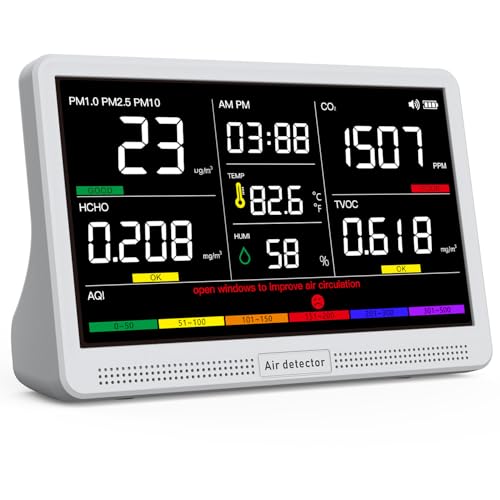
A seven-inch display that puts every reading on the wall where the whole family can see it.
The screen is the reason to buy this one. Seven inches of LED shows nine parameters — CO2, PM2.5, PM1.0, PM10, HCHO, TVOC, temperature, humidity, and AQI — plus the time, all at once, with three brightness levels for any room. Sensors sit on the outside of the body and sample the air directly, which the maker rates at 0.001 units of resolution. It runs up to 8 hours on a full charge through USB-C, and the included adapter keeps it topped up on a counter.
Seven AQI alert buzzers cover the range of conditions, and a mute button kills the noise when you have heard enough. It swaps between Fahrenheit and Celsius with a double-press of the power button — a small thing that saves real annoyance. Owners find the display clear and easy to read at a glance, and the compact body easy to move from the kitchen to the bedroom. Humidity readings have proven genuinely useful for people tending tropical plants.
The honest catch is history. There is no charting and no phone or tablet logging, so you must watch the screen to spot a trend. One owner found TVOC and CO2 alarms firing falsely within the first day, and the maker later sent an updated model that added recording. Accuracy on a home-grade sensor can drift over time and needs occasional recalibration against outdoor air. This is a general monitoring tool, not a medical-grade instrument, and no home monitor at this level should be treated as one.
The case for the big screen
- Nine readings visible at once, no menus, no phone required
- External sensors sample air directly for quick response
- Three brightness settings suit a bright kitchen or a dim bedroom
- Mute button silences alerts without disabling them
What to accept going in
- No data history or app charting
- Occasional false alarms on TVOC and CO2 in early use
- Sensor accuracy drifts and needs periodic recalibration
- Wall power is the realistic setup; battery is a backup
Right for you when: you want a set-and-glance display the whole household can read without an app or a login.
Think twice when: you need to review yesterday’s numbers — without built-in history, that data is gone the moment it leaves the screen.
4. Temtop M10+ 6-in-1 CO2 Meter & Indoor Air Quality Monitor
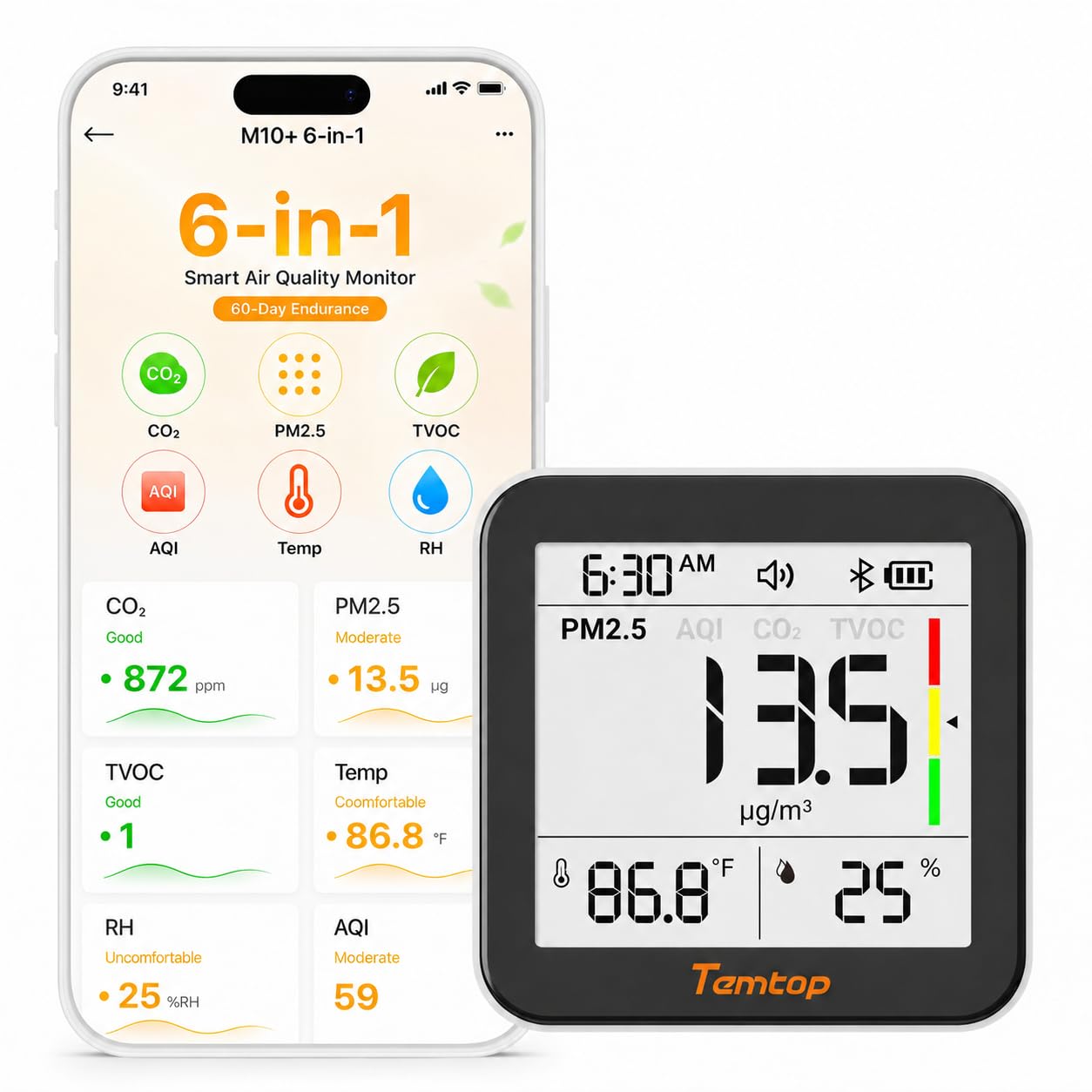
The e-ink screen and sixty-day battery that keep a bedroom monitor quiet and off the charger.
Up to 60 days of battery life comes from an energy-efficient algorithm paired with an e-ink display (a low-power screen like an e-reader that holds a static image without drawing much current). That is a different world from the YNAK’s 8-hour runtime or the BREATHE’s 6 hours. The screen has no backlight, so it will not glow at you across a dark bedroom, and readings stay visible without lighting up the room.
It tracks CO2, PM2.5, TVOCs, AQI, temperature, and humidity across a metal-and-plastic body. The Temtop app pairs over Bluetooth, so no Wi-Fi network is needed — stay nearby and the live data shows on your phone, with automatic hourly logging and export. The adjustable alarm can be muted completely for nurseries and home offices. Sensor quality is what owners praise most here, with battery life running a close second in what they talk about.
What you should know before buying is the sampling rhythm. Data logs once an hour, which is fine for spotting long-term averages but useless for tracking a quick cooking event or a candle. One owner sat in front of a fire for 30 minutes and the unit still called the air clean, and the CO2 sensor responds slowly, on the order of an hour. If you want second-by-second response, this is the wrong device — and the alarm offers only a single on/off toggle with no threshold adjustment.
The long-run winner: sixty days on a charge and a screen that stays legible without backlighting makes this the easiest monitor to just leave in a bedroom and forget about.
The real limitation: hourly sampling means fast events slip past undetected, which is a fair trade for the battery life it buys.
Best fit: a bedroom or nursery where you want continuous CO2 awareness without a cable trailing to an outlet.
Not the fit: anyone tracking a cooking spike in real time, since the readings refresh once per hour.
5. BREATHE Airmonitor Plus Gen 2 Indoor Air Quality Monitor

Eight sensors, ninety days of history, and a CSV export for anyone who tracks patterns.
For someone who actually wants to see the trend line, this is the most complete package here. It measures eight things: CO2, PM1, PM2.5, PM10, TVOC, formaldehyde (HCHO), temperature, and humidity. The NDIR CO2 sensor is paired with laser particle sensing and dedicated TVOC and formaldehyde detection, so gases and particles are covered by separate hardware rather than inferred from one another. Ninety days of data store in the free Breathe Tech app, with graphs, configurable CO2 and PM2.5 alerts, and CSV export for your own spreadsheets.
At 4 ounces, it is the lightest monitor in this article — even lighter than the 6.1-ounce LifeBasis — and the Gen 2 rechargeable design gives up to 6 hours of portable use, or you can leave it on USB-C power for continuous running. Owners find it responsive, with readings updating quickly when you open a window or start cooking, and the setup with the app is described as simple to follow.
The catch is connectivity and battery. It needs 2.4 GHz Wi-Fi and has no Bluetooth, which is a problem for anyone without a home network. The alarm cannot be silenced on some units, the app has no AQI value, and the display runs bright — one user found the proximity sensor failed on a bad unit and had it replaced. Battery life in practice runs shorter than the quoted 6 hours, and the whole device is best treated as a corded indoor monitor rather than a portable one.
Where it shines: the combination of eight distinct sensors, real-time alerts, and ninety days of exportable history makes this the pick for tracking how your home’s air changes over weeks, not minutes.
The cost of that power: you are tethered to 2.4 GHz Wi-Fi and, realistically, to a USB-C cable for long sessions.
Pick it when: you want graphs, alerts, and exportable data to understand how cooking, cleaning, and occupancy move your indoor air.
Pass if: your home lacks 2.4 GHz Wi-Fi or you need the monitor to run untethered all day.
6. Airthings 2989 View Radon Monitor

The only pick here that watches radon, the gas most home monitors skip entirely.
If your home is in a radon-prone area, no PM2.5-and-CO2 monitor will substitute for this one — radon is a different gas, and it needs a different sensor. The View Radon tracks radon alongside humidity and temperature, and it is the one device on this list built specifically around that job. Six AA batteries power the sensors for up to 3 years, so a basement or hallway unit runs for months without a battery change.
The Calm Tech e-ink display shows up to four values and can be woken with a wave of the hand, and the color coding makes the level readable at a glance. The Airthings app and online dashboard add graphs, notifications, and insights over Wi-Fi. Plug in with the USB cable and this device becomes a hub, bringing other Airthings units online through it. What owners trust most is reliability, and buyers report radon readings that match professional test kits over years of continuous use.
The mixed part is worth knowing. Wi-Fi connectivity draws grumbles — the device relies on it for remote data — and radon monitoring demands patience, since meaningful readings build over weeks, not hours. Value is a question mark for some buyers given the price of entry, and one unit arrived reading flat zero, though Airthings replaced a degraded-display model out of warranty the next day. This is a long-view instrument, not a quick-check gadget.
Why it earns the premium
- Dedicated radon sensor no other pick here has
- Up to 3-year battery on 6 AA cells
- Hand-wave e-ink display reads at a glance
- Doubles as a hub for other Airthings devices when plugged in
What to weigh first
- Wi-Fi connectivity frustrates some users
- Radon trends need weeks, not hours, to mean anything
- Higher entry cost than general air monitors
- Occasional dud units, though support has replaced them
Made for you if: you live in a radon zone, have a mitigation system, or want the number no general monitor can give you.
Overkill if: radon is not a local concern and your real interest is dust and carbon dioxide.
7. IQAir AirVisual Pro Air Quality Monitor

Swiss-built and sharp enough to track your indoor air beside the air outside your door.
This is the pick for the buyer who wants one screen showing both sides of the window. The AirVisual Pro pulls real-time outdoor AQI (air quality index, a score for overall pollution) from a worldwide network of public stations alongside its own indoor PM2.5 (fine particles) and CO2 readings, so you can see whether the pollution inside is coming from your kitchen or drifting in from the street. It runs on rechargeable power via USB or an outlet, and it shows temperature, humidity, and US or China AQI on top of the particle reading. Historical indoor AQI, temperature, and humidity all store in the app.
Owners call the PM2.5 and CO2 readings accurate, and the unit spikes within seconds of cooking, sweeping, or running a diffuser. It gives indoor-versus-outdoor comparisons and action recommendations, so the readings translate into something to do rather than a number to stare at. The display is clear, the app works on phone, tablet, or desktop, and the whole thing is built as a Swiss instrument rather than a consumer gadget.
The limitations are real, though. It measures PM2.5, CO2, smoke, dust, temperature, and humidity — but not PM10, PM1, VOC, or ozone, so it is narrower than the BREATHE Airmonitor Plus on sensor count. The displayed AQI uses PM2.5 only, which means a high PM10 level can still read as a good score on the front screen. And the CO2 sensor has needed a manual reset for some owners after throwing a false red reading. With a built-in screen driving the price, it is the premium end of this list — and worth it only if the indoor-outdoor comparison is what you are after.
Standout spec: real-time PM2.5 and CO2 with a free global outdoor AQI feed, all on one built-in screen, no phone needed to check the basics.
Be realistic about: its narrower sensor set and the occasional CO2 recalibration — the AQI number you see reflects PM2.5, not every pollutant.
Know the Specs
Carbon Dioxide (CO2)
Carbon dioxide is the gas you breathe out. In a closed bedroom or office, it climbs steadily and is the clearest signal that a room needs fresh air. Monitors here read it two ways: an NDIR infrared sensor (the more precise type, used in the LifeBasis and BREATHE units) or a semiconductor sensor (cheaper, more drift-prone). If CO2 is why you are buying, pick a device that names its sensor type. And remember that a home monitor’s CO2 reading is for ventilation guidance, not a lab-grade measurement — closed spaces will always outpace a fast-reading sensor.
PM2.5 and Particulate Matter
PM stands for particulate matter, measured in micrometers — a micrometer being one millionth of a meter. PM2.5 is the fine fraction small enough to reach deep into your lungs, and it jumps when you cook, burn a candle, or let in smoky air. Monitors that add PM1.0 and PM10 cover finer and coarser particles too. Laser particle sensors read these in real time, which is why you can watch the number climb the moment a pan hits the stove. For everyday home use, PM2.5 is the number worth prioritizing.
TVOC and Formaldehyde (HCHO)
TVOC stands for total volatile organic compounds — the fumes that off-gas from cleaning sprays, paint, new furniture, and adhesives. Formaldehyde (HCHO) is a specific one of those gases, and it is worth reading separately if you have recently installed cabinetry or painted a room. Some monitors measure both; others roll everything into one TVOC number. If new furnishings are your concern, a unit that flags HCHO on its own tells you more than a single combined score.
Battery Runtime and Logging
Battery life decides whether a monitor realistically follows you from room to room. The picks here span a wide range — from 8 hours on the YNAK and 6 hours on the BREATHE, up to 11-12 hours on the LifeBasis and roughly 60 days on the Temtop’s e-ink design. Logging interval matters just as much: hourly logging like the Temtop’s suits long-term averages but misses a quick cooking spike, while real-time units catch every change. Decide if you want history or instant feedback before you buy.
Common Questions
Do I really need a monitor that reads carbon dioxide?
What does PM2.5 actually measure?
Will a home monitor detect radon?
How often do the readings update?
Are these home monitors medical grade?
Do I need Wi-Fi for the app-based monitors?
How long will a fully charged monitor actually last?
Can these monitors trigger my air purifier automatically?
Are the readings sensitive enough to catch cooking?
Should I get a screen or rely on the phone app?
The Bottom Line
For most homes, the air quality monitor for home winner is the Amazon Smart Air Quality Monitor because it tracks five key readings and can switch on a purifier or fan the moment air quality slips — with no second app to manage. If you want a pocketable CO2 reader to carry between rooms, reach for the LifeBasis 11-in-1 Air Quality Detector. For anyone chasing trend lines and exportable history, the BREATHE Airmonitor Plus Gen 2 is the pick; and if radon is your real worry, the Airthings View Radon is the one device here built to answer that question.
How we choose
We do not accept paid placement. Every pick is matched to a real buyer and a real use-case; we do not hands-on test units.
Sources
Specifications: manufacturer listings and product documentation. Review insights: verified customer reviews, as of October 2026. Pricing: not shown on this page (it changes often); check the current price via the retailer link.
As an Amazon Associate, Aappliancez earns from qualifying purchases. This does not affect which products we feature.