Disclosure: Some links in this post are affiliate links. As an Amazon Associate I earn from qualifying purchases, at no extra cost to you. Learn more
Specs are compiled from manufacturer listings and verified buyer reviews and can change over time — please confirm the key details on the product page before buying.
A P0420 code does not automatically mean a four-figure dealership bill. The right aftermarket converter can clear that code and pass emissions — but only if it matches your engine, your state’s emissions standard, and your welding ability. The wrong choice leaves you with a light that never goes out and a converter that is illegal to install in your state.
This guide is built by comparing the manufacturers’ published specifications and the patterns across verified customer reviews, so you get each pick’s real strengths and trade-offs instead of marketing spin.
Fitment, emissions compliance, and bolt-on versus weld-in decide whether your repair works the first time. The picks below cover direct-fit bolt-ons, weld-in universals, and full kits, so you can weigh every aftermarket catalytic converter option before you buy.
Top Picks


How To Choose The Best Aftermarket Catalytic Converter
Three things decide whether your replacement works: does it bolt to your car, is it legal in your state, and can you get it onto the pipe with your own tools.
Check your state’s emissions rules before anything else
An EPA-compliant converter (one built to meet federal emissions rules) is not legal to sell or install in California, Colorado, and in certain cases Maine and New York. If you register your car in one of those states, a federal converter will fail inspection no matter how well it works. Every listing tells you its restricted states — read that line before you look at anything else.
Direct-fit versus universal: the decision that costs you a day
A direct-fit converter is 3D-scanned or matched to the original so it drops in with OE-style hangers, brackets, and flange locations. You unbolt the old one and bolt on the new one. A universal converter is a bare canister you cut into the existing pipe and weld or clamp in place. Universal units cost less and fit a wider range of vehicles, but they need welding or fabrication, and a sloppy weld is where leaks and rattles start.
Match the inlet and outlet diameter to your exhaust
Universal converters are sold by pipe diameter — a 2.5″ inlet and 2.5″ outlet, for example, or ID (inside diameter) versus OD (outside diameter). Measure your existing exhaust pipe before ordering. A converter that is 1/32″ oversized can still leak when clamped, and a pipe that is 70mm wide is a hair wider than most 2.5″ units, so welding is often the honest solution rather than a clamp.
Know which converter your code is actually pointing at
P0420 means the downstream oxygen sensor (the one after the converter that sniffs how clean the exhaust is) is reading a drop in efficiency. On some engines that sensor sits ahead of the rear converter, so the rear unit cannot be monitored and replacing it fixes nothing. Confirm front versus rear position first — it is the single most common wasted purchase in this category.
Side-by-Side Comparison
| Model | Best For | Fit Type | EPA/Federal Compliant | Item Weight | Amazon |
|---|---|---|---|---|---|
| A-Premium Rear Catalytic Converter, E.P.A Compliant★ Best Overall | Nissan Altima 2.5L owners chasing a rear-bank P0420 | Rear position, direct fit | Yes — Federal Emissions | 12.62 pounds | Amazon |
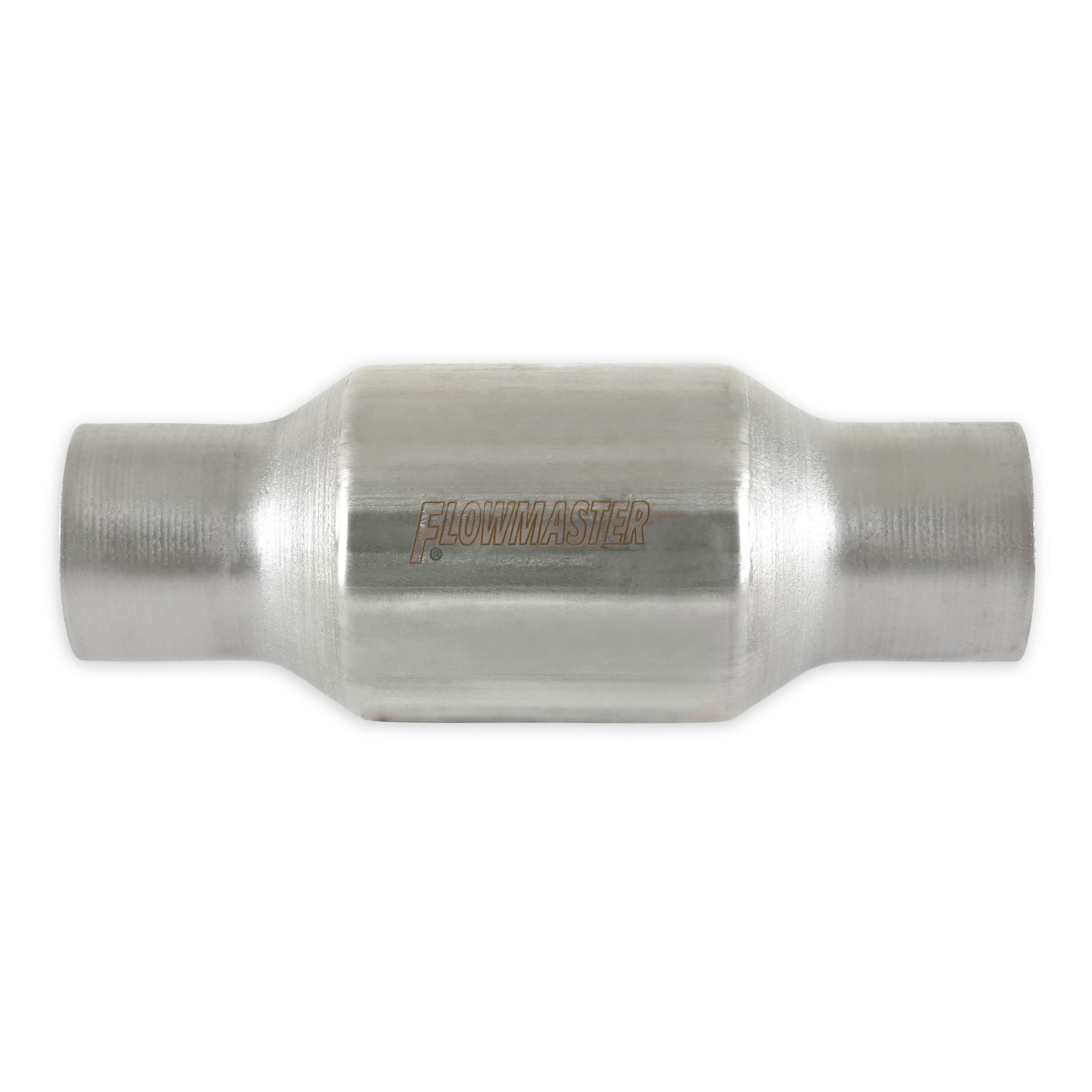
| Flowmaster 2230125 Catalytic Converter – Universal – FederalBuilder’s Weld-In | Builders who want a 2.50″ weld-in with a 5-year case warranty | Universal fit, welding required | Federal | 1 kg | Amazon |
| High Flow Front Catalytic Converter Kit Direct-Fit Honda AccordFront-Bank Hondas | Accord, TLX, and CR-V 2.4L owners who want front-position bolt-on | Front position, direct fit | Not legal in CA or NY | 9.31 pounds | Amazon |
| Walker Ultra EPA 93253 Universal Catalytic Converter | Subaru Forester and Impreza owners welding a 2.5″ unit | Universal fit, fabrication | EPA compliant, 1996+ OBDII | — | Amazon |
| Walker Ultra EPA 54782 Direct Fit Catalytic Converter | 2007-2018 Altima owners who want no welding | Rear position, direct fit | EPA compliant, 1996+ OBDII | 11 pounds | Amazon |
| MagnaFlow Universal Catalytic Converter 51356 | Tight undercarriage space — 2.5/2.5″ weld-in | Universal fit, welding required | EPA compliant | 5.4 pounds | Amazon |
| Catalytic Converter Kit Fit Honda Accord 2008-2017 | 3.5L / 3.7L Honda and Acura V6 engines needing the full kit | Direct fit 3-piece kit | Not legal in CA or NY | 18.21 pounds | Amazon |
| A-Premium Front Catalytic Converter, E.P.A Compliant | Captiva Sport, Equinox, and Terrain 2.4L front-position | Front position, direct fit | Yes — Federal Emissions | 17.61 pounds | Amazon |
| MagnaFlow Direct-Fit Catalytic Converter 93419 | DIY installs on Tahoe, Yukon, and Avalanche 5.3L trucks | Direct-fit clamshell | Federal/EPA compliant | 30 pounds | Amazon |
Detailed Reviews
1. A-Premium Rear Catalytic Converter, E.P.A Compliant
Our pick — 4.5+★ from 150+ verified ratings; the strongest balance of quality and price.
Built for the Altima owner whose rear-bank converter has already failed once.
If you own a 2007-2018 Nissan Altima with the 2.5L four-cylinder, this is the converter that solves the problem most of those cars eventually have. It bolts to the rear position with a 1240mm overall length and a converter body of 236mm by 120mm by 120mm, all in stainless steel. Two oxygen sensor ports are cut into the body, so your existing sensors thread straight back in. That is the whole job most weekends.
What wins people over is the value — the part lands well under what a dealer quotes for the same repair, and the fitment feedback backs it up. The installation is described as cut and dry for a manifold-style job, and the mounting hardware comes in the box so you are not hunting for bolts at 9 p.m. One buyer put it simply: “Direct Fit and works great, huge power increase and performance Improvement.” For a car this common, direct fit matters more than brand name.
The honest trade-off is shipping. Some units arrive dented from the box taking a hit in transit — one buyer rated four stars purely for that, and noted a stud stripped when torqued to spec, so buying spare studs up front is smart. A recurring gripe in the durability column is worth knowing too: a handful of buyers report the unit failing and taking engine damage with it, which is a real risk when a cheap converter’s internal substrate breaks apart. That is not most units, but it is the reason this part earns the top spot on value rather than on long-term durability.
Why it takes the top spot
- Direct fit for 2007-2018 Altima 2.5L — no fabrication, no welding rig needed
- Two oxygen sensor ports and stainless steel body match the original layout
- Mounting hardware included, which several owners called out as a plus
- Value is the most-praised aspect by a wide margin — owners repeatedly note it undercuts the dealer part
Where it can bite you
- Not legal to sell or install in California, Colorado, and in certain cases Maine and New York
- An occasional unit shows up dented from shipping — inspect the box before signing
- Durability is the one recurring complaint; a few owners mention early failure
- One buyer had to source different clamps because the supplied set did not line up
Reach for this if: you drive a federal-emissions Altima 2.5L and want the cheapest path to a working rear converter without touching a welder.
Look elsewhere if: you register in CA, NY, CO, or ME — this part is restricted there, so you need a state-compliant unit.
2. Flowmaster 2230125 Catalytic Converter – Universal – Federal
A sound-first universal canister with the longest warranty on the list.
Flowmaster sells this as a universal-fit converter for car applications, and the listing is refreshingly blunt about one thing: it requires welding and/or fabrication. This is not a bolt-on. You cut it into your existing exhaust and join it to the 2.50″ inlet, which is exactly what an exhaust shop does in an afternoon. The stainless steel construction and a case that measures 10.5 x 4 x 4 inches make it a compact option when space under the car is tight.
What people talk about most is the quality — owners rate it as much better than the stock setup, and the sound gets described as sounding like a V8 engine, which is the whole reason you buy a Flowmaster over a generic canister. The warranty is the standout paperwork here: 25,000-mile emissions coverage and a 5-year/50,000-mile exterior case warranty, both longer than the federal mandate requires. It is built in the USA and ships as a single item.
Two honest catches. The odor reduction column is mixed — some owners get no exhaust smell at all, others still catch fumes, so do not buy this expecting a smell-free exhaust if something else in the system is tired. Durability is the sharper concern: several customers note the unit breaking apart and lasting only about a year, which is the opposite of what a 50,000-mile case warranty implies. Buy it for sound and flow, keep an eye on it annually, and treat the weld quality as the deciding factor in how long it lasts.
Sound is the sales pitch: if you want a deeper tone and better flow than the factory canister, this delivers it — owners describe the note as V8-like rather than stock-quiet.
The paperwork is genuinely strong: 25,000-mile emissions coverage and a 5-year/50,000-mile exterior case warranty, both beyond the federally mandated floor.
The catch: it welds in, so budget for shop labor if you do not own a welder, and the odor-reduction results are genuinely split.
Best for: the builder or exhaust-shop customer who wants flow and tone on a 2.50″ system and is fine paying for the weld.
Think twice if: you want a driveway bolt-on, or you need a converter that promises long-term durability over sound.
3. High Flow Front Catalytic Converter Kit Honda Accord
The lightweight front-bank answer for four-cylinder Hondas and Acuras.
At 9.31 pounds, this is the lightest converter in this lineup — noticeably easier to hold overhead on your back while you line up the flange — and its box runs 20.39 x 8.35 x 8.31 inches, a fraction of the shipping volume of the A-Premium rear unit at 48.9 x 7.3 x 5.5 inches. That size difference matters if you are doing the swap solo in a driveway. Fitment covers 2013-2017 Honda Accord 2.4L, 2015-2020 Acura TLX 2.4L, and 2015-2019 CR-V 2.4L.
The internals use ceramic substrates loaded with Pt, Rh, and Pd — platinum, rhodium, and palladium, the precious metals that actually scrub the exhaust — shaped into a deformed profile to increase contact area. That is where the “high flow” claim comes from, and it is why the check engine light on a P0420 code commonly goes out after install. Reviewers point out it bolts up clean and the airflow sensors thread right in. The standout proof of that is a buyer who had a cat stolen off a 2007 CR-V: “this bottled right on, new flange worked great,” with the exhaust shop saying it sounded good for aftermarket and no lights afterward.
Two things you should weigh before ordering. First, the fabrication complaint is real — one owner found the third converter flange welded 30 degrees off on a 2008 Odyssey and had to have the exhaust cut to align it, so some units need massaging. Second, this does not fit models with California emission standards and is not legal for sale in CA or NY. The lifetime warranty is the safety net here: if the part fails, the seller replaces it.
What it gets right
- Lightest unit here at 9.31 pounds — easier to hang solo
- Lifetime warranty against failure or breakage
- Precious-metal loaded ceramic substrate targets the P0420 code directly
- Direct fit on Accord, TLX, and CR-V 2.4L with no welding on a clean truck
What to watch for
- Not legal for sale or install in CA or NY
- Flange alignment is not always perfect — one unit needed the exhaust cut to fit
- Warranty replacement means waiting on a shipment, not a same-day swap
If you drive a 2.4L Honda or Acura with a federal emissions label, this is the low-effort path — light, direct-fit, and backed for life.
Skip the hassle if: you are in CA or NY, or you want a part that guarantees perfect flange alignment from the start.
4. Walker Ultra EPA 93253 Universal Catalytic Converter

A 2.5-inch universal canister for older cars where the pipe is already tired.
Walker’s 93253 is a universal-fit unit for OBDII vehicles from 1996 and newer, sized 2.5″ in and 2.5″ out on the inside diameter. It ships with gaskets and uses a round stainless-steel body with an aluminized pipe and heat shields, and a customizable design with expandable bushings to bridge small gaps between your pipe and the converter. It fits a long list of Subaru applications, including 2009-2013 Forester, 2008-2010 Impreza, and 2009-2017 Legacy.
Performance is what owners praise most, and the value column is nearly as strong. A Trailblazer owner found it fit quite well, noting the exhaust measured 70mm against the 2.5″ unit, and after welding it in the truck ran strong again. A 2013 Tahoe owner had the local shop install both and reported the problem was fixed. Install type is listed as bolt-on, but plenty of owners end up welding — one notes it slips onto the old exhaust pipe, another says it needs to be welded in place.
Here is the honest catch, and it matters on older cars: welding is usually the real install, and one owner spent labor money on that and still found the total exceeded a bolt-on alternative. That same pattern shows up in a longer-term hit — the media cracked in under two years on one truck, and the 25,000-mile warranty requires mailing the part back at your own cost and waiting for a replacement. If your pipes and flanges are rusty, budget for a shop weld rather than a driveway clamp.
Performance proof: owners call it out most — a P0420 code cleared, a Trailblazer ran strong again, and a Tahoe problem was fixed after installation.
The fitting is tight but not guaranteed: the 2.5″ ID can be a hair small against a 70mm pipe, which is why welding beats clamping here.
Warranty reality: 25,000 miles, mail-in return at your cost — plan on the part outlasting the warranty, not the other way around.
Pick this if: your Subaru or older car needs a universal canister and you have a welder or a shop you trust.
Better to avoid if: your exhaust is rusted through — the labor to weld and cut rusted bolts often costs more than the part.
5. Walker Ultra EPA 54782 Direct Fit Catalytic Converter

The direct-fit twin of the top pick — same Altima fitment, different design philosophy.
Where the A-Premium unit is a rear-position converter, this Walker 54782 is a full direct-fit assembly with OE-style hangers, brackets, routings, and heat shields built in. That means no specialized fabrication and no welding: the flanges, hangers, and brackets are already there. It fits 2007-2013 and 2012-2018 Nissan Altima, and the box measures 35.48 x 12.5 x 8.05 inches. Weight is 11 pounds, roughly a pound and a half lighter than the A-Premium rear unit.
Fit is the clear strength — owners rate it the single best thing about this part, with dozens calling it out, and the quality and functionality rankings sit just behind. One 2017 Altima SR owner replaced a failing flexpipe-and-converter assembly with it and had the car back to normal in one job, noting the part was well under what a local auto parts store quoted for the same repair. Another 2015 Altima owner swapped out a rusted original exhaust and rated it five stars despite needing to buy gaskets separately.
Two things nobody tells you until after the order. It ships with no connection hardware or gaskets — you buy those locally, which is a few dollars but a second trip. And on the exhaust note, results are split: some shoppers say a quiet ride, while a few describe a horrible sound after install. Then there is the sharpest warning in this whole category, and it comes from an Altima owner who bought this exact part for a P0420 code: on some four-cylinder Altimas, the downstream oxygen sensor sits ahead of the rear converter, so the rear unit cannot be monitored at all. That owner’s actual fault was the manifold-mounted pre-cat. Check your sensor location before you buy.
Why the Altima crowd likes it
- Direct-fit bolt-on with OE-style hangers and brackets — no welder required
- Fit is the most-praised aspect, with owners describing an almost factory match
- OE-style flanges and heat shields built for strength
- EPA compliant for 1996+ OBDII vehicles when you check your state rules
Be ready for this
- No bolts or gaskets in the box — order them with the part
- Sound after install is split; a few owners hear a bad note, most do not
- Will not fix a P0420 on engines where the monitored sensor sits ahead of this converter
The right call for: federal-emissions Altima owners who want a bolt-on fix with a confirmed sensor location behind the converter.
Wrong call if: a shop already told you the fault is the pre-cat on the manifold — this part cannot clear that code.
6. MagnaFlow Universal Catalytic Converter 51356
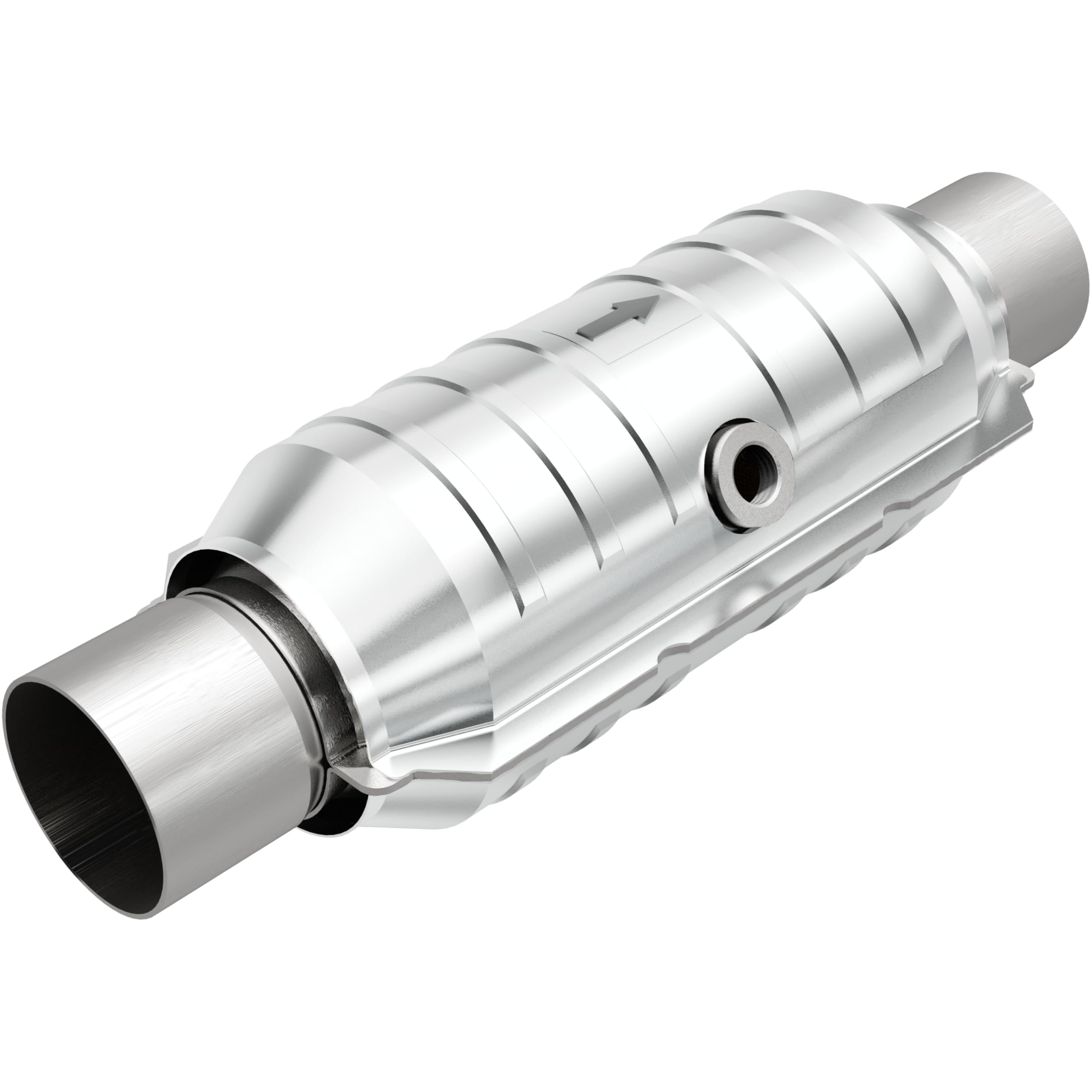
5.4 pounds of weld-in converter for engine bays that leave no room to spare.
At 5.4 pounds and a 16″L x 5″W x 4.75″H case, this is the compact end of the universal converter world — the one you reach for when a full direct-fit assembly simply will not fit in the space where the old converter sat. It runs 2.5/2.5″ inlet and outlet, and MagnaFlow builds the tubing from 16 gauge 409 stainless steel (a corrosion-resistant grade, which is what you want under a car that sees road salt) with 308 stainless steel MIG welds at the joints. Welding is required; there is no bolt-on option here.
Reliability is the standout for owners — it is the most-cited aspect in the whole review set, ahead of value and installation combined. The experience people describe is consistent: the check engine light stays off after a reset, and the part passes emissions. One buyer on a 2017 F150 5L replaced both cats and reported the light went out; another at three months in had no issues and a passed emissions inspection. The 2006 Expedition owner noted these fit nearly identical to the originals and the O2 sensors plugged right in.
Two things to keep straight. First, fit is genuinely mixed — some say it matches their car perfectly, others report a mismatch, which is the nature of a universal part. Second, a 1-star report describes a failure at 1,000 miles with loose honeycomb rattling, and MagnaFlow reportedly denied the warranty because it is a universal converter. A separate owner saw the engine light return at 7 months. That is not the majority experience, but universal cats are usually sold without the direct-fit warranty protection, so know that going in.
Why owners keep coming back: reliability is what gets praised most — the check engine light stays off and the emissions test passes.
The build: 16 gauge 409 stainless tubing and 308 stainless MIG welds are the reasons it survives road salt better than a cheap canister.
Fair warning: as a universal part it carries no direct-fit warranty coverage, so a failure is usually on you.
Best suited to: anyone whose original converter location is too tight for a full assembly and who has welding access.
Not the pick if: you want warranty protection or a part that drops in without cutting the exhaust pipe.
7. Catalytic Converter Kit Honda Accord 16658

A three-piece kit that covers the whole V6 exhaust path in one order.
If you drive a 3.5L or 3.7L Honda or Acura V6, replacing one converter usually means replacing all three — and that is exactly what this kit is built for. It covers 2008-2017 Accord 3.5L, 2008-2019 Odyssey 3.5L, 2009-2022 Pilot 3.5L, 2009-2021 Ridgeline 3.5L, plus the Acura side: MDX, RDX, RL, RLX, TL, TLX, TSX, and ZDX. At 18.21 pounds in a 16.42 x 14.48 x 6.26 inch box, it is a substantial single shipment rather than three separate orders.
The build mirrors the same construction as the Accord 2.4L unit: stainless steel body, and ceramic substrates loaded with Pt, Rh, and Pd to boost purification. The lifetime warranty applies here too: if the part fails or breaks, contact the seller for a replacement. For high-mileage V6 Hondas and Acuras, that coverage on a failure-prone exhaust part is worth real money.
Two catches worth planning around. The fabrication complaint that shows up on these Honda kits is a flange welded 30 degrees off, requiring the exhaust to be cut to align — on a 2008 Odyssey that meant roughly four hours of work plus welding time to handle the rear cat job. And like its 2.4L sibling, it does not fit models with California emission standards and is not legal for sale in CA or NY. If you are outside those states and ready for a shop visit, the kit saves you money on the parts side.
The kit math works: three converters in one shipment covers the full V6 exhaust path instead of sourcing each piece separately.
Lifetime warranty: a straight replacement offer if the part fails or breaks — meaningful on a high-mileage V6 exhaust system.
The fine print: not legal in CA or NY, and flange alignment can be off enough to require cutting and re-welding.
For the V6 owner: this is the economical way to refresh Accord, Odyssey, Pilot, Ridgeline, or Acura converters in one shot.
Reconsider if: you are in CA or NY, or you want a kit that bolts on without any cutting or welding.
8. A-Premium Front Catalytic Converter, E.P.A Compliant

The front-position fix for the GM 2.4L that eats converters early.
Chevrolet Captiva Sport 2012-2015, Equinox 2010-2014, and GMC Terrain 2010-2014 with the 2.4L four-cylinder all share this front-position converter — except the Partial Zero Emissions Vehicle variants, which this does not cover. Read that exclusion twice if you are unsure which emissions package your Equinox has. The unit is stainless steel, 640mm overall with a 145mm converter body, and it carries a single oxygen sensor port rather than the two on the rear unit.
Fit is the reason people pick this one. It is the top-rated aspect in the owner feedback, with most reviews calling out how well it seats and seals — including a gasket-sealed installation on a 2010 Equinox 2.4L. One retired mechanic went in skeptical, expecting a cut-rate part, and came away saying it looked like OEM rather than a cheap replacement after the codes cleared and the emissions monitors reset on a long drive. Another owner on a 2012 model confirmed the front unit’s design: a larger double-barrel catalyst chamber with the heat shield mounted to the rear.
The catch is quality consistency. The quality column is split, with owners saying some units do not meet OEM standards, and one buyer had the check engine light come straight back on after replacing the original. That is a small slice of the feedback, but it is the reason the value ranking edges height on this part rather than a durability promise. The one-year unlimited-mileage guarantee covers you if you land a bad unit — save the receipt and start there. This is also restricted in CA, NY, CO, and ME, so check your state.
Why it earns its spot
- Front-position direct fit for Captiva Sport, Equinox, and Terrain 2.4L
- Fit is the most-praised aspect — buyers report a gasket-sealed install
- One-year unlimited-mileage guarantee backs the part
- Retired-mechanic feedback compares the construction to OEM, not a budget knock-off
The real caveats
- Does not fit Partial Zero Emissions Vehicle variants of the Equinox or Terrain
- Restricted in CA, NY, CO, and ME
- Quality is split — one owner had the light return immediately
- Single O2 port means it is not a match for two-sensor applications
The smart buy for: a federal-emissions Equinox, Terrain, or Captiva Sport 2.4L owner who wants a front converter that seats and seals clean.
Not your part if: your vehicle is a Partial Zero Emissions Vehicle variant or you register in CA, NY, CO, or ME.
9. MagnaFlow Direct-Fit Catalytic Converter 93419

A 30-pound clamshell built for Tahoe and Yukon owners who do their own work.
This is the heavy end of the direct-fit world: 30 pounds of stainless steel in a 45.75 x 19 x 11.5 inch package, designed with 3D scanning so it drops into the factory location and can be installed without a lift. MagnaFlow builds it to HM Grade standards, meaning extra catalyst material to improve emissions conversion, and the clamshell design uses mandrel-bent piping (smooth bends that do not pinch the flow) with OEM-like O2 port locations and integrated butt joints. All required hardware comes in the box.
Fit and installation are the two aspects owners talk about most, and both are positive. The 2002 GMC Yukon SLT 5.3L Flex Fuel owner had it in after roughly 2.5 hours and called the fit excellent, the note quiet, and the quality OEM-grade. On an 04 Chevy Avalanche the kit arrived with the driver and passenger gaskets, fit perfectly, and needed the passenger rear O2 sensor pulled to position the cat before reinstalling. One consistent detail: nearly every installer ends up dropping the passenger-side transmission crossmember, which is five bolts — plan for it and the job goes smoother.
The honest trade-offs are worth knowing. Noise is genuinely mixed — several owners mention loud rattling, which usually points to an install issue or a loose heat shield rather than the catalyst itself. Build quality is also mixed, with a reported issue at the O2 sensor bung. And one buyer received a unit with scratches, dents, and carbon buildup despite ordering new, so open the box and inspect before you start. At the top of the price range, the 5-year/50,000-mile limited warranty on both construction and emissions is what justifies the spend.
Where it leads: fit is the most-praised aspect by a wide margin, with dozens of owners confirming it drops into the factory location on Tahoe, Yukon, and Avalanche trucks.
The warranty story: 5 years or 50,000 miles covering both construction and emissions — the longest comprehensive coverage in this lineup.
Install note: dropping the passenger-side transmission crossmember (five bolts) is the standard first step on these trucks. A transmission support bushing is often worth replacing while you are in there.
Worth the premium if: you own a 5.3L GM truck, want a direct-fit clamp-in install, and value the longest construction-plus-emissions warranty here.
Maybe not if: you want a full assembly with zero extra work — the crossmember drop and O2 sensor repositioning are part of the job.
Know the Specs
Fit Type: Direct-Fit vs Universal
This is the spec that decides how long the job takes. A direct-fit converter is shaped and located to match your original — it uses OE-style hangers and brackets (the metal hooks and plates that hold the exhaust in place) and typically bolts on without cutting. A universal converter is a plain canister you cut into the pipe and weld or clamp. Direct-fit costs more and fits one vehicle family. Universal costs less and fits many vehicles, but requires fabrication, and the quality of that weld decides whether it lasts.
Emissions Compliance and Restricted States
An EPA-compliant or Federal-emissions converter (built to meet federal rules rather than California’s stricter standard) is not legal to sell or install in California, Colorado, and in certain cases Maine and New York. Check the restricted-states line in every listing and confirm against your state’s aftermarket converter regulations before you order. Your vehicle’s Emissions Control Information Label tells you which standard your car was built to — that label is the final authority, not the listing.
Inlet and Outlet Diameter
On a universal converter, the inlet and outlet sizes (measured as ID for inside diameter or OD for outside diameter) must match your exhaust pipe closely. Common sizes are 2.25″ and 2.5″. A converter that is only slightly oversized can still leak when clamped, because a clamp compresses the pipe rather than filling a gap. If the fit is loose, welding is the reliable fix and a clamp is not.
Oxygen Sensor Ports and P0420 Codes
Oxygen sensor ports (the threaded bungs where the O2 sensors screw into the exhaust stream) matter because your car’s computer uses the downstream sensor to measure converter efficiency. A P0420 code means that sensor reports the converter is not scrubbing emissions well enough. Front converters usually carry fewer ports than rear ones. If the monitored sensor sits ahead of the converter you are replacing, the code will not clear — confirm which converter your sensor monitors before buying.
Common Questions
Will an aftermarket catalytic converter clear my P0420 code?
Is an EPA-compliant converter legal where I live?
Do I need a direct-fit or a universal catalytic converter?
How long should an aftermarket catalytic converter last?
What is the difference between an EPA and a California compliant converter?
Will an aftermarket converter pass an emissions test?
Do I need new gaskets and bolts with a replacement converter?
Can I install an aftermarket catalytic converter myself?
Will a new catalytic converter change my exhaust sound?
Why does my check engine light come back after replacing the converter?
The Bottom Line
For most buyers looking at an aftermarket catalytic converter, the smart pick is the A-Premium Rear Catalytic Converter, E.P.A Compliant — a direct-fit rear unit for the 2007-2018 Nissan Altima 2.5L with two oxygen sensor ports, mounting hardware in the box, and a price that undercuts the dealer part by a wide margin. If your Altima’s problem is the front or pre-cat position instead, the Walker Ultra EPA 54782 is the direct-fit assembly that bolts on with no welding at all. And if you drive a 3.5L or 3.7L Honda or Acura V6, the three-piece FOMIUZY kit refreshes the entire exhaust path in one order and carries a lifetime warranty.
The one thing to do before you buy anything: check your state’s restricted list and confirm which converter your oxygen sensor actually monitors. That two-minute check separates a repair that clears the code from a part that sits in its box while the light stays on.
How we choose
We do not accept paid placement. Every pick is matched to a real buyer and a real use-case; we do not hands-on test units.
Sources
Specifications: manufacturer listings and product documentation. Review insights: verified customer reviews, as of October 2026. Pricing: not shown on this page (it changes often); check the current price via the retailer link.
As an Amazon Associate, Aappliancez earns from qualifying purchases. This does not affect which products we feature.