Disclosure: Some links in this post are affiliate links. As an Amazon Associate I earn from qualifying purchases, at no extra cost to you. Learn more
Specs are compiled from manufacturer listings and verified buyer reviews and can change over time — please confirm the key details on the product page before buying.
The mask that suits you is the one whose LEDs actually sit near your skin — not the one with the longest feature list. That single point of contact decides whether your sessions do anything useful, and it is where affordable red light therapy masks quietly split apart. This guide sorts seven of them by real coverage, real runtime, and the honest trade-offs buyers run into after week three.
This guide is built by comparing the manufacturers’ published specifications and the patterns across verified customer reviews, so you get each pick’s real strengths and trade-offs instead of marketing spin.
Some masks pack 400 beads into a flexible shell, some use 240 and lean on deeper infrared, and a few throw in a neck panel you will either love or never attach. Here is how to weigh the real differences between Affordable Red Light Therapy Masks without chasing a spec sheet you cannot use at home.
Top Picks
How To Choose The Best Affordable Red Light Therapy Masks
The first thing to accept is that a light therapy mask is a session tool, not a one-time fix. You are buying something you will wear for 10 to 30 minutes several times a week, so fit and comfort matter as much as the bulb count. A stiff mask that presses into your eye sockets will sit in a drawer by week two, no matter how good its numbers look.
Start with bead count and where those beads land
More LED beads (the small light-emitting diodes inside the mask) generally mean more even coverage across your forehead and cheeks. A 400-bead mask spreads light across a whole face; a 120-bead mask covers the same area with wider gaps. Neither is wrong — you just want to know which one you are buying, because even coverage is what stops one cheek getting a stronger dose than the other.
Read the wavelengths, not the color names
Red light at 660nm and near-infrared at 850nm are the two numbers that repeat across serious masks. Red light works at the surface, which is why it gets tied to tone and the look of fine lines. Near-infrared goes deeper into the skin, which is why masks pair it with firmness claims. Blue light around 460nm is the one aimed at oily, blemish-prone skin. If a listing only says “7 colors” and never names a wavelength, treat that as a marketing label rather than a spec.
Check the timer before you check the price tag
Three timer presets (often 10, 20, and 30 minutes) let you match a session to your evening instead of watching a clock. A remote with a built-in timer means you can lie back and let it shut off on its own. This matters more than people expect, because the sessions you actually finish are the ones that build a habit.
Decide early if you want cords or freedom
A cordless mask charges and then runs free, so you can walk around or fold laundry mid-session. A corded one usually needs a power bank nearby. Some masks, like the EVFOFO, run off a battery pack that needs recharging every couple of uses. Neither design is a flaw — but know which one fits your routine before you commit.
Side-by-Side Comparison
| Model | Best For | LED Beads | Wavelengths / Modes | Weight | Amazon |
|---|---|---|---|---|---|
| BNU Wireless Red Light Therapy Mask★ Best Overall | Everyday full-face sessions | 400 | 660nm, 850nm, 460nm, 600nm | 1.98 lb | Amazon |
| biuufish 8 Color LED Face MaskMost Settings | Variety of light settings | 240 | 8 colors incl. 850nm infrared | 2.01 lb | Amazon |
| Beuwe Red-Light-Therapy-Mask | Face, neck, hands and body | 100 light points | 7 colors | 3.81 lb | Amazon |
| FOLOKE LED Light Therapy Mask | Neck and shoulder coverage | 120 | Red and near-infrared | — | Amazon |
| EVFOFO Red Light Mask, Face & Neck | Face plus neck in one mask | — | Multiple color wavelengths | 1.48 lb | Amazon |
| NVBOTY Red Light Therapy for Face | Long-term daily routine | 400 | 850nm, 630nm, 605nm, 460nm | 2.2 lb | Amazon |
| RENPHO Rejuven Red Light Therapy Mask | Contoured full-face coverage | 324 | 3 modes: red + infrared, blue, mixed | 6.53 oz | Amazon |
Detailed Reviews
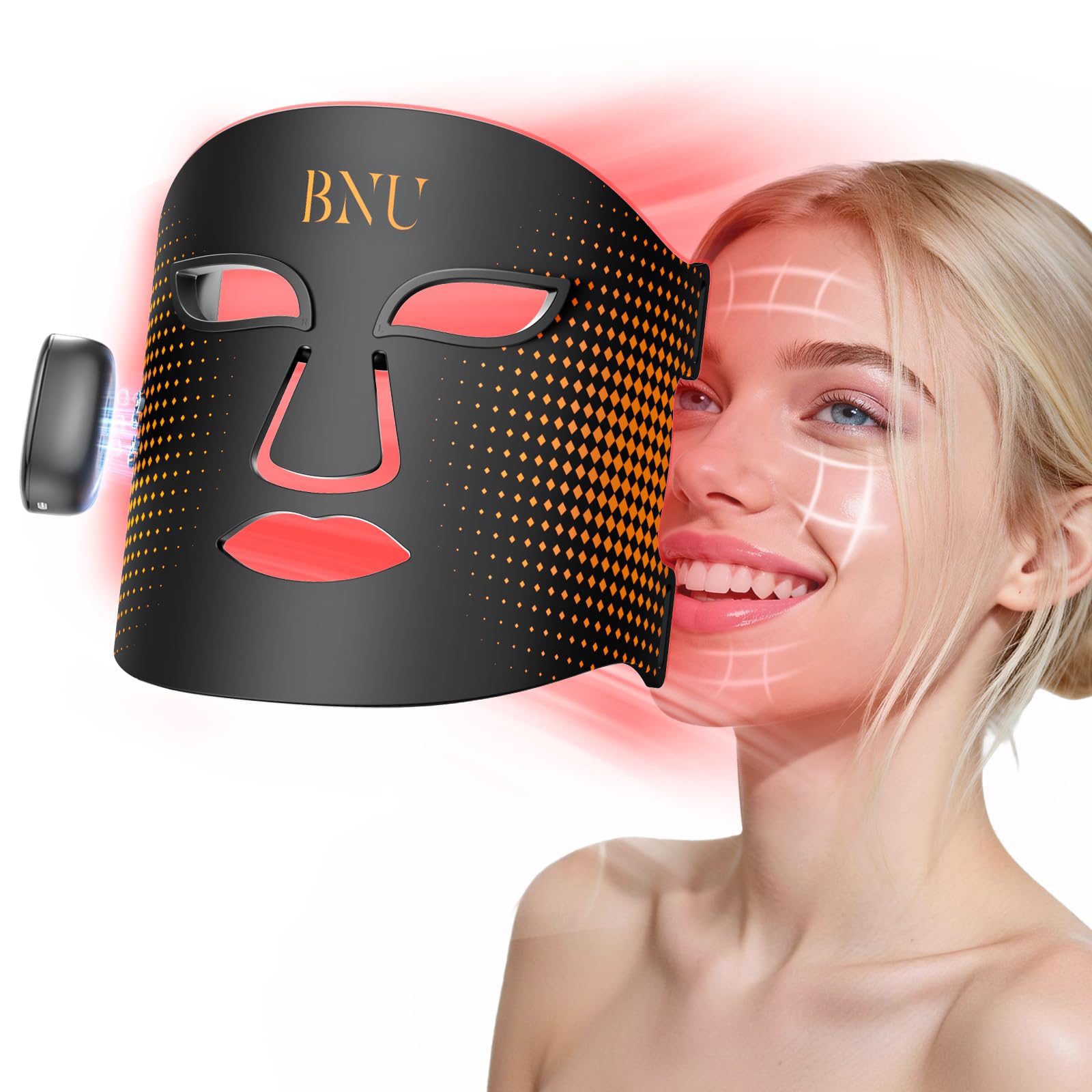
1. BNU Wireless Red Light Therapy Mask for Face with 4 Modes
Four hundred beads, no cord, and a battery that outlasts most evening routines.
For anyone who wants full-face coverage without a wire trailing behind them, the BNU sets the pace here: 400 LED beads spread across the forehead and cheeks at a weight of 1.98 pounds. That bead count is the headline, and it is where this mask separates from the biuufish below — 400 beads against 240. You get the denser spread, so the light reaches more of your face in a single 20-minute sit.
The four modes cover the wavelengths that matter: red at 660nm for surface tone, near-infrared at 850nm to go deeper, blue at 460nm for blemish-prone patches, and yellow at 600nm aimed at dull-looking skin. Choose a session length from 10, 20, or 30 minutes and the timer handles the rest. The soft silicone shell bends to your face instead of sitting on it like a helmet, which is why comfort is the thing that keeps coming up in the feedback. Buyers report it is the eye hole pads that make it easy to wear for a full session.
Runtime is listed at up to 2 hours of continuous use, so you are not hunting for the charger every other night. The catch worth knowing: the maker is specific that this wants a standard 5V low-power charger and that fully draining the battery can cause charging trouble later. Keep it topped up, keep the port dry, and charge it fully before the first session.
Where it pulls ahead
- 400 LED beads against the biuufish’s 240 — a visibly denser spread across the face
- Four distinct wavelengths, each with a named target: 660nm, 850nm, 460nm, 600nm
- 10, 20, or 30-minute timer and up to 2 hours of cordless runtime
- Soft silicone that conforms instead of pressing
What to keep in mind
- Wants a standard 5V charger — fast chargers can trip its protection
- At 1.98 pounds it is close to the biuufish’s 2.01 pounds, so neither is featherweight
- Consistency is on you; the listed effectiveness depends on steady sessions
Made for: the buyer who wants the most LEDs per session and the freedom of a cordless mask.
The trade-in: a plain 5V charger and a full charge before your first use, or the lights can behave oddly.
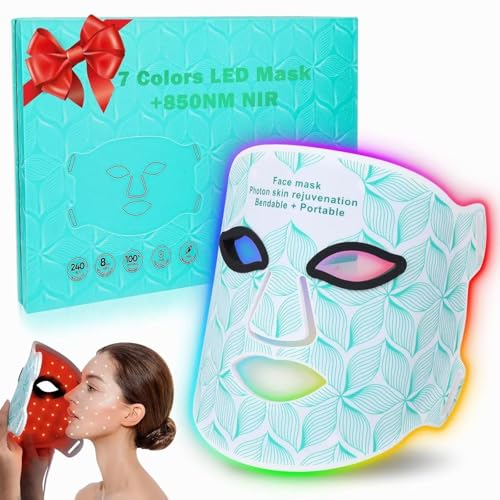
2. biuufish Red Light Therapy for Face, 8 Color LED Face Mask
Eight light colors and a 58mW/cm² energy figure for the buyer who likes dials to turn.
If you want to experiment with different wavelengths rather than settle on one routine, this is the mask that gives you room. It runs 7 visible light wavelengths plus 850nm infrared, so you can move between blue for oily patches, red for tone, and infrared for the deeper pass. The maker credits the built-in 4-in-1 chip tech with quadrupling energy efficiency, and the stated energy density is 58mW/cm².
What balances that is three adjustable intensity levels, so you can run a softer session when your skin feels sensitive. The silicone is soft and flexible, and the 13.27 x 8.98 x 1.89-inch shell means it wraps a whole face at 2.01 pounds.
The honest limit is the battery. It is a rechargeable design and it must sit wired to the battery pack or controller while you wear it, so you are not truly untethered. Charging takes a few hours and then lasts. Your session is guided by a smart timer with 10 to 30-minute windows, and the listed routine is 4 to 5 times a week at 20 to 30 minutes. Owners mention calmer skin and less visible pores after 5–6 uses in under two weeks, plus improvement in age spots, wrinkles, and acne scarring.
What wins people over: the range of settings. You are not locked into one wavelength, and switching intensities lets you back off when skin feels reactive.
The one thing to plan around: the dangling pack. It works, but if hands-free is your goal, the BNU’s true cordless shell suits you better.
Reach for this if: you want the widest spread of wavelengths and intensity steps in one flexible mask.
Look elsewhere if: you refuse to wear a corded controller pack during sessions.
3. Beuwe Red-Light-Therapy-Mask, 7 Colors

A three-dimensional panel you hold over your face, your neck, and anywhere else.
This is not a strapped-to-your-head mask, and that is the whole point. The Beuwe uses 100 light points in a three-dimensional arrangement that you hold or place over whatever area you want to treat — face, neck, hands, or body. Seven light colors cover the wavelength spread, and the routine printed for it is 20 to 40 minutes, 2 to 3 times per week.
It weighs 3.81 pounds, which is what makes it a sit-down device rather than a walk-around one. The upside is that it is highly durable and reusable, and it stores away without a strap to lose. For someone who wants one tool to work on the face and the back of the hands without buying two masks, that flexibility is the appeal. Effectiveness is the thing buyers talk about most, and the feedback pairs it with ease of use — the short treatment window keeps it habit-friendly.
This one earns its spot on long-term feedback. One long-term user credits a firm, radiant glow to twelve months at three sessions a week, 35 minutes each. The recurring note in the feedback is not a defect but a method: several buyers point out that firm-looking skin after a month could just as easily come from their cream, so judge this one over months, not weeks. One honest caveat sits in the item’s own text — the maker’s description is thin on how the seven colors map to specific skin concerns, so read the manual rather than the listing.
The strongest case
- 100 three-dimensional light points reach beyond the face to neck, hands and body
- Seven colors for a range of concerns in one device
- No straps, no slipping fit — you hold it where you want it
- 20 to 40 minutes, 2 to 3 times per week is an easy pace to keep
The honest limitations
- 3.81 pounds means you are holding it, not wearing it
- 100 light points is far fewer than the 400-bead masks above
- Results only appear over months of consistent use
Suits: anyone who wants to treat face and body with one device and does not mind holding a panel.
Worth noting: a 3.81-pound panel held over your face for 20 minutes is a commitment, not a passive wear.
4. FOLOKE Red Light Therapy for Face LED Light Therapy Mask

A neck attachment that pairs with the mask for people who want the jawline treated too.
The FOLOKE bundle is built around a neck device that clips onto the face mask, letting you treat the jaw and shoulders in the same session. Its 120 LEDs run red and near-infrared light, aimed at the look of wrinkles and mild to moderate inflammatory acne. Charging runs through a modern Type-C port, with a full top-up taking 3 to 4 hours.
Use is meant to be simple: pick a mode, relax for 15 to 20 minutes, 3 to 4 times a week. Skin-safe plastic holds the LEDs and the flicker-free design is aimed at keeping the light steady rather than pulsing. The built-in rechargeable battery means no cable across your chest during the session — though the listing also notes an AAA battery, so check what arrives in the box.
Here is the trade-off you should weigh before buying. The fit is the recurring problem in the feedback, with the chin and jaw lights sitting roughly an inch off the skin and the mask not settling well on the face. Light that far from skin gives you a weaker dose in exactly the zone the neck panel is meant to help. The rest of the picture is rosier: effectiveness is the most-praised part of this mask, and buyers describe soft skin and less visible wrinkles after using it every other day. One buyer notes it does not cause irritation.
The reason to pick it: face plus neck coverage and a Type-C port you already have a cable for — 120 LEDs, 15 to 20 minutes, 3 to 4 sessions a week.
The catch: if you have a narrow or round face, the chin lights may hover instead of hug, so be ready to adjust or return it.
Good match for: buyers who want neck-and-jaw treatment bundled with the face mask and can live with a fit that needs adjusting.
Think twice if: you have a small or narrow face where the jaw lights tend to sit off the skin.
5. EVFOFO Red Light Mask, Face & Neck

The lightest of the face-and-neck masks, and the one most tied to its charger.
At 1.48 pounds this is the lightest option here, and that lightness is what makes the face-plus-neck coverage workable in a single wear. Multiple color wavelengths are built in — not just red — and a built-in timer tells you when the session is done instead of leaving you guessing. The Velcro straps are adjustable, though they take a little figuring out; customers note you need a ponytail in place for the straps to connect properly.
Where the EVFOFO gives you the most pause is the battery. Several owners note it needs charging for at least 2 hours after every 2 uses, and a daily user reports it running only about 3 sessions per charge. That is a real rhythm to build around, not a once-a-month nuisance. The remote also has no clip, so holding it can cost you the hands-free wear the mask is meant to give.
Neck coverage is where it shines. Buyers who want the jaw and neck treated alongside the face keep coming back to that, and effectiveness is the most-cited positive in the feedback — quick visible results, improved tone and smoothness, less visible dark spots and pores. Take the pacing advice: 2 to 3 weeks in without changes is normal, so keep going rather than expecting a switch to flip.
Why it earns a spot: neck coverage at the lightest weight of the face-and-neck masks, with a timer that ends the session for you.
Set your expectations: a charging cycle after every couple of sessions, and a remote with no clip to keep it on you.
Best served: buyers who specifically want the neck treated and accept a frequent charging routine.
Less suited to: anyone who wants to run a week of sessions without reaching for the cable every other night.
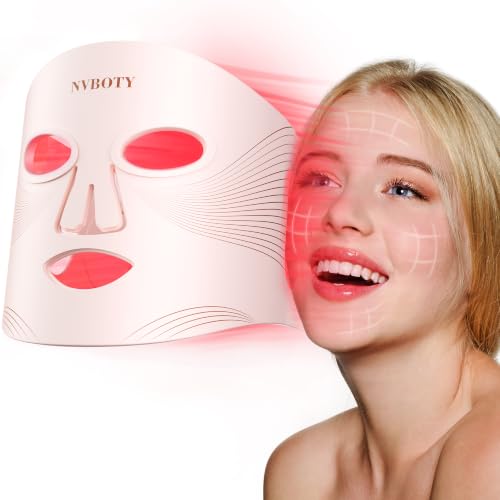
6. NVBOTY Red Light Therapy for Face, 4 Modes, 2000mAh Remote
Four hundred LEDs, a rechargeable 2000mAh remote, and four wavelengths to work through.
The NVBOTY answers the same bead question as the BNU — 400 LEDs — but adds four named wavelengths and an all-in-one shell. The modes are Infrared 850nm and Red 630nm together, Orange 605nm, Blue 460nm, and a 4-color cycle, and each mode carries three intensity levels. Ignore the maker’s claim of more than twice the LEDs and power of leading brands; the usable specs are the 400 count and the wavelength list.
Control is the standout detail. The remote holds a 2000mAh battery and runs the timer: 10 minutes by default, then 15, 20, 25, or 30 with short presses, and the device shuts off on its own when the timer ends. The shell is soft, skin-friendly silicone with the straps built in, so there is no separate strap to lose. The maker’s listed routine is 3 to 4 sessions a week at 20 minutes, and warns that visible results need more than 4 weeks of steady use.
Build quality is what buyers praise most, with reliability running a close second in the feedback. The one recurring honesty note is durability of the charging port: the Type-C connection (a common oval USB plug) can get finicky over months of daily use, and one buyer had it stop charging entirely before a low-maintenance replacement came through. Customer service handles that well — the long-term care is usually painless even when a unit has a hiccup. The eye mask design blocks light from your eyes so you can multitask, and buyers describe it fitting into a daily routine without irritation.
If you want the highest bead count paired with a proper remote and a timer that walks you through 10 to 30 minutes, this is that mask. The 2.2-pound shell is heavier than the BNU’s 1.98 — a difference you feel after 20 minutes lying still.
Why it stands out
- 400 LEDs across four wavelengths, each with three intensity levels
- Rechargeable 2000mAh remote with 10 to 30-minute timer presets
- All-in-one silicone shell with no strap to misplace
- Eye mask blocks light so you can read or scroll mid-session
What to watch
- 2.2 pounds is the heaviest shell of the 400-bead pair
- The USB-C port is the weak point over months of daily use
- Visible results need more than 4 weeks — the maker says so directly
Worth it when: you are building a long-term routine and want the remote-controlled timer and full wavelength set to match.
skip it if: a heavier 2.2-pound shell would keep you from wearing it the 3 to 4 times a week it needs.
7. RENPHO Rejuven Red Light Therapy Mask, 324 LEDs

A contoured 324-LED shell that closes the gap the flat masks leave near the jaw.
RENPHO’s pitch is the fit, not the settings. The 324 LEDs sit in a shell shaped to follow the curves of a face rather than a flat panel, so light reaches the jaw and cheekbone without the hover you get from a looser mask. Three modes cover the essentials: red plus infrared for full-face wrinkles, blue for mild to moderate inflammatory acne, and a mixed mode.
At 6.53 ounces this is by far the lightest mask on the list — a fraction of the NVBOTY’s 2.2 pounds — and that lightness is what lets it sit through a reading session without pulling on your face. Protective eye cups are included, and the silicone is described as ultra-light and skin-friendly. It is the kind of shell you forget you have on, which is usually what keeps a routine alive into week four.
There are two honest caveats. The maker itself says the mask is not recommended for darker or tanned skin tones, which can absorb more light energy — so it is not the pick for everyone. And the fit that works so well on many faces is built for an average shape; a small round face can find the eye holes misaligned, pressing into the sockets. Buyers describe soft, smoother skin after steady use with no irritation, and often rate its price-to-quality against higher-end options.
The pitch in one line: 324 LEDs in a contoured 6.53-ounce shell, with three modes and included eye cups.
The two catches: the maker advises against darker or tanned skin tones, and a small round face may find the eye holes off.
Fits best: buyers with an average face shape who want the lightest contoured shell and a straightforward three-mode routine.
Not the one for: darker or tanned skin tones the maker explicitly advises against, or a small round face.
Know the Specs
LED bead count
The number of tiny light-emitting diodes packed into the shell — 400 on the BNU and NVBOTY, 240 on the biuufish, 324 on the RENPHO, 120 on the FOLOKE. More beads generally mean a denser, more even spread across the face, which is why a 400-bead mask reaches the temples and jaw with less gap than a 120-bead one. It does not automatically mean stronger light; intensity levels and energy density decide that.
Wavelengths in nanometers (nm)
A nanometer is a billionth of a meter, and the number tells you how deep the light reaches. Red at 660nm works near the surface, which is why it is tied to tone and fine lines. Near-infrared at 850nm penetrates deeper, which is why masks pair it with firmness claims. Blue at 460nm is aimed at oily, blemish-prone skin. A mask that names its wavelengths is showing you a real spec; one that only says “7 colors” is giving you a label.
mAh and runtime
mAh (milliamp-hours) measures how much charge a battery holds. The NVBOTY remote carries 2000mAh, and the BNU lists up to 2 hours of continuous runtime. In practice this tells you how many sessions you get before reaching for the cable — a mask that needs a charge every 2 uses, like the EVFOFO, asks more of your evening than one that runs for hours.
Timers and session length
A timer is the part that makes a routine stick. Presets of 10, 20, or 30 minutes let you pick a session to match the time you actually have. The biuufish uses a smart automatic timer from 10 to 30 minutes; the NVBOTY remote starts at 10 and steps to 15, 20, 25, or 30. A mask that shuts off on its own means you can lie back instead of checking the clock.
Common Questions
How long before I actually see anything from a red light mask?
What is the difference between red light and near-infrared light in these masks?
Can I use a fast charger with a cordless LED face mask?
Should I worry that the mask leaves a gap near my chin and jaw?
Is a red light therapy mask safe to use on darker or tanned skin?
How many sessions a week do these masks actually recommend?
Can I wear a mask while reading or working?
Does a cordless mask still work while it charges?
Why does the LED count differ so much between masks?
How long does the battery last on a rechargeable LED mask?
The Bottom Line
For a face mask you will actually keep wearing, the affordable red light therapy masks pick with the strongest all-round case is the BNU Wireless Red Light Therapy Mask. It gives you 400 LED beads across four wavelengths, a 10/20/30-minute timer, and up to 2 hours of cordless runtime in a 1.98-pound silicone shell. If you want the widest spread of light settings and do not mind a corded battery pack, the biuufish 8 Color Mask packs 8 colors and 58mW/cm² into the same budget tier.
For a routine you will run for months, the NVBOTY with its 2000mAh remote and 400 LEDs is the pick to build around; the weight of 2.2 pounds is the one thing to picture on your face first. If neck and jaw coverage matter more than bead count, the EVFOFO gives you face-and-neck treatment at the lightest 1.48 pounds, and the Beuwe is the flexible tool for anyone who wants face, hands, and body in one device.
One honest nudge before you click: the biggest variable is not the listing — it is whether you can keep a 3-to-4-session week. The masks that hold up here share a pattern of comfort and fit that lets them stay in the routine, and comfort is what the feedback keeps coming back to.
How we choose
We do not accept paid placement. Every pick is matched to a real buyer and a real use-case; we do not hands-on test units.
Sources
Specifications: manufacturer listings and product documentation. Review insights: verified customer reviews, as of October 2026. Pricing: not shown on this page (it changes often); check the current price via the retailer link.
As an Amazon Associate, Aappliancez earns from qualifying purchases. This does not affect which products we feature.