Disclosure: Some links in this post are affiliate links. As an Amazon Associate I earn from qualifying purchases, at no extra cost to you. Learn more
Specs are compiled from manufacturer listings and verified buyer reviews and can change over time — please confirm the key details on the product page before buying.
If you ride a trike — or an exercise bike, cruiser, or e-bike — and you finish every ride with a sore tailbone, the seat is almost always the reason. Swapping the stock saddle for a wider, better-padded one takes minutes. This guide narrows the field to the strongest choices available right now, so you can match the right seat to your body, your bike, and how long you actually ride.
This guide is built by comparing the manufacturers’ published specifications and the patterns across verified customer reviews, so you get each pick’s real strengths and trade-offs instead of marketing spin.
The picks below cover every body size and bike type, from a classic tractor-style saddle to a width-adjustable seat you can tune to your own sit bones. Whether you commute, cruise, or pedal indoors, start by matching seat width and padding to your body.
Top Picks


How To Choose an Adult Tricycle Seat
A tricycle seat takes more load than a bicycle saddle because you sit far longer without standing on the pedals to unweight your tailbone. Two specs decide the fit: seat surface width and whether the seatpost hardware matches your trike’s frame.
Width is the first decision
Adult trike seats run from roughly 8.66 inches up to 13.5 inches across, and the wider the surface, the more of your weight spreads onto your sit bones instead of pressing into soft tissue. A seat around 12 inches wide suits most adult riders, while a 13.5-inch model gives plus-size riders real support. Measure the seat you have now and go wider if your current saddle leaves you sore after a few miles.
Seatpost fit and the support bar
Trike saddles attach either by a clamp ring or a dual-rail seatpost, and some models — like a classic tractor saddle — rely on a rear support bar to hold the back of the seat steady. Check your trike’s seatpost diameter before you order, because a seat that will not clamp on is useless no matter how soft it is.
Foam, springs, and pressure grooves
Memory foam compresses and slowly returns, which cushions bumps better than cheap open-cell foam. Springs or steel hardware under the seat soak up road shock. A center groove or noseless cutout takes pressure off the perineum area — the soft tissue between your legs — which is what lets many riders stay in the saddle for two hours instead of twenty minutes.
Backrest or no backrest
A backrest supports your lower back on a trike, where you often sit more upright than on a two-wheeler. The trade-off is that it can make swinging a leg over the seat harder, and its mounting hardware adds a step to installation.
Side-by-Side Comparison
| Model | Best For | Seat Size | Mount Style | Weight | Amazon |
|---|---|---|---|---|---|
| SUN Trike Western Saddle★ Best Overall | Classic tractor-style comfort | 16″ wide x 12″ long | Rails plus rear support bar | 16 oz | Amazon |
| WUVOP Oversized Bike SeatBest Value | Widest padding for big riders | 12.2″ long x 13.5″ wide | Universal clamp adapter | — | Amazon |
| BUCKLOS Wide Bike Seat | Smaller riders wanting width | 12″ L x 12.4″ W x 4.9″ H | Standard seatpost | 1.28 kg | Amazon |
| CDYWD Noseless Oversized Bike Seat | Pressure relief on long rides | 9.5″ L x 13.5″ W x 5.5″ H | Universal adapter | 1.16 kg | Amazon |
| THALOUS Oversized Bike Seat | Backrest on a budget | 11″ x 8.66″ seat, 7.48″ x 8.66″ back | Seatpost with tube | 4.2 lb | Amazon |
| HUGEOAKS Width Adjustable Bike Seat | Tuning width to your body | Adjustable 7.08″ / 7.87″ / 8.66″ | Standard seatpost | 0.83 kg | Amazon |
| MOONCOOL Oversized Bike Seat | Trike riders wanting a backrest | 11.5″ L x 9.5″ W | Fits standard 7/8″ seat posts | 2.48 kg | Amazon |
Detailed Reviews
1. SUN Trike Western Saddle Black
Our pick — 4.5+★ from 250+ verified ratings; the strongest balance of quality and price.
A wide steel-backed tractor saddle that turns a trike into somewhere you can actually sit all day.
The number that decides this one for most trike owners is the pan: 16 inches wide by 12 inches long, which is a genuinely broad platform for your hips. Behind that surface sits a rigid steel pan rather than a plastic shell that flexes under load. The result is a seat that stays flat and planted when a heavier rider settles onto it, instead of cupping or wobbling.
Riders who have tried it on electric fat trikes and convert conversions consistently point to the same thing: sitting height and overall build quality are what they notice. That makes sense, since the pan barely compresses, so you sit at the height the trike was designed around rather than sinking into padding. It has been a known part number for a long time — the listing dates back well over a decade — and the design has not changed much, which is its own quiet endorsement.
The honest catch is fitment and padding. Several owners of Aventon and AddMotor trikes needed an adapter or extra brace to get the support bar mounted, and one taller rider who found it the best seat he had used still had to do some work to make it fit. Then there is the cushion itself: some riders want more give under them and find the stock padding firm. It weighs 16 ounces as a bare saddle, so the lightweight feel comes from a simple structure — no springs, no extra foam layers. What you are buying is a proven pan shape, not a plush pillow.
What Earns Its Keep
- A 16-inch-wide pan gives large riders real surface area to sit on.
- The rigid steel pan holds its shape instead of flexing under a heavy rider.
- Buyers report the seat and rear support bar feel stable on electric trikes.
- Simple, low-weight build (16 ounces) with no springs to rattle loose.
Where It Asks for Patience
- Support bar is not included, and some trikes need an adapter to mount it.
- Padding reads firm to riders who want a softer, springier feel.
- You may need to adjust the frame or brace to get the seat angle right.
Go for it: Big-framed riders on an electric or fat-tire trike who want a flat, stable, proven pan and don’t mind sourcing a support bar.
Look elsewhere: If your trike has an unusual clamp setup with no room for a rear brace, plan on extra hardware before this one drops in cleanly.
2. WUVOP Oversized Bike Seat Wide Comfort Saddle
The widest foam surface in this lineup, with a hollow groove that keeps you cool and takes pressure off soft tissue.
At 12.2 inches long by 13.5 inches wide, the WUVOP saddle simply puts more foam under you than almost anything else here. The padding is high-density memory foam wrapped in faux leather, and the seat carries a ventilation groove down the center that moves air through instead of trapping it. There is also a stated load rating: it was tested to withstand a maximum load of 500 pounds. That matters if you or the person riding it is heavier, because a wide seat is only comfortable if the base does not give way.
Comfort is what makes this one popular — it is comfortably the most-praised thing about the seat. Riders talk about riding over 20 miles without discomfort, and the shape is curved to spread pressure evenly rather than press the nose into you. One rider with a tailbone injury says the seat made long rides pain-free. Installation is the other thing people like: two universal adapters and tools come in the box, and swapping the stock seat takes a couple of minutes, not an afternoon.
Size is where the reviews split, and you should read that honestly. Some love that it is twice as wide as a factory seat; a few find it genuinely too big, or note the nose section can press if you sit far forward. Its bulk also adds weight you will notice when you carry the trike, and one heavier rider needed extra tightening on the pivot to keep it fixed. Then there is the big number: 4.5+ stars across 400+ buyers.
Why riders pick it: The 500-pound tested load rating and 13.5-inch width give larger riders a seat that stays supportive where narrow saddles fail.
What to weigh first: The oversized shape is bulky, so if your trike has limited clearance between the seat and handlebars, measure before ordering.
Reach for this if: You want the widest cushion in this lineup and a price that makes trying it an easy call.
Think twice if: You prefer a trim seat profile or your trike is tight on space around the seatpost.
3. BUCKLOS Wide Bike Seat Extra Large Saddle
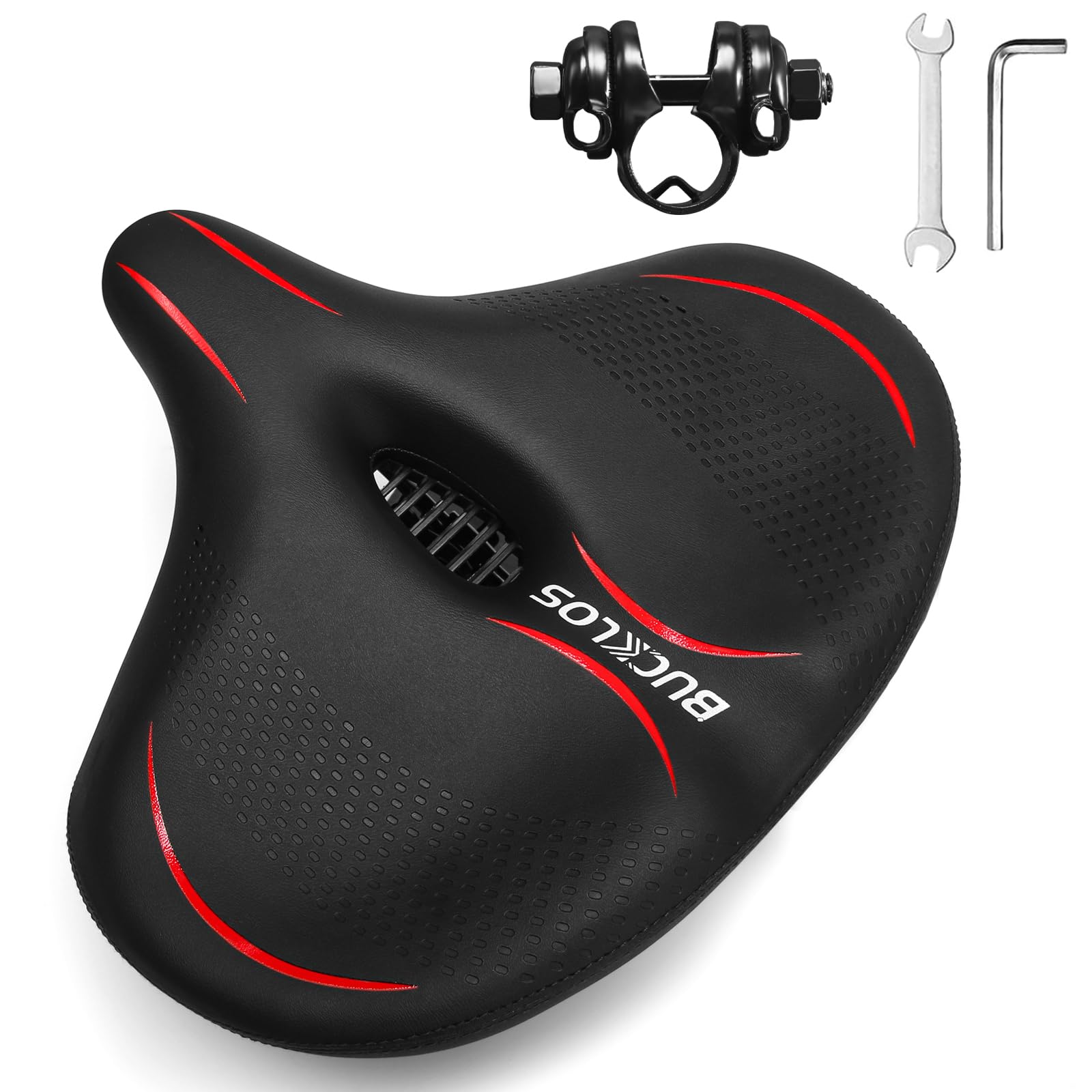
Narrow at the front, broad at the back, and sprung underneath so the bumps stop at the hardware.
BUCKLOS shapes this saddle with a slim nose and a wide tail — 12 inches long by 12.4 inches wide — so your thighs clear the sides while your sit bones land on the broad section. Underneath, two shock-absorbing spring balls soak up road chatter, and the covering is leather over a foam-and-silicone pad. The center is hollowed out to let air move through, which keeps you cooler and takes pressure off the perineum. A water-resistant leather surface also means a wet trike seat wipes dry instead of soaking in.
Build quality is the second thing that wins riders over, and it is not an accident: a carbon steel frame holds the shape, while memory foam and polypropylene keep the pad supportive rather than mushy. Owners describe fitting it in about ten minutes on an Electra Townie Go, and one rider who had tried gel sleeves and several narrow seats calls this the first pain-free option. Another, in their seventies, called it the most comfortable seat they had owned. That age range matters — upright trike riders who do not pedal hard get the most out of a wide, sprung seat like this.
Two limits are worth knowing. At 1.28 kg it is heavier than a bare trike saddle, so you feel it when lifting the bike. And the springs that soften the ride are not rated for extreme loads — one rider over 500 pounds bent the bars, though the seat worked fine afterward for a lighter user. For everyone in normal weight ranges, the combination of wide pan and spring give is exactly what you want on a rough path.
The Case for It
- 12.4-inch width with a narrow nose keeps thighs clear while supporting sit bones.
- Dual spring balls absorb bumps that a rigid saddle sends straight up.
- Hollow center improves airflow and eases pressure on long rides.
- Leather cover wipes clean and resists water.
Room to Improve
- At 1.28 kg it is noticeably heavier than a simple saddle.
- Not built for very heavy riders — the spring bars can bend under extreme weight.
Best matched to: Riders of small to medium build who want a wide seat without extra foam bulk, and anyone riding rough paths or sidewalks.
Not the one for: Very heavy riders who need a rigid pan that will not flex at the hardware.
4. CDYWD Noseless Oversized Bike Seat
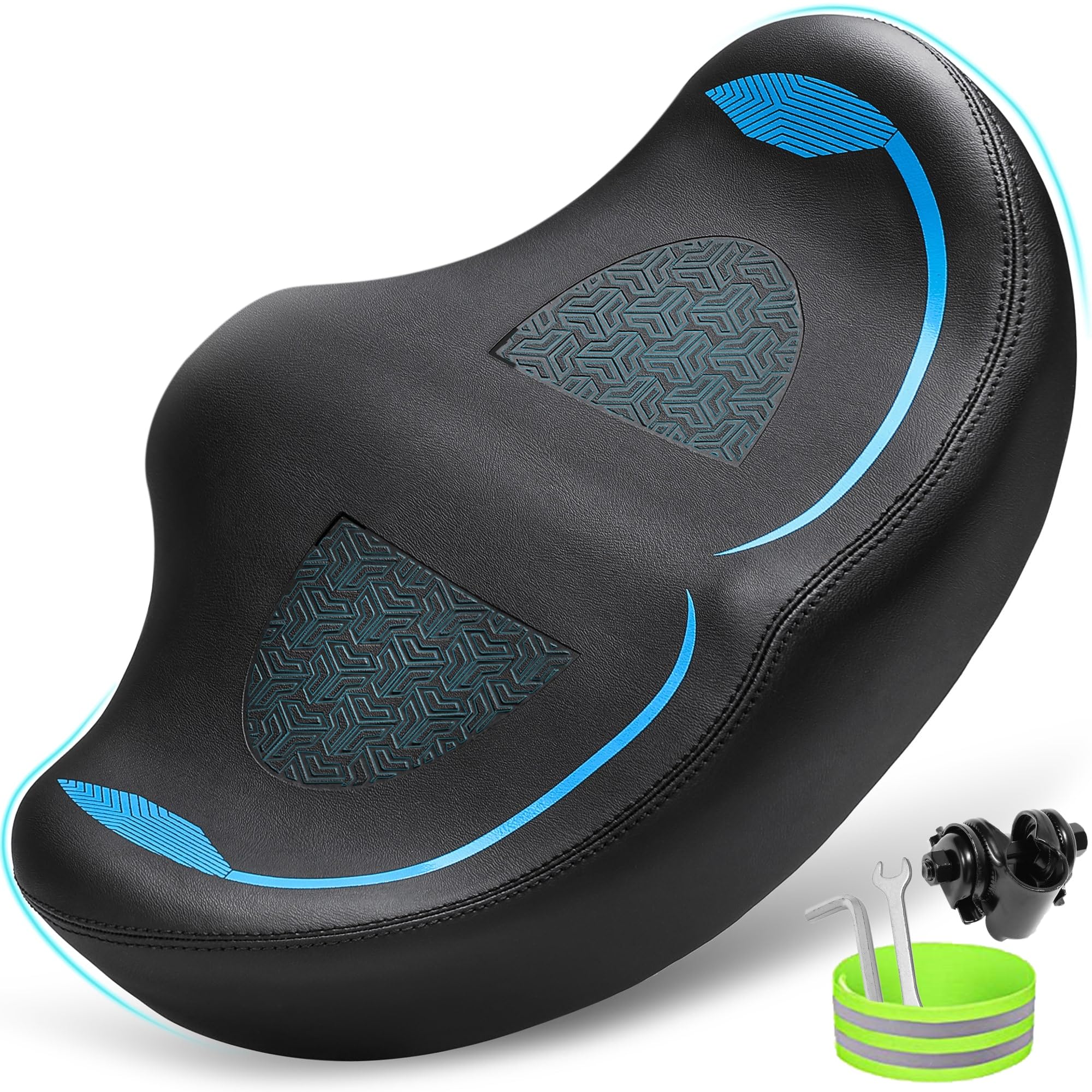
The noseless one — no horn to press into you, and wing-shaped foam that spreads weight across the whole seat.
CDYWD takes a different approach from a traditional saddle. Instead of a long nose, this seat has a short stub where the nose would be, so there is nothing pressing into the inside of your thigh or your soft tissue. The wing-shaped foam — 2.96 inches thick — is cut to fit the curve of your hips, and the whole seat measures 9.5 inches long by 13.5 inches wide by 5.5 inches high. A PU leather cover with a printed pattern raises friction so you do not slide forward, and it sheds water.
Comfort is the headline here, and it is the seat’s most-praised quality by a wide margin. The sheer width means it suits plus-size riders especially well: one customer describes it as sitting on a cloud, and another who had been limited to a few blocks per ride was soon doing three miles without complaint. The seat stays supportive rather than sinking — one 245-pound rider calls it stiffer than the original but more supportive, and expects it to break in. It comes with a universal adapter, tools, and a reflective armband, and installation is quick enough that it is not a project.
Stability is the trade-off some owners run into. A few find the seat does not stay snug on the post and develop a little wiggle, which is the kind of thing that needs a check after the first few rides. There is also the noseless shape itself — if you are used to bracing against a horn, it takes a ride or two to trust. The seat covers popular mounts well, though some riders find the universal adapter needs adjusting to sit flush. At 1.16 kg it is light for its size.
Where it shines: The noseless, wing-shaped 13.5-inch seat removes pressure that a traditional horn creates, which is why long-distance and plus-size riders keep coming back to it.
The one thing to check: Give the mounting hardware a firm tighten and re-check it after the first few rides, since a small amount of wiggle is the most common note.
Worth choosing when: You ride long, want maximum pressure relief, and are ready to let go of a traditional horned saddle shape.
Pass if: You rely on a nose to steer or steady yourself, or you want a seat that bolts down and never needs a re-check.
5. THALOUS Oversized Bike Seat Backrest

A seat and backrest in one piece, aimed at riders who want upright support behind them.
The THALOUS saddle pairs an 11-inch by 8.66-inch seat with a 7.48-inch by 8.66-inch backrest, so you get lower-back support built in rather than bolted on later. The frame uses carbon steel for the connecting parts, and the pad is high-elastic latex wrapped in waterproof, wear-resistant PU. It weighs 4.2 pounds, which is the heaviest pick here — but that weight comes with the backrest structure you are paying for. It fits tricycles, mountain and road bikes, commuters, e-bikes, and exercise bikes.
Where this seat earns its place is on a sit-down scooter or a trike used for relaxed cruising. One owner converted a sit-down scooter into something closer to a mobility ride with the added backrest, and was happy with it. Installation is straightforward, with clear instructions and the mounting tools included.
Now the honest part: this one has a small review base, and the feedback is more mixed than the others. The backrest only adjusts vertically — its angle sits at 90 degrees — so a rider looking for a reclined lean will not find it here. Some found the padding thin and the seat less comfortable than expected, and a few units arrived with the fabric under the seat already shedding and exposed staples. This is a fair warning rather than a deal-breaker, and it is why this pick suits low-mileage, upright riding best. If your trike has a curved or unusually shaped seatpost, check the fit first: it needs a tube-style post with a narrowest end around 0.87 inches.
Go for it: You want an upright backrest at a low outlay for gentle trike or scooter riding.
Look elsewhere: You need backrest angle adjustment or a seat you can lean back into — the 90-degree back won’t recline.
6. HUGEOAKS Width Adjustable Bike Seat
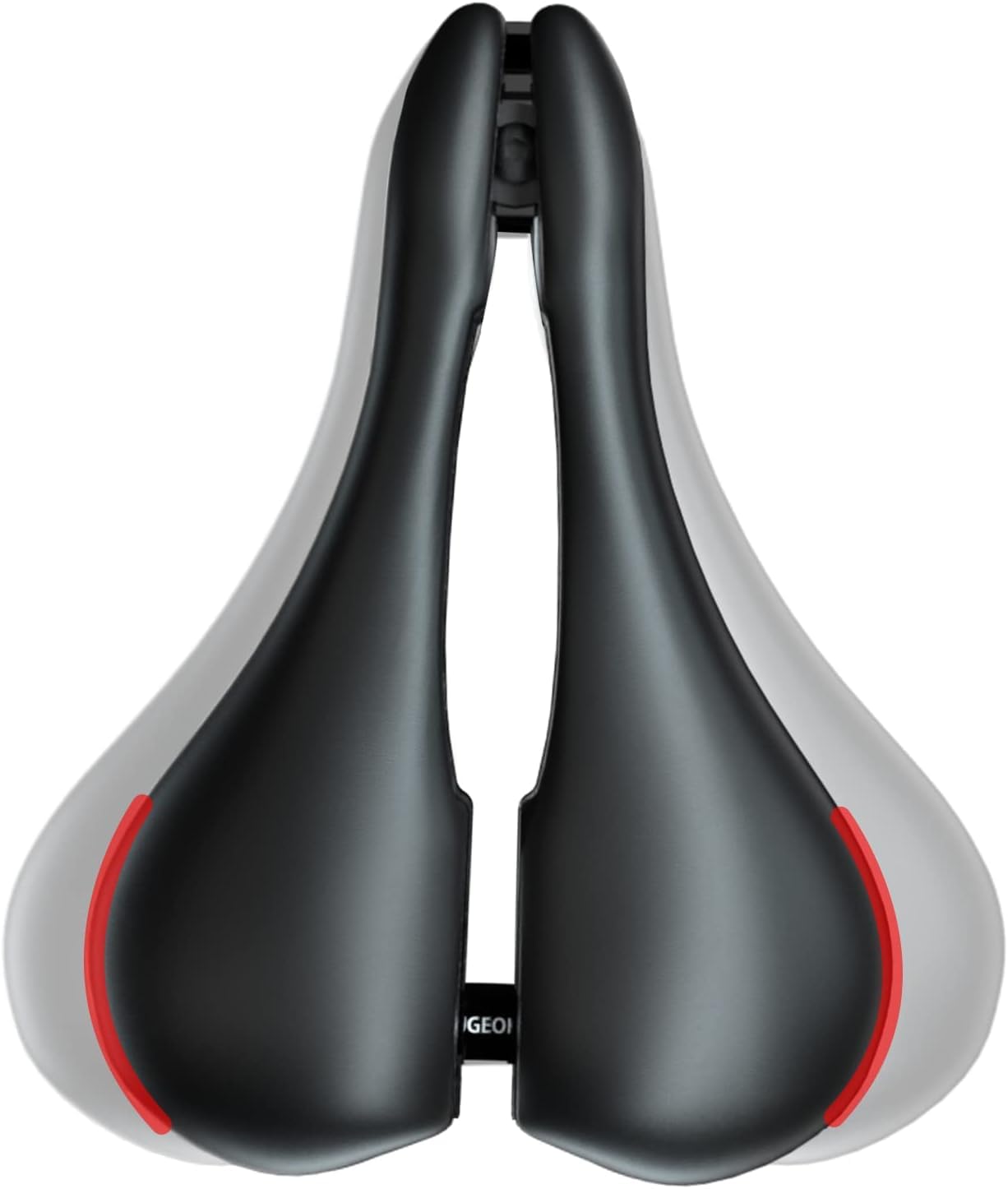
The one seat you can widen or narrow to fit your own sit bones — three settings, from 7.08 to 8.66 inches.
Most saddles ask you to guess your width. This one lets you change it: the HUGEOAKS seat adjusts across three widths — 7.08 inches, 7.87 inches, and 8.66 inches — so you can find where your sit bones rest comfortably instead of settling for what the maker chose. The seat surface is curved to spread weight off the tailbone and lower back, with a movable rear that pivots wider as you open it up. Underneath, 304 spring steel hardware provides support and resists corrosion and bending, and a horizontal metal brace at the rear keeps both sides level under load.
What makes this different is the width dial. A seasonal off-road cyclist riding 25 to 40 miles reported significant pressure relief versus traditional saddles, and a rider in their sixties with perineum and enlarged-prostate irritation called it the most comfortable seat they had tried on the medium setting. Thick memory foam keeps your sit bones off the hard plastic base over bumps. Installation is quick, and the seat fits mountain bikes, city bikes, road bikes, and stationary exercise bikes.
The trade-offs are the mirror image of that flexibility. The metal brace system means the seat is firm — some find the padding hard, especially bony riders, who may feel sit-bone ache at first. And because the back widens as a pair of pivoting halves, the front widens too, which can cause inner-thigh chafe on very long rides. There are only three settings, not a continuous range, so you might sit between them. Weighing 0.83 kg, it is among the lighter seats here.
The adjustable win: Three widths — 7.08, 7.87, and 8.66 inches — let you tune the seat to your own body rather than hoping a fixed size fits.
Where it bites: The firm foam suits some riders and leaves others wanting more, and widening the rear also widens the front, which can rub the inner thigh.
Reach for this if: You have struggled to find a fixed-width seat that works, or you deal with perineum pressure and want width you can fine-tune.
Think twice if: You want a soft, plush feel, or your legs are close together when you pedal — the pivoting front can rub on long rides.
7. MOONCOOL Oversized Bike Seat with Backrest

A padded seat plus adjustable backrest, sized for standard 7/8-inch trike posts.
MOONCOOL builds this one specifically for trikes, with a seat base of 11.5 inches by 9.5 inches and an adjustable backrest for lower-back support. It fits standard 7/8-inch seat posts and is made from iron and polyurethane, so the frame is sturdy and the PU pad resists wear. The backrest adjusts up and down, and the seat itself slides only a half-inch to an inch fore and aft — small tweaks, but enough to level the seat on a slightly uneven frame. Weighing 2.48 kg, it is built to take regular, everyday use.
Owners mention it as a clear step up from the stock MoonCool trike seat, noting the larger cushioned surface and better quality than the factory part. It fits the TK1 with a bit of work — removing the 7/8 post holder and mounting on the rails — and the results are worth the effort for a comfortable, sturdy back plate. Many trike owners looking for a backrest land here first because it is specifically designed for the trike layout.
The catches are real and worth sizing up front. Fit is the most-discussed concern: the seat is not a universal bolt-on, and a few owners found it did not align with their trike without bending the mounting bracket or swapping the included bolt for a 10mm, 1.50-thread replacement. The backrest can also make getting on and off from behind the seat harder, since it sits in your way. And stability notes come up — a little fore and aft sliding, and the back moving slightly — which is the sort of thing a firm re-tighten addresses.
Best matched to: Trike riders with a standard 7/8-inch post who want an included, adjustable backrest without hunting for a separate mount.
Not the one for: Bikes with non-standard posts or frames where the bracket won’t sit level without modification.
Know the Specs
Seat Width and Length
Width is measured across the widest part of the seat, and it decides how much of your weight lands on your sit bones rather than soft tissue. Length matters less but affects where the nose sits relative to your pedaling position. On an adult trike, wider generally means more support — up to the point where a very broad seat starts to crowd your thighs. A 13.5-inch seat like the CDYWD spreads weight the most; a 9.5-inch trike seat still beats a narrow bicycle saddle.
Seatpost Diameter and Mount Type
The seatpost is the tube that connects the seat to the bike frame. Some seats clamp around it with a ring, others bolt onto a pair of rails, and still others need a rear support bar. A common trike post is 7/8 inch, but check yours before ordering. If the diameter is wrong or the seatpost is curved, the seat will not mount securely no matter how comfortable it is.
Memory Foam vs. Latex Padding
Memory foam is high-density foam that compresses and slowly returns to shape, so it cushions each bump and spreads pressure. Latex is springier and rebounds faster. Both beat the thin foam on a factory saddle. Thickness is listed in inches — 2.96 inches on the CDYWD, for example, is a substantial pad — but thickness only helps if the foam underneath is dense enough not to bottom out.
Pressure Grooves and Noseless Shapes
A center groove, hollow, or noseless cutout (a saddle without a long front horn) reduces pressure on the perineum, the soft tissue between the legs. For riders who spend hours seated — especially on an exercise bike or trike — that relief is often the single biggest comfort gain, more than extra padding alone.
Common Questions
Will a wide bike seat fit my adult tricycle’s seatpost?
Does a noseless seat like the CDYWD work on a trike?
How much weight can these seats support?
Is a backrest worth it on a trike?
How do I stop a wide seat from slipping or wiggling?
Will a wide seat make pedaling harder?
How long does it take to install a new trike seat?
Do I need a support bar with a trike saddle?
What is the difference between a memory foam and latex seat pad?
The Bottom Line
For most adult tricycle riders, the adult tricycle seat to buy is the SUN Trike Western Saddle. Its 16-inch-wide rigid steel pan and proven trike shape give big riders a stable, flat platform, and a rear support bar makes it feel planted. If you want maximum foam and the widest surface, the WUVOP Oversized Bike Seat delivers 13.5 inches of high-density memory foam and a tested 500-pound load rating. And for riders who need width they can tune to their own body, the HUGEOAKS Width Adjustable Bike Seat is the smartest call.
How we choose
We do not accept paid placement. Every pick is matched to a real buyer and a real use-case; we do not hands-on test units.
Sources
Specifications: manufacturer listings and product documentation. Review insights: verified customer reviews, as of October 2026. Pricing: not shown on this page (it changes often); check the current price via the retailer link.
As an Amazon Associate, Aappliancez earns from qualifying purchases. This does not affect which products we feature.