Disclosure: Some links in this post are affiliate links. As an Amazon Associate I earn from qualifying purchases, at no extra cost to you. Learn more
Specs are compiled from manufacturer listings and verified buyer reviews and can change over time — please confirm the key details on the product page before buying.
If a tile has popped off your pool wall, you have two real choices: drain the pool and do it the slow way, or find an adhesive that cures while fully submerged. This guide sorts the four strongest options for exactly that job, from a thickened epoxy that stays put on overhead surfaces to a thinset cement that sets in five minutes on a vertical waterline.
This guide is built by comparing the manufacturers’ published specifications and the patterns across verified customer reviews, so you get each pick’s real strengths and trade-offs instead of marketing spin.
Setting a loose tile back onto a pool wall is a different job from gluing two boards together. Water pressure, chlorine, salt, and UV exposure all work against the bond, and the surface is often vertical or upside down. That is why the best adhesive pool tile for your repair depends on whether you can drain the water, how fast you need it to grab, and how much material the job actually takes.
Top Picks

How To Choose The Best Adhesive Pool Tile
The first decision is whether the pool stays full or gets drained. That answer eliminates most of the shortlist: a dry-air-cure product cannot set a tile that stays submerged.
Full pool or drained pool
If you want to leave the water in place, you need a formula that cures while submerged. Pool Patch builds its paste specifically for that scenario, since it bonds without you draining the water. A thinset powder like E-Z Patch mixes with water on your bench first, so it suits a drained spa, a waterline you can isolate, or a tile you can pull clear of the water while it grabs.
Working time versus gel time
Working time is how long you can still move, shape, and reposition the adhesive after you apply it — TotalBoat gives you 50 minutes at 77°F — so it is the window for a fussy, multi-tile repair. Gel time is when it stops flowing and firms up, and for the same epoxy that is 30 to 35 minutes. A thinset that sets in minutes is great on a vertical wall because gravity has less time to win, but it punishes slow hands.
Sag on vertical and overhead surfaces
Pool waterline tiles sit on a wall, and wall work is where thin, runny adhesives fail. A thickened product that stays where you press it keeps a tile from creeping downward while the bond kicks. Sag resistance matters most on the top waterline row, where gravity pulls hardest.
Matching the adhesive to the tile and the pool
Ceramic, mosaic, and stone all need a bond that grips a slightly different surface. Saltwater and chlorine pools also need a formula that resists those chemicals rather than breaking down in them. Check the label for the surfaces it bonds and the chemicals it resists, then match those claims to your pool.
Side-by-Side Comparison
| Model | Best For | Form | Full Cure | Weight | Amazon |
|---|---|---|---|---|---|
| TotalBoat Thixo Structural Marine Epoxy Glue★ Best Overall | Structural repairs and filling voids | Gel and liquid epoxy | 24 hours | 16 ounces | Amazon |
| Pool Patch Underwater Pool Tile Adhesive | Repairing tiles without draining the pool | Paste | — | 4.6 ounces | Amazon |
| E-Z Patch 3 Thinset Pool Tile Setting Cement | Fast waterline and vertical tile setting | Powder | 3 days | 16 ounces | Amazon |
| Berkland Marine Adhesive Sealant 5200 Fast Cure | Watertight sealing above and below the waterline | Polyurethane paste | 24 hours | 13 ounces | Amazon |
Detailed Reviews
1. TotalBoat Thixo Epoxy Glue 185ml
Our pick — 4.5+★ from 550+ verified ratings; the strongest balance of quality and price.
A thickened epoxy that holds its shape overhead, so waterline tiles stay exactly where you press them.
This is the pick for the messy jobs — a cracked tile bed, a chipped surround, a void behind the waterline that needs filling as much as gluing. It arrives as a 185 ml cartridge that drops straight into a standard caulking gun, and the included mixing tips blend the two parts for you at a fixed 2:1 ratio. No measuring cups, no stirring, no half-cured batch left in a bucket. The formulation is a thickened epoxy, which means it resists running, so it stays where you apply it on a vertical wall or an overhead surface — though the maker notes it is still thin enough to wet out fiberglass.
The working window is the headliner. At 77°F you get 50 minutes before it starts to set, then a 30 to 35 minute gel time, and a full cure in 24 hours. That long open time is the difference between a calm repair and a panic if you are resetting several tiles or shaping filler. Once cured it can be drilled, sanded, and painted, and it is fully waterproof. It bonds wood, fiberglass, metals, brick, concrete, glass, slate, tile, and stone, so it is not tile-specific — it is a general trouble-shooter you will reach for long after the pool is done. For weight, this cartridge runs 16 ounces, and against the Pool Patch paste at 4.6 ounces the Thixo tube carries roughly 3.5 times the mass, which is why it stretches across far more repair work before you reorder.
The catch is honesty about the tube itself. Several owners have flagged that a two-part cartridge is only partly filled compared with a regular tube of caulk, so the physical size can mislead you into thinking there is more material than there is — one buyer got caught short mid-project. It is also a premium-priced adhesive relative to a plain thinset, so if your job is one loose tile, it is more material than you need. Note too that curing behavior is temperature sensitive; it wants warm weather to behave as advertised.
Where it earns its place
- No-mix 2:1 cartridge with included tips means no measuring and no wasted batch.
- Stays put overhead and on vertical surfaces, so tiles do not sag while they set.
- 50 minutes of working time at 77°F gives you room to position tiles carefully.
- Cures fully waterproof and can be drilled, sanded, and painted after 24 hours.
What to know before you buy
- The cartridge is not filled to the brim — expect less material than the tube size suggests.
- Premium-priced versus a plain thinset powder, so it is overkill for a single tile.
- Needs warm conditions to hit its stated cure times.
Reach for this if: you have a structural repair, a void to fill, or more than one tile to reset and you want one cartridge that bonds almost anything.
Look elsewhere if: your job is one loose mosaic tile and you would rather not pay premium-epoxy money for it — the Pool Patch paste covers that case.
2. Pool Patch Underwater Pool Tile Adhesive (4 oz)

The one that lets you fix a fallen tile without touching your pool’s water level at all.
Here is the pitch in one line: this is a professional-strength paste designed to set a loose ceramic, mosaic, or stone tile while it is fully submerged, so you skip the drain entirely. Draining a pool to fix a tile means losing the water, the chemicals, and a day of your time. This product sidesteps all three, which is the whole reason it exists. It bonds while the tile sits under water, and the brand describes the bond as industrial strength — the kind that stands up to the pressure of a full pool pressing on it. If your problem tile is underwater right now and you would rather not pump out thousands of gallons, that capability is the entire buying decision.
It is built for the realities of pool chemistry, too. The formula is UV stable, which is what keeps it from yellowing or cracking under constant sun, and it resists both chlorine and saltwater. That combination matters because a tile adhesive that shrugs off one but not the other will fail early in a salt pool or a heavily chlorinated one. It also handles the material variety you actually find in pools — ceramic, mosaic, and stone — rather than being tuned to a single tile type. At 4.6 ounces, the container is a compact, targeted size suited to patch work rather than a full re-tile.
The honest trade-off is scale. Four and a half ounces goes a long way on a handful of tiles but not far on a whole waterline, so measure your job before ordering. The smaller container also means that if you misjudge vertical placement and redo a tile, you burn through material faster than you expect. It is best treated as a spot-repair tool: perfect for the two or three tiles that came loose this season, less suited to a full surround reset.
Why it earns a slot: for anyone who cannot or will not drain the pool, the submerged-cure capability and the chlorine-and-saltwater resistance are exactly the two boxes a waterline repair needs ticked.
The practical limit: at 4.6 ounces it is sized for individual tiles rather than a full set of replacements, so buy with your tile count in mind.
Best fit: a pool owner with a couple of loose tiles who wants to keep the water where it is and fix the problem this weekend.
Not the one for: a full waterline reset that needs bulk material — the thinset and the marine sealant both carry more per container.
3. E-Z Patch 3 Thinset Pool Tile Setting Cement, 1 lb., White

Mix it, set the tile in minutes, and it grabs on a vertical wall before gravity can act.
What wins people over with this thinset is speed on a wall. As one buyer put it, it “sets within 5 minutes which is beneficial on vertical wall tiles.” That quick grab is exactly what you want on a waterline row, where a slow-setting product lets the tile creep downward before the bond takes hold. It is a powder you mix with water on your bench, so there is no tube to store and nothing to dry out in the can. One owner reattached loose pool tiles in 10 to 20 minutes following the instructions. The 1 lb. can is a white cement you can tint with a concrete pigment if you want it to blend into your grout line, and the maker notes the modified formula uses pozzolans and polymers to bond better than plain cement.
It is made in the USA by E-Z Patch and suits both indoor and outdoor use, with a low-odor mix that will not overwhelm a small equipment room. It bonds ceramic and concrete, full cure takes 3 days, and the brand describes it as a one-time solution for dents and cracks that should hold for years. For pool owners this is a two-part kit in a can: dry cement plus water you add yourself, which is what makes it so simple and so affordable relative to the tubed options.
The recurring note in owner feedback is the water-to-powder ratio — getting it right takes practice, and one buyer found the container was just enough to attach three tiles, so plan your batch quantities carefully. The short open time cuts both ways, too: it rewards preparation and punishes dithering, so have your tools and a dry-fit ready before you mix. On balance the crowd likes it — it holds a 4.0+ rating, with fast set and durability coming up again and again as the reasons owners keep recommending it.
Why it’s the waterline standard: a five-minute set on a vertical wall is the single most useful trait for pool tile repair, and this is the pick that leans hardest into it.
Choose this when: you are setting tiles on a vertical wall or waterline and want a fast, affordable powder you mix to the consistency you like.
skip it if: you need a no-mixing, ready-to-squeeze product or a bond you can shape over a long working window — the TotalBoat epoxy is the one for that.
4. Berkland Marine Sealant 5200 10 oz White
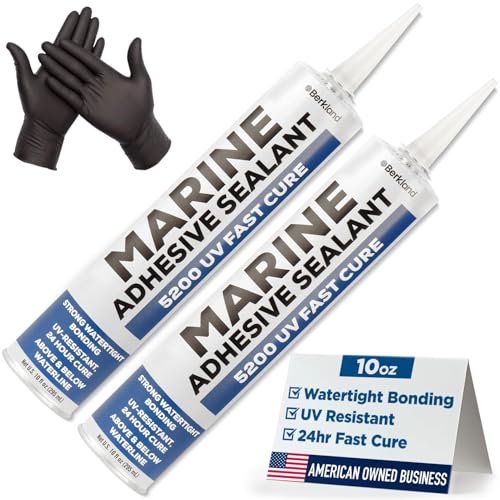
A permanent watertight seal built for above and below the waterline, and it comes as a two-pack.
If your pool problem is a leak or a joint rather than a missing tile, this is the tube you want. The 5200 fast-cure formula is designed to create a permanent, flexible bond that holds against water pressure, surface flexing, and impact, and it works above or below the waterline. That flexibility is the point on a surface that moves in the water; a rigid bond cracks, a flexible one moves with the surface and keeps the seal. It cures fast, too — it skins in 1 hour and reaches handling strength by 24 hours, so you are not parked waiting on it.
Two cartridges come in the box, plus disposable gloves, and each one loads into a standard caulk gun like the TotalBoat cartridge. The formula is UV and weather resistant, engineered for full sun, salt spray, and temperature swings, and the brand says it will not crack, shrink, or chalk after years of sun. It adheres to fiberglass, wood, aluminum, steel, gelcoat, and most plastics, so it covers the surfaces around a pool or a boat deck. If your tile surround sits near a fitting or a joint you also need sealed, one tube handles both.
The one small gripe owners raise is convenience, not performance — the tube performs, but a nozzle cap would be a welcome addition for storing a partly used cartridge between sessions. That is a minor point against a product that earns a strong reception from its buyers.
Where it shines: permanent watertight sealing above and below the waterline, with a 1-hour skin and 24-hour handling strength, backed by resistance to UV, salt, and temperature extremes.
The nit to note: no nozzle cap for resealing between uses, so plan to finish a cartridge once you open it.
The right call for: anyone sealing a joint, fitting, or surround where a permanent watertight bond above or below the waterline is the goal.
Think twice if: your only fix is bonding a single ceramic tile with no sealing need — the paste handles that with less fuss.
Know the Specs
Working time and gel time
Working time is how long the adhesive stays movable after you apply it, so you can position and adjust a tile. TotalBoat labels its epoxy at 50 minutes of working time at 77°F, then a 30 to 35 minute gel time when it firms up. A thinset that sets in minutes gives you almost no window, which is perfect on a vertical wall but demands that everything be ready before you mix. Read both numbers before you buy: a short working time on a multi-tile repair means rushed, misaligned tiles.
Full cure versus set
A product that feels hard is not always fully cured. Full cure is when the bond reaches its final strength, and the numbers here run the range — 24 hours on the TotalBoat epoxy and the Berkland sealant, and 3 days on the E-Z Patch thinset. A tile can hold position long before that final strength arrives, but keep water pressure and weight off the joint until the cure time has passed. Cold weather stretches these cure times, so wait longer in shoulder seasons.
Full-submersion curing
Most adhesives need dry air to cure, which is why draining the pool is the usual advice. An underwater formula is engineered to set while it is submerged, so you can repair a tile with the water still in place. If your job is under water and you do not want to drain, this is the spec that matters most, and it is the reason the Pool Patch paste exists in the first place.
Chemical and UV resistance
Pool water is not plain water. Chlorine and salt both attack bonds over time, and constant sun does its own damage. A formula labeled chlorine and saltwater resistant, and UV stable to prevent yellowing or cracking, is telling you it was built for the pool environment rather than a dry indoor wall. Check the label for these claims when your tile sits permanently under water in a treated pool.
Common Questions
Can I really glue a pool tile without draining the pool?
How long should I wait before putting a repaired pool tile back under pressure?
Will a pool tile adhesive hold on a vertical waterline wall without sliding?
Is a thinset cement or a tube adhesive better for pool tile repair?
How much adhesive do I need for a few loose tiles?
Does saltwater or chlorine damage pool tile adhesive over time?
Can I use the TotalBoat Thixo epoxy for pool tile or only for boats?
What is the difference between the fast-cure 5200 sealant and the standard version?
Do I need to worry about color if I am repairing white pool tiles?
Will a standard caulking gun fit these cartridges?
The Bottom Line
If you have never repaired a pool tile before, start with the Pool Patch Underwater Pool Tile Adhesive, because it does the one thing a beginner cannot work around — it cures with the water still in the pool. The premium all-rounder here is the TotalBoat Thixo epoxy, a 185 ml no-mix cartridge with 50 minutes of working time, 16 ounces of material, and the ability to bond almost any surface you point it at. For a fast, affordable vertical-wall set, the E-Z Patch thinset grabs in minutes. And if the job is a watertight seal rather than a missing tile, the Berkland 5200 fast-cure two-pack is the one to reach for — its 1-hour skin and flexible below-waterline hold make it the standout for joint and fitting work. Match the format to the job: paste for spot repairs, thinset for fast vertical sets, epoxy for structural voids, and sealant for watertight joints.
How we choose
We do not accept paid placement. Every pick is matched to a real buyer and a real use-case; we do not hands-on test units.
Sources
Specifications: manufacturer listings and product documentation. Review insights: verified customer reviews, as of October 2026. Pricing: not shown on this page (it changes often); check the current price via the retailer link.
As an Amazon Associate, Aappliancez earns from qualifying purchases. This does not affect which products we feature.