Disclosure: Some links in this post are affiliate links. As an Amazon Associate I earn from qualifying purchases, at no extra cost to you. Learn more
Specs are compiled from manufacturer listings and verified buyer reviews and can change over time — please confirm the key details on the product page before buying.
Gluing wood veneer is different from ordinary woodworking, because a thin veneer sheet will telegraph every lump, every drip, and every drop of moisture straight to the show surface. A glue with too much water soaks in and swells the grain. A cement with aggressive grab locks the sheet down before you can slide it flat. And a glue line the wrong color turns permanent once the sheet lands on a pale open-grained face. Choosing the right adhesive is not a small detail here, because the glue determines whether the veneer sits flat and clean or blisters and curls a week later.
This guide is built by comparing the manufacturers’ published specifications and the patterns across verified customer reviews, so you get each pick’s real strengths and trade-offs instead of marketing spin.
What follows covers five proven options for laminating veneer and laminated wood surfaces, from gallon jugs and specialty cold-press formulas to a spray that reaches where a brush cannot. Each pick is judged on the one thing that actually matters at the bench, which is why this look at the adhesive for wood veneer focuses on how each glue handles moisture, open time, and bleed-through.
Top Picks


How To Choose The Best Adhesive for Wood Veneer
Veneer is unforgiving, so the glue you pick matters more here than it does for a rough shop jig. Start by deciding how much working time you need, then check how the glue behaves around moisture, then match the color of the cured glue line to the species you are laying.
Open time: the number that decides your workflow
Open time is how long the glue stays spreadable and tacky after you apply it, before it skins over. A shorter window means you must place the sheet and clamp it fast. A longer window lets you slide the veneer into alignment and check for trapped air before the bond takes hold. For a large panel of unbacked veneer, that extra minute or two is often the difference between a flat lay and a wrinkle. Roberts rates its flooring adhesive with up to 20 minutes of open time, while 3M’s spray gives a 60-minute bonding range, so a full-panel job is not a race against the clock.
Water content and bleed-through on open-grained veneers
Most wood glues are water-based, and water is what swells a thin veneer face. On open-grained species like oak or ash, thin glue can wick up through the pores and show as a dark line under the finish. A glue formulated to limit bleed-through keeps the glue line translucent and the surface clean. Dampen both faces evenly before laying to reduce draw-through, and never flood the joint with excess.
Glue line color and sandability
A glue that dries crisp disappears under a natural finish. A glue that dries to a tan or yellow film blends with warm woods but shows under pale species. Check how the cured line sands, because a glue that softens when sanded gums up the paper and clogs the surface. Titebond Original dries to a translucent film that sands smooth without softening, which keeps a veneer face flat for finishing.
Clamp pressure and cure schedule
Full cure time is how long the joint needs before it reaches its rated strength, separate from the fast grab you feel in the first minutes. Titebond Original lists a full cure of 24 hours, as does the 3M spray and the Roberts adhesive. Veneer needs even pressure across the whole sheet, so cauls or a press board keep it flat while that cure runs its course. Plan your finishing around that window rather than handling the panel early.
Side-by-Side Comparison
| Model | Best For | Full Cure Time | Form | Glue Line | Amazon |
|---|---|---|---|---|---|
| Titebond 5066F Original Wood Glue★ Best Overall | All-round shop work and veneer lay-ups | 24 hours | Liquid (1 gallon) | Translucent | Amazon |
| Weldbond Multi-Surface AdhesiveMost Versatile | Mixed-material veneer and craft panels | 20 minutes | Liquid (14.2 oz bottle) | Dries clear | Amazon |
| Roberts 1407-30C Wood Adhesive | Bonding veneered flooring to concrete and plywood | 24 hours | Liquid (30 oz can) | Beige | Amazon |
| Titebond Cold Press Veneer Glue | Large flat veneer panels and open-grained faces | — | Liquid (2 x 32 oz) | Translucent | Amazon |
| 3M Hi-Strength Spray Adhesive 94ET | Large panels and laminate-to-veneer faces | 24 hours | Spray (19.8 oz can) | Clear | Amazon |
Detailed Reviews
1. Titebond 5066F Original Wood Glue – Gallon, Yellow
Our pick — 4.5+★ from 12,000+ verified ratings; the strongest balance of quality and price.
The workshop staple that grabs veneer fast enough to skip the long clamp wait.
If you want one jug that handles veneer, furniture repair, cabinet work, and the odd luthier repair without you hunting down a specialty bottle, this is the pick that earns the top slot. The gallon pail weighs 9.9 pounds, which sounds heavy until you realize you are buying the lion’s share of a workshop staple that will not run dry mid-project. The aliphatic resin formula (a wood glue that cures hard and clear rather than rubbery) sets fast, so your clamp time drops and you get back to moving the sheet into alignment sooner than a slow-curing cement would allow.
What wins people over most is the hold, and the drying speed follows right behind it. Owners describe a glue that spreads smoothly, sets with just enough working time to line up the joint, and dries to a natural color that blends into the wood. One luthier-facing review sums it up: “perfect for repairing guitars. I needed a full bridge reset and this was perfect, the only glue I will use for this sort of thing.” That shrinks-as-it-dries behavior pulls a veneer sheet down tighter as it cures, which is exactly the trait that keeps a flat panel flat.
Here is the honest caveat. The strength is field-proven, but some buyers flag the pour consistency as mixed, and the 9.9-pound gallon is heavy to lift, so smaller bottles suit one-off veneer jobs. Every glue in this class also has a finite shelf life, so buy only what you will use before it thickens in the jug.
What Earns It The Top Slot
- Fast set cuts clamp time on veneer and furniture joints
- Dries to a translucent film that sands smoothly without softening
- Unaffected by most stains, paints, and finishes
- Low-VOC formula under 0.2 g/L and nonflammable
- Cleans up with water before the glue dries
Where It Falls Short
- The 9.9-pound gallon pail is a lot to lift and store for a single veneer job
- Glue consistency is the one point buyers rate as mixed
- Every batch has a finite shelf life, so do not over-buy
Reach for this if: you want one durable, fast-setting glue that covers veneer lay-ups, cabinet repair, and general furniture work.
Look elsewhere if: you only have a small veneer repair to run and the weight and volume of a gallon jug would sit unused in the shop.
2. Weldbond Multi-Surface Adhesive that Bonds Most Anything!
One bottle that glues veneer to wood, glass, ceramic, tile, and stone without giving up the clear line.
This is the pick for the maker who is bonding veneer to something other than bare wood, like a glass backing panel or a mosaic-style craft build. The 14.2 oz bottle carries a formula that cures in 20 minutes, so your panel is ready to handle far sooner than a 24-hour glue allows. It also sets water resistant and weatherproof, which matters near a window or a damp garage wall.
The real draw here is a clear cure. What surfaces to the top of the review pages is how effective this adhesive is across mixed materials, with its grab and its drying properties right behind. The film dries totally clear, so an unbacked veneer face will not show a brown glue ghost under a natural finish. There is no odor complaint to speak of either, which keeps a small craft room workable. Compare that clarity to the Titebond Original above, whose yellow-tinted film wants a warm wood underneath to blend cleanly.
The trade-off to know before you buy is the resin’s nature. A PVA glue that cures this quickly and stays flexible is not built for the heaviest of structural loads, so a thick veneer panel under real stress should still go to a dedicated wood glue like the gallon jug or to a cold-press formula. For repairs, craft panels, and light veneer faces, though, the clear cure and fast set make this a genuinely useful bottle to keep on the shelf.
The clear-film advantage: curing to a totally clear finish means no tinted line creeping through a pale or open-grained veneer face.
The quick-set bonus: a 20-minute cure means you can move on to sanding and finishing far sooner than the 24-hour glues on this list.
Pick this for mixed-material work: veneer onto glass, ceramic, tile, or stone, where a clear cured line and a fast 20-minute set both help.
Step up if your load is heavy: a stressed veneer panel on a thick wood substrate suits a dedicated wood glue better than a flexible multi-surface formula.
3. Roberts 1407-30C Wood Adhesive, 30oz, Beige
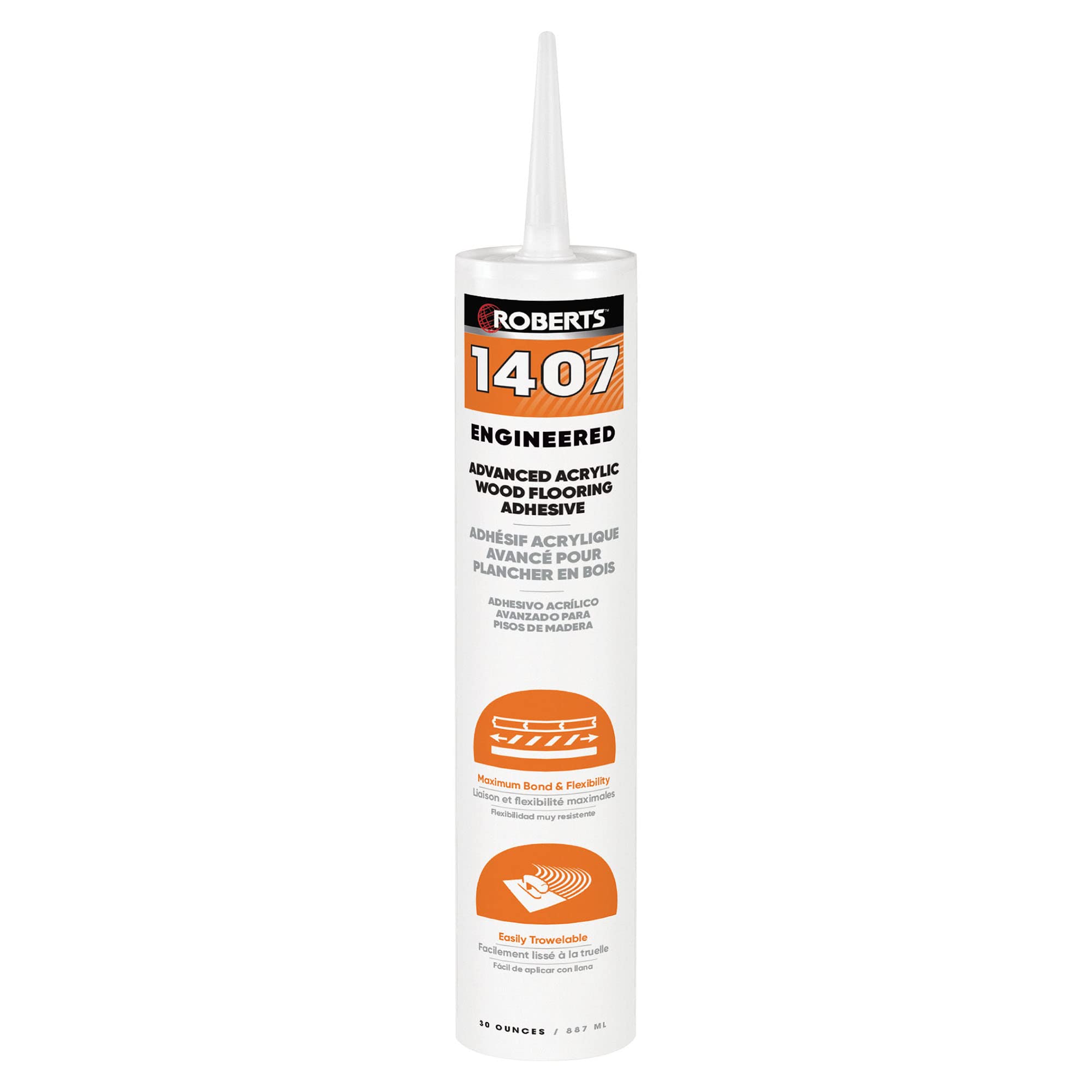
The flooring adhesive that holds veneered planks flat over concrete without a wrestling match.
Veneered flooring puts a different demand on a glue than a bench veneer panel does, because the sheet is bonded to a substrate that is nailed or glued to a slab, and the bond has to stay put underfoot. This can delivers a latex emulsion that is solvent-free and water based, rated for heavy residential and moderate commercial use. It gives up to 20 minutes of open time and 30 minutes of working time, so you can position and reposition a plank before it grabs. At 2.6 pounds, the 30 oz can is a fraction of the 9.9-pound gallon jug in this lineup, which makes it far easier to carry around a whole floor.
Owners say it holds wood floors down effectively and cleans up with warm water more easily than other glues. On a roughly 12-square-foot engineered hardwood run, the panel stayed flat with no popping or floor-raising a week later. Adhesion is the trait called out most, with consistency close behind. The catch is working speed: the same customers who praise the grab also note it dries quickly, so once the sheet or plank goes down you need to be moving.
Two honest limits surface in the details. Batch freshness affects the flow, so older stock can skin over in just a few minutes and want a second pair of hands. And while the glue bonds solidly to wood, concrete, plywood, and cork underlayment, the threaded review pages are clear that this is not built for loads above a few hundred pounds. For its intended job, gluing veneered flooring down, it does exactly what it promises.
Why floor installers reach for it: a 20-minute open time and 30-minute working time give room to seat a plank and adjust it before the bond sets.
Cleanup that actually happens: a water-based, solvent-free formula wipes off tools and hands with warm water, which a lot of flooring adhesives will not do.
Best suited to: glue-down veneered or engineered flooring over concrete, plywood, or cork underlayment, at a weight you can carry all day.
Not the pick for: heavy-duty structural loads above a few hundred pounds or thick bench veneer panels that want an all-purpose wood glue instead.
4. Titebond Cold Press Veneer Glue, 32 oz, Pack of 2
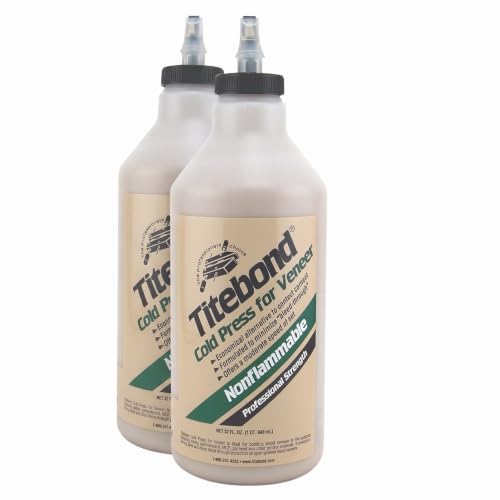
Purpose-built for veneer, with a formula designed to stop the glue line bleeding through open grain.
This is the one on the list built specifically for the job, a cold-press veneer glue rather than an all-purpose wood glue. The name gives away the method: you lay the sheet, glue it cold, and press it flat without heat. It comes as a two-pack of 32 oz bottles, so you have a lot of adhesive on hand for a large panel run, and the label claims pros prefer this formula 7 to 1.
The standout trait for veneer is the formula designed to prevent bleed-through on open-grained and unbacked veneer. That is the exact failure a beginner runs into, where thin glue wicks up through oak or ash pores and shows a dark line under the finish. This mix is engineered to keep the glue line clean and translucent instead. It also offers a moderate speed of set, giving a manageable working window so you can align a large sheet before the bond locks, and it is a nonflammable water-based PVA with no harmful fumes for indoor use. It bonds solid wood, MDF, plywood, and particleboard.
The realistic catch is cost-per-job. Owners split on value here, with some calling it a fair price for the volume and others finding it expensive. There is also a maker boast on the label about pro preference that you should treat as a claim rather than a lab result. If your work is mostly small repairs rather than large veneer panels, the cheaper multi-surface bottle or the versatile wood glue will stretch further.
The Veneer-Specific Wins
- Formula designed to minimize bleed-through on open-grained and unbacked veneer
- Moderate set speed leaves time to align a large sheet
- Water-based PVA with no harmful fumes, safe for indoor work
- Two 32 oz bottles give ample volume for a full panel build
- Bonds veneer to solid wood, MDF, plywood, and particleboard
The Cost Reality
- Buyers split on value, with a portion finding it priced high for the volume
- The pro-preference figure on the label is a maker claim, not a verified test result
- Overkill for small veneer touch-ups where a general-purpose glue works fine
The right fit: a furniture or cabinet maker laminating large veneer panels who wants a formula that fights bleed-through and forgives alignment.
Look past it if: your veneer jobs are one-off small repairs and the price-per-job of a veneer-specific glue is more than the task needs.
5. 3M Hi-Strength Spray Adhesive 94ET
The spray that covers a whole veneer panel in one pass and stays repositionable for an hour.
When a veneer sheet is too large or too awkward to brush, a spray does the work a brush cannot reach. This can lays down an adjustable-width web pattern, so you control the spread of the adhesive across the surface in one pass rather than chasing it with a glue bottle. It provides a 60-minute bonding range, the longest on this list, so on a big or complex build you get a full hour to reposition and align the sheet before the bond sets. The formula carries a fast, aggressive initial grab to hold material in place once you press it down.
It resists improve temperatures and moisture, and it is GREENGUARD certified and compliant with CARB and OTC VOC requirements. Quality is the thing buyers rate highest, with hold strength next. It bonds wood, laminates, metals, select rubbers, carpet, and flooring, and the low-VOC formulation keeps the odor down as advertised. Compare this 60-minute range to the 20-minute open time on the Roberts can above, and the spray gives much more slack on a large panel.
There are two real limits to weigh. This product is labeled for industrial and occupational use, not consumer use, so read the intended-use guidance before buying. And buyers are split on drying time, which means you should plan the cure around your schedule rather than assuming a quick set. It lists a 24-hour full cure, so follow that timeline for finish work on veneer.
Where it beats a brush: an adjustable web spray covers a large veneer face evenly and gives a full 60-minute bonding range to align it, which no brushed glue here matches.
One label to heed: it is marked for industrial and occupational use rather than consumer use, so check the intended-use guidance before you buy.
Worth grabbing for: large or complex veneer and laminate panels where you want speed of coverage and an hour of repositioning time on the sheet.
Consider another route if: you prefer a controlled brush-on line for a small veneer repair, or you need a product marked for consumer rather than occupational use.
Know the Specs
Open Time vs Working Time
Open time is how long the spread glue stays tacky and open before it skins over, while working time is the window for positioning the material. A short open time means you must place the veneer and clamp fast, while a longer window lets you slide the sheet into alignment. Roberts lists up to 20 minutes of open time and 30 minutes of working time, and the 3M spray offers a 60-minute bonding range, so a large panel does not become a race.
Bleed-Through and Glue Line Color
Bleed-through is when thin glue wicks up through the pores of an open-grained or unbacked veneer and shows as a dark line under the finish. A formula designed to minimize it keeps the cured glue line clean and translucent. Glue line color matters too: a clear or translucent film disappears under a natural finish, while a beige or yellow line blends better with warm species but shows on pale ones.
Common Questions
Will water-based wood glue swell my veneer?
How long do I have to reposition the veneer before the glue grabs?
What causes bleed-through and how do I stop it?
Can I use spray adhesive on wood veneer?
Is a cold-press veneer glue different from regular wood glue?
How long does the glue need to fully cure before I can finish the surface?
Can I glue veneer directly to concrete or does it need plywood first?
Does the color of the dried glue line matter for veneer?
Should I dampen the veneer before laying it with water-based glue?
The Bottom Line
For most people working with veneer, the adhesive for wood veneer winner is the Titebond 5066F Original Wood Glue because it sets fast, dries to a translucent film that sands smooth, and covers veneer along with every other furniture and cabinet job you will run — rated 4.5+ stars by 12,000+ owners. If bleed-through on open-grained faces is your worry, grab the Titebond Cold Press Veneer Glue, which is built for that exact problem. And for a large panel that wants the fastest coverage and the longest repositioning window, the 3M Hi-Strength Spray Adhesive 94ET with its 60-minute bonding range is the one to reach for.
How we choose
We do not accept paid placement. Every pick is matched to a real buyer and a real use-case; we do not hands-on test units.
Sources
Specifications: manufacturer listings and product documentation. Review insights: verified customer reviews, as of October 2026. Pricing: not shown on this page (it changes often); check the current price via the retailer link.
As an Amazon Associate, Aappliancez earns from qualifying purchases. This does not affect which products we feature.