Disclosure: Some links in this post are affiliate links. As an Amazon Associate I earn from qualifying purchases, at no extra cost to you. Learn more
Specs are compiled from manufacturer listings and verified buyer reviews and can change over time — please confirm the key details on the product page before buying.
Getting plastic to stay stuck to concrete is harder than it looks, because smooth plastic gives adhesive almost nothing to grip and concrete is porous, dusty and often damp. What fixes it is an adhesive formulated to grip a non-porous face while soaking into a rough, porous one. Below are five adhesives that genuinely handle that mismatch, each matched to a different job.
This guide is built by comparing the manufacturers’ published specifications and the patterns across verified customer reviews, so you get each pick’s real strengths and trade-offs instead of marketing spin.
Some of these are pastes you squeeze, some are sprays for wide flat panels, and one is a liquid you mix into mortar rather than apply to plastic at all — so the choice starts with your joint, not the brand. Here is the honest breakdown of the adhesive for plastic to concrete that actually holds.
Top Picks
How To Choose The Best Adhesive for Plastic to Concrete
The wrong assumption most buyers carry is that “strongest” means “sticks to everything.” Plastic to concrete is a specific pairing: one surface is slick and non-porous, the other is gritty and absorbent. An adhesive has to grab the plastic mechanically while soaking into the concrete enough to lock on. Pick a formula that only grips one of those surfaces and the bond peels, no matter its strength rating.
Match the form of the adhesive to the shape of the joint
A tube of paste is right for small brackets, trim, a plastic box on a wall, or filling a gap where the two surfaces do not sit perfectly flat. A spray is right when you are covering a large flat panel, like plastic sheeting or a laminate sheet laid over a slab. Spraying a tiny bracket wastes product and makes a mess; squeezing a tube over a whole sheet takes forever and goes on uneven.
Read the working time before the strength claim
Working time is how long you have to slide the plastic into position before the glue grabs. Gorilla lists up to 30 minutes of working time on its construction tube, which is generous for lining up trim. Spray contact adhesives with a fast tack want you placed and pressed almost immediately. If your panel is awkward or heavy, the longer window matters more than a bigger strength number.
Plan around the cure, not the grab
A bond that feels locked in ten minutes is not the same as a finished cure. Full cure times across these products run from 10 minutes on the fast 3M contact spray to 24 hours on the Gorilla tube and the Loctite cartridge, and up to 30 days on the Sika concrete admixture. That last one is not a surface glue at all — it gets mixed into cement or mortar — so match the product type to your actual task before you compare cure clocks.
Check the temperature and the water exposure
Loctite rates its Power Grab Ultimate for temperatures from 0°F to 140°F and calls it weatherproof and waterproof. That matters if the plastic-to-concrete joint lives outdoors, on a step, or in a shower. Cold weather slows every adhesive down, so a joint made in freezing conditions needs more clamp time, not less.
Side-by-Side Comparison
| Model | Best For | Form | Full Cure Time | Working Window | Amazon |
|---|---|---|---|---|---|
| Gorilla Max Strength Construction Adhesive★ Best Overall | Everyday plastic-to-concrete fixes | Paste tube | 24 hours | Up to 30 minutes | Amazon |
| 3M Max Strength Contact AdhesiveBest for Flat Panels | Wide flat panels and laminate | Web spray | 10 minutes | Fast tack, quick positioning | Amazon |
| Loctite Power Grab Ultimate crisp | Outdoor and wet joints | Cartridge paste | 24 hours | Quick initial tack | Amazon |
| SIKA SikaLatex R Bonding Admix | Concrete repairs under plastic fixtures | Liquid additive | 30 days | Mix-in, no dilution | Amazon |
| 3M Hi-Strength Spray Adhesive 94ET | Large builds needing repositioning | Aerosol web spray | 24 hours | 60-minute bonding range | Amazon |
Detailed Reviews
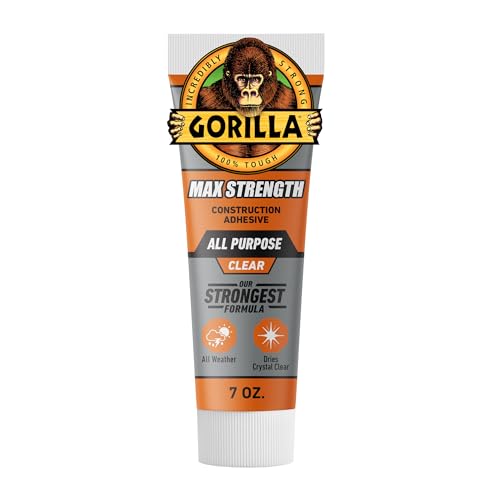
1. Gorilla Max Strength Construction Adhesive 7 oz
Our pick — 4.5+★ from 13,000+ verified ratings; the strongest balance of quality and price.
The clear paste that gives you a full half hour to line things up before it bites.
Start with the working window, because that is where this tube earns its place. Gorilla lists up to 30 minutes of working time, which is a long stretch in a category where most glues want you pressed and done. If you are setting a plastic bracket against a rough concrete wall and need to shim it level, that half hour is the difference between a straight joint and a crooked one you have to rip off.
The formula is 100% waterproof and rated to work under water and on wet surfaces, so a joint on a damp basement wall or an outdoor step is fair game. It also fills gaps, which matters here because concrete is rarely dead flat — the paste bridges the low spots instead of starving the contact patch. It dries crisp, is paintable in 2 hours, and can be sanded once cured, so a visible bead can be hidden rather than just tolerated. In a crowd of well over ten thousand owners it holds 4.5+ stars, and quality is what wins people over most, with raw strength right behind.
The catch is honesty about the slick side of the joint. Adhesion is the most mixed signal in the reviews, and the split is real — the paste grabs unprepped smooth surfaces durably for some, while other buyers find it will not stick at all. Clean and lightly scuff the plastic first and you land on the right side of that line. Expect a 24-hour full cure and a shiny clear finish that can still be visible on dark slate, and note some tubes ship without a pointed applicator, so a little excess is normal.
Owners put the durability this way: “It’s a thick paste that doesn’t run or drip, and the hold is far stronger than I expected.”
Where the tube pulls ahead
- Up to 30 minutes of working time lets you position and re-level before it grabs
- 100% waterproof and rated to bond on wet surfaces and under water
- Gap-filling paste bridges the pits in rough concrete
- Paintable in 2 hours and sandable once cured, so the bead disappears
What to plan around
- Adhesion splits: fine on scuffed plastic, poor on glassy non-porous faces
- 24-hour full cure means clamps or supports overnight
- Some tubes arrive without a pointed applicator, so application is imprecise
- Clear dries shiny and can still show on dark, flat concrete
Reach for this if: you are fixing a plastic fixture, trim piece or bracket to concrete and want time to get it straight, wet or dry.
Think twice if: your plastic is glossy and you will not scuff it — the mixed adhesion reports are mostly that scenario.
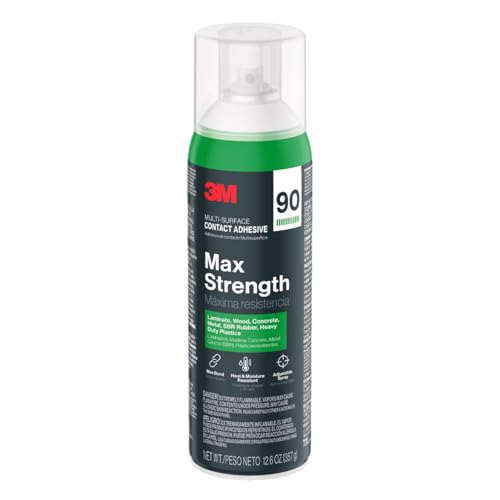
2. 3M Max Strength Contact Adhesive, 12.6 oz (357 g)
Lay a whole plastic sheet over a slab in one pass, then walk away after ten minutes.
Where a tube fights a small joint, this can covers area. It is a web spray — the aerosol lays down a spider-web pattern of glue rather than a wet puddle — and that is exactly what you want when a sheet of heavy-duty plastic or a laminate panel needs to sit flat against concrete. The adjustable nozzle gives you precision spray control, so you can dial the width of the web to the panel instead of hosing the whole floor.
The cure clock is the headline: 3M rates a maximum bond in 10 minutes, which is the fastest finished cure in this group and a world away from the 24-hour tube. It is also heat and moisture resistant, and 3M lists concrete, metal, rubber and heavy-duty plastics among the surfaces it handles. For laminate, veneer or soundproofing work it spreads even coverage across a large face, so there are no starved patches. Quality and effectiveness are what carry the reputation on this can.
What you are trading for that speed is forgiveness. Buyers report a mixed picture on adhesion — as one put it plainly, “It grabbed poorly on some patches of the panel but held great on others.” That is the classic contact-adhesive outcome when a surface is not fully cleared of old material first. Spray control and wrinkle resistance are mixed too, so press the panel down evenly rather than dabbing at it. Go light and uniform rather than soaking the surface, and the bond behaves far better than a heavy coat does.
What makes the can useful
- Web spray covers large flat panels in one even pass
- Max bond rated in 10 minutes, the quickest cure here
- Heat and moisture resistant for outdoor and humid joints
- Adjustable nozzle keeps the spray where you want it
The honest limits
- Contact adhesion is unforgiving of dirty or un-cleared concrete
- Wrinkle resistance is mixed, so press evenly and fast
- Over-spraying compresses foam-backed material and leaves dips
- Little use for tiny brackets — this is an area product
Pick this for: plastic sheeting, laminate or a broad panel going down on a concrete slab where speed and coverage beat finesse.
Leave it for the tube: small plastic hardware or a single bracket — the spray is overkill and harder to control in tight spaces.
3. Loctite Power Grab Ultimate Construction Adhesive
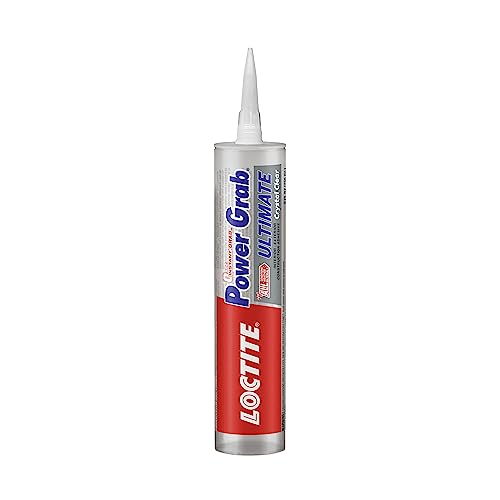
Built for the outdoor joint that has to survive rain, sun and a freezing night.
The spec that separates this cartridge from the Gorilla tube is the temperature range and the non-porous claim. Loctite rates it for 0°F to 140°F and calls it weatherproof and waterproof, and it is explicitly built to bond two non-porous surfaces — the plastic-versus-plastic case that trips up ordinary construction adhesive. Unlike the Gorilla paste, which leans on gap-filling into rough concrete, this one is aimed squarely at slick faces meeting each other, including wet ones.
The list of compatible materials names plastic first, and it will also take wood, plywood, MDF and tile. It stays crisp during application and after cure, so a bead on a visible edge does not announce itself. Quick initial tack means less bracing and nailing — you press, it grabs, and you move on. On the ground, a step repair shows the weather resistance: as one reviewer noted, “It’s been through a year of weather on that outdoor step and is still holding.”
The honest caveat is cold-weather patience. Owners mention that below freezing it can stay tacky past the 24-hour cure mark without clamps, even though the label covers cold conditions. Bring it indoors to warm up before you use it, or clamp the joint, and you avoid that entirely. It also cures hard and clear rather than rubbery, cap the tip well or it hardens shut, and once it lands on fabric it does not come out. Expect a thick paste with a good working window and decent gap-filling for a cartridge product.
Best suited to: a plastic fixture on outdoor concrete, a shower or tub surround, or any joint that gets wet and swings through temperature extremes.
Skip the shortcut: do not apply it in freezing weather and expect a 24-hour cure — warm it first or clamp it overnight.
4. SIKA SikaLatex R Acrylic Concrete Bonding Admix 1 gal

Not a glue you squeeze on plastic — a fortifier that makes the concrete itself hold better.
Be clear about what this gallon jug is, because buying it by mistake is the main risk here. It is an acrylic bonding admix — a liquid you mix into cement, mortar or grout to boost adhesion and tensile strength — not a surface adhesive you spread on the back of a plastic part. Sika formulates it with an acrylic-polymer latex that turns into hardened concrete with 500 psi bond strength, and you can also use it as a coating primer for grout. If your concrete under a plastic fixture is crumbling or dusty, fixing the concrete is the correct first move, and this is the product for that.
Durability is the reason to keep a jug around. The acrylic fortifier resists repeated freezing and thawing, so a repair on an outdoor slab does not come apart each winter, and it does not create a vapor barrier. No dilution is needed, which keeps preparation quick, and a gallon covers a serious run of patching. Bonding is what the reputation rests on, with durability next — customers note it sealing and smoothing a concrete patio and holding up in an outdoor stone fireplace mortar.
The trade-offs are about patience and timing. Full cure is listed at 30 days, and cold temperatures can stretch the drying out to three days — reviewers point out that if you disturb it while it is still going off, it crumbles and looks like a failure when it is not. It also carries a one-year shelf life, so check the date when it arrives. Plan the repair, mix, apply, and then leave it alone.
Why it earns a spot
- 500 psi bond strength hardens into tougher concrete, not a surface film
- Resists repeated freezing and thawing for outdoor repairs
- No dilution needed, so mixing is fast
- Doubles as a coating primer for grout
Read before you buy
- It is an admix for cement and mortar, not a direct plastic-to-concrete glue
- 30-day full cure, and cold weather can stretch it to three days
- Disturbing it during cure crumbles the surface
- One-year shelf life, so check the date on arrival
The right tool when: the concrete itself is failing — a crumbly slab or loose step under the plastic — and you need a repair that survives winter.
Wrong tool when: you simply want to stick a plastic bracket to sound concrete; reach for the Gorilla tube or the Loctite cartridge instead.
5. 3M Hi-Strength Spray Adhesive 94ET
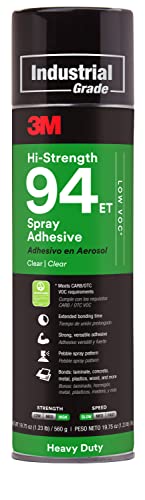
For the big, awkward build where you need a full hour to slide the panel into place.
Three specs set this can apart from the other 3M spray on this list. First, a 60-minute bonding range — a full hour to reposition and align large or complex builds, where the contact adhesive wants you placed in minutes. Second, GREENGUARD certification plus CARB and OTC VOC compliance, with Low VOC under 20%, which matters if you are working indoors. Third, an adjustable-width web spray pattern that lays a controlled, consistent coat instead of a patchy one.
The tack is aggressive up front — 3M describes a high initial grab that supports quick handling — and the formulation resists improve temperatures and moisture, so a joint in a warm workshop or a damp basement is within its comfort zone. It bonds wood, laminates, metals, select rubbers, carpet, flooring, foam, fabric, glass and plastic, which is a wide net for a single can. Quality leads the reputation, with adhesion close behind, and it sprays easily and consistently. A can also goes a long way: shoppers say getting roughly 18 months of household use from one.
Two warnings come with it. The maker labels this for industrial and occupational use only, not consumer use, and buyers report a strong airplane-glue smell that wants ventilation. The 24-hour full cure is a real wait, and value is a mixed note — some find it costly for the volume. Test any readiness by feel with gloves on, since there is no non-contact indicator on the can. For a one-off small job the Gorilla tube is the simpler buy; for a wide panel with a long alignment, this is the one.
The case for the can
- 60-minute bonding range gives real time to align large builds
- Low VOC under 20%, GREENGUARD certified and CARB compliant
- Adjustable-width web spray for consistent coverage
- Heat and moisture resistant, bonds a wide range of substrates
The trade-offs to know
- Labeled for industrial and occupational use only, not consumer use
- Strong solvent smell, so ventilate the workspace
- 24-hour full cure and a mixed value note on volume
- No non-contact readiness indicator on the can
Choose it for: a large panel or reupholstery build where you need an hour to work the plastic into place against a concrete surface.
Look elsewhere for: a small one-off joint or an unventilated indoor space — the tube is simpler and this can wants airflow.
Know the Specs
Working Time and Full Cure Time
Working time is how long you can slide and re-position the plastic before the glue grabs — the Gorilla tube allows up to 30 minutes, which is generous. Full cure time is when the bond reaches final strength, and it runs from 10 minutes on the fast 3M contact spray to 24 hours on the Gorilla tube and Loctite cartridge, and up to 30 days on the Sika admixture. A joint that feels solid after the initial grab is not fully cured, so keep clamps on longer for heavy loads.
Non-Porous Surfaces and Gap Filling
Plastic is non-porous — it gives adhesive almost nothing to soak into — while concrete is rough and absorbent. Gap-filling pastes like the Gorilla tube and Loctite cartridge bridge the pits in concrete so the contact patch stays full. Sprays cover large flat faces in one even pass but leave no thickness to fill a gap. For two slick plastic faces meeting, look for an adhesive that explicitly claims non-porous bonding, as the Loctite does.
Water, Temperature and Weather Resistance
A joint that lives outdoors or in a wet room needs waterproof and weatherproof ratings, not just strength. Gorilla rates its tube 100% waterproof and usable on wet surfaces; Loctile rates its cartridge for 0°F to 140°F and calls it weatherproof and waterproof; Sika’s admix resists repeated freezing and thawing. Cold slows every adhesive, so warm the product and extend clamp time in winter.
Spray Versus Tube
Match the form to the job size. A tube is best for small brackets, trim and gapped joints where you need control. A spray is best for broad flat panels, soundproofing and laminate where even coverage matters and you can mask off the overspray. Buying a spray for one bracket wastes product; buying a tube for a whole sheet is slow and uneven.
Common Questions
Will construction adhesive stick plastic to bare concrete?
Why does my plastic-to-concrete glue peel off after a while?
Can I use these adhesives on wet concrete?
How long before I can put weight on the joint?
Is a spray better than a tube for sticking plastic to concrete?
Will the clear adhesive really dry invisible?
Do I need to clamp or brace the joint while it cures?
Can I use the Sika admix to glue plastic directly to concrete?
Will freezing weather stop the adhesive from setting?
Should I rough up the plastic before gluing?
The Bottom Line
For most plastic-to-concrete jobs, the adhesive for plastic to concrete winner is the Gorilla Max Strength Construction Adhesive, because its up-to-30-minute working time, gap-filling paste and 100% waterproof rating handle the awkward realities of a rough wall and a slick part. If you are laying a wide flat panel, the 3M Max Strength Contact Adhesive covers area fast and cures in 10 minutes. For an outdoor or wet joint, grab the Loctite Power Grab Ultimate for its 0°F to 140°F range and non-porous bonding. And if the concrete itself is failing, repair it first with the SIKA SikaLatex R before you stick anything to it. Whichever you pick, scuff the plastic and let the full cure finish before loading the joint.
How we choose
We do not accept paid placement. Every pick is matched to a real buyer and a real use-case; we do not hands-on test units.
Sources
Specifications: manufacturer listings and product documentation. Review insights: verified customer reviews, as of October 2026. Pricing: not shown on this page (it changes often); check the current price via the retailer link.
As an Amazon Associate, Aappliancez earns from qualifying purchases. This does not affect which products we feature.