Disclosure: Some links in this post are affiliate links. As an Amazon Associate I earn from qualifying purchases, at no extra cost to you. Learn more
Specs are compiled from manufacturer listings and verified buyer reviews and can change over time — please confirm the key details on the product page before buying.
Outdoor repairs fail for one boring reason: the glue gave up before the material did. Sun bakes it, rain gets behind it, frost works it loose, and six months later the paver, the trim board, or the boat fitting is moving again. The picks below are the ones built for that abuse — two-part epoxies, marine sealants, and construction adhesives that cure hard instead of turning to chalk. If you want the short answer, start with the PC-Masonry epoxy: it fills cracks in concrete and stone and shrugs off both wet surfaces and temperature swings. Everything after that is about matching the chemistry to your material.
This guide is built by comparing the manufacturers’ published specifications and the patterns across verified customer reviews, so you get each pick’s real strengths and trade-offs instead of marketing spin.
Getting this right is mostly about two questions: what are you bonding, and will it be submerged, flexing, or sitting in full sun all year. Read the material list before you buy, because a sealer made for fiberglass and gelcoat behaves very differently from a paste meant for cracked brick. adhesive for outdoor use earns its keep when the bond survives a full winter, not just the first afternoon.
Top Picks
How To Choose The Best Adhesive for Outdoor Use
Outdoor adhesive is a chemistry decision, not a brand decision. Pick the wrong family — say, a household silicone where you need a structural epoxy — and no amount of careful application will save the joint. Start by naming your two surfaces and whether water will sit on the repair.
Match the chemistry to the material
Epoxy paste is the go-to when you are rebuilding stone or concrete. It cures to a hard, machinable solid you can sand and paint. Polyurethane sealants stay flexible, which is what you want on a boat hull that twists in waves. Construction adhesive sits in between: strong grab, some flexibility, and a formula that can handle non-porous surfaces.
Check the temperature window before you open the tube
Every adhesive has a working temperature range, and ignoring it is the most common reason a repair fails. Some formulas cure fully in 24 hours at room temperature but stall when the mercury drops near freezing. Others are rated for a wide service range once cured but need mild weather to set at all. Read both numbers — the application range and the service range — because they answer different questions.
Decide whether the joint will move
A rigid bond on a surface that expands and contracts with heat will crack. If your project flexes — hull panels, deck boards, anything that takes wave impact or foot traffic — you want a flexible sealant rather than a hard epoxy. If it is static, like a masonry crack, a rigid paste gives you the strongest hold.
Side-by-Side Comparison
| Model | Best For | Form | Full Cure | Key Strength | Amazon |
|---|---|---|---|---|---|
| PC Products PC-Masonry Epoxy Paste★ Best Overall | Cracked concrete and stone | Two-part paste | — | Wet and dry surfaces | Amazon |
| Loctite Power Grab Ultimatecrisp Pick | Invisible exterior repairs | Liquid | 24 hours | crisp bond | Amazon |
| Berkland Marine Adhesive Sealant 5200 | Boat hardware and leaks | Paste | 24 hours | Above or below waterline | Amazon |
| 105 Adhesive Sealant | Marine and industrial sealing | Liquid and paste | 7 days | Non-flammable, solvent-free | Amazon |
| TotalBoat Thixo Structural Epoxy | Structural bonding and filling | Gel and liquid | 24 hours | No-sag thickened epoxy | Amazon |
Detailed Reviews
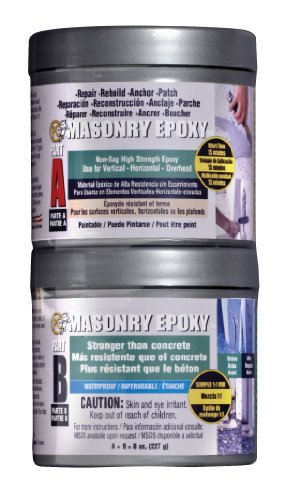
1. PC Products PC-Masonry Epoxy Adhesive Paste 8 oz
Our pick — 4.5+★ from 350+ verified ratings; the strongest balance of quality and price.
A two-can masonry paste that fills what concrete lost — and does it on a wet surface.
If you are staring at a crumbling step edge, a spalled brick, or a crack that keeps widening, this is the pick. It is a two-part epoxy paste that replaces missing masonry rather than just coating it, so you are rebuilding the material, not hiding the gap. The cans come as two parts you combine on site. Once cured, the gray paste is hard enough to be sanded, stained, or painted to blend with the surrounding concrete.
The numbers that matter here are about weather. It accepts application temperatures from 35 to 115 degrees F — meaning you can work it in a cold autumn afternoon or a hot summer day, as long as it is above freezing. Once cured, the service range stretches from -20 to +200 degrees F, which covers everything a North American winter or a sun-baked patio can throw at it. It also resists moisture during application, so a damp surface is not a dealbreaker the way it is with many adhesives.
A non-sagging paste is what makes this usable on vertical and overhead surfaces. It stays where you put it instead of running down the wall or dripping onto your shoes. The consistency is the trade-off — the paste is thick, and mixing the two parts takes real effort for some people. The trick is to mix thoroughly and work in small batches, because the paste starts firming up before long. Compare that to the Loctite Power Grab Ultimate, which is a pourable liquid with quick grab but also a mixed report on how well it holds. The PC-Masonry gives up convenience in exchange for a stronger, harder, more structural result.
The case for the two-can paste
- Fills cracks and rebuilds missing concrete instead of just sealing over them
- Works on wet or dry masonry — a damp wall does not stop the repair
- Wide service range of -20 to +200 degrees F handles real seasonal swings
- Cured paste can be drilled, sanded, stained, or painted
Where it demands patience
- Two parts must be mixed by hand, and the thick paste takes effort to blend
- Working time is short once mixed, so small batches are the safe route
- You supply your own application tools — this is a can, not a cartridge gun
Buy it if: you are repairing stone, brick, or concrete and want the joint to be permanent and structural.
Leave it if: you need to bond two smooth non-porous panels instead — a sealant or construction adhesive is the better chemistry there.
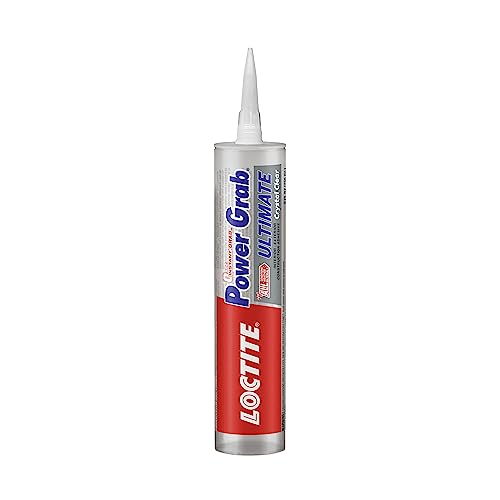
2. Loctite Power Grab Ultimate Construction Adhesive 1 Pack
Disappears as it sets, so your visible repair stays invisible under full sun.
This is the pick when the joint is going to be seen. The Loctite Power Grab Ultimate cures crisp — still transparent during application and after it hardens — so a repaired paver edge, a re-bonded tile, or a filled gap does not announce itself with a white or yellow smear. It is a liquid construction adhesive in a cartridge, which means you feed it through a caulking gun rather than mixing anything by hand.
Its weather rating covers 0 to 140 degrees F, so it handles a hot deck in summer and a cold snap in winter once cured. It also bonds two non-porous surfaces, which is a genuinely awkward job for most adhesives — glass, tile, and plastic are all fair game. Full cure takes 24 hours, and the quick initial tack reduces the need for bracing or nailing while you wait. Buyers report it holding pavers on outdoor steps through a year of weather: “One buyer reports the pavers on outdoor steps held through a full year of weather.”
Here is where you need to think before ordering. Adhesion gets mixed feedback — some report the bond simply does not grab on their surface, and ease of use lands the same way. Cold is the other factor: one account describes a failed exterior door hold in freezing temperatures, still tacky after a 24-hour cure even with ventilation. If your project sits in deep winter cold, this is not the formula for it. In mild or warm weather, though, the things buyers keep coming back to are the clarity and how easy fresh squeeze-out wipes away with mineral spirits before it sets.
The honest trade-off: this formula buys you invisibility and no-mix convenience, and the cost is a bond whose reported reliability depends more on your surface and temperature than on technique.
Reach for this if: your repair is visible, your weather is mild, and you want a clear, no-mix bond that wipes clean while wet.
Look elsewhere if: the job will sit below freezing for the first 24 hours — the cure stalls before it can grab.
3. Berkland Marine Adhesive Sealant 5200 Fast Cure, 3 oz White
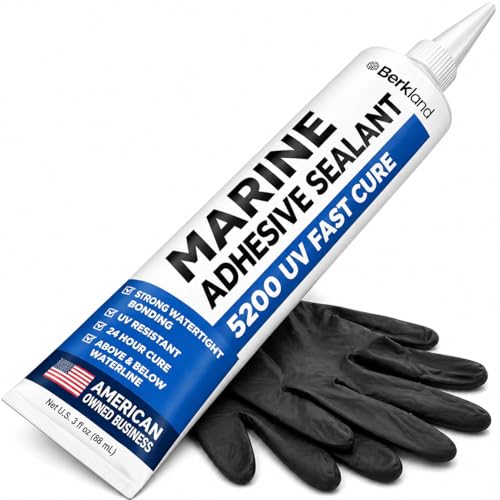
Goes months of leak checks in a few hours — two hours to tack-free instead of days.
For boat fittings, through-hulls, and portlights, the wait is usually the worst part. Traditional 5200 sealant can take up to 7 days to fully cure, which is a week your boat sits on the hard. This fast-cure version skins in 1 hour, goes tack-free by 2 hours, and reaches handling strength by 24 hours. At 4.5 ounces, the compact 3 oz tube is sized for targeted repairs and small bedding jobs rather than a full hull run.
It is rated for above or below the waterline and built to handle water pressure, hull flexing, and wave impact. The formula is UV and weather resistant — it will not crack, shrink, or chalk after sun and salt spray — and it bonds fiberglass, wood, gelcoat, aluminum, steel, and most plastics. It comes with disposable gloves, and the instructions matter: this is stiff material. Buyers who have used it on a bathroom leak say the fix simply stopped leaking: “One buyer used it on a bathroom leak and reports the leak stopped.”
The catch is elbow strength. Squeezing this out of the tube is hard work — several accounts mention heating the tube in roughly 120-degree-F water to make it flow, and squeezing from the rear to avoid blowing out the crimped end. Ventilation and gloves are non-negotiable. Plan on a difficult first application on a rough surface and you will not be surprised. If your job is a wide, flat, easy-access seam rather than a tight boat fitting, the TotalBoat Thixo flows from a standard caulk gun with far less fight, though it cures to a hard epoxy rather than a flexible seal.
Who it suits: anyone sealing or bedding hardware where salt, sun, and water contact are permanent conditions.
A strong match for: boat owners and anyone who needs a flexible, permanent watertight seal on fiberglass, wood, or metal.
Consider another formula if: you want an easy squeeze — this tube is genuinely stiff and fights back.
4. 105 Adhesive Sealant 10.1 oz Black
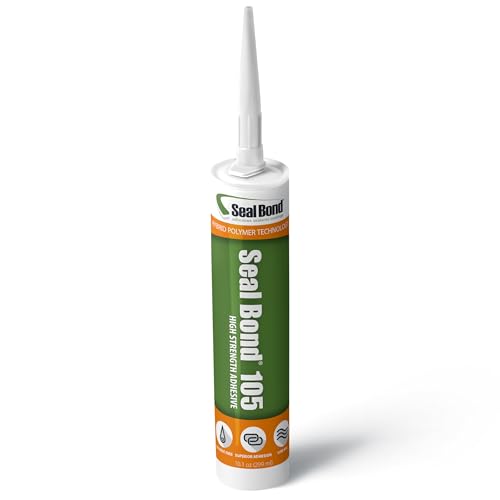
A solvent-free polyether sealant you can run in an enclosed space without fumes building up.
Most outdoor sealants smell like a chemistry lab, which rules them out for garages, basements, and any space without real airflow. This one is built differently — non-flammable, solvent-free, and isocyanate-free. Combined with a one-component formula that needs no primer, it is the easiest of the group to actually start using. Application is a standard caulking cartridge, so no mixing, no two-part ratio, no extra cups.
The 10.1 oz black cartridge is rated for marine and industrial above-the-waterline use, with a weatherproof seal that resists UV exposure and temperature extremes while staying flexible. It bonds concrete, fiberglass, plastic, and wood. Full cure is 7 days — longer than the sealants above — so plan on leaving the joint alone for a while even though it sets quickly enough to hold position within the hour. Owners mention it happily taking on jobs the label never promised. One rebuilt worn work boot soles: “One buyer filled cavities in worn work boot soles and reglued them to the uppers, and reports the repair holding after months of daily wear.”
Two things to know going in. The material is thick and does not forgive a sloppy hand — it sets fast, so have everything staged before you open the cartridge. And unlike silicone, which self-levels into a smooth bead, this one is hard to tool into a clean finished edge; the best you can manage is a slightly rough surface. If a crisp, professional-looking bead line is the goal, silicone still wins that specific contest. If durability and safe indoor use are the goal, this one wins.
Why it earns its place
- Solvent-free and non-flammable, so it is safer in enclosed spaces
- One-component, no-primer formula applies straight from a standard caulk gun
- Stays flexible while resisting UV, cracking, and degradation
- Bonds concrete, fiberglass, plastic, and wood
Plan around this
- Full cure runs a full 7 days before the bond is at full strength
- Sets fast, so slow or hesitant application shows in the bead
- Hard to tool into a smooth, clean finish compared to silicone
Best fit for: boat owners and industrial users who value a non-toxic, non-flammable sealant they can apply indoors.
Skip if: your project demands a crisp, smooth bead line — silicone tools better, even if it does not last as long outside.
5. TotalBoat Thixo Structural Marine Epoxy Glue 185ml Tube

The thickened two-part epoxy that stays put on a vertical surface while it cures rock hard.
This is the one for a repair that has to carry load and cannot afford to sag while it sets. The 185 ml cartridge is a two-part thickened epoxy with an internal static mixer in the tip, so the resin and hardener combine automatically at the correct ratio as you squeeze. No measuring cups, no stirring, no wasted batch at the bottom of the container — you get the same firm bond every time.
The viscosity is the headline spec. It is thick enough to hold position on overhead or vertical surfaces and stay exactly where you put it, yet thin enough to wet out fiberglass properly. Working time is generous: at 77 degrees F you get roughly 50 minutes before the material starts to gel — enough to reposition and clamp without panic. Gel arrives at 30 to 35 minutes and full cure in 24 hours. It bonds wood, fiberglass, metal, brick, concrete, glass, slate, tile, and stone, and the cured epoxy can be drilled, sanded, and painted — 100% waterproof once set.
Two real caveats. First, tube yield: the mixers and internal two-part ratio mean one cartridge delivers noticeably less usable adhesive than a plain caulk tube of similar size, which matters if you are estimating a repair that needs volume. Second, the first portion that comes out of the tube is typically the slowest to set up — expel and discard the first squeeze or so, then start applying. Neither is a defect, but both cause avoidable surprises if you do not plan for them. For a structural fiberglass repair or a load-bearing joint on furniture or a boat, this is the most capable adhesive of the five.
Standout strength: the no-sag thickened formula is what turns a difficult overhead or vertical repair into a manageable one.
Cost of admission: it is the priciest option here and delivers less usable volume per tube, so buy a second cartridge for anything bigger than a targeted repair.
Pick this for: structural repairs on a vertical or overhead surface where the adhesive must hold its shape while curing.
Pass on this if: you are sealing a flexible seam above the waterline and do not need structural strength — a marine sealant is the better fit.
Know the Specs
Full Cure Time
The time it takes the adhesive to reach full strength after application. A 24-hour cure lets you get back to normal use the next day; a 7-day cure means leaving the joint undisturbed for a full week. Choose based on how soon you need the surface back in service, and always give the joint adequate time before putting weight on it.
Application Temperature Range
The window in which the adhesive will actually set. Above or below these limits, the formula stalls or never grabs, even if it looks like it applied fine. Check this before starting work in a cold garage or a hot sunny afternoon, because temperature is the most common cause of a bond that fails.
Flexible vs Rigid Bond
Flexible sealants move with the surface — ideal for boats, deck boards, and anything that expands and contracts. Rigid epoxies cure hard and hold their shape under load, which suits static repairs like concrete cracks. Matching flexibility to how much the joint will move is what keeps a repair from cracking open the first season.
Non-Sagging Formula
A non-sagging paste holds its position on vertical and overhead surfaces instead of running down before it sets. This is essential for ceiling cracks, wall-mounted fittings, and any repair you cannot lay flat. Thickened formulas cost more and need more effort to apply, but they are the only option for gravity-defying jobs.
Common Questions
Can I use a two-part epoxy on wet surfaces or do I have to wait for the area to dry?
How cold can it be before outdoor adhesive stops curing properly?
Will marine sealant really hold below the waterline or is that marketing?
How long is the working time on thickened epoxy before it becomes unworkable?
Can I paint or stain over an outdoor adhesive after it cures?
Does clear construction adhesive yellow over time in sunlight?
Why is my marine sealant hard to squeeze out of the tube?
Is a two-part epoxy or a single-component sealant better for a structural repair?
Do I need a caulking gun for these adhesives?
The Bottom Line
For most outdoor repairs, the strongest all-around pick is the PC-Masonry Epoxy Paste — it rebuilds cracked concrete and stone, tolerates wet surfaces, and holds from -20 to +200 degrees F, which is the widest service range in this group. If your repair is visible and you want an invisible bond that wipes clean while wet, grab the Loctite Power Grab Ultimate. And for any load-bearing joint on a vertical or overhead surface that needs to cure hard without sagging, the TotalBoat Thixo is the one to reach for — just buy extra if your project needs volume.
How we choose
We do not accept paid placement. Every pick is matched to a real buyer and a real use-case; we do not hands-on test units.
Sources
Specifications: manufacturer listings and product documentation. Review insights: verified customer reviews, as of October 2026. Pricing: not shown on this page (it changes often); check the current price via the retailer link.
As an Amazon Associate, Aappliancez earns from qualifying purchases. This does not affect which products we feature.