Disclosure: Some links in this post are affiliate links. As an Amazon Associate I earn from qualifying purchases, at no extra cost to you. Learn more
Specs are compiled from manufacturer listings and verified buyer reviews and can change over time — please confirm the key details on the product page before buying.
Glass is smooth and won’t soak up any glue, and metal expands and shrinks as it warms and cools. That mismatch is why so many metal-to-glass repairs pop apart within days. The five picks below all hold real bonds on metal and glass — one is a steel-reinforced epoxy that cures hard enough to drill, one is a primerless adhesive built for auto windows, and one is a fast jeweler’s resin that dries invisible. Each pick lists its cure time, its compatible surfaces, and its honest trade-offs, so you can buy the right tube once.
This guide is built by comparing the manufacturers’ published specifications and the patterns across verified customer reviews, so you get each pick’s real strengths and trade-offs instead of marketing spin.
Every pick here is sorted by what it actually bonds and how long it takes to cure, so you can match the glue to your repair instead of guessing. This shortlist of the adhesive for metal to glass runs from a fast-setting jeweler’s resin to a steel-reinforced epoxy.
Top Picks
How To Choose The Best Adhesive for Metal to Glass
You are bonding two surfaces that behave differently. Metal moves slightly as it heats and cools, while glass stays put. A rigid glue that cures like stone can crack under that movement, and a soft glue that stays rubbery can slowly let go. So match the adhesive’s cure behavior to the material and to the stress your joint will see.
Set time versus cure time
Set time is how long you must hold the parts still before the glue grabs. Cure time is how long before the joint reaches full strength. A steel-reinforced epoxy like the J-B Weld 8281 sets in 4-6 hours and fully cures in 15 heavy-use hours, so it suits a repair you can leave overnight. A fast epoxy like Starbond reaches handling strength in about 5 minutes, so you can let go of a part almost immediately. Pick the speed that fits your repair window.
Match the formula to the material
Not every glue loves both surfaces. A urethane glass adhesive like the Dow U-418 cures using moisture pulled from the air, which makes it a natural fit for windows and glass panels. A neoprene contact cement like S-18 bonds rubber and vinyl to metal but is meant for indoor work. An epoxy is your generalist, but check that the label lists both metal and glass as compatible materials before you buy.
Side-by-Side Comparison
| Model | Best For | Full Cure Time | Compatible Materials | Item Form | Amazon |
|---|---|---|---|---|---|
| J-B Weld 8281★ Best Overall | Steel-strength structural repairs | 15 hours | Metal, glass, ceramic, wood, PVC, fiberglass | Paste | Amazon |
| S-18 All-Purpose AdhesiveMost Versatile | Rubber, vinyl, and fabric to metal | 24 hours | Glass, metals, ceramics, cork, fabric, felt, rubber | Liquid | Amazon |
| Vigor Jeweler’s Epoxy 2 Step | Invisible jewelry and small metal-to-glass repairs | 24 hours | Ceramic, metal, glass | Liquid | Amazon |
| Dow Automotive U-418 Beta Seal | Auto glass and window-panel bonding | 24 hours | Glass | Gel | Amazon |
| Starbond 5 Minute Epoxy Pro Kit | Fast, flexible vibration-prone joints | 24 hours | Ceramic, glass, metal, wood | Paste | Amazon |
Detailed Reviews
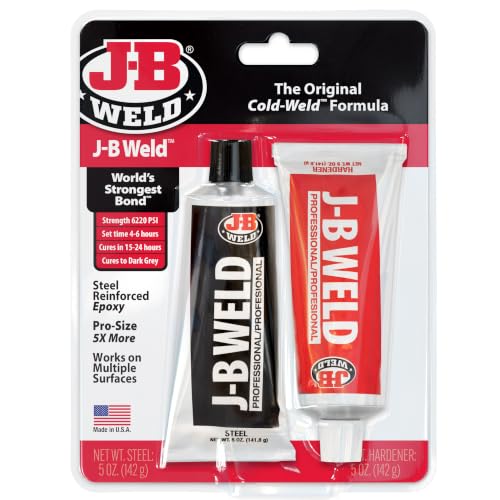
1. J-B Weld 8281 Professional Size Steel Reinforced Epoxy
Our pick — 4.5+★ from 10,000+ verified ratings; the strongest balance of quality and price.
The steel-reinforced epoxy that cures hard enough to drill through
This one takes the top spot on a single number: 5,020 PSI tensile strength. That is how much pulling force the cured bond resists before it lets go, and it is what separates a structural epoxy from a craft glue. It is steel reinforced and holds up to 550 degrees Fahrenheit (287 degrees Celsius), so a joint sitting in summer sun or near an engine bay will not soften and slide. That covers a metal bracket bonded to a glass panel, a cracked pot, a stripped thread, or an automotive repair.
Working with it takes a little patience. Mix the two tubes at a 1:1 ratio, let the joint set for 4-6 hours, then leave it to fully cure in 15 hours. What you get back is a dark grey bond you can tap, file, sand, mold, and drill once cured. For a glass-to-metal joint under load, being able to sand the cured bead flat means you can make the repair disappear behind the frame. The 10 oz pack covers plenty of smaller jobs, and at 3.2 ounces it is noticeably lighter in the hand than the 5.6-ounce S-18 contact cement below, so it sits steadier while you work.
Buyers report the cured bead holds for years on metal, plastic, and glass repairs. It has bonded a slippery plastic rain barrel to galvanized pipe, repaired a concrete statue, and patched a cracked glass coffee pot with a patch no bigger than a postage stamp. One buyer put it in the broadest terms: “Always works great, binds well, cures fast. Use for steel, plastic, and just about anything.” The recurring gripe is the squeeze-out. Mixing is messy, and owners mention the tubes carry a fair amount of air. For a joint that has to be invisible, the grey color matters too — you cannot hide it inside a clear glass seam.
Where It Pulls Ahead
- 5,020 PSI tensile strength gives a bond you can drill, sand, and machine once cured
- Withstands up to 550 degrees Fahrenheit (287 degrees Celsius), so warm joints hold firm
- Bonds metal, glass, ceramic, wood, PVC, and fiberglass from a single 10 oz kit
- Fully waterproof and resistant to petroleum, chemical, and acid once cured
Where It Tests Your Patience
- The 1:1 mix is messy and customers note the tubes carry noticeable air
- Cured color is dark grey, which is hard to hide inside a clear glass seam
- You cannot load the joint for 4-6 hours while it sets
Best for: structural metal-to-glass repairs that will carry weight or take a knock.
Look elsewhere if: your joint sits in plain view through clear glass and you need it to vanish.
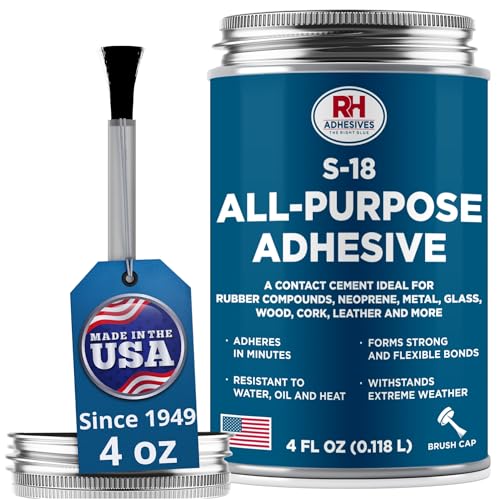
2. S-18 All-Purpose Adhesive 4 oz
The brush-and-grab contact cement that sticks rubber and vinyl to metal fast
Reach for this one when your metal-to-glass job is really a metal-to-everything job. S-18 grips both porous and non-porous surfaces — rough wood and slick glass from the same formula — and it bonds rubber to metal, a pairing most household glues will not hold. The water-resistant solvent base lets it work in marine settings and in difficult temperatures. At 5.6 ounces in the can it holds more adhesive than the 3.2-ounce J-B Weld tubes, so a bigger project does not run you dry mid-job.
Speed is where it wins people over. It grabs fast on vinyl to metal, which is why it lives on the front desk in busy studios for quick fixes on chairs, boards, and trim. Reviewers point out it reattached a pair of detached boot soles with enough left for a second pair. Full cure takes 24 hours, and the can lists glass, metals, ceramics, cork, fabric, felt, rubber compounds, and tile as compatible. The catch is the fume. The solvent smell is strong, so work in a ventilated spot or leave the room while it flashes off. Keep it indoors, too — Shoppers say one attempt to glue neoprene matting onto a car for hail protection fell apart under heat, weight, and rain.
Where it genuinely stumbles is heavy flexible loads. Adhesion and hold draw mixed feedback, and it does not match the security of sewing on a stress-bearing fabric seam. But for a metal bracket attached to a glass panel, or edge trim reattached to a frame, it does the job faster than any epoxy here. Treat it as an indoor, low-flex repair and it does exactly what you ask.
Fast-grab strength: Bonds vinyl, rubber, and neoprene to metal within minutes, which is why studios keep a can within arm’s reach.
The ventilation tax: Strong solvent smell needs airflow, and it is a poor fit for outdoor joints that see heat and rain.
Reach for this if: you are bonding rubber, vinyl, fabric, or trim to a metal or glass frame indoors.
Think twice if: the joint lives outdoors or will be pulled apart repeatedly, since heavy flex loads beat it.
3. Vigor Jeweler’s Epoxy 2 Step 12.0451

The clear jeweler’s resin that dries invisible on small metal-to-glass joins
Some repairs are so small that a grey structural bead would be the whole problem. This two-part epoxy cures clear and colorless, so a repaired drop on amber, a pearl set back on a ring post, or a small stone reset in metal blends into the surround. It is waterproof too, which matters if the piece sees salt water, a hot tub, or regular washing. Buyers report a jade bracelet repair where a rival epoxy broke at both glued points within 48 hours, while the Vigor bond held clear and solid.
Speed is the other draw. Full cure lands at 24 hours, but handling comes much sooner — owners describe it setting in 4 minutes, which makes small, fiddly parts far easier to keep positioned. You apply it as a liquid with a brush or roller, though for jewelry a toothpick or fine brush is the practical tool. It reaches a working bond faster than the 15-hour-cure J-B Weld above, which shortens how long you must leave a delicate piece untouched. Mixing is less convenient than squeezing super glue, and getting it right matters: remove every trace of old glue residue first, or the new bond may lift with the old layer.
The one thing to plan around is grip on very smooth material. Adhesion draws mixed feedback, and owners mention one stone fell out within three days while its neighbor held. This is a small-repair, small-bottle product — jewelry and delicate parts, not a metal bracket carrying real weight. Keep it to light-load, cosmetic, and fine-detail jobs and it keeps its promise.
Invisible results: Dries clear and colorless, so repairs on amber, pearls, and small stones blend into the piece with no visible line.
Works best on: jewelry, small glass chips, and light cosmetic metal-to-glass repairs where the joint must stay invisible.
Not built for: a joint that carries structural weight or a large surface that must grip under load.
4. Dow Automotive-U-418 Beta Seal Glass Adhesive, Black

The primerless urethane built for glass panels and vehicle windows
When the glass is the fragile part and the frame is the anchor, you want an adhesive designed around glass rather than adapted to it. The U-418 is a urethane gel (a thick adhesive that cures using moisture in the air), and that moisture cure is its signature trick. No primer, no mixing, no 1:1 ratio to eyeball. It dispenses as a gel, so application is quick and easy, and odor is minimal next to the solvent-based S-18 above — a real plus in a closed garage. It ships as an 8-ounce cartridge, enough to run a long bead around a window or reseal a whole panel.
Customers note the primerless convenience carries real weight. A windshield bead applied straight to degreased glass held for a year and 4,000 miles on an RV. The same adhesive reattached car power-window glass clips that cured in about 24 hours and let the window work again. On a Mustang convertible, it rejoined the rear window to the vinyl top in two spots and held for five months. The black color is the one cosmetic note — it is meant to sit behind a frame or in a gasket where you will never see it. You get a full 24 hours of cure time before the joint takes its real load.
The recurring irritation is the nozzle. Reviewers point out the applicator tip is missing from many shipments, and the oversized spout will not fit a standard caulking gun, so you either cut it down with tin snips or track down an oversized gun. A few buyers have returned theirs over it. It also cures slowly in cold weather — warm the cartridge in a water bath first — and once it is on your hands, getting it off takes WD-40 or Goof Off and still leaves traces. Gloves are not optional with this one.
Why Glass Loves It
- Primerless formula cures on ambient moisture, so there is no mixing and no separate primer step
- Built specifically for glass bonding, from auto windows to window wells
- Minimal odor keeps a garage or workshop comfortable during a long bead run
What to Plan Around
- The applicator tip is missing from many shipments, a common enough issue that buyers return theirs
- The oversized spout does not fit a standard caulking gun without trimming
- Slow to cure in cold weather and very difficult to remove from skin
Best for: auto windows, glass panels, and any joint where glass is the primary surface to bond.
Order the tip too: expect to trim the oversized spout or supply your own applicator before you start.
5. Starbond 5 Minute Epoxy Pro Kit

The flexible fast-set epoxy for joints that shake, flex, and take a knock
Joints that move call for a different glue, and this one is rated at 2,600 lb shear strength — the sliding force a one-inch overlap of the cured bond resists. Its flexible toughened formula is engineered to absorb vibration and stress without brittle cracking, so it bends under movement instead of snapping. Think a bracket bolted to a vibrating frame, a mirror mount on a moving panel, or a household joint that gets bumped. Full set still takes 24 hours to fully cure, so the slow-epoxy rule applies if you plan to rush. It is also clear-curing, where the grey J-B Weld above would be a dead giveaway on a visible glass edge.
The grab speed is the other reason to pick it. It reaches handling strength in about 5 minutes, so you can hold a small part in place and let go almost immediately — and it stays repositionable until nearly dry, which is forgiving on a fiddly joint. Mix it 1:1 by volume. It bonds wood, metal, glass, ceramic, and many plastics like ABS (a common hard plastic used in housings and trim) and PVC, so it covers a wide range of jobs around the house.
The pro kit is built for people who are tired of leaky syringes. You get screw-cap bottles, reusable mixing trays, and application tools, so there is less waste and the bottles keep better on the shelf. The honest limit: reviewers report it is more likely to let you down on a butt-joint under steady load — one buyer on a crown-molding test found it cracked at both joints he glued. In practice, the fix is simple: prep the surfaces and clamp until fully cured, and it rewards you on standard metal-to-glass work. Just do not expect it to hold a joint that flexes on its own without reinforcement.
The versatility win: One kit covers wood, metal, glass, ceramics, and plastics like ABS and PVC, so you can skip buying a different adhesive for each material in the house.
Clamping matters: It stays flexible after curing, which favors vibration-prone joints but can be a weak point on a rigid butt-joint under constant pull.
Pick this one if: your joint will see vibration, flex, or an occasional knock and you want a clean, clear finish.
Skip the clamp-free shortcut: a joint that never gets clamped to full cure is the one it is most likely to fail.
Know the Specs
Tensile strength and shear strength
Tensile strength (how hard you can pull a bond straight apart before it fails) is rated at 5,020 PSI on the J-B Weld 8281. Shear strength (how much sliding force a bond resists) is what the Starbond kit lists at 2,600 lb. For a metal-to-glass joint carrying a static load, higher tensile numbers mean a more rigid hold. For a joint that twists or vibrates, shear and flexibility matter more than raw pull strength.
Set time versus full cure
Set time is how long before the parts stop moving; full cure is when the joint reaches its rated strength. Starbond reaches handling strength in about 5 minutes and fully cures in 24 hours, while the J-B Weld 8281 sets in 4-6 hours and cures in 15 hours. A joint that sets fast usually still needs the full cure window before you load it, so plan your repair around the cure time, not the set time.
Cure mechanism: mixing versus moisture
Two-part epoxies like J-B Weld and Vigor cure when you mix the resin and hardener at a 1:1 ratio, so the mix must be accurate. A urethane adhesive like the Dow U-418 uses a completely different route: it pulls moisture from the air to cure, which is why it needs no primer and no mixing. Moisture-cure adhesives are slower in dry, cold conditions, while mixed epoxies cure at a more predictable rate.
Surface compatibility and prep
Check the compatible-material list before you buy. The Dow U-418 is designed for glass, while the S-18 covers glass, metals, rubber compounds, and fabric, and the J-B Weld 8281 covers metal, glass, ceramic, wood, PVC, and fiberglass. On any of them, cleaning off old adhesive residue and grease first is what decides whether the new bond grips or lifts with the old layer underneath.
Common Questions
Which adhesive is best for bonding metal to glass?
Can I use epoxy to glue glass to metal?
How long does a metal-to-glass bond take to cure?
Will a clear epoxy be strong enough for a metal-to-glass repair?
Do I need a primer before applying a glass adhesive?
Can a flexible epoxy hold a joint that vibrates?
Is contact cement good for glass and metal together?
What is the difference between set time and cure time?
How should I prepare metal and glass before gluing them?
Can I drill or sand a cured metal-to-glass epoxy joint?
The Bottom Line
For most metal-to-glass repairs, the adhesive for metal to glass that does the job best is the J-B Weld 8281 because its 5,020 PSI tensile strength and 550-degree Fahrenheit (287 degrees Celsius) heat resistance hold a structural joint that you can then sand and drill. If you want a fast, flexible bond that cures clear on a joint that shakes, grab the Starbond 5 Minute Epoxy Pro Kit. And for a small jewelry or cosmetic fix where the line must disappear, the Vigor Jeweler’s Epoxy is the one to reach for. Buyers agree on one point — the J-B Weld is the epoxy they reach for when the joint has to hold for years.
How we choose
We do not accept paid placement. Every pick is matched to a real buyer and a real use-case; we do not hands-on test units.
Sources
Specifications: manufacturer listings and product documentation. Review insights: verified customer reviews, as of October 2026. Pricing: not shown on this page (it changes often); check the current price via the retailer link.
As an Amazon Associate, Aappliancez earns from qualifying purchases. This does not affect which products we feature.