Disclosure: Some links in this post are affiliate links. As an Amazon Associate I earn from qualifying purchases, at no extra cost to you. Learn more
Specs are compiled from manufacturer listings and verified buyer reviews and can change over time — please confirm the key details on the product page before buying.
A mirror that slides down a tiled wall, or a windshield seal that lets go right where the glass meets the frame, usually depends on one thing: you used the wrong type of glue for that joint. Silicone flexes as temperatures swing, contact cement grabs fast but needs both surfaces to be right, and epoxy locks rigid — mix those up and the bond fails. So before you glue anything, figure out which of those three your job needs.
This guide is built by comparing the manufacturers’ published specifications and the patterns across verified customer reviews, so you get each pick’s real strengths and trade-offs instead of marketing spin.
Below are five adhesives, and each one wins a different job. Some are built for flexibility, some for grab speed, and some for raw load-bearing strength. The fastest way to land on the right one is to match your joint to the cure time and the material list in this guide to the best adhesive for glass to metal.
Top Picks
How To Choose The Best Adhesive for Glass to Metal
Ask yourself one question before you buy: does your glass-to-metal joint need to move, or does it need to stay put? Flexible joints — a shower frame, a metal tile seam, an outdoor repair that freezes overnight — want a silicone that stretches as the two materials expand at different rates. Rigid joints — a mirror panel, a fuel tank patch, a loose bracket — want an epoxy or a urethane that locks down and carries weight.
Match the cure time to what you are gluing
A 30-minute full cure (the point where the adhesive reaches its rated strength) is fine for a seam you will not load. A 24-hour cure is what you want when the joint has to hold something heavy while it sets. Glass and metal expand and contract at different rates as the temperature changes. Move a joint too early and it usually fails on the first cold night — that is the most common cause of a bond letting go.
Check the material list, not the label
Every product here lists the exact materials it bonds to, and that list matters more than the brand name. If your job involves acrylic (a clear plastic often sold as a glass substitute), read carefully — one of the picks here is explicitly noted as less effective on it. If your job involves glass specifically, you want a formula built for glass, not a general-purpose tube that also happens to list glass somewhere.
Plan for the applicator
Several cartridges in this category ship without a nozzle, and a few have a spout sized for a runway caulking gun rather than a standard one. Before the tube arrives, decide if you need a caulking gun, tin snips, or a warm water bath for cold-weather work. Five minutes of prep beats a wasted tube.
Side-by-Side Comparison
| Model | Best For | Cure Type | Full Cure Time | Compatible Materials | Amazon |
|---|---|---|---|---|---|
| Silicone 2 Advanced Metal★ Best Overall | Flexible metal seams and outdoor joints | Silicone paste | 30 minutes | Metal, glass, wood, plastic | Amazon |
| S-18 All-Purpose AdhesiveFastest Grab | Fast-grab fixes on mixed materials | Neoprene contact cement | 24 hours | Ceramics, cork, fabric, felt, glass, metals, rubber compounds, tile | Amazon |
| Dow Automotive U-418 Beta Seal | Glass bonding where you cannot prime | Urethane gel | 24 hours | Glass | Amazon |
Detailed Reviews
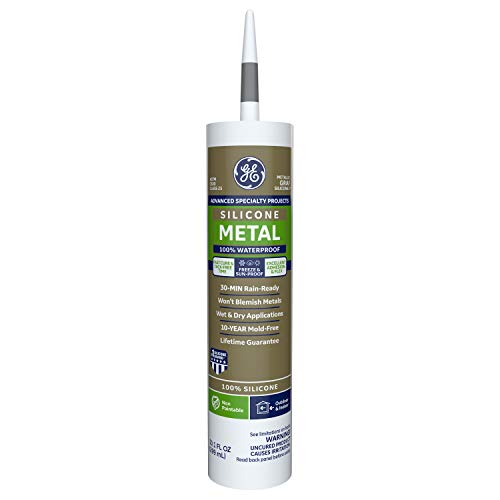
1. Silicone 2 Advanced Metal
Our pick — 4.5+★ from 800+ verified ratings; the strongest balance of quality and price.
The flexible one: it moves with the metal instead of fighting it.
This pick takes the top spot because its 30-minute full cure is the shortest in the lineup by a wide margin. That matters any time your glass-to-metal joint lives outdoors, near a garage door, or anywhere the temperature swings. It is a silicone paste in Metallic Gray. Seal the base of a garage or tie together metal tile seams, and you can apply it, tidy the line, and walk away inside half an hour.
The Metallic Gray color does real work, not just cosmetics. Once cured, it reads as actual metal, so it disappears into tin tile seams and stainless steel surrounds — the joint looks original, not patched. It lists adhesion to metal, glass, wood, and plastic, so it handles mixed-material jobs where you bridge a glass edge to a metal frame in one pass. It is also rated for indoor and outdoor use, watertight, and formulated to resist mold and mildew — handy if the joint sits in a damp spot.
Plain reliability is what wins people over. One buyer reports a metal joint still holding at -5 degrees: “It’s now -5 degrees and it is still working great!” — the exact cold-weather test a flexible sealant has to pass. The recurring caution is lifespan: some users find the seal does not last as long as they hoped on permanent installations. Note the size before you order: a 9.8 fluid-ounce tube at 10.1 ounces of shipping weight, noticeably heavier to hold than the 5.6-ounce S-18 contact cement in the next pick.
High-Temp Silicone Seal
- A 30-minute full cure gets you off the ladder fast — the quickest setting time among these picks.
- Metallic Gray cures to look like real metal, so glass-to-metal seams visually disappear.
- Bonds metal, glass, wood, and plastic, and is rated for both indoor and outdoor use.
- Watertight and formulated to resist mold and mildew.
Cure Time Needs Patience
- It is a flexible sealant, not a structural glue — it will not carry a heavy static load the way epoxy does.
- Some owners find the lifespan shorter than they expected for a permanent bond.
- At 9.8 fluid ounces it is the heaviest tube here, which matters if you are working overhead or one-handed.
Pick For Heat: your glass-to-metal joint sees weather, temperature swings, or vibration and needs to flex rather than lock.
Skip For Speed: you are hanging something that must not budge — the epoxy and mirror picks below carry static weight far better.
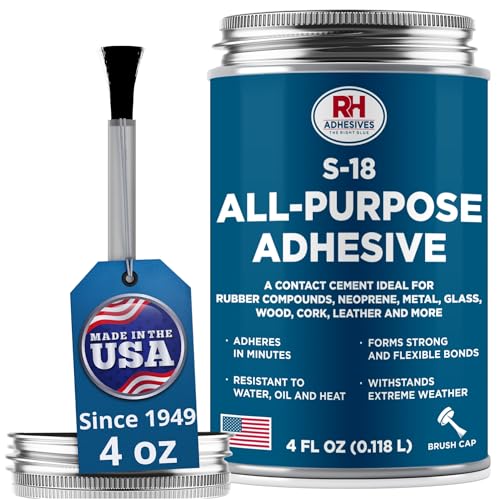
2. S-18 All-Purpose Adhesive 4 oz
The 4-ounce grab-and-go tube for repairs that cannot wait for a 24-hour cure.
This earns its spot on material coverage: it lists eight compatible surfaces, the broadest list in this lineup. That is a neoprene contact cement (a rubber-based glue you coat on both parts, let get tacky, then press together) in an off-white liquid form. One 4-ounce tube on a studio shelf covers vinyl to metal, rubber to metal, and fabric to wood without a second trip to the store.
At 5.6 ounces of shipping weight, it is easy to hold overhead or in a tight corner — roughly half the heft of the Silicone 2 tube. That matters when you are trying to hit a small contact patch on the underside of a trim panel. The manufacturer has been making adhesives in the United States since 1949. The formula is spec’d for water resistance plus a heat-resistant, strong film, which is why it gets used in marine jobs and hot workshops alike.
Hold is the reason to buy it. One buyer rescued a peeling sample board 15 minutes before a client walk-through, and the vinyl-to-metal grab held through the meeting. The honest catch is two-part. Adhesion is the most-mixed trait in this block, with users reporting trouble getting it to bite on rubber surfaces — so test rubber-to-metal on scrap first. And the solvent smell is real; the manufacturer calls it out, and the instructions assume a ventilated workspace.
Heavy Headliner Hold: Where it beats the Silicone 2. It carries the widest material compatibility list here — eight materials including rubber compounds — where the Silicone 2 covers four. It is also about half the shipping weight.
Strong Solvent Fumes: Where the Silicone 2 beats it. Cure time goes the other direction: 24 hours here versus 30 minutes on the Silicone 2, so this is not the pick for a fast-load-bearing joint.
Choose For Fabric: you are patching upholstery, headliner, trim, or a sample board and you need the grab to happen now.
Avoid In Small Rooms: the joint is rubber-on-metal and you cannot ventilate the room — test the rubber bond on scrap first.
3. Dow Automotive-U-418 Beta Seal Glass Adhesive

The windshield-grade urethane that cures on the moisture already in the air.
Only this pick is built for glass alone — its compatible material list names glass and nothing else. That makes it the specialist here. It is a black urethane gel (a thick rubber-like adhesive) in an 8-ounce cartridge with a 24-hour full cure. Its headline feature is “Primerless Convenience”: the formula pulls moisture from the air around it to cure, so you skip the separate primer step that normally eats up a windshield or RV job. Minimal odor and a United States origin round out the spec sheet.
The RV repair story is the one that sells it. One owner reattached a glued-in windshield whose original adhesive had failed at the glass interface — no primer, applied through a regular caulking gun and smoothed by hand — and it held for 1 year and 4000 miles, with a cold-weather tip to warm the sealant in a water bath first. The same urethane reattached a Mustang convertible top where the rear window had separated from the vinyl in two spots, still holding 5 months later after a 48-hour cure.
Two things to check before the tube ships. First, the applicator tip: a meaningful share of users report the nozzle missing from the box, and the spout is oversized for a standard caulking gun — plan on a larger gun or a quick trim with tin snips. Second, this stuff commits once it touches skin; users warn that removal takes WD-40 or Goof Off and still leaves traces, so gloves are not optional.
Primerless Glass Bond: no separate primer step is what separates this from a general-purpose glass adhesive — it goes straight from cartridge to surface.
Pricey Per Ounce: the cartridge hardware is the weak link, and skin contact is a job-site hazard worth taping for.
Use On Windshields: windshield, convertible top, and RV glass-to-metal repairs where you want one cartridge and no primer bottle.
Pass On Budget Jobs: glossy plastic or rubber-only jobs — the compatible list here is glass, plain and simple.
4. PEGATANKE – Black 2 Part Epoxy Resin & Cold Weld Adhesive

The structural one: 550 pounds of dead weight per 1.48 ounces of glue.
This is the only pick here that publishes a load rating. The maker rates this epoxy to hold up to 550 pounds of dead weight per 1.48 ounces, which is why it lands the heavy-load slot. That makes it the pick for a fuel tank patch or a bracket that carries real weight. It is a two-part epoxy (a resin and a hardener you mix together) in a black kit — 1.48 ounces net weight, a thick paste rather than a runny liquid — and the maker also rates it to resist up to 120 PSI of pressure. It cures underwater when fully submerged, which covers nautical machinery and flooded-basement repairs that no silicone or contact cement here can touch.
The application is a six-step process spelled out on the packaging: clean the area, mix compounds 1 and 2 in equal parts, stir with the included spatula for 3 minutes, apply, join the parts, and let it set. Drying runs 30 minutes in direct sun or 90 to 120 minutes in shade, with total curing around 8 hours. It lists metal, steel, aluminum, copper, MDF, ceramic, paving stone, wood, glass, PVC, plastic, tile, and fiberglass as compatible surfaces — the widest list of any pick here at thirteen materials.
The one hard limitation is written into the product page itself: it is less effective on acrylic. If your job involves an acrylic panel or acrylic mirror, this is not the pick — the CS-4300 mirror adhesive below is explicitly rated for acrylic. For fuel tanks, exhaust piping, water tanks, coolant tanks, catalytic converters, bumpers, and surface cracks, the load rating plus the underwater cure makes it the natural first choice.
Two-Part Cold Weld: Where the Silicone 2 is the better call. Rigid is rigid. A joint that needs to expand with heat should go to the Silicone 2, not here — this epoxy does not flex.
Mixing Required: The heavy-load case. No other pick in this lineup publishes a load rating — this one is spec’d at 550 pounds per 1.48 ounces and 120 PSI of pressure resistance, and 550 pounds is real dead weight: think a full coolant tank hanging from a patched mount.
Grab For Metal: fuel tank, exhaust, coolant tank, bumper, and crack repairs where the joint must lock solid and take real weight.
Skip For Quick Fixes: acrylic surfaces — the maker calls out reduced effectiveness there, so route acrylic jobs to the CS-4300 instead.
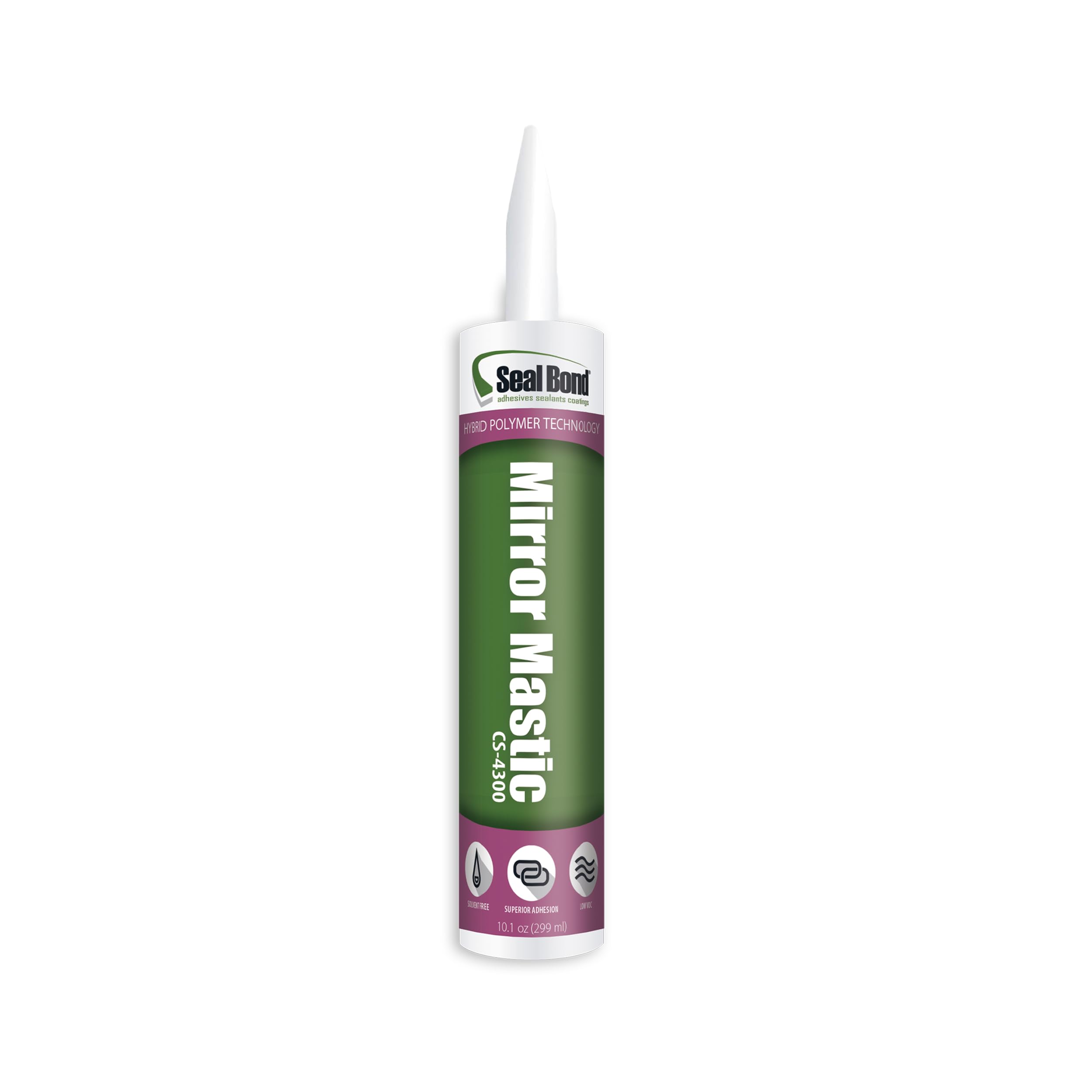
5. CS-4300 Mirror Adhesive 10.1oz Cartridge
The indoor pick: low odor, acrylic-safe, and built to hang mirrors flat.
Three of these picks are off the table in a sealed bathroom the moment you open the tube. This one is not, and that is why it gets the mirror slot. The formula is solvent and isocyanate free with ultra-low VOCs (volatile organic compounds — the fumes that give most adhesives their smell), and it meets SCAQMD and CDPH air-quality standards. It ships as a 10.1-ounce cartridge, compatible with both conventional and acrylic mirrors. It also has excellent build out — the ability to stay thick and bridge small gaps behind a rigid panel instead of pulling it flat.
The heavy-mirror proof is what makes this one credible. One installer hung four 150-pound-plus, 8-foot-by-4-foot mirror panels on drywall with a crosshatch pattern — two tubes per 16-by-8-foot area — and reported no corrosion, misalignment, or failure after 3 years. Another job replaced 22-year-old falling mirrors with a zig-zag pattern plus edge lines, two tubes per 30-by-50-inch mirror, using the immediate grab to lock position within about a sixteenth of an inch.
The honest catch, and it is the most-mixed trait in this block, is that the tube is not a magic wand for every mirror: the most-discussed topic among users is adhesion, and One owner watched an oval bathroom mirror release from the wall 45 minutes after going up. Surface prep and a properly flat wall are what separate the success stories from that one. Also plan around the hardware — the cartridge does not always come with a nozzle.
Low-Odor Mirror Set: Why it is the mirror specialist. Ultra-low VOCs plus SCAQMD and CDPH compliance make it the one to reach for when you are working indoors without ventilation, and the acrylic compatibility covers the panel types the PEGATANKE epoxy cannot.
Slow Full Strength: What the reviews teach you. Proper prep, a flat wall, and even adhesive distribution are what decide the outcome — a mirror is only as good as the surface behind it.
Buy For Mirrors: bathroom, gym, and cabinet mirror installs indoors, including acrylic mirrors and heavy panels that need build out behind them.
Look Elsewhere For Speed: you are gluing non-glass surfaces or overhead metalwork — this formula is engineered around mirrors.
Know the Specs
Full Cure Time — Why 30 Minutes and 24 Hours Are Different Jobs
Full cure time is how long the adhesive needs before it reaches its rated strength, and the range across these picks tells you exactly what each one is built for. A 30-minute full cure locks the joint fast enough that you can finish a seam and leave — the right choice for non-structural sealing like a tile seam or a shower frame. A 24-hour full cure is the slow track, and it is what you want when the joint is carrying weight or seeing weather while it sets. Load a slow-cure adhesive too early and the bond usually lets go at the first cold snap — that is the most common reason a glass-to-metal bond fails.
Material Compatibility — The List That Decides the Pick
Every one of these products prints the surfaces it bonds to, and that list is the fast filter. A glass-only formula like the Dow U-418 is far more specialized than an eight-material general-purpose contact cement — neither is “better,” they just solve different jobs. The one trap in this category is acrylic (a clear plastic that looks like glass): at least one adhesive here is explicitly noted as less effective on it, while the mirror adhesive is rated for acrylic. Read the list before you buy, not after the joint fails.
Common Questions
Can I use the same adhesive for a mirror and a windshield?
Why did my last glass-to-metal glue let go after a few months?
Is contact cement or epoxy better for bonding metal to glass?
Do I need a special caulking gun for these adhesives?
Will the PEGATANKE epoxy work on an acrylic mirror?
Can any of these adhesives cure underwater?
How much adhesive do I need for a large mirror?
Does the silicone sealant carry weight like a glue?
Are any of these safe to use indoors without ventilation?
How do I keep the adhesive off my hands during a glass repair?
The Bottom Line
For most people searching for the best adhesive for glass to metal, the right answer is the Silicone 2 Advanced Metal — a 30-minute full cure, a Metallic Gray finish that disappears into real metal, and compatibility with metal, glass, wood, and plastic in one tube. It is the most forgiving pick for a joint that lives outdoors or moves with temperature. If you want primerless convenience on a windshield or RV glass repair, grab the Dow U-418. And for heavy load-bearing work — fuel tanks, exhaust, or anything carrying real weight — the PEGATANKE two-part epoxy is the one to reach for.
How we choose
We do not accept paid placement. Every pick is matched to a real buyer and a real use-case; we do not hands-on test units.
Sources
Specifications: manufacturer listings and product documentation. Review insights: verified customer reviews, as of October 2026. Pricing: not shown on this page (it changes often); check the current price via the retailer link.
As an Amazon Associate, Aappliancez earns from qualifying purchases. This does not affect which products we feature.