Disclosure: Some links in this post are affiliate links. As an Amazon Associate I earn from qualifying purchases, at no extra cost to you. Learn more
Specs are compiled from manufacturer listings and verified buyer reviews and can change over time — please confirm the key details on the product page before buying.
EVA foam bonds easily with the right glue and melts with the wrong one. Standard super glue melts it into a smoking puddle. Hot glue cools before it grips a curved seam. The fix is an adhesive labeled foam-safe, and the five picks below span odorless CA that bonds in seconds to contact cement built for fabric and upholstery. If you just want the short answer: the Bob Smith Industries BSI-139H is the one to buy for EVA and XPS foam work, because it sets clear in 5 to 15 seconds and won’t attack the foam.
This guide is built by comparing the manufacturers’ published specifications and the patterns across verified customer reviews, so you get each pick’s real strengths and trade-offs instead of marketing spin.
Some adhesives are thin and wick into tight joints, while others are thick and fill gaps; some are flexible forever, and some harden like glass. This guide covers the chemistry, cure times, and real-world repair scenarios so you can pick the right adhesive for eva foam on the first try.
Top Picks
How To Choose The Best Adhesive for EVA Foam
Pick the wrong bottle and standard cyanoacrylate will melt the foam on contact. Here are the four things that decide whether a glue works on EVA or ruins it.
Foam-Safe Chemistry Comes First
EVA foam is a closed-cell material, and standard cyanoacrylate — the stuff in ordinary super glue — reacts with it and melts it. Look for the words “foam safe” on the label. An odorless formula is a bonus, because traditional CA fumes are harsh in a small room. Brands like Bob Smith Industries, Beacon, and Great Planes all build versions that skip the melting problem entirely.
Cure Speed And Working Time
A thin CA glue can grab in 5 to 15 seconds, which is perfect when you can hold a seam steady by hand. A contact cement gives you minutes of repositioning time but needs 24 hours to fully cure. Think about how you’ll clamp the joint: if you can’t hold it, buy the slower glue.
Flexibility After Curing
EVA foam bends, and a rigid glue line cracks under flexing. Beacon Foam-Tac stays flexible after it cures, which is why it holds up on RC plane wings that twist in the air. If your finished piece needs to move — armor, mats, curved panels — flexibility matters more than raw bond strength.
Viscosity: Thin Versus Thick
Thin, watery glue wicks into tight cracks and seams, while a thicker gel fills gaps and stays put on vertical surfaces. Most EVA crafters keep one of each: a thin CA for precision work and a thicker product for gluing large panels together.
Side-by-Side Comparison
| Model | Best For | Cure Time | Item Weight | Material Type | Amazon |
|---|---|---|---|---|---|
| Bob Smith Industries BSI-139H★ Best Overall | Odorless precision bonding | 15 seconds | 1.44 ounces | Cyanoacrylate | Amazon |
| Beacon Foam-Tac, 2 ozBest Value | Flexible foam repairs | 24 hours | 9.07 g | Foam | Amazon |
| RH Adhesives S-18 | Upholstery and headliners | 24 hours | 5.6 ounces | Neoprene Adhesive | Amazon |
| Great Planes Pro Foam Safe CA Thin | RC planes and water-thin bonds | 5 minutes | 27.22 g | Plastic | Amazon |
| DAP Weldwood Original Contact Cement | Permanent wood and leather bonds | 2.5 hours | 16 ounces | Wood | Amazon |
Detailed Reviews
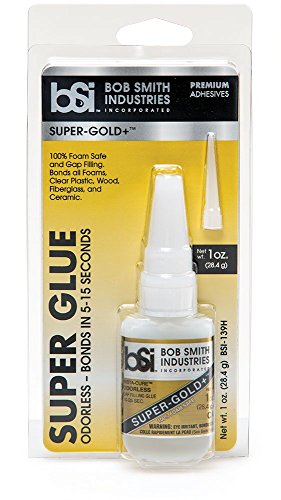
1. BSI-139H Clear Super-Gold Super Glue
Our pick — 4.5+★ from 850+ verified ratings; the strongest balance of quality and price.
When you need a clear, odorless bond on EVA foam that won’t melt the edges, this is the bottle to grab.
This is the undisputed crowd favorite — 4.5+ stars across 800+ ratings and a product that has become the de facto standard for foam-safe cyanoacrylate. The 1 oz bottle is a cyanoacrylate (CA) formula, which means it’s a liquid plastic that hardens when it meets moisture in the air. Unlike standard super glue, it won’t eat through EVA or XPS foam. It cures in 15 seconds, so you hold the seam, count to fifteen, and move on.
What wins people over is the 5-to-15-second set that lands the same way every time. The BSI-139H sets in 5 to 15 seconds with a gap-filling action, and it dries perfectly clear — important when you’re building cosplay armor where a milky glue line would ruin the finish. The included extender tip lets you place a precise bead instead of flooding the joint. This is also the safest CA to use in a small room, because it’s odorless: buyers specifically say the lack of fumes makes long finishing sessions far more comfortable.
Here’s the honest catch: the 1 oz bottle costs premium money for the volume you get, and the applicator tip gets mixed feedback — some find it precise, some find it wasteful. The item weighs just 1.44 ounces, a full 4.2 ounces lighter than the S-18 contact cement, so it’s easy to store and carry. The bottle also has a history of arriving with a leak, though the seller has consistently refunded those cases without hassle.
What makes it the top pick
- Sets clear in 5 to 15 seconds for fast, tidy seams
- 100 percent odorless, so it’s comfortable for indoor use
- Foam-safe formula that bonds EVA, XPS, plastic, wood, fiberglass, and ceramics
- Includes a precision extender tip for tight work
- Reliable gap-filling action
Worth knowing before you buy
- Premium cost per ounce compared to thicker contact cements
- The applicator tip splits opinion — useful to some, messy to others
- Occasional reports of a leaky bottle in transit
- A 1 oz bottle won’t last long on big builds
Reach for this if: you’re bonding EVA or XPS foam and want a fast, clear, odorless bond you can hold by hand.
Look elsewhere if: you need to glue large flat panels and want to budget carefully — a contact cement will stretch further.
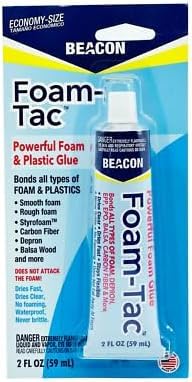
2. Beacon Foam-Tac Powerful Foam and Plastic Glue, 2 oz
The thick, flexible glue that RC builders trust when a foam wing has to twist in the air and survive.
Foam-Tac is a different animal from the thin CA glues. It’s a thicker, white adhesive that cures in about 15 minutes and stays flexible after it dries — which is exactly what you want for EVA foam that bends and flexes. The formula includes UV blockers to guard against sunlight and a special adhesion promoter that boosts bond durability. It’s compatible with EPP, EPO, and DEPRON foams, along with balsa wood, carbon fiber, and 3D printed parts.
What everyone raves about is the holding power: the bond outlasts the foam itself, so glued seams tear the material before they let go. That adherence is the headline: it grabs onto foam and plastic quickly and doesn’t let go. The flexibility is the second big win, because it lets the joint move with the material instead of cracking at the glue line. The 2 oz bottle weighs just 9.07 g, making it 18.15 g lighter than the Great Planes Pro CA Thin — a genuinely pocketable tube you can toss in a toolkit.
The trade-off: it cures in about 15 minutes but full cure takes 24 hours, and the viscosity gets mixed reviews — some find it perfect for gap filling, others find it stringy. A few buyers also flag the cost as high for the volume. Buyers report it saved a cracked Cambro-style cooler when it was on its way to the trash: the glue penetrated the cracks cleanly and flexed with the plastic through everyday use.
Why foam builders pick it: The flexible, UV-resistant bond makes it the go-to for RC plane repairs and any EVA project that has to move without cracking.
Honest note: Full cure takes 24 hours, so plan for a clamp or weight overnight, and expect a thicker consistency than a thin CA.
Ideal for: cosplay armor, RC wings, and any EVA foam joint that needs to flex rather than crack.
skip it if: you need a fast, invisible, water-thin glue line — reach for the Great Planes CA instead.
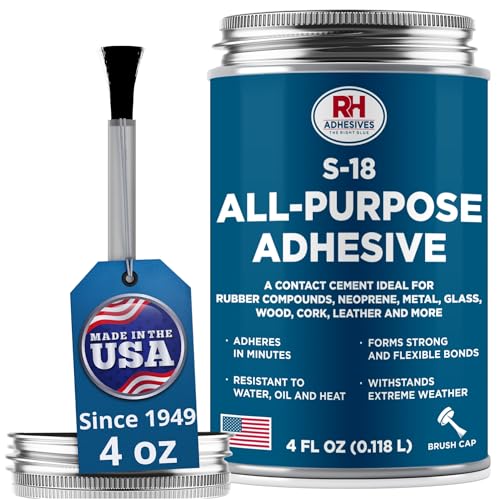
3. S-18 All-Purpose Adhesive 4 oz
The heavy-duty contact cement you reach for when EVA foam meets rubber, metal, or fabric and needs to stay put.
This is not a foam-specific CA — it’s a neoprene-based contact cement, which is a thick, rubbery glue that you spread on both surfaces, let get tacky, then press together for an instant grab. The S-18 is formulated for headliners, upholstery, and mixed-material jobs. It bonds porous and non-porous materials, handles both rubber-to-metal and plastic-to-other-material work, and delivers strong peel strength with resistance to oil and aging.
What earns it a place here is the hold. It’s the top aspect everyone highlights — a tenacious grab that sets in seconds and holds. The 4 oz can is water-resistant and performs in difficult temperatures, plus it’s made in the USA by a company that’s been formulating adhesives since 1949. The bottle weighs 5.6 ounces, 4.2 ounces heavier than the BSI-139H, so it’s a shop-cabinet item rather than a pocket one. The most-discussed trait, though, is adhesion — and it’s genuinely mixed. Some find it grips beautifully, others report it won’t stick to certain rubber surfaces. Treat it as a careful pairing rather than a universal bond.
The real caution is heat and moisture. One user’s neoprene-to-car project for hail protection held fine during curing but failed after curing in high heat and rain. So keep S-18 to indoor applications and ventilate well — the solvent smell is strong. The 4 oz can is enough to re-glue a pair of boots and leave enough for another pair. Owners mention the S-18 held through multiple wears after reattaching the glued portion of a stitched boot sole.
The real strength: A professional-grade hold with oil and water resistance, ideal for indoor upholstery, headliners, and mixed-material repairs where you can apply it on both sides.
Where it falls short: Never use it outdoors in high heat or rain — the neoprene bond doesn’t hold up to heat and moisture over time, and it needs a well-ventilated room.
Built for: indoor upholstery, headliner, and multi-material repair jobs where you want a professional hold.
Not the one for: outdoor weather-exposed projects or any bond involving wet or high-heat conditions.
4. Great Planes Pro Foam Safe CA Thin Glue 20g, GPMR6067

Water-thin and made for wicking into tight foam joints, as long as you can hold the seam steady.
This is a specialty CA glue aimed squarely at RC builders working on foam airplanes, though anyone repairing styrofoam can use it. It’s water-thin — genuinely runny — so it wicks into cracks instead of sitting on top of them. The 20 g bottle weighs 27.22 g, making it 18.15 g heavier than the Beacon Foam-Tac, a full bottle rather than a tube. The full cure time is listed at 5 minutes, but in practice customers note it grabs in 15 to 30 seconds and welds within 1 to 2 minutes.
The advantage is a clean, invisible bond on foam that can’t take a thick glue line. Reviewers point out on foam plane wings: it dissolves the printing on contact but dries back, hardens into a strong joint, and is truly foam safe. It works even better when paired with an activator — users patched a Knockerball hole and reused the bottle for months. It’s the most mentioned point that the glue’s watery consistency is both its strength and its risk: apply it sparingly with a watercolor brush and wipe excess immediately, because it dissolves paint and will run where you don’t want it.
The honest downside is patience. Some buyers wish it kicked faster — one noted it takes minutes, not seconds, to set on split foam, requiring masking tape to hold the seam. It also bonds skin instantly, so keep your fingers clear. Store the bottle cool to extend shelf life.
What makes this different
- Water-thin viscosity wicks into tight cracks
- Genuinely foam safe on styrofoam and foam planes
- Grabs in 15 to 30 seconds and welds in 1 to 2 minutes
- Works even better with an activator for tough patches
- A 20 g bottle goes a long way when applied sparingly
What to watch for
- Runs easily — needs a watercolor brush for control
- Dissolves paint and printing on contact
- Bonds skin instantly, so handle with care
- Some users find the cure slower than they’d like
Pick this when: you need a thin, invisible bond on foam planes or delicate styrofoam fittings.
Consider something thicker if: you can’t hold the seam steady — the watery formula will run and needs masking tape to sit still.
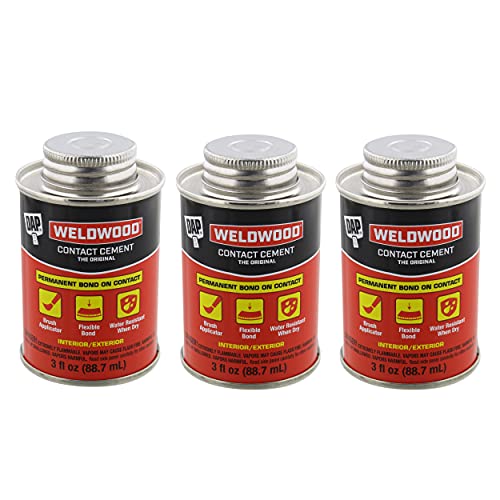
5. DAP 00107 Weldwood Original Contact Cement, 3 oz – 3 Pack
The permanent-bond contact cement for leather, wood, and suede — when a repairable joint just won’t cut it.
Weldwood Original is a classic contact cement with a cult following, and the three-pack delivers 16 ounces of it in a single purchase. You coat both surfaces, let them dry until tacky, then press together for an immediate, permanent grip. The full cure time is 2.5 hours. It’s a liquid formula with low VOC content (fewer volatile organic compounds, meaning less solvent in the air) and it’s nonflammable, which matters if you work in a garage or shop. It bonds wood, suede, leather, plastic, rubber, and other porous and non-porous materials.
What makes it a legend in repair circles is the sheer holding strength — the bond is permanent and it’s the top aspect that keeps people loyal. When used properly, it produces reliable and predictable results, and the crowd that has used it for years keeps coming back. The other big advantage: it’s a rubber-based cement that works on suede boot toes, heavy wood doors, and other surfaces where a lightweight craft glue would fail.
The honest caution is ventilation. It’s highly effective but users describe it as toxic-smelling; you need a fan and an open window. The other mixed point is adhesion — when the container sits for a while, the glue can dry out inside. Store it capped tightly and use it reasonably fast. The 16-ounce package weight reflects the metal cans, so this is a bench tool, not a pocket carry.
Where it shines: Permanent, heavy-duty bonding for leather, wood, suede, and rubber, with low VOC and nonflammable formulation for shop safety.
The honest caveat: The smell is strong enough to demand ventilation, and the glue can dry out in the can if you leave it open too often.
Made for: shoe repairs, leatherwork, wood bonding, and any project where a permanent, heavy-duty grip is the goal.
Not ideal if: you’re gluing EVA foam specifically — a foam-safe formula like the Bob Smith Industries or Beacon is the safer choice.
Know the Specs
Cure Time And Working Window
Cure time is how long the glue needs to fully set, and it’s measured from the moment you press the surfaces together. A fast CA can cure in 15 seconds, so you hold the joint and move on. A contact cement needs 2.5 to 24 hours to fully cure. The working time is different — that’s how long you have to reposition the parts before the glue grabs. Thicker contact cements give you minutes; thin CAs give you seconds. Match the cure speed to how steady your hands are and whether you can clamp the joint.
Foam-Safe Versus Standard Formula
Foam-safe means the formula won’t melt EVA or styrofoam on contact. Standard cyanoacrylate reacts with foam and eats through it, which is why a foam-safe CA is non-negotiable for EVA work. Odorless formulas skip the harsh CA fumes, so they’re nicer to use in small rooms. Viscosity matters too: a water-thin glue wicks into cracks, while a thicker product stays put and fills gaps. Pick based on whether you’re bonding tight seams or filling gaps.
Common Questions
Will regular super glue melt EVA foam?
How long does foam-safe CA glue take to set?
Is Beacon Foam-Tac safe for EVA foam?
Can I use contact cement on EVA foam?
What is the difference between thin and thick CA glue?
Do I need ventilation when using contact cement?
How long does a 1 oz bottle of foam-safe CA last?
Can foam-safe glue bond foam to plastic?
Which foam adhesive is best for outdoor projects?
Is foam-safe CA glue stronger than hot glue?
The Bottom Line
For most people, the adhesive for eva foam winner is the Bob Smith Industries BSI-139H because it sets clear in 5 to 15 seconds and its odorless, foam-safe formula handles EVA, XPS, plastic, and wood without melting the material. If you want a flexible bond that survives bending and twisting foam — cosplay armor, RC wings — grab the Beacon Foam-Tac, whose UV blockers and adhesion promoter keep outdoor jobs from yellowing. And for indoor upholstery, headliners, and heavy-duty mixed-material repairs, the RH Adhesives S-18 is the one to reach for — just keep it out of high heat and rain. Any of the five will handle an EVA foam project, provided you match the cure speed and flexibility to the job.
How we choose
We do not accept paid placement. Every pick is matched to a real buyer and a real use-case; we do not hands-on test units.
Sources
Specifications: manufacturer listings and product documentation. Review insights: verified customer reviews, as of October 2026. Pricing: not shown on this page (it changes often); check the current price via the retailer link.
As an Amazon Associate, Aappliancez earns from qualifying purchases. This does not affect which products we feature.