Disclosure: Some links in this post are affiliate links. As an Amazon Associate I earn from qualifying purchases, at no extra cost to you. Learn more
Specs are compiled from manufacturer listings and verified buyer reviews and can change over time — please confirm the key details on the product page before buying.
If you have ever glued two sheets of cardstock together and watched the paper buckle into a wave, you already know the real problem with paper crafting. It is not the colour or the layering — it is the water in the glue soaking into the fibres and drying unevenly. The fix is simple once you know what to look for: a thick glue that grabs on contact, or a dry adhesive that never introduces moisture at all. This guide covers both, so you can pick the right one for the way you actually work.
This guide is built by comparing the manufacturers’ published specifications and the patterns across verified customer reviews, so you get each pick’s real strengths and trade-offs instead of marketing spin.
Every pick below is judged on how it behaves on heavy paper in particular, because thin copy paper forgives almost anything. Read on to find the right adhesive for cardstock.
Top Picks

How To Choose The Best Adhesive for Cardstock
The paper you are gluing decides almost everything. Cardstock is thick, absorbent and stiff, which means it reacts badly to any adhesive that carries water into the sheet. Pick wrong and you get ripples, curled corners, and glue bleeding through to the front of the page. Pick right and the bond disappears into the finished project.
Wet glue versus dry adhesive
A liquid glue soaks into the paper fibres and swells them, then shrinks them back as it dries — that shrinking is what pulls a sheet into a wave. A dry adhesive strip or sheet simply sits between the two layers with no moisture to release, so the paper stays flat. If a flat finish matters more to you than a permanently welded bond, go dry.
Why acid-free matters for anything you keep
Acid in an adhesive slowly breaks down the paper it touches, turning pages brittle and yellow over years. If you are building scrapbook pages, photo albums, or anything you plan to pass on, look for the words acid free and photo safe on the label. This matters far more for long-term projects than for a greeting card you will hand over next week.
Matching the applicator to the job
Small die-cut letters need a precision tip that lays down a dot, not a puddle. Long straight borders and large mounts need broad, even coverage instead. Many crafters end up with two tools for this reason — a fine-tipped bottle for detail work and a tape runner or roller for big flat surfaces.
Side-by-Side Comparison
| Model | Best For | Format | Container / Size | Acid Free & Photo Safe | Amazon |
|---|---|---|---|---|---|
| Aleene’s Original Tacky Glue 16 fl oz 3-Pack★ Best Overall | Everyday craft and DIY | Liquid | Three 16 fl oz bottles | — | Amazon |
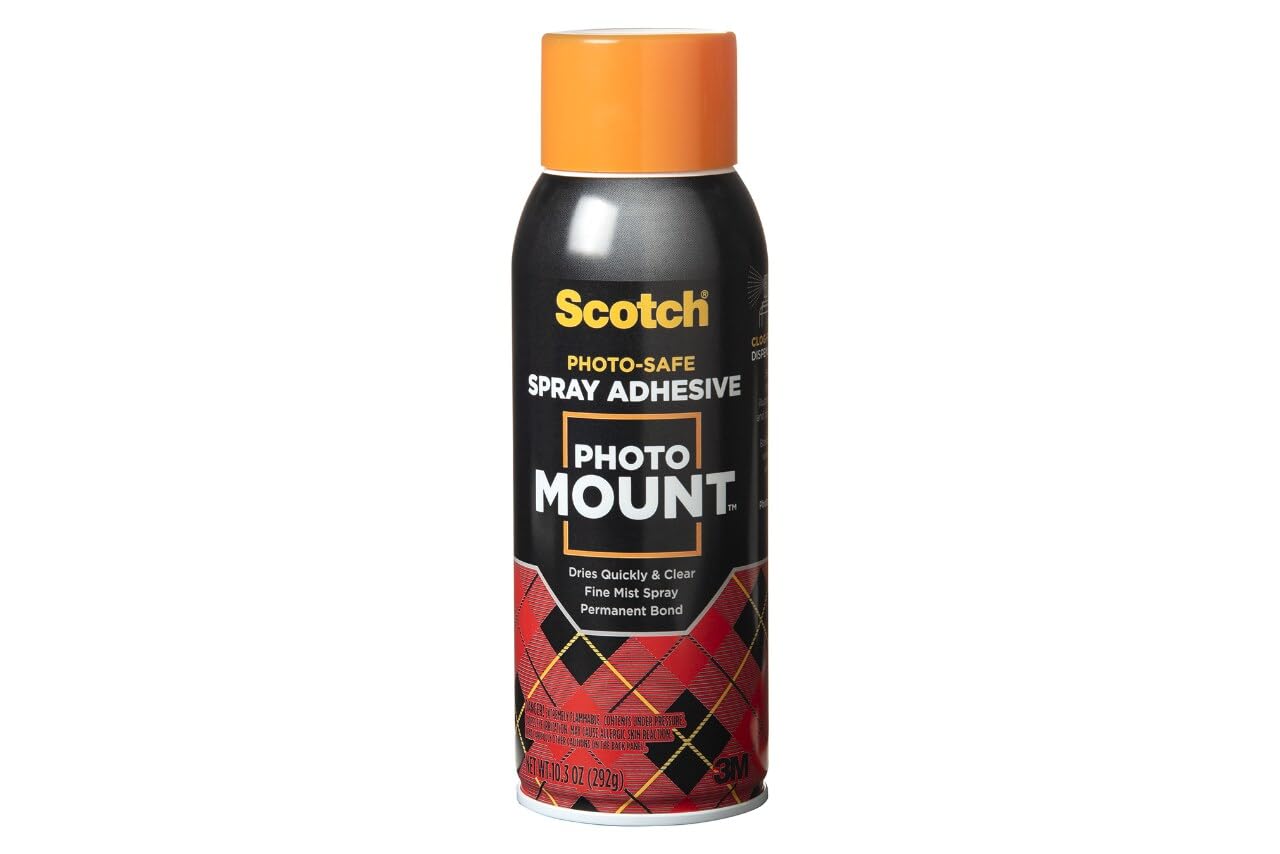
| Scotch Photo Mount Adhesive 6094Best for Photos | Mounting photos to foam core | Spray | 10.3 oz can | Photo safe (ISO 18916) | Amazon |
| Scotch Scrapbookers Glue Two-Way Applicator 3-Pack | Precise scrapbook placement | Liquid | Three 1.6 oz / 47 ml bottles | Photo Safe | Amazon |
| Scrapbook Adhesives by 3L E-Z Runner Grand | Long runs and large mounts | Dry tape strips | 150 feet, refillable | — | Amazon |
| Scrapbook Adhesives by 3L Adhesive Sheets 12×12 | Turning cardstock into stickers | Dry adhesive sheets | 25 sheets, 12 in x 12 in | Acid free, photo and archival safe | Amazon |
Detailed Reviews
1. Aleene’s Original Tacky Glue 16 fl oz 3-Pack
Our pick — 4.5+★ from 750+ verified ratings; the strongest balance of quality and price.
Three 16 fl oz bottles of thick PVA that grabs cardstock on contact and dries clear without yellowing.
Aleene’s Tacky Glue is the bottle most crafters reach for without thinking, and the reason is the texture. It is a PVA-based liquid — polyvinyl acetate, the same family of glue used in woodworking — thickened until it holds materials the moment they touch. That instant grab is what lets you position a cardstock panel and let go, instead of standing there holding it while you count to thirty. It dries permanently clear, so a heavy layer behind vellum or a light-coloured card never shows through.
You get three 16 fl oz bottles, or roughly 3.7 pounds of glue in the box. That sounds excessive until you have a workshop full of hobby projects: paper, felt, foam, wood, metal and ceramics all bond with the same jug. The formula has been sold for over 75 years, and that track record shows in how predictable it is. The glue is also forgiving to clean up — wet spills wipe away, dried drips come off with soap and water.
The one thing owners push back on is drying speed, because the same thickness that gives you grab also holds moisture longer than a thin white glue. Work in thin lines and let each layer set before adding the next, and heavy cardstock stays flat rather than rippling. It holds 4.5+ stars across 700+ ratings, the highest of any pick here. Long-time users make the case better than any spec sheet: “I would say I have been using this glue for over 30 years and I am still happy with it’s preformance.”
Where It Pulls Ahead
- Thick PVA formula grabs on contact, so you are not stuck holding pieces in place
- Three 16 fl oz bottles cover months of regular crafting
- Dries clear and permanent with no yellowing, so light cardstock stays clean
- Cleans up with soap and water once dried
Where It Needs Care
- Drying time draws mixed feedback — several buyers find it dries very quickly, others find it slow, so test on scrap paper first
- Liquid glue can ripple thin paper if you lay it down too heavily
Stock this if: you want one bottle that handles paper, felt, foam, wood and ceramics without buying five specialist adhesives.
Pass on it for: jobs where you need an instant dry bond — that is a tape runner’s territory, not a liquid’s.
2. Scotch Photo Mount Adhesive 10.3oz
A spray that lays an even film across a whole sheet, so big mounts sit flat with no glue lines.
Brush-on glue forces you to think about coverage, and uneven coverage is exactly what warps a large mounted print. This one skips the problem entirely: you spray a fine mist across the back of the sheet, press it down, and the adhesive is already uniform edge to edge. The can holds 10.3 oz, it cures fully in 24 hours, and the formula is photo safe in accordance with ISO Standard 18916. In plain terms, that standard says the adhesive will not stain or degrade a colour photograph over time, which is the whole reason you would choose a purpose-built mount spray over ordinary glue.
At 300 g the can is heavier than the 200 g E-Z Runner Grand, so this is a benchtop tool rather than something you toss in a tote. The list of surfaces it likes is broad: good quality cardstock board, plastic, glass, clean metal and foam core, all with a smooth finish. It is explicitly not suitable for outdoor use. Full repositionability is the quiet benefit — a photo can be nudged into place before the bond locks, which professionals clearly value: “Mounts 8×10 prints to foam core perfectly; adheres quickly with little adjustment time but strong hold.”
The catch is ventilation. Owner feedback flags the fumes repeatedly, and the sensible routine is a mask and an outdoor or open-window spray session. A few also find it comes out in gobs rather than an even mist, which usually traces back to a can held too close to the work. Get the distance right and the finish is clean. For anything involving actual photographs, the photo-safe chemistry justifies the fuss.
What you are paying for: photo-safe chemistry that meets ISO Standard 18916 plus a spray pattern that covers a full sheet in seconds. Worth it the moment the sheet in question is a print you cannot replace.
The honest trade-off: you need a mask, a window or a driveway, and room to lay the sheet flat while the mist settles.
Reach for this if: your cardstock work involves mounting photographs, illustrations or anything printed that must stay colour-accurate for years.
Look elsewhere if: you work at a small indoor desk — the smell and overspray make a bottle or tape runner the friendlier choice.
3. Scotch Scrapbookers Glue 1.6 Ounce Pack of 3
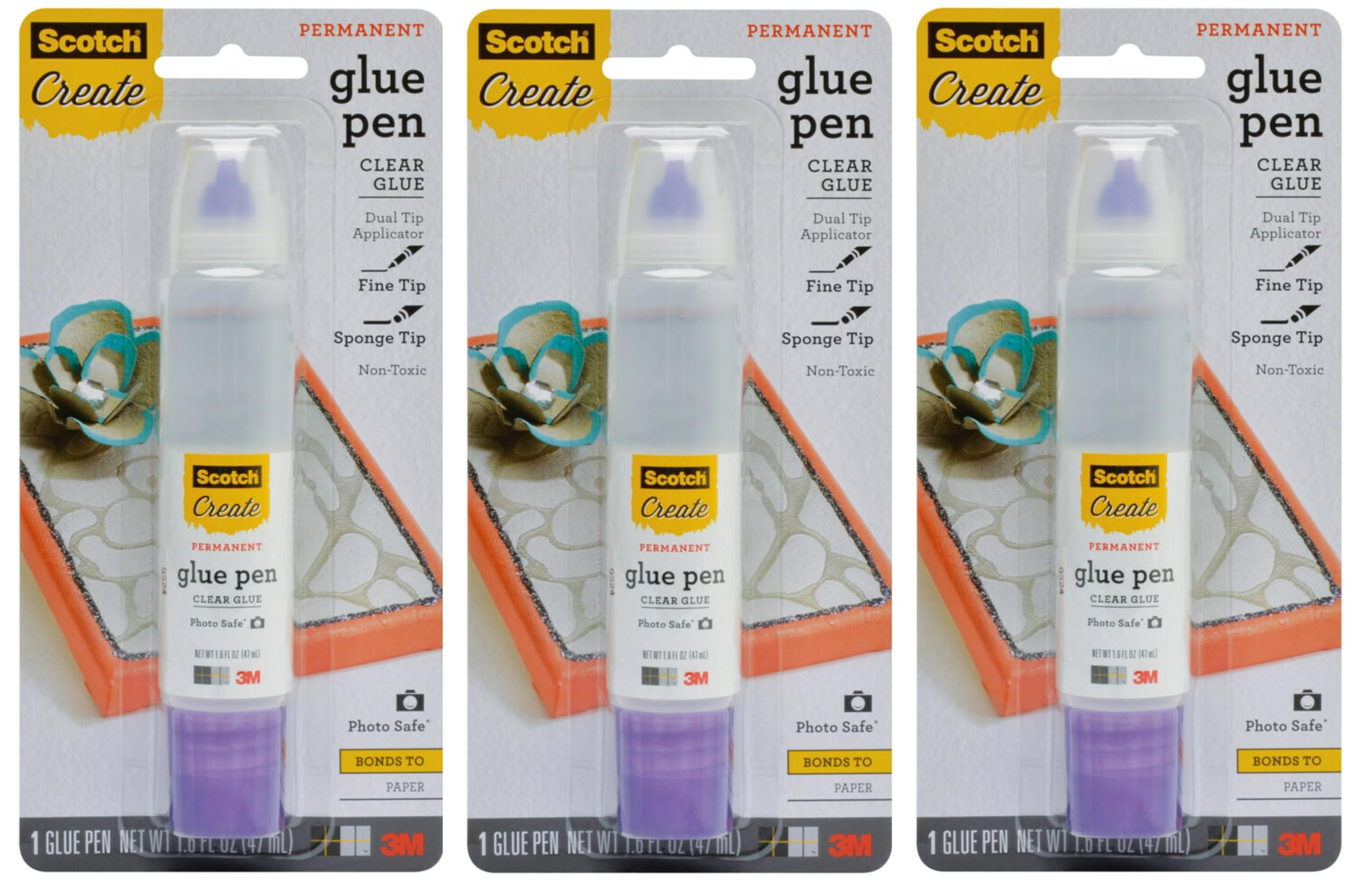
One bottle, two entirely different tips, for dots and for covering ground fast.
Two interchangeable tips on a single 1.6 oz bottle is the entire pitch here, and it is a good one. The precision tip lays a narrow bead for small dots and tight corners, while the sponge tip spreads a broader patch for larger surfaces. Flip between them and you stop hunting for a second tool mid-project. Three bottles come in the pack, each 1.6 oz (47 ml), and the adhesive itself is a PVA glue that is photo safe as well as designed for paper and photos.
What has crafters loyal is the grab. The glue holds after a brief repositioning window, which means you can slide a die-cut into place before the bond sets, then leave it. It sticks to paper, acetate, plastic and metal, so mixed-media layouts do not need a second adhesive. There is a real skill ceiling here: practitioners of card making describe the precision tip as the reason they can place a small dot exactly where it belongs, and they call the broad tip the one for covering a large area.
Two honest caveats, both from the people using it daily. Liquids that sit between paper and a heavy top layer can pull a wrinkle into the sheet, and the review pages note this. Loosely, the point is that this is a wet adhesive — press cardstock flat and give it time. There is also a rare manufacturing seam issue where a tube oozes at the joint on first use, typically fixed by swapping on an older tip. Neither flaw dims the overall impression, and the quality of the glue itself earns more praise than anything else here.
The tip combination is the product: precision on one end for placement, sponge on the other for coverage, on every bottle in the pack. It is the only pick here that solves both jobs with one hand.
Know before you buy: it is a liquid, so heavy cardstock laid flat and left to set behaves best. This is a placement tool, not a flood-the-surface tool.
Count on it when: your work lives in the small details — die-cuts, cards, ATCs and layered scrapbook elements where a millimeter of glue placement changes the finished look.
Think twice if: you are covering full 12×12 sheets, where a dry runner will be faster and flatter.
4. Scrapbook Adhesives by 3L 2000 E-Z Runner Grand

A 150-foot dry roller that lays permanent adhesive strips with no moisture, so paper stays flat.
Here is the anti-wrinkle answer. Because this dispenser lays a dry permanent adhesive strip, there is no water to swell the cardstock, which means no ripples, no curling corners and no drying time at all. Press, roll, done. The Grand holds 150 feet of permanent double-sided white adhesive, and at 200 g it sits comfortably in the hand for long runs. If you saw the 300 g weight on the Scotch Photo Mount spray, this is the lighter tool of the two by a noticeable margin — a dispenser you can hold for an hour of uninterrupted rolling.
It also handles shapes a bottle struggles with: long lines, short lines, curves and circles. Easily customizable adhesive means you can add foils or glitter on top, and heat embossing the strip adds texture to a project. The unbreakable release liner is what makes the application consistent and smooth, with no tearing or skipping mid-roll. Cartridge changes are a genuine strong point — pop the old one out, click the new one in, and there is no manual winding to fiddle with.
What repeatedly wins people over is how little thought the tool requires. Refill swaps happen in seconds rather than minutes, and crafters who used to carry several smaller dispensers have consolidated down to this one. A long-time scrapbooker said it runs out of adhesive before the bond ever slips: “Only glue used for scrapbooking; strong hold on paper, ribbon, metal.” If you want a single dispenser that covers a whole album, this is the one to buy.
Why It Earns the Slot
- 150 feet of dry adhesive strips with no moisture, so cardstock stays flat
- Refillable cartridges swap in seconds with no manual winding
- Works on long lines, short lines, curves and circles
- Light enough to hold for extended crafting sessions
Tightest Point of the Design
- The strip is permanent once pressed, so you get one shot at placement — no long repositioning window like a wet glue
- You are buying into a refill ecosystem, so it is worth keeping spare cartridges on hand
Make it your default if: flat, fast, dry bonds are the priority and you would rather roll than wait for glue to set.
Keep a bottle alongside it if: your projects also involve ribbon, metal or three-dimensional embellishments the strip cannot press into.
5. Scrapbook Adhesives by 3L Adhesive Sheets 12Inch x 12Inch
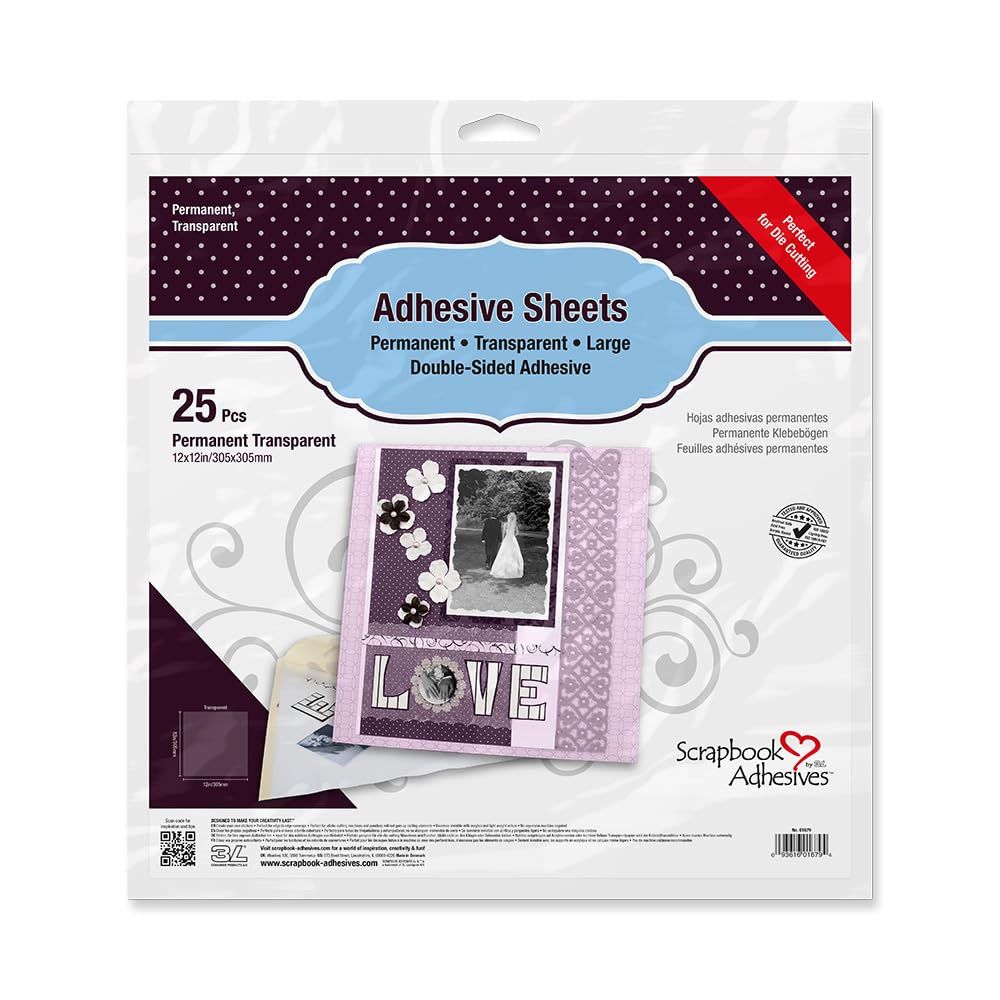
Turn a whole sheet of cardstock into a sticker, then cut any shape you like from it.
This is the pick for anyone who has ever tried to glue forty tiny die-cut letters by hand. Instead of applying adhesive dot by dot, you bond a full 12 x 12 sheet of adhesive to the back of your cardstock first, then run the whole thing through a die-cutting machine. The blade passes through both layers together and every letter that comes out is already backed. Fifty adhesive sides across 25 sheets, each with full-surface edge-to-edge coverage.
Two specifications make this the long-haul choice for archival work. The sheets are acid free and described as photo and archival safe, which means the paper they touch is not being slowly eaten away over the years. They are also water resistant. Each sheet is 0.3 inches thick and weighs 1.12 ounces, and the dry format means no moisture near your cardstock.
Budget-minded crafters often arrive here after costing out a pricier brand, and the reports back are that these hold up just as well on intricate cuts. Adhesive quality drives more of the positive feedback than any other trait, and the people running complex layered cards describe the bond as slightly stronger with no added bulk. The honest limits: the sheets are very thin, they are not as simple to peel as the name suggests, and the backing film can be stubborn to remove after a die-cut. Watch the alignment as you lay the sheet down and roll the backing off slowly.
The whole sheet is the feature: 25 adhesive sheets at 12 x 12 inches each, acid free and described as archival safe, which is what you want under anything meant to last decades.
The peeling is the work: owners describe the film as hard to separate, so budget patience on the first few sheets until you find your technique.
Buy it when: you are mass-producing shapes — die-cut lettering, layered cards or Cricut cuts — and hand-gluing each piece has stopped being realistic.
Stick with a bottle when: you only ever glue two flat sheets together, because a full adhesive sheet is more material than that job needs.
Know the Specs
Wet Adhesive Versus Dry Adhesive
A wet adhesive — any liquid or spray — carries moisture into the paper, and that moisture has to leave before the bond is finished. As it leaves, the sheet shrinks unevenly and pulls into a curve. A dry adhesive, such as a tape strip or an adhesive sheet, has no water to release at all. The bond forms the moment you press. If you are working with heavy cardstock and want it to stay perfectly flat, the dry option usually wins.
Acid Free and Photo Safe Explained
Acid free means the adhesive will not introduce the acids that turn paper yellow and brittle over time, so pages stay bright and flexible for years. Photo safe is a narrower promise about photographs specifically, and it can be verified against a published standard. Any adhesive that carries water and sits between the paper and a heavy top layer needs to be pressed flat afterward and given time to dry before moving the piece. For scrapbooks, albums and anything archival, look for both phrases before you buy.
Common Questions
Will liquid glue make my cardstock warp?
What does acid free actually mean for scrapbooking?
Is Scotch Photo Mount safe to use directly on photos?
Can I use a tape runner on heavy cardstock instead of glue?
How do adhesive sheets work with a die-cutting machine?
Which adhesive is best for gluing cardstock to foam core?
Does Aleene’s Tacky Glue dry clear or yellow?
How many 1.6 oz bottles come in the Scotch Scrapbookers pack?
Can I use spray mount indoors?
Are the 3L adhesive sheets double sided?
The Bottom Line
For most crafters the winner is the Aleene’s Original Tacky Glue 3-Pack, because three 16 fl oz bottles of instant-grab, clear-drying PVA cover paper, foam, ribbon and fabric without buying a second adhesive. If flat, unrippled cardstock is the whole point of your project, grab the Scrapbook Adhesives by 3L E-Z Runner Grand and roll dry strips instead of waiting on glue. And for anything involving photographs, the Scotch Photo Mount Adhesive is the one to reach for — the photo-safe chemistry is what you are buying.
One last thing worth acting on: the tacky glue is the crowd favourite in this group at 4.5+ stars across 700+ ratings.
How we choose
We do not accept paid placement. Every pick is matched to a real buyer and a real use-case; we do not hands-on test units.
Sources
Specifications: manufacturer listings and product documentation. Review insights: verified customer reviews, as of October 2026. Pricing: not shown on this page (it changes often); check the current price via the retailer link.
As an Amazon Associate, Aappliancez earns from qualifying purchases. This does not affect which products we feature.