Disclosure: Some links in this post are affiliate links. As an Amazon Associate I earn from qualifying purchases, at no extra cost to you. Learn more
Specs are compiled from manufacturer listings and verified buyer reviews and can change over time — please confirm the key details on the product page before buying.
You want the walker that keeps your baby upright and happily busy — not the one that shoots across the room the moment they lean on it. Two things separate a walker that helps from one that scares you both: speed control (a way to slow the wheels down) and a stable base (a wide, low frame that resists tipping). The picks below get that balance right, from a starter to a convertible that grows through toddlerhood.
This guide is built by comparing the manufacturers’ published specifications and the patterns across verified customer reviews, so you get each pick’s real strengths and trade-offs instead of marketing spin.
A baby walker is part toy and part first-vehicle, so the specs that matter most are wheel resistance, seat height settings, and how much the base resists tipping. This breakdown of the best Activity Walkers sorts the sturdy from the slippery so you can match one to your baby’s stage.
Top Picks


How To Choose The Best Activity Walkers
An activity walker is a rolling toy your baby either sits inside or pushes while standing, and the whole point is to hand them a little independence without handing them a runaway cart. The right one covers several stages — sitting to play, pulling up, then pushing around the room. Get the wrong one and you spend every session chasing it down.
Speed control is the feature that actually protects your baby
A walker that rolls freely on hardwood moves under your baby faster than they can react, which is why so many parents describe early walkers as wobbly or even unsafe. Walkers with a speed dial or adjustable rear wheels let you add resistance at the start and loosen it as their balance improves. On a push-behind model, this is the feature to check first. If a walker has no speed adjustment at all, expect to babysit every second of use.
Height settings and seat depth keep feet planted
Sit-in, push-behind, or both
Sit-in walkers work earlier, from about six months, because the seat holds your baby upright while the toys keep them happy. Push-behind walkers come later, once your baby can pull up and grip a handle. Many parents end up wanting both stages from one purchase, which is where foldable 3-in-1 and 5-in-1 designs earn their keep. Think about which stage you are in right now before you pay for extra modes you will not use yet.
Detachable activity panels are where the real mileage hides
The panel with the buttons, spinners, and piano keys is what keeps a baby entertained when they are done walking. A panel that lifts off and travels to the floor or a crib extends the toy’s life well past the walking phase. Check how the toys attach — suction cups are the most common failure point on review pages, so a panel with tray-mounted pieces tends to hold up better than one relying on suction alone.
Side-by-Side Comparison
| Model | Best For | Age Range | Mode Count | Speed Adjustment | Amazon |
|---|---|---|---|---|---|
| VTech Sit-to-Stand Learning Walker (Blue)★ Best Overall | First walker for a 9-month sitter | 9 Months – 3 Years | Sit & play / stand & walk | Two-speed control switch | Amazon |
| Ingenuity Step & Sprout 3-in-1 WalkerFolds Flat | Small homes and travel | 6 Months + | 3 activity modes | — | Amazon |
| Fisher-Price Laugh & Learn Smart Stages Puppy WalkerBudget Smart Stages | Budget learning toy | 6 – 36 Months | 2 ways to play | — | Amazon |
| CUTE STONE 2 in 1 Baby Walker (Pink) | A lightweight first push walker | — | 2-in-1 (walker / table) | Rear wheel adjustment button | Amazon |
| Fisher-Price Laugh & Learn 4-in-1 Snack Cart Walker | Pretend-play fans | 6 Months – 3 Years | 4 ways to play | — | Amazon |
| Tiny Land Wooden Baby Walker | Montessori-style nurseries | Toddler | 2-in-1 (walker / activity center) | Adjustable wheel-resistance knob | Amazon |
| 5 in 1 Foldable Baby Walker | One walker for every stage | 6 – 18 Months | 5 modes | — | Amazon |
| Foldable Baby 5-in-1 Activity Walker (Mint Green) | Convertible play and feeding station | 6 – 18 Months | 5 modes | Adjustable rear wheels | Amazon |
| Music and Lights Baby Walker (Black) | Music-and-lights lovers | 6 – 18 Months | 6 modes | 2 speed adjustable wheels | Amazon |
Detailed Reviews
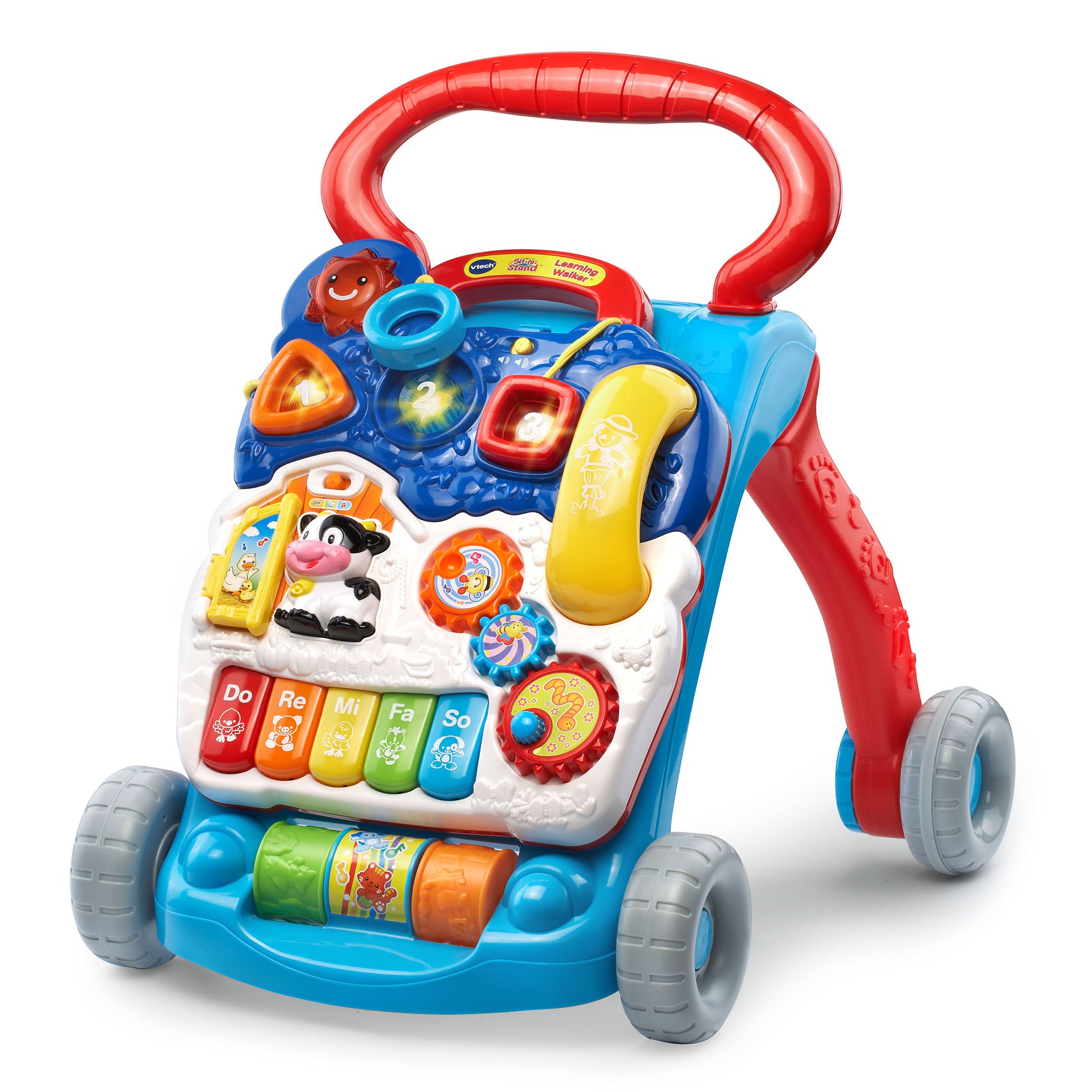
1. VTech Sit-to-Stand Learning Walker
Our pick — 4.5+★ from 98,000+ verified ratings; the strongest balance of quality and price.
Baby sits to play the piano, then stands and pushes — one toy covering both stages.
This is the walker most families end up recommending to each other, and it earns that spot with one feature: the activity panel lifts off the frame, so a 9-month-old who cannot walk yet still gets the whole toy. That detachable tray snaps back on when they are ready to push, which is why the age range stretches from 9 months to 3 years. At 4.6 pounds and about 18 inches at the handle, you can shift it out of the way with one hand while holding your baby.
The wheels are the part that separates it from cheaper carts. A two-speed control switch lets you set how freely it rolls, and the wheels lock when the panel is off, so the frame stays put instead of drifting away while your baby plays seated. The activity center covers five piano keys, a telephone handset, three shape sorters, light-up buttons, and spinning rollers — enough variety that the novelty does not burn off in a week. The manufacturer rates it for a child up to 35 pounds.
Buyers report a walker that earns its floor space: a 9.5-month-old who plays the buttons and spinners while sitting, then rolls it around once standing, with the wheels holding still in play mode so it does not escape. The one honest catch is sound — the music and voice effects split opinion, and volume is not adjustable the way some parents expect, so if your house has noise-sensitive adults, weigh that trade-off.
What buys this its top spot
- Removable panel means the toy works months before walking starts
- Two-speed control plus wheel-lock covers both a sitter and a toddler
- 4.6 pounds and roughly 18 inches tall — easy to shift or store
- Rated to 35 pounds, so it keeps pace with a growing toddler
Where it asks a little patience
- Sound effects are the most-split feature among parents
- Plastic build scuffs over time in a busy playroom
- No height adjustment on the seat itself
Best for: a 9-month-old who is starting to pull up and needs one toy that stays useful for a year.
Heads-up: the music is part of the appeal, and it is also the part some parents tire of first.
2. Ingenuity Step & Sprout 3-in-1 Foldable Baby Activity Walker
Built for the apartment parent who needs the walker gone when playtime ends.
If your living space doubles as a playroom, this one earns its place by disappearing. A latch and carry handles let the whole frame fold down, and it stores in the gap between a couch and a wall. Three height positions keep the seat at the right level as your baby grows, and the frame is narrow enough to roll through a standard doorway — something you notice every single day. It runs through three modes: sit-in activity walker, push-behind walker, and the toys on their own.
Those three removable toys clip into the tray, and each has a suction cup base so it can also stick to a table or high-chair tray for play away from the walker. That is the idea, and it is a good one. The execution is where the review pages get honest: the suction is the recurring weak spot, and the toys tend to pop loose once a baby grabs and tugs. One buyer put it plainly, saying one suction piece keeps falling off while the other two hold firm and still lift off easily when needed.
Where this walker consistently wins is comfort and looks. The seat pad draws the most favorable notes of anything on the product page, and the muted First Forest palette means it does not clash with a living room. It glides well on hardwood and struggles more on thick rug — a pattern that shows up across nearly every wheeled walker and is worth knowing before you buy.
The realistic read: treat the suction toys as a bonus rather than the core feature. They work on a smooth tray and fight a baby who has decided to yank them. The walking frame itself is the value here.
Reach for this if storage space is your biggest constraint and you want a walker that folds and travels.
Look elsewhere if you expect the suction toys to stay clamped to the tray through daily tugging — plan on the frame doing the heavy lifting.
3. Fisher-Price Laugh & Learn Smart Stages Puppy Walker
The learning-packed starter that teaches letters while your baby learns balance.
Three Smart Stages levels (settings that grow with your child’s age) deliver more than 75 songs, sounds, and phrases covering the alphabet, shapes, colors, numbers, and Spanish words. Seven hands-on activities keep small fingers moving — light-up piano keys, a light-up nose, a roller, a spinner, and a flip page among them. The handle is sized for an easy grip, and the four-wheel base is meant to steady those early steps. It suits ages 6 to 36 months.
This is the cheapest walker on this list and the one with the most built-in teaching content, which is why it keeps turning up as a first-birthday gift. Parents describe babies who adore it and start pushing it around immediately. The genuine caveat, and the one that matters most for a very new walker: it rolls away easily, and more than one parent has called the early-stage stability borderline for a baby who cannot yet correct their own balance.
So who is this actually for? A baby who is already cruising and confident will love the speed and the noise. A baby taking their literal first steps will need you right there with a hand on the frame. There is no wheel brake and no speed dial here — the trade-off for the low price and the rich learning content is that you supply the control.
Why parents keep buying it
- 75+ songs and phrases across 7 activities — heavy learning content for the money
- Three Smart Stages settings stretch the toy from 6 to 36 months
- Lightweight, easy to assemble, and small enough for a corner
What to plan around
- No speed control and no wheel lock — it rolls freely
- Best saved for babies who can already steady themselves
- Four wheels mean more maneuverability, less braking
Suits: a cruisers-and-up baby in a house where you will be within arm’s reach the whole time.
Think twice if your baby is on their very first wobbling steps — free-rolling wheels make you the brake.
4. CUTE STONE 2 in 1 Baby Walker

Five play zones, a wide triangular base, and a panel that travels to the floor.
Five play zones sit on this panel — shape sorting, musical keys, spinning gears, sensory rattles, and a mini basketball hoop — and the whole thing lifts off to work as a floor toy or a standalone table. A wide triangular base with a low center of gravity is the anti-tip design, and an adjustable anti-slip handle gives your baby something secure to grip. Speed is managed two ways: a non-slip rubber ring and a button on the rear wheels. The body is non-toxic ABS plastic with rounded edges.
The basketball hoop is the detail that shows up in owner comments most often — babies latch onto it and it keeps them circling back to the toy. Grandparents buying for a granddaughter describe a walker that takes a beating and keeps going, with a musical piece the child can pull off and carry around. Lightweight is genuinely part of the appeal here; a smaller adult can move it room to room one-handed.
Two limits worth stating plainly. First, the “table” mode is the weaker half — the legs draw mixed feedback for tipping, and more than one owner has simply left them off and used the walker alone. Second, the lightweight build that makes it easy to move is the same build that feels less planted than the heavier wooden options here. Neither is a dealbreaker for the walking function, but the legs deserve a careful test before you trust a toddler around them.
Standout spec: five distinct play zones on one detachable panel is more activity variety than anything else at this size and price tier.
The honest note: the mini basketball feature is a hit; the table legs are the part owners quietly set aside.
Pick this for a first-time walker in the 9-to-12-month window who wants a busy panel and parents who want something easy to relocate.
Set expectations on the table conversion — the walking function carries the toy, not the legs.
5. Fisher-Price Laugh & Learn 4-in-1 Snack Cart Walker

A walker that turns into a snack cart your toddler keeps playing with for years.
Four ways to play carry this from a sitting baby to a pretending toddler, and the theme is a snack cart. A globe button switches the whole toy between English, Spanish, French, and Brazilian Portuguese — genuine multilingual content rather than a token phrase or two. Three Smart Stages levels introduce opposites, numbers and counting up to 10, shapes, and the alphabet, all wrapped in more than 135 songs, sounds, and phrases. There are lights, and 14 play pieces to prep, sort, and serve.
The cart has moving parts that make it feel like a real toy store counter: press buttons, turn the grill dial, or open and close the cooler door to trigger sounds. At 3.1 pounds it is light enough to push easily, yet parents describe it as stable rather than flimsy. What stands out in the feedback is the shelf life — families report toddlers who started with it as walkers and kept using it as a shopping cart long after they could walk, with older siblings and even a 5.5-year-old joining in.
The one thing to decide before buying is whether 14 small pieces fit your household. They are the reason the pretend play works so well, and they are also the reason a walker becomes a pickup job after every session. If you have a baby who mouths everything, expect to manage the small parts closely. For a family that enjoys pretend play, that trade is worth making.
Where it stands out
- Four languages — English, Spanish, French, and Brazilian Portuguese — from one globe button
- 135+ songs, sounds, and phrases plus three learning levels
- 3.1 pounds, easy to push, and stable enough for a new walker
Worth knowing first
- 14 small play pieces mean daily tidying
- Best for families who enjoy pretend play rather than pure walking practice
Land on this one when you want a walker that stays in rotation as a shopping cart well past the first-steps phase.
skip it if you would rather not track 14 loose pieces around the living room.
6. Tiny Land Wooden Baby Walker
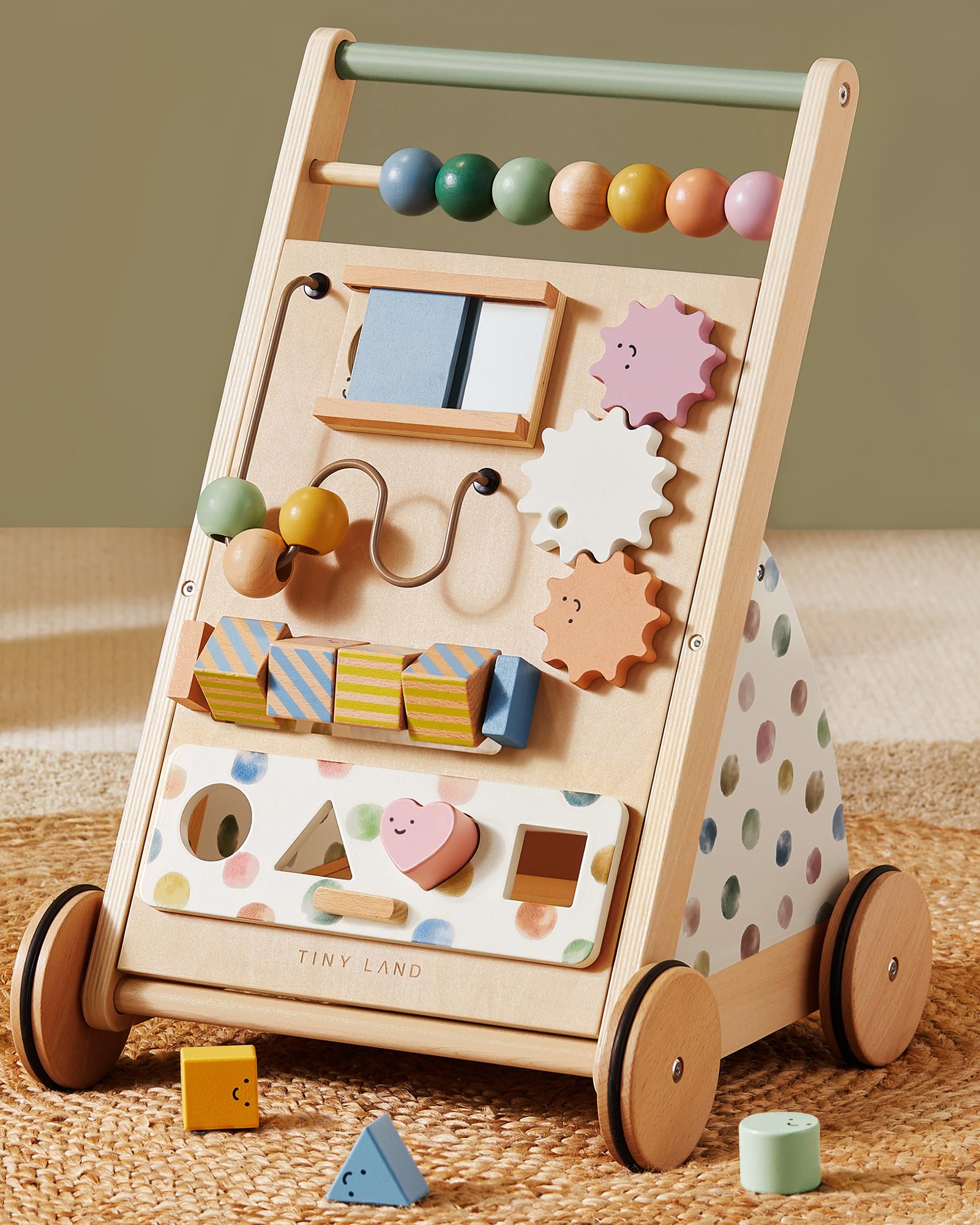
A wooden walker you leave out on purpose, not one you hide behind the couch.
Solid natural wood, non-toxic finishes, and rounded edges put this in a different category from the plastic carts — this is furniture your baby happens to play with. It weighs 9.5 pounds, stands about 21 inches tall, and rolls on four quiet rubber wheels that will not scratch a wood floor. Mirrors, gears, and learning toys sit on the front for hands-on play. The color is a soft Morandi palette designed to fit a living room rather than shout at it.
The feature that does the real work is a knob that adjusts how freely the wheels spin. Turn it in and the walker resists rolling, which is exactly what you want during the first wobbly week; loosen it as your baby gains confidence. Owners mention babies taking their first independent steps within a week, and a wheel-resistance knob that holds its setting. At 9.5 pounds it is far heavier than the plastic options here, and that weight is deliberate — it resists tipping in a way lighter walkers cannot.
Be honest about assembly. It takes real time, and the review pages split on it — some call the instructions straightforward, others ran into components that did not line up cleanly on the first attempt. Budget an evening and a clear floor. The other thing to know is the physical footprint: at roughly 21 inches tall it takes up more visual space than a folding plastic walker, though that is rather the point of a piece this handsome.
Read on the build: 9.5 pounds of solid wood with rubber wheels means it sits planted, stays quiet, and respects hardwood — three things no lightweight plastic walker manages at once.
Read on the setup: set aside a real block of time for assembly, and expect the pieces to need a patient hand.
Choose this if you want a walker that looks like a nursery piece, stays quiet on wood floors, and prioritizes stability over portability.
Weigh the trade: 9.5 pounds is not something you carry up and down stairs casually.
7. 5 in 1 Foldable Baby Walker

One frame that keeps reinventing itself from six months to eighteen.
Five modes — walk, bouncer, rocking, push, and eating — cover a lot of ground for a single frame, which is the appeal for anyone tired of buying a new piece of gear every few months. Three height positions let you keep the seat level with your baby as they grow. The breathable seat cover is the other thing owners mention constantly, and a triangular chassis with an enlarged base is the anti-tip design. A separate silicone non-slip mat adds grip. Musical toys, shape-recognition toys, and a colorful toy rack are included, and the music and cushion lift out.
The conversion is the headline, but the folding is the daily win. It collapses in a few steps and slides under a bed or sofa, and it comes back up just as fast. Owners describe babies who settle into it comfortably and stay entertained by the toy rack without needing much else — one parent commented that there is just enough on it to keep a child happy. A 6-month-old reaching up to chew on the top handrails is a scene that turns up more than once.
The honest caveat is the seat supports. They are described as not fully locking into place on some units, which is a comfort and confidence detail to check the moment yours arrives. It is not a walking-function failure, and most owners never raise it — but it is the single point that shows up in an otherwise very positive picture. Note too that this is a sit-in walker; there is no free-push handle for a toddler to grip and shove.
What you get for the footprint
- Five modes in one frame, from bouncer to eating table
- Folds flat in a few steps and stores under furniture
- Three height positions to match your baby’s growth
- Detachable musical toys and washable seat cover
The fine print
- Seat supports are reported to not always lock firmly
- Sit-in design only — no push-behind handle
The right call for a family who wants one gadget to cover sitting, bouncing, rocking, eating, and walking without owning five separate items.
Before you rely on it, check that the seat supports click in firmly on arrival.
8. Foldable Baby 5-in-1 Activity Walker

The walker that becomes a rocker, a bouncer, a feeding table, and a push cart.
Five modes shift this frame into a walker, a bouncer combo, a rocker, an eating table, and a hand-push cart, aimed at the 6-to-18-month stretch. Three adjustable height positions keep the seat at the right level as your baby grows, and the breathable seat cover is built for long sessions rather than quick ones. Music and toys on the activity center are there to hold attention and work on coordination. Speed is managed at the rear wheels, so you can dial down the roll while they are learning.
Quality is the word that dominates owner feedback here — the build comes across as solid and better-made than the price tier suggests, and the seat cover is described as easy to remove and wash. One owner noted she skipped the dryer on the washable padding to protect the foam, which is a sensible tip for any walker with a soft seat. Folding is straightforward and the frame tucks under furniture between uses.
The wheel behavior is the one point to weigh. Feedback is genuinely mixed on how easily it rolls — some owners describe a baby zooming around the house, others find the wheels need a nudge to get going on certain floors. It is the kind of thing that depends on your carpet or timber as much as the walker. Since the rear wheels are adjustable, most of this resolves with a tweak rather than a return.
What stands out: five modes and adjustable rear wheels make this the most flexible all-in-one in the mid-range bracket, and the washable removable seat is a genuine daily-life feature.
What to expect: rolling feel varies by floor surface, so plan to fine-tune the wheel setting in your own home.
Fits best a family who wants rocker, bouncer, feeding seat, and walker from one purchase and will actually use all five.
One thing to test early: roll the frame on your own floors and adjust the rear wheels before your baby’s first session.
9. Music and Lights Baby Walker
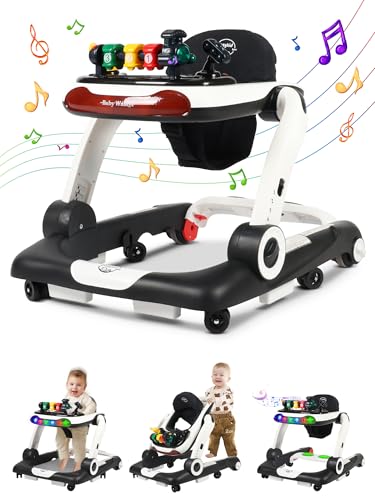
Six modes, a light disk, and an ergonomic backrest for long play sessions.
Six modes cover bounce, toddler, push, bounce music, music game, and tray use, aimed at babies 6 to 18 months. Four anti-slip pads act as assisted brakes, and there are four double-tier wheels plus two speed-adjustable wheels so you can tune the roll. A larger, stronger chassis is the stability story. The music and light disk plays and lights up to work on auditory development, with interactive game elements for hand-eye coordination. An ergonomic backrest supports your baby’s back during extended use, and the swivel wheel design makes the frame easier to push and steer.
This one is certified to ASTM and CPSIA safety standards (independent US safety rules for children’s products), which is a concrete thing to check off a list of walker worries. Owners call it sturdy and well made with a comfortable seat, and the light-and-music center holds attention longest — one reviewer noted her granddaughter fussed when taken out of it. The soft seat cover is removable and washable.
The honest catch is price. This sits at the very top of the range here, and at least one owner flatly felt it was a bit too expensive for what it does, even while calling it stable and easy to move. What you are paying for is the certified safety build, the ergonomic seat, and the six-mode range. If the music-and-lights angle is not a draw for your baby, that premium is harder to justify against the simpler walkers above.
Where it earns its spot: ASTM and CPSIA certification, four anti-slip assisted brakes, two speed-adjustable wheels, and an ergonomic backrest — this is the most safety-specified frame on the list.
What splits opinion: the cost. It is the priciest pick here, and the music-and-lights center is the feature you are paying a premium for.
Best suited to a household that wants the music-and-lights experience and values the certified safety build and supportive seat.
Worth a second thought if your baby ignores toys with sound — the simpler picks above do the walking job for less.
Know the Specs
Speed control and wheel resistance
Speed control is a dial, switch, or adjustable rear wheels that change how freely the walker rolls. At its tightest setting, the wheels resist turning so the walker moves slowly and your baby has time to place each foot. As their balance improves, you loosen it. This spec decides whether a new walker feels safe or scary, so check it before you buy. Walkers with a two-speed switch, an adjustable knob, or adjustable rear wheels are all solving the same problem in slightly different ways.
Height settings and seat depth
Detachable panels and toy attachment
A removable activity panel means the toy keeps working when your baby is sitting, not walking — it lifts off to the floor, a crib, or a table. Check how the toys connect to the tray. Suction cups are the most common weak point and tend to pop loose once a baby grabs and pulls. Tray-mounted pieces that click in usually hold up better through daily tugging.
Folding and storage footprint
Foldable designs collapse in a few steps and slide under a bed or sofa, which matters a lot in a small home. A folding plastic walker typically weighs between about 3 and 5 pounds and moves easily; a solid wood model runs around 9.5 pounds and stays put, but you will not be carrying it up stairs often. The weight you choose depends on portability versus planted stability.
Common Questions
What age should a baby start using an activity walker?
What is the difference between a sit-in walker and a push-behind walker?
Is a walker safe for a baby learning to take first steps?
How do I stop a walker rolling too fast on hardwood floors?
Can a foldable walker really be stored under a bed or sofa?
Why do the suction-cup toys keep falling off my walker?
Should I choose a wooden walker or a plastic one?
Does an activity walker really help a baby learn to walk, or is it just a toy?
How long does a typical activity walker stay useful?
Can I adjust a walker’s height as my baby grows?
The Bottom Line
For most families, the activity walkers winner is the VTech Sit-to-Stand Learning Walker because it covers both stages — a detachable panel for sitting play and a two-speed frame for pushing — and it holds up from 9 months to 3 years. If quiet, wood, floor-friendly stability is what you want, reach for the Tiny Land Wooden Baby Walker, which sits planted at 9.5 pounds and lets you dial the wheels down while your baby finds their balance. And for a walker that keeps growing into pretend play, the Fisher-Price Laugh & Learn Snack Cart Walker is the one to reach for, with four languages and 14 play pieces that stay interesting long after the first steps. The honest nudge: match the walker to the stage your baby is in right now. A free-rolling frame is fine for a confident cruiser and a poor fit for a first-step beginner, while a frame with speed control serves both.
How we choose
We do not accept paid placement. Every pick is matched to a real buyer and a real use-case; we do not hands-on test units.
Sources
Specifications: manufacturer listings and product documentation. Review insights: verified customer reviews, as of October 2026. Pricing: not shown on this page (it changes often); check the current price via the retailer link.
As an Amazon Associate, Aappliancez earns from qualifying purchases. This does not affect which products we feature.