Disclosure: Some links in this post are affiliate links. As an Amazon Associate I earn from qualifying purchases, at no extra cost to you. Learn more
Specs are compiled from manufacturer listings and verified buyer reviews and can change over time — please confirm the key details on the product page before buying.
If you want the short answer: the COSTWAY 12000BTU Mini Split Air Conditioner & Heater is the smartest buy here because it runs near-silent, covers 750 square feet, and heats as well as it cools. A wall unit is a permanent decision — you cut a hole, you wire a circuit, and you live with the result for years. So the picks below sort by what actually goes wrong in real homes: wrong voltage, missing sleeve, noise at 2 a.m., and cooling claims that don’t hold in a heatwave.
This guide is built by comparing the manufacturers’ published specifications and the patterns across verified customer reviews, so you get each pick’s real strengths and trade-offs instead of marketing spin.
You will see through-wall, mini-split, and PTAC styles side by side, with the voltage and sleeve details spelled out before you commit. That matters because the wrong voltage is the number one reason a wall unit goes back — and this breakdown of ac wall units flags it for every model.
Top Picks


How To Choose The Best AC Wall Units
Most buyers start with BTU and stop there, then discover the hard part later: their wall has no 230V outlet, or the old sleeve is two inches too narrow. Get the installation physics right first and the comfort follows.
Match BTU to the room, then be honest about the room
Match the unit to your room size before you buy. Several makers here rate a 12,000 BTU unit (BTU is the cooling power rating) at around 550 square feet, and a 14,000 BTU unit at up to 700 square feet. Those ratings assume a normal ceiling, decent insulation, and closed curtains. An uninsulated garage or a room with a high open ceiling needs headroom above the rating. That is why buyers of the Whirlpool 14,000 BTU model cooled a 684 square foot insulated garage to 70°F but needed roughly six hours to do it.
Check the outlet before you check anything else
This is the single most common return reason in the category. Some through-the-wall units run on standard 115V household current, while others demand a 230V circuit with a 20A plug. The Whirlpool 14,000 BTU model uses a 230V/15A outlet, and the Cooper & Hunter PTAC ships with a 20A power plug and reset breaker. If you do not already have that receptacle, budget for an electrician’s visit on top of the unit.
Know if you need a sleeve, a grille, or a bracket
Through-the-wall units slide into a metal sleeve set into the wall, and that sleeve is often sold separately. The OLMO 8,000 BTU and TCL 10,000 BTU listings both state the wall sleeve is not included. The Whirlpool 14,000 BTU fits sleeves 24.5 to 27 inches wide, and the TCL fits sleeves sized 26 by 20 by 15.57 inches. Measure your existing sleeve before ordering, not after.
Decide if you want heat, dehumidifying, or cooling alone
Cooling-only units are simpler and cheaper to run. A heat pump or supplemental heater adds year-round use but changes the wiring and the price tier. The COSTWAY 12,000 BTU includes a 1-ton heat pump, while the Frigidaire and Keystone models listed here are cooling only or cooling plus dehumidifying. If your winters are mild, cooling-only is the honest choice.
Side-by-Side Comparison
| Model | Best For | Cooling Power | Floor Area | Voltage / Type | Amazon |
|---|---|---|---|---|---|
| COSTWAY 12000BTU Mini Split★ Best Overall | Year-round cool and heat | 12,000 BTU | 750 sq ft | Split system | Amazon |
| ROVSUN 12000 BTU Mini SplitRoom-Filling Power | Quiet bedrooms | 12,000 BTU | 750 sq ft | 115V split | Amazon |
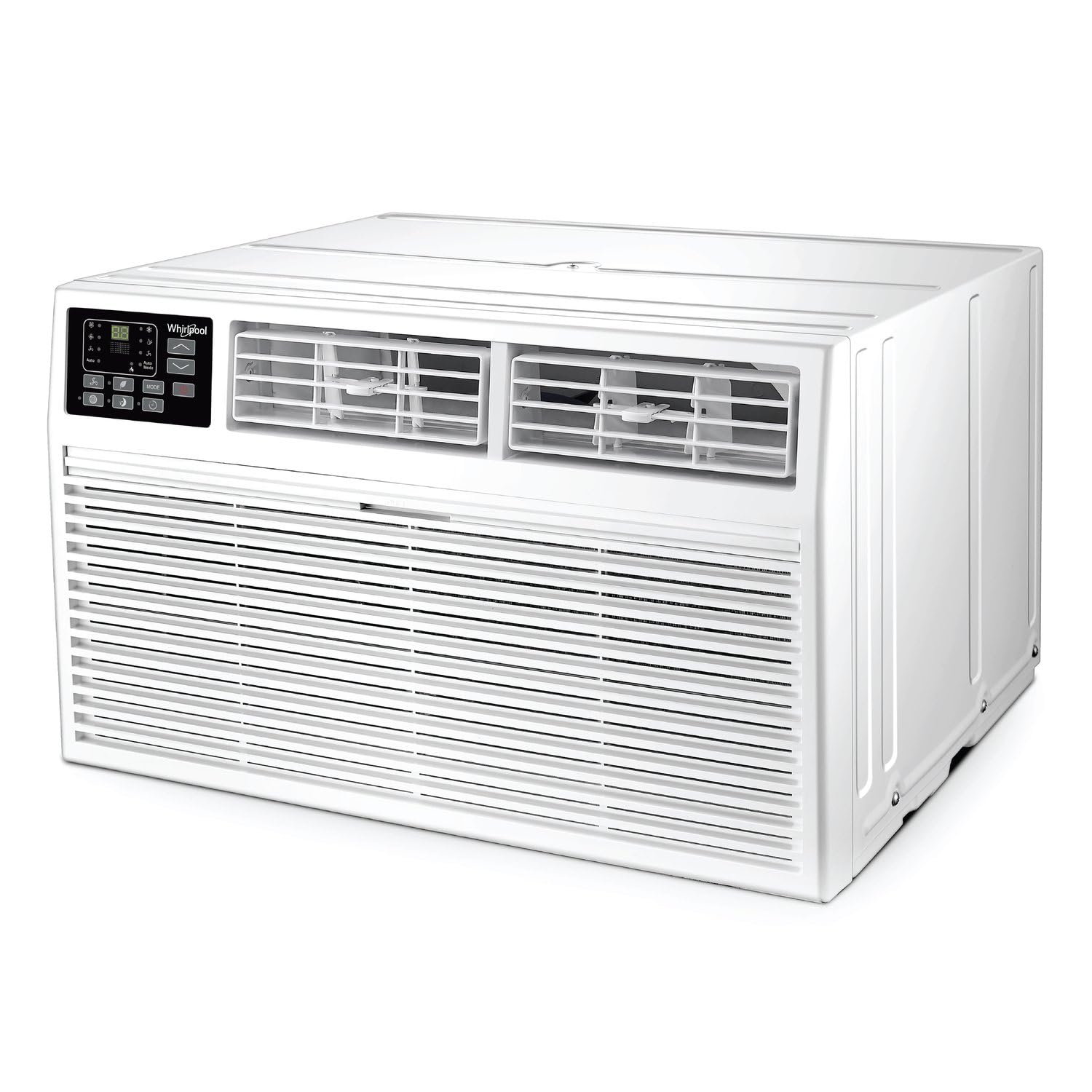
| Whirlpool 14,000 BTU Wall ACGarage Workhorse | Garages and big rooms | 14,000 BTU | 700 sq ft | 230V/15A through-wall | Amazon |
| Frigidaire 12,000 BTU Built-In | Easy wall swap | 12,000 BTU | 550 sq ft | Built-in wall | Amazon |
| LG 10,000 BTU Through-Wall | Small rooms and apartments | 9,800 BTU | 440 sq ft | 115V through-wall | Amazon |
| OLMO 8,000 BTU Through-Wall | Smart control on a budget | 8,000 BTU | 0.67 tons | 115V through-wall | Amazon |
| TCL 10,000 BTU Smart | Voice and app control | 10,000 BTU | 450 sq ft | 230V through-wall | Amazon |
| Keystone 12,000 BTU Wall AC | Dehumidifying a room | 12,000 BTU | 550 sq ft | Wall mounted | Amazon |
| BLACK+DECKER 18,000 BTU | Whole floors | 18,000 BTU | 1,000 sq ft | Window/wall | Amazon |
| Friedrich Chill Premier 18,000 BTU | Inverter quiet cooling | 18,000 BTU | 1.5 tons | 230/208V | Amazon |
| Cooper & Hunter 15,000 BTU PTAC | Hotels and rentals | 15,000 BTU | 800 sq ft | 230/208V PTAC | Amazon |
Detailed Reviews
1. COSTWAY 12000BTU Mini Split Air Conditioner& Heater
Our pick — 4.0+★ from 1,500+ verified ratings; the strongest balance of quality and price.
A 1-ton inverter heat pump that heats and cools 750 square feet with self-cleaning and a blackout remote display.
This is the pick for the buyer who wants one unit to handle July heat and January cold without a separate heater on the wall. A 1-ton heat pump sits inside, and the inverter compressor changes power frequency instead of clicking on and off all day — so it holds a steady temperature instead of swinging it. It covers 750 square feet, the largest rated coverage of the mini-split picks here.
Efficiency is where this model leaves the through-wall crowd behind. Its air flow efficiency reads 1147 cubic_feet_per_minute_per_watt against 265 on the Whirlpool 14,000 BTU wall unit, and its annual energy consumption is 1970 watts versus 3650 on the Whirlpool. In plain terms, it moves far more air per watt of power, which is the difference between the compressor hunting all afternoon and the room quietly sitting at your set point.
You get five working modes (auto, cooling, dehumidifying, heating, fan), four fan speeds, plus sleep, ECO, iFEEL and turbo settings. A 0.5 to 24 hour timer lets you schedule it, and the remote’s display screen blacks out on its own so a dark bedroom stays dark. The self-cleaning cycle runs the interior up to 134.6°F so the coil stays clean without you opening panels. What wins people over most is the fit and finish — the build quality and quiet operation come up again and again, with buyers running it next to their ear just to confirm it is on. As owners put it on the shop-cooling side: “very quiet, strong airflow, good build quality.”
Budget for pro installation, because this is a split system (an indoor head plus an outdoor unit linked by refrigerant lines). It needs a licensed HVAC installer, a vacuum pump to evacuate the lines, and a dedicated 230V circuit. A few buyers got a unit with a flare joint (the fitting where the copper line seals) that leaked refrigerant. The copper line also kinks easily if you bend it tighter than a 6 to 7 inch radius. Both are installer-side risks, not something you fix later. The manual also skips some vacuum steps, so watch a video before the tech arrives. Still, the 5-year parts and 8-year compressor coverage backs the hardware itself.
What earns the top spot
- 750 sq ft coverage with a 1-ton heat pump and inverter compressor for steady temps
- 1147 cubic_feet_per_minute_per_watt vs 265 on the Whirlpool — far more air per watt
- Five modes, four fan speeds, sleep/ECO/iFEEL/turbo, and a 0.5–24 hour timer
- Self-cleaning at 134.6°F plus 5-year parts and 8-year compressor coverage
Where it asks more of you
- Requires a licensed HVAC installer and a vacuum pump — not a plug-in
- Rare reports of leaking flare joints and a copper line that kinks easily
- Manual leaves some vacuum steps unclear; plan on a video walkthrough
Reach for this if: you want one wall unit that heats and cools a large room and you are fine hiring an installer for a day.
Look elsewhere if: you need something that slides into an existing through-wall sleeve this weekend.
2. ROVSUN 12000 BTU Mini Split AC & Heater
A 115V mini split that runs on standard household current and drops to 28dB in mute mode.
This is the pick if you want mini-split comfort but cannot run a 230V line. It is a 115V/60Hz unit — standard household voltage — so it plugs into a normal outlet. Owners say that means no long electrical run and a DIY install that is actually feasible with a video or two. It cools up to 550 square feet, or warms it, since the inverter heat pump (a compressor that varies its speed to hold a set temperature) runs 61°F to 88°F year-round.
The quiet number is the one worth circling: 28dB in mute mode. That is close to a whisper, and it is why so many buyers stick this in bedrooms and garages. The 20 SEER rating is AHRI certified, meaning an independent body has verified the efficiency claim, and higher SEER generally means lower running cost over time. It also takes app and voice control through Alexa or Google Assistant, so you can set a routine to have the room cool before you walk in.
Where it stands apart from its COSTWAY cousin above: the 115V power is the real differentiator, and it costs you some coverage — 550 square feet here against 750 on the COSTWAY. What earns the most goodwill is the overall build quality, followed by value for money, and buyers describe wall units that look good and run quiet on low and medium. One long-term owner found the wiring was the hardest part of installation, and a couple of units arrived with a fan that failed to power on — the seller sent return labels both times. The catch worth knowing: it ships in two separate boxes, so do not schedule the installer until both land.
The voltage advantage: standard 115V current means no electrician for most homes — a genuine convenience the 230V units cannot match.
Plan for two boxes: the indoor and outdoor units ship separately, so confirm both have arrived before booking installation.
Best fit for: a bedroom or garage where you have a standard outlet and want near-silent heat and cool.
Not the pick for: a space larger than 550 square feet — step up to the COSTWAY’s 750 square feet.
3. Whirlpool 14,000 BTU Wall Air Conditioner
A 14,000 BTU through-wall unit with 10,600 BTU supplemental heat, sized for a 700-square-foot garage.
If your “room” is actually a garage or a shop with an open ceiling, this is the pick made for the job. It delivers 14,000 BTU of cooling and 10,600 BTU of supplemental heat, rated for spaces up to 700 square feet. The heat is explicitly not a primary winter source — think of it as taking the chill off, not replacing your furnace. Buyers report it cooled a 684 square foot insulated garage from 88°F to 70°F in roughly six hours, and knocked humidity down 15% along the way.
The flexibility is real: 8-way directional louvers spread air where you point it, three fan speeds and four operation modes let you tune it, and a washable quick-access filter pulls out for a wipe without tools. A trim kit and rear grille are included to finish the wall opening, and it fits sleeves 24.5 to 27 inches wide. The 4.9-foot attached plug means it reaches a 230V/15A outlet without an extension cord.
Set expectations on efficiency and install weight, because both are on the higher side. Annual energy consumption reads 3650 watts against 1970 on the COSTWAY, and air flow efficiency is 265 cubic_feet_per_minute_per_watt, so it is not a lean machine. It tips the spec sheet at 74.5 pounds and calls for two people to seat it in the sleeve. Functionality and build quality both come up as mixed in the review pages — a compressor that never fired on arrival is the recurring complaint, so unbox and test before you haul it to the wall.
Why it suits a garage
- 14,000 BTU cooling plus 10,600 BTU supplemental heat for 700 sq ft spaces
- 8-way louvers, 3 fan speeds, 4 modes, and a 24-hour programmable timer
- Trim kit and rear grille included; fits sleeves 24.5–27 inches wide
What to weigh honestly
- High annual energy consumption (3650 watts) — it works hard and drinks power
- Heavy at 74.5 lbs; plan two people for the lift into the sleeve
- Mixed reports of compressors dead on arrival; test it before installing
Leans toward: insulated garages, workshops, and big sun-baked rooms that need raw BTU muscle.
Think twice if: you only have a 115V outlet — this needs a 230V circuit.
4. Frigidaire 12000 BTU Wall Air Conditioner

A built-in 12,000 BTU wall unit for 550 square feet with an air ionizer and a washable filter.
This is the one for someone replacing an older wall unit in a bedroom or a small living room who wants a clean, tidy swap. It delivers 12,000 BTU across 550 square feet and adds an air ionizer to the airflow, so the air circulating the room is treated rather than just cooled. The washable filter comes out and rinses, and a check-filter indicator tells you when it is due — no cartridge to buy.
Comfort settings are thorough for a built-in: a 24-hour on/off timer, sleep mode, dry mode, energy saver mode, three fan speeds, and a remote. The physical frame measures height 14.5 inches, 24 inches deep, with 19 inches of depth on the unit, so check your existing opening before ordering. Owners who installed it easily found it energy efficient and straightforward to set up.
The trade-offs are weight, sound, and a non-universal sleeve fit. The unit is heavy and a few owners find it noisy even on the lowest setting, and it is slower to chill a 12×12 room than the BTU rating would lead you to expect. Quality and cooling both read as mixed across the reviews, so read the install guide carefully and verify your sleeve dimensions. The plastic sleeve frame is on the lighter side, so treat it gently during the fit.
The value read: filter care costs nothing beyond a rinse, and the ionizer adds air treatment without extra running parts — genuinely low maintenance.
Good match for: replacing a worn built-in wall unit where you already have a sleeve sized to fit.
Pause if: quietness is your top priority — a few owners find it noticeable on the lowest fan.
5. LG 10,000 BTU Through the Wall Air Conditioner
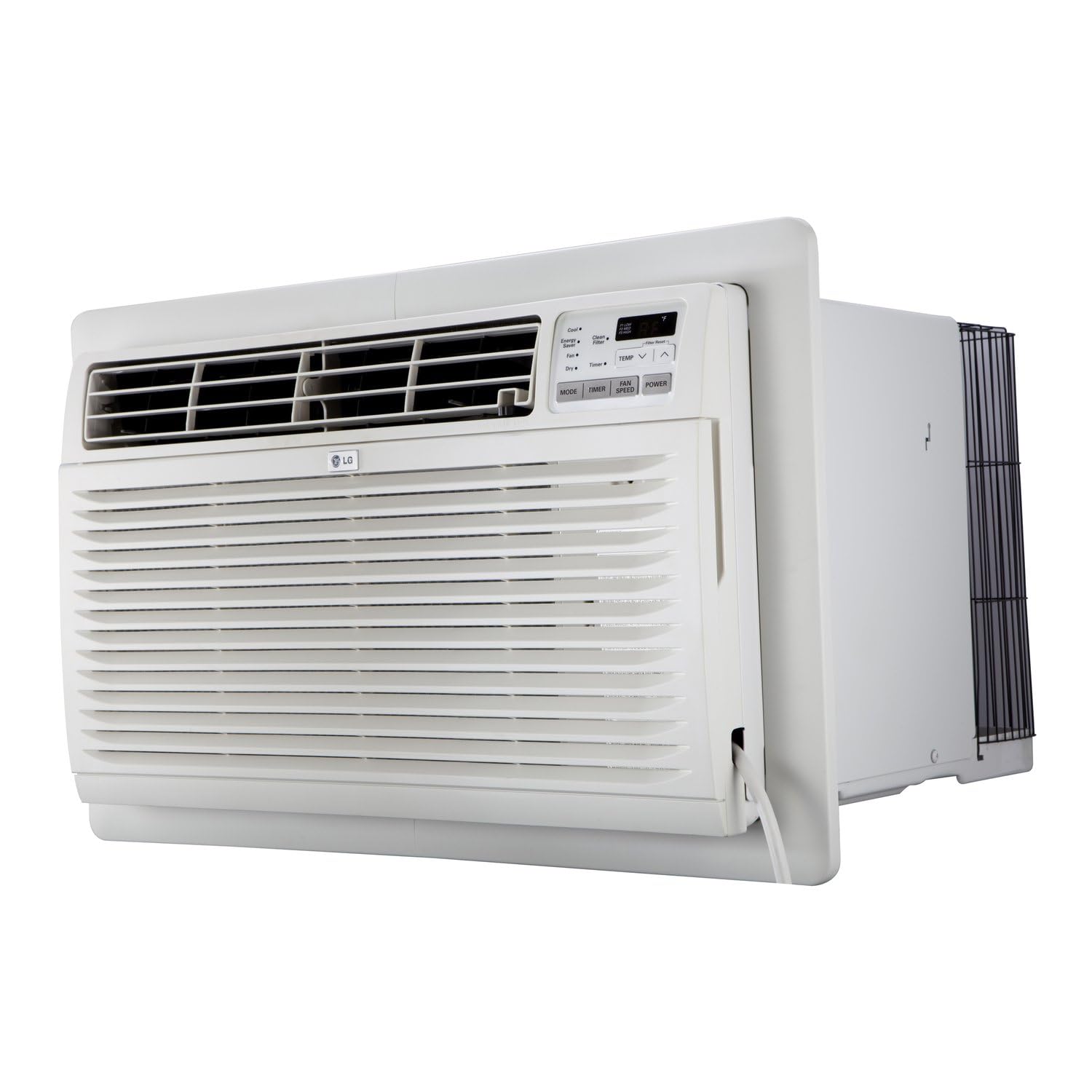
A 115V through-wall unit rated for 440 square feet that owners install in about an hour.
For a NYC one-bedroom or a converted garage, this is the sensible footprint. It puts out 9,800 BTU and is rated for rooms up to 440 square feet, running on standard 115V current so no electrician is needed for most homes. It uses R-32 refrigerant with an energy efficiency ratio of 10.7, and Dry mode pulls up to 2.9 pints of moisture an hour — useful in a damp basement or a muggy summer.
You get three cooling speeds, three pre-programmed modes, and 4-way air deflection, so you can aim the air where it matters. Energy Saver mode cycles the compressor off once you hit your set temperature while the fan keeps air moving. The snap-together plastic trim kit frames the indoor side, and a mesh grille protects the outdoor face. Owners describe installation as easier than expected — two people handled it in about an hour including pulling the old unit, and one 71-year-old buyer studied the instructions for three days and then did it in roughly an hour.
The honest limits: it is only rated for 440 square feet, and a few owners find the compressor noticeable at night when it kicks in below 72°F. There is a long-term durability note too — heavy 24/7 summer use in a hot Texas garage wore out prior units in the three-to-four-year range. The instructions come in several scenario variants, so match yours to the install you are doing and watch a video before you start.
Suits you if: you have a 115V outlet and a room up to 440 square feet to cool.
Consider a bigger unit if: you are cooling a whole floor — 9,800 BTU will not carry it.
6. OLMO 8,000 BTU Through-the-Wall AC

An 8,000 BTU cooling-only wall unit with app, remote, and push-button control for a small room.
This one earns its spot on smart convenience in a small space. It delivers 8,000 BTU — 0.67 tons — and is designed for 115V, single-phase, 60Hz current with R-32 refrigerant. That cooling-only design keeps it simple: no heat pump, no burner, just cool air. It is built for residential, commercial, and hotel use, which tells you it is made to sit in a wall and stay put.
The control story is the reason to pick it. You get a digital push-button panel with LED display, an included remote, and app control on a compatible phone — so you can set the temperature without getting up. Sleep mode and a timer round out the daily-use settings, and multiple fan speeds let you dial the airflow up on a hot afternoon. Buyers describe fast delivery, easy installation, and being able to run it from the app as the standout convenience.
Two practical facts to know before you buy. First, the wall sleeve is not included — you have to buy it separately, so factor that into the plan. Second, it is cooling only, which is a non-issue in a mild climate but a real limit in a cold one. On lifespan, the headline review is blunt: owners mention roughly two years of service in Florida heat, so treat it as a lower-duty unit for comfort cooling rather than a heavy-cycle workhorse.
What sells it
- 8,000 BTU (0.67 tons) at 115V — standard household current
- App, remote, and push-button panel control with LED display
- Sleep mode, timer, and multiple fan speeds
Where the fine print bites
- Sleeve sold separately — you supply the wall opening
- Cooling only, no heat for winter
- Customers note about two years of life in hot climates
Worth it for: a single room where app control and a low BTU draw matter more than raw power.
skip it if: you need heating or you expect a decade of heavy summer use.
7. TCL 10,000 BTU Through-the-Wall Air Conditioner
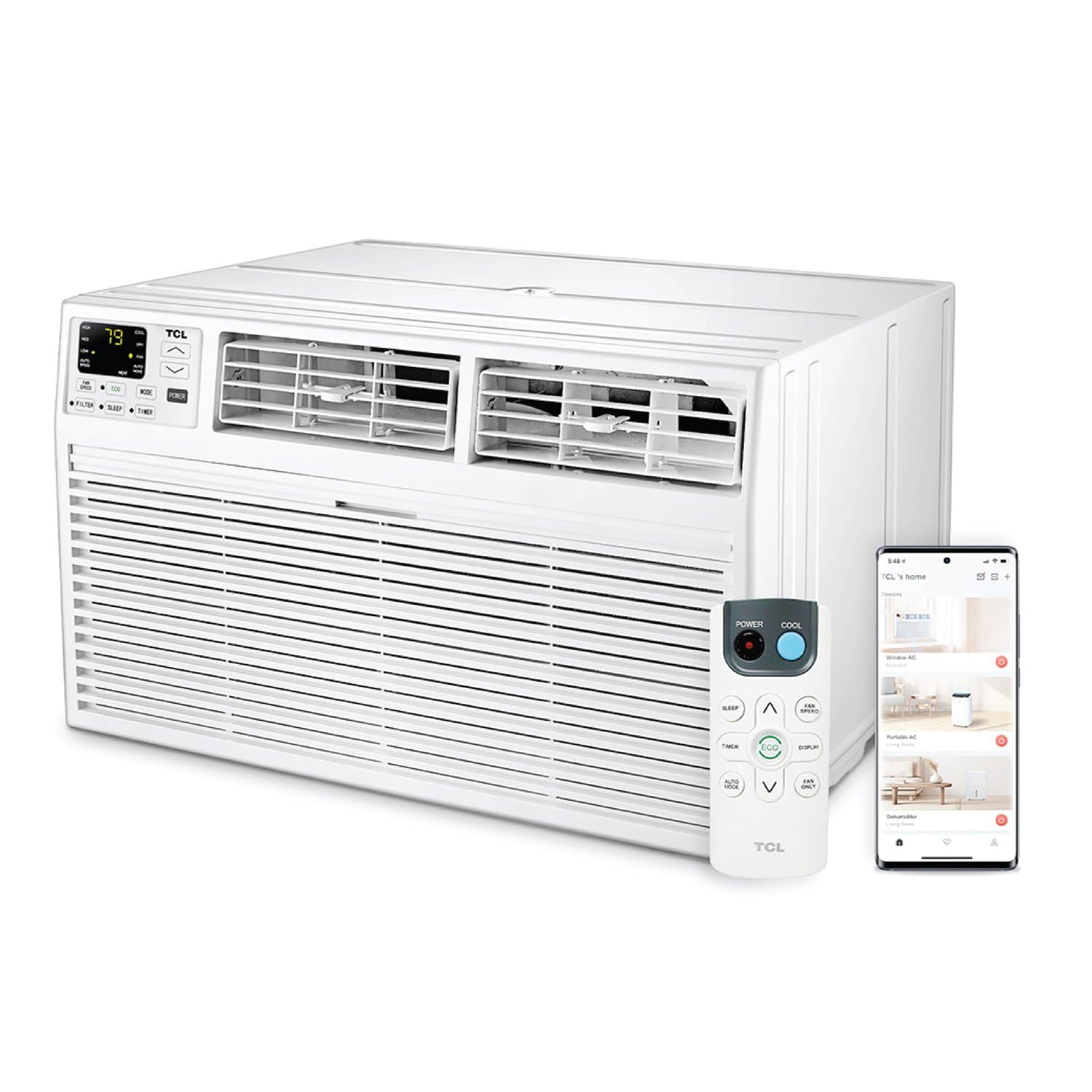
A 10,000 BTU through-wall unit rated for 450 square feet with Alexa and Google Assistant control.
If your phone is never far away, this is the wall unit that keeps pace. It cools up to 450 square feet and connects to Amazon Alexa and Google Assistant, so you can change settings without crossing the room. A remote is in the box for the times you would rather not talk to it. The in-wall design also keeps your floor and window clear — no portable unit to roll around, no exhaust hose in the way.
Dry Mode is the quiet hero for humid climates: it pulls moisture from the air to cut stickiness and help keep odors down. Fans of this style point to how cleanly it integrates into the wall — no floor space lost, no window blocked. In a 750 square foot insulated shop one buyer reports it holding at or under 75°F even on 100°F-plus days, which is stout for a 10,000 BTU unit. Others describe the 450 square foot living room cooling in about 25 minutes with four-way vents spreading air evenly.
Be strict about the electrical and sleeve requirements before you commit. This unit needs a 230V circuit, so verify your outlet situation first, and the wall sleeve is sold separately — it fits sleeves sized 26 by 20 by 15.57 inches. A few owners found the 450 square foot rating optimistic in a room with a high ceiling, and one unit failed within the first week. The app can be finicky on first connection, but it settles once paired.
The smart-home pitch: Alexa and Google Assistant voice control plus an app mean the thermostat is in your pocket — a real upgrade over a remote-only unit.
Pick this if: you want voice control and a clean in-wall look for a medium room.
Check first: you have a 230V outlet and a sleeve at 26 by 20 by 15.57 inches — neither is included.
8. Keystone 12,000 BTU Wall Mounted AC Unit
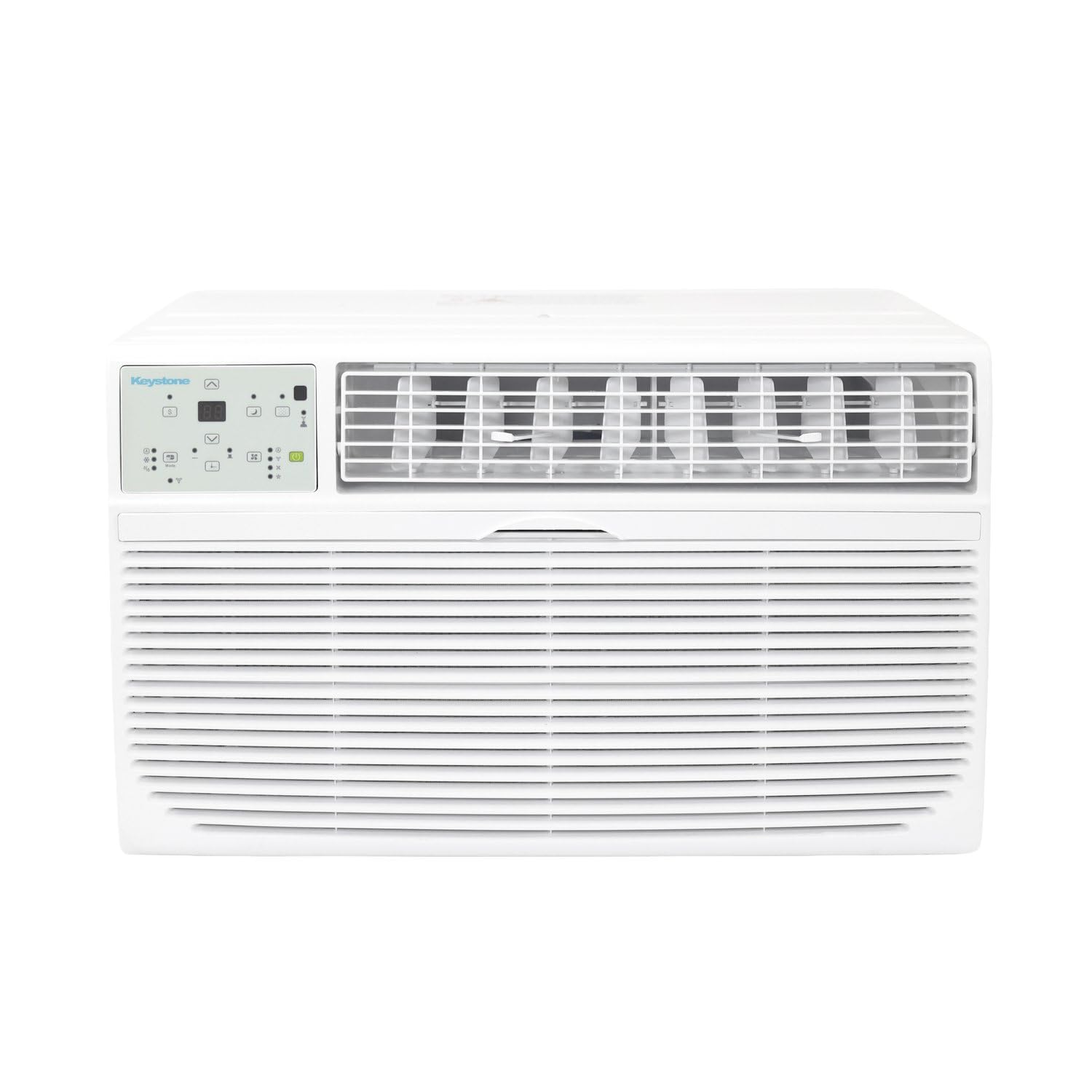
A 12,000 BTU wall unit for 550 square feet that pulls 2.5 pints of moisture per hour.
This is for the damp room — the basement studio, the bathroom-adjacent bedroom, the coastal apartment where the air feels heavy. It cools up to 550 square feet at 12,000 BTU, and its built-in dehumidifier removes 2.5 pints of moisture per hour. That is a real working number if your problem is clammy air as much as heat. Three cooling modes, three fan speeds, and 4-way adjustable louvers give you control over where the air goes, and a programmable timer handles the schedule.
The remote is the clever bit. It measures the temperature of the room you are standing in, shows it on the LCD screen, and sends a signal back to the unit every three minutes, so the cooling tracks your actual position in the room. The unit mounts in the wall with a standard universal interior trim kit, so you keep your window view and your floor. On the strong side, reviewers point out it holding comfortable temps in a high-ceiling room larger than its 500 square foot rating during 90°F-plus heat.
Set expectations on noise and certainty. It is loud — that comes up in the reviews, and loudness is the trade-off for the BTU output. No sleeve is included, so supply your own, and there is no heat function if you need winter warmth. Durability is the open question: buyers talk about a shorter-than-hoped service life, and one prior unit developed mold from water pooling in an unlevel in-wall case, which points to getting the wall pitch right during install. An occasional unit arrives dented in shipping, so inspect before signing.
Why it earns the spot
- 12,000 BTU for 550 sq ft plus 2.5 pints of dehumidification per hour
- Remote reads room temp and signals the unit every 3 minutes
- 3 modes, 3 fan speeds, 4-way louvers, and a programmable timer
What you give up
- Noticeably loud — the BTU output comes at a sound cost
- No sleeve included and no heat function
- Shoppers say shorter service life; keep the in-wall case level
Right for: humid rooms where moisture control matters as much as temperature.
Wrong for: a bedroom where quiet at night outranks dehumidifying.
9. BLACK+DECKER Window Air Conditioner 18000 BTU, BD18WT6
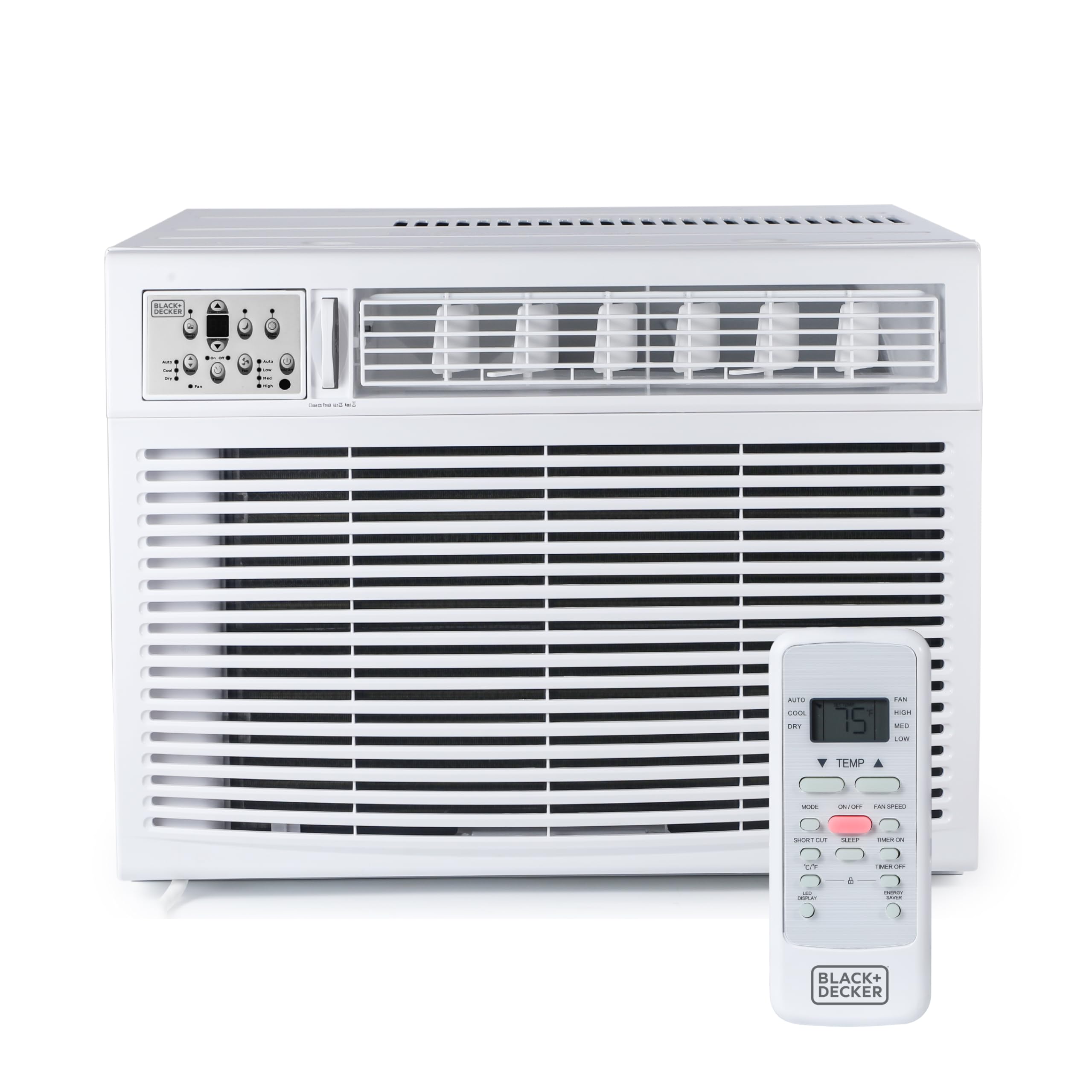
An 18,000 BTU heavy hitter rated to cool a full 1,000 square feet.
When the space is a whole floor or a large open-plan room, this is the capacity you want. It delivers 18,000 BTU and is rated for up to 1,000 square feet, which is the biggest coverage on this list alongside the Friedrich. It runs at four levels — auto, low, medium, and high — and uses R-32 refrigerant, which is easy on the ozone layer and efficient to run. A full function remote handles every setting, including sleep mode, energy saver, and a 24-hour timer.
Installation is dressed up for ease: accordion-style side panels let it fit standard double-hung windows from 28 to 40.5 inches wide and as low as 18.5 inches high, so most standard windows will take it. It also works as a window or through-wall unit. For a big space with an open layout, that raw 18,000 BTU is the reason to pick it — fewer units, one window, one plug.
Reliability is the honest caution here. Annual energy consumption reads 1091.58 kilowatt hours per year (kWh is the unit your power bill counts). Buyers report a short first-year life in a couple of cases — a unit that quit cooling around the one-year mark, and one that arrived with the fan and compressor never firing. The 4-year compressor warranty requires a certified technician for a claim, which can be a hassle to arrange. The styrofoam packaging also demands patience to unpack. Buy it for the capacity, but keep the receipt and test it the day it lands.
What it is built to do: cool 1,000 square feet from one install point, which the smaller through-wall units simply cannot match.
Choose it for: a whole floor or a big open living space that needs 18,000 BTU in one window.
Weigh the risk if: you want a low-maintenance long-term unit — test it immediately and keep the warranty paperwork.
10. Friedrich Chill Premier Inverter 18,000 BTU Window & Wall Unit

An Energy Star inverter unit that cools 18,000 BTU with barely a sound.
If you want a big unit that disappears acoustically, this is the pick. It is an 18,000 BTU cooling-only unit that works as a window or wall unit on 230/208V. It runs an inverter compressor — the type that varies its speed smoothly instead of banging on and off — which is why it stays quiet and holds temperature better than a standard fixed-speed compressor. Efficiency carries an Energy Star certification, and an activated carbon filter sits on the intake.
The comfort case is straightforward: cooling only, no heat, and a premium build aimed at a quiet room. Buyers describe cooling fast and running so quietly you barely notice it is on, and the sweep feature spreads air more evenly across the room. It is lighter than the 35-year-old unit it replaced for some buyers, which made the swap less back-breaking than expected. It runs on 230/208V, so you need that circuit already in place.
The one caveat worth knowing is price tier — this sits at the premium end of the group — and reports of a unit that failed after a short run exist, so check it powers on within the return window. There is no heat function, which matters if you want year-round use. For a cooling-only job where noise is the deal, this is the most refined wall unit here.
Why the inverter matters: smooth speed changes mean less cycling and less noise — a genuinely different experience from a fixed-speed compressor.
For you if: quiet cooling and Energy Star efficiency for 18,000 BTU are the priorities.
Not for you if: you need heat or only have standard 115V wiring.
11. Cooper & Hunter 15,000 BTU PTAC

A packaged terminal unit with a 3.5 kW heater built for hotel rooms and rentals.
This is the one for a landlord or hotel owner who needs a wall unit that heats and cools and looks built-in. It is a PTAC — packaged terminal air conditioner — delivering 15,000 BTU of cooling and 3.5 kW of electric heat, on R-32 refrigerant. That pairing makes it a year-round unit: one box, hot or cold, all seasons. It is rated for spaces up to 800 square feet and runs on 230/208V with a 20A power plug and reset breaker.
Controls are where it shines for a rental property. You get a wireless smart kit and remote for temperature, fan, and mode, plus a digital button panel with LED display for when you are standing at the wall. The included heater lets you skip a separate space heater. It ships freight because of its size — Cooper & Hunter lists dimensions of 21 by 42 by 16 inches — and the carrier calls ahead to coordinate delivery. On the cooling side, owners mention it working flawlessly even in subzero conditions, and quickly bringing a lobby to a chilly 72°F.
The mixed side is durability and the door details. Front covers have arrived broken, so inspect the crate at delivery, and the remote is short-range — one owner found it only reached about four feet, well short of 15. The app is basic with no fine-tuning. The wall sleeve and exterior grille are not included, so account for them on a new install. A handful of units did fail early, and the warranty requires registration — do that on day one to avoid being denied later.
The case for a PTAC
- 15,000 BTU cooling plus 3.5 kW electric heat for 800 sq ft
- Wireless smart kit, remote, and LED button panel
- Built for hotel rooms, apartments, homes, and dorms
The paperwork and the crate
- Front covers can arrive broken — inspect at delivery
- Short-range remote (about 4 ft) and a basic app
- Register the warranty immediately; sleeve and grille sold separately
Built for: a rental, hotel, or dorm where year-round heat and cool from one wall unit is the goal.
Look elsewhere if: you only need cooling — a cooling-only unit is simpler and cheaper to live with.
Know the Specs
BTU: what the cooling number actually means
BTU (British Thermal Unit) is the amount of heat the unit can pull out of a room — higher BTU, bigger space. A 12,000 BTU unit often covers around 550 square feet, while an 18,000 BTU unit can reach up to 1,000 square feet. Match the number to your room’s real size, ceiling height, and insulation, because a room with high open ceilings or minimal insulation will need headroom above the rating.
Voltage: the make-or-break spec
Voltage tells you what kind of outlet the unit needs. A 115V unit plugs into a standard household outlet, while a 230V unit needs a dedicated circuit. The difference decides whether you install it yourself this weekend or book an electrician first. Check your outlet before anything else — this is the most common reason a wall unit gets returned.
Sleeve vs. split: two different installations
A through-the-wall unit slides into a metal sleeve set into the wall, and a mini-split mounts an indoor head on the wall with an outdoor compressor connected by copper lines. A sleeve install is faster and often a swap of an old unit; a split needs an HVAC technician, a vacuum pump, and refrigerant lines. Neither is harder to live with — they just ask different trades.
Inverter vs. fixed-speed compressor
A fixed-speed compressor bangs on and off to hold temperature, while an inverter compressor varies its speed smoothly. Inverter units tend to be quieter, hold a steadier temperature, and use less energy, which is why the mini-splits and the Friedrich here run them. A fixed-speed unit is fine for a garage or a room where noise is not the concern.
Common Questions
Can I install a through-the-wall AC unit myself?
What is the difference between 115V and 230V wall units?
Do I need a wall sleeve and is it included?
How many square feet will a 12,000 BTU wall unit cool?
Is a mini-split better than a through-the-wall unit?
What voltage does a Cooper & Hunter PTAC need?
How long do wall air conditioners usually last?
Can a wall AC unit also heat the room?
How do I clean the filter on a wall air conditioner?
Do wall units work with Alexa or Google Assistant?
The Bottom Line
For most buyers, the strongest pick among these AC Wall Units is the COSTWAY 12000BTU Mini Split. It cools and heats 750 square feet with an inverter compressor and a self-cleaning cycle, and it moves far more air per watt than the through-wall crowd. If you want mini-split comfort on a standard 115V outlet, reach for the ROVSUN 12000 BTU. And if a hot garage is the job, the Whirlpool 14,000 BTU has the raw BTU muscle and the sleeve fit to match.
Wherever you land, order the sleeve first, check your outlet voltage second, and test the unit the day it arrives — do those three things and the install goes smoothly.
How we choose
We do not accept paid placement. Every pick is matched to a real buyer and a real use-case; we do not hands-on test units.
Sources
Specifications: manufacturer listings and product documentation. Review insights: verified customer reviews, as of October 2026. Pricing: not shown on this page (it changes often); check the current price via the retailer link.
As an Amazon Associate, Aappliancez earns from qualifying purchases. This does not affect which products we feature.