Disclosure: Some links in this post are affiliate links. As an Amazon Associate I earn from qualifying purchases, at no extra cost to you. Learn more
Specs are compiled from manufacturer listings and verified buyer reviews and can change over time — please confirm the key details on the product page before buying.
If you are recovering from a tummy tuck, the right abdominal binder does two plain jobs: it holds gentle, even pressure on your healing belly and keeps the swelling down enough that you can stand up, walk, and cough without wincing. The wrong one rolls down, digs into your incision, or loosens after an hour, and you end up fighting it all day. Below are the binders and wraps that hold their place, plus the compression boards and girdles people pair with them, so you can match one to your body, your recovery stage, and how much help you want getting it on by yourself.
This guide is built by comparing the manufacturers’ published specifications and the patterns across verified customer reviews, so you get each pick’s real strengths and trade-offs instead of marketing spin.
You will see how each one fits a real body, how the closures behave, and where the honest trade-offs sit. My aim is simple: help you find the best abdominal binder after tummy tuck without a shelf of returns sitting by your bed.
Top Picks


How To Choose An Abdominal Binder After A Tummy Tuck
Buying a binder for post-surgery is different from buying a postpartum belt for comfort. Your skin and incision are tender, your body changes size week by week as swelling shifts, and the binder has to be tight enough to support yet loose enough to breathe. Sort your shortlist on three things first: how the closure adjusts, whether the size range actually covers your waist, and whether the material is soft against skin that is still healing.
The closure is the whole ballgame
A binder only works if you can get it on without help and tighten it in small steps. Hook-and-loop closures (the Velcro-style grip) let you pull one tab and press it down anywhere, so you can dial the pressure up or down without taking the whole thing off. Multi-strap designs give independent belts for the belly, waist, and pelvis, which helps if your swelling moves around. Rigid panels aside, if the closure is weak, the whole binder sags — so check that the grip is described as strong before you buy.
Match the size to your swelling, not your goal weight
Most of these use a waistline range to pick a size, and that range matters more than the dress size on the label. Measure your waist where the binder will sit, then pick the size whose range covers that measurement with room to tighten. If your swelling is unpredictable, an adjustable strap system or a three-piece set lets you tighten and loosen through the day rather than buying a second binder when your body shifts.
Softness against an incision
Pick soft elastic or breathable mesh that sits flat under clothing, so it stays hidden and does not bunch. A plush or padded front helps if the binder presses against a fresh scar. A rigid board like a faja board (a stiff curved plate) is usually worn between your skin and a garment to spread pressure evenly — it is not a soft binder on its own. Layer a thin cloth underneath any binder that is stiff or that tends to rub.
Made in USA and material claims
If domestic manufacturing matters to you, some NYOrtho binders are labeled Made in USA and are also described as latex free, which matters if you have a rubber sensitivity. Other picks blend polyester and spandex for stretch, and one board uses 75% polyamide and 25% spandex with a foam core. None of that changes the core job — hold steady, even pressure in a shape your body will tolerate — but it does affect how the binder feels and how long the fabric survives repeated washing.
Side-by-Side Comparison
| Model | Best For | Style | Size / Fit Range | Material | Amazon |
|---|---|---|---|---|---|
| NYOrtho Abdominal Binder Lower Waist Support Belt★ Best Overall | Everyday post-surgery support | Hook-and-loop compression wrap | Custom fit | Soft elastic, latex free | Amazon |
| Abdominal Compression Board (Paz Wean)Best for Smoothing | Flattening under a faja or garment | Curved foam board | 12.2 x 8.2 inches | 75% polyamide, 25% spandex | Amazon |
| Postpartum Belly Band with 2 Adjustable Straps (TDSP0019-XL)Most Adjustable | Adjustable strap support | One-piece, two straps | Small 33″–36″ to XLarge 42.6″–47.5″ | 80% polyester, 20% spandex | Amazon |
| Postpartum Belly Band with 2 Adjustable Straps (SP009-B-L) | Light strap support | One-piece, two straps | Small 33″–36″ to XLarge 42.6″–47.5″ | 80% polyester, 20% spandex | Amazon |
| NYOrtho Abdominal Binder B08JSCGWSG | Second colour, same support | Hook-and-loop compression wrap | Custom fit | Soft elastic, latex free | Amazon |
| NYOrtho Abdominal Binder B005DLKZTM | Backup binder, same fit | Hook-and-loop compression wrap | Custom fit | Soft elastic, latex free | Amazon |
| KeaBabies Revive 3 in 1 Postpartum Belly Binder (Midnight Black, M/L) | Staged recovery, three belts | Three belt set, hook-and-loop | M/L, XL, 2XL | 80% polyester, 20% elastic | Amazon |
| KeaBabies Revive 3 in 1 Postpartum Belly Binder (Dusty Plum, 2XL) | Larger frame, three belts | Three belt set, hook-and-loop | 2XL, waist 46″–55″ | 80% polyester, 20% elastic | Amazon |
| ChongErfei 3 in 1 Postpartum Belly Wrap Recovery Band | Firm, boned support | Three belt set, built-in boning | S/M, L, XL/PLUS, 2XL | 80% polyester, 20% spandex | Amazon |
| TiRain 3-Piece Postpartum Belly Band (Plus) | Larger frames, gentle hold | Three-piece, separate fastening | US Size 14–18 (Size Plus) | Not stated in listing | Amazon |
| SHAPERX Fajas Colombianas Postpartum Shapewear | Smoothing under clothing | Bodysuit, zipper with inner hooks | Size per listing chart | Stretch compression fabric | Amazon |
Detailed Reviews
1. NYOrtho Abdominal Binder Lower Waist Support Belt
Our pick — 4.0+★ from 20,500+ verified ratings; the strongest balance of quality and price.
The plain-wrap classic that quietly wins the long recovery: strong grip, soft elastic, no fuss.
For the weeks when you just need even pressure around your middle and a closure that holds, this NYOrtho wrap is the one most people land on. The hook-and-loop grip (the Velcro-style closure) is the star here — buyers praise the quality of this binder most, and the whole point is that you can press it down tight and it stays tight while you sleep, sit, and walk. It is described as soft elastic and latex free, and it is made in the USA. That latex-free note matters if rubber-based fabrics leave you itchy against a healing incision.
The straightforward wrap design is what makes it work for a tummy tuck recovery. You lay it on, pull one end across, and press the grip flat — no zippers, no hooks, no second pair of hands needed. A lot of people wear it over a thin vest or t-shirt and it stays put under loose clothing. Unlike the three-belt sets further down, there is only one piece to manage, so mornings are quicker and you are not figuring out which belt goes where while you are still sore. The one recurring gripe is pressure: some people find it does not hold the abdomen as tightly as they want, so if you have a firm compression target set by your surgeon, note that going in.
Where it earns its place at the top is the balance. It is comfortable enough for all-day wear, handles lower-back support reasonably well, and the closure survives repeated adjustment — the part that actually breaks on cheap wraps. It is a strong starting binder if you want one reliable piece and no multi-part system to manage. If your belly is still quite swollen right after surgery, a strap-based adjustable design may let you fine-tune tighter; the NYOrtho rewards a good size choice more than constant re-tightening.
What wins people over
- Hook-and-loop closure grips strong and holds through the day
- Soft elastic, latex free, and made in the USA
- One-piece wrap is quick to put on alone
- Doubles as lower-back support for the daily walk
What to weigh first
- Some find the compression lighter than expected
- Fit needs a careful size pick to feel right
- Not a three-belt system, so no separate pelvis support
Your best all-rounder: anyone who wants one dependable wrap that goes on solo, holds steady, and is gentle enough for long wear.
Think twice if: your recovery plan calls for very firm, dial-it-in compression — an adjustable strap system gives you more tightening range.
2. Abdominal Compression Board
Not a binder on its own — the flat board that stops your garment creasing into your healing belly.
Here is the assumption that trips people up: a compression board is not a wrap and it does not tighten itself. It is a curved, firm foam plate you tuck between your skin and a compression garment or faja to spread the pressure evenly and keep the fabric from folding or digging into your skin. The board measures 12.2 by 8.2 inches and pairs a soft outer fabric of 75% polyamide and 25% spandex with a supportive foam core. The ergonomic curve is shaped to follow the natural line of your abdomen, so it sits flatter than a flat panel would.
If you are past the early days and wearing a faja or girdle, this is the quiet helper that stops the creasing that makes a garment uncomfortable when you sit. It is also used to support a smoother abdominal contour during recovery from liposuction or a tummy tuck, and the curved shape follows your belly rather than poking. Reviewers describe a smoother line under the garment and less folding at the edges.
The honest catch is that the board can feel firm against a sensitive belly, and some find it uncomfortable while others find it surprisingly fine. It is best treated as a support layer for when you are already in a garment, not the first thing you reach for on day one. Start with gentle pressure and short sessions, and see how your body responds before wearing it for long stretches.
Where it fits: best as a second layer once you are in a faja or girdle and want a flatter, crease-free finish.
The honest limit: it is rigid by design, so it is a firm-on-the-belly experience — not the soft wrap a fresh incision usually wants first.
Reach for this if: your garment keeps folding into your abdomen and you want an even, smooth surface under it.
Look elsewhere if: you need something to hold compression on its own — pick a wrap or strap binder instead.
3. Postpartum Belly Band Support 2 Adjustable Straps
Two straps you tighten independently — the dial-it-in option for a belly that changes week to week.
The sizing here is spelled out, which is a real help when you are guessing at a swollen waist. Small covers a waistline of 33″–36″, Medium 36.1″–39.5″, Large 39.6″–42.5″, and XLarge 42.6″–47.5″. Measure where the band will sit and pick the range your number falls into. The two adjustable straps underneath let you loosen or tighten each side without taking the whole thing off, so as swelling shifts you are not stuck in a fixed size. The fabric blends 80% polyester with 20% spandex for stretch.
The one-piece, low-profile design is the draw if you are tired of bulky multi-piece wraps that are fussy to wear alone. It slips on, sits smooth under everyday clothes, and is gentle enough for the standing, walking, and getting up that fill your day. It is a postpartum band rather than a dedicated post-surgical brace, but plenty of people use it after surgery for the same reason — a soft, steady hold around a sore middle.
Two things to size honestly against. First, the band is cut more toward a short torso and a balanced or hourglass shape, so if you have a long torso it may sit higher or lower than you want. Second, fit and stability are hit and miss — some love how tight it stays, others find it rolls down when they sit. Neither makes it a bad band; it just means the size chart is worth following closely.
Why it earns a spot: the two straps give you real fine-tuning, and the published waist ranges take the guesswork out of sizing.
Set your expectation: it is soft support, not firm compression, and it can slide down on a long torso.
Best for: someone who wants soft, adjustable daily support and a clearly stated size range to shop by.
Skip the guesswork if: you have a long torso — check the fit comments before committing.
4. Postpartum Belly Band Support SP009-B-L

Same two-strap design in a lighter build — a comfortable daily hold when you want less bulk.
This is the same adjustable band as the pick above, in a slightly lighter build. The same four size ranges apply — Small 33″–36″, Medium 36.1″–39.5″, Large 39.6″–42.5″, and XLarge 42.6″–47.5″ — and the same 80% polyester, 20% spandex blend gives it stretch. Where it differs is weight: it is listed at 5.64 ounces, compared with 7.05 ounces on the other version. On a sore middle, that lighter feel is a small but real comfort point during a long day of wear.
The two straps still let you tighten each side on its own, and the one-piece design still slips on without a second pair of hands. If you wear a lot of fitted tops during recovery, the low-profile look sits smooth under them. It is soft support by design — not a rigid brace, just a steady, breathable hold that helps you feel put together while you heal.
The trade-offs follow the design. Fit and stability are mixed, so it can roll down on some bodies, and the softer hold may not feel firm enough if your surgeon wants more compression. Sizing is the key lever. Follow the waist range and you get the intended feel; pick too small and the straps have nothing to work with.
The case for it: a lighter build of a proven two-strap design, so it is an easy all-day band for a swollen, tender middle.
What to keep in view: softening the ride also softens the compression, so it is comfort-first support.
Pick this one: if you want the two-strap adjustability in a lighter, less bulky feel for everyday wear.
Pick the other version instead: if you want a touch more structure and weight in the band.
5. NYOrtho Abdominal Binder B08JSCGWSG

The same NYOrtho wrap in a second colourway — grab it if your first choice keeps selling out.
This is the identical NYOrtho compression wrap to the top pick, in a different colour variant. Same soft elastic that is latex free, same Made-in-USA note, same strong hook-and-loop grip that holds tight through a day of sitting and standing. The wrap design still lets you lay it on, pull one end across, and press the grip flat without help. If you have already settled on the NYOrtho as your recovery binder, this version is simply another way to get it — handy if you want a second one for washing days or the other colour was out of stock when you looked.
Because the design is identical, the same notes apply: the closure is the reliable part, the soft elastic is gentle against a healing incision, and it doubles as lower-back support for your daily walk. Where it can fall short is the same place — some people find it does not hold the abdomen as firmly as they hoped. So the same advice holds: pick your size from the stated fit, and if your plan calls for very firm compression, look at the strap-based adjustable picks instead.
Treat this as the known-quantity option rather than a new experiment. It is a proven binder that does the core job, and there is comfort in choosing a design already worn by so many recovering bodies.
The straight read: a proven wrap in a second colour, with the same strong closure and soft latex-free fabric as the top pick.
The caveat: the pressure runs lighter than some people want, so it rewards an accurate size choice.
Worth having: as a spare for wash days or if you simply want the option of another colour in the same trusted wrap.
Not the one to choose: if you need maximum firmness — step up to an adjustable strap system.
6. NYOrtho Abdominal Binder B005DLKZTM
Another cut of the same workhorse wrap — the familiar hold, with a slightly different fit.
The NYOrtho name keeps showing up on this list because the formula works: a soft, latex-free elastic wrap with a hook-and-loop grip strong enough to stay tight. This listing is the same wrap in a profile the brand labels for custom fit. If the top pick felt slightly off on your frame, this variant is worth a look because it is the same proven design with a different fit cut. The closure behaviour and the soft-touch fabric are the same, so you know what you are getting.
For the practical side, it goes on the same way — one piece, no straps or belts, press and hold. It sits flat under loose clothes, supports your lower back on the walk, and stays comfortable for long stretches. The latex-free build is a genuine plus against a healing incision, and the USA manufacturing is spelled out if that matters to you.
The same honest trade-off carries over: the compression runs lighter for some people, and getting the tightness you want depends on choosing the right size and pressing a firm seal at the ends. If you like the sound of the NYOrtho but the standard cut has not been quite right, this variant is the one to try before giving up on the design.
Why it is here: the same dependable NYOrtho wrap in a different fit profile, for the people the standard cut did not suit.
The trade-off: like the others in this family, it will not deliver firm, dial-it-in compression.
Worth a try: if the standard NYOrtho cut has not been ideal and you still want that proven closure and soft fabric.
Not the pick: if you are mainly chasing heavy compression — look at the strap and belt systems instead.
7. KeaBabies Revive 3 in 1 Postpartum Belly Support M/L

Wear one belt, two, or all three — a staged system that grows with your recovery.
Here is a useful idea for a body that changes by the week: instead of one band, you get three belts — a stomach belt, a pelvis belt, and a waist belt — and you wear one, two, or all three depending on where you are in recovery. The set is made of 80% polyester and 20% elastic, closes with hook-and-loop tabs (the Velcro-style fasteners), and includes a pelvis belt that the single-piece wraps cannot match. For a tummy tuck recovery, that extra pelvis coverage can be the thing that makes sitting and walking feel steadier.
Reviewers keep coming back to the quality, and the softer feel is paired with partially stretchable panels for comfortable movement and a back contoured with breathable mesh. The pieces are adjustable, so you can tighten the stomach belt and leave the pelvis belt relaxed on a tough day. It is also designed to be worn with a layer of cloth beneath for extra comfort, which is a small habit that keeps a stiff edge off a healing incision.
Comfort is where it splits. The multi-part design is less bulky than a one-piece band, and that keeps it wearable, but the belts can bunch on curves and a short torso, and the pelvis belt tends to ride up. On a long torso, the three pieces cover the stomach but the pelvis belt placement can need readjusting, and pulling it back into place can tug uncomfortably. That is a fit explanation rather than a flaw — the set rewards matching the belts to your shape.
For your washing routine, fasten the hook-and-loop before washing, hand wash with warm water, wring gently, and dry flat, and never iron or bleach it.
what separates it: three separate belts let you target the belly, waist, and pelvis at the same time instead of asking one band to do everything.
Who may struggle: very long or short torsos, where the belts need more adjusting to sit right.
Best for: someone who wants staged support and separate pelvis coverage, and does not mind managing three pieces.
Skip if: you want a single grab-and-go band for the early, foggy days.
8. KeaBabies Revive 3 in 1 Postpartum Belly Support 2XL

The three-belt KeaBabies set cut for a fuller waist — 46″ to 55″, with the same staged design.
Sizing is the whole reason this version is on the list. The 2XL is built for a waist of 46″–55″, so if the smaller KeaBabies set does not go around you comfortably, this is the one with room. Everything else is the same three-belt system: a stomach belt, a pelvis belt, and a waist belt in 80% polyester and 20% elastic, closed with hook-and-loop tabs, and designed to be worn as one, two, or all three pieces. The colour here is Dusty Plum, and the set includes three items.
If you are coming off a tummy tuck and carry more around the middle, the separate pelvis belt is the real advantage — it can support the lower belly while the stomach belt handles the front. The partially stretchable panels keep it wearable, and the breathable mesh at the back helps on long days. It is a three-belt system you adjust to your day rather than a one-size band you fight with.
The same fit caveats hold here, and they matter more at this size: the belts can bunch on curves, the pelvis belt tends to ride up, and readjusting takes a bit of patience. Go by the 46″–55″ waist figure, not your dress size, and set aside a little time in the morning to get the three pieces settled before you head out.
The deciding detail: a genuine 46″–55″ waist range in a three-belt system, which many single bands simply do not offer.
Prepare for: a little daily adjusting, especially the pelvis belt, which tends to slide up.
Made for you: if you have a fuller waist and want staged belly-and-pelvis support from one set.
Look elsewhere if: you want a single band with no pieces to line up.
9. 3 in 1 Postpartum Belly Wrap Recovery Band
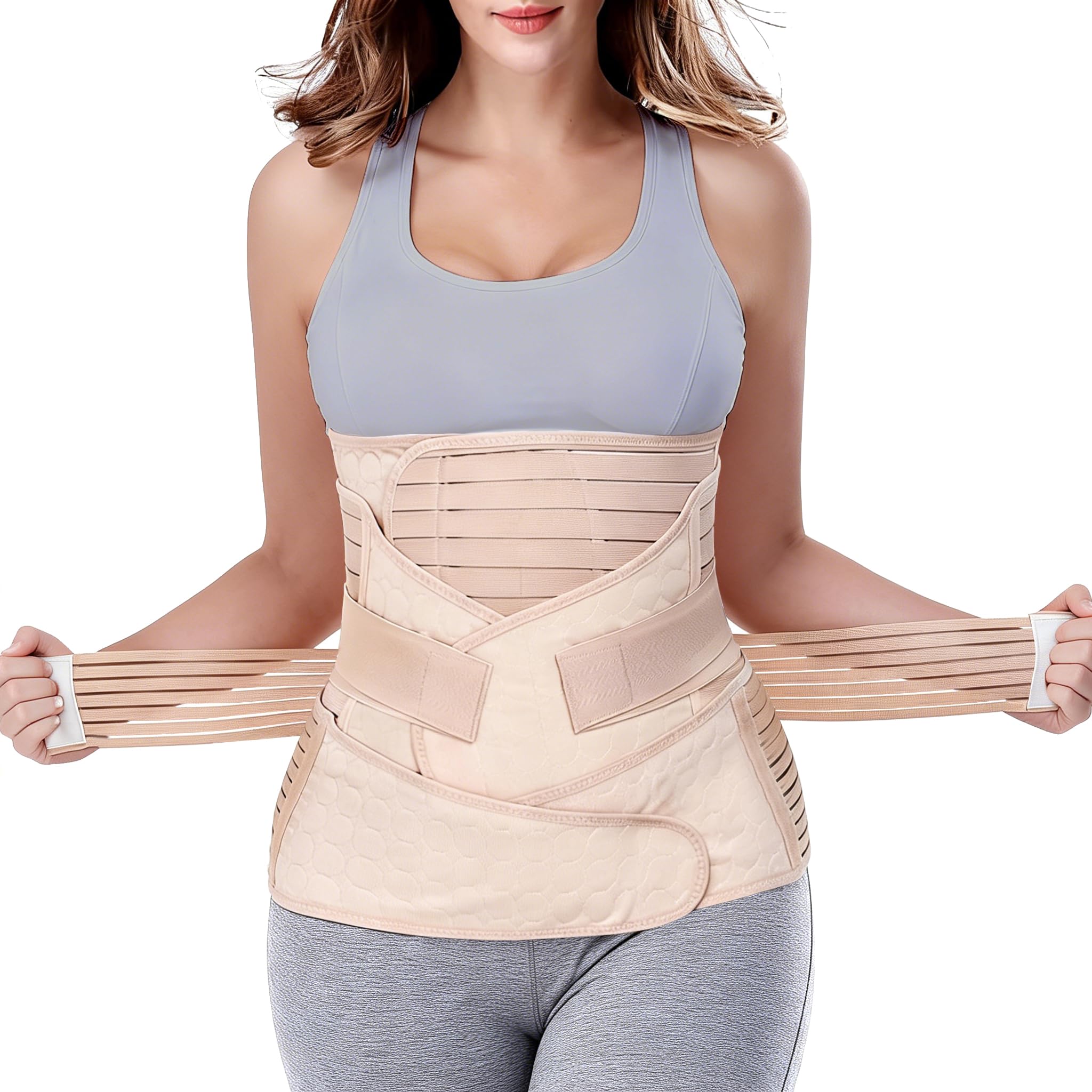
Firm, boned, and highly adjustable — the pick for a long torso and a real dial-in fit.
The detail that stands out on this one is the built-in boning — stiffened strips that help hold the lower back and keep the belts from folding over as you move. Add the three-belt setup and it becomes the firmest, most configurable option on this list. It comes in four sizes — S/M, L, XL/PLUS, and 2XL — in an 80% polyester, 20% spandex blend. If you are recovering from a tummy tuck and want more structure than a soft elastic wrap gives you, this is the direction to look.
The custom-compression idea is the real draw. The hook-and-loop tabs let you set different tension across three torso sections, so you can snug the lower belly and keep the upper belt looser — useful when the swelling is concentrated in one spot. On a long torso the length works in your favor, and the boning helps posture during the long stretches of standing and walking. One owner’s honest note is that it is “firm, customizable, strong lower-belly and posture support” rather than soft and squishy — that is exactly what you want if a soft band has not felt like enough.
The trade-offs are the flip side of the firmness. The boning is not removable, and on some bodies it sits in an odd spot and becomes intrusive. The top belt can roll down at the back edges, and short torsos can find it hard to place the belt under the breasts. The pelvic belt supports an apron belly but needs repositioning after long sitting. None of that makes it a poor binder — it is a fit-and-shape match, and it rewards getting the size right.
The firm-support read: built-in boning and three adjustable belts give the tightest, most targeted hold here, with good back support.
Where it can pinch: the boning placement and belt roll on some shapes, so fit is everything.
Go for it: if you want firm, boned compression with the ability to dial in each section separately.
Look elsewhere if: you have a short torso or want a soft, forgiving band with no stiff panels.
10. Postpartum Belly Band 3-Piece Postpartum Girdle

A soft three-piece set built for larger frames, with separate fastening so you place support where you want it.
This one is aimed at larger frames: it comes in US Size 14–18 (Size Plus), and the separate fastening areas let you position coverage over your belly and lower back independently. That makes it a gentler, more forgiving option than a single tight band — the idea is a held feeling rather than heavy compression. If your main goal after a tummy tuck is steady, low-pressure support while you stand, walk, and do light household activity, this is the softer route.
The manufacturer is refreshingly plain about what it does not do: it supports coverage and a held feeling, and it does not promise treatment, healing, weight loss, slimming, permanent shaping, or correction of a medical condition. There are also clear safety notes — do not overtighten or wear it over irritated skin, and stop if you feel pain, numbness, tingling, skin changes, or breathing difficulty. If you have just had a C-section or tummy tuck, follow your professional guidance on when and how tight to wear it.
The honest limits are fit and skin comfort: some people find it comfortable, while others report rashes and a run smaller than expected. Because it is sold as one size band, getting the size right matters. Start with gentle tension and adjust gradually, and keep an eye on how your skin reacts under it.
What it is good at: soft, positionable support for larger frames, with honest, clear safety guidance on the listing.
What to watch: sizing runs small for some and skin sensitivity can be an issue, so build in slack.
Suits you if: you want gentle, adjustable support on a larger frame and prefer a soft held feeling over firm compression.
Not for you if: you want strong surgical-level compression or a firm, structured hold.
11. SHAPERX Fajas Colombianas Postpartum Tummy Control

Not a wrap but a full bodysuit — the smoothing layer you wear when the swelling has settled.
This is a different animal from the binders above. The SHAPERX is a Fajas Colombianas-style compression bodysuit — a full garment you step into rather than a band you wrap. It closes with a zipper backed by inner hooks, and it has three hooks and eyes, an adjustable shoulder strap, and a soft fabric meant for daily wear. The bodysuit shape is what makes it useful under clothing, where it smooths the whole torso instead of pressing on one strip of your belly.
It is built for postpartum and post-surgical use, and the coverage is the point: it sucks everything in and shapes the body, which is the familiar result of a good faja. The inner hooks mean you can set the edges before zipping, so the closure does not strain against a sore middle. For a tummy tuck recovery, this is usually a later-stage piece — once the swelling has settled and you want a smooth line under your clothes — rather than the first thing you put on.
The honest caveat is drying and ease: a full bodysuit is more of a production to put on than a wrap, and you should check the size chart closely since it is a fitted garment. Also give it time to air-dry. If you want the simplest possible thing for the early days, a wrap is easier; the faja earns its spot once you want your clothes to lie smooth.
The smoothing angle: a bodysuit shape and a zipper-plus-inner-hooks closure give a clean, held line under everyday outfits.
The trade-off: it takes more effort to don than a wrap, and the fit depends on getting the size right.
The one for: later-stage recovery, when you want smooth all-over shape and a garment that disappears under clothes.
Not the first buy: if you need simple, quick support for the earliest days — start with a wrap.
Know the Specs
Closure Type: Hook-and-Loop Versus Straps
The closure is what keeps pressure even. Hook-and-loop (the Velcro-style grip) lets you press a tab down anywhere along its length, so you tighten in small steps. If the grip is weak, the binder sags through the day — so a strong closure matters as much as the fabric. Adjustable strap systems add a second layer: each strap can be tightened on its own, which helps when swelling is uneven or your waist changes week to week. A zippered bodysuit uses a zipper plus inner hooks instead, which gives a fixed, smooth shape but less step-by-step tuning.
Size Ranges and How to Read Them
Most of these list their fit as a waistline range, like Small 33″–36″ up to XLarge 42.6″–47.5″, or a 2XL covering 46″–55″. Measure where the binder will sit and pick the range your number falls into. Do not size down toward a goal weight. A binder that is too small digs in, has no tightening room, and rolls; one with some room lets the closure do its job. For a healing abdomen, matching the stated range is more important than the label on the tag.
Soft Elastic, Foam Boards, and Boning
A soft elastic wrap is the gentle, daily choice. Some wraps are latex free and made in the USA. A foam board is a rigid, curved plate with a soft outer fabric — one uses 75% polyamide and 25% spandex around a foam core — worn between your skin and a garment to spread pressure and stop creases, not as a stand-alone binder. Built-in boning (stiffened strips sewn in) adds back support and posture help, at the cost of a stiffer feel against the body. Match the material to your stage: soft fabric early, firmer structure later.
Layering and Care
A thin cloth between a stiff edge and your skin keeps a healing incision comfortable. For a three-belt system, settle each belt flat before you tighten. To keep a hook-and-loop grip alive, fasten the tabs before washing so the hooks do not snag the fabric. Some sets call for hand washing in warm water, a gentle wring, and flat drying, with no ironing or bleaching. Those habits protect the grip and the stretch, which is what holds the binder to your body in the first place.
Common Questions
Can I wear a regular postpartum belly band after a tummy tuck?
How do I pick the right size for an abdominal binder?
Is a compression board the same thing as an abdominal binder?
What is the difference between a one-piece wrap and a three-belt set?
Will an abdominal binder roll down when I sit?
How long should I wear my binder each day?
Is a boned binder better than a soft elastic one?
Do these binders work for men too?
How should I wash a hook-and-loop abdominal binder?
Can I wear a faja bodysuit right after surgery?
The Bottom Line
For most people recovering from a tummy tuck, the NYOrtho Abdominal Binder is the sensible first buy — soft latex-free elastic, a hook-and-loop grip that holds tight, made in the USA, and simple enough to put on alone on a foggy morning. If you want firm, dial-it-in compression with back support, the ChongErfei 3 in 1 and its built-in boning is the one to reach for. And once the swelling settles and you want everything smooth under your clothes, the SHAPERX faja bodysuit takes that job. Start with the wrap, add a system if your recovery asks for more, and size by your waist measurement — that is what decides whether a binder helps or fights you.
How we choose
We do not accept paid placement. Every pick is matched to a real buyer and a real use-case; we do not hands-on test units.
Sources
Specifications: manufacturer listings and product documentation. Review insights: verified customer reviews, as of October 2026. Pricing: not shown on this page (it changes often); check the current price via the retailer link.
As an Amazon Associate, Aappliancez earns from qualifying purchases. This does not affect which products we feature.