Disclosure: Some links in this post are affiliate links. As an Amazon Associate I earn from qualifying purchases, at no extra cost to you. Learn more
Specs are compiled from manufacturer listings and verified buyer reviews and can change over time — please confirm the key details on the product page before buying.
You want altitude, air pressure and which way north is on your wrist, and you do not want to plug in a cable every night. The short answer is a Casio Pro Trek or a Garmin Instinct. The picks below split on one question: do you want a pure sensor watch you wear for years, or a wearable you charge and sync? Knowing which side you sit on saves you from buying the wrong one.
This guide is built by comparing the manufacturers’ published specifications and the patterns across verified customer reviews, so you get each pick’s real strengths and trade-offs instead of marketing spin.
An ABC watch combines an altimeter, a barometer and a compass in one case, which is why the abbreviation exists. Below you will find every spec that actually changes daily wear, plus the honest limits on each of these sensor watches. These are the abc watches worth your wrist space.
Top Picks


How To Choose The Best Abc Watches
Most people buy an ABC watch (altimeter, barometer and compass in one) thinking the sensors are the hard part. They are not — the sensors all work well enough for a hiker. What separates a watch you keep for six years from one you resell in six weeks is everything around the sensors: how you charge it, how the screen reads in bad light, and how many button presses it takes to get a reading.
Do you want solar, or do you want a charger?
A Tough Solar panel, like the one on the Casio Pro Trek models here, tops up a rechargeable cell from ordinary daylight. You never plug anything in, and you never open the case to swap a battery. The Garmin crowd works the other way — a charging cable, a USB port, and a battery that runs for weeks rather than months. Neither is better. Solar suits a watch you want to forget about; a cable suits one that tracks GPS and sleeps on your nightstand.
Screen readability in sunlight and shadow
A negative display is a dark LCD with light-coloured digits. It looks sharp on a product photo and genuinely struggles in shade and mid-indoor light. That trade-off shows up on the Suunto Core and the G-Shock Rangeman. If you mostly read your watch in a dim garage rather than on a ridge, buy a positive display.
Calibration is not a defect
An altimeter calculates height from air pressure, so a weather change will shift your altitude reading even when you have not moved. That is physics, not a fault. Every serious pick here lets you calibrate against a known elevation, and the manual tells you how. Budget a few minutes on the first day to set your compass, altitude reference and time zone properly.
How much do you want to learn?
A Casio PRG-270 with four buttons and dozens of modes needs a manual and a half hour of patience. A Suunto Core needs a 33-page manual to open up everything. If that sounds like a chore, a Garmin with an app and a menu you actually enjoy is the smarter buy. The sensor data is the same; the learning curve is not.
Side-by-Side Comparison
| Model | Best For | Water Rating | Power Source | Weight | Amazon |
|---|---|---|---|---|---|
| Casio PRG-270-1 Pro Trek★ Best Overall | Pure sensor watch, no charging | 100 m | Tough Solar | 8.47 oz | Amazon |
| Casio PRW3500 Pro TrekTop Performer | Big legible military look | 650 ft | Tough Solar + atomic | 3.32 oz | Amazon |
| North Edge ApacheBudget Entry | Budget entry into ABC | 50 m | CR2430 battery | 3.95 oz | Amazon |
| Suunto Core | Clean analog-style outdoor look | — | Lithium metal cell | 2.26 oz | Amazon |
| Garmin Instinct 2 (Renewed) | GPS tracking plus ABC sensors | 100 m | Rechargeable, up to 28 days | — | Amazon |
| Casio PRG600 Pro Trek | Easy-to-read analog and digital dial | 100 m | Tough Solar + atomic | 2.36 oz | Amazon |
| Casio Rangeman GW9400-3 | Abuse-proof G-Shock toughness | — | Tough Solar + atomic | 5.93 oz | Amazon |
| Garmin Instinct 2 Solar Tactical | Solar smartwatch for field use | 100 m | Solar + 300 mAh cell | — | Amazon |
| Garmin Instinct Crossover Solar | Analog hands with smart guts | 10 ATM | Solar + rechargeable | — | Amazon |
| Garmin epix Gen 2 | Bright AMOLED plus full mapping | — | Rechargeable, up to 16 days | — | Amazon |
| Casio G-Shock Mudmaster GWG-2000 | Premium forged-carbon toughness | — | Tough Solar + atomic | 3.74 oz | Amazon |
Detailed Reviews
1. Casio Men’s Pro Trek PRG-270-1 Tough Solar Triple Sensor
Our pick — 4.5+★ from 2,000+ verified ratings; the strongest balance of quality and price.
The watch that made the whole ABC category affordable, and it never asks for a cable.
Start with the number that decides everything else: this runs on Tough Solar, meaning a solar panel built into the dial keeps the rechargeable cell topped up from ordinary daylight. You do not plug it in and you do not open the case to change a battery. That is the whole pitch — put it on and forget about it.
The Triple Sensor Version 3 engine inside measures altitude in 1 m increments, which is roughly a single stair step, and gives you a compass reading for 60 seconds of continuous measurement instead of the old 20. It also carries a barometer with a pressure-tendency alarm that warns you when the air pressure swings, plus a thermometer. If you hike in changeable weather, that pressure alarm is the feature you will actually use; it tells you a front is moving in before the sky does.
Here is the honest part: this is a big watch. The case measures 0.59 x 0.59 x 0.59 inches in the listing data and it weighs 8.47 ounces, so it is the heaviest pick on this list and noticeably chunkier than the 3.32-ounce PRW3500 above it. The left-side buttons confuse people at first, and the compass needs recalibrating now and then rather than trusting it blind on a marked trail. The thermometer only reads ambient air when the watch is off your wrist, because your body heat corrupts it. None of that is a flaw exactly; it is the price of a sensor stack this deep at this tier.
What earns it the top spot
- Tough Solar means no battery swaps and no charging cable — buyers report six years of daily wear
- Altitude readable to 1 m, so small elevation changes register instead of being rounded away
- Pressure-tendency alarm gives you a weather heads-up before a front arrives
- Four alarms, snooze, dual time zones, stopwatch, countdown timer and a backlight that owners describe as genuinely bright
- 100 m water resistance covers rain, swimming and a dropped watch in a stream
Where it asks for patience
- 8.47 oz is heavy — this is not a watch you forget you are wearing
- The left-side buttons have a real learning curve; budget a half hour with the manual
- Thermometer reads your body heat while worn, so you must take it off for air temperature
- Compass drifts and needs periodic recalibration
- A full charge from empty needs roughly 8 hours of direct sun
Buy this one if: you want the sensor data without a charging routine, and you can live with a wide, weighty case.
Look past it if: a slim profile matters more to you than a barometer — the PRW3500 below drops to 3.32 oz.
2. Casio PRW3500 Series Pro Trek Tough Solar Atomic
A full-size military-styled sensor watch that weighs less than half the PRG-270 above it.
The comparison is worth spelling out, because it is the entire reason this watch exists. It weighs 3.32 ounces against the PRG-270’s 8.47 ounces, and it measures 4.35 x 4.65 x 3.8 inches in the listing data against the 0.59 x 0.59 x 0.59 of the PRG-270 — a 7.4x gap in the listed dimensions. On the wrist that reads as a big watch that does not feel big. One owner wore it as a four-year daily driver through ocean swimming and hiking and says exactly that: no babying, buttons still working after saltwater rinses.
What it adds over the cheaper Pro Trek is Multiband 6 atomic timekeeping — a radio signal from a ground transmitter that sets the watch to the second, usually overnight. It also carries the full Triple Sensor set (compass, altitude and barometric pressure, plus temperature), a barometer and Tough Solar charging. A 650 ft water rating covers rain and swimming, the textured buttons work with gloves on, and the auto backlight fires when you turn your wrist toward your face.
The catch is the display. This is a negative LCD, meaning light digits on a dark background, and it looks superb in direct sunlight but dims badly in shadow and moderate indoor light. That is why the auto light exists. Two other honesty notes: the thermometer only reads ambient temperature when off the wrist, and temperature and altitude both need calibrating before they mean anything. One more quirk — atomic sync and the barometer weather alerts can fight each other, so you may need to choose.
Weight-to-feature ratio: this is the lightest full-Triple-Sensor Casio here at 3.32 oz, and it still manages solar charging plus radio-set time.
What to plan around: the negative display. Buy it for the sunlight view and the tough build; do not buy it expecting easy reading in a dim tent.
Reach for this if: you have larger wrists and want the rugged look without the bulk that the PRG-270 carries.
Think twice if: most of your reading happens indoors or in shade — the dark-background screen is the trade-off you are accepting.
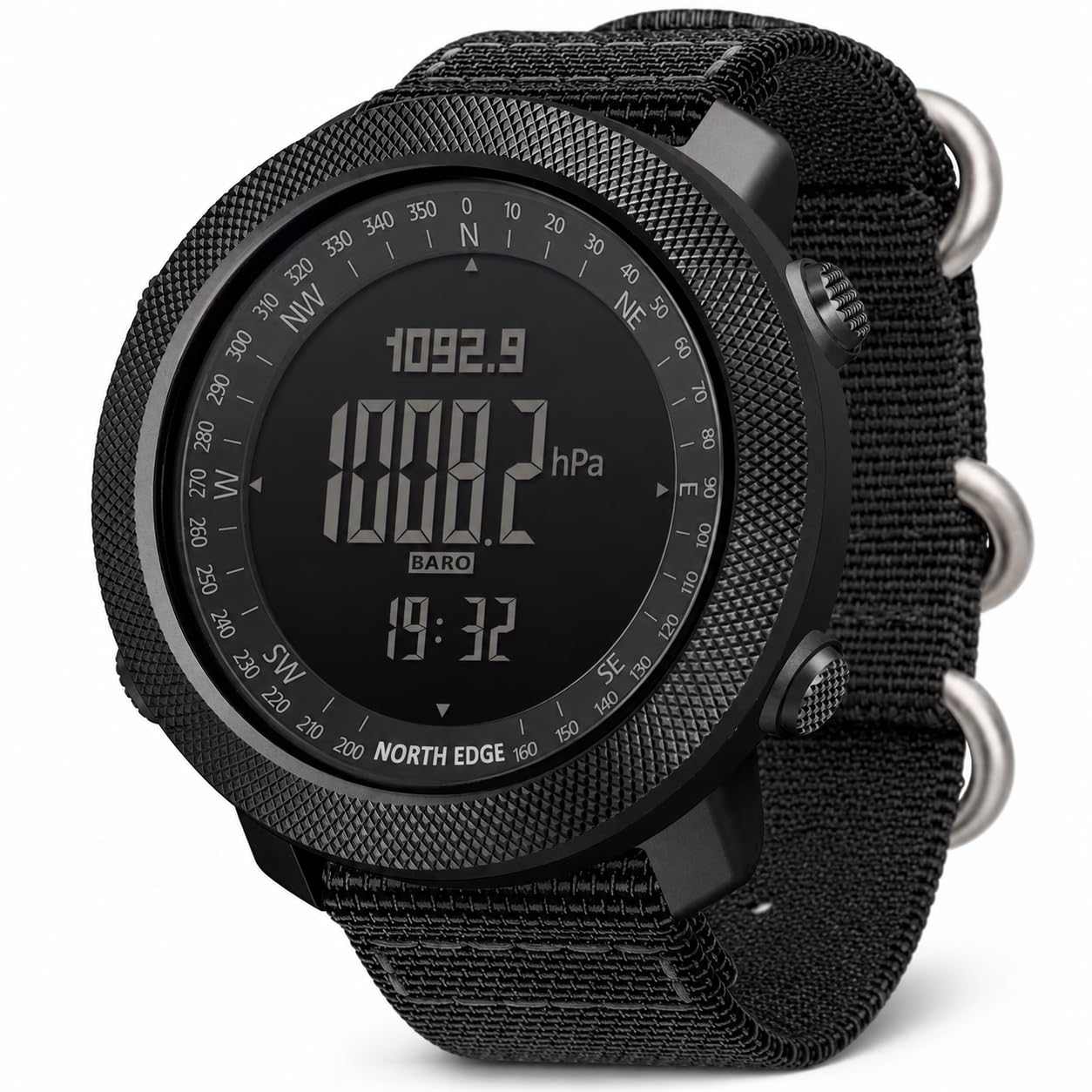
3. NORTH EDGE Apache Tactical Survival Digital Watch
All three sensors, a pedometer and no app — the cheapest way into the ABC format.
This is an entry-level pick and it behaves like one, in both directions. It gives you a compass, altimeter, barometer and thermometer in a 3.95-ounce case, plus a pedometer that works entirely on its own with no Bluetooth and no phone pairing. It runs on a single CR2430 coin cell, which you replace rather than recharge. If you want to test whether you will actually use sensor data before spending real money, this is the low-risk way to find out.
Owners tend to land on its looks and its heft first — the general read is that it feels substantial and reads like a proper field watch. One carpenter bought it purely as a work watch and ended up wearing it everywhere instead. Another describes the learning curve bluntly: a few cool features, some time to figure out, and a YouTube video does the job of the manual. That is fair. The four-button layout is not intuitive on day one.
The build quality is where this one splits opinion, and you should know it going in. This is military style, not military grade. The 50 m rating handles rain, hand washing and surface swimming — not hot water, sauna or diving, and never press the buttons underwater.
The real value line: no app, no Bluetooth, no charging routine. You get altitude, pressure, direction and a step count from a coin cell you swap once in a while.
The honest caveat: treat the strap as the weak link and swap it early if you plan to wear this daily.
Good fit for: someone testing the ABC habit, or a work-site watch you are not precious about.
Step up instead if: you need real durability or 100 m water resistance — the Casio options here are built for years, not months.
4. SUUNTO Core Series Outdoor Watch

The lightest watch on this list, and the one that looks least like a gadget.
At 2.26 ounces it is the featherweight of the group, and that is not a footnote — it is the whole argument. It sits flat, disappears under a sleeve, and looks like a watch rather than a piece of field equipment. It carries compass, altimeter and barometer readings, a storm alarm that warns on a rapid pressure drop, dual time zones, and a button lock so you stop changing modes by accident when you bend your wrist. The lithium cell lasts around a year; one owner replaced it at 14 months.
Against the Casio options, it gives up ground on two counts. There is no solar charging and no atomic timekeeping, and it does not carry the 100 m rating the Pro Treks do. What you get in return is a cleaner silhouette and a screen you can adjust for brightness on some models. The compass and barometer are described as consistent with dedicated handheld navigation gear, and the thermometer behaves the same way every wrist sensor does — unreliable while you are wearing it.
Two things will decide whether this is your watch. First, the display is dim. Owners describe struggling to read it in bright sunlight, and there is no way to brighten it for daytime; the small characters make night reading awkward too, and the interface needs both a quick guide and a long manual to open up. Second, the band has a history — the standard strap is the most-criticized component across the range. Neither is fatal on a watch this light and this good-looking, but neither is imaginary.
The thing to weigh: 2.26 oz and a low, flat profile against 100 m water resistance and solar charging. This watch picks comfort and looks; the Pro Treks pick capability.
Worth it for: the hiker who wants one watch for town and trail and hates feeling a lump on the wrist.
Not your watch if: you read sensors on the move — the dim screen and small characters are the compromise you would be accepting.
5. Garmin Instinct 2 Rugged GPS Watch (Renewed)

When you need a breadcrumb trail back to the car, not just a compass heading.
The distinction that matters: a compass tells you which way is north, but this watch records where you have been and routes you back. It pulls position from multiple satellite constellations — GPS, GLONASS and Galileo — so a signal holds better in tree cover and canyon walls than a single-system receiver manages. It also carries the standard ABC sensors in a fiber-reinforced polymer case with a scratch-resistant Gorilla glass lens, rated to 100 meters of water resistance and built to survive shock and temperature swings.
Battery is where it wins the conversation. Up to 28 days in smartwatch mode and up to 30 hours in GPS mode, which is the difference between a watch you charge on a schedule and one you charge when you think about it. The e-ink style display is also genuinely readable in bright sun — one long-time Instinct user upgraded from a Suunto Core and called the screen brighter in every lighting condition. The raised bezel edge protects the glass from face-down drops, which is why owners skip screen protectors.
Two things to plan for. This is a renewed unit, so it arrives refurbished — accounts describe it turning up like new, though the silicone band can pick up odour and gets stiff over time, and stretch bands are a common swap. Second, the smart features are deliberately thin: notifications are view-only, and you cannot reply to a text from the wrist. If you want a mini phone, this is not it. If you want tracking plus a trail back home, it is exactly it.
The case for the Instinct 2
- Three satellite systems for positioning in cover where single-system GPS drops out
- Up to 28 days in smartwatch mode, so charging is an occasional event not a nightly chore
- 100 m water rating plus thermal and shock resistance in a fiber-reinforced polymer case
- E-ink display readable in direct sunlight; the raised bezel guards the glass on drops
What it does not do
- Renewed stock — expect a refurbished unit, not a sealed fresh one
- Silicone band can hold odour; many owners switch to a stretch band
- Notification replies are not possible; viewing only
- The 100 m water rating is untested territory for most owners, so treat it as a spec not a promise
The pick for: trail runners, hikers on unfamiliar ground, and anyone who wants a route back rather than a heading.
Look elsewhere if: you want a pure solar sensor watch with no cable — the Casio Pro Treks never need charging at all.
6. Casio PRG600 Series Pro Trek Analog-Digital

Analog hands plus a digital sensor screen, in a case slim enough for a shirt cuff.
Readability is the reason to pick this one over the other Pro Treks, and the number behind it is 13.4 mm — the case thickness, which is slim enough to slide under a cuff and, more importantly, keeps the dial legible instead of cramming everything into one crowded screen. Large Arabic numeral hour markers sit beside an STN LCD (a high-contrast liquid-crystal screen) that holds contrast at an angle, so you can read it with your arm half-turned. Owners describe reading the whole dial without glasses, and one calls it the easiest digital they have owned for older eyes.
Underneath it runs Triple Sensor Version 3 — compass, altitude and barometric pressure, temperature — with one-touch measurement, Tough Solar charging (a solar panel that tops up the battery from light), atomic timekeeping (the watch syncs itself to a time signal), five daily alarms, a 1/100 second stopwatch reading to 23:59’59.99″, world time across 29 time zones, and a full auto LED Super Illuminator backlight that lights when you turn your wrist. It weighs 2.36 ounces and carries 100 m water resistance, so it handles rain and swimming. It fits the outdoor role and the office role without looking out of place in either.
Expect a real learning curve — the stem-based setting is not intuitive, and you will want the manual for module 5497. There is also a genuine gotcha: some “low battery” alarms on this model trace back to the auto-light feature draining the cell, and switching that off fixes it. The altimeter and barometer share one sensor, so a pressure change shifts both readings; treat them as trends rather than survey data. Some owners wish for atomic sync on models that lack it, and for a slightly thinner case.
The dial argument: 13.4 mm thick, 2.36 oz, and an STN LCD that stays readable off-angle — this is the one to buy if you find digital displays squinty.
The setup argument: download the manual before you start, and turn off auto-light if the low-battery warning appears.
The right watch for: anyone who wants analog hands for daily reading and digital sensors when the trail starts.
Skip the stem menus if: you want an interface you can master without a manual — a Garmin’s app-driven setup is friendlier.
7. Casio Rangeman GW9400-3 G-Shock Twin Sensor

Seven years of blue-collar abuse and it still runs — that is the entire sales pitch.
If you work with your hands outdoors, start here and read backwards. A Rangeman with seven years of hard trade use behind it never died, sat around two-thirds charge off solar, survived lakes and hot tubs, and only needed replacing when the strap finally gave out. Another account has it taking acetone, oils, grease, detergents and impacts for over two years with the band and buckle still holding. The dual fasteners and metal retainer are part of why it stays put.
The sensor set is a Twin Sensor — barometric pressure and direction — plus atomic timekeeping through Multiband 6. That last part gets underrated: the watch sets itself to the second overnight, usually without you doing anything, and one owner rates that as the single best feature. The barometer warning that rain is coming is the other one people mention without prompting, and the altimeter held within 1 meter of a known height two days after calibration. It weighs 5.93 ounces and sits comfortably even on a smaller wrist.
The display is the concession. This is a negative LCD, and the consensus is blunt: it needs a wrist tilt or a backlight tap to read below bright indoor light. The auto-light compensates, and some wish it stayed on longer. The thermometer also reads about 10 degrees high and needs calibrating, the timer runs in 1-minute minimum increments, and stopping the snooze alarm involves a trip through time-adjust mode. The lens will pick up scratches eventually, though the recessed lip keeps the crystal itself clear for years.
Durability, in plain terms: this is a G-Shock. The exterior is scratch-resistant and the case took years of shop-floor work without failing.
The everyday friction: a dark-backed display and a fiddly timer. Neither matters on site; both annoy at a desk.
Built for: tradespeople, off-grid campers, and anyone who has killed a watch before.
Not for you if: you need to read the time at a glance in a dim room — the negative display is the recurring gripe for good reason.
8. Garmin Instinct 2 Solar Tactical Edition

Solar charging that stretches to unlimited in smartwatch mode, plus a stealth switch.
Most solar watches use the sun to top off. This one can go further: with all-day wear and three hours a day outside in 50,000 lux conditions, the battery life in smartwatch mode becomes unlimited. In GPS mode it stretches to 48 hours with continuous direct sunlight. That is a specific claim with specific conditions attached, and you should read it that way — a long-sleeved office week is not 50,000 lux. The 300 mAh lithium polymer cell carries you when the sun does not.
The tactical layer is what separates this from the standard Instinct 2. Stealth mode shuts off wireless communication and data sharing entirely, so the watch stops broadcasting. You also get Jumpmaster activity, waypoint projection, a dual-position GPS format and preloaded tactical activities, plus night vision compatibility in the additional feature list. The case is fiber-reinforced polymer built to U.S. military standard 810 for thermal, shock and water resistance, water-rated to 100 meters, with a 22 mm silicone band.
Honest limits. The value question splits opinion — some find it worth the money, others feel the premium is steep for what the tactical extras deliver in civilian life. The navigation side gets mixed readings too, and calorie tracking is unreliable unless you actively start an activity rather than letting the watch infer it. Solar assist helps rather than rescues; several accounts describe solar contribution as modest in real-world wear. None of that undercuts the core — it is still a rugged GPS watch with ABC sensors.
The tactical argument: stealth mode is a real off-switch for wireless, not a label. If that matters to you, nothing else on this list offers it.
The everyday reality: unlimited solar battery assumes three hours of direct sun a day. Budget for the charging cable in winter.
The one to take: if you need a GPS watch with a genuine communications-off mode and military-spec durability.
Ask yourself first: will you use Jumpmaster and waypoint projection? If not, the standard Instinct 2 does the same daily job.
9. Garmin Instinct Crossover Solar Hybrid, 45mm

Physical hands over a digital screen, so it reads as a watch on the wrist.
The trick here is the RevoDrive hand system — real luminescent analog hands that keep accurate time in demanding conditions, sitting above a high-resolution digital display in a dual-layered bezel. You get the look of a conventional watch with the guts of a smartwatch underneath. Build is to MIL-STD-810 for thermal and shock resistance with a 10 ATM water rating, which Garmin equates to withstanding pressure at a depth of 100 meters. GPS, GLONASS and Galileo navigation plus built-in ABC sensors cover the outdoor side.
Battery is where the solar claim lives, and it is conditional. The maker claims infinite battery life in battery saver mode, up to 70 days in smartwatch mode, and up to 31 hours in GPS mode — all assuming all-day wear with three hours a day outside in 50,000 lux (a bright-sunlight level). Real-world accounts land lower, around two weeks with solar assist, and one owner points out that the advertised estimate oversells it. Garmin Pay works for contactless payment if your bank is supported, which is worth checking before you count on it.
The recurring complaint is specific and worth knowing: the watch face fogs up and can stay fogged in cold weather. A loose minute hand shows up as a warranty return in some units, which points to a manufacturing variance rather than a design flaw across the line. The Garmin Connect app also draws mixed reviews compared to Samsung Health and Google Fit, though it handles waypoints and data well. The hands are readable in the dark, the case has proven durable, and the analog readout is the reason people pick this over a screen-only watch.
Why pick it: actual hands, an always-on digital layer, and MIL-STD-810 toughness in one body. Nothing else here does all three.
Where it asks for trust: the fogging complaint repeats enough to mention. It is a fit issue, not a reason to dismiss the model.
For the buyer who: wants smartwatch function without giving up hands on the dial.
Consider the standard Instinct if: you would rather have the larger, brighter screen and skip the analog mechanism entirely.
10. Garmin epix Gen 2 Premium Active Smartwatch

A 1.3-inch AMOLED screen on an adventure watch — the display is the headline.
AMOLED is the same screen technology as a good phone, meaning bright and colour-rich rather than the grey-green e-ink of the Instinct line. At 1.3 inches with always-on capability, this is the watch for someone who has squinted at a dim sensor display and given up. Set against the Instinct 2 Solar above, the difference is night and day in low light. The case is fiber-reinforced polymer with a titanium rear cover, and select versions add a sapphire lens and titanium bezel.
Battery is the trade for that screen, and it is a fair one: up to 16 days in smartwatch mode with gesture wake (the screen lights when you raise your wrist), or up to 5 days with always-on. GPS mode runs up to 42 hours with gesture wake, up to 30 hours always-on. One owner using always-on off and wrist gesture on landed at roughly 12 days. Multi-band GNSS (a receiver that reads several satellite frequencies at once) gives better positioning in challenging terrain, and the mapping side is genuinely deep — TopoActive maps via Wi-Fi, SkiView maps covering 2,000 ski resorts, and CourseView for more than 42,000 golf courses.
The friction points are real but narrow. It is a premium-priced watch, and owners say so plainly. The charger is proprietary, which means a lost cable is a specific purchase rather than a borrowed one. Watch-face installation has proven glitchy for some, throwing software-version errors. One runner initially blamed the watch for treadmill distance failures, then found the treadmill mode and retracted it — a reminder that this watch rewards time spent in the menus.
What the epix brings
- 1.3-inch always-on AMOLED that stays readable in every lighting condition
- Multi-band GNSS for positioning where single-frequency receivers struggle
- Preloaded maps for 2,000 ski resorts and 42,000+ golf courses, plus downloadable TopoActive
- Up to 16 days in smartwatch mode with gesture wake
What you give up
- Premium tier pricing; owners flag the cost directly
- Proprietary charging cable — no standard USB at the watch end
- AMOLED drains faster; always-on drops smartwatch mode to 5 days
- Map use pulls battery down noticeably in the field
The one for: skiers, golfers and hikers who want mapping and a screen they can actually see.
Do not buy it for: maximum battery life. The Instinct 2 Solar goes far longer on a charge.
11. Casio G-Shock Mudmaster GWG-2000-1A3JF Carbon

Forged carbon, analog hands and a digital readout — the top of the G-Shock tree.
At 3.74 ounces this carries the Mudmaster name without the weight penalty people expect from a G-Shock, and the forged carbon case is the reason it looks the way it does. Then the practical side: solar charging and atomic timekeeping mean no winding and no cable, and the watch sets itself to the second on a nightly radio sync. One owner has worn it daily for three years with zero issues. Another describes long-term travel with atomic sync working from a nightstand without being oriented north.
The sensor set is Triple Sensor — compass, barometric pressure and altitude, plus temperature — and the display combines analog hands with a digital layer. Legibility gets consistent praise: readable at a quick glance, without reading glasses, with a powerful LED for dark, dim, dawn and dusk. It is water-resistant enough that owners mention swimming with it on. The analog hands move aside when you need to see the digital screen, which is the small engineering detail that makes the hybrid layout work.
Two honest notes. The accuracy feedback is mixed on this model, more so than on the cheaper Pro Treks, so calibrate the compass and altimeter rather than assuming. And the band picks up a white cast in its groove over time that does not come out; owners describe it as barely visible, so it is a cosmetic annoyance rather than a fault. One unit shipped with a non-English manual, which is worth checking on arrival since setup expects the instructions.
What the extra tier buys: a forged carbon case, 3.74 oz on the wrist, hands that move out of the way, and a backlight that covers every low-light situation.
The one thing to verify: calibrate the sensors on day one, and check the manual’s language in the box.
The top-tier choice if: you want G-Shock toughness with an analog face and you are not counting grams.
Worth pausing on if: the Rangeman above covers the same rugged brief for less — this one buys build finish, not extra sensors.
Know the Specs
The Three ABC Sensors
The letters stand for Altimeter, Barometer and Compass. The altimeter tells you how high you are; it works by reading air pressure, because pressure drops as you climb. The barometer reads that same pressure to flag weather shifts, and a fast drop usually means a front is coming. The compass uses a magnetic direction sensor for a heading. On most of these watches the altimeter and barometer share one pressure sensor, so a change in weather will shift your altitude reading too. That is why you calibrate against a known height before a hike.
Tough Solar Versus a Charging Cable
Tough Solar is a panel set into the watch dial that turns daylight and UV into charge for a built-in cell. It is not a battery you swap — it is a rechargeable cell the panel keeps topped up, so a charged watch can run for months or years without intervention. A cable-charged smartwatch works differently: it holds a larger battery for GPS and screen use, then refills from USB. Solar watches suit people who want to forget the watch exists; cable watches suit people who want maps and tracking.
Atomic Timekeeping and Multiband 6
Multiband 6 is a radio receiver that picks up a time signal from ground transmitters, so the watch corrects itself to the second, usually overnight while you sleep. You never set the time zone manually once it is configured. Watches without it rely on a quartz crystal and drift a couple of seconds a month, which is fine for most people. One quirk worth knowing: on some models the atomic sync and the barometer weather alerts can interfere with each other.
Water Resistance Ratings Explained
A 50 m rating handles rain, hand washing and surface swimming. A 100 m rating covers swimming and snorkelling comfortably. The 650 ft figure on the PRW3500 is the same idea in feet. None of these are dive ratings, and pressing buttons underwater is a bad idea on any of them. Hot water, saunas and showers are the usual way people shorten a watch’s life, because heat affects the seals.
Common Questions
Why does my ABC watch altitude reading change when I have not moved?
Do I need to charge a Casio Pro Trek?
Is a negative display harder to read than a positive one?
Why does the thermometer read too warm when I am wearing the watch?
How accurate is the compass on these watches for real navigation?
Can I swim with a 50 m water resistant watch?
What is the difference between Multiband 6 atomic time and a Bluetooth-synced watch?
Does solar charging actually keep a Garmin running indefinitely?
How long do the batteries last in these watches?
Is a Garmin Instinct worth it over a Casio Pro Trek?
The Bottom Line
For most people, the abc watches winner is the Casio Pro Trek PRG-270-1 because it delivers the full Triple Sensor stack on Tough Solar with no cable and no battery swap, and and it holds 4.5+ stars across 2,200+ ratings. If you want the same capability in a lighter, larger-cased body, the Casio PRW3500 drops to 3.32 ounces and adds Multiband 6 atomic time (it syncs to a radio time signal). And if you need to record where you have been rather than just which way is north, the Garmin Instinct 2 is the one to reach for — you trade the no-charging routine for real GPS routing. One last nudge before you decide: the PRG-270 has the deepest owner track record on this list, and that is the safest place to put your money.
How we choose
We do not accept paid placement. Every pick is matched to a real buyer and a real use-case; we do not hands-on test units.
Sources
Specifications: manufacturer listings and product documentation. Review insights: verified customer reviews, as of October 2026. Pricing: not shown on this page (it changes often); check the current price via the retailer link.
As an Amazon Associate, Aappliancez earns from qualifying purchases. This does not affect which products we feature.