Disclosure: Some links in this post are affiliate links. As an Amazon Associate I earn from qualifying purchases, at no extra cost to you. Learn more
Specs are compiled from manufacturer listings and verified buyer reviews and can change over time — please confirm the key details on the product page before buying.
Your first real decision is not which speakers to buy. It is if you want a receiver-based setup that needs wires run to the back wall, or a wireless bar-and-rears package that goes up in an afternoon.
This guide is built by comparing the manufacturers’ published specifications and the patterns across verified customer reviews, so you get each pick’s real strengths and trade-offs instead of marketing spin.
Some picks here run on a receiver and separate speaker cabinets, while others put detachable rear speakers on a bar and skip the amplifier entirely. Either way, this breakdown of the best 7.1 surround sound system tells you what each one actually gives you in your living room.
Top Picks

How To Choose The Best 7.1 Surround Sound System
Two families of product sit under the 7.1 label, and they solve different problems. A receiver-based system gives you separate speaker cabinets, real binding-post wiring, and upgrade paths — but you supply and place every speaker. A wireless bar with detachable rears gives you the surround layout in one box with no amplifier and no cable to the back wall.
Decide receiver-based versus soundbar-based first
If you already own speakers or plan to build up over years, buy a receiver and add cabinets. If your room is finished, your floor is carpeted, and you are not pulling baseboards off, a wireless package keeps the household peace. The ULTIMEA Skywave X70 and JBL Bar 700MK2 both put the rear channels behind you without a run of speaker wire.
Match the subwoofer to your room, not the spec sheet
A 10-inch driver is the common size in this group, and it moves more air than an 8-inch one at the same volume. In a bedroom, a big sub can be genuinely too much — one Fluance owner found it overpowering at low listening levels. In a family room, that headroom is what makes an explosion land in your chest.
Check the HDMI version against your console or TV
7.1 surround only arrives intact if the receiver passes the signal your source sends. HDMI 2.1 inputs carry 8K and 4K/120, which matters for a current-generation console. Older 4K TVs can trip up even good receivers, so confirm your display’s HDMI version before you blame the amp.
Calibration is the feature people forget to check
A microphone-driven auto-setup (it pings the room and sets speaker distances and levels) can rescue a bad speaker position. Absence of it does not ruin a system — the Skywave X70 skips auto-calibration entirely and still fills a room, because you set the surround trim yourself from −6 to +6.
Side-by-Side Comparison
| Model | Best For | Channels | Sub Driver | Amplifier / Power | Amazon |
|---|---|---|---|---|---|
| ULTIMEA Skywave X70★ Best Overall | Wireless all-in-one theater | 7.1.4 | 10 inches | 980W peak, GaN amp | Amazon |
| Yamaha TSR-700Budget Anchor | Budget 7.1 receiver base | 7.1 | — | Receiver, 8K HDMI | Amazon |
| Onkyo TX-NR6100THX Certified | THX-certified movie power | 7.2 | — | 210 W/Ch | Amazon |
| Denon AVR-X1700H | Balanced receiver for mixed use | 7.2 | — | 80W per channel | Amazon |
| JBL Bar 700MK2 | Detachable wireless rears | 7.1 | 10 inches | 780W max | Amazon |
| Fluance Elite SX71BR | Full cabinet speaker set | 7.1 | 10 inches | — | Amazon |
| Yamaha RX-A2A AVENTAGE | Premium build and calibration | 7.2 | — | 100W 2ch | Amazon |
| Sony STR-AN1000 | 360 spatial mapping | 7.2 | — | 165 W (6 ohms) | Amazon |
| Sony BRAVIA Theater Quad HT-A9M2 | Wireless four-speaker spatial audio | 16 speaker units | Optional (Sub 7 / Sub 8 / Sub 9) | Control box | Amazon |
| Klipsch Reference R-625FA Pack | Tower-and-dual-sub bundle | 9.2 receiver included | 12 inches (two subs) | 100W/400W main channels | Amazon |
Detailed Reviews
1. ULTIMEA Skywave X70 Surround Sound System
Our pick — 4.5+★ from 200+ verified ratings; the strongest balance of quality and price.
The wireless heavyweight that puts height channels above your head without a single cable run
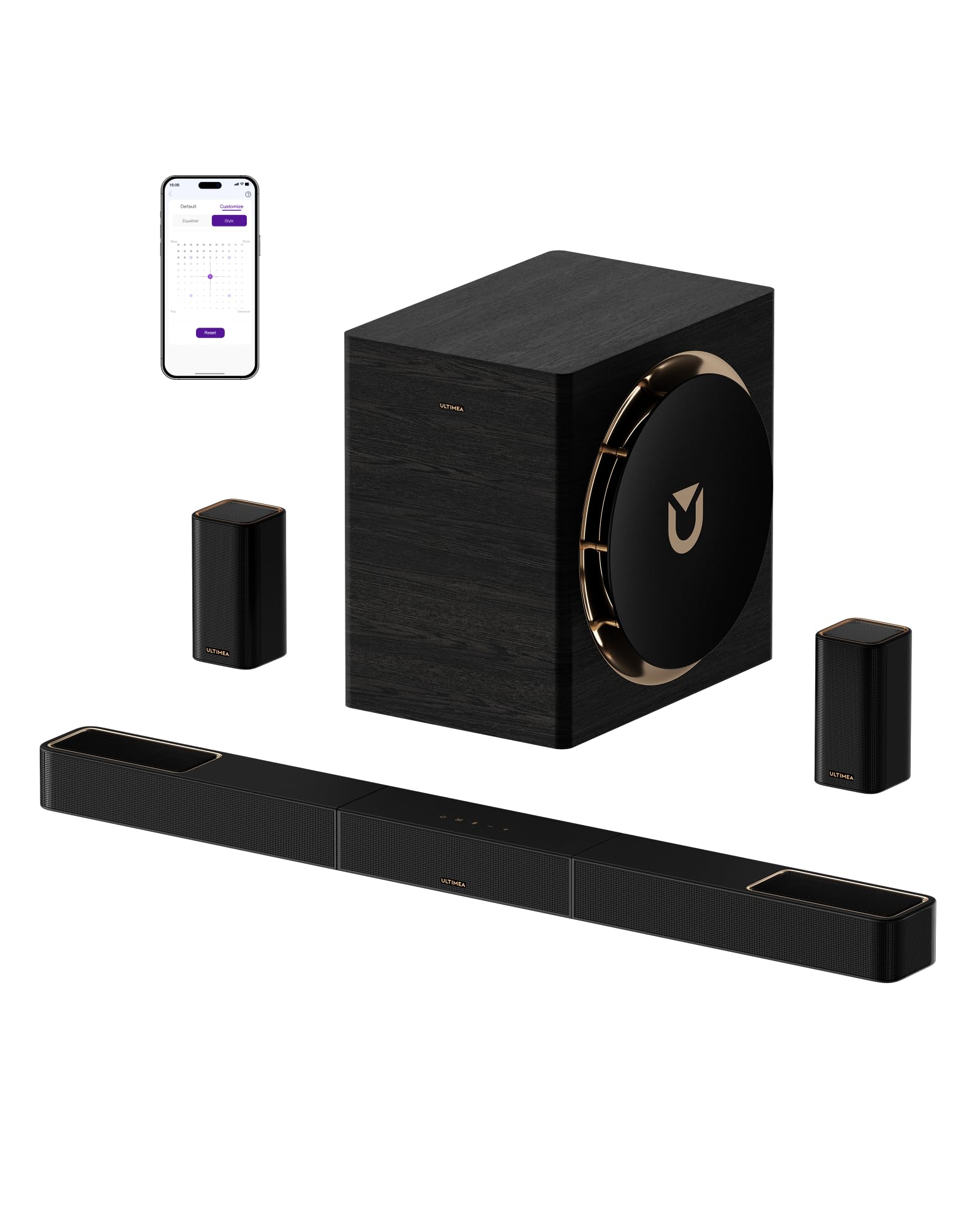
Four channels of height is the number that defines this one. The Skywave X70 is a 7.1.4 package — seven surround channels plus four upfiring drivers that bounce sound off your ceiling — so rain and helicopters arrive from above, not just from the sides. The whole layout runs on dual 5GHz wireless transmission from a bar to the sub and two rears, which means no cable to the back wall. It is the crowd favorite here too, at 4.5+ stars across 220+ ratings.
You get real bass hardware, not a decorative box. A 10-inch driver with 980W peak output reaches down to 20Hz, so explosions hit with weight. The GaN amplifier (gallium nitride — a chip design that wastes less energy as heat) pushes efficiency up to 98%. The NEURACORE processing engine runs 24-bit/192kHz audio at under 0.5% distortion, so dialogue stays clean at loud volumes instead of hardening. What wins people over most is the sound itself, by a wide margin — owners compare the sub to a pair of Polk 10-inch subs and the system to a Yamaha 7.2.2 setup, and buyers report “huge bass at volume 14/100.”
The catch is setup knowledge. There is no auto-calibration or room correction, so you balance the surrounds yourself on a −6 to +6 trim. Fire TV remotes will not drive it, and after a pause timeout you need the remote again. 4K HDR passthrough works, but there is no DTS support — a real gap if your library leans on DTS discs. Compare this with the JBL Bar 700MK2 below: the JBL handles Dolby Atmos and DTS Virtual:X, while the ULTIMEA goes further on height channels with 7.1.4 versus 7.1.
What earns the top spot
- 7.1.4 layout — four height channels, not just side and rear surround
- 10-inch sub reaching 20Hz with 980W peak output
- Dual 5GHz wireless links to rears and sub, so no cable to the back wall
- 4K HDR passthrough, CEC power and volume sync, 10-band EQ in the app
Where it asks more of you
- No auto-calibration — you dial in the surrounds by ear
- No DTS decoding, which rules out some disc libraries
- Fire TV remotes cannot control the bar
Built for: a finished living room or media room where you want the height-and-rear effect without pulling carpet up.
Worth knowing first: budget an evening with the EQ and surround trim, because the room settings are yours to set, not the system’s.
2. Yamaha TSR-700 AV Receiver
The entry ticket to a real receiver build, with an 8K passthrough that costs almost nothing to get
If you own speakers and just need the brain of the system, this is the cheapest honest route into 7.1. The TSR-700 is a 7.1-channel receiver with 8K HDMI output and MusicCast streaming built in, so Spotify runs through the amp rather than a separate box. It sits at the entry tier of this group, which makes the 8K output the standout rather than an afterthought.
You stay for the sound. Dolby Atmos decoding and Yamaha’s clean amplification carry it — owners trading up from an older receiver describe the result as clearer and more dynamic, with menus that are easier to work through and a unit that runs cooler on less power. Streaming over Wi-Fi and Bluetooth works without drama.
The HDMI connection is the recurring sore point. Some units refuse to power back on, and the ARC handshake (the link that lets your TV send sound back to the receiver) has been known to cause audio skipping every 10-15 seconds, worsening over time until the HDMI cable comes out. The speaker terminals also assume you know what you are doing — one buyer’s four-star note reads: “Without instructions, it’s hard to figure out how to connect what speakers to what terminals.” Yamaha’s remote and MusicCast app cover the daily controls fine.
The buying logic: if you already have cabinets and a sub, this receiver open up Atmos and an 8K passthrough for the least outlay in this group, and it is the sensible base for building a full 7.1 room.
The honest limit: buy it from an authorized dealer and test the ARC link the day it arrives — HDMI handshake trouble is the one thing that sends it back.
Reach for this if: you own speakers, you want Atmos and 8K on a tight budget, and you can troubleshoot an HDMI link.
Look elsewhere if: you want plug-in-and-play — a wireless package skips this whole class of problem.
3. Onkyo TX-NR6100 AV Receiver
Two extra channels over the Yamaha, and a THX badge that means something at volume
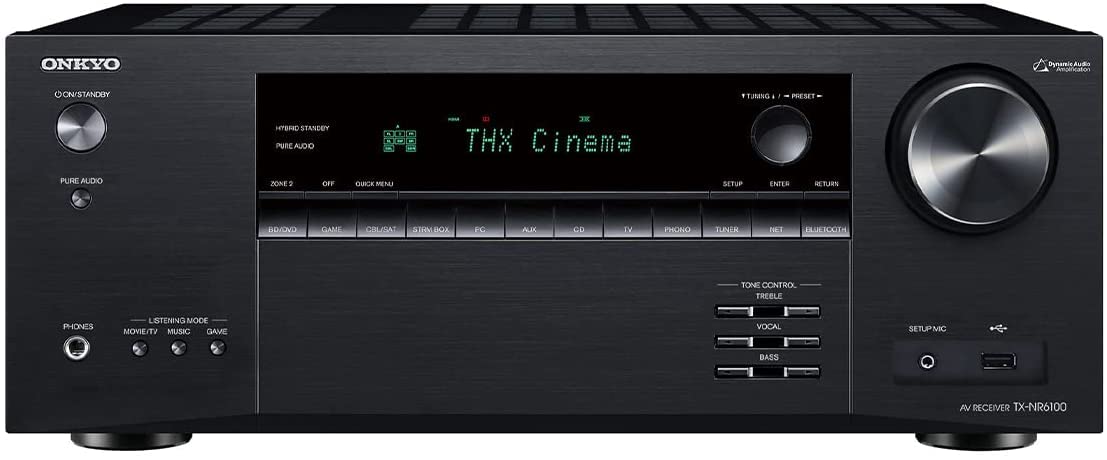
Count the channels and this receiver already separates itself: 7.2 against the Yamaha TSR-700’s 7.1. The extra subwoofer output is the practical difference — two subs smooth out bass across a wide room instead of leaving a dead zone in one seat. Add 210 watts per channel with THX Select certification (a third-party standard for cinema-level output in a room the size of a home theater) and this is the pick for someone who watches loud.
Dolby Atmos and DTS:X both decode here, and 8K with HDMI 2.1 at 40Gbps over three inputs future-proofs the video chain. The listening reports line up — owners running 5.1 Klipsch sets and 5.1.2 Atmos layouts describe power that outruns a Denon X1700 and height effects that stay synchronized and placed. Eight HDMI ports mean the console, streamer, disc player and TV all stay plugged in at once.
Weigh this: Onkyo had a rough patch. A unit arriving with dead HDMI outputs is not unheard of, and if that happens to you it is a return, not a repair. On the plus side, the one owner who has lived with it for nine months reports easy wiring, a built-in fan, low heat, and a rear USB port that auto-triggers a cooling fan — signs of a stable install once you get a good unit.
Why it climbs the list: 7.2 channels, 210 W per channel and THX Select certification give it more muscle than anything cheaper here, and the second sub output is a genuine upgrade for a wide room.
Before it ships: test every HDMI input the day it lands. Occasional dead units are the known risk on this model, and the return window is when you sort it.
Best matched to: a large room with two subs and a stack of sources, run by someone who wants cinema volume without flagship pricing.
Think twice if: you want the smallest possible box — this is a full-size receiver that needs shelf depth and airflow.
4. Denon AVR-X1700H AV Receiver

The middle-of-the-road receiver that gets the boring parts right, especially its connections
Where this one wins is the wiring, not the wattage. The AVR-X1700H gives you 6 HDMI inputs and 1 output, three of them dedicated 8K, plus a phono input for a turntable and two subwoofer pre-outs. That single phono jack is the quiet differentiator against the Onkyo above — a record player plugs straight in with no adapter. At 80W per channel it is not the loudest thing here, and it does not need to be for a typical 7.1 or 7.1.2 room.
Dolby Atmos and DTS:X decode as expected, and Dolby Atmos Height Virtualization fills in overhead effects even when you have no height speakers mounted. HEOS adds multi-room audio so a second zone can play something else while the movie runs. A full 3D audio path with HDR10+ and Dolby Vision support means the video chain is sorted for a modern TV.
The honest trade-off is software polish. Auto-calibration works, but more than one owner has found that manual tuning in an unusual room beats the mic result. Pair it with a wired Ethernet run if you can.
The hardware case
- 6 HDMI in / 1 out with three dedicated 8K inputs
- Phono input for a turntable plus two subwoofer pre-outs
- Dolby Atmos Height Virtualization for rooms with no ceiling speakers
- HEOS multi-room streaming and Alexa / Google voice control
The software caveats
- Auto-calibration often leaves center channel too low; manual tuning pays
- App is dated and Wi-Fi drops are common — wire it if possible
- 80W per channel is modest for very large rooms
Good fit for: a mixed household — movie nights, a turntable, and streaming to a second room.
Less ideal for: anyone who wants a set-and-forget app experience, since the tuning rewards a hands-on owner.
5. JBL Bar 700MK2 Soundbar with Subwoofer, Dolby Atmos Surround

Two speakers lift off the bar and go behind you — that is the whole trick, and it works
The engineering idea here is worth the mention first. The Bar 700MK2 is a soundbar whose two ends detach and become wireless surround speakers, so you get true 7.1-channel sound without a receiver, an amplifier or a run of cable. Total output is 780W max, and the wireless sub pairs a 10-inch driver with a frequency response that reaches down to 20Hz. Lift two speakers off, place them behind the couch, done.
You get height effects without ceiling speakers. Dolby Atmos and DTS Virtual:X (a processing mode that fakes overhead sound) handle the height illusion, and MultiBeam 3.0 spreads the front stage so people on the side of the couch are not left out. PureVoice 2.0 rebalances dialogue against the effects so whispered lines survive the explosions. The audio quality is what makes it land — owners describe it as theater-like, and one review page put it plainly: “Amazing sound quality, good battery life, easy to set up and have had no issues with it at all.”
The detachable speakers run on batteries, and that is the cost of the freedom — a few buyers find the recharge time a nuisance, and they can be topped up over USB-C. The default tuning also runs bass-heavy, so plan on dropping the sub level a good way in the EQ before it balances with the bar. Neither is a reason to skip it; both are things to expect.
The argument for it: detachable wireless rears plus a 10-inch sub in one box, with 780W max and Atmos on top, makes this the least disruptive route to surround in a finished room.
The catch: rechargeable rears eventually need charging, and the out-of-the-box bass is too forward for most rooms until you trim it.
Pick this one if: you rent, you have a finished room, and running speaker cable is simply not going to happen.
Not your pick if: you want separates you can upgrade one piece at a time — the Onkyo or Denon route serves that better.
6. Fluance Elite High Definition 7.1 Speaker System (SX71BR)

Seven real wood cabinets, one sub, and no amplifier included — the speaker route done properly
This is the only pick here that is purely speakers. In the box you get two 3-way floorstanding towers, two bookshelf speakers, two surround speakers, a dedicated center channel and the DB10 powered subwoofer with its 10-inch driver. All seven are timbre matched — voiced to sound the same as sound travels around the room — so effects do not change character as they pan from front to back. You bring the receiver; the cabinets bring the room.
The enclosures are engineered MDF with a woodgrain finish, chosen to suppress the box vibration that muddies a soundtrack. Output is genuinely strong: one long-term owner had the sub “kicks beautifully past volume 30” and still calls the system a five-year keeper. Support is a rare plus — when towers arrived damaged in shipping, replacements came free.
Plan the space before you buy, because this fills it. A bedroom will be overpowered, and one buyer found the two large bookshelf surrounds too big for proper rear placement — smaller rears would sit better behind a couch. There is also no receiver in the box, so the total cost is this set plus an amp like the Denon or Onkyo above.
What the cabinets deliver
- Seven timbre-matched speakers plus the 10-inch DB10 sub in one set
- 3-way floorstanding towers with a dedicated center channel
- Engineered MDF cabinets with woodgrain finish to cut resonance
- Lifetime parts and labor warranty on the speakers
Plan around this
- No receiver included — budget for the amp separately
- Bookshelf surrounds are bulky for rear placement
- Too much output for a small bedroom
Right for: a dedicated media room where you have a receiver already and floor space for two towers.
Wrong for: a compact apartment, where the tower cabinets alone will dominate the room.
7. Yamaha RX-A2A AVENTAGE 7.2-Channel AV Receiver

The receiver that tunes your room for you, then keeps up with a game console
Your money goes into room calibration here. The RX-A2A carries YPAO R.S.C. with multipoint measurement — you place a microphone at several seats and the receiver corrects distances and levels across them, not just the balance. Add Surround:AI, which reworks effects in real time as the scene changes, and the gap between a good amp and a well-tuned one closes. This is the AVENTAGE line, Yamaha’s top-tier build, and it weighs 25.4 pounds, which tells you about the chassis.
The video chain is fully ready: 7 HDMI in and 1 out, all inputs at 4K60, with three of them taking 8K60 and 4K120. ALLM and VRR matter for a console because they cut input lag and stop screen tearing. Dolby Atmos and DTS:X both decode, and a phono input covers a turntable. MusicCast covers Spotify, Apple Music, Amazon Music HD, TIDAL and more, and it works with Sonos if you already own a Port.
Setup effort is the honest tax. Some owners find the configuration over-complicated next to an older Yamaha, and the on-screen menus only appear over HDMI rather than on the receiver’s own display. A small number of units have shown reliability trouble and video handshake dropouts that needed a power cycle. When it is working, the audio is excellent.
Where the value sits: multipoint YPAO calibration, 8K60 and 4K120 on three inputs, and a 25.4-pound AVENTAGE chassis put this ahead of a basic receiver for a room with awkward seating.
The effort it asks: the setup menus assume some patience, and the display is not as forgiving as the rest of the hardware.
Suits: a multi-seat home theater where one calibration pass across all the couches is worth the fuss.
Skip the fuss if: you want a receiver you can set up without reading a manual — the Denon is friendlier.
8. Sony STR-AN1000 7.2ch Home Theater 8K A/V Receiver

One button turns a normal seven-speaker room into something that wraps behind your ears
Sony’s pitch here is the 360 Spatial Sound Mapping button, and by the accounts that tried it, the button earns its place. Push it and the receiver reworks the output from your existing speakers into a wider, taller field — owners describe the effect as transforming the immersion, with a front sound stage that spreads well beyond the cabinets. Power is 165W at 6 ohms, over 7.2 channels with two subwoofer outputs. Video runs HDMI 2.1 with 6 inputs and 2 outputs, covering 8K and 4K/120.
Dolby Atmos and DTS:X decode as standard, and Dolby Speaker Virtualization adds height effects without ceiling speakers. If you own a Sony TV, S-Center sync pulls the center channel through the TV’s own speakers, which owners say sharpens dialogue. Digital Cinema Auto Calibration IX handles setup. As one buyer sums it up: “The SOUND…Wow. Sony nailed it!” — with Spotify streaming straight from a phone working smoothly too.
The patience test is the software. Some units have shipped with random shutdowns, HDMI handshake errors and a long startup wait, and a small number needed board replacement. Zone naming also confuses people — the receiver itself is the “Main” zone, so a second amp goes on Zone 3. Set it up right and it is dependable; set it up casually and it will frustrate you.
The standout: 360 Spatial Sound Mapping plus 165W at 6 ohms turns a conventional 7.2 speaker set into a room-filling field, and HDMI 2.1 with two outputs covers a TV and a projector at once.
The watch-out: this is a unit that rewards a careful install — several reports of startup and handshake trouble trace back to setup and firmware, so register it and update before you judge it.
Built for: a Sony TV owner who wants dialogue pulled from the panel and spatial mapping across a standard 7.2 layout.
Not for: a plug-and-play buyer with zero appetite for firmware updates and zone setup.
9. Sony BRAVIA Theater Quad HT-A9M2 Audio System

Four slim wireless speakers do the work of a full surround array, and the result is uncanny
Sixteen speaker units, four cabinets, no receiver. The Theater Quad puts 16 drivers across four slim wireless speakers, then uses 360 Spatial Sound Mapping to place phantom channels anywhere in the room — including height and a center that is not physically there. Sound Field Optimization calibrates the whole arrangement to your room automatically. It is a completely different architecture from the receiver picks above, and for a small room it can match them.
Owners with full 5.2.4 receiver systems have compared the two directly, and the Quad holds its own on imaging and Atmos placement in a compact room; the phantom center, they say, beats a real center channel for dialogue. That is a strong claim, and it repeats across the reviews. Dolby Atmos, DTS:X and IMAX Enhanced all decode. Setup takes about 30 minutes through the app, and 4K120, VRR and ALLM cover a modern console.
The bass is the catch. There is no subwoofer in the box — optional Sub 7, Sub 8 and Sub 9 models add it — and the wireless connection needs a stable network. Some buyers find the app buggy during pairing, with disconnects fixed by a wired LAN connection. Price is the other consideration, since this sits at the top of the group.
Why it surprises people
- 16 speaker units across four wireless cabinets, positioned anywhere
- Sound Field Optimization calibrates itself to the room
- Phantom center and height channels without physical speakers for them
- HDMI 2.1 with 4K120, VRR and ALLM for gaming
Budget for these
- No subwoofer included — the optional Sub 7, 8 or 9 is effectively required
- App pairing can drop; a wired LAN connection stabilizes it
- Highest outlay in this group
Worth it for: a small-to-mid room where four slim cabinets and no receiver is the only layout that fits.
Hold off if: deep bass is non-negotiable and you are not willing to add a sub on top.
10. Klipsch Reference Home Theater Pack

Two 12-inch subs, tower speakers with height drivers, and the receiver already in the box
Everything arrives together here, which is the point. The bundle packs two R-625FA floorstanding towers, a R-52C center, a pair of R-41M bookshelf surrounds, two R-12SW 12-inch powered subwoofers, and an Onkyo TX-NR7100 9.2-channel receiver. That is a complete room in one purchase, with the amplifier already chosen for you. Main channel power handling runs 100W continuous and 400W peak.
You come for the Klipsch horn sound. Aluminum LTS tweeters behind Tractrix horns (a folded horn that focuses high frequencies) push highs forward, and the spec claims 96 dB sensitivity, which means a modest amp can drive them loudly. The dual 12-inch subs deliver bottom end that owners describe in plain terms — the dual woofers “shake the house but I love it,” and the pair adds “more bottom than you actually need (but you definitely want).” For movie night, that is exactly the brief.
Two practical notes. And delivery comes as several separate cartons on different days, which is normal for a kit this size but confusing if you are not expecting it. Frequency response runs 38Hz to 21kHz.
The bundle delivers
- Complete kit: towers, center, surrounds, two 12-inch subs and a 9.2 receiver
- 38Hz–21kHz response with 96 dB sensitivity for easy driving
- Atmos height channels built into the R-625FA towers
- 5-year Klipsch warranty on the speakers
Set expectations
- Ships as multiple cartons arriving on different days
- Receiver setup and menu tuning takes real time
- Volume levels vary between media sources and need adjusting
Best for: someone starting from zero who wants one order to cover the entire room, subs and amp included.
Consider skipping if: you already own a receiver — you would be paying for one you do not need.
Know the Specs
Channel count and the.1,.2,.4 suffix
The first number is how many main speakers the system drives; 7.1 means seven speakers plus one subwoofer. A second digit after the point, as in 7.2, means two subwoofer outputs — useful for smoothing bass across a wide room. A suffix like 7.1.4 adds four height channels that bounce sound off the ceiling, which is what places a helicopter above your head. More channels demand more speaker positions, so match the number to the room you actually have.
Subwoofer driver size and low-frequency reach
The subwoofer handles the low end, and its driver size in inches sets how much air it moves. A 10-inch driver is standard here and a 12-inch pair moves more, which is why a dual-12 bundle can overwhelm a small room. Frequency response measured in hertz tells you how deep it reaches — 20Hz is deeper than 38Hz in the same way a lower note sounds lower. Lower numbers reach further down, but placement usually matters more than the number.
HDMI versions, 8K and 4K/120
HDMI is the single cable carrying picture and surround audio from your console or streamer to the receiver or bar. HDMI 2.1 inputs carry 8K and 4K at 120 frames per second, which matters for a current console. Older 4K TVs can still trip the handshake, so confirm your display’s HDMI version before blaming the amp. Passthrough is simply the receiver passing the picture through untouched so the TV does the scaling.
Room calibration and what it fixes
Calibration uses a microphone to measure how your room colors the sound, then corrects speaker distance, level and tone. Multipoint versions take readings at several seats rather than one, which is why a multi-couch theater benefits. Not every system includes it — some expect you to set surround trim by hand. It is the difference between a system that adapts to a room and one you tune by ear.
Common Questions
Do I need a receiver for a 7.1 surround sound system?
What does the 7.1 in 7.1 surround actually mean?
Will a wireless surround system sound worse than wired speakers?
How do I stop my receiver losing the HDMI signal from my TV?
Do I need a subwoofer with the Sony BRAVIA Theater Quad?
Is an 8K receiver worth it if my TV is only 4K?
How much power do I need for a 7.1 speaker set?
Can I put a 7.1 system in an apartment bedroom?
What is room calibration and why do some systems skip it?
Do I need to run speaker cable to the back of the room?
Will a 7.1 system work with a projection setup?
The Bottom Line
For most rooms, the 7.1 surround sound system that does the most work with the least fuss is the ULTIMEA Skywave X70, because its 7.1.4 layout, 10-inch sub and dual 5GHz wireless links deliver height effects and rear channels without a receiver or a cable run. If you already own speakers and want the cheapest path to Atmos and 8K, the Yamaha TSR-700 is the base to build on. For a finished room where cable is out of the question, the JBL Bar 700MK2 and its detachable rears are the one to reach for. And if you want a whole room in one order, subs and amp included, the Klipsch Reference pack covers it.
The Skywave X70 carries 220+ ratings at 4.5+ stars, and that crowd confidence sits behind its top spot: the bass and the sound quality are the two things buyers keep coming back to.
How we choose
We do not accept paid placement. Every pick is matched to a real buyer and a real use-case; we do not hands-on test units.
Sources
Specifications: manufacturer listings and product documentation. Review insights: verified customer reviews, as of October 2026. Pricing: not shown on this page (it changes often); check the current price via the retailer link.
As an Amazon Associate, Aappliancez earns from qualifying purchases. This does not affect which products we feature.