Disclosure: Some links in this post are affiliate links. As an Amazon Associate I earn from qualifying purchases, at no extra cost to you. Learn more
Specs are compiled from manufacturer listings and verified buyer reviews and can change over time — please confirm the key details on the product page before buying.
If your hand aches after ten minutes of onions, the fix is usually the blade length, not your technique. A 6″ chef knife (measured from the base of the blade to the tip) sits under your knuckles instead of dragging behind them, so you steer the cut with your wrist rather than your whole arm. This guide covers eleven real options and tells you which one to buy for your kitchen, your hand size, and how much care you want to put into upkeep.
This guide is built by comparing the manufacturers’ published specifications and the patterns across verified customer reviews, so you get each pick’s real strengths and trade-offs instead of marketing spin.
Steel type, edge angle, construction, and handle material change how a knife feels in daily prep. A stamped blade you can rinse and forget feels different from a hand-finished Japanese edge you treat like a good pair of scissors. Below you will find clear picks for the best 6″ chef knife, side by side.
Top Picks


How To Choose The Best 6″ Chef Knife
Start with your cutting board, not the brand name. A 6-inch blade covers most home prep — onions, garlic, herbs, chicken breast — while staying light enough to choke up on for precision work. The real decision is how much care you want to give the edge and how the handle feels when wet.
Steel and edge angle: how long it stays sharp
High-carbon stainless steel holds an edge longer than a soft alloy, but it wants hand washing. The edge angle matters just as much. A 16-degree edge (the angle the blade is ground to, measured from the center of the steel) slices cleaner than a wider grind, though it is more delicate on bones and hard squash. A 14-16° hand-polished edge or a 12° Japanese angle gives you a finer cut but demands respect on the board.
Forged versus stamped: weight and balance
A forged knife is shaped from a single piece of steel, so it carries more weight and usually a full tang (the steel running through the handle). That extra mass does the cutting for you. A stamped blade is cut from a sheet of steel — lighter, cheaper, and easier to control for small hands. Neither is better; they suit different cooks.
Handle material and wet-hand grip
Thermoplastic elastomer (a rubbery plastic) and Santoprene stay grippy when wet, which matters when you are handling raw chicken. Wood and Pakkawood (layered wood resin) look warmer but want drying after washing. If you routinely cook with wet hands, prioritize a textured synthetic handle.
Side-by-Side Comparison
| Model | Best For | Blade Length | Construction | Weight | Amazon |
|---|---|---|---|---|---|
| Victorinox Fibrox 6 Inch Straight Edge Chef’s Knife★ Best Overall | All-round home prep | 6 inches | Stamped | 2.72 ounces | Amazon |
| Mercer Culinary M23506 Renaissance 6-Inch Chef’s KnifeBest Balance | Serious home cooks | 6 inches | Forged | 4 ounces | Amazon |
| Mercer Culinary M20606 Genesis 6-Inch Chef’s KnifeBest Grip | Wet-hand chopping | 6 inches | Forged | 4 ounces | Amazon |
| WÜSTHOF Classic 6″ Chef’s Knife | Precision and safety | 6 inches | Forged | 6.4 ounces | Amazon |
| Shun Classic 6″ Chef’s Knife | Japanese-edge enthusiasts | 6 inches | Forged | 0.13 kg | Amazon |
| MIYABI Kaizen 6-Inch Chef’s Knife | Thin-slice precision | 6 inches | Forged | 8 ounces | Amazon |
| SHAN ZU Damascus Chef Knife 6 inch | Damascus looks, smaller hands | 6 inches | Forged | 141 g | Amazon |
| Mercer Culinary Millennia 6 Inch Chef’s Knife | Cushioned comfort grip | 6 inches | Stamped | 11 inches overall | Amazon |
| Global 6″ Chef’s Knife | One-knife kitchens | 6 inches | Stamped | 147 g | Amazon |
| Farberware EdgeKeeper 6-Inch Chef Knife | Low-maintenance edge care | 6 inches | Stamped | 5.3 ounces | Amazon |
| OAKSWARE 8 Inch Chef Knife | Larger tasks and bigger hands | 8 inches | Forged | 8.48 ounces | Amazon |
Detailed Reviews
1. Victorinox Fibrox 6 Inch Straight Edge Chef’s Knife, Black
Our pick — 4.5+★ from 3,500+ verified ratings; the strongest balance of quality and price.
The Swiss workhorse that weighs almost nothing and still cuts through a pile of onions.
Weighing 2.72 ounces, the Fibrox is the lightest knife on this list — and that lightness is the whole point. You can dice a whole onion and mince the garlic afterward without your wrist tiring, because there is barely any blade to hold up. It is stamped from stainless steel rather than forged, which keeps the price in budget-friendly territory for a knife that shoppers have made the crowd favorite — 4.5+ stars across 3,700+ ratings.
The handle is thermoplastic elastomer, a rubbery plastic that stays grippy even when your hands are wet with chicken juice. The blade arrives sharp and laser-tested, so it chops, minces, slices and dices straight out of the packaging. It is also dishwasher safe, which is rare at this level and a genuine relief if you hate hand washing.
Here is the honest catch: because the blade is so light, it does not carry the weight that lets a heavy forged knife power through a raw butternut squash or a bone-in bird. It also wants touching up more often than a high-carbon forged edge. The trade-off is fair — you give up mass and edge retention, you gain speed and easy care.
What makes it the go-to
- 2.72 ounces is the lightest here — wrist stays fresh through long prep
- TPE handle stays non-slip when wet
- Dishwasher safe, unusually accommodating for a chef’s knife
- Arrives sharp and laser-tested from the factory
Where it falls short
- Light mass struggles on squash and bone
- Needs honing more often than a high-carbon forged blade
Reach for this if: you want one low-fuss knife for everyday vegetables and proteins, and you cook with wet hands.
Look elsewhere if: you regularly break down whole chickens or heavy squash and want a blade with mass behind it.
2. Mercer Culinary M23506 Renaissance 6-Inch Chef’s Knife
The one that makes a 6-inch blade feel like a full-size knife without the wrist drag.
Forged from high-carbon German cutlery steel, this Mercer brings real mass to a short blade. The triple-riveted handle is tough and lightweight, and the rounded spine (the top edge of the blade) means your fingers rest easy when you choke up for control. The geometry is what makes it special: a 6-inch blade that stays out of the way when you dice onions but still has enough belly to rock through herbs and mince shallots.
What wins people over is how well the Renaissance handles the small stuff. It is easy to maneuver without your knuckles knocking the cutting board, and the steel holds its edge through a long prep session. The handle material is Delrin and Santoprene, both synthetic, so it grips well enough in a wet kitchen. Hand wash it and dry it fully — Mercer tells you not to soak it or put it in the dishwasher.
The trade-off is the care requirement. This is a forged knife that wants hand washing and drying, and leaving it wet will eventually dull the edge and stain the blade. It is also heavier than the Fibrox above at 4 ounces, so if you have small hands the weight may feel foreign at first. But once you adapt, the extra mass does a lot of the work for you.
Why it ranks high: the combination of forged German steel, a rounded spine, and a 6-inch blade that handles dicing without knuckle clearance issues is rare. It is a working knife, not a display piece.
The honest limit: hand wash and dry only. It is not a dishwasher knife, and treating it like one will cost you the edge.
Best for: the home cook who wants forged performance and a comfortable rounded spine for daily dicing.
Skip if: you want to toss the knife in the dishwasher after every meal.
3. Mercer Culinary M20606 Genesis 6-Inch Chef’s Knife, Black
The wet-hand specialist — a grippy Santoprene handle wrapped around a forged German blade.
Most knives grip well when dry and turn slippery the moment your hands are wet. The Genesis fixes that with a Santoprene handle, a rubbery synthetic that stays non-slip even with wet hands. That matters if you are handling raw chicken or rinsing vegetables between cuts. The blade is precision-forged high-carbon German steel with a taper-ground edge, so it comes from the start sharp and holds that sharpness over a long session.
The 6-inch blade is the right size for dicing onions, mincing shallots, chopping herbs, crushing garlic, and shredding cabbage. What wins people over is how the edge handles a tomato — it slices through the skin cleanly rather than crushing it. Buyers report the Genesis is balanced toward the grip end, which gives you more control on delicate work. At 4 ounces it sits in the middle of this list, heavier than the Fibrox but lighter than the full-size forged options.
Easy care is the one place it asks for patience. Mercer says to wash it by hand with warm water and mild soap, rinse, and dry completely with a soft towel. Do not put it in the dishwasher or submerge it. Hand washing adds a minute per meal, but it is what keeps the edge keen and the handle intact.
What earns its place
- Santoprene handle stays grippy with wet hands
- Forged high-carbon German steel with a taper-ground edge
- Balanced toward the grip for control on delicate cuts
- Slices tomatoes cleanly rather than crushing them
What to know going in
- Hand wash and dry only — no dishwasher, no soaking
- 4 ounces may feel heavy in very small hands
Pick this one for: a wet-hand workflow where grip matters as much as sharpness.
Rather not: if you want a knife you can rinse and leave without drying it every time.
4. WÜSTHOF Classic 6″ Chef’s Knife

A German-forged classic with a full bolster and an edge that keeps its bite between sharpenings.
Forged from a single piece of high-carbon stainless steel and tempered to 58-degree HRC (Rockwell hardness — a scale for how hard the steel is), the WÜSTHOF Classic is built to hold an edge. WÜSTHOF’s Precision Edge Technology gives it a blade the maker describes as 20% sharper with twice the edge retention than previous models. That edge slices through vegetables cleanly and stays keen between sharpenings rather than going dull mid-prep.
The full tang runs the steel through the handle, and the full bolster (the thick metal collar between blade and handle) adds safety and control by keeping your fingers off the edge. At 6.4 ounces it is the heaviest of the 6-inch models here, and that mass lets the blade do the cutting for you. What wins people over is the balance — the knife sits in your hand and cuts effectively without you forcing it.
The trade-off is the weight. If you have small hands or prefer a lighter feel, 6.4 ounces may be more knife than you want, especially compared with the 2.72-ounce Fibrox. It is also the pick that wants hand washing and drying. But if you value a full bolster and a forged German blade, this is the one that feels most substantial.
The case for it: a forged German blade with a full tang and full bolster, tempered to 58-degree HRC, that holds an edge and gives you safety and control in one package.
The catch: 6.4 ounces is the heaviest here, so small hands or light-knife habits may find it a lot to handle.
Worth it for: cooks who want a safety-first forged German knife with a bolster and real heft.
Think twice if: you want a featherweight blade or you dislike hand washing.
5. Shun Classic 6″ Chef’s Knife
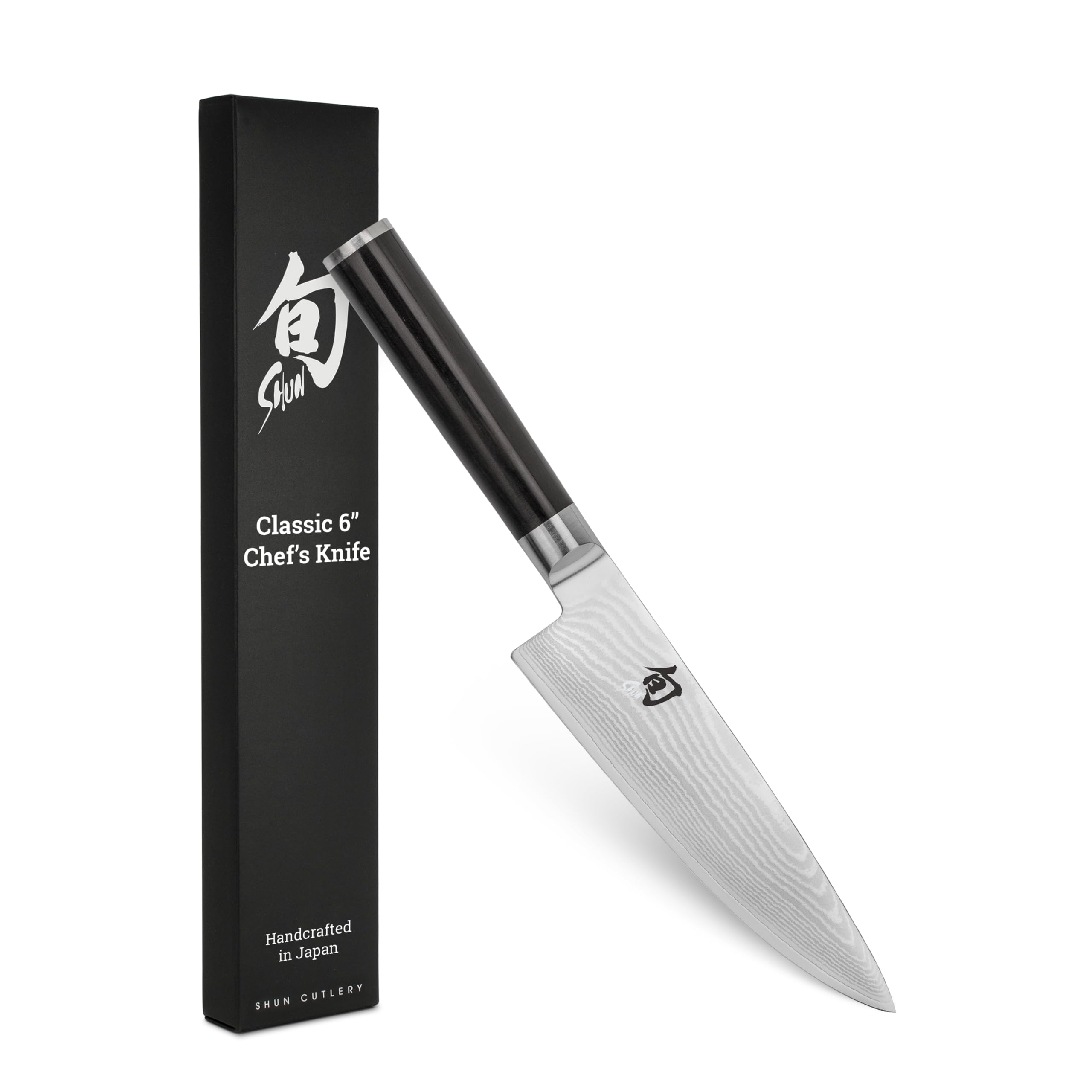
A handcrafted Japanese blade that slices through tomatoes like they are softened butter.
The Shun Classic is built around VG-MAX steel with 68 layers of Damascus cladding (Damascus means folded steel layers that create a visible wave pattern). The edge is ground to 16 degrees, which is a sharper angle than a typical German knife, so it cuts with less pressure. What wins people over is the Shun’s cut itself — it glides through onions and tomatoes cleanly rather than crushing the flesh. The D-shaped Pakkawood handle gives a secure grip for both left and right-handed cooks.
Each knife is handcrafted in Japan, and the maker supports it with free sharpening and honing. That is a real long-term benefit if you want to keep the edge at its best without buying your own stones. The 16-degree edge also means you should avoid chopping through bones or frozen food, which can chip a thin Japanese blade.
The honest trade-off is maintenance. A 16-degree edge is thinner and less forgiving than a 20-degree German edge, so it wants a light touch and regular honing. It also wants hand washing and drying. If you treat it like a German workhorse, you will shorten its edge life. Treat it well and it will reward you with a cleaner cut.
Why it stands out
- VG-MAX steel with 68 layers of Damascus cladding
- 16-degree edge slices with very little pressure
- D-shaped Pakkawood handle works for left and right hands
- Free sharpening and honing from the maker
The trade-off
- Thin 16-degree edge is unforgiving on bones and frozen food
- Hand wash and dry; wants regular honing
Choose this if: you want a true Japanese-style edge and will treat it like a precision tool.
Not for: cooks who regularly chop through bones or frozen blocks.
6. MIYABI Kaizen 6-Inch Chef’s Knife, Black

A katana-inspired edge honed to a razor angle — precision for cooks who notice the difference.
The Kaizen uses VG10 super steel with a thin Japanese blade profile, hand-honed to a 9.5 to 12-degree edge using Miyabi’s three-step Honbazuke process. That is one of the sharpest edge angles on this list, and it shows in the cut — it makes slicing tomatoes and onions feel like cutting through butter. The CRYODUR blade is ice-hardened to Rockwell 60, so the steel holds that fine edge to a very high standard.
The 65-layer flower Damascus design with a katana edge gives it a striking look, and the Micarta handle (a layered synthetic material) feels solid in hand. At 8 ounces it is the heaviest 6-inch knife here, so the blade carries real momentum. What wins people over is the Kaizen’s balance — the knife feels great in hand, has good weight without being too heavy in use, and performs exceptionally well on soft produce.
Here is the honest part: that very fine 9.5 to 12-degree edge is delicate. It is not a knife for chopping through bones, frozen food, or tough squash, and it wants a light hand and regular care. The Micarta handle is comfortable but the knife overall demands respect. If you want a heavy-duty chopper, this is not it. If you want a precision slicer, it earns its place.
Where it shines: the 9.5 to 12-degree Honbazuke edge on VG10 steel hardened to Rockwell 60 makes every cut feel easy, and the 65-layer Damascus design gives it a look you will not get from a stamped blade.
The honest limit: that fine edge is not built for bones or frozen food, and the 8-ounce weight is the heaviest here.
Made for: cooks who want the sharpest Japanese edge and will treat the knife accordingly.
Look elsewhere if: you want a knife for heavy chopping or bone-in work.
7. SHAN ZU Damascus Chef Knife 6 inch, 67-Layer Japanese Steel

The Damascus-patterned knife that punches well above its price, at 141 grams of forged Japanese steel.
At 141 grams, this is the lightest forged knife on the list, and it brings a striking look. The 67-layer blade is forged from 66 layers of carbon steel (33 layers of Damascus steel top and bottom) around a 1-layer 10Cr15MoV Damascus core, hardened to 62 HRC. That high hardness is what lets the 12-degree edge stay sharp through long sessions and resist rust. The fiberglass G10 handle is stable and non-deformable, with a polygonal shape that sits comfortably in the hand.
The Damascus pattern is formed by stacking carbon steel sheets, folding them repeatedly, and overheating until the pattern appears — then polishing makes it stand out. What wins people over is the SHAN ZU’s combination of that visual appeal with real cutting performance. Owners also note the size works well for smaller hands, which makes this one of the better picks for cooks who find full-size blades awkward.
The catch is the care. A 62-HRC, 12-degree edge is very hard and very fine, so it is not the knife for chopping through bones or frozen food. It also wants hand washing and drying to preserve the Damascus finish and the edge. If you want a beautiful, sharp knife for slicing and dicing soft ingredients, this delivers.
What buyers respond to
- 67-layer Damascus blade with a visible pattern
- Hardened to 62 HRC for edge retention
- 141 grams — the lightest forged knife here
- Works well for smaller hands
What to weigh
- Fine 12-degree edge is not for bones or frozen food
- Hand wash and dry to protect the finish
This is your knife if: you want Damascus looks and a hard Japanese edge with a handle that suits smaller hands.
Pass if: you need a knife for heavy, bone-in chopping.
8. Mercer Culinary Millennia 6 Inch Chef’s Knife

A stamped knife with a cushioned handle that feels soft in hand and sharpens up easily.
The Millennia is the comfort pick. The cushioned soft handle is what earns the most praise — it feels good in hand and reduces fatigue during long prep sessions. The blade is high-carbon steel, stamped rather than forged, and it holds an edge well. Owners find it easy to sharpen and maintain, so if you keep a honing steel on the counter, this knife rewards that habit. It also comes from the start sharp and cuts cleanly through vegetables and proteins.
At 6 inches, the blade is sized for everyday tasks — slicing, dicing, mincing — without the heft of a forged knife. The trade-off is durability. Some buyers find the edge chips rather easily, which is the one recurring note across the reviews. That does not make it a bad knife; it makes it a knife to treat with care and keep away from bones and frozen food. If you want a comfortable, budget-friendly everyday knife and you are willing to sharpen it occasionally, this is a solid choice.
The appeal: a cushioned handle that reduces fatigue, a stamped high-carbon blade that sharpens easily, and a comfortable feel for long prep sessions.
The honest caveat: the edge can chip if you push it through bones or hard ingredients — keep it for soft prep and it will serve you well.
Best for: cooks who prioritize handle comfort and want an easy-to-sharpen everyday knife.
Skip if: you regularly chop through bone-in meat or frozen food.
9. Global 6″ Chef’s Knife

A smooth stainless blade that becomes the most-used knife in your kitchen.
The Global 6-inch earns its spot as the most-used knife in your kitchen because its smooth stainless design makes it hygienic and easy to maintain. At 147 grams, it feels light in hand, and owners find it well-balanced and comfortable to hold. The straight-edged blade is sized just right — not too large — so it often ends up as the knife you reach for first. The stainless steel construction means fewer places for food to hide, which is a real plus for raw meat prep.
What wins people over is the edge. The Global’s edge is razor-sharp and stays sharp for a considerable time, and the knife feels balanced enough that you can use it for everything from slicing to chopping. Owners describe the Global as their favorite, and many say it becomes the most used knife in the kitchen. The 6-inch blade is small enough for precision and big enough for daily prep.
The honest limit is the handle. It is wood, so it needs hand washing and drying and will not tolerate soaking. If you want a knife you can leave in the sink, this is not the one. But if you want a smooth stainless blade that feels light and balanced and handles most kitchen tasks, this earns its place.
Why it works
- smooth stainless design is hygienic and easy to maintain
- Light 147-gram weight feels balanced in hand
- Razor-sharp edge that stays sharp for a considerable time
- Small enough for precision, big enough for daily prep
What to keep in mind
- Wood handle needs hand washing and drying
- Not designed for soaking or dishwasher use
Choose it for: a smooth stainless knife that handles everything and feels light in hand.
Not ideal if: you want a dishwasher-safe knife or dislike drying a wooden handle.
10. Farberware EdgeKeeper 6-Inch Chef Knife
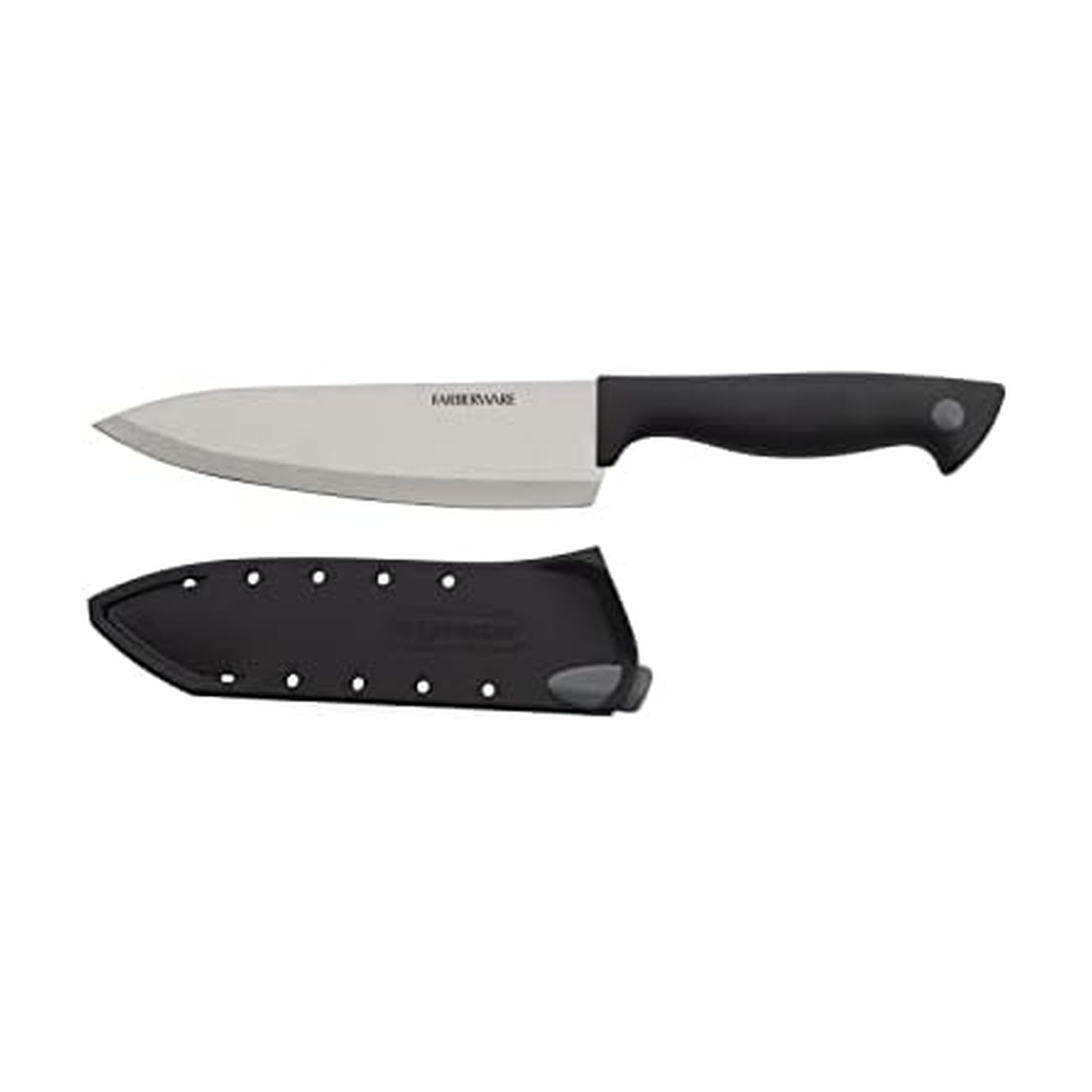
The budget knife that sharpens itself every time you pull it out of the cover.
The EdgeKeeper solves a problem most cheap knives ignore. Its protective blade cover has a built-in sharpener that hones the edge every time you insert or remove the knife, so the blade stays razor-sharp without a separate tool. If you never remember to reach for a honing steel, that feature alone justifies a look. The blade is high-carbon stainless steel that resists staining, and the ergonomic handle is shaped to reduce hand fatigue during extended chopping.
At 5.3 ounces, it has a bit more heft than the 2.72-ounce Fibrox, and the 6-inch blade handles slicing, dicing, and mincing vegetables, fruits, herbs, and proteins. Owners say it performs well as a regular knife, and the sheath is a genuine convenience for storage. Hand wash it with warm water and mild detergent, rinse, and dry immediately — the sheath is not a soaking vessel.
The honest trade-off is that a self-sharpening sheath gives you an edge that is good enough rather than exceptional. It is not a fine Japanese edge, and the blade is stamped rather than forged. But for a budget-friendly everyday knife that stays sharp without extra tools, this is a smart pick. If you want a knife for precision work, the Forged options above will serve you better.
Where it wins: a self-sharpening sheath that hones the edge on every insert and remove, so the knife stays sharp without a honing steel.
The trade-off: stamped blade and a good-enough edge, not a precision Japanese cut.
This one suits: cooks who want a low-maintenance, budget-friendly knife that stays sharp on its own.
Look past it if: you want a forged blade and a truly fine edge for precision work.
11. OAKSWARE 8 Inch Chef Knife

The 8-inch option for cooks who want a full-size blade with a forged heft.
This is the outlier on the list — an 8-inch blade for cooks who want more reach than a 6-inch knife gives. It measures 13.39 inches overall and weighs 8.48 ounces, so it is dramatically heavier and longer than the 6-inch Fibrox at 2.72 ounces. That extra mass and reach let it power through a brisket, pork chops, heavy cabbage, and garlic with control. The German high carbon stainless steel is forged with a 14-16-degree hand-polished edge and 57+ Rockwell hardness, so it holds its edge through a long carving session.
The full-tang forged handle is secured with triple rivets for weight distribution, and the smooth blade-to-handle transition leaves nowhere for food and grease to hide. If you find a 6-inch blade too small for big jobs, this gives you the length and weight without stepping into a premium price. It is also tough enough to handle acidic meat juice and dish soap without staining.
The catch is the size. If you have small hands or a compact kitchen, the 8-inch blade will feel long and heavy compared with the 6-inch options here. It is also the heaviest knife on the list at 8.48 ounces. But if you need a bigger blade for larger tasks and want a forged build, this is a strong pick.
What it brings
- 8-inch blade for larger tasks and more reach
- 14-16-degree hand-polished edge at 57+ Rockwell hardness
- Full-tang forged handle with triple rivets
- smooth blade-to-handle joint for easy cleaning
What to consider
- 8.48 ounces — the heaviest knife here
- Too long and heavy for small hands or compact kitchens
Go with this if: you need a bigger blade for brisket, cabbage, and larger prep tasks.
Not for: small hands or anyone who wants the nimble feel of a 6-inch blade.
Know the Specs
Blade length and control
A 6-inch blade (measured from the base to the tip) keeps your knuckles clear of the cutting board when you rock through herbs and dice onions. A shorter blade is easier to steer, but it gives up reach on large items like brisket or cabbage. The longer 8-inch option here gives you more leverage for big tasks but demands more wrist effort on fine work.
Edge angle and steel hardness
Edge angle is how thin the blade is ground at the cutting edge. A 16-degree edge slices with less pressure than a wider grind, while a 12-degree Japanese angle is finer still. Rockwell hardness (HRC) measures how hard the steel is — higher numbers hold an edge longer but are less forgiving on bones. A 57+ HRC forged blade and a 62 HRC Damascus blade both hold edges well, but neither is built for heavy chopping.
Common Questions
Is a 6-inch chef knife big enough for everyday cooking?
Forged or stamped — which should I choose?
What does high-carbon steel mean for a chef knife?
Can I put a 6-inch chef knife in the dishwasher?
How often should I sharpen a chef knife?
What edge angle is best for home cooks?
Do I need a honing steel or sharpening stones with a Japanese knife?
Is a heavier knife better for chopping vegetables?
Will a Damascus-patterned blade stay sharp longer than a plain steel one?
How do I keep a wooden or Pakkawood handle from cracking?
Is a 6-inch chef knife safer than an 8-inch one for beginners?
The Bottom Line
For most kitchens, the 6″ chef knife that makes the most sense is the Victorinox Fibrox. It weighs just 2.72 ounces, stays grippy with wet hands, and is dishwasher safe — a combination that makes daily cooking easier instead of fussier. If you want forged German steel with a rounded spine, take the Mercer Renaissance. And if a fine Japanese edge is what you are after, the Shun Classic slices with a 16-degree angle that most home blades cannot match.
Whichever you pick, remember that a 6-inch chef knife lives or dies by how you treat it. Hand wash the forged and Japanese options, hone them lightly, and keep them off bones and frozen food. Do that, and any knife on this list will stay sharp and serve you for years of daily prep.
How we choose
We do not accept paid placement. Every pick is matched to a real buyer and a real use-case; we do not hands-on test units.
Sources
Specifications: manufacturer listings and product documentation. Review insights: verified customer reviews, as of October 2026. Pricing: not shown on this page (it changes often); check the current price via the retailer link.
As an Amazon Associate, Aappliancez earns from qualifying purchases. This does not affect which products we feature.