Disclosure: Some links in this post are affiliate links. As an Amazon Associate I earn from qualifying purchases, at no extra cost to you. Learn more
Specs are compiled from manufacturer listings and verified buyer reviews and can change over time — please confirm the key details on the product page before buying.
If you tow a fifth wheel with a short-bed truck, the slide hitch you pick decides whether your cab stays dent-free. A slider lets the hitch head travel backward as you turn, so the trailer nose swings away from the truck instead of into it. The picks below split into two clear families: heavy auto-sliding steel units for maximum capacity, and lightweight single-point hitches that one person can lift out. Which one you want depends on your truck bed length, your trailer’s gross weight, and whether you have a second set of hands in the driveway.
This guide is built by comparing the manufacturers’ published specifications and the patterns across verified customer reviews, so you get each pick’s real strengths and trade-offs instead of marketing spin.
Every hitch here mounts to a standard rail or factory puck setup, so fitment is the first thing to confirm before you buy. If you want the short version, the strongest all-rounder is the B&W 25K Companion OEM for Ford puck trucks, and it leads our list of the 5th wheel slider hitches.
Top Picks


How To Choose The Best 5th Wheel Slider Hitches
The single most expensive mistake in this category is buying a hitch rated for less than your trailer actually weighs when loaded. Two numbers matter, and they are not the same thing. GTW is gross trailer weight — the full weight of the trailer including cargo and water. Pin weight is the downward load the trailer tongue puts on the hitch itself, and it is usually 15 to 25 percent of the trailer’s total weight. A hitch can be rated for plenty of trailer weight and still fall short on pin weight, so check both against your own trailer’s sticker.
Slide travel and bed length
Slide travel is how far back the hitch head moves when the trailer pushes against it. More travel means you can turn sharper before the trailer nose reaches your cab or your rear window. Fixed hitches take up less bed space but give you nothing back on a tight turn. A slider trades a little bed length for clearance, which is exactly why it exists.
Mounting style decides your installation day
Rail mounting uses a set of industry-standard rails bolted to your truck bed. Puck mounting drops into the factory prep holes that come on many newer trucks, which speeds up install and removal considerably. A gooseneck-ball mount sits over a 2-5/16 inch ball you already have, so you skip a dedicated rail kit entirely. Measure what your truck actually has before you order anything.
Weight you can physically handle
Heavy steel sliders run into the hundreds of pounds, and they usually need two people to lift them in and out. Lightweight hitches get down to the point where one person can manage the job alone. If you share the truck with a daily driver and pull the hitch out between trips, weight matters as much as the tow rating.
Side-by-Side Comparison
| Model | Best For | Towing Capacity (GTW) | Pin Weight | Hitch Weight | Amazon |
|---|---|---|---|---|---|
| B&W 25K Companion OEM (RVK3305)★ Best Overall | Ford puck-system trucks | 25,000 lbs | 6,250 lbs VTW | 161 pounds | Amazon |
| B&W Companion Slider (RVK3405)Best Slide Clearance | Short-bed trucks needing extra clearance | 20,000 lbs | 5,000 lbs VTW | 287 pounds | Amazon |
| Reese 30922 M5Modular Pick | Ford Super Duty owners wanting a modular system | 27,000 lbs | 6,750 lbs | 49.2 pounds | Amazon |
| CURT 16130 Q20 | Quiet rail-mounted towing | 20,000 lbs | 5,000 lbs vertical load | 140 pounds | Amazon |
| CURT 16600 CrossWing | One-person install on standard rails | 20,000 lbs | — | 86.7 pounds | Amazon |
| CURT 16602 CrossWing Gooseneck | Trucks already running a gooseneck ball | 20,000 lbs | — | 104.2 pounds | Amazon |
| Andersen Rail Mount Kit 3200 | Lifting the hitch in and out solo | 20,000 lbs GTWR | 4,500 lbs tongue weight | 45 pounds | Amazon |
| PullRite 2600 Superlite | Steel single-point conversion | 20,000 lbs GTW | — | 130 pounds | Amazon |
| Andersen Ultimate Toolbox 3220-TBX | Keeping bed space free | 24,000 lbs GTWR | 4,500 lbs tongue weight | 45 pounds | Amazon |
| PullRite 4500 SuperGlide | 2020 and newer GM puck trucks | 24,000 lbs | 6,000 lbs | 219 pounds | Amazon |
| PullRite 2315 SuperGlide | Ram puck-system short beds | 24,000 lbs | 6,000 lbs | 298 pounds | Amazon |
Detailed Reviews
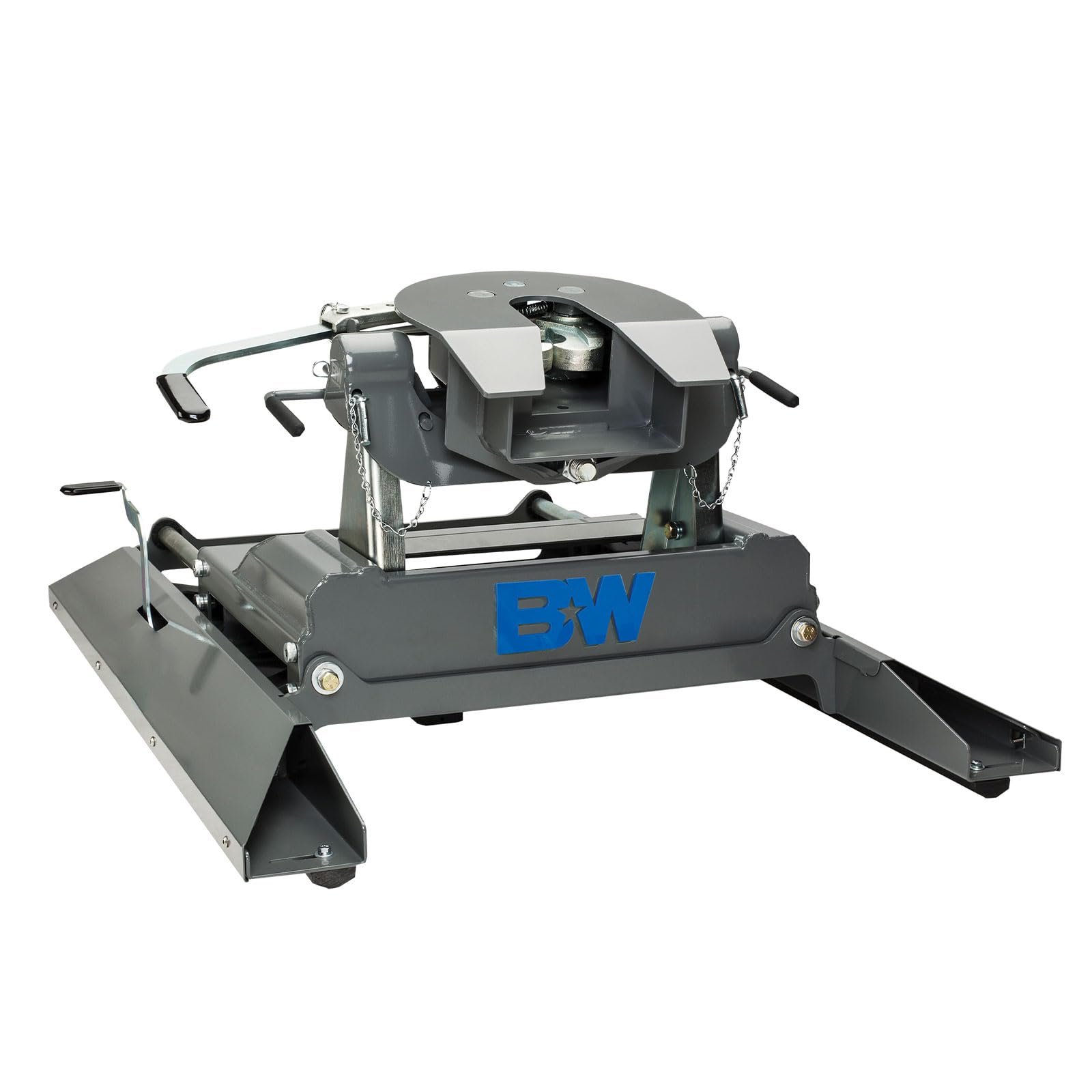
1. B&W Trailer Hitches 25K Companion OEM Fifth Wheel Hitch
Our pick — 4.5+★ from 200+ verified ratings; the strongest balance of quality and price.
Built to drop straight into your Ford’s factory pucks and haul a heavy trailer without a creak.
This is the hitch to buy if your truck has the Ford OEM prep package and your trailer is genuinely heavy. It carries a 25,000 lb GTW rating and a 6,250 lb VTW pin weight rating, which is the vertical load the trailer tongue presses down onto the hitch. That combination puts it well clear of most of the pack — the B&W Companion Slider below is rated 20,000 lb GTW and 5,000 lb VTW, so this one holds a full step more capacity in both figures. The fully articulating head pivots front to back and side to side, which keeps the trailer level over uneven ground instead of stressing the frame.
What wins people over most is the build. Owners call it well-made and solid, and one report notes it pulled a 16,000 lb fifth wheel 600+ miles without trouble. Setups that bolt into the Ford pucks take minutes rather than hours, and the cam-action latching handle releases cleanly even when you are parked on a sloped campsite where a jammed handle would otherwise ruin your morning. Splitting into two manageable pieces makes removal far less painful than the total weight suggests.
Here is the honest catch. At 161 lb, one person is not lifting this into a truck bed. That is the recurring theme in owner feedback — the hitch is heavy, and you will want a second set of hands or a lift to move it. It also eats a real slice of bed space, though it does break down to two pieces for storage. For a dedicated tow rig, neither point matters much. For a truck that doubles as a daily driver, they do.
Why owners keep this one
- 25,000 lb GTW and 6,250 lb VTW ratings clear a much heavier trailer than most rivals here
- Drops into the Ford OEM puck system with no extra rail kit to buy or drill
- Articulating head pivots both directions so the trailer stays level over dips and crowns
- Cam-action handle releases even when the truck is parked off-level
The part you should plan around
- 161 lb is a two-person job to lift in and out of the bed
- Occupies meaningful bed space when installed
- Ford puck trucks only — it will not bolt to a generic rail setup
Made for: Ford prep-package owners towing a heavy trailer who leave the hitch in most of the season.
Think twice if: you pull the hitch out after every trip, because 161 lb does not come out quietly.
2. B&W Trailer Hitches Companion Slider Fifth Wheel Hitch
The 12-inch rollback that keeps a short-bed truck’s rear window intact.
The defining number on this hitch is its 12 inches of slide travel — the distance the head moves backward when the trailer pushes against it on a turn. On a short-bed truck that travel is the difference between clearing your cab and denting it, and owners with a GMC crew cab HD call the rollback function essential rather than a nice-to-have. It is rated 20,000 lb GTW and 5,000 lb VTW, so it suits a broad spread of mid-weight fifth wheels.
Polyurethane bushings are what separate this from a rattling steel slider. They hold the head steady so the hitch runs quiet instead of banging through every expansion joint. The same cam-action release and articulating head from the 25K Companion carry over here, so unhitching on a sloped site stays simple. Mounting to standard rails means it is not locked to one truck brand the way a puck-specific unit is.
The 287 lb weight is the number to respect. As owners put it, this hitch “needs 2 people to lift into truck.” The nylon strips underneath must contact the metal bed floor to keep the hitch from twisting, which sometimes means trimming plastic bed liner material first. Neither issue is a defect — both are setup realities of a heavy slider.
Where it earns its label: 12 inches of slide travel is real, usable clearance, not a token figure, and the polyurethane bushings keep the ride civil.
Know before you order: 287 lb and a bed-liner strip that may need trimming mean install day is a two-person job.
Reach for this if: you run a short bed and want a genuine rollback slider that still rides quiet on the highway.
Look elsewhere if: you need to move the hitch yourself, because 287 lb will not cooperate.
3. Reese 30922 M5 Fifth Wheel Hitch
A 49.2 lb modular head with the highest capacity figure on this page.
On paper, this is the lightest way to get a 27,000 lb towing capacity. It is rated 6,750 lb pin weight and offers 14-inch to 18-inch vertical adjustment, and the 49.2 lb figure makes the 287 lb B&W slider above look like a barbell by comparison. The three-part modular design and Talon Jaw head — a jaw shaped to grip the pin and cut side-to-side chucking — are genuinely interesting engineering for a hitch in this class.
The catch is real, and you should know it before you order. This listing sells a specific part of a system rather than a complete, ready-to-bolt-in hitch in every case. Multiple buyers report receiving only the legs rather than the full hitch head shown in the photos, and several flag that replacement parts have been hard to source. This is the pick to choose only if you have confirmed exactly which components you are getting and you know the M5 system well enough to assemble it yourself.
The honest read: the capacity and light modular weight are compelling for a buyer who already runs the M5 platform and knows the parts list by heart.
Do your homework first: verify precisely what ships in the box, because the listing photos show the complete system.
Best for: experienced M5 owners adding a specific component they can identify on sight.
Not for: a first-time buyer who wants one box to arrive with everything needed for install.
4. CURT 16130 Q20 5th Wheel Hitch, 20,000 lbs
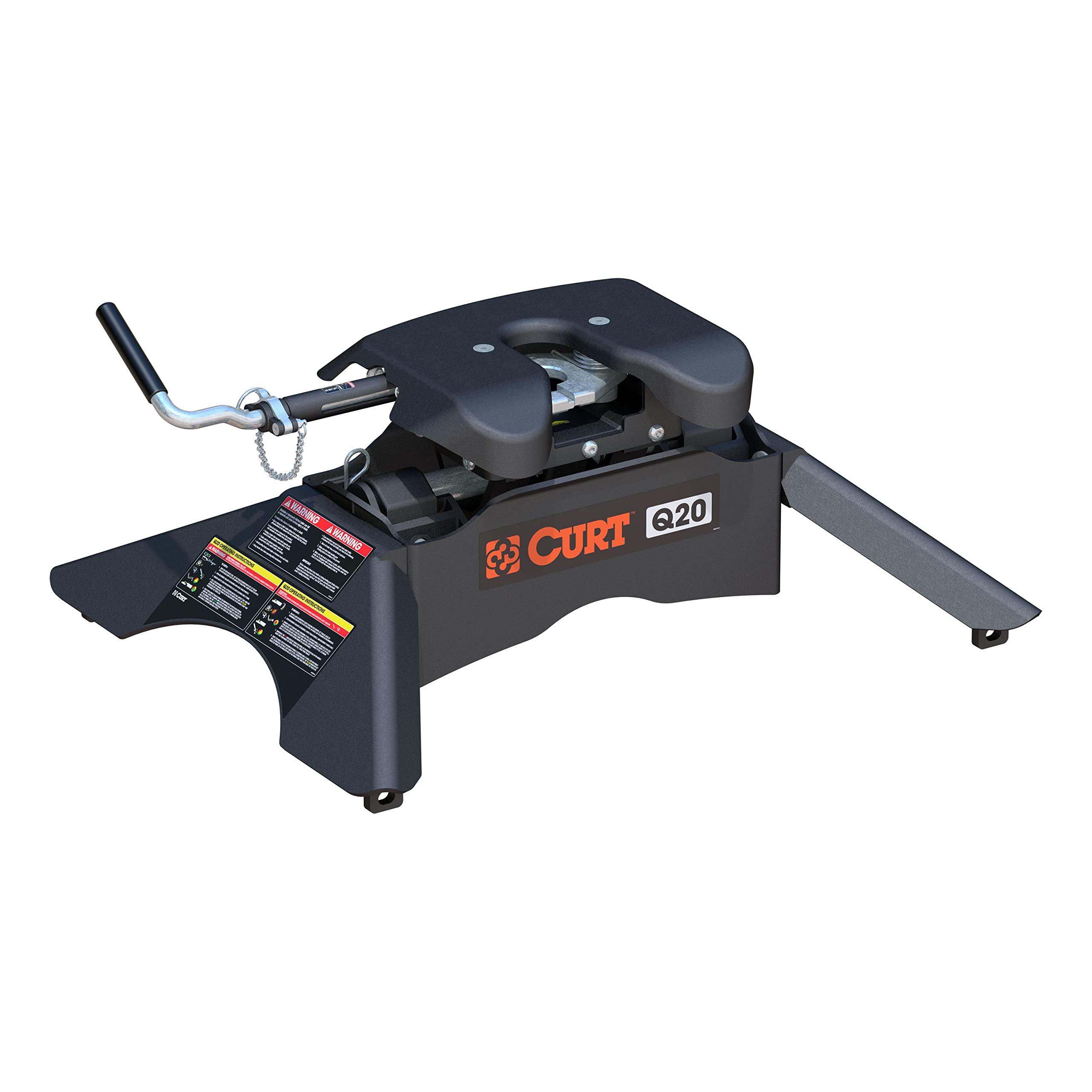
The rail-mounted hitch engineered specifically to keep your trailer from banging.
If the noise is what bothers you most about towing, this is the one to study. A spherical axial bearing lets the head tilt in any direction it needs, which is the mechanical reason this hitch runs quiet instead of clunking through every bump. It is rated 20,000 lb gross trailer weight and 5,000 lb vertical load, and tested to SAE J2638 specs — a published industry standard for fifth wheel hitch strength.
Three details separate it from a plain slider. A 3-position indicator shows at a glance whether you are coupled, uncoupled, or ready to tow, which removes the walk-around guesswork. The single short-throw handle is lockable, so nobody can walk up and release your trailer in a parking lot. And it drops into any industry-standard 5th wheel base rails, so it is not tied to one truck brand the way a puck-specific unit is.
One limitation belongs in the fine print: this hitch is not compatible with articulating or turret-style pin boxes such as Rota-Flex and Sidewinder. If your trailer runs one of those, you need a different design. Owners also note the durability picture is mixed — a handful of experiences suggest keeping an eye on wear over the long haul.
What stands out: the coupling indicator and the lockable handle together make hooking up safer and less stressful than a bare-bones slider.
The fine print: turret-style pin boxes like Rota-Flex and Sidewinder will not work with this hitch — check your pin box before ordering.
Pick it when: you want a quiet, indicator-equipped rail hitch and your trailer runs a standard pin box.
Pass if: your trailer has an articulating pin box, because this hitch will not accept it.
5. CURT 16600 CrossWing Lightweight 5th Wheel Hitch, 20,000 lbs

A 20,000 lb hitch with a 60 lb main body that one person can handle.
This is the answer for anyone who has given up on pulling a heavy slider out of the bed alone. The main body weighs just 60 lb, and the hitch’s strategic grip points are placed so one person can install it without a helper. It still carries a 20,000 lb rating and is tested to SAE J2638 specs, built from steel rather than aluminum to hold that capacity.
ShockDrop technology is the comfort story — a cushioned isolator absorbs the jerking, jarring and rattling that otherwise travels up through the truck frame. Coupling is deliberately simple, with a visible contact surface and a head channel that guides the kingpin into place, so you are not guessing whether the pin is seated. It fits industry-standard rails and, per the specs, will not fit X5.
The trade-off is honest. A few owners mention a jerky feel in certain towing conditions, and one noted rough separation at unhitching. That is a minority experience against the broader pattern of buyers who find it easy to install, easy to remove, and solid on the road. If you have a heavy trailer and tow long distances, the bigger auto-sliders still deserve a look.
what separates it: you can lift this hitch alone, yet it still handles a 20,000 lb trailer weight rating — a rare mix in this category.
The trade-off: ride quality is not universally praised — a minority note jerking that the heavier steel sliders do not have.
Worth it for: the solo tower who wants full capacity without calling a friend to help lift.
Consider a heavier slider if: a jerky ride would bother you more than the lifting does.
6. CURT 16602 CrossWing Lightweight 5th Wheel Hitch

The CrossWing for trucks that already have a gooseneck ball in the bed.
If you already run a gooseneck hitch, this is the version of the CrossWing that saves you from adding rails. It mounts over a standard-height 2-5/16 inch gooseneck ball and is compatible with CURT OEM-style, Double Lock EZr and B&W gooseneck hitches, so it slots into a setup many trucks already have. The 20,000 lb rating and SAE J2638 testing match the rail version above.
The main body weighs 70 lb, and the same ShockDrop cushioned isolator and visible-contact coupling system carry over, so hooking up stays a one-person job. One owner reports eight months of towing a 40 ft fifth wheel with no issues. The head channel still guides the kingpin into place, which is the feature that matters most when you are backing up alone.
There is one thing to know about how this design behaves. It wants you reasonably straight when re-hitching, and on genuinely unlevel ground you may need to reposition the truck to line things up. The manufacturer’s own guidance reportedly points to flat ground and RV park situations. Also note the gooseneck ball style can allow some twist under certain driving conditions.
The case for it: gooseneck-ball mounting means no rail kit purchase and no drilling, and 70 lb is manageable solo.
One behavior to expect: re-hitching on a slope can take a little repositioning of the truck.
Choose this if: your truck already has a compatible gooseneck ball and you want to skip rails entirely.
Choose the rail version instead if: you want the CrossWing on a truck with no gooseneck setup.
7. Andersen Hitches Rail Mount Hitch Kit 3200

Forty-five pounds, a remote release cable, and a five-minute install by yourself.
This is the hitch for the person who is tired of a two-hundred-pound anchor in the bed. At 45 lb, one person can install the kit in under 5 minutes and pull it back out just as fast. It is rated 20,000 lb GTWR and 4,500 lb tongue weight, and it installs onto industry-standard rails in either a long-bed or short-bed truck without any special adapters.
The remote release cable assembly is the feature that changes your routine — you can latch and unlatch without climbing into the bed. Three height positions, 14-7/16 inch, 15-9/16 inch and 16-11/16 inch measured from the top of the rails to the top of the ball mount, let you dial in the trailer attitude you want. Owners consistently call it stronger and quieter than the conventional fifth wheel hitch it replaced, and several praise how the offset lets a standard-bed truck take a tight turn without adding a slider.
The honest caveat is fitment-driven, not a defect. The same offset that clears the cab in a standard bed means some drivers can hook up at an angle without perfect fore-aft alignment, and that takes a little learning. It is also a change of approach if you are coming from a traditional slider, so give yourself a calm first hookup to get used to it.
Where it wins
- 45 lb total weight makes install and removal genuinely a one-person job
- Remote release cable removes the need to climb in and out of the bed
- 20,000 lb GTWR and 4,500 lb tongue weight suit most half-ton and up trucks with rails
- Three height settings from the top of the rails let you set trailer attitude precisely
- Fits industry-standard rails in both long-bed and short-bed trucks
What to plan for
- It behaves differently from a conventional slider, so the first few hookups take adjustment
- Requires a truck that already has industry-standard rails installed
- Light kits are not the answer if you want a heavy steel slider feel
Ideal for: the solo tower who values a five-minute install and a bed that stays usable the rest of the week.
Skip if: you specifically want the weight and heft of a traditional steel slider.
8. PullRite 2600 Superlite Fifth Wheel Hitch

A 130 lb single-point hitch in steel, for people who want the tightest possible connection.
This is the middle ground between the ultra-light alloy hitches and the heavy steel sliders. It is built from high-grade steel, rated 20,000 lb GTW, and weighs 130 lb, which is why owners call it the sturdier gooseneck-to-fifth-wheel option. The tighter connection to the ball is the whole point — a snug fit translates to a smoother, less chucking ride than a looser mount allows.
You can see the hitch from your cab during hookup, so lining up alone is easier. It accepts a 2-5/16 inch ball (the standard gooseneck ball size) and locks securely. The offset adjusts at both the ball and the kingpin adapter (the part that connects to your trailer), letting a 2022 Ram 2500 Megacab with a 6.4 ft bed clear the cab at 90°. One owner towed a 37-foot Keystone Montana 1,800 miles from Bakersfield to South Dakota without a single issue.
Two setup notes to expect. The set screws and bolts need a specific torque sequence, which takes patience and the right tools. And older or non-standard kingpins, such as a Rota-Flex, need the additional PullRite 4446 isolator to work properly. Neither is unusual in this category, but both are worth knowing before install day.
Why it holds its position: single-point visibility plus steel construction is a strong combination for a tower who wants tightness without a slider’s bulk.
One accessory to price in: a Rota-Flex or similar pin box will need the additional 4446 isolator.
Suits you if: you want the security of a steel single-point mount with cab-clearing offset adjustability.
Look at the alloy options if: 130 lb is more hitch than you want to move around.
9. Andersen Hitches Ultimate 5th Wheel Connection 3220-TBX

A 45 lb aluminum hitch rated for 24,000 lb that frees your entire truck bed back up.
Capacity and weight do not usually travel together, but this hitch carries 24,000 lb GTWR and 4,500 lb tongue weight in a 45 lb package. It is the highest-capacity hitch here that one person can move without breaking a sweat. The toolbox model gives you two height settings, 16-1/2 inch and 18-5/16 inch from the bed floor to the top of the ball mount, so it can be tuned to fit most trucks.
A ball funnel design makes hooking up painless — the makers claim it works even if the ball is 3 inches off center, a real convenience when you back in solo. The patented remote latch and unlatch cable means you never climb into the bed to release the trailer. Owners praise the 45 lb weight most of all, with reports of the whole hitch installed in under thirty minutes and removed in around five.
Set your expectations against the bigger steel hitches. It works with all standard brands of gooseneck hitches and pulls cleanly on the road, but a couple of owners note the shipped packaging left it scuffed or with cracked plastic in transit — a delivery issue, not a hitch problem. The more relevant point: it lacks the sheer heft of a heavy steel slider, which is exactly why some heavy-tow buyers prefer the alternative.
The argument for it: 24,000 lb GTWR in 45 lb of aluminum, with a remote latch and a ball funnel that make solo hookup genuinely easy.
A fair note: a heavy steel slider feels more substantial if that is the confidence you are looking for.
Best for: an owner who wants high capacity, light weight, and a bed that goes back to work between trips.
Not for: a buyer who equates heavier with better and wants a substantial steel unit.
10. PullRite 4500 OE Puck Series 24K SuperGlide

Automatic sliding for 2020 and newer GM trucks with the factory puck setup.
This is the serious short-bed solution for a newer GM truck. It mounts directly to the OE puck points, carries a 24,000 lb maximum gross trailer weight and 6,000 lb pin weight, and delivers 14 inches of fully automatic slide. Automatic matters because the hitch moves itself as the trailer pushes against the head during a turn — you never get out to pull a manual release on a tight ramp.
The dual articulating head moves side-to-side and front-to-back, which keeps the trailer level and the ride smoother through dips. Owners describe the puck system as making installation a breeze, and the consensus from GM Sierra HD 3500 drivers is that the hitch simply removes the worry of tight maneuvering. The whole point is that a short bed plus a tight turn no longer ends in cab contact.
One recurring refinement, not a fault, is that releasing the hitch can occasionally take a little patience — the connection is tight by design. That slight stubbornness is the price of the tight tolerances this design relies on, and it is a small trade for automatic sliding. If you have a long bed and no clearance concern, a fixed unit will save you a lot of hitch.
Why it fits a short-bed GM
- 14 inches of fully automatic slide — no manual release to pull on a ramp
- 24,000 lb GTW and 6,000 lb pin weight clear a heavy fifth wheel
- Direct mount to OE puck points eliminates a separate rail kit
- Dual articulating head moves both directions for a smoother ride
- Prevents cab contact on tight turns in a short-bed truck
What to remember
- Occasional release resistance — the fit is intentionally tight
- Truck-specific: designed for 2020 and newer GM puck-style trucks
- Heavier and bulkier than a lightweight single-point hitch
Made for: a 2020-or-newer GM short-bed owner who tows heavy and wants automatic clearance on every turn.
Steer clear if: you already have a fixed hitch and rarely need tight-turn clearance.
11. PullRite 2315 OE Puck Series SuperGlide Hitch 24K for Ram

Eighteen inches of auto slide and removable posts for Ram puck-truck towers.
For a Ram owner running the factory puck system with a short bed, this is the most slide travel on the page — 18 inches of fully automatic slide. It is rated 24,000 lb maximum gross trailer weight and 6,000 lb maximum trailer pin weight, and the mounting post assemblies are completely removable, which makes installing and removing the hitch itself considerably easier than a bolted-in unit. Compare it to the PullRite 4500 above and you get the same 24,000 lb rating with more slide travel.
What makes this hitch popular with short-bed Ram drivers is that it allows well past a 90° angle without the trailer nose reaching the cab — owners describe jackknifing a toy hauler while backing up without any contact. The install is friendly too, with the puck setup and one owner noting a solo install using a wheeled ramp. It is a well-made hitch that hooks and unhooks easily.
Two things you should know. A Capture Plate is required to activate the sliding cam arm, and it is sold separately — budget for that part. And the hitch wants you reasonably straight when you pull out from under the camper; it does not tolerate being off-straight by much. At roughly 300 lb, it also prefers two people to move it in and out, though the factory pucks make the actual mounting much easier.
Where it stands out: 18 inches of automatic slide is the longest travel on this page, which is why short-bed Ram owners keep coming back to it.
Two things to plan for: the required Capture Plate is sold separately, and re-hitching wants you reasonably straight.
Right for: a Ram puck-truck owner with a short bed who tows a big trailer and wants maximum auto-slide clearance.
Consider the 4500 if: you drive a newer GM truck instead of a Ram.
Know the Specs
GTW versus Pin Weight
GTW is the total gross trailer weight the hitch is rated to pull — the trailer plus its cargo. Pin weight is the downward load the trailer tongue presses onto the hitch. A hitch can be strong on one and short on the other, so always check both against your own trailer’s sticker. A good rule of thumb in the towing world is that pin weight runs roughly 15 to 25 percent of gross trailer weight, but confirm the real number on your trailer before you buy.
Slide Travel and Automatic vs Manual
Slide travel is the number of inches the hitch head moves backward when the trailer pushes against it on a turn. More travel means you can turn sharper before the trailer nose reaches your cab. Automatic sliders move themselves as you drive; manual sliders need the driver to pull a release. Automatic is more convenient and safer on a busy ramp, while manual is simpler and less expensive. Fixed hitches have zero travel — they need a long bed to clear the cab on their own.
Common Questions
Will a 5th wheel slider hitch fit my short-bed truck?
What is the difference between an automatic slider and a manual slider?
How do I know how much trailer weight my hitch can handle?
What do I need to make a 5th wheel hitch work without rails?
Can one person install a 5th wheel hitch alone?
Why does my slider hitch need a Capture Plate?
Will a 5th wheel slider hitch work with a Sidewinder or Rota-Flex pin box?
How much slide travel do I actually need for a 6.5 ft truck bed?
Are lightweight 5th wheel hitches as strong as heavy steel ones?
Do I need a slider if I have a long-bed truck?
Which 5th wheel slider hitch is easiest to remove when not towing?
Does the hitch height need to be adjusted after installation?
The Bottom Line
For most towers shopping the 5th wheel slider hitches on this page, the pick that holds up best is the B&W 25K Companion OEM — it pairs a 25,000 lb GTW (gross trailer weight, the most your loaded trailer can weigh) and 6,250 lb VTW (vertical tongue weight, the downward force on your truck) rating with Ford puck fitment (mounts into Ford’s factory under-bed holes) and a reputation for being genuinely well-made. If cab clearance on a short bed is your priority, grab the B&W Companion Slider with its 12 inches of slide travel (it moves the hitch back so your trailer clears the cab). And for the tower who wants to lift the hitch out alone, the Andersen Rail Mount 3200 at 45 lb is the one to reach for. Match your GTW and pin weight to your trailer first, and the rest of the decision falls into place.
How we choose
We do not accept paid placement. Every pick is matched to a real buyer and a real use-case; we do not hands-on test units.
Sources
Specifications: manufacturer listings and product documentation. Review insights: verified customer reviews, as of October 2026. Pricing: not shown on this page (it changes often); check the current price via the retailer link.
As an Amazon Associate, Aappliancez earns from qualifying purchases. This does not affect which products we feature.