Disclosure: Some links in this post are affiliate links. As an Amazon Associate I earn from qualifying purchases, at no extra cost to you. Learn more
Specs are compiled from manufacturer listings and verified buyer reviews and can change over time — please confirm the key details on the product page before buying.
If your only wired option is a sluggish DSL line or a satellite dish that quits in the rain, a 5G router turns a cellular signal into a normal Wi-Fi network for your whole house. The trick is picking one that supports your carrier’s bands and holds a connection, because a 3.4 Gbps router that drops every few hours is worse than the slow line you already have. This guide covers nine models, sorted by carrier support, band coverage and antenna options.
This guide is built by comparing the manufacturers’ published specifications and the patterns across verified customer reviews, so you get each pick’s real strengths and trade-offs instead of marketing spin.
You will learn which specs actually change your daily speeds, which carriers each box officially supports, and which models need a separate access point or a firmware update. The crowd favorite here holds 4.0+ stars across 800+ owners and earns the top slot on the strength of its rural signal handling. Read on for the best 5g router picks broken down by who each one genuinely suits.
Top Picks

How To Choose The Best 5G Router
A 5G router is not a plug-in-and-forget box like the one your cable company hands over. It pulls a cellular signal through a SIM card (the small chip that carries your mobile plan) and rebroadcasts it as Wi-Fi. So two things decide whether you are happy: the bands (the radio frequencies) your carrier uses, and how strong the signal is where the router will sit. Get those right and the rest is detail.
Match the router to your carrier’s bands first
Every carrier broadcasts on specific frequency bands, and a router only talks to the ones it supports. The MoFi MOFI4500, for example, lists LTE bands 2, 4, 5, 12, 13, 14, 17, 66 and 71 — that band list is the first thing to check against your carrier’s coverage map. If your carrier’s main band is not on the list, the router will fall back to something slower or never connect at all.
Decide if you need 5G or just fast 4G
5G is not available everywhere, and a solid 4G LTE connection often beats a weak 5G one. Look at whether the router handles both standalone (SA) and non-standalone (NSA) 5G, since carriers are rolling these out at different paces. A router that falls back to 4G LTE cleanly will keep you online when 5G coverage thins out.
Check the port and antenna options
Gigabit LAN ports matter if you have a desktop, a NAS or a gaming console that wants a wire. Detachable antennas with SMA connectors let you plug in a high-gain outdoor antenna later — the single most effective fix for a weak rural signal. A router with fixed internal antennas locks you into whatever reception you get on day one.
Side-by-Side Comparison
| Model | Best For | Rated Top Speed | Wi-Fi Standard | SIM Setup | Amazon |
|---|---|---|---|---|---|
| MoFi MOFI4500★ Best Overall | Rural homes on 4G LTE | 4G LTE (bands 2,4,5,12,13,14,17,66,71) | Single-band 2.4 GHz | Single SIM | Amazon |
| Hitron D60Failover Ready | Failover backup for a home office | Up to 3.4 Gbps on 5G NSA | Wi-Fi 6, dual-band | Nano SIM + eSIM | Amazon |
| RM520N AX3000Signal Searcher | Metal buildings and weak-signal spots | Up to 3.4 Gbps | Wi-Fi 6, dual-band | Single SIM | Amazon |
| UOTEK 5G CPE | Homes wanting 8 antennas on a budget | Up to 1800 Mbps | Wi-Fi 6, dual-band | Single SIM | Amazon |
| Cudy P5 | Always-on business continuity | Up to 3.4 Gbps | Wi-Fi 6, dual-band | Dual Nano SIM | Amazon |
| GL.iNet GL-X3000 | RV and remote-work power users | Up to 3000 Mbps | Wi-Fi 6, dual-band | Dual-SIM (single standby) | Amazon |
| TravlFi XTR Pro | Full-time RVers who hate contracts | Up to 3.6 Gbps motor-rated | Wi-Fi, dual-band | No SIM needed | Amazon |
| Winegard Gateway | RV owners with an Air 360+ dome | Up to 2000 Mbps | 802.11ac, dual-band | Dual SIM | Amazon |
| MoFi MOFI6500-5GXeLTE | Business-grade dual SIM failover | Up to 3.4 Gbps | Wi-Fi 6, dual-band | Dual SIM with auto failover | Amazon |
Detailed Reviews
1. MoFi Cellular Routers – 4G LTE & 5G WiFi Router (MOFI4500)
Our pick — 4.0+★ from 850+ verified ratings; the strongest balance of quality and price.
The rural workhorse that turns one bar into four with a bolt-on antenna.
The MOFI4500 is the pick that most rural buyers end up with, and its most important feature is the band list: LTE bands 2, 4, 5, 12, 13, 14, 17, 66 and 71. That list is deep enough to ride on major U.S. carriers like AT&T, T-Mobile and Verizon — as long as your device is carrier-open up. Two MOFI-UWMB-MAXRANGE1 upgraded cellular antennas come in the box, which means you are not starting from the cheapest possible radio hardware.
What wins people over is how fast the box gets out of the way of your day. The wizard gets a connection running in minutes, and the software underneath is a full Linux build with configuration depth that grows with you. It is also built for vehicles — it can run under trees and in motion, and it fails only when there is simply no cell tower within reach. Buyers who added a yagi antenna reported the signal jumping from 1 bar to 4 bars, with strong Wi-Fi reaching both buildings on a two-building rural property.
The catch is that the default Wi-Fi antennas are the weakest part of the package. Several owners describe video buffering on Netflix and similar services until they added a separate access point (a second Wi-Fi box that spreads the signal). Plan for that if you stream a lot. The other honest note is that a single SIM means no automatic carrier failover (no backup network that kicks in if yours drops) — this is the box for someone on one carrier in a spot with at least a whisper of signal, not for someone who needs redundancy. At 4.0+ stars across 800+ owners, nearly everyone ends up happy with it.
What earns it the top slot
- Nine LTE bands cover the major U.S. carriers, so a rural or mobile install usually has something to lock onto
- Two upgraded MOFI antennas ship in the box instead of being an upsell
- Minute-long wizard setup that even a first-timer can follow, with expert-grade Linux depth underneath
- Built-in wireless repeater mode extends coverage for outbuildings or a travel trailer
What to know before you buy
- Default Wi-Fi antennas show their limits on heavy video streaming
- Single SIM, so no automatic carrier failover like the Cudy P5 below offers
- 2.4 GHz single-band Wi-Fi means no separate 5 GHz lane for modern devices
Reach for this if: you live outside cable reach on one carrier and want a well-supported box with a deep band list and room to grow.
Look elsewhere if: you need two carriers switching automatically, or you stream heavily and do not want to add a separate access point.
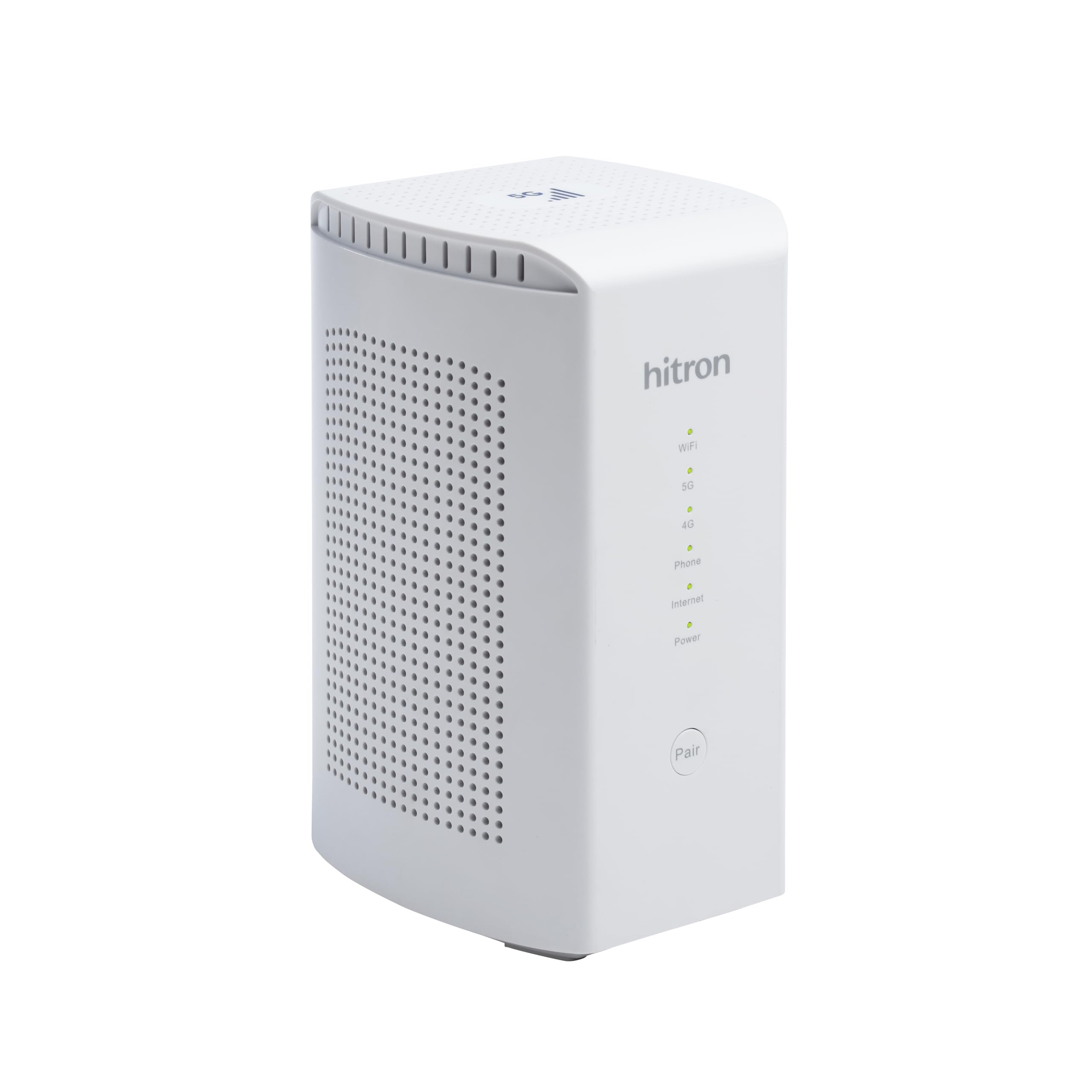
2. Hitron D60 5G Cellular Router
A quiet insurance policy for the home office that only speaks up when your main line dies.
The D60’s headline number is 3.4 Gbps on 5G NSA — the download ceiling the manufacturer lists, which in the real world translates into fast enough streaming and quick file transfers. It is certified to work with T-Mobile, AT&T and US Cellular, and it ships with both nano SIM and eSIM support. That eSIM option is a practical convenience: you can provision service without hunting down a physical card.
Where it shines is as a backup link. The cellular fail-over capability is built for residential and small-office users who cannot afford downtime, and the box switches over automatically when your wired WAN drops. Owners describe it as genuinely plug-and-play — the recurring theme is that it is up and running in less than five minutes with strong speeds right after setup. Speed is the aspect owners praise most, and the low latency for 5G gets noticed next to slower competitors like GL.iNet’s offering.
The honest limit is what happens after the first few days. A few units are reported to run for 6 to 48 hours and then crash with only the power LED lit, staying solid only on first boot or after a factory reset. There is also a sleep-mode quirk: left with no devices connected, it can go dark and need a power cycle to wake. Given a 3-month limited warranty, that table warranty is short relative to what you pay for the hardware — reserve this one for failover duty rather than as your only internet source.
Where it earns its keep: a certified, auto-switching backup line for a home office or small shop — the WiFi 6 radios (the newer, faster Wi-Fi standard) and 4×4 5 GHz MIMO (four antennas sending and receiving on the 5 GHz band) pull serious throughput when it is awake, so a full workday of video calls and uploads keeps moving. The eSIM (a digital SIM built into the box) means fewer trips to a store for a card.
The honest caveat: long-run stability is the mixed report here, so keep a spare power-cycle habit handy and treat it as a second line rather than your sole lifeline.
Choose this when: you already have decent cable or fiber and want a cellular safety net for outages.
Think twice if: you need a 24/7 primary router with weeks of unattended uptime.
3. RM520N AX3000 WiFi 6 Modem 5G Router with SIM Card Slot
Nine antennas and a Qualcomm SDX62 modem built for the metal shed where your phone shows nothing.
The spec sheet here is genuinely unusual: nine detachable high-gain antennas, split four 5dBi cellular and five 5dBi Wi-Fi. That matters because a metal building blocks the indoor signal your phone relies on, and a router with external antennas can reach out through a wall or a roof where an internal-antenna box cannot. The Qualcomm SDX62 modem inside supports 5G NR SA and NSA, and the Wi-Fi 6 radios split into 574 Mbps on 2.4 GHz and 2402 Mbps on 5 GHz for up to 128 simultaneous users.
In a weak-signal space, the numbers move in a way that is hard to argue with. Buyers report the RM520N lifting an existing setup from 10/1 Mbps down/up to 150/50 Mbps — that is the difference between a stuttering video call and a real work session. One owner in a metal building described the router pulling 80-100 Mbps with the door closed, versus near-zero phone signal inside the same structure. The 10 Gbps LAN port bandwidth and 3400 Mbps listed data rate give you plenty of headroom if the network ever feeds a NAS or a server.
The trouble is polish. Setup is not always frictionless — one buyer found the band-lock menu missing until a few factory resets, and another lost both settings and speeds after experimenting with 5G mode selection. There are also reports of a dead-on-arrival power adapter and a bent antenna case, so open the box and test the hardware within the return window. Some interface pop-ups appear in Chinese, though the menu itself is English.
Strongest case for it: the nine-antenna array with SMA connectors for an outdoor cellular antenna makes it one of the few picks that can genuinely rescue a metal-building or deep-rural install without extra hardware.
Fair warning: this is a diy-friendly box for someone comfortable in a settings menu, not a set-and-forget appliance.
This one belongs in: a workshop, barn, or metal-sided house where the priority is fighting for signal, not hand-holding the interface.
Pass it over if: you want a first-minute setup with zero menu work.
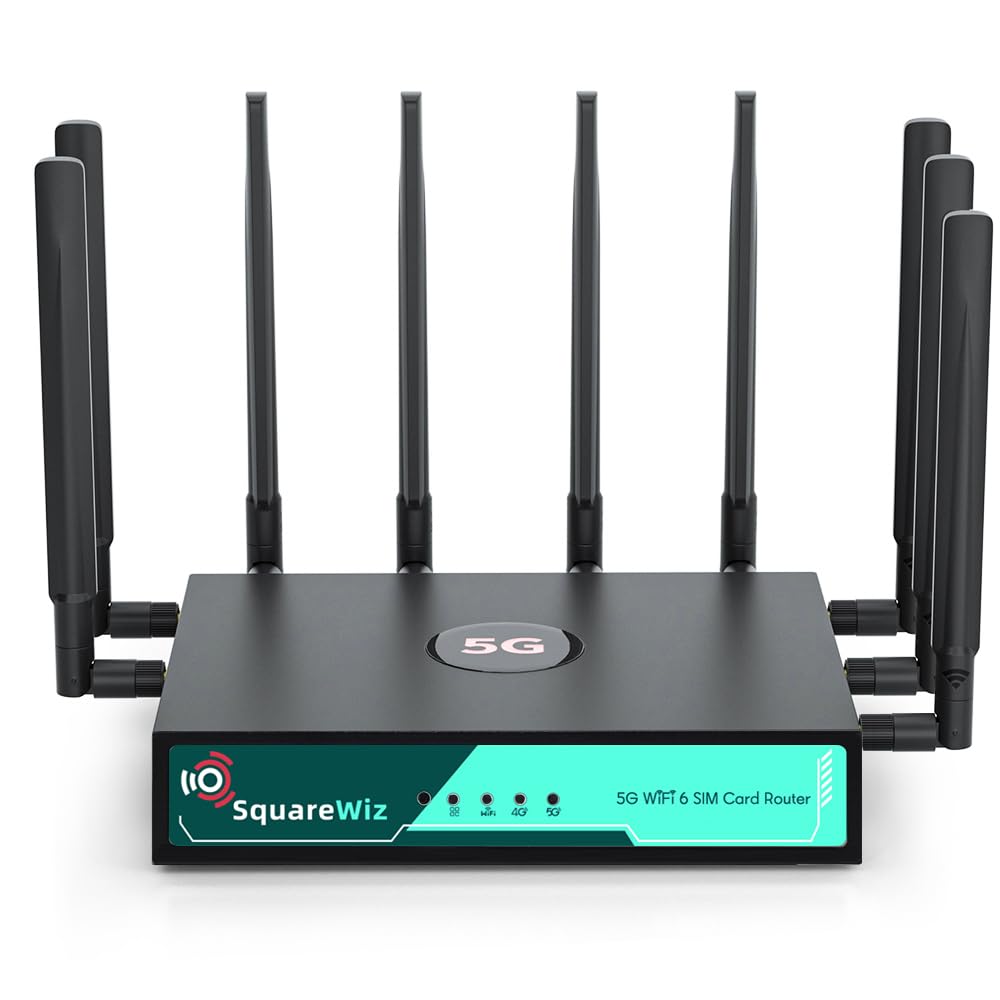
4. UOTEK 5G SIM Card Router CPE

Eight antennas on the outside, a proper Wi-Fi 6 engine on the inside, and an appetite for a fight over signal.
Count the antennas first — this UOTEK carries up to eight external ones, split four cellular and four 5G. That is an unusually tall stack for the class, and it explains why this box tends to outperform smaller routers in a tricky signal spot. The Wi-Fi 6 (802.11ax) radios with OFDMA and DL MU-MIMO let several devices send and receive in parallel, which keeps a busy house from choking on one heavy stream. Dual frequency with four spatial streams tops out at 1800 Mbps of bandwidth.
What buyers tend to notice first is the speed — 5G for downloads and LTE for uploads in one setup, with performance that keeps pace in the area’s most difficult signal pockets. One owner in a difficult signal area recorded around 200 Mbps consistently, and after switching from NSA to SA mode picked up both the n41 and n25 bands, with ping in the 15-25ms range. That kind of control over which bands you lock is what a serious rural or RV install wants.
The friction points are real but narrow. The manual is poor — you will not find the default IP or the admin password printed clearly, and the setup wizard assumes some comfort with router menus. A bug in the firmware means enabling HTTPS management can lock the web interface until a factory reset. Update firmware early and you avoid the worst of it.
The best fit is: a tinkerer in a signal-challenged home or RV who wants a large antenna array and band-lock control at a mid-range price.
The reason to hesitate: limited support responsiveness and thin documentation mean you should be comfortable fixing your own interface issues.
5. Cudy P5 5G AX3000 Router

Two SIM trays and a failover ladder, for the shop that cannot afford a dead afternoon.
Failover is the whole story here. The Cudy P5 runs a Qualcomm X62 modem rated to 3.4 Gbps and pairs it with two Nano SIM slots, so you can switch providers or keep a backup line live on a second network. The triple failover covers WAN, Cellular1 and Cellular2, which means the router keeps the internet alive when the primary connection falls over. That means a shop keeps its internet when the primary connection falls over.
The rest of the hardware backs up the failover claim: Wi-Fi 6 at 2402 Mbps on 5 GHz, four detachable SMA antennas, and one configurable WAN/LAN port plus three LAN ports. Wi-Fi 6 delivers 2402 Mbps on the 5 GHz band plus 574 Mbps on 2.4 GHz, and four detachable SMA cellular antennas let you swap to high-gain externals if your spot is weak. You get one configurable WAN/LAN port plus three LAN ports, wall-mount or desktop install, a power switch, and the Cudy App for cloud management with parental controls and WPA3 security. The 2976 Mbps listed data rate and dual-band class line up with the rest of the spec. Owners who use it for port forwarding with a business SIM describe nine months of daily running with no dropouts — set it and leave it.
The honest trade-offs sit in edge cases. The design is bulky and the antennas stick out, so it is not the prettier box on the shelf. There is a known bug where enabling HTTPS management can freeze the web interface until a factory reset. And one buyer on a business line with a static IP could not get it to connect until the carrier removed the static IP — worth knowing if your plan is unusual. Speed on a Verizon tablet SIM lands at 40-60 Mbps down, solid but not spectacular.
Why it holds its spot: two SIM slots and three failover paths are rare in one box, and the app plus WPA3 give you a manageable always-on network.
The thing to plan for: a static-IP business line can be a headache on first setup, and the appearance is utilitarian.
Buy this if: uptime is the point — a shop, a remote office, or a travel setup that cannot tolerate a single carrier outage.
Keep looking if: you want the smallest, cleanest box on the shelf or you rarely lose a connection.
6. GL.iNet GL-X3000 (Spitz AX) Cellular Gateway 5G Router

The RV veteran’s choice — a configurable little gateway that keeps a full-time rig online across two carriers.
The GL-X3000 is a Wi-Fi 6 router first: 574 Mbps on 2.4 GHz and 2402 Mbps on 5 GHz, with MU-MIMO so several devices can pull data at once. It supports 5G NR in both NSA and SA modes, falls back to 4G LTE and 3G, and is certified for AT&T and T-Mobile. Six detachable antennas and dual SIM slots with single standby handle the mobile case — you pick whichever carrier is stronger and the router fails over to the other if that one drops.
Where this box separates itself is the software. It runs OpenWrt v21.02 (an open-source router operating system) with more than 5,000 ready-made plug-ins, so a tinkerer can tune it exactly to preference, and the no-code admin panel keeps the basics simple. VPN tunnelling (a private, encrypted connection) is pre-installed with WireGuard and OpenVPN supporting 30+ services, and you can read max VPN speed at 150 Mbps on OpenVPN or 300 Mbps on WireGuard — enough for remote work on a secure tunnel. In practice, full-time RVers describe dual-SIM switching, all-band 5G, Wi-Fi 6 and 300+ Mbps down, staying above 90 Mbps even during the busy hour, so a workday of calls and uploads holds up when the campground fills. The SMA connectors (the screw-on antenna ports) let you add an external antenna when the campground signal is weak.
Two things to weigh honestly. The quality build earns the most praise, but long-run reliability draws negative feedback — some users report the unit dying well inside a couple of years, which makes the included 2-year warranty a comfort. Speed is mixed by band: some owners see congestion-based slowdowns on deprioritized plans, and one described only two-band aggregation on some configurations. If your carrier de-prioritizes you at peak, no router fixes that.
What road warriors love
- Dual SIM with automatic failover keeps the rig online when one carrier drops
- Six detachable antennas and an SMA port for an external dome antenna
- OpenWrt v21.02 with 5,000+ plug-ins for full customization
- Certified for AT&T and T-Mobile; works with 4G LTE and 3G fallbacks
Where it asks patience
- Reliability is the honest worry — a 2-year warranty is welcome but not everyone gets that far
- Carrier deprioritization effects speeds at peak times regardless of router quality
- Speed on some bands is capped by 2-band carrier aggregation
The natural owner is: a full-time RVer or remote worker who needs one router across two carriers and does not mind the odd reboot.
Reconsider if: you need plug-and-forget simplicity with no software tuning.
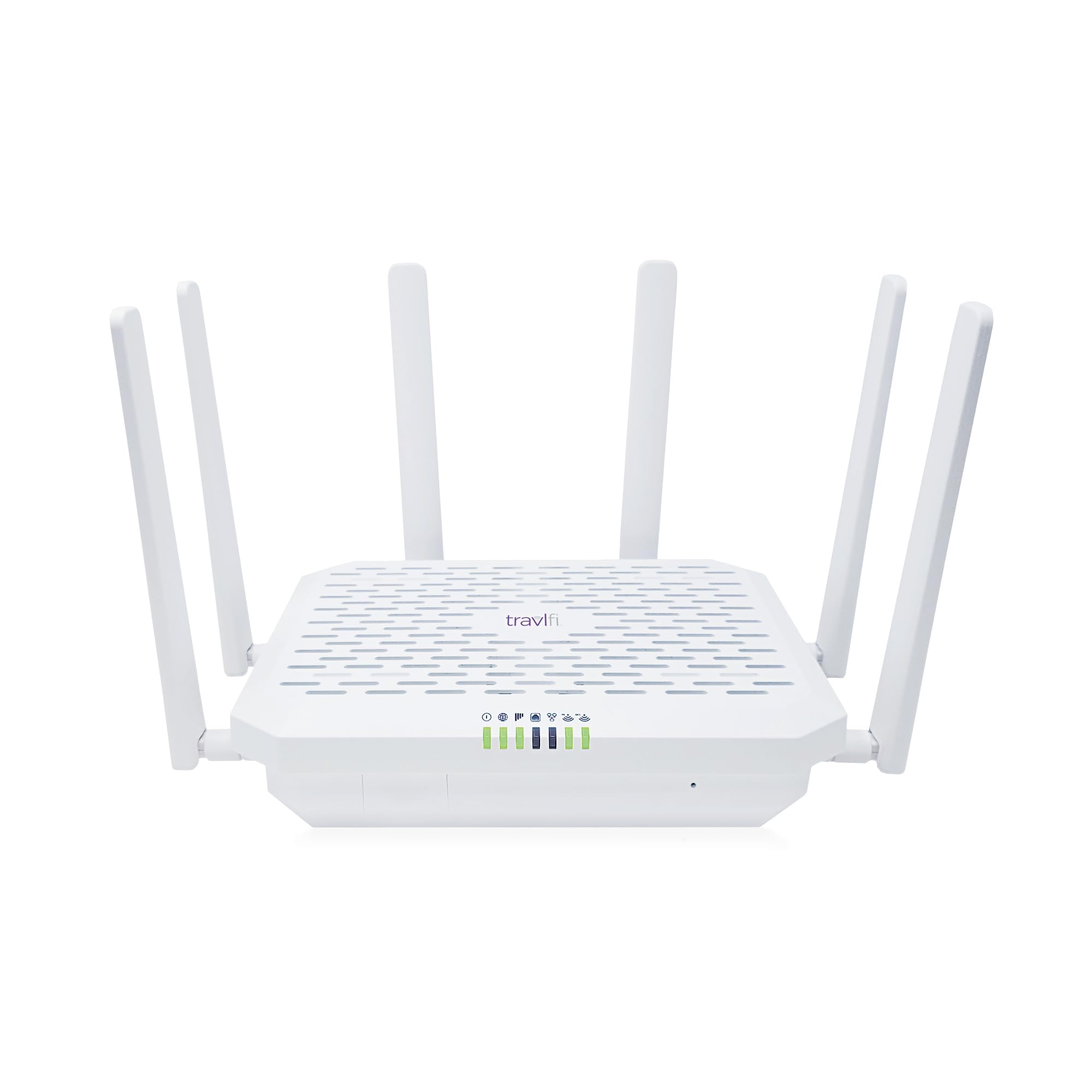
7. TravlFi XTR Pro 5G RV Router, Unlimited Data, No Contract
One plan, several networks, zero contracts — the roaming rig with the simplest billing.
The feature that defines the XTR Pro is that there is no SIM to insert. TravlFi (the built-in service that picks a network for you) handles the multi-network selection, picking the strongest signal across several major networks and falling back to 4G LTE (the older, slower cellular standard) when 5G isn’t there. The 5G speeds are listed up to 200 Mbps, and unlimited data with no cap sits at the heart of the pitch. Pay-as-you-go billing means you prepay a month at a time and can pause the service without a fee — that is a real advantage for a seasonal camper who does not want to pay for January in a cold garage.
As a piece of hardware, owners mention it works better than home internet in some rural buildings. Speeds of 200 Mbps down and 30 Mbps up get reported in the review pages, and signal quality is one of the top things owners highlight — connection stays solid even in low-bandwidth environments. RVers who switched over from Starlink due to obstruction issues describe the three-SIM approach always connecting, with 90-120 Mbps down and 15-30 up on a typical day.
The main uncertainty is coverage. Not every location treats this box equally, and one motorhome owner found reception terrible in every spot they tried and returned to Starlink. That is a coverage problem rather than a hardware defect — if you camp in fixed spots, check the service map for the ones you plan to visit. The other consideration is that the subscription never stops, so the value depends on how many months you are actually on the road.
The winning convenience: no SIM, no contract, and one plan that leans on several networks to fill in the gaps — pause any month you are not travelling and stop paying.
The honest limit: if the networks TravlFi picks are weak in your particular region, you are paying for a subscription that cannot help you.
Good for: the seasonal RVer who wants one bill and no contract, and who will not mind paying per month of actual use.
skip it if: you camp the same spot for months at a time and could solve the same problem with a cheaper fixed SIM.
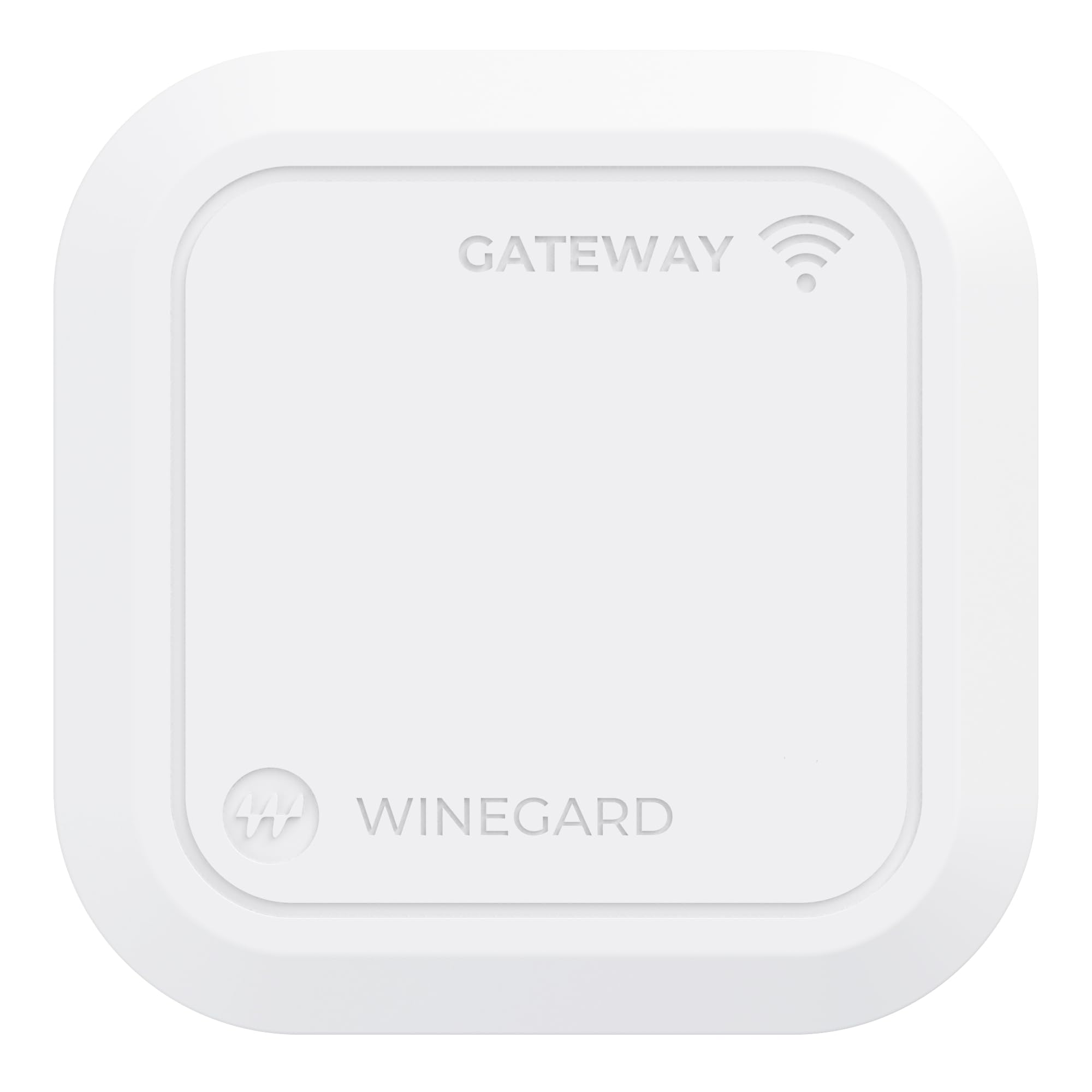
8. Winegard Gateway Ceiling Router for RV
A ceiling-mounted add-on for one specific crowd — the one already carrying a Winegard Air 360+ dome.
The Gateway is not a standalone router. It is a 5G modem built to pair with the Winegard Air 360+ 5G roof antenna, so its coverage figure of up to about a third of a mile depends entirely on the dome on your roof. Dual-band Wi-Fi (802.11ac on 2.4 GHz and 5 GHz) runs the local network, and Ethernet WAN lets you add Starlink or another satellite feed alongside the cellular signal. The listed data rate is 2000 Mbps.
The value comes from pairing with the Air 360+ dome, which is what sets its coverage. Dual SIM makes it easy to switch carriers, and the FreedomGo SIM included with the box gets you onto the AT&T network through Winegard’s plan. Owners who already had the dome describe it as a large step up from the prior 4G version and even from a phone hotspot, holding a weak Verizon signal where other hotspots give out. That is the win here — a ceiling-mounted modem that uses the Air 360+ dome you already have instead of a second roof antenna.
The reason to hesitate is that the same integration is also the friction point. Installation goes well for some and less well for others, so the setup steps are the most-discussed subject on the review pages. Compatibility draws mixed reports too: one owner got it working only with a proper mobile data hotspot plan, not a T-Mobile home internet SIM. And several owners question the value versus what else is on the same shelf, mainly because the setup assumes network-savvy help and the router does not work cleanly without it. Owners also consistently wish for a physical on/off switch — during troubleshooting, the power cycling gets old fast.
Buy it if: you already have a Winegard Air 360+ dome on the RV and want the matching 5G modem with a clean ceiling install.
pass on it if: you are starting from a bare RV or do not want to pay for the accompanying dome.
9. MOFINETWORK MOFI6500-5GXeLTE-RM520-HP Router
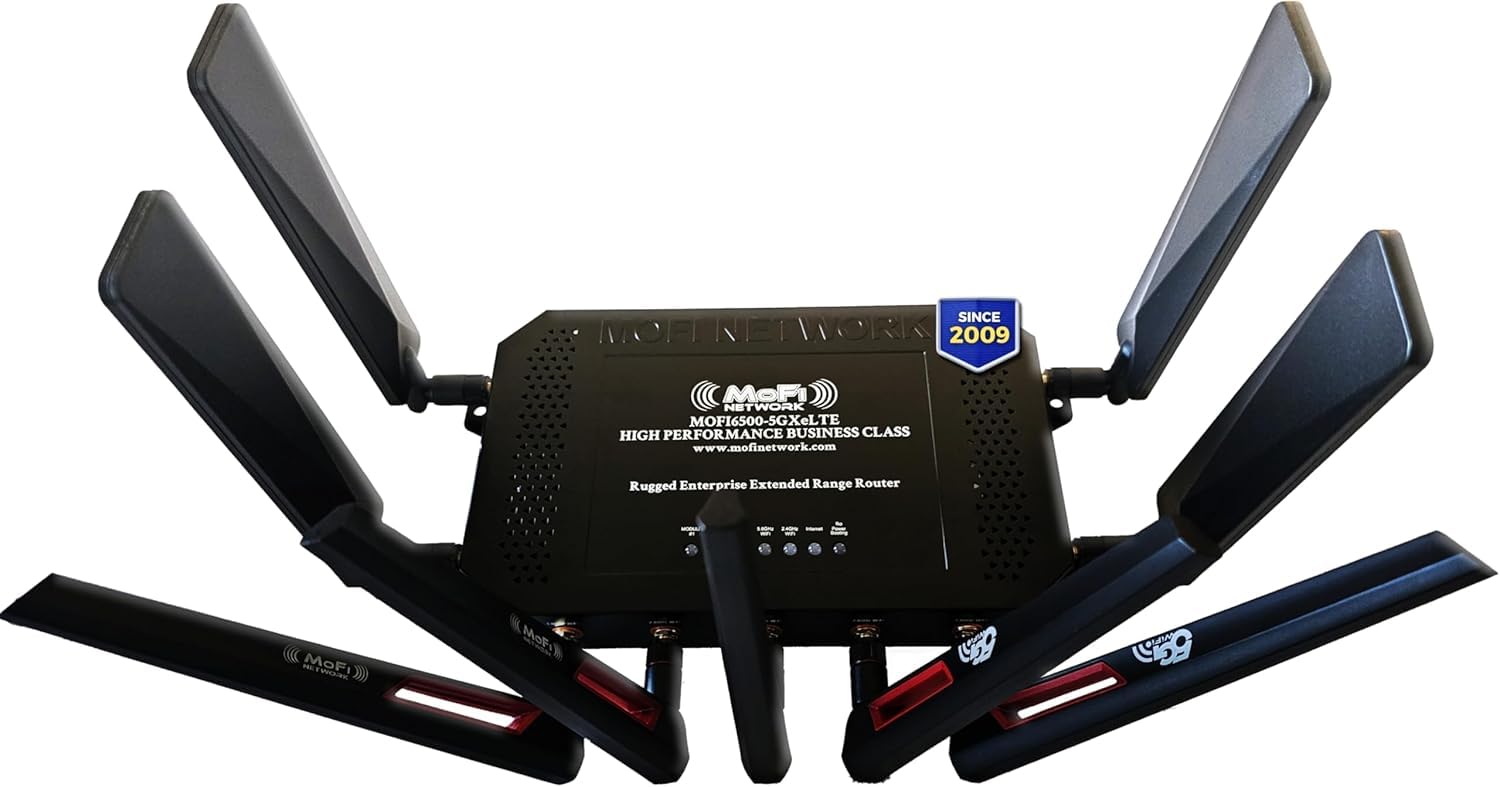
The dual-SIM upgrade of the MOFI4500 — same workhorse, now with automatic carrier switching.
Where the MOFI4500 sticks to a single SIM, this MOFI6500 adds dual SIM support with automatic failover (a second SIM takes over if the first network drops) so a dropped network switches over without a human involved. The 5G side is rated up to 3.4 Gbps, and Wi-Fi 6 delivers the strong range with internal signal amplification. A full metal case plus detachable antennas means the box runs cooler and lives longer than a plastic one, and the hardware package in the box is complete — a 10-foot CAT6E Ethernet cable, a certified power adapter, four 5G cellular antennas and five Wi-Fi antennas.
Business features separate this model from a consumer box. IP pass-through (letting a device take the public address directly), failover support, band lock (pinning the router to one frequency), VPN compatibility and Zerotier certified connectivity are all on board for enterprise-grade performance. Tech support is available by toll-free phone, which is a real differentiator in this category. The performance many owners describe lands close to the 4G LTE version — up and running in about two minutes with the wizard, expert-grade Linux depth underneath, and the same rural workhorse behaviour with strong signal and a solid build that replaced a home ISP on a 5G plan.
The fine print on dual SIM is worth reading carefully. This model does failover, not simultaneous dual-SIM — one SIM is active at a time. If you want two SIMs truly live at once, you would need to seek out the specific MOFI6500 DUAL variant. The vendor’s own documentation on this has been described as unclear, so call the support line before you buy if simultaneous dual SIM is what you need. Otherwise, this is the cleaner-built, better-supported version of the rural 5G workhorse, and it lives up to the same crowd that already loves the 4500.
Where this box wins
- Dual SIM with automatic failover for continuous connectivity
- Metal case with internal Wi-Fi 6 amplification and detachable antennas
- Band lock, IP pass-through, VPN and Zerotier certified for business use
- Complete accessory pack — all antennas and cabling included
Read the fine print
- Dual SIM is failover only — not simultaneous; check the DUAL variant if that matters
- The price sits at the higher end of the range here, so this is a deliberate step up
- Default Wi-Fi antennas on the family have shown streaming limits without an outdoor boost
The right buyer is: someone who was already set on a MOFI workhorse but wants the metal case, dual SIM failover, and a phone line you can actually call.
Better fit elsewhere if: you need true simultaneous dual SIM — that is a specific variant, not this one.
Know the Specs
LTE and 5G bands
Bands are the individual frequency slices a carrier broadcasts on, and a 5G router can only use the ones it lists. A model like the MOFI4500 lists LTE bands 2, 4, 5, 12, 13, 14, 17, 66 and 71; if your carrier’s main band is missing from that list, the router will fall back to something slower. Check your carrier’s band list before you fall in love with a router’s speed number.
Standalone vs non-standalone 5G
SA (standalone) is a 5G network running on its own, while NSA (non-standalone) borrows a 4G LTE anchor for control. Carriers tend to roll these out at different speeds, so a router that handles both keeps working as your local network upgrades. Models from Cudy, Hitron, GL.iNet and RM520N all specify SA and NSA support.
SIM failover and dual SIM
Dual SIM lets a router hold two carrier cards so it can switch when one drops. Pay attention to whether the second slot is failover-only (one active at a time) or truly simultaneous — they mean very different things. The Cudy P5 and the GL-X3000 both offer failover, while the MOFI6500 line offers it on this model but reserves true simultaneous operation for a specific dual variant.
Signal amplification and antennas
The router’s antenna setup determines how much of a weak outdoor signal it can scrape up. Detachable SMA antennas let you plug in a high-gain outdoor dome or yagi for a real-world boost, and the RM520N takes that furthest with nine antennas. Wi-Fi 6 on top handles the local network load, with a split of up to 2402 Mbps on 5 GHz and 574 Mbps on 2.4 GHz on models like the Cudy P5 and GL-X3000.
Common Questions
Will a 5G router work with my existing carrier SIM?
Do I need a 5G router or is a 4G LTE router enough?
Can I use a 5G router as a backup for my cable internet?
How strong does the cellular signal need to be?
Can I add an outdoor antenna to these routers?
What is the difference between dual SIM failover and simultaneous dual SIM?
Do I need a contract with TravlFi XTR Pro?
Can I add Starlink or a satellite feed to these routers?
Will it work with a T-Mobile home internet SIM?
How long does one of these routers last?
The Bottom Line
The best 5g router overall is the MoFi MOFI4500, and the reason is simple: nine LTE bands, two upgraded antennas in the box, and a software platform that stays useful years after setup. It handles the messy rural reality most 5G buyers actually face. If you need a backup line that switches over automatically when cable dies, the Cudy P5 is worth the step up for its two SIM slots and triple failover. And if the router is going in an RV that crosses between carriers, the GL.iNet GL-X3000 gives you the cleanest dual-SIM mobile setup.
Here is the honest nudge: most of the models on this list work, but the ones that work with the least fuss are the ones with the deepest carrier certification and the most complete antenna package. Spend your research time on the band list and the plan you intend to use — those two choices, more than any spec on the box, decide whether your 5G router feels like an upgrade or an experiment.
How we choose
We do not accept paid placement. Every pick is matched to a real buyer and a real use-case; we do not hands-on test units.
Sources
Specifications: manufacturer listings and product documentation. Review insights: verified customer reviews, as of October 2026. Pricing: not shown on this page (it changes often); check the current price via the retailer link.
As an Amazon Associate, Aappliancez earns from qualifying purchases. This does not affect which products we feature.