Disclosure: Some links in this post are affiliate links. As an Amazon Associate I earn from qualifying purchases, at no extra cost to you. Learn more
Specs are compiled from manufacturer listings and verified buyer reviews and can change over time — please confirm the key details on the product page before buying.
If your only internet option is a phone hotspot that dies at 5pm or a rural line that crawls, a 5G modem fixes that. It is a box that takes a SIM card (the chip that carries your mobile plan) and turns cellular signal into proper home Wi-Fi. The short answer: spend on the ones with detachable or external antennas and honest carrier support. Avoid anything that locks you to a single carrier’s bands (the radio frequencies a network uses).
This guide is built by comparing the manufacturers’ published specifications and the patterns across verified customer reviews, so you get each pick’s real strengths and trade-offs instead of marketing spin.
What separates a modem that holds a call from one that drops mid-meeting is less about the headline speed and more about carrier matching, antenna placement, and failover. Below is the honest breakdown of the 5g modem.
Top Picks


How To Choose The Best 5G Modem
A 5G modem is not a router you plug into a wall jack. It is a cellular gateway — a box that holds a SIM card, pulls a 5G (or 4G LTE) signal out of the air, and shares it as Wi-Fi and Ethernet. Get the carrier compatibility wrong and nothing else matters.
Match the modem to your carrier’s bands first
Every carrier runs on different radio bands. A unit certified for AT&T and T-Mobile may not hold a steady 5G lock on Verizon, and some models are sold as a specific carrier’s variant with bands removed. Check the listing’s band list against your carrier before you buy. If you travel internationally, confirm the modem is truly open up for local SIMs.
Decide between a portable hotspot and a fixed gateway
A battery hotspot fits in a bag and runs for hours away from power — good for travel and short outages. A fixed gateway with a metal case, Ethernet ports, and detachable antennas suits a home or RV where the modem stays put. Pick the hotspot for travel and short outages, the fixed gateway for a home or RV that stays put.
Look at failover, band lock, and antenna options
Failover means the modem switches to a backup connection automatically when the main one drops. Band lock lets you pin the modem to a specific frequency so it stops hunting. Detachable antennas let you run a cable to a roof or window mount, which is often the single biggest real-world speed gain in a weak-signal area.
Side-by-Side Comparison
| Model | Best For | Data Rate | Frequency Band Class | Antenna | Amazon |
|---|---|---|---|---|---|
| MOFINETWORK MOFI6500-5GXeLTE-RM520-HP★ Best Overall | Business-class home & RV gateway | 3.4 Gbps | Dual-Band | Retractable | Amazon |
| NETGEAR Nighthawk M6 (MR6110)Best for Travel | Portable travel hotspot | 2.5 Gbps | Dual-Band | Internal | Amazon |
| Hitron D60 5GBudget Champion | Budget-friendly home router | 3.4 Gbps | Dual-Band | Internal | Amazon |
| NETGEAR Nighthawk M6 Pro (MR6500) | mmWave travel & roaming | 3600 Mbps | Tri-Band | Internal | Amazon |
| UOTEK 5G CPE SIM Router | High-gain antenna home use | 1800 Mbps | Dual-Band | External | Amazon |
| D-Link G530 5G NR AX3000 | App-managed home failover | 3000 Mbps | Dual-Band | Internal | Amazon |
| GL.iNet GL-X3000 (Spitz AX) | RV & rural power users | 3000 Mbps | Dual-Band | Retractable | Amazon |
| GL.iNet GL-XE3000 Puli AX | Events & power-outage backup | 3000 Mbps | Dual-Band | Retractable | Amazon |
| Yeacomm NR610 Outdoor | Farm, yard & RV exterior | 4.67 Gbps | Dual-Band | Internal | Amazon |
Detailed Reviews
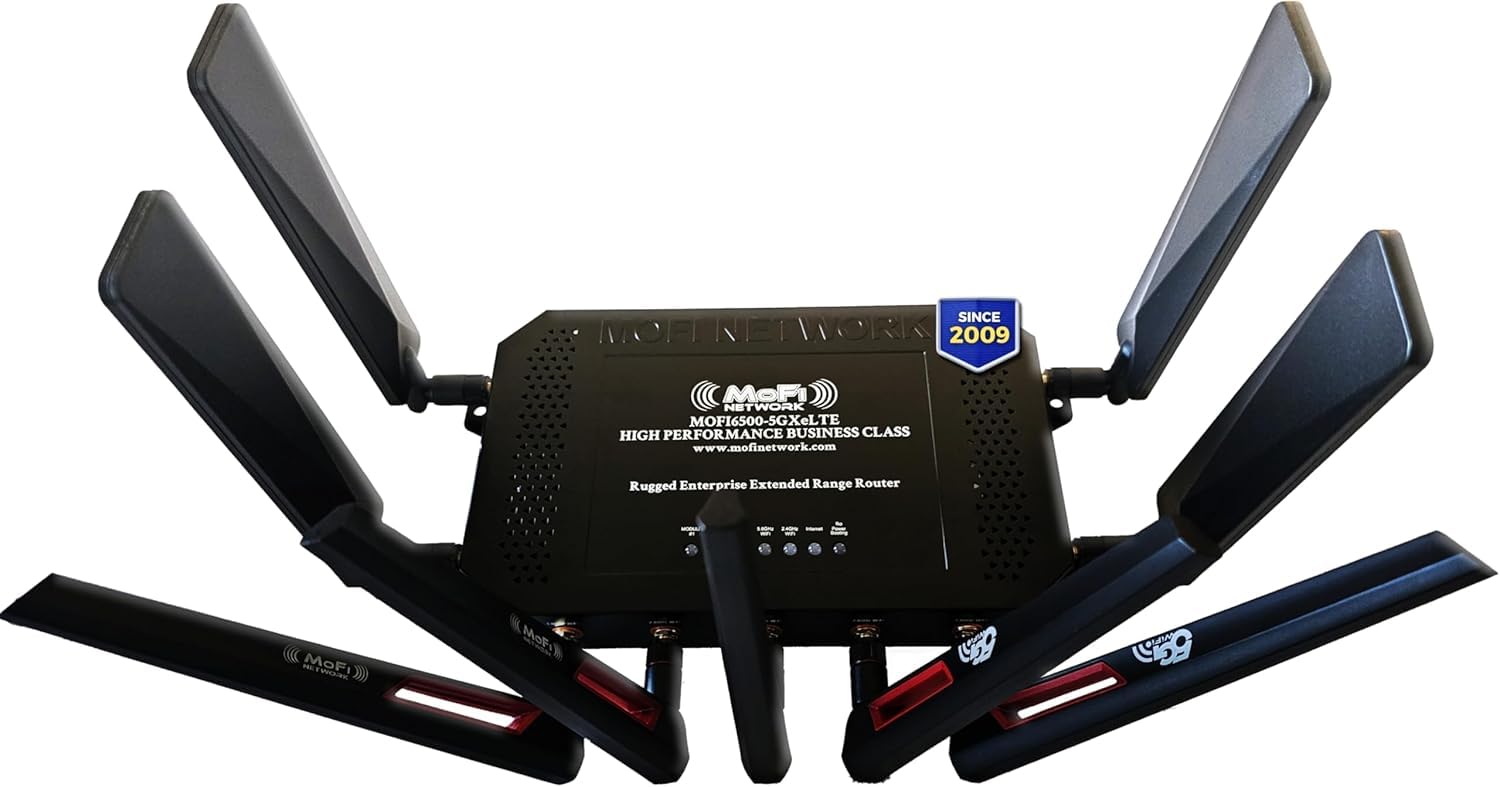
1. MOFINETWORK MOFI6500-5GXeLTE-RM520-HP 5G Cellular Router
Our pick — 4.0+★ from 850+ verified ratings; the strongest balance of quality and price.
The metal-bodied gateway that wants to replace your cable line, not sit in a bag.
The MOFI6500 is built for people done with dropped calls to the ISP. It moves data at 3.4 gigabits per second — the same throughput figure the Hitron D60 carries — and packs a full metal case with four 5G cellular antennas and five more for the 2.4/5 GHz Wi-Fi bands. That rig is why it is a bench unit rather than a pocket one: it wants to sit somewhere with airflow and a good signal, not travel.
What earns it the top spot is the business-class software. You get failover support, band lock (pinning it to one radio frequency so it stops hunting), VPN compatibility, and IP pass-through so a real router behind it can take over the network. The built-in amplification is designed to push stronger wireless range than a bare modem, which matters in a two-building setup where one wall stops most signals.
The trap is the SIM wording. Failover means both SIM slots are there but only one runs at a time — the modem switches, it does not run both simultaneously. True simultaneous dual-SIM requires the separate DUAL model. The other honest caveat is support: a frustrated caravan owner describes it as reliable on nearly any network but rates the vendor help desk poorly, and switched brands as a result. The modem is the strong part; the hand-holding is not.
The case for the metal box
- 3.4 Gbps data rate and dual-band Wi-Fi 6 with built-in amplification
- Failover, band lock, VPN compatibility and IP pass-through for a full home network
- Full metal case with detachable antennas for heat dissipation and range
- Works across Verizon, AT&T and T-Mobile per the listing
Where it pinches
- Dual SIM is failover only — not simultaneous unless you buy the DUAL model
- Signal can vary by location; some users report strong reception, others weak
- Support experiences are a recurring gripe
Buy this for: a home or RV where a metal gateway with real Ethernet ports and tower-level control replaces a tired cable line.
Not the one: if you need both SIMs live at once — you want the DUAL variant.
2. NETGEAR Nighthawk M6 5G Mobile Hotspot Router
A pocket 5G hotspot that punches past phone tethering on the road.
The M6 is the travel-first answer. It runs at 2.5 gigabits per second — noticeably behind the 3.4 Gbps on the MOFI and Hitron boxes above, because this one is built around a small battery and portability, not raw throughput. What it delivers is a Wi-Fi 6 signal from a package small enough to leave in a backpack, with an intuitive touchscreen for data used and signal bars.
Setup is the easy part. An AT&T SIM slot, a QR-code connect option, and a wizard that gets most people online in minutes. As owners put it, one buyer took the unit to Japan and ran it on a local GSM SIM, reporting “6-8hr battery, QR-code connect, multi-device” and a compact build that held up. Another reports the external antenna pulls signal even from a weak cell area on a boat.
Two things to size up. First, this is the AT&T-certified variant, so other carriers may not behave — T-Mobile bands on the MR6110 are reportedly locked unless you modify it, which the listing does not promise. Second, the recurring gripe is the power path: it will not charge while switched on, so you charge in standby. It heats up under long load, and some report it disconnects after hours of use. As a hotspot for a few hours it is sharp; as a 24/7 gateway it is not the tool.
What wins people over: a 2.5 Gbps portable hotspot with a touchscreen, open up international GSM support, and Wi-Fi 6 across multiple devices at once.
The honest catch: battery does not charge while running, it warms under load, and non-AT&T coverage is not guaranteed.
Reach for it when: you want internet in a bag for meetings, trips, or backup — not a replacement for home broadband.
Look past it when: you need always-on uptime on a carrier other than AT&T.
3. Hitron D60 5G Cellular Router with SIM Card Slot
Same 3.4 Gbps ceiling as the top pick, from a much smaller box.
The D60 matches the MOFI on headline throughput at 3.4 gigabits per second, and it does it in a 1.14 kg plastic unit with internal antennas. That makes it the simpler desk-side choice. The AX3000 Wi-Fi 6 radios are rated to deliver up to 5.4 Gigabits, and the spec sheet calls for a Nano SIM from one of three certified carriers — T-Mobile, AT&T, or US Cellular.
Where the D60 pulls ahead of the M6 and rivals the MOFI is redundancy: it accepts both a Nano SIM and an eSIM for failover, so a second line can take over if the first drops. Setup is genuinely quick — the review pages repeatedly describe being fully operational in under five minutes with no app battles.
What to watch: the 2.4 GHz primary band is a clue this is a home router, not a fast-access-point machine, and the listing tops it with 4×4 MIMO on the 5 GHz side to compensate. The one technical catch is sleep mode — when no devices are connected, the unit idles and needs a power cycle to wake. A handful of buyers report a cold-boot reliability issue too, so treat this as the solid mid-tier pick, not the bulletproof one. The 3-month limited warranty is short, so register it and test it early.
Best fit: a first SIM-router where price and fast setup matter more than the longest possible track record.
One real limit: sleep mode can leave it needing a power cycle, so avoid it if no device stays connected.
4. NETGEAR Nighthawk M6 Pro Mobile Hotspot (MR6500)

mmWave in your pocket, with a 2.8-inch touchscreen and a 5040mAh battery.
This is the fastest hotspot class in the lineup, with a 3600 megabits per second data rate and support for both mmWave and Sub-6 bands. The M6 Pro takes a Nano SIM and runs on the Qualcomm SD X65 chipset. Its standout spec is the band list — it covers mmWave n260 and a long Sub-6 roster including n77 and n78, plus 4G LTE on the standard carriers. The 5G Pro calls itself open up for AT&T and T-Mobile and international roaming.
The honest setup story: the AT&T-branded variant is the one being resold here, and the bands it carries are not the same as a true open up unit. Some owners mention it shows 5G on T-Mobile but cannot actually use T-Mobile 5G, and overseas it falls back to LTE. What it does reliably is home-style speed near a tower — speed tests that far exceed a phone hotspot, guest Wi-Fi separation, and a 2.5G Ethernet port.
The battery is the weak link. It runs down quickly under load, and the recommended posture is to keep it powered when you are parked. This is a renewed unit, so the refurb quality varies — a handful of owners received a charger that would not run the device without its battery installed. Check the box contents against the listing on arrival and you avoid most of the hurt.
Why it earns a place: 3600 Mbps, mmWave and Sub-6, a 2.8″ color touch LCD, up to 32 devices, and a 2.5G port — a compact powerhouse for travel and temporary setups.
Room to know: carrier-band limits and battery drain are the two recurring frustrations; this is a renewed unit, so quality varies.
Pick it for: fast travel internet where mmWave coverage exists, and you can tolerate a resold AT&T variant’s band quirks.
Think twice if: you need guaranteed full T-Mobile 5G or a long battery — this one wants to be plugged in.
5. UOTEK 5G SIM Card Router CPE (Wi-Fi 6 AX1800)

The antenna farm: eight spars and 1800 Mbps for a house that swallows Wi-Fi.
The defining number here is the antenna count — up to 8 total (4 for 4G plus 4 for 5G) on a traditional external design. The data rate is 1800 megabits per second, well below the 3.4 Gbps of the MOFI and Hitron. The 5G network access is the point: no cable needed, just a SIM, and it supports both NSA (non-standalone) and SA (standalone) 5G modes.
Where the UOTEK earns its keep is signal pull. In a spot where a stock gateway struggles, the antenna count and spatial streams let it hold on. Buyers describe switching from NSA to SA and seeing channels n41 and N25 come through. The software is a familiar router GUI, easy enough to navigate, and the build is described as sturdy. This is a plug-in, sit-it-on-the-shelf modem, not a travel unit.
The honest catch is the documentation. The manual is thin — one buyer notes it does not even list the default IP or admin password, which adds an annoying first step. Newer firmware ships separately and must be requested. The mesh features are advertised but the settings are hard to find in the interface, so treat mesh as a bonus, not a buying reason. The older chipset in some units also limits carrier aggregation.
The right buyer: a fixed home install where external antennas are the main lever for weak signal.
Where it loses ground: setup docs and mesh claims — route around both and you get a solid 1800 Mbps gateway.
6. D-Link G530 5G NR AX3000 Router with SIM Card Slot

A familiar router brand’s SIM gateway, with parental controls you actually manage from an app.
The G530 acts most like a home router of the bunch. It moves data at a 3000 megabits per second rate (Mbps — how much data flows each second). Its Wi-Fi 6 output (the newer, faster Wi-Fi standard) splits into up to 574 Mbps on 2.4 GHz and 2402 Mbps on 5 GHz, so a 4K stream and a video call can run at once. It is certified with PTCRB (a body that tests devices for mobile networks), AT&T, T-Mobile and Verizon. The Falcon app handles setup, guest network, usage caps, and child profiles with scheduling and site blocking.
The failover system is its real selling point for a hybrid home. Dual-WAN auto-failover flips to 5G or a wired line when the primary drops, so a video call survives a cable outage. Security is taken seriously here: IEC 62443-4-1 and ETSI EN 303 645 certification, WPA3 encryption, and DNS over TLS and HTTPS support. There is a gigabit LAN and WAN port for wired devices.
Then there are the honest limitations. This is a mixed bag by reputation — a buyer says it boosted a rural line from about 10 to over 100 Mbps, while others hit blunt walls. One thing to check first: some setups only broadcast a 5G connection, so older 2.4 GHz security cameras need a converter. A few customers note needing occasional restarts with a slow boot. And some found the setup steps conflict with the written guide, which recommends a wired connection the app does not always require. Verify carrier certification on your specific line before buying.
Where it pulls ahead
- Dual-WAN failover keeps the network up when a line drops
- Parental controls and usage caps from the Falcon app
- WPA3 plus IEC 62443-4-1 and ETSI EN 303 645 security certs
- Certified with AT&T, T-Mobile and Verizon
What to know before you buy
- Some reviewers point out needing periodic restarts and slow boots
- 5G-only setups can strand older 2.4 GHz-only devices
- Setup instructions and app flow do not perfectly match
Good for: a family home that wants easy app management and automatic switchover between wired and cellular.
Verify first: that your specific carrier plan certifies this model, since not every line does.
7. GL.iNet GL-X3000 (Spitz AX) Cellular Gateway 5G Router

The RV crowd’s favorite: an OpenWrt gateway that runs dual SIMs and multi-WAN like a pro.
Start with the software, because that is where the X3000 wins. It runs on OpenWrt (v21.02), a customizable router operating system with 5,000-plus ready-made plug-ins. Dual SIM with automatic failover is baked in, along with multi-WAN across Ethernet, repeater, cellular and tethering. There are pre-installed OpenVPN and WireGuard, with VPN throughput rated at 150 Mbps over OpenVPN and 300 Mbps over WireGuard.
The hardware is serious: up to 574 Mbps on 2.4 GHz and 2402 Mbps on 5 GHz over Wi-Fi 6, six detachable antennas on a metal-friendly white case, and a 3000 megabits per second data rate. For an RV or a rural house, that means you can run a roof-mounted external dome and let the modem fail over between carriers when one gets congested.
What most impresses the long-term owners is build quality and how well it holds a signal. A mobile user runs it in a car with a T-Mobile SIM, getting steady real LAN and strong Wi-Fi at home or on the go, and rates it above dedicated hotspots. A caravan owner running dual SIMs reports never dropping below 90 Mbps even when the park is busy, and says it pays for itself in about 10 months versus a monthly MiFi plan. One owner has run it in the same shop on Google Fi for three-plus years and it is still performing.
The flip side is that this is a power-user box. Shoppers say it is a weak router for many smart-home devices, only separates 2.4 and 5 GHz instead of offering a unified SSID, and has a 2-band carrier aggregation limit. Setup can take a couple of minutes before it connects and broadcasts. One complaint of a unit failing in under two years exists, but the overwhelming read is a solid piece of kit for someone who wants to tune it.
Choose it if: you are an RV or rural user who wants OpenWrt, dual SIMs, and the ability to run external antennas.
Pass if: you want a set-and-go box — this rewards a tinkerer.
8. GL.iNet GL-XE3000 Puli AX 5G Router

The Spitz AX’s sibling with a battery — internet that keeps running when the power does not.
The Puli AX takes the GL.iNet formula and adds the one thing the X3000 lacks: a built-in 6400mAh battery. That cell is rated for up to 8 hours of connectivity, which is why offices, events and construction sites pick it over the plug-only competition. The Wi-Fi 6 speeds are the same 574 Mbps on 2.4 GHz and 2402 Mbps on 5 GHz, and the data rate is 3000 megabits per second — identical to the X3000.
The battery is a genuine upgrade for anyone who has watched a router die mid-meeting during a storm. Owners describe running for several hours into a power outage without a blink. On a multi-state road trip through no-signal stretches, one reports the Puli AX with a Simpoyo SIM got better service than expected, handled hotel captive-login Wi-Fi through the repeater, and lasted 6-8 hours on battery.
OpenWrt is back, with the same 5,000-plus plug-ins and pre-installed OpenVPN and WireGuard. Support is fast and cordial once you reach it, but the box rewards patience on day one. It ships with a 2-year warranty and a universal plug set.
what separates it: a 6400mAh battery (milliamp-hours — battery capacity) for up to 8 hours of uptime, so a power cut does not drop your connection. Dual-SIM failover (a second SIM takes over if the first loses signal) keeps you online. OpenWrt customization (open-source router software you can tweak) and detachable antennas suit RV and field use.
The learning curve: dual SIM slots sharing one IMEI make activation fiddly, and the first SIM may need a power cycle to register.
Built for: events, job sites, and offices that cannot go dark, or RVers who want internet without a power hookup.
Know going in: plan extra setup time for the dual-SIM activation.
9. Yeacomm NR610 Outdoor 5G Router (IP67, POE)

The one you bolt to a pole and forget — IP67 weatherproof and rated to 4.67 Gbps.
The NR610 is the only outdoor-rated unit in the list. Its IP67 enclosure handles dust and rain and is rated to work from -30 to +55 °C, and the 4.67 gigabits per second data rate is the highest headline number here. It runs on both NSA and SA 5G and is backward compatible with LTE and 3G. The kit includes the outdoor router, Ethernet cable, installation brackets, and a POE power adapter.
The point is signal. A rural Verizon user reports dual 300 Mbps on this outdoor unit versus 50-150 Mbps from a stock indoor gateway. Some report peaks north of 500 Mbps, and the review pages put it at 600-800 Mbps download with very good reception in the right spot.
The catch is the carrier setup, not the hardware. The modem is not a turnkey plan-signup device. The brand itself recommends using an existing T-Mobile or AT&T SIM rather than registering a brand-new data-only plan via the unit’s IMEI (the phone’s unique ID number). One buyer had T-Mobile flag the IMEI as locked. Bring your own active SIM and you sidestep most of that. Also note it broadcasts 2.4 GHz Wi-Fi for configuration only, so you speed-test over the LAN port (the wired network socket) or a plugged-in Wi-Fi 6 router.
The outdoor argument
- IP67 weatherproof housing rated for -30 to +55 °C
- 4.67 Gbps data rate with NSA and SA 5G support
- Built-in 6 high-gain internal cellular antennas and 4×4 MIMO
- POE power and up to a 300ft Cat6 run from the injector
The fine print
- Carrier onboarding trips people up — bring an active SIM
- Wi-Fi is 2.4 GHz only, meant for setup, not speed
- Needs directional tuning in far-from-tower spots
The winner for: farm, yard, RV, or anywhere the modem lives outside and the tower is far away.
Not ideal if: you want a ready-to-activate plan from the box — this rewards an active SIM in hand.
Know the Specs
Data transfer rate (Gbps)
Measured in gigabits per second, this is the modem’s rated wireless top speed. A higher number means more ceiling for downloads and streaming, but your actual speed depends on the tower and plan. A 3.4 Gbps modem on a congested tower runs slower than a 1800 Mbps unit on a clear line.
Band class (dual-band vs tri-band)
Dual-band means the modem broadcasts 2.4 GHz and 5 GHz Wi-Fi. 2.4 GHz reaches farther through walls, while 5 GHz carries more speed at shorter range. A tri-band label adds a third radio channel — useful in crowded homes where one band is saturated.
Failover & dual-SIM
Failover lets the modem switch to a backup connection when the main one drops. On most units this is “single standby” — only one SIM is active at a time. True simultaneous dual SIM requires two cellular modules, which is a separate, higher-end model.
Antennas and signal
Internal antennas keep the unit tidy; detachable or external antennas let you run a cable to a roof or window mount. In a weak area, moving the antenna is often the single biggest speed gain you can make — bigger than moving up a price tier.
Common Questions
Will a 5G modem work with my existing T-Mobile, AT&T, or Verizon SIM?
What is the difference between a 5G modem and a phone hotspot?
Do I need an external antenna for rural internet?
What does dual-SIM “failover” actually mean?
Can a 5G modem replace my home cable or fiber ISP?
Why does my 5G modem show 5G but only run on 4G?
How long do these modems last?
Do I need a special data plan for a 5G modem?
Will a 5G modem work with Wi-Fi 6 smart-home devices and cameras?
Is a battery-powered 5G modem worth it over a plug-only one?
The Bottom Line
For most people replacing a slow or unreliable line, the MOFINETWORK MOFI6500 is the strongest all-round choice. It is a metal gateway (a modem and router in one box) with a 3.4 Gbps rate (gigabits per second — about 3,400 Mbps), dual-SIM failover, band lock (you pick which frequencies it uses) and real Ethernet. It is built for someone who wants a router, not a bag accessory. If you travel and want internet in a backpack, the Netgear Nighthawk M6 is the portable pick. RVers and tinkerers should look at the GL.iNet Spitz AX for its OpenWrt control and antenna flexibility. And if the modem has to live outdoors, the IP67 Yeacomm NR610 is the one to bolt up and forget. IP67 means it is dust-tight and survives a dunk in water. Match the unit to your carrier’s bands and your antenna mounting options, plug in an active SIM, and you are online.
How we choose
We do not accept paid placement. Every pick is matched to a real buyer and a real use-case; we do not hands-on test units.
Sources
Specifications: manufacturer listings and product documentation. Review insights: verified customer reviews, as of October 2026. Pricing: not shown on this page (it changes often); check the current price via the retailer link.
As an Amazon Associate, Aappliancez earns from qualifying purchases. This does not affect which products we feature.