Disclosure: Some links in this post are affiliate links. As an Amazon Associate I earn from qualifying purchases, at no extra cost to you. Learn more
Specs are compiled from manufacturer listings and verified buyer reviews and can change over time — please confirm the key details on the product page before buying.
If your only broadband option is a cell tower two miles away, the box that decides whether you get 90 Mbps or nothing at all is the modem, not the SIM card. A 5G cellular modem captures a tower signal and rebroadcasts it as Wi-Fi and Ethernet for a house, an RV, or a job site. This guide sorts nine real options by what actually holds a connection — with the honest catches named.
This guide is built by comparing the manufacturers’ published specifications and the patterns across verified customer reviews, so you get each pick’s real strengths and trade-offs instead of marketing spin.
You will see battery runtime, chipset names, failover behavior, and antenna counts broken down in plain language, so you can match a modem to your tower distance and your patience for setup. Each pick below is a 5g cellular modem that holds a connection where a phone hotspot gives up.
Top Picks

How To Choose The Best 5G Cellular Modem
You are buying a radio receiver, not a router. You are buying a radio receiver that happens to hand out Wi-Fi, and the radio part is what fails when you are far from a tower. Judge every candidate on four things: which 5G bands it supports, whether it has real external antenna connectors, what happens when the cellular link drops, and how much of the setup you are willing to do yourself.
Check the band list against your carrier, not the headline speed
A modem can advertise 3.4 Gbps and still crawl if it cannot see the band your tower is broadcasting. Look for the specific n-numbers your carrier uses in your area. One buyer of the Nighthawk M6 Pro found this out the hard way: the AT&T-branded variant shows 5G on a T-Mobile SIM but cannot actually use T-Mobile’s 5G. The box’s top speed is a lab ceiling, not what your tower will deliver.
External antenna ports are the difference between usable and useless
Inside a metal shed or a basement, cellular signal falls off a cliff. A modem with SMA connectors (the screw-on ports for an outside antenna) lets you fix that with a directional antenna. In one rural two-building setup, adding a yagi antenna took the signal from 1 bar to 4 bars and pushed strong Wi-Fi to both buildings. A modem with sealed internal antennas cannot be rescued that way.
Understand what “dual SIM” actually buys you
Many modems hold two SIM cards but only run one at a time, switching only when the active one fails. That is failover, not simultaneous dual-SIM. It still keeps you online when one carrier drops, which is the whole point for a home office or a remote site. Just do not expect to bond two carriers’ bandwidth unless the listing explicitly says both run at once.
Decide how much setup you want to do
Some units are running in two minutes with a wizard; others need a manual band selection, an APN entry, or a firmware update before they behave. The GL.iNet Spitz AX, for example, needed a specific LTE+NSA configuration to work on one Verizon-based carrier. Wizard-driven units suit a hands-off owner; manual band and APN entry suits a tinkerer.
Side-by-Side Comparison
| Model | Best For | Top Speed | Chipset | SIM Setup | Amazon |
|---|---|---|---|---|---|
| MOFINETWORK MOFI6500-5GXeLTE★ Best Overall | Business continuity & rural homes | 3.4 Gbps | — | Dual SIM, failover | Amazon |
| Hitron D60 5GBest Value | Failover backup on a budget | 3.4 Gbps | — | Nano SIM + eSIM failover | Amazon |
| NETGEAR Nighthawk M6 ProBest for Travel | Travel hotspot | 8 Gbps (5G) | Qualcomm SD X65 | Single Nano SIM | Amazon |
| RM520N AX3000 | Big-house coverage | 3.4 Gbps | Qualcomm SDX62 | SIM slot, multi-WAN | Amazon |
| UOTEK 5G CPE | Smart-home & office indoor | 1800 Mbps | X62 (per listing) | SIM slot | Amazon |
| Cudy P5 | Always-online business sites | 3.4 Gbps | Qualcomm X62 | Dual Nano SIM | Amazon |
| GL.iNet Spitz AX (GL-X3000) | RV & road trips | 3000 Mbps | — | Dual SIM, single standby | Amazon |
| GL.iNet Puli AX (GL-XE3000) | Power-outage backup | 3000 Mbps | — | Dual SIM, single standby | Amazon |
| Teltonika RUTX50 | Industrial sites (not USA) | 3.3 Gbps | — | Dual SIM, auto-failover | Amazon |
Detailed Reviews
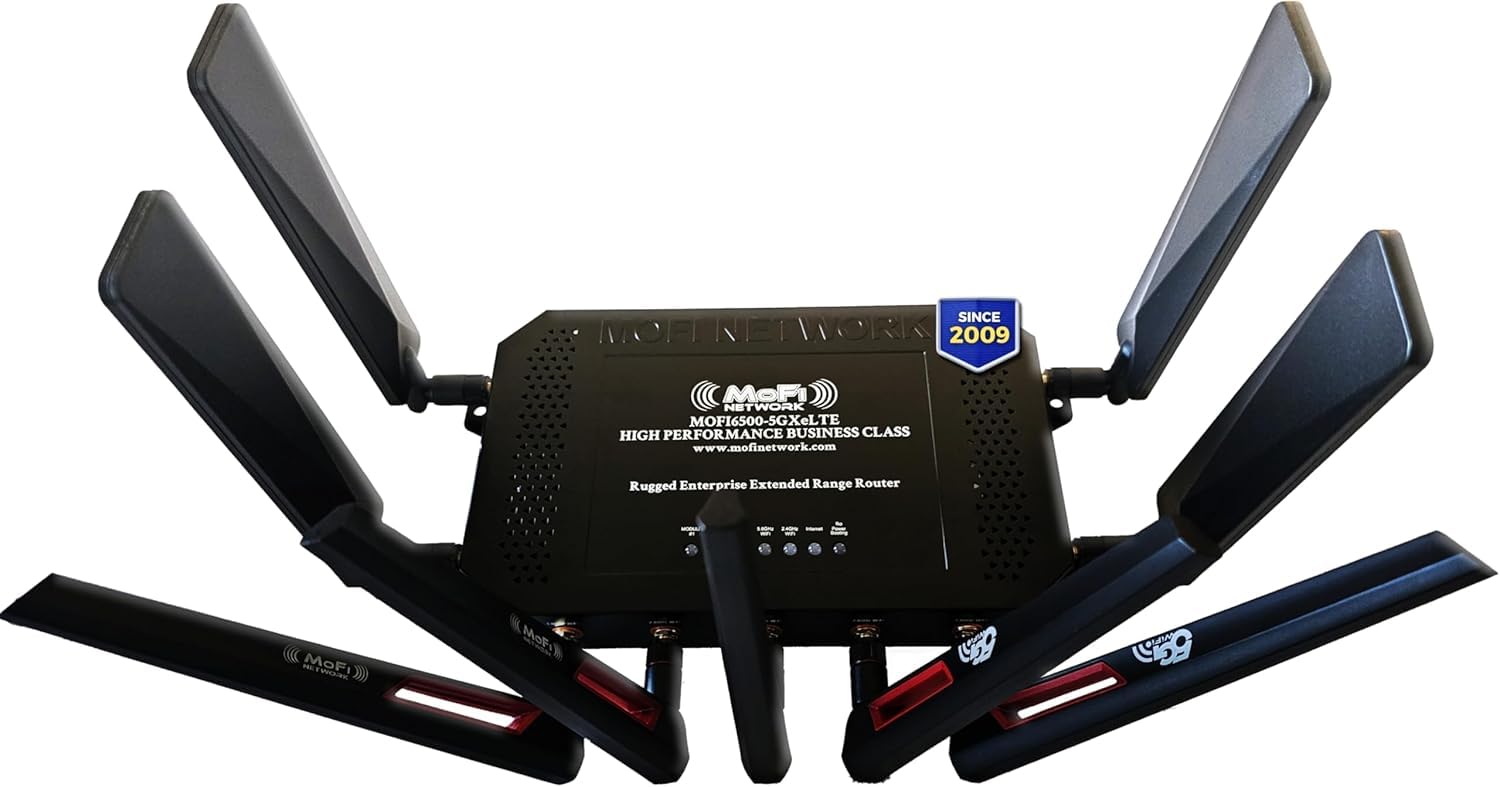
1. MOFINETWORK MOFI6500-5GXeLTE-RM520-HP 5G Router
Our pick — 4.0+★ from 850+ verified ratings; the strongest balance of quality and price.
A full metal box with nine screw-on antennas and a business-grade brain underneath.
This is the pick for someone replacing a wired ISP at a rural property, or keeping a small office online when the primary line drops. It moves 3.4 gigabits per second over 5G, which is plenty for 4K streaming and a home office running at the same time. The case is all metal, not plastic — that matters because a modem running 24/7 gets warm, and metal sheds heat instead of cooking the internals. It ships with four 5G cellular antennas and five 2.4/5GHz Wi-Fi antennas, all detachable, plus a 10 ft CAT6E Ethernet cable and a certified power adapter. Both the cellular side and the Wi-Fi side are amplified internally, so the 5 GHz Wi-Fi reaches across a large house or two buildings rather than dying at the far wall.
The business features are what push this ahead of the pack. You get IP pass-through (lets one device take the public address directly), band lock (pins the modem to the band your tower actually uses), VPN compatibility including Zerotier, and auto failover between two SIM cards. That last one is the reason it holds the top spot for a critically online setup: if carrier one goes dark, it switches to carrier two without you touching anything. The metal build is also genuinely rugged, and the detachable antennas mean you can swap in a directional one when the stock set is not enough. In a rural two-building install, adding a yagi antenna took reception from 1 bar to 4 bars and delivered strong Wi-Fi to both structures, holding stable for two weeks.
Setup is friendlier than the spec sheet suggests. A Fort Worth user had it running in about two minutes through the setup wizard, and a full-time RV owner runs it under trees and in motion. The honest catch is the SIM wording. This model’s “dual SIM” is failover only — one SIM active at a time. If you need both SIMs live simultaneously, the maker sells a separate DUAL variant, and the current listing does not make that distinction obvious. The other recurring note is reception: some buyers see strong signal and some struggle, which usually traces back to tower distance rather than the hardware. Two other small things to know: the default Wi-Fi antennas caused video buffering for one buyer who swapped in a third-party access point, and a small number of users hit unhelpful vendor support on replacement requests. Neither changes the daily performance for most owners.
What earns it the top slot
- 3.4 Gbps 5G throughput with amplified internal antennas on both cellular and Wi-Fi
- Auto failover between two SIM cards keeps a home or office online when one carrier drops
- Band lock, IP pass-through, VPN and Zerotier support — real business controls
- Full metal case with detachable antennas for better heat dissipation and external-antenna upgrades
Where it asks you to read carefully
- “Dual SIM” here means failover only — simultaneous dual SIM lives on a separate DUAL model
- Reception is tower-dependent; some owners need an external antenna to get a solid signal
- Stock Wi-Fi antennas left one buyer buffering until a third-party access point went in
Reach for this if: you are replacing a wired connection at a rural home or need a business site that stays online through a carrier outage.
Look elsewhere if: you need both SIMs transmitting at once — order the DUAL variant instead.
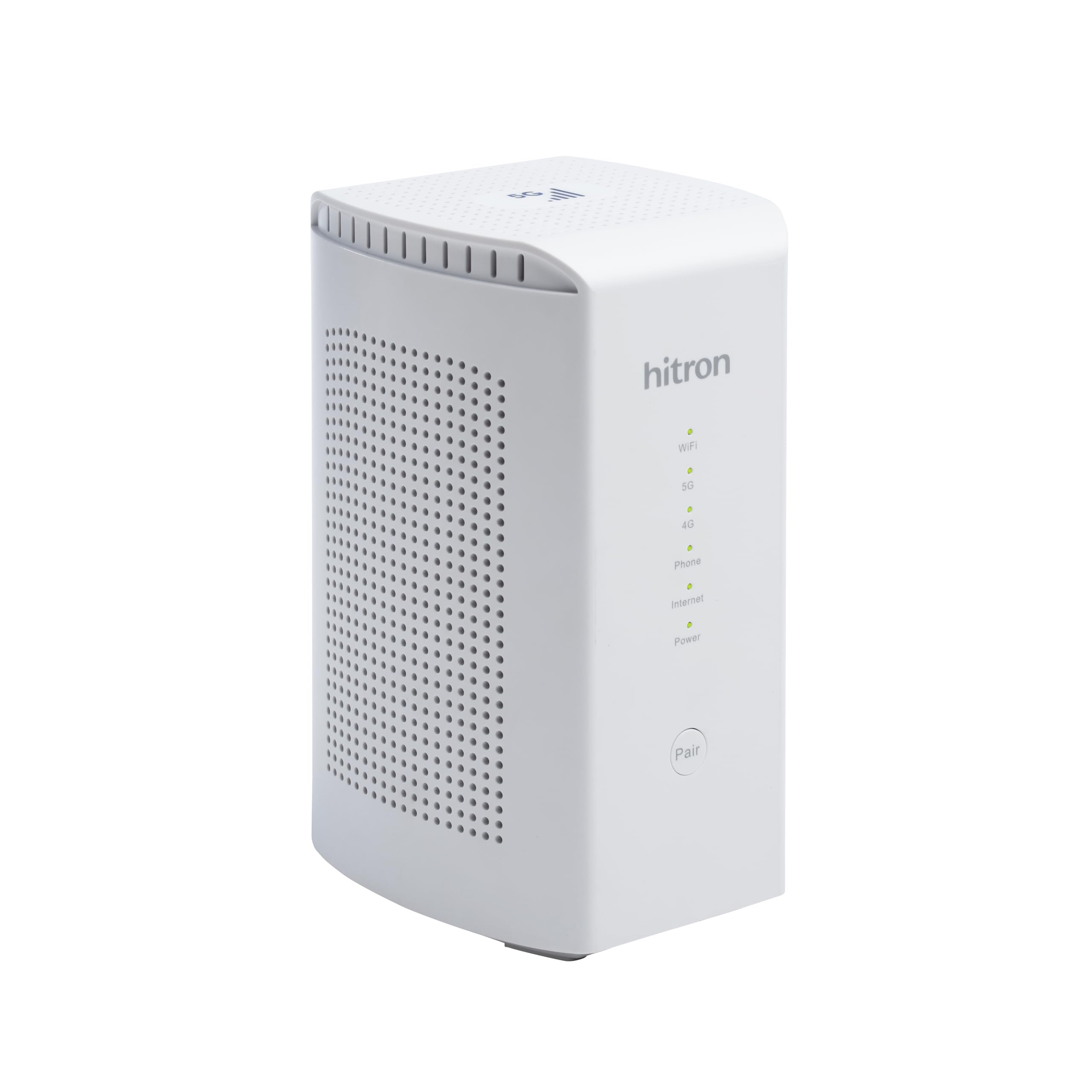
2. Hitron D60 5G Cellular Router with SIM Card Slot
The cheapest way onto a certified 5G router without gambling on an unknown brand.
Certification is the story here. This unit is certified to work with T-Mobile, AT&T and US Cellular, which means fewer of the band-matching headaches that eat weekends on uncertified imports. It reaches 3.4 Gbps on 5G NSA, matches the MOFINETWORK’s top speed, and backs down to 4G LTE when 5G is not there. It supports both SA and NSA 5G architectures, so it works on the newer standalone 5G networks as well as the older mixed ones. Nano SIM plus eSIM gives you failover capability, and the whole thing weighs in at about 1.14 kg, light enough to move between rooms or toss in a bag.
Reliability is what wins people over — it is the most-discussed quality in its review pages by a clear margin. Owners treat it as a fallback when the main internet line dies, and it earns that trust: one Chile-based user reports it running perfectly on a local carrier. Plug-and-play is the other theme. As owners put it, it was “fully operational with great Mbps speeds” in less than 5 minutes, and it accepted every SIM card tried.
The catch is a serious one for some setups. One buyer found it fast and low-latency on first boot but crashing after 6-48 hours, needing a factory reset to recover — and moved to a different brand. Treat that as a fit note rather than a blanket verdict: it worked flawlessly for plenty of others, but if you need a modem that never hiccups for months unattended, that variability is worth knowing. Two smaller quirks: the IMEI must be registered in countries that require it or the carrier blocks it, and if it sleeps with no devices connected it needs a power cycle to wake. The 2.4 GHz frequency and the 3-month warranty round out the budget trade-offs.
The value read: you get certified 5G and a full gigabit of fallback capability on a router that most owners have running in five minutes. Certified 5G plus gigabit fallback for a budget-tier price.
The reliability question: it is the main thing buyers talk about, and the answer swings between rock-steady and needing a reset. Keep it inside its return window until you have confirmed it holds for a few weeks.
Suits you when: you want a carrier-certified 5G unit as a failover backup or a simple home router and you are comfortable with a short warranty.
Reconsider for: an unattended business line where a multi-day crash would cost you — that needs a unit with a longer track record of stability.
3. NETGEAR Nighthawk M6 Pro Mobile Hotspot (MR6500)
A pocket-sized modem built to leave the house with you, battery and all.
If you have been dragging your phone’s hotspot through meetings, this is the upgrade: it is the only pick here with mmWave 5G support (the ultra-fast short-range flavor of 5G) alongside the standard Sub-6 bands. It hits 8 Gbps on 5G and 2.9 Gbps on 5GHz/6GHz Wi-Fi, with a 2.5G Ethernet port for a wired device. The 2.8″ color touch LCD lets you change settings without a browser, and the Qualcomm SD X65 chipset handles up to 32 connected devices. A 5040mAh battery keeps it alive away from a wall outlet, and it weighs 8.96 ounces — light enough to slip into a jacket pocket.
The travel scenario is exactly where it shines. A SIM swap gave one buyer consistent Wi-Fi at around 100 Mbps near a window, good enough for FPS gaming, while setup is under five minutes and the speed test beat the phone’s hotspot outright. That is the honest pitch: it replaces the hotspot in your phone so your phone stops cooking and your laptop gets a real connection. It is also a renewed unit, so condition can vary — some arrive looking like new and one came as a floor model, both of which still worked as advertised.
Two caveats stand out. First, the AT&T-branded version shows 5G on T-Mobile but cannot actually use T-Mobile’s 5G, and abroad it drops to LTE only — so check the band list against your carrier before you travel. Second, the built-in battery runs down fast and is the recurring complaint; it is not a leave-plugged-in-for-months desk modem, and running it on a charger without the battery installed did not work for at least one owner. Connectivity is strongest on AT&T and weaker on other networks. Weaker reception on non-AT&T networks is a real limit for a travel modem.
Pick it when you roam: the mmWave plus 5040mAh battery combo makes it the travel specialist of this list, and it beats phone tethering on both speed and battery drain.
Not a home base: short battery runtime and carrier band limits keep it off the desk-replacement shortlist.
Made for: travelers and field workers who want a dedicated portable 5G connection instead of burning up their phone.
Pass on it if: you need a permanently plugged-in unit for a house — that is the MOFINETWORK or Cudy territory, not this hotspot.
4. RM520N AX3000 WiFi 6 Modem 5G Router with Sim Card Slot

Nine screw-on antennas and a Qualcomm SDX62 brain, aimed at pulling a signal out of thin air.
This is the pick for the person in the metal outbuilding or the rural house with almost no bars. It packs a Qualcomm SDX62 5G modem delivering up to 3.4 Gbps over 5G NR (SA and NSA), and it spreads 574 Mbps on 2.4GHz plus 2402 Mbps on 5GHz Wi-Fi across the house. The standout is the antenna array: four 5dBi cellular antennas and five 5dBi Wi-Fi antennas, all detachable, with SMA connectors for an external cellular antenna if you want to go further. It handles 128 simultaneous Wi-Fi users, and the multi-WAN setup lets you load-balance Ethernet, repeater, cellular and tethering with configurable failover priorities.
That antenna count is not decoration. A buyer using it inside a metal storage building, where a T-Mobile phone dropped from 250-300 Mbps outside to nearly nothing indoors, got 80-100 Mbps from this router through a closed door. Setup needed no cellular configuration at all — insert the SIM and go. The VPN software is unusually complete for the tier, with PPTP, L2TP, GRE, WireGuard and Zerotier built in and support for 20 more DDNS providers, which is why remote camera setups are a natural fit.
The recurring gripe is housekeeping, not hardware. The modem tends to drop the cellular network every 24 hours to a week and needs a manual restart, and the scheduled 4 AM auto-restart does not fire as promised. Some buyers also hit odd menu behavior — a band lock that went missing until a few factory resets, and a 5G SA/NR selection that would not stay saved. The bigger catch is support: there is no helpline, and a factory reset bricked one owner’s unit. Budget for the expertise to self-fix, and the low review count means the long-term record is still thin.
Signal-pulling strengths
- Four 5dBi cellular plus five 5dBi Wi-Fi detachable antennas with SMA ports for external upgrades
- Qualcomm SDX62 modem hitting 3.4 Gbps, plus a 128-user Wi-Fi 6 load ceiling
- Full VPN suite (WireGuard, Zerotier, PPTP, L2TP, GRE) for remote camera access
- Pulled 80-100 Mbps through a closed door where a phone got almost nothing
DIY maintenance required
- Needs a manual restart every 24 hours to a week; the scheduled auto-restart did not work
- No support line, and one owner bricked the unit with a factory reset
- Some China-defaulted pop-ups and settings that refused to save until repeated resets
Built for: the dead-zone setup where antenna gain decides everything and you are happy to tinker with settings yourself.
Not for: anyone who needs a vendor to walk them through a fix — there is no support number to call.
5. UOTEK 5G SIM Card Router CPE, WiFi 6 Dual Band Router

A desk-friendly 5G box with eight antennas and a smarter Wi-Fi schedule for busy homes.
This one is built for a house full of phones, tablets and smart plugs, not a construction site. It runs Wi-Fi 6 (802.11ax) with OFDMA and DL MU-MIMO, which is the tech that lets the router serve several devices at once instead of queuing them — so video calls stop stuttering when someone else is downloading. Bandwidth reaches 1800 Mbps across dual frequency with four spatial streams, enough for UHD streaming and online gaming. Eight antennas (4 for 4G plus 4 for 5G) handle the wireless side, and you can run it in mesh mode via wired or wireless backhaul for wider coverage.
Speed is what wins people over — it is the most-discussed strength. In a weak-signal area, one owner locked about 200 Mbps consistently, better and more consistent than a T-Mobile gateway. Switching from NSA to SA standalone 5G mode improved ping from 29-37ms down to 15-25ms and added a bit of throughput, which is a real, measurable stability win for gaming and calls. It is also an industrial-grade build, and the price-to-performance ratio lands well for a 5G router with 8 antennas.
You can get this running easily, but the paperwork will slow a beginner down. The instructions leave out the login IP address and the password, so you may need to email support for the latest firmware before everything works — the setup itself is easy once you have that. A second real limitation: the listing mentions smooth mesh via wired and wireless backhaul (a way to link extra units over a cable or over the air), but one buyer found no mesh settings in the router and no clear sign of which mesh nodes work with it. Connectivity feedback is split, as it is across this category. This one suits someone comfortable logging into an admin page by IP (the router’s numeric address on your network).
The measurable win: dropping NSA for SA cut ping to 15-25ms for one owner and settled the connection. Ping in the 15-25ms range is what keeps calls and games from stuttering.
The real friction: thin instructions and a mesh claim that does not fully deliver. Fine if you can find the login address; frustrating if you cannot.
Good match for: a smart home or small office where lots of devices share one 5G connection and you can handle the admin page.
Skip if: you want a true multi-node mesh from the start — the mesh settings simply are not there.
6. Cudy 5G SA/NSA AX3000 4-Port Gigabit Wi-Fi 6 Router (P5)

Set it up once and forget it — this is the modem that has simply kept running.
If “does it stay online for months without me touching it” is your top question, this is the answer. It carries a Qualcomm X62 modem good for 3.4 Gbps, with two Nano SIM slots for carrier redundancy so you can switch providers or keep a backup connection live without depending on a single network. The triple failover (WAN, Cellular 1, Cellular 2) is the feature that matters for a business that cannot go dark. Wi-Fi 6 spreads 2402 Mbps on 5GHz plus 574 Mbps on 2.4GHz, and four detachable SMA antennas let you add high-gain externals for weak-coverage spots. Four gigabit ports (one configurable WAN/LAN, three LAN) and wall-mounting round it out.
The track record is the selling point. One buyer set it up for a T-Mobile business line to enable port forwarding and reports nine months of dropouts-free service, with the full feature set, a good web interface, and VPN and static IP all working. Another runs it daily on a Verizon tablet SIM at 40-60+ Mbps down and 2-5 Mbps up with a verified IMEI. The 4×4 MIMO (multiple antennas working together) helps it hold weak signal. The software side is where the friction lives: enabling HTTPS management made the web interface unresponsive for one owner, requiring a factory reset that persisted even after a firmware update. A separate owner hit an incompatibility with a T-Mobile static IP line that only cleared after the carrier disabled it.
Worth flagging: one buyer found the SIM setup more involved than expected, and China-based support answers only in a narrow overnight window. The price runs higher than the value tier, and the seller notes a one-year spare-part availability window. But the daily experience for most is a router that just works, and that is the whole job.
The case for it: dual SIM slots plus triple failover plus nine months of demonstrated stability is what continuous-operation sites actually need — and the detachable antennas rescue weak-signal locations.
The case against: the HTTPS management bug and a static-IP incompatibility are the kinds of edge cases that cost a day of troubleshooting when they hit.
Worth it for: business continuity and remote sites that need to stay online without babysitting, provided your carrier plan is not a static-IP setup.
Look again if: you rely on HTTPS admin access, or you need quick hands-on support from the vendor.
7. GL.iNet GL-X3000 (Spitz AX) Cellular Gateway 5G Router

The road-trip modem with OpenWrt under the hood and six antennas on the roof.
Full-time RVers and mobile workers gravitate here for one reason: customization. It runs on OpenWrt (v21.02), a router operating system with more than 5,000 ready-made plug-ins, so you are not boxed into a vendor’s feature set. Wi-Fi 6 delivers 574 Mbps on 2.4GHz plus 2402 Mbps on 5GHz with MU-MIMO for multiple devices. Dual SIM runs in single standby with automatic failover, so you can keep two carriers on hand. There are six detachable antennas, and a physical eSIM option (sold separately) lets you switch operators and countries. VPN support covers pre-installed OpenVPN and WireGuard with 30+ supported services, up to 150 Mbps on OpenVPN and 300 Mbps on WireGuard.
The open system is the payoff for the right buyer. Quality wins over owners by a wide margin — the thing people rave about is simply how well it is built. Setup is the second-biggest theme, and RV buyers report it running day after day: dual SIM switching, 5G across all bands, Wi-Fi 6, and SMA external antenna ports with decent stock paddle antennas. Speeds hit 300+ Mbps and stayed above 90 Mbps even when busy, in one road-tripper’s use. It works as an in-car 5G modem with a stable local network, though it takes about two minutes to boot and start advertising Wi-Fi.
Its modem half outshines its router half. One experienced user calls it a good 5G modem and a mediocre router, citing limited two-band carrier aggregation (combining two chunks of spectrum for more speed), separate rather than combined 2.4/5GHz networks, and LAN-to-WAN headaches on some bands. It also needs a specific manual LTE+NSA configuration (a hand-entered setting for the 5G non-standalone mode) to work on one Verizon-based carrier. And the price is premium for the performance you get. If you want a plug-and-play box for a parent, this is not it; if you want a router you can bend to your will, it is.
Why RVers swear by it
- OpenWrt firmware with 5,000+ plug-ins for deeply custom setups
- Dual SIM with auto failover and a physical-eSIM option for country switching
- Six detachable antennas plus SMA ports for external rooftop antennas
- Wi-Fi 6 with MU-MIMO and 300+ Mbps reported on the road
Where it takes effort
- Some carriers need a manual LTE+NSA configuration before it works
- Router side trails the modem side — limited carrier aggregation and separate bands
- Premium price relative to the performance, and about a 2-minute boot to Wi-Fi
Ideal owner: the RV or overlanding type who wants to tune antenna placement, band lock, and VPN rules themselves.
Wrong buyer: anyone expecting a hands-off appliance that just works for a non-technical family member.
8. GL.iNet GL-XE3000 Puli AX 5G Router with 6400mAh Battery

A 5G router with a built-in battery that keeps the office online when the grid fails.
The battery is the headline: a built-in 6400mAh cell rated for up to 8 hours of uninterrupted connectivity, which is the difference between a modem and a genuine power-outage lifeline for an office, construction site, or event. It runs the same Wi-Fi 6 setup as the Spitz AX (574 Mbps on 2.4GHz, 2402 Mbps on 5GHz, MU-MIMO), with dual SIM single-standby and automatic failover. Multi-WAN covers Ethernet, repeater, cellular and tethering with load balancing. OpenWrt gives you the same 5,000+ plug-ins, and the VPN load is identical: 150 Mbps OpenVPN, 300 Mbps WireGuard.
Portability is a real draw — owners describe tossing it in a backpack and taking it anywhere. A road-tripper used it with a Simpoyo SIM across multiple states and got better service and faster speeds in remote spots, while 5GHz Wi-Fi range held up well. During a power outage, the built-in battery kept one owner’s network running for hours. Setup is quick: one buyer inserted a SIM, connected to T-Mobile instantly, and had both networks running in minutes. Battery life lands at 6-8 hours in practice, matching the spec.
Getting online is the honest catch. One owner hit a 6-hour battle to connect and lost the link again after a PC reboot, with only a self-help webpage for backup — and the dual SIM slots share one IMEI (the phone-style ID a carrier uses to recognize a device), which tripped up another user whose first SIM went unrecognized until repeated power cycles sorted it. The other edge: 5G can be picky about position, working well near a window and poorly elsewhere. For a portable unit that is expected; for a fixed install, find the window first.
The battery pitch: 6400mAh and up to 8 hours of runtime upgrade this from “another 5G router” to an outage-proof gateway. Carrying it in a backpack is the bonus.
The setup risk: the shared-IMEI dual-SIM design and a thin support path mean a first-time user may need patience on day one.
Choose it for: a site or event that cannot tolerate a power cut, and you want the router to pack up and travel afterward.
Think twice if: you are mostly stationary and will never use the battery — the Spitz AX gives you the same engine for less.
9. Teltonika RUTX50 Industrial 5G Router (EU PSU)

Enterprise hardware for Europe and beyond — with one very important geographic catch.
This is the industrial-tier option, built for mission-critical use. It pushes cellular speeds up to 3.3 Gbps, supports both 5G architectures, and promises single-digit latency (a handful of milliseconds’ delay, which matters for real-time control systems). Dual SIM gives uninterrupted communication via auto-failover, and dual-band throughput handles up to 150 clients at once. It steps back to 4G LTE CAT 20 and 3G when 5G is not available. The box includes four mobile antennas, two Wi-Fi antennas, a GNSS (satellite positioning) antenna, a 1.5-meter Ethernet cable, a SIM adapter kit, and the EU power supply.
Here is the dealbreaker-shaped catch: the maker explicitly states this unit is for use in Europe, the Middle East, Africa, Oceania and Brazil — not for use in the USA. If you are a North American buyer, stop reading and pick the MOFINETWORK or Cudy instead; this routing is for the international installer, the systems integrator, or the overseas site that needs an industrial gateway with 150-client capacity. For that audience, the GNSS antenna and the CAT 20 LTE fallback are exactly the redundancy a remote installation needs.
The frequency is 5 GHz dual-band, connectivity runs over Ethernet, and the fixed antennas are less flexible than the screw-on designs on the other picks. Since this listing carries no customer review data, treat the spec sheet as the source and confirm band support for your country’s carriers before ordering. The EU plug in the box is the other practical wrinkle for buyers outside that region — you will need your own adapter.
Built for the job site: 3.3 Gbps, single-digit latency, and 150 clients make this the heaviest-duty spec sheet on the list — for the right continent.
Check your map first: the USA exclusion and EU plug are not fine print; they decide whether this unit works for you at all.
Right for: European, Middle Eastern, African, Oceanian or Brazilian installations that need industrial reliability and 150 concurrent clients.
Hard pass if: you are buying for the United States — the maker says it will not work there.
Know the Specs
Chipset: the radio brain inside your modem
The chipset — Qualcomm SD X65, SDX62, or X62 on the picks here — is the modem’s radio processor, and it sets the ceiling on speed, band support, and how many carriers it can aggregate at once. A newer chipset with more aggregation usually means more stable speeds in weak signal. One Cudy buyer running a four-antenna setup still needed the 4×4 MIMO help of the chipset to hold a weak signal. When you compare two modems, compare their chipsets before their advertised top speed.
SA vs NSA: two flavors of 5G and why it matters
NSA (non-standalone) 5G piggybacks on older 4G infrastructure; SA (standalone) runs on the newer 5G core. SA often gives lower latency, which is the lag before data starts moving. On the UOTEK, switching from NSA to SA dropped ping from 29-37ms to 15-25ms and added throughput. If a modem supports both, you can choose SA for gaming and calls. Both are labeled on the picks here where the maker states support.
Battery runtime: desks vs. bags
A built-in battery changes what a modem is for. The GL.iNet Puli AX’s 6400mAh cell is rated for up to 8 hours, keeping a network alive through a power cut, and the Nighthawk M6 Pro’s 5040mAh battery keeps a travel hotspot going. Compare that to plug-in-only picks like the MOFINETWORK or Cudy, which assume wall power. If outages are a real risk, battery runtime is the spec that decides it; if you are desk-bound, spend the money on antennas instead.
Failover and dual SIM: staying online when one carrier dies
Failover is the modem’s automatic switch to a backup connection when the primary drops. Dual SIM in failover mode means one SIM is active and the other waits, switching only on failure; simultaneous dual SIM runs both. Marketing blurs these two, so read the exact wording. The MOFINETWORK’s “dual SIM” is failover only, and the true simultaneous version is a separate DUAL model. If you need true carrier bonding, confirm it explicitly.
Common Questions
Will a 5G cellular modem work with my carrier’s SIM card?
What is the difference between SA and NSA 5G on these modems?
Do I need an external antenna for a 5G cellular modem?
Does dual SIM mean both SIM cards run at the same time?
How long does a 5G cellular modem take to set up?
Can I replace my home internet with a 5G cellular modem?
Why does my 5G modem disconnect and need a restart?
Is a 5G modem better than using my phone’s hotspot?
What does band lock do on a 5G cellular modem?
Can I use a 5G cellular modem for online gaming?
Will a 5G modem work during a power outage?
The Bottom Line
For most people building a serious connection, the MOFINETWORK MOFI6500-5GXeLTE is the one to buy. It pairs 3.4 Gbps 5G (gigabits per second, a measure of download speed) with the business controls — band lock, IP pass-through, VPN and two-SIM failover (switching to a backup SIM when the first drops) — that keep a rural home or small office online when the primary line drops, all inside a metal case with detachable antennas you can upgrade. It is also the most battle-tested option here, and that matters when the modem is the thing standing between you and no internet at all. If you want a carrier-certified 5G router that most owners have running in five minutes, grab the Hitron D60 5G. And for a modem that leaves the house in a backpack — with mmWave (the fastest, shortest-range 5G band) and a 5040mAh battery — the NETGEAR Nighthawk M6 Pro is the one to reach for. Whichever you pick, do one last check against your carrier’s band list and your tower distance; that decision does more for your speed than any spec on the box.
How we choose
We do not accept paid placement. Every pick is matched to a real buyer and a real use-case; we do not hands-on test units.
Sources
Specifications: manufacturer listings and product documentation. Review insights: verified customer reviews, as of October 2026. Pricing: not shown on this page (it changes often); check the current price via the retailer link.
As an Amazon Associate, Aappliancez earns from qualifying purchases. This does not affect which products we feature.