Disclosure: Some links in this post are affiliate links. As an Amazon Associate I earn from qualifying purchases, at no extra cost to you. Learn more
Specs are compiled from manufacturer listings and verified buyer reviews and can change over time — please confirm the key details on the product page before buying.
Most espresso machines sold for home kitchens hide a detail that quietly decides whether your shots taste sweet or sour: the size of the basket that holds the coffee. The 51 mm espresso machine group — a 51 mm portafilter holding a smaller coffee basket — is the compact, forgiving end of that world. It heats faster, takes up less counter, and costs far less to get into. Below are the ten models worth your attention, sorted so the strongest all-rounder sits first and the deep-pocket premium machines come at the end.
This guide is built by comparing the manufacturers’ published specifications and the patterns across verified customer reviews, so you get each pick’s real strengths and trade-offs instead of marketing spin.
Pressure ratings and wattage get all the attention, but the basket diameter, portafilter fit, and how well the steam wand behaves on a rushed morning decide whether you actually keep using the thing. Here is the honest rundown on the 51 mm espresso machine models that hold up.
Top Picks


How To Choose The Best 51 Mm Espresso Machine
A 51 mm espresso machine is not a downgrade from a 58 mm machine — it is a different tool for a different kitchen. The smaller basket holds less coffee, which means it is more forgiving of a slightly uneven tamp and easier to dial in without a scale and a lot of practice. What matters is matching the machine to how you actually drink coffee, not chasing the biggest pump number on the box.
Start with the basket and portafilter, not the pump
You fill the portafilter (the handle-and-basket assembly) with ground coffee. A 51 mm portafilter takes a smaller dose of grounds than a 58 mm one, so the same bag of beans lasts a little longer and the machine needs less physical space around the group head. Every machine on this list uses a 51 mm basket except where the listing names a different size, and that consistency makes the shots easier to compare. Pressurized filter baskets — the kind with a single small hole that creates back-pressure — are what most of these machines ship with, and they are far more forgiving of a grocery-store grind than the open single-wall baskets used on prosumer setups.
Read the pressure rating in context
Bar is a unit of pressure, and 20 bar means the pump can push roughly twenty times normal atmospheric pressure. Higher is not automatically better-tasting, but a 20-bar pump paired with pre-infusion — a gentle low-pressure soak of the grounds before the full push — tends to give a fuller, more even extraction. The wattage number next to it (1350W on several of these machines) tells you how hard the heating element can work, which is why some of these heat up in well under a minute and some take several.
Decide if you need a milk frother and a milk tank
If you drink lattes and cappuccinos most mornings, the steam wand is the part you will touch as much as the brew button. A wand you have to hold a pitcher under takes practice; a built-in milk tank system that draws milk and froths it with one button is easier but usually means more parts to rinse. Some machines here use a manual wand, one has a three-in-one design with a dedicated milk tank, and one skips the wand entirely in favor of grinding and tamping. Be honest with yourself about which of those you will actually clean every day.
Check the footprint against your counter
Counter depth is the spec buyers forget. A machine that is 12 to 14 inches deep will push right to the back of a standard counter, and the taller premium units need overhead cabinet clearance too. If your kitchen is tight, look at the models that run around 5.5 to 9 inches wide — that narrow body is why a compact machine can live next to a toaster without getting exiled to a cupboard.
Side-by-Side Comparison
| Model | Best For | Portafilter | Pressure | Water Capacity | Amazon |
|---|---|---|---|---|---|
| Neretva 20 Bar Super Compact★ Best Overall | Best all-rounder for beginners | 51mm | 20 bar | 1.31 liters | Amazon |
| AMZCHEF 20-Bar Pump CM1861Fastest Warm-Up | Fast weekday mornings | 51mm | 20 bar | 44 oz removable tank | Amazon |
| Amaste 3-in-1 Touch ScreenOne-Button Milk | One-button latte drinkers | 51mm | 20 bar | 60 oz | Amazon |
| AYCHIRO Semi-Automatic | Small kitchens on a budget | 51mm | 20 bar | — | Amazon |
| Electactic Grinder Combo | Bean-to-cup without a separate grinder | 58mm | 15 bar | 2.3 liters | Amazon |
| Gevi 20 Bar Stainless | Café-style crema on a mid budget | 51mm | 20 bar | 1 liter | Amazon |
| Laekerrt CMEP01 | PID temperature control on a budget | 51mm | 20 bar | 35 fl oz | Amazon |
| SHARDOR 20 Bar with LCD | Quick heat-up and clear display | 51mm | 20 bar | — | Amazon |
| PHILIPS Baristina | Hands-off grind, tamp, and brew | Portafilter | 16 bar | 1.2 liters | Amazon |
| De’Longhi La Specialista Maestro | Serious hobbyists who want control | — | — | 100 ml | Amazon |
Detailed Reviews
1. Neretva 20 Bar Espresso Machine Super Compact
Our pick — 4.0+★ from 1,000+ verified ratings; the strongest balance of quality and price.
The compact 51 mm machine that turns a first espresso setup into a daily habit.
The first thing to know about the Neretva is that its 1.31-liter water tank is one of the larger reservoirs in this group of compact machines, so you are not refilling it every other shot. At 17 pounds it is the heaviest 51 mm model here — the AMZCHEF sits at 8.5 pounds, so you will feel the difference lifting it — but that weight is working in your favor. A heavier stainless-steel body stays put when you lock the portafilter and press down, which is exactly what you want when you are still learning to tamp.
The brewing side is built around a 20-bar pump and a 1350W boiler, with low-pressure pre-infusion that wets the grounds gradually before the full push. In practice that means fewer air bubbles in the puck and a more even pull, which is how you get a balanced cup rather than a sour edge on one half. You also get a readable temperature display, a steam wand for milk, and a 51 mm portafilter with both single- and double-shot pressurized baskets in the box, plus a dosing funnel and a spoon/tamper. The whole kit means you can pull a shot the day it arrives without buying extra parts.
What keeps people coming back is the value — the thing owners talk about most, by a wide margin, is what the machine gives you for the money. Espresso quality comes second in owner discussion and holds up: shots come out with real crema, and the steam wand handles a proper cappuccino. The catch is the housing: part of it is plastic. Some of the housing is plastic, and the heating speed metric splits owners: some find it comes up to temperature quickly, some find the coffee runs lukewarm. Run a blank shot through the empty basket first to warm the cup and group head, and that complaint mostly disappears. On doubles, buyers report a quirk worth knowing: “What I don’t like is the fact when you make a double you have to push the button wait 35 sec then push it again to start the other half of the double shot.” It is a two-press routine, not a fault.
What Sells It
- 1.31 liters is one of the biggest tanks among the compact 51 mm machines here, so fewer refills mid-week.
- 20-bar pump with low-pressure pre-infusion for a steadier, more even extraction.
- Ships with single and double pressurized baskets, dosing funnel, and spoon/tamper — nothing extra to buy.
- The 17-pound stainless body stays planted during tamping, unlike the 8.5-pound AMZCHEF.
Where It Gives Ground
- Partly plastic housing — treat it gently and expect cosmetic wear before mechanical wear.
- Heating speed divides owners; run a warm-up shot so your cup is not lukewarm.
- A double shot needs the button pressed twice with a pause in between.
- Water tank can air-lock if it runs dry — keep it topped up.
Buy this if: you want a complete first espresso setup in one box that will not need replacing parts on day one.
Look past it if: you want a fully automatic double-shot button and no two-press routine.
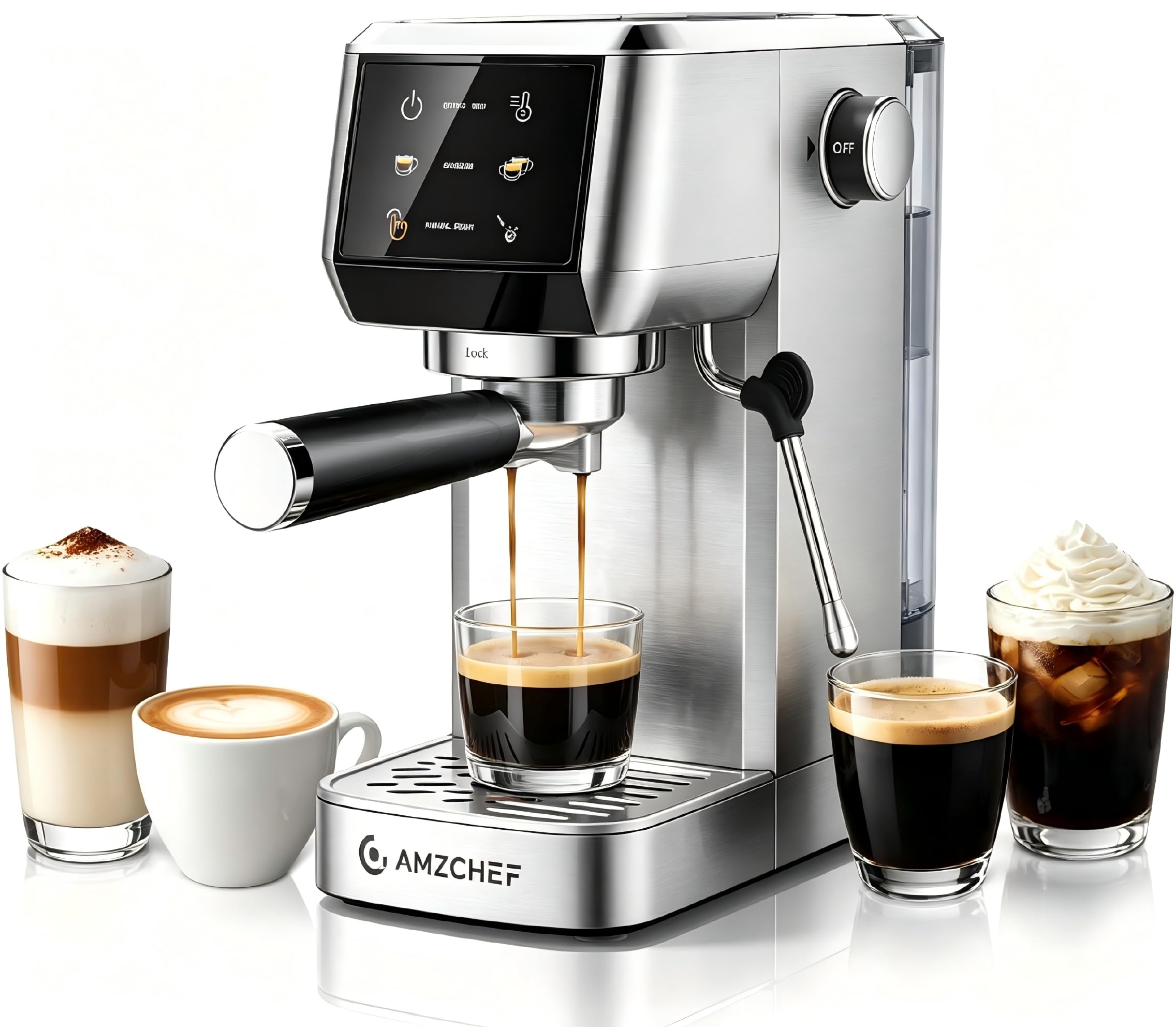
2. AMZCHEF Espresso Machine 20-Bar
Ready in about thirty seconds — the fastest warm-up on this list.
If your espresso habit is a five-minute window before work, the AMZCHEF was built for that. Its 1350W heating system reaches ready temperature in roughly 30 seconds, and the 20-bar pump follows with a quick single or double pull. That is the kind of timing that fits between the alarm and the door, and it explains why performance is the trait owners bring up most about this machine.
The temperature control is the part worth pointing at. You get a three-level PID — a controller that holds a steady brew temperature — set at 194°F, 198°F or 201°F. Different beans want different heat, so being able to nudge that dial lets you get a sweeter shot out of a darker roast or a brighter one out of a light roast, without changing anything else. The 360° steam wand swivels so you can angle the pitcher comfortably, and the touch panel offers single, double, or manual extraction. All of that sits in a 12.1″D x 13″W x 6.5″H frame, which is 10% shallower than the Neretva at 11″D x 12″W x 9.1″H — note if your counter is short on depth.
Two numbers to keep straight: this machine is the smaller of the pair on weight at 8.5 pounds, versus 17 pounds for the Neretva, so it will shift slightly when you lock in the portafilter. The removable 44 oz water tank keeps refills simple, and 15-minute auto-off saves you from leaving it running. The recurring gripe in owner feedback is small rather than structural — nothing about the brew itself, but a reminder that the lightweight body needs a steadying hand during tamping.
Why it earns its spot: a 30-second preheat plus a three-level PID is a rare combination in this compact class, and it lets you tune the shot to the bag of beans you actually bought.
The right pick for: anyone whose coffee has to happen on a schedule, and who wants some control over brew temperature.
Think twice if: you prefer a heavy, immovable base when you tamp — this one is light on purpose.
3. Amaste Espresso Machine Touch Screen
A milk tank and six presets that turn a latte into a button press.
This is the machine for the household where the milk drink is the point. A built-in frothing system draws milk straight from the container and mixes it with steam, so you choose dense or silky foam and the machine does the work. Six preset modes cover single or double shot espresso plus small and large latte and cappuccino, all from a touchscreen. If you have ever fumbled a pitcher in the morning rush, that simplification is the entire appeal.
The brew side runs a 20-bar pump with pre-infusion, and an NTC thermistor — a temperature sensor that keeps the brew bath in a set band — holds the machine between 197°F and 204°F. The 60 oz water tank is the biggest on this list, which means more drinks before a refill, and the froth pathway has an automatic clean cycle: set the knob to “clean,” press the button, and the machine flushes itself. The top cup warming tray is a nice touch for keeping your mug hot before the shot lands.
The owner feedback is mixed. The most-discussed aspect in owner feedback is general quality, and much of that discussion is mixed rather than glowing. The brewed drinks themselves get strong marks — flavor and brew quality are both praised — but temperature is the sore spot. Several owners mention the milk does not get properly hot. That is the trade-off to weigh before buying: if you want a hot flat white, expect to warm the milk further or adjust your technique. The built-in tank also means the frothed-milk parts need regular rinsing, even with the auto-clean cycle. One practical note from owners: the machine can run more volume than the cup sizes suggest, so use a taller mug than you think you need to avoid overflow.
The honest read: excellent for a household that wants cappuccinos without touching a steam wand, less suited to anyone who demands scalding-hot milk every single time.
Reach for this if: you want a one-touch milk drink and a big 60 oz tank that keeps you out of refills.
Weigh the alternative if: milk temperature is the deciding factor in your morning cup.
4. AYCHIRO Espresso Machine with Milk Frother

Stainless steel, a cup warmer, and a frother that works harder than the price suggests.
What stands out on the AYCHIRO is the spec list relative to where it sits in this lineup: a 20-bar pump and a 1350W element, plus a cup warmer, a removable water tank, and a removable drip tray. The stainless-steel body is the feature that earns the most positive owner attention, and it does look the part on a counter. For a semi-automatic machine, the workflow is about as simple as it gets — grind, fill, tamp, press.
The frother is the surprise. It is stronger than most people expect, and customers note it can turn a half cup of milk or creamer into foam fast enough that it might overflow if you walk away. That is a good complaint to have. One practical note from owners: the machine does not ship with a milk frothing cup, so plan to add one — you will want a metal pitcher you can hold rather than a mug that gets too hot to touch.
The trade-off here is the learning curve. This is a machine you have to learn, and owners read the manual for a reason: the first few shots can come out weak or poorly extracted. It also uses a double-espresso dose where a second press adds more, weaker coffee, so anyone expecting a single perfect ristretto will need to adjust. For anyone willing to spend a week dialing it in, the results are a small, sleek machine that earns its counter space back.
Best suited to: a small kitchen that wants a stainless machine with a strong frother and a cup warmer, and someone patient enough to read the manual.
Less ideal for: a purist chasing a precise single-shot ristretto with no button re-presses.
5. Electactic Espresso Machine with Built-in Grinder
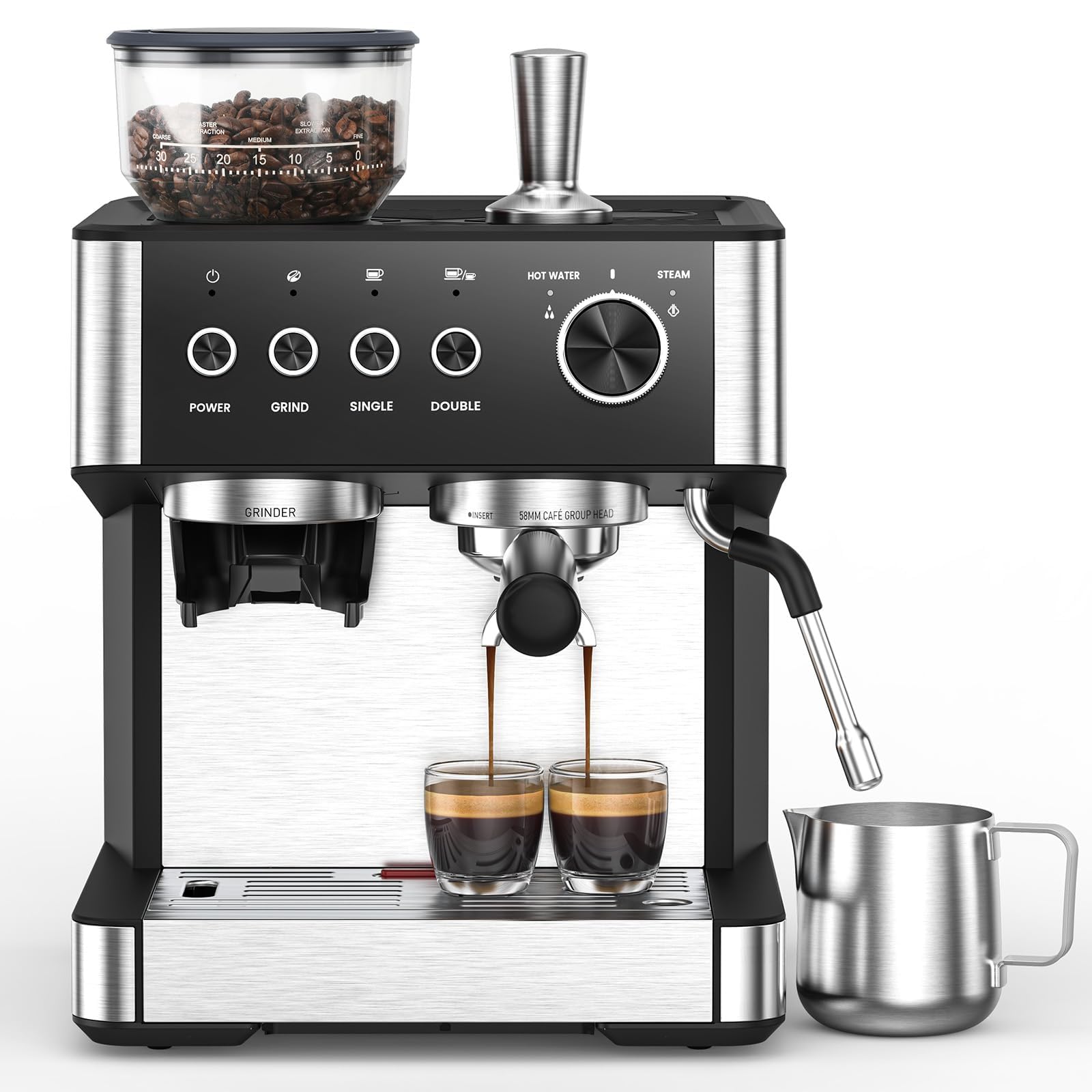
A built-in grinder so your beans go from bag to shot without a second appliance.
If you want fresh-ground coffee without cluttering the counter with a separate grinder, this is the pick. It has a built-in anti-clog grind path with a polished chute and reinforced helical auger, designed to eject grounds instead of holding onto them even with oily dark roasts. That is the feature that defines the machine: buy whole beans, dump them in, and skip the separate grinder entirely.
A few numbers differ from the rest of this list. The portafilter here is 58mm, not 51mm, and the pump is 15 bar rather than 20. Neither is a problem — a 15-bar pump still produces the pressure needed for crema — but know that the dosing will feel different from the 51 mm machines. You also get a 2.3-liter removable water tank, which is the second-largest tank on the list behind the Amaste’s 60 oz, plus a stainless milk jug and both single and dual wall baskets in the box. The 18-pound body is heavy enough to stay planted. A detachable drip tray makes cleaning easier and the machine carries ETL certification.
Owner reviews flag two recurring problems. Noise is the recurring complaint — several owners describe it as loud, and grinding plus brewing will not be quiet. There are also reports of water leakage, so inspect the seals and tank seat on arrival. Performance is what wins owners over: it is the most-praised trait by a wide margin, followed by value. A grinder failure inside the first two months shows up in the feedback, and support response has been an issue for some, so the warranty matters. Treat the grinder like an appliance that needs cleaning, not a maintenance-free part.
Selling Points
- Built-in anti-clog grinder replaces a separate appliance — whole beans to shot in one machine.
- 2.3-liter removable tank, the second-largest on this list.
- 58mm portafilter plus stainless milk jug and both basket types included.
- ETL certified, 18-pound body stays planted, detachable drip tray for easy cleaning.
Watch-Outs
- Noise is the mixed-feedback metric — expect a loud grind and brew.
- Some reviewers point out water leakage; check the seals and tank seat on day one.
- 15-bar pump is lower than the 20-bar machines here.
- Grinder failures and slow support surface in a small number of cases.
Pick this when: you want to buy whole beans and skip a separate grinder without giving up counter space.
Hold off if: a quiet kitchen is a priority for you.
6. Gevi 20 Bar Espresso Maker with Milk Frother

Full stainless housing and a pressure gauge that lets you see the extraction.
The Gevi’s reason to exist is on its face: full stainless-steel housing, a 20-bar pump, NTC temperature control, pre-infusion, and a pressure gauge. That gauge is the feature that makes it stand out from the cheaper 51 mm machines — you can actually watch the needle and learn what a good pull looks like. Combined with a removable froth nozzle that comes off for cleaning, the machine is built for someone who wants to understand the process, not just press a button.
At 8.6 pounds in a 12.3″D x 5.5″W x 12″H body, it is the narrowest of the 51 mm machines here — the 5.5-inch width is the number that matters if your counter is tight alongside a sink. Milk foaming extends to whole, oat, and soy, so a dairy-free cappuccino is doable. The 1-liter tank is on the smaller side, which means more refills in a busy household but also a compact footprint. Shoppers say that with good beans, the espresso and crema are strong for the money, and a warming tray keeps cups hot.
The trade-off to know is durability. The pressure gauge is the part that shows up in owner complaints, breaking after several months in a handful of cases, and the heating element failing at around seven months appears in feedback too. Gevi’s replacement support is generally responsive but the process can be lengthy. Filter baskets are dual-wall only, so you cannot step up to a single-wall basket later for a finer grind. If you accept it as a capable mid-budget machine that may need a warranty claim down the road, the price-to-performance ratio is compelling.
My take: the pressure gauge is a real teaching tool, and the stainless housing reads better than most at this level — just register the warranty on day one.
A fit for: tinkerers who want to learn from a visible pressure gauge and a solid stainless build.
Not for you if: you expect a maintenance-free appliance for many years without any support contact.
7. Laekerrt 20 Bar Espresso Maker CMEP01

A PID chip and an Italian-made pump in navy blue stainless.
The Laekerrt CMEP01 is the machine that keeps one thing steady: temperature. It uses a PID control chip — a small processor that holds the brew temp within a tight band — and pairs it with a 20-bar Italian-made pump. That combination is what good espresso depends on, and it means the shot you pull on Monday should taste like the one on Friday. The adjustable stainless steam wand has enough length to reach different pitcher geometries, and the cup warmer keeps your mug warm before the shot.
The CMEP01 ships with a carafe, a reusable filter, and button controls, and holds 35 fluid ounces of water. That is a tank sized for a few drinks, not a party. The navy-blue polished body is distinctive, and the double-shot function is a single tap on the shot selection button. At 4.0+ stars and a large review base, it is one of the more established picks on this list — the appearance and ease of cleaning are both praised consistently.
The weak spot is long-term reliability. Owner feedback on durability splits: plenty of people report it functioning excellently for a long time and consider it good value, while a smaller group says it stops working properly and is not worth the cost. That is a normal spread for a budget-to-mid machine, but it is worth weighing if long-term reliability is your top priority. The 35-fluid-ounce tank also means refills are more frequent than on the bigger 60 oz Amaste.
Best fit for: someone who wants PID temperature control and a proper Italian pump without moving into premium territory.
Better elsewhere if: a large water tank is high on your list — the Amaste carries far more.
8. SHARDOR 20 Bar Espresso Machine with LCD Display

A clear LCD, a 30-second thermoblock, and a cup warmer that earns its keep.
The SHARDOR is the machine to look at if you want to see what you are doing. The LCD display sits above simple button controls, and the stainless body with a warming tray on top reads clean on a counter. A 1350W thermoblock heating system gets it ready in about 30 seconds, so the warm-up is short even on a rushed morning. You get stainless filter baskets for single or double shots, and it pulls a double shot into one cup without fuss.
Value is the thread owners pull on most, and brew quality sits right behind it — the shots come out with crema, and the double-shot capability is a frequent point of praise. The 20-bar pump with an adjustable steam wand covers lattes and flat whites. Compact at 10.9″D x 9.1″W x 11.3″H, it fits a tight corner, and the machine carries a 2026 manufacture year. One owner sums the feeling up tidily: “Great for non expert coffee people like me. Prettu easy to figure it out, works great so far.”
Two maintenance points matter here. First, this machine needs descaling on a schedule — mineral scale builds up internally and will affect the shots if you ignore it. A regular descale every 30 days with a diluted vinegar solution, then a thorough rinse, is the routine one owner lays out in detail. Second, the steam pipe handle can run very hot after frothing, so use a cloth when you move it. Neither is a flaw; both are standing instructions. The drinks themselves land warm but on the milder side of the temperature spectrum for some palates.
Where it wins: the LCD plus the 30-second heat-up makes this the most beginner-friendly machine to actually operate, and the shots back it up.
The housekeeping: descale every month or the internal scale will drag the shots down — that is a real chore, not optional upkeep.
Choose it for: a clear readout, a fast start, and single- or double-shot flexibility in a compact body.
Pass if: you want a machine you can ignore for months at a time without descaling.
9. PHILIPS Baristina Espresso Machine

Swipe the handle and the machine grinds, tamps, and brews for you.
The Baristina is the anti-hobbyist machine. It grinds, tamps, and brews with a 16-bar pump, and the whole bean-to-cup sequence runs in under 60 seconds — you swipe the handle and let it work. There is no grind-size dial, no manual tamping, no pitcher juggling. If you want a real espresso shot in the morning without learning puck prep, this is what that looks like. The espresso, lungo, and extra-intense options cover the range without asking you to dial anything in.
The physical package is small: a 14.96″D x 7.09″W x 13.58″H body in white with a wood handle, and over 50% recycled plastics in the non-contact parts. A 1.2-liter water tank handles several drinks, and the machine is quiet compared to the steam-wand machines on this list — no high-pitched hiss. Owners praise the simplicity, the crema, and the easy cleanup. The grounds eject cleanly and the whole thing wipes down in a minute.
The defining trade-off is durability. The Baristina’s durability is a real concern in owner feedback: portafilter breakage, water leaking from the top of the portafilter, low pressure, and units stopping after a handful of months all appear in the record. A protection plan is a sensible add. The other honest limit is flavor depth — the machine favors medium roasts, and owners coming from a manual machine find the shot milder and less intense than what a heavier pump can produce. It is a convenience-first machine, and it is honest about that.
The offer: the least effort of any machine here — grind, tamp, and brew in one swipe, in under a minute.
The price of that: owner-reported reliability concerns around the portafilter, so a protection plan earns its place.
Suits you if: you want real espresso with zero puck prep and you value quiet, easy cleanup.
Skip the trade-off if: you want the last word in intensity and plan to keep the machine for many years untouched.
10. De’Longhi EC9665M La Specialista Maestro

Eight grind settings, five temperature profiles, and a tamping station — the deep end.
If you are the kind of person who wants to own every variable, the La Specialista Maestro is the machine on this list built for that. Sensor Grinding Technology gives you 8 grind settings and a digital dosing guide. The Smart Tamping Station works with the sensors to set consistent pressure and dose with less mess. Dynamic Pre-Infusion adapts to the density of the dose, and Active Temperature Control offers 5 infusion profiles that vary by bean type. Each of those is a lever you can pull to chase a better shot.
The scale is real: a 35.3-pound stainless body in a 14″D x 16.5″W x 18.5″H frame. That is the tallest and widest machine here by a wide margin, so measure your overhead cabinet clearance before you commit. The 100 ml capacity figure is small, and owners say the water tank is adequate but the rear placement is annoying to fill. Once you get it dialed in, the extraction is excellent — owners describe full-flavor shots and consistent results, and the LatteCrema system handles milk automatically with a stainless frothing jug included.
You pay for control and give up simplicity. Dialing in takes about a month of trial and error for some owners. The grinder requires scheduled maintenance, and a clogged chute is a real risk if you ignore it — plan to clean the grinder at regular intervals. De’Longhi’s support line has been hard to reach for some. Own it as a high-involvement machine and you will get the most out of it; treat it as a set-and-forget appliance and it will frustrate you.
Why hobbyists want it: you can vary grind, dose, and temperature profile independently, which is the whole point of a machine like this.
Why some buyers regret it: the schedule — grinder cleaning, descaling, and a steep learning curve — is real work, not a one-time setup.
The machine for you if: you want to dial in every variable and can give it the maintenance schedule it needs.
Not your machine if: you want to press one button and walk away.
Know the Specs
51 mm portafilter and basket size
The portafilter is the handle-and-basket assembly you fill with grounds. A 51 mm basket holds a smaller dose than a 58 mm basket, so the same bag of beans stretches further and the machine can be built slimmer. The trade-off is that a smaller basket leaves less room for error in the dose — but on these machines, most ship with pressurized baskets that add back-pressure and forgive a coarser grind. If you mainly brew medium and dark roasts and want the shot to pull reliably without a scale, a 51 mm machine is the easier tool to learn on.
Pump pressure in bar
Bar is a pressure unit — 20 bar is twenty times atmospheric pressure. Higher is not a guarantee of flavor, but a 20-bar pump paired with pre-infusion gives you even extraction and full crema. Some machines here use 15 bar or 16 bar and still pull good shots, so treat pressure as one input rather than a headline. The wattage figure next to it (1350W on several here) tells you how aggressively the heating element runs, which drives how quickly the machine is ready to brew.
PID and NTC temperature control
A PID is a small controller that holds the brew temperature steady; an NTC thermistor is the sensor it reads. Together they keep the brew water in a set band — the Amaste holds 197°F to 204°F — so the shot tastes the same from one morning to the next. Without that control, temperature drifts and your coffee turns sour or bitter. If you switch beans often, having a temperature you can adjust is the feature that keeps you in control.
Steam wand vs built-in milk tank
A steam wand is the metal tube that injects steam into a pitcher of milk; you hold the pitcher and manage the foam by feel. A built-in milk tank draws milk and froths it automatically, which is faster and more consistent but adds parts to rinse. Manual wands reward practice with better microfoam, and a 360° swivel wand makes pitcher positioning easier. Automatic systems suit drinkers who want the same cappuccino every day without the fumble.
Common Questions
Will a 51 mm portafilter basket fit the same cups as a 58 mm machine?
Is 20 bar actually better than 15 bar for espresso?
How long does a 51 mm espresso machine take to heat up?
Do I need a separate grinder with these machines?
How often should I descale a 51 mm espresso machine?
Can I use pre-ground supermarket coffee in a 51 mm machine?
Is the steam wand hard to use for a first-time latte maker?
How much counter space do I need for a compact espresso machine?
What is pre-infusion and does it change the taste?
Should I pick a 51 mm machine with a milk tank or a steam wand?
The Bottom Line
For most kitchens, the 51 mm espresso machine that gets the balance right is the Neretva 20 Bar Super Compact. Its 1.31-liter tank, 51 mm portafilter, and included single and double baskets mean you can brew on day one without buying extras, and it carries the group’s highest owner rating at 4.0+ stars across 1,300+ reviews. If you want your machine ready in about thirty seconds with a three-level PID to tune the temperature, the AMZCHEF is the one to reach for. And if the milk drink is the whole reason you are buying, the Amaste with its built-in milk tank is the shortcut.
One last honest note before you commit: nearly every machine here rewards the same two habits. Warm your cup with a blank shot, and give the steam wand or milk tank a rinse right after you use it. Do those two things and a compact 51 mm machine pulls a cappuccino worth skipping the café queue for.
How we choose
We do not accept paid placement. Every pick is matched to a real buyer and a real use-case; we do not hands-on test units.
Sources
Specifications: manufacturer listings and product documentation. Review insights: verified customer reviews, as of October 2026. Pricing: not shown on this page (it changes often); check the current price via the retailer link.
As an Amazon Associate, Aappliancez earns from qualifying purchases. This does not affect which products we feature.