Disclosure: Some links in this post are affiliate links. As an Amazon Associate I earn from qualifying purchases, at no extra cost to you. Learn more
Specs are compiled from manufacturer listings and verified buyer reviews and can change over time — please confirm the key details on the product page before buying.
If you are shopping for a 50W-class HF transceiver, the fastest way to waste money is to buy watts you never use and skip the one part that decides whether you get on the air at all — the antenna tuner. A rig that loads a random wire in seconds will make contacts on a wet Tuesday; a rig with double the output and no tuner will sit there flashing a high-SWR warning. This guide sorts the nine radios worth your attention by what they actually do in the field, from a 20W backpacker that talks across an ocean to a 100W mobile that runs off your truck battery.
This guide is built by comparing the manufacturers’ published specifications and the patterns across verified customer reviews, so you get each pick’s real strengths and trade-offs instead of marketing spin.
Power ratings on this shelf run from a single watt up to a full 100W, so the trick is matching the output to where you actually operate. Below, every pick is broken down by tuner range, band coverage, and the honest trade-off you live with daily, so you can narrow down the right 50W HF Transceiver without guessing.
Top Picks


How To Choose The Best 50W HF Transceiver
Two radios on this page can both claim 50W-class output and still behave nothing alike, because output power is only one number on the box. What decides your day is whether the radio can load the antenna you actually own, whether it covers the bands you talk on, and whether the control layout fights you when you are standing in a field with cold fingers.
Antenna tuner range beats extra watts
A built-in automatic antenna tuner (ATU) is a circuit that matches the radio to whatever wire or whip you connected, so the transmitter sees a safe load instead of reflecting power back at it. A wide-range tuner loads a random-length wire or a coiled field antenna that a narrow tuner simply refuses. If your tuner can only handle a narrow slice of mismatch, you end up carrying an external tuner box anyway, which defeats the point of a compact rig. Read the tuner range before you read the wattage.
Band coverage and mode support
HF (high frequency, roughly 1.8 to 30 MHz) is where long-distance contacts live, while 6M and up adds local and repeater traffic. Check whether the radio you are eyeing covers 160 through 6 meters, or just a slice. Mode support matters too: SSB (single sideband, the voice mode used on HF), CW (Morse), AM and FM. All-mode radios hand you the whole toolkit; a narrower radio locks you out of some of it.
Mobility: detachable heads and power draw
If the radio is going in a vehicle, a detachable or remote-mountable display lets you hide the body under a seat and keep the controls in reach. For backpacking, weight and current draw decide whether a small battery lasts a full activation or dies halfway. A 100W rig and a 20W rig can be the same physical size — the difference shows up in how much battery they drain.
Side-by-Side Comparison
| Model | Best For | Output Power | Band Coverage | Built-in Tuner | Amazon |
|---|---|---|---|---|---|
| Xiegu G90★ Best Overall | Portable field and backpack use | 20W | HF bands | Yes — wide range auto | Amazon |
| Midland MXT500Best Value | Vehicle and base GMRS comms | 50W | GMRS / UHF | — | Amazon |
| AnyTone AT-D578UVIII PlusMost Versatile | Multi-band voice and DMR work | 50W VHF / 45W UHF | 144-148, 420-450, 222-225 MHz | — | Amazon |
| Xiegu X6100 | Travel and RV portable HF | 5W to max 10W | 3-30 MHz HF / 50MHz | Yes — auto | Amazon |
| Midland BR180 BizTalk 6-Pack | Indoor warehouse and hospitality teams | 1W | UHF | — | Amazon |
| Yaesu FT-891 Bundle | Mobile HF with a quick-reference card | 100W | HF / 6M | — | Amazon |
| Yaesu FT-891 | Compact mobile and base HF | 100W | 160 to 6 meter bands | — | Amazon |
| ICOM 7300 | Home-station HF and general receive | 100W (25W AM) | 0.030-74.800 MHz RX | Yes — built-in | Amazon |
| Icom IC-705 | All-band portable QRP with remote control | 10W external, 5W battery | HF/VHF/UHF all mode | — | Amazon |
Detailed Reviews
1. Xiegu G90 HF Radio Transceiver
Our pick — 4.5+★ from 400+ verified ratings; the strongest balance of quality and price.
Twenty watts, a tuner that loads almost any wire, and a screen you can actually read outdoors.
The number that sells the G90 is not its 20W output — plenty of radios make more watts. It is the wide-range internal automatic antenna tuner, which means the radio can match a random-length wire or a coiled field antenna without you schlepping a separate tuner box. That is the whole reason this rig keeps winning portable operators over: one box, one wire, you are on the air. At 3.53 pounds it slings into a backpack without argument.
The detachable display unit separates from the radio body, so you can park the head on a dashboard or a picnic table and tuck the body away. Around the screen, the 48 kHz wide spectrum display with waterfall shows you where the signals are instead of leaving you to hunt — genuinely useful when you are standing in a field with a compromised antenna. A 48 kHz spectrum readout is about seeing traffic before you transmit, and that is what saves your activation time.
Where owners land: the tuner does the heavy lifting. Owners regularly report contacts of 4,000 miles and beyond on an omnidirectional antenna, including one North Carolina-to-Slovenia stretch logged at “4691 miles on 15 watts.” A cool head helps here — the consensus is quality first, value second, with the interface and feature set close behind. The recurring gripe is reliability and signal consistency, which the data lists as mixed, so treat a G90 as a superb 20W field rig rather than a backup for a 100W home station. It also carries an 18-month warranty through the maker, void if you modify the hardware.
What earns the top spot
- Wide-range internal ATU — loads a random wire or field antenna without an extra box
- Detachable display head — mount the controls remotely, hide the body
- 48 kHz spectrum and waterfall — you see signal conditions before you transmit
- 3.53 pounds and runs all day on a small battery, per owner reports
Where it pushes back
- 20W will feel thin to a beginner leaning on a poor antenna
- Menu-driven controls and a small screen take real learning time
- Reliability and signal consistency read as mixed in owner feedback
Reach for this if: you activate parks, hike with a wire, and want one compact box that loads almost anything.
Think twice if: you want plug-and-play and see 20W as a daily ceiling rather than a portable specialty.
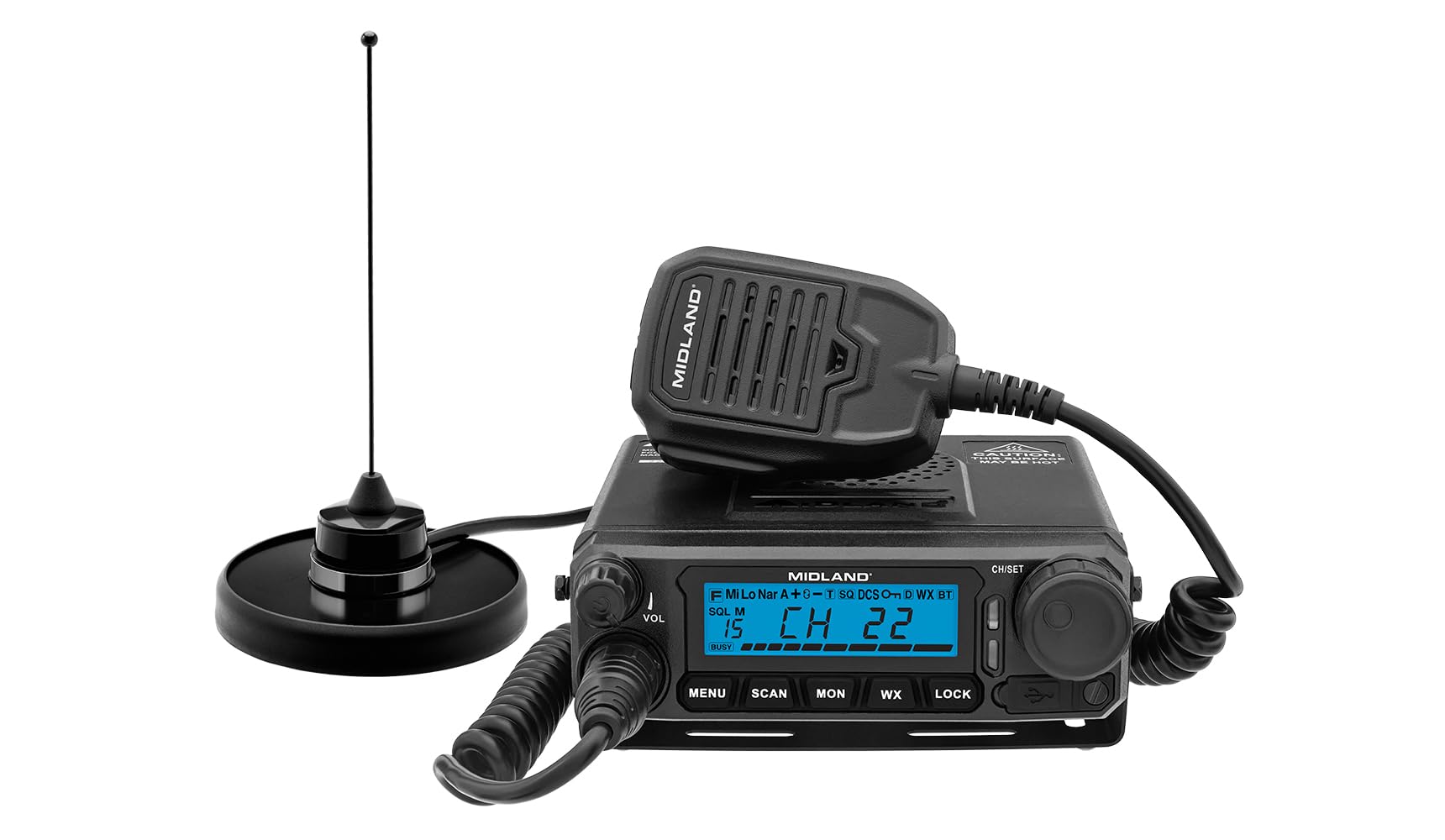
2. Midland MXT500 50W IP66 MicroMobile GMRS Two-Way Radio
A full 50W in a sealed body small enough to clear a truck dash.
If you ride trails, run a farm, or want a dependable base for the family, the MXT500 delivers 50W into a compact chassis measuring 1.75″D x 5.5″W x 8″H. That is roughly half the depth of the AnyTone mobile rig above, which runs 7.5″D x 5.5″W x 2″H — a difference that decides whether the radio tucks under a dash or fights for space.
The dB figure printed for audible noise is 0.5 db, and what owners actually notice is the tail end of that: voices arrive clean instead of buried in hiss, so you catch callsigns the first time. The manufacturer claims repeater hits up to 85 miles, but that figure depends on terrain and antenna — a stock whip and an upgraded MXTA26 do not perform the same. Beyond voice, there is NOAA weather scan and alert with 128 channels and 8 repeater channels, which matters less for talking than for knowing when the weather is turning.
Owners call this one simple to install and easy to set up, and the “IP66” rating means it is sealed against dust and strong water jets, so rain and trail dust are not the enemy. Sound quality carries the most praise by a wide margin, with the signal side well behind it. The recurring gripes are cost — the data flags it as mixed on value — and an internal speaker noted as weak, with an external Midland unit recommended for the best sound. Programming over a computer is the faster path; the manual route works but takes patience.
What buyers notice: mount it in a side-by-side and the reception holds up in the mountains — loud and clear even where terrain should not cooperate.
The honest trade-off: GMRS and NOAA only. If you need amateur HF bands or DMR talkgroups, this is the wrong shelf entirely.
Built for: trail trucks, UTVs, farm and ranch work, and anyone who wants a sealed 50W base that sets up in an afternoon.
Look elsewhere if: you need to key up on amateur bands or lean on talkgroups rather than simplex channels.
3. AnyTone AT-D578UVIII Plus Tri-Band DMR Mobile Radio
One chassis that covers 2 meters, 70 centimeters, 220, and air band at once.
Frequency coverage is where this radio separates itself from everything else on the page. You get 144-148 MHz, 420-450 MHz, and 222-225 MHz from a single unit, plus air band receive and APRS location data in and out. APRS is the amateur position-reporting system, so the radio will beacon where you are while you talk. Digital modes ride along too, and the tuner covers UHF, VHF, and 220 rather than one slice of the spectrum.
Output runs 50W on VHF and 45W on UHF, and it carries 4000 channels, which is why owners describe the codeplug work as the real setup task rather than poking at buttons. Head-to-head with the Midland MXT500, this rig is heavier at 4.2 pounds and physically deeper, and it does not carry the same sealed weather rating — but it talks on bands the GMRS radio cannot touch. Power here rewards operators who want bands and channels, not just range on one service.
Buyer praise centers on radio quality by a clear margin, with value and audio behind it. The standout detail from owner experience is a Bluetooth PTT that pairs flawlessly, and a GPS antenna described as sensitive enough to lock indoors in about ten minutes and outdoors in roughly thirty seconds. Programming splits opinion, and ease of use reads negative in the data, so this is a learn-the-codeplug radio. It ships with a codeplug and a training course to shorten that path, which is unusual on this shelf.
Worth knowing: this is licensed amateur gear, so plan on the appropriate license before you transmit on these bands.
Suits operators who: want multiple bands, DMR, APRS and Bluetooth audio out of one mobile install and will invest time in a codeplug.
Not the pick if: you want it working straight from the start without any programming effort.
4. Xiegu X6100 HF Radio Transceiver

A self-contained field station that fits in a daypack and runs off its own battery.
The case that matters most here is the one it comes in: 1.9 pounds with a battery built in, which makes it the lightest full HF rig on this page. The screen is the other headline — 4 inches at 800×400, which is big enough to read a waterfall at arm’s length instead of squinting at abbreviations. Both of those details point at the same buyer: someone running the radio from a hotel balcony, a trailhead, or an RV diner table where setup space is scarce.
The architecture is SDR, meaning software handling the modulation and demodulation work, so the radio can put more live information on screen and process it faster than a conventional design. Power runs from 5W up to a max of 10W, and the maker notes that pairing it with an XPA125B amplifier opens up longer-range work. The built-in automatic antenna tuner means the wire you brought is the only antenna you need to carry.
Owner experience is genuinely mixed, and the split is worth understanding before you buy. The display earns the loudest praise — one buyer points to the 800×480 resolution straight out of the spec sheet — and the intuitive interface and sensitive receive draw compliments too. Against that, the battery reads as minimal, with one owner reporting the internal pack running on the order of a couple of hours of SSB or CW before it quits. Some units have frozen during operation and documentation is thin. Owners also note that the display is not a touchscreen and the CW decoder outputs gibberish, so this is not a radio that forgives impatience.
Practical heads-up: update the firmware and do a factory reset first thing, since the shipped state is not always the best one, and plan on carrying spare power for longer activations.
A strong fit for: travelers and field operators who value weight, an integrated battery, and a readable display over raw watts.
Look past it if: you need long off-grid runtime without supplemental power, or you expect crisp documentation and a flawless first boot.
5. Midland BR180 BizTalk UHF Business Two-Way Radio 6 Pack

Six radios, one charging dock, and a 14-hour battery shift that covers a full workday.
This is the outlier on the page and it deserves to be, because it solves a different problem. The box holds six handhelds, a dock that charges all six at once and stores spare batteries, and ear-wrap headsets with push-to-talk. For a restaurant floor, warehouse aisle, or hotel team, that is a working system on day one — no bench or antenna farm required.
Power is 1W on UHF, and that figure is the honest dividing line. Low power here means long battery life and clean indoor coverage, and it also means limited wall penetration and range — the maker is not hiding that, and owners call it out. Channels are pre-programmed on four UHF business frequencies, so the setup is essentially unpack, charge, hand out. The case says 4 channels on the box and 56 in the listing title, but the working number for your team is the pre-programmed set you get from the start; confirm exactly what your batch ships with if channel count matters to you.
What owners appreciate is the build and the fit — a solid handset, a comfortable headset for long shifts, and a dock that charges everything in one place. The recurring friction is coverage: it is the right radio indoors and the wrong one across hilly terrain, and the reviews are blunt about that split. One thing to sort before you order: these operate on business frequencies that require an FCC license, so this is not a grab-and-go for personal use the way GMRS is.
Field note: buy for a fixed indoor footprint — retail, hospitality, warehouse — where 1W is genuinely enough.
Go here when: you are outfitting a team inside a building and want six radios plus a shared dock with nothing else to buy.
skip it if: your crews work outdoors across distance, where the low output will let you down.
6. Yaesu FT-891 HF/6M All Mode 100W Mobile Transceiver

A hundred watts of mobile HF with a laminated cheat card for the buttons you forget.
Same radio as the standalone FT-891 below, packaged with a quick-reference card that stays in the glovebox. That sounds like padding until you are three hours into a drive and cannot remember which menu buried the keyer speed, and the card solves it in one glance. USB connectivity is on board, and the rig covers 1.6 MHz to 54 MHz, so HF through 6M is all inside the one chassis.
Output is 100W with all-mode operation, and the dual-band reach means a single mount can serve your HF work and your 6M local nets. It runs off a 100-channel memory system, which is generous once you get your regular frequencies loaded. Owners running it from a Silverado alongside a Yaesu FTM 400XDR describe adding HF to an existing mobile install and calling it the right call — that is exactly the scenario this bundle targets.
Buyer sentiment leans positive, with 4.0+ stars across 20+ ratings on this listing and the recurring theme that it takes a learning curve for the controls. That tracks with the reported experience: excellent TX/RX performance for portable work, hard-to-find availability because of ham radio popularity, and the usual menu-deep control scheme. One unit arrived non-functional and went back for replacement, which is the kind of thing that happens with any electronics shipment and not a pattern. Power here is real, and that is the point of the bundle.
Why the bundle: same transceiver as the standalone, plus a reference card that answers the menu questions a paper manual answers slowly.
Best for: mobile operators who want 100W HF and 6M in one chassis without hunting down a reference sheet separately.
Hold off if: you already know this radio and do not need the quick-reference card, or you are not ready to work within a deep menu tree.
7. Yaesu FT-891 HF/50 MHz All Mode Mobile/Base Transceiver

A hundred watts in a body small enough that the install is the easy part.
The FT-891 makes its case with numbers: 100W across 160 through 6 meters, all-mode operation covering AM, FM, USB, LSB and CW, and a chassis measuring 8.27″D x 6.1″W x 2.05″H at 8.4 pounds. That is a desk-sized footprint for a rig that keys a full 100W, which is why it shows up in vehicles and on POTA tables interchangeably. It pairs with the ATAS-120A automatic tune antenna for mobile work.
Owners running it for CW and mobile use point to the zero-beat button, the clear display, and the adjustable audio peak filter that can stand in for a narrow crystal filter. Programming is described as easy, and the omission of 2m and 70cm is framed as a feature rather than a gap — this is an HF and 6M machine, and it does not pretend otherwise. A prepper build in the reviews pairs it with a tuner, an outdoor antenna, a solar panel and an inverter in a Pelican case, which tells you the form factor is small enough to pack as a go-bag.
Where the reports get honest: the front end can overload from strong nearby stations, there is no internal tuner so an LDG or similar external box is part of the budget, and the menu tree is deep enough to be called hefty. Output is reported at 90-92W rather than a full 100W on some units, and the rear audio port has a hiss some owners notice. It ships with a 3-year Yaesu warranty, and the frequency stability comes from a TCXO, which is the internal clock that keeps you on frequency as the radio warms up — the kind of spec you only miss when it is absent.
Why it earns the spot
- 100W across 160 to 6 meters in a 2.05-inch-tall chassis
- TCXO frequency stability — holds frequency as the radio heats up
- 3-year Yaesu warranty backing the build
- Adjustable APF and zero-beat button make CW work comfortable
What you will live with
- No internal tuner — you will buy and mount an external one
- Front end can overload near strong local signals
- Menu-heavy controls and modest audio from the rear port
Pick it for: compact 100W HF and 6M in a vehicle or base, especially if you want a proven, warranty-backed transceiver.
Budget for more if: you have no tuner and no antenna solution, since both are separate purchases here.
8. ICOM 7300 02 Direct Sampling Shortwave Radio Black

A direct-sampling 100W home station that doubles as a general-coverage receiver.
The architecture is the headline: direct sampling means the radio digitizes the incoming signal at the receiver front end instead of down-converting it through analog stages first, which is why the band scope is this responsive and why the radio is this quiet. Receive covers 0.030 to 74.800 MHz, so you are not limited to amateur bands — shortwave broadcast, utility signals and more are all inside the tuning range. Roughly the size of a small amplifier at 8.4 pounds, it is a tabletop station rather than a go-bag.
Output is 100W in SSB and CW, dropping to 25W on AM, and there is a built-in antenna tuner so you are not adding a box to get on the air. All three of those details — direct sampling, wide receive, integrated tuner — are why this radio has held its place as the default first serious home HF station. Compared with the FT-891, you are trading the compact mobile form factor for a bigger front panel, a wider receive range, and a built-in tuner.
Owner sentiment is strong and lopsided in the same direction: sound quality is the quality most often cited, followed by functionality, value and ease of use. In plain terms, buyers describe a rig that does what they need and then some, with audio reports they are happy to repeat on air, and a general-coverage receive that gets used for listening far beyond the ham bands. There is no meaningful negative pattern in the feedback — the complaints are the ordinary ones any rig attracts.
Why it stands out: the receive range plus a built-in tuner means one box covers your operating and your listening, with 100W behind it.
Right choice when: you are building a home station and want a well-rounded 100W HF rig with a wide-band receiver in one unit.
Not your rig if: you need a small, low-draw radio to carry into the field away from mains power.
9. Icom IC-705 HF/VHF/UHF All Mode Transceiver

Every amateur band from HF to 70cm in a box the size of a hardcover book.
Range is the reason this radio exists. Transmit coverage spans 1.800-1.999 through 430.000-450.000 MHz, so HF, 6M, 2M and 70cm are all handled by one handheld-sized unit. Receive spreads wider still, from 0.030-199.999 and 400.000-470.000 MHz, which makes it a capable scanner when you are not transmitting. The 500-channel memory bank is more than most operators will ever fill.
Power comes in two flavors depending on how you feed it: 10W when you connect the 13.8VDC external supply, or 5W on the included BP-272 lithium-ion pack at 7.4V and 2000 mAh. That split is the whole personality of a QRP radio — QRP meaning low-power operating, the discipline of making contacts on a handful of watts. The 4.3-inch touch screen raises visibility and operability in the field, and the Bluetooth and wireless LAN let you link to a phone for remote control rather than hunching over the radio itself.
Owners rate this one at 4.5+ stars across tens of ratings, which puts it at the top of this page for owner satisfaction, and the selling point in the feedback is consistency: it holds up in the field. Because the shape is unusual — 3.2″D x 3.29″W x 3.23″H, essentially a cube — it packs where a mobile rig will not, and the touch screen plus phone linking are what owners point to when they describe field usability. The catch is battery runtime; run it on the internal pack and you are working at 5W with a limited window, so plan your power strategy before a long activation.
The trade: the IC-705 gives you every band and a touch screen in the smallest possible body — the price is 5W battery output and shorter runtime on the internal pack.
Made for: operators who want all-mode, all-band coverage in a package that fits a backpack pocket.
Consider the FT-891 over it if: you need to run 100W from a vehicle, where the 705’s 5W battery ceiling will be the wrong shape for the job.
Know the Specs
Output power and what 50W actually buys you
Fifty watts is a useful middle ground: enough to work HF with a decent antenna, modest enough that many rigs sized at that output are still mobile-friendly. That said, on HF the difference between a 20W radio and a 100W radio is rarely the deciding factor in whether you make a contact — your antenna and your operating skill do more of that work. Where power does matter is weak-signal work and pileups, so treat 50W as comfortable, not guaranteed.
Antenna tuner: the spec buyers skip
A built-in automatic antenna tuner matches the radio to the antenna you actually have, so the transmitter sees a safe load. Look at the tuner’s range, not just its presence — a wide-range tuner can load a random wire or a field antenna; a narrow one will not, and you end up carrying an external tuner, which cancels out the compact rig you bought. If the radio you are considering has no internal tuner, budget for the external box and its cabling before you buy.
Band coverage and mode support
HF bands sit between roughly 1.8 and 30 MHz, where long-distance contacts happen. VHF and UHF, including 2 meters and 70 centimeters, are for local and repeater traffic. A radio that covers all three replaces two radios for many operators. On the mode side, SSB and CW are the HF workhorses, AM and FM handle utility and repeater traffic, and DMR adds a digital layer on top of the analog basics.
Power draw and portability
Two radios can be the same physical size and drain completely different amounts from a battery. A 1 amp receive draw on 100W gear is a good figure if you are running off a deep-cycle battery in a vehicle, while a battery-powered portable at 5W to 10W is aimed at a different job entirely. Match your portable rig to the power you can carry. A 14-hour handset battery covers a full indoor workday, while a 2000 mAh pack on a field activation runs out far sooner.
Common Questions
Will a 50W HF transceiver reach across an ocean?
Do I need a ham license to use the Yaesu FT-891 or the ICOM 7300?
What is the difference between HF, VHF and UHF bands?
Do I need a tuner if my radio has one built in?
Can I run a 100W mobile transceiver off my vehicle’s 12V system?
How much range should I expect from a GMRS radio like the Midland MXT500?
Should I buy a portable HF rig or a base station radio?
What does SDR mean on a transceiver like the Xiegu X6100 or X6200 generation?
Do I need to program a DMR mobile radio before I can use it?
Are 1W business radios like the Midland BR180 enough for a warehouse?
The Bottom Line
For most operators shopping the best 50w hf transceiver shelf, the right starting point is the Xiegu G90, because a wide-range internal tuner plus portability plus a readable 48 kHz waterfall gets you on the air with one box and one wire. If a vehicle install and 100W of headroom matter more, the Yaesu FT-891 is the one to mount. And if you want every bandin one pocket-sized unit, the Icom IC-705 is the pick. Whichever way you go, do not buy output power you will never use — buy the tuner range and the band coverage that match where you actually operate, then let the antenna do the rest of the work.
How we choose
We do not accept paid placement. Every pick is matched to a real buyer and a real use-case; we do not hands-on test units.
Sources
Specifications: manufacturer listings and product documentation. Review insights: verified customer reviews, as of October 2026. Pricing: not shown on this page (it changes often); check the current price via the retailer link.
As an Amazon Associate, Aappliancez earns from qualifying purchases. This does not affect which products we feature.