Disclosure: Some links in this post are affiliate links. As an Amazon Associate I earn from qualifying purchases, at no extra cost to you. Learn more
Specs are compiled from manufacturer listings and verified buyer reviews and can change over time — please confirm the key details on the product page before buying.
Buying a 50 liter hiking backpack is mostly a bet on one thing: whether the frame and hip belt can move the weight off your shoulders before mile eight. Below you will find seven packs that have survived real trail use, sorted by what each one actually does best, so you can match the bag to your trip instead of guessing.
This guide is built by comparing the manufacturers’ published specifications and the patterns across verified customer reviews, so you get each pick’s real strengths and trade-offs instead of marketing spin.
You will see how much weight each suspension system genuinely carries, where the lid and pocket layout helps or hurts on the trail, and which fabrics hold up to brush and rock. The goal is a simple one: you finish this page knowing which 50 liter hiking backpack fits the trips you actually take, not the ones in the brochure.
Top Picks
How To Choose The Best 50 Liter Hiking Backpack
Fifty liters is the size that covers most overnight trips and short multi-day hikes. That makes it a crowded shelf, and the differences that matter are rarely printed in big letters on the box. The four things below are what separate a pack you keep for a decade from one you resell after a season.
Suspension and load transfer
A 50 liter pack loaded for a weekend tends to land somewhere between 25 and 35 pounds, and your shoulders cannot carry that happily by themselves. Look for a frame sheet or internal stays that push the load onto the hip belt. The Mardingtop uses a single-rod internal frame that one buyer called comfortable and adjustable over 13 miles with search-and-rescue gear — a simple design that works when the belt is tightened properly. Higher-end packs add tensioned mesh panels that hold the pack off your back and reduce sweat, at the cost of a little sway when the bag is full.
Torso fit beats body type
The single most common reason a good pack feels bad is a torso length that does not match your spine. That is why an adjustable torso system — the sliding back panel on the Osprey Renn and Rook, or the Vari Quick back length on the Deuter — matters more than the number of pockets. A pack the maker lists as youth-sized can still fit a smaller adult once the torso system is dialed in. Measure from the bony bump at the base of your neck to the top of your hip bones before you shop, and you will avoid the most expensive mistake in this category.
Pockets, lids and the wet/dry question
Organisation is where cheap packs quietly fail. A cinch-top main compartment with a removable lid gives you two separate spaces, while a full-length U-zip or front zipped panel lets you empty the whole bag without unpacking it. A wet/dry separation pocket is the difference between a damp rain shell and dry clothes on day two. If you hike with a hydration bladder, check for a dedicated sleeve and a hose port on the top or side — most packs here include one, but the bladder itself is almost never included.
Weather protection and fabric weight
An included rain cover is worth more than a marginally lighter fabric. Fabrics in the 600D polyester and 600D nylon range resist abrasion from branches and rock, while ripstop weaves add tear resistance without much bulk. Lighter fabrics save weight but demand more care. If you hike in sustained rain, a cover that stows in its own pocket or the bottom pocket means you never leave it at home.
Side-by-Side Comparison
| Model | Best For | Stated Volume | Suspension | Stated Weight | Amazon |
|---|---|---|---|---|---|
| Mardingtop 50L★ Best Overall | All-round value | 50L | Single-rod internal frame, MOLLE webbing | — | Amazon |
| The North Face Terra 50Grows With Them | Young hikers and first backpackers | 50L | Removable frame sheet, adjustable torso | — | Amazon |
| Stansport Internal Frame 50L | Hauling heavy, bulky loads | 50L | Plastic frame sheet plus frame stays | — | Amazon |
| OutdoorMaster 50L | Long days and travel carry-on | 50L | Foldable aluminum support bars | 2 pounds | Amazon |
| Osprey Renn 65L | Women heading out overnight | 65L | Adjustable AirSpeed tensioned backpanel | 3.6 lb | Amazon |
| Osprey Rook 50L | Men on weekend trips | 50L | Adjustable AirSpeed tensioned backpanel | 3.6 pounds | Amazon |
| Deuter Aircontact Lite 50 + 10 | Long-distance and extended travel | 50 + 10L | Aircontact back system with X-frame | 1640 g | Amazon |
Detailed Reviews
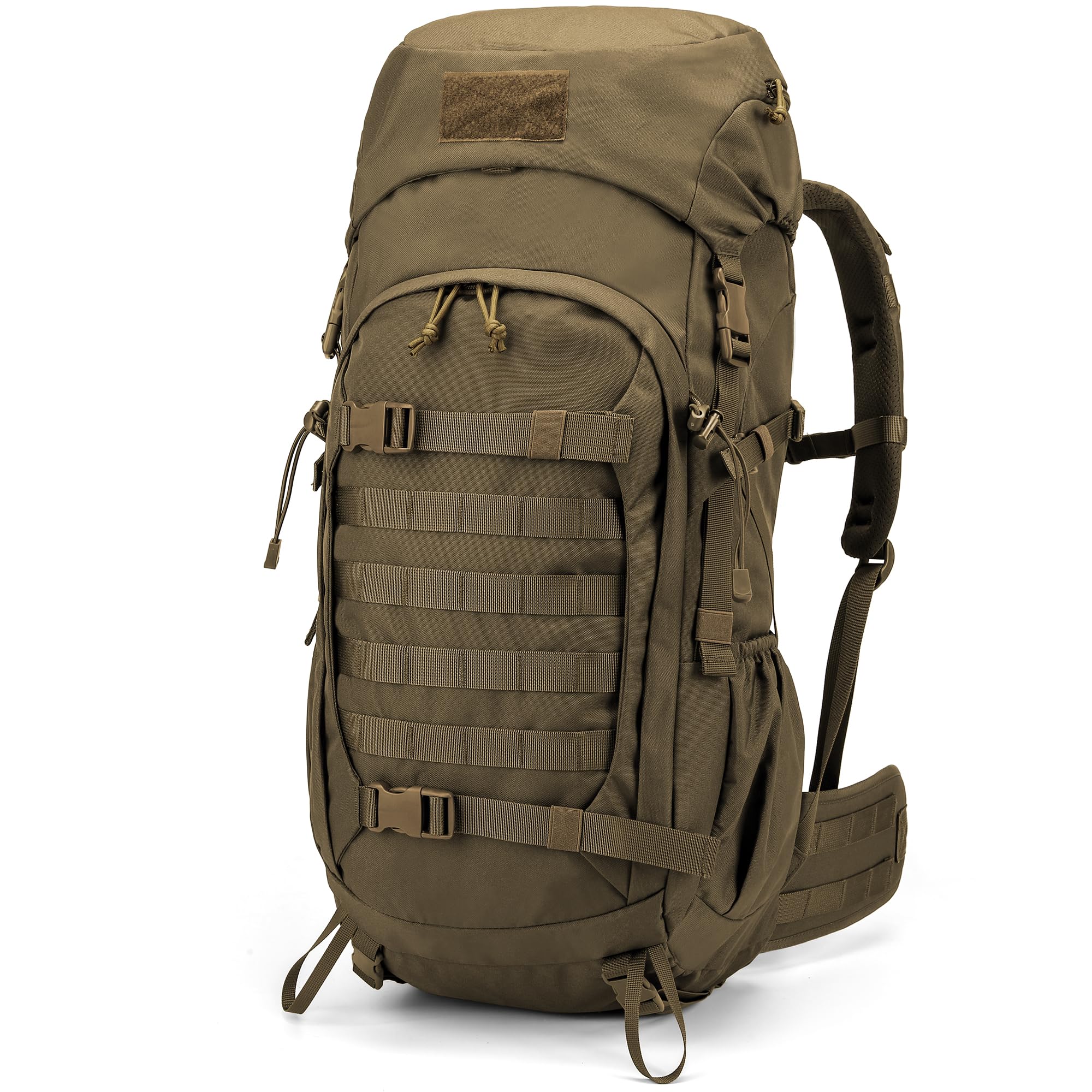
1. Mardingtop 50L Hiking Backpack with Rain Cover
Our pick — 4.5+★ from 600+ verified ratings; the strongest balance of quality and price.
A 600D polyester hauler with an included rain cover that shrugs off brush and keeps your gear dry.
The two specs that decide this pack are the fabric and the cover. It is built from 600D polyester — a thick, tightly woven cloth that shrugs off branches and rock scrapes — and it ships with a rain cover that stows into the bottom of the top pocket. Buyers report the cover keeps the load completely dry even when the sky opens up. For the money, that combination is why this is the pick most people should start with.
The carry system is a single-rod internal frame paired with an adjustable padded sternum strap and hip belt, plus a breathable mesh back panel. It is not a full hard frame, and it does not pretend to be: as one buyer put it, “Have used it on a 6 mile ruck so far and it has been great.” Weight moves onto the hips when you tighten the belt properly, which is exactly what you want for a weekend load. The MOLLE webbing on the outside is the bonus feature — you can lash on a tactical pouch or a wet jacket without opening the bag.
Inside, a 5-liter hydration bladder fits the dedicated sleeve, and the same compartment swallows a 15.6-inch laptop for travel days. Storage is where the pack splits opinion: the main compartment and top pocket are enormous, but the internal organisation is thin, and the rain cover eats into that top pocket when packed. The back panel also runs warm on a hot climb. Nothing here is a dealbreaker for a three-season hiker, and the build quality is what wins people over most.
Where it earns its place
- 600D polyester shell with YKK buckles and zippers handles trail abuse
- Rain cover included and stows in its own top pocket
- Hydration sleeve takes a 5-liter bladder; same slot fits a 15.6-inch laptop
- Adjustable sternum strap and hip belt fit a wide range of body sizes
What to know before you buy
- Internal organisation is minimal — few small pouches
- Back panel runs hot on warm climbs
- It is a single-rod frame, not a full hard frame, so heavy loads flex
Reach for this if: you want one pack for weekend hikes, travel and a bit of rough ground, and you would rather have durability than a featherweight shell.
Think twice if: your trips run to full expedition weights or you need a dozen interior pockets to stay organised.
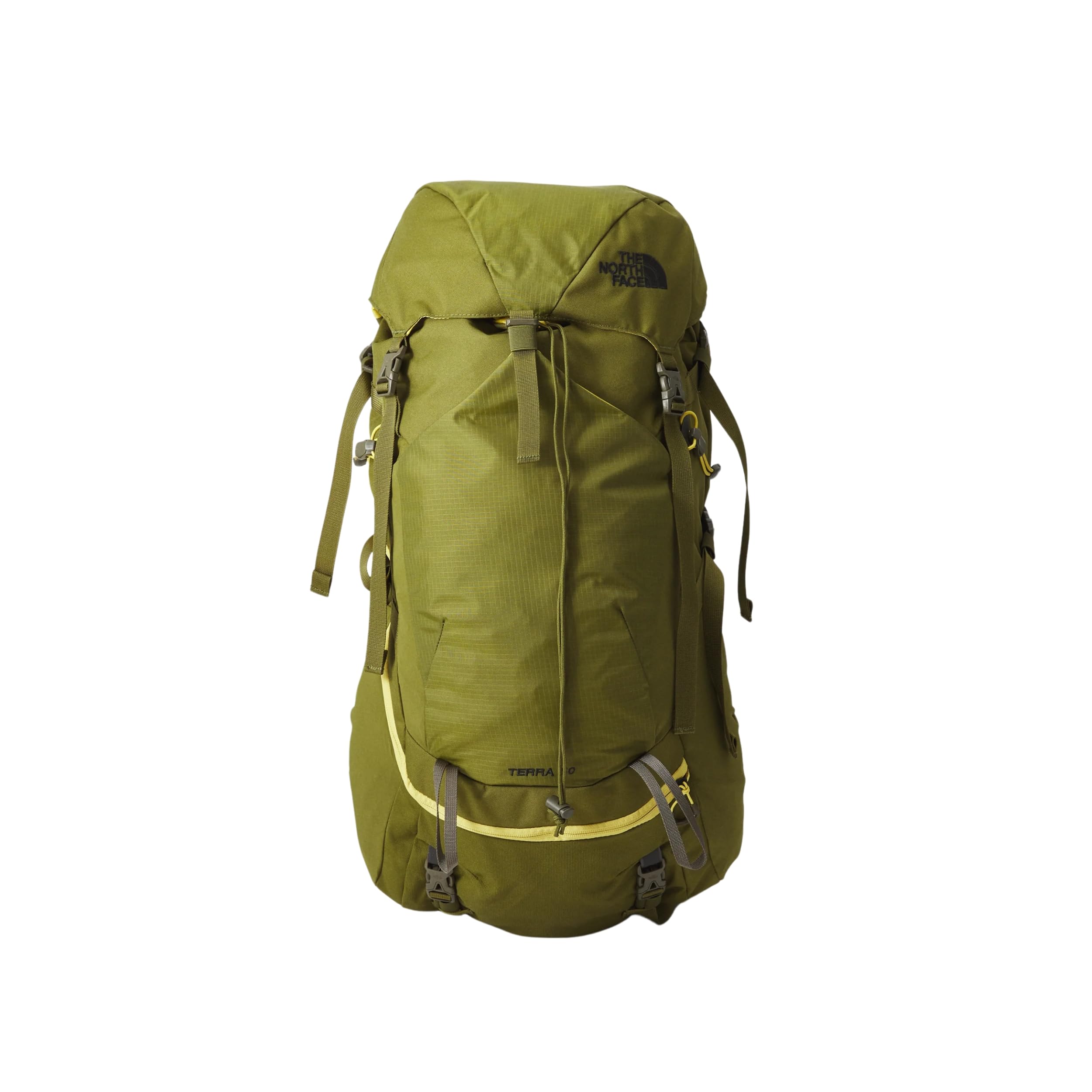
2. THE NORTH FACE Terra 50 Hiking Backpack
The first backpack that fits a growing body instead of fighting it.
Most 50 liter packs scale down poorly for younger or smaller hikers. This one is built the other way round — a youth-sized back panel with an adjustable torso system so the harness slides to match the spine as the wearer grows. If you are outfitting a teenager for their first overnight or shopping for a smaller adult frame, that adjustment is the whole argument.
The rest of the layout is genuinely trail-ready rather than a stripped-down kids’ bag. A cinch-top main compartment with a removable lid gives you a zip pocket and key hook on top. Hipbelt pockets, mesh water bottle pockets and a bladder sleeve keep the things you reach for most within arm’s reach, and a full-length U-zip opens the bag from the side so you are not digging from the top down. Side compression straps, a sternum strap and bottom webbing cinch a partial load down so it does not slosh around.
The frame is a removable sheet rather than a rigid skeleton — the maker’s own description is support without the extra weight. That keeps the pack light and packable, but it also means this is a beginner-first design: it will carry a weekend load comfortably and leave heavier expedition weights to the framed packs further down this list. Trekking pole attachment points and a breathable back panel round out a spec sheet that reads like a much more expensive pack.
The real selling point: an adjustable torso panel on a 50 liter pack is rare at any level, and here it means one bag can serve a hiker through a growth spurt or serve two people of different heights.
The honest limit: the removable frame sheet favors light loads, so plan this as an overnight and short-trip pack rather than a heavy hauler.
Suits: first-time backpackers and families who need a pack that adapts to a still-changing body.
Not for: anyone routinely carrying expedition weight who needs a rigid frame to push it onto the hips.
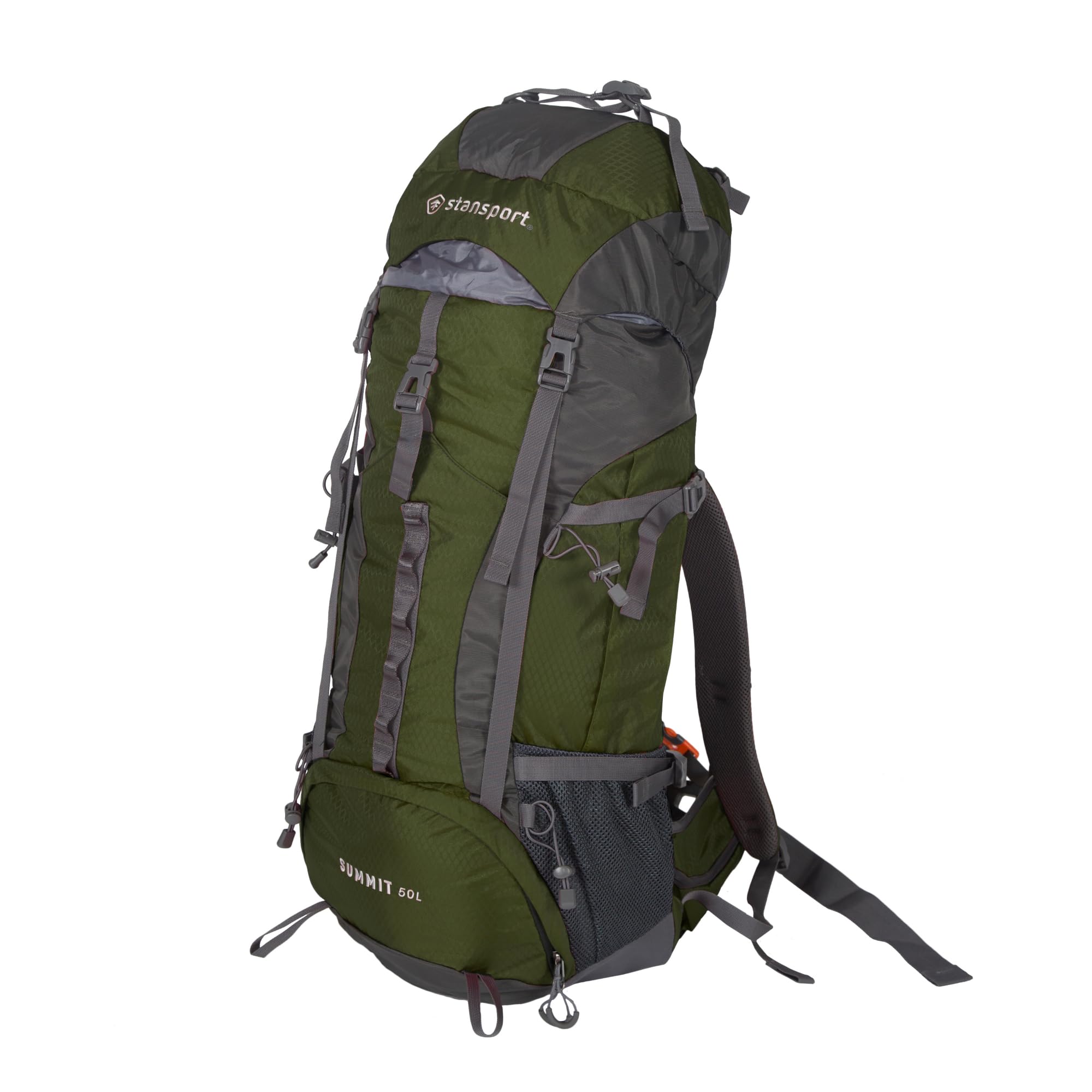
3. Stansport Internal Frame Pack, 50 Liter
The pack people buy when a trail bag has to double as a cargo mule.
Stansport’s answer to the 50 liter question is a plastic frame sheet plus frame stays that hold the bag’s shape no matter what you stuff into it, wrapped in double diamond ripstop polyester. The packing space is the headline: at 12.5 inches deep by 12.5 inches wide by 28 inches tall, it swallows noticeably bulkier loads than the Mardingtop at 9.1 inches deep by 11.4 inches wide by 28.3 inches tall. If you are hauling a sleeping pad, a tote of supplies or a blind and folding chairs to a campsite, that extra boxiness earns its keep.
The suspension is a maximum-flow mesh system that lifts the pack off your back for ventilation, with padded shoulder and waist straps. A 5’5″ reviewer loaded it to 80 pounds without trouble, and another reports it outlasting several pricier packs through heavy abuse — though that same buyer notes a strap eventually failed at 140 pounds and was swapped for a milspec replacement. Read that as a ceiling, not a flaw: this pack is happiest when loads stay sensible.
Organisation leans practical. A zippered sleeping bag compartment with a divider, a side access panel, compression straps, zippered waist belt pockets and dual mesh bottle pockets cover the trail basics. A hide-a-way rain cover keeps everything dry. The honest catch is the strap length — several hikers want longer integrated straps to tie bulky loads down, so budget for a couple of extra tie-downs if you plan to lash gear across the outside.
Praise that repeats
- Ripstop build holds its shape under rough handling
- Sleeping bag compartment with a divider and side access panel
- Maximum-flow suspension moves the bag off your back
- Hide-a-way rain cover and dual bottle pockets included
Where it asks more of you
- Integrated straps come up short for lashing bulky loads
- Heavier and boxier than a purpose-built trail pack
- The frame and straps reward careful load packing
Pick it for: hunting camps, gear hauling and anyone who treats a backpack as a workhorse rather than a gram-counter’s toy.
Leave it if: every ounce counts and you want a trim trail silhouette.
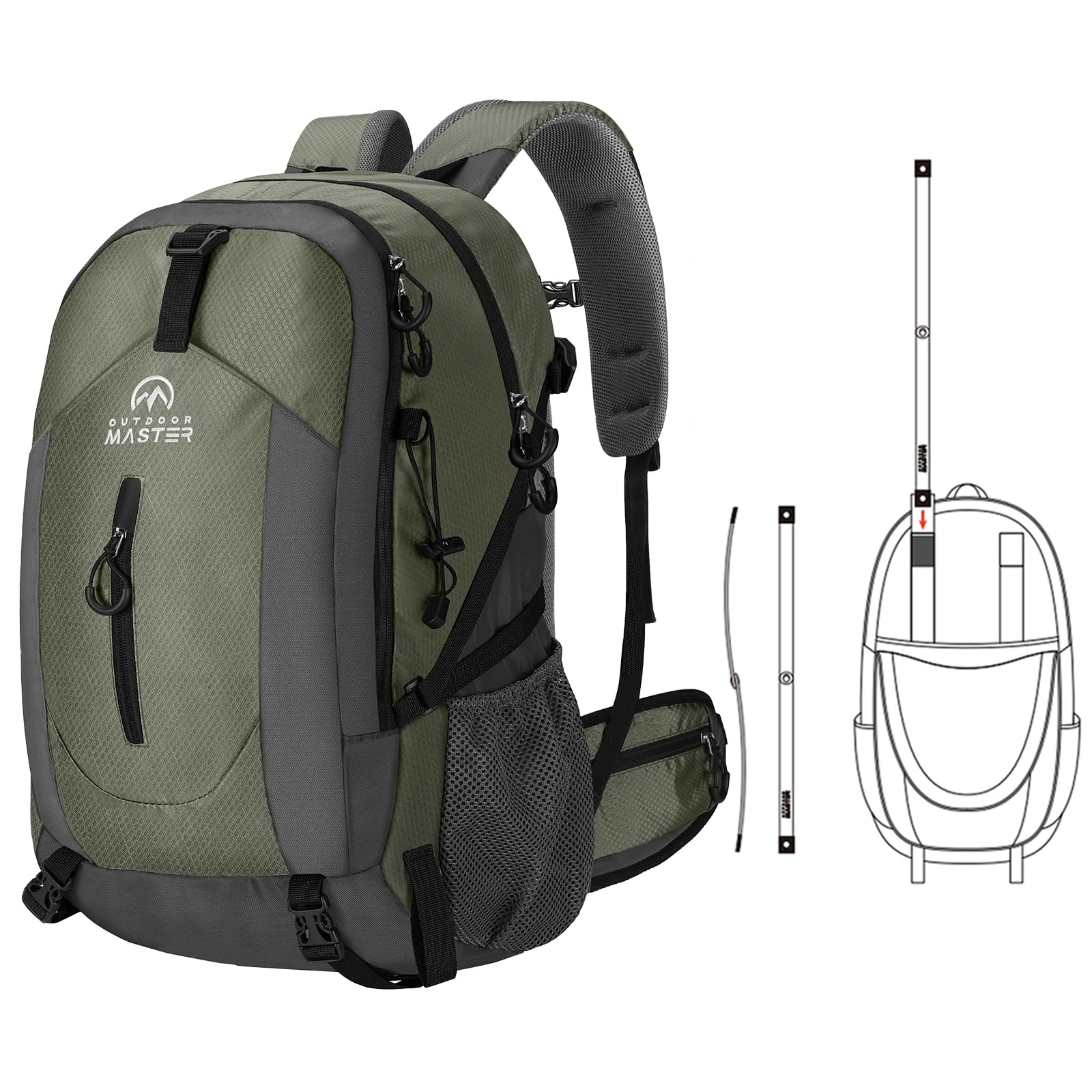
4. OutdoorMaster 50L Hiking Backpack
Two pounds of pack, aluminum bars for your back, and a pocket for everything.
The number worth knowing first is 2 pounds. That is the stated item weight of the OutdoorMaster, and it is light enough to forget you are wearing it on an airport walk. The support comes from foldable aluminum bars rather than a fixed frame — they stiffen the back when you need it and fold flat when the bag goes in a car or overhead bin. The fabric is 600D nylon, upgraded from the 210D many packs use, and it is described as water resistant, tear resistant and anti-scratch with a rain cover tucked into a bottom pocket.
Organisation is unusually thorough for the weight: a zippered main compartment, a central pocket, an outer pocket, two front zip pockets, two waist zip pockets, two mesh side pockets and a wet/dry separation pocket inside the main bag for sweaty clothes. A 16-inch laptop fits, which is more than most packs here manage. The caveat that shows up in the spec sheet is the trade-off of the bars — they do not fold down small, so the pack never compresses as flat as a frameless one.
On the trail, what wins people over is the build. The seams are sewn to resist rips and tears, and the pack has come through months of family day hikes and a 10-day hike with no rips despite being overfilled and rubbed against sharp objects. The recurring note is organisation on the small scale: plenty of big pockets, few small internal ones, so loose items can end up loose. The 16-inch laptop sleeve is the clearest edge over the North Face Terra 50, whose listed compatible device size tops out at 10.24 inches.
Why it travels well: foldable aluminum support, a 16-inch laptop sleeve, a wet/dry pocket and nine separate storage zones make this a pack that handles a work trip and a trail day without changing bags.
The honest note: the rigid bars take up space when folded, so it does not pack down as small as a frameless bag.
Best matched to: hikers who also fly, commute or carry a laptop, and want one bag that does both without weighing them down.
Less ideal for: anyone who needs to compress the pack into a small duffel between trips.
5. Osprey Renn 65L Women’s Backpacking Backpack

A women’s-specific harness with a suspended mesh back that keeps you cool when the climb gets long.
The Renn runs 65 liters rather than 50, so read this as the pack for hikers who take an overnight or a two-night trip and want room to spare. The defining piece is the AirSpeed suspension — a tensioned back panel that is adjustable for a range of torso lengths and holds the pack off your body. A LightWire frame transfers the load onto the hipbelt so your shoulders are not doing the work. A removable raincover stores in its own pocket, and the sleeping bag compartment has a floating divider.
What women hiking overnight tend to notice first is the fit: the harness pulls the pack close for weight distribution, and one 5-day trip tester fit a tent, sleeping bag, food, water and gear inside with the rainfly going on easily in torrential rain. Serious backpackers in the same circles have looked at this pack over their own. It is not without quirks — the hipbelt pockets sit far enough back that you have to take the pack off to reach them, and the top compartment is awkward to dig into. Some hikers also find the suspended mesh keeps the pack slightly off the back, which can introduce a bit of sway once fully loaded.
Set against the Rook below, the Renn is the same architecture tailored to a women’s frame, at slightly less weight than other 65-liter Ospreys in the maker’s range. It is a fair chunk of the total at 3.6 lb empty, so pack light if you are covering serious distance.
The reason to choose the Renn: adjustable AirSpeed suspension and a women’s-specific harness on a pack with room for a genuine overnight load, plus a raincover built in.
Watch out for: the hipbelt pockets are placed for a partner to reach, not you — and the pack is heavy before you put anything in it.
Made for: women planning overnight or multi-night trips who want ventilation and a proper load-transferring frame.
Consider the Rook instead if you need exactly 50 liters or want the men’s frame shape.
6. Osprey Rook 50L Men’s Backpacking Backpack

Exactly 50 liters, a ventilated suspended back, and nothing on the spec sheet you do not need.
This is the pack that answers the keyword directly: 50 liters, six pockets, 3.6 pounds. The AirSpeed back panel is adjustable across a range of torso lengths and keeps a gap between the pack and your spine so your back stays dry on the climb. The LightWire frame routes the load to the hipbelt, and the raincover is integrated and removable, stowing in its own pocket. A zippered sleeping bag compartment with a floating divider handles a bag and lets you cinch the rest tight.
What owners praise most is the quality, and the trail evidence backs it up. One buyer describes using it for hiking and camping over several years, carrying loads with the weight distributed well and expecting 10+ years of life from it. Another carried 25 pounds up a mountain and called it super comfortable, with lots of adjustment straps and a lightweight frame. A third notes that loosening the side straps opens extra room when you have overpacked. It also scales down: it fits a 5’2″, 100-pound 11-year-old well enough for Scout trips, though it is large on that frame.
Set against the Terra 50, this is the more capable load carrier, but it carries more pack weight too. The honest limit is that 50 liters is 50 liters — one owner packed a week of clothing into it and ended up around 25 kg, which is beyond what the suspension is designed to carry comfortably. For 2 to 3 day trips it is sized right, and the waterproofing and materials hold up in rain.
What buyers keep coming back to
- AirSpeed ventilation keeps the pack off your sweaty back
- Torso-adjustable harness fits a wide range of heights
- Integrated removable raincover in its own pocket
- Sleeping bag compartment with a floating divider
The realistic boundaries
- 3.6 pounds of empty pack weight before you load it
- 50 liters is tight for anything past a few nights
- Overkill if you mostly travel by plane and suitcase
Go with this if: you are a man planning weekend and 2-to-3-day hikes and want proven ventilation and fit without extra bulk.
Look elsewhere if: your trips stretch past three nights and you need expandable volume.
7. Deuter Aircontact Lite 50 + 10 L Backpacking Backpack
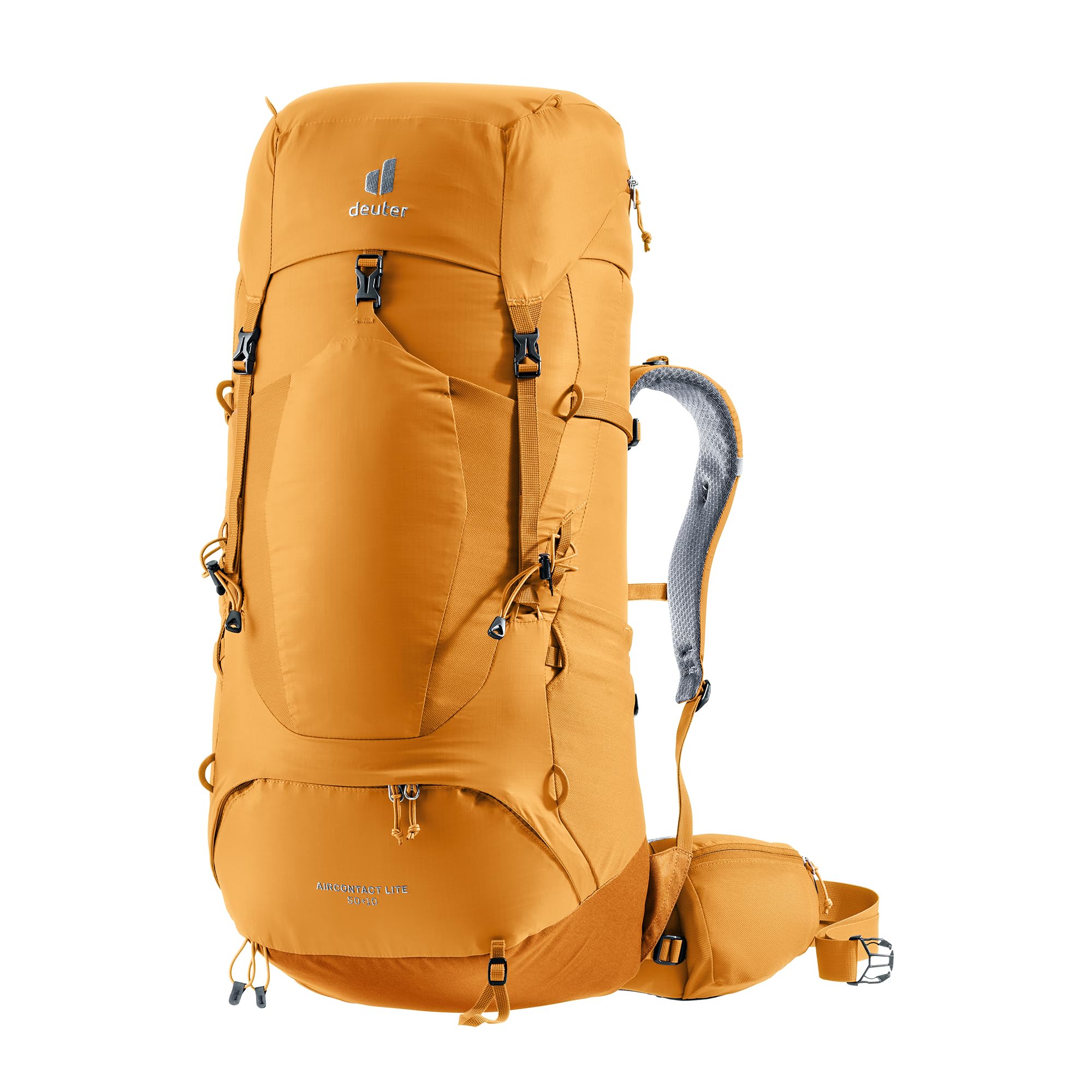
Fifty liters that grows by ten when your trip runs longer than planned.
The 50 + 10 in the name is the feature — a height-adjustable lid that adds ten liters of usable volume when you need it, and comes off entirely when you do not. That flexibility is why this pack suits long-distance hikers and travelers rather than weekend-only walkers. It weighs 1640 g and measures 30 by 12 by 11 inches, so it stays in the same weight class as the Osprey packs while offering more room when the load grows.
The Aircontact back system is the technical heart of it. Instead of holding the pack away from your body, it pulls the weight close to your center of gravity so you keep control of the load and the transfer to the hips stays efficient. The cushions are built from hollow chamber foam and use a pump effect from your own movement to keep air moving. Combined with the Vari Quick adjustable back length, a continuously adjustable chest strap, load adjustment straps and padded hip fins, the fit dials in to a range of body shapes.
The detail list is long and genuinely useful: an X-frame for load transfer, docking loops for a helmet holder, ice axe and trekking pole attachment, an internal valuables pocket, a separate bottom compartment, a stretch inner compartment, a key clip, an SOS label, two stretch mesh pockets and two zippered hip fin pockets. It is compatible with a 3-liter drinking system, though the bladder itself is not included. The fabrics are 140D PA ripstop and 600D polyester with over 50% recycled content — durable, but the lighter ripstop panels ask for a little more care around sharp rock than a plain heavy weave.
What the extra spend buys: expandable volume, a body-hugging Aircontact carry that keeps heavy loads under control, and a genuinely deep feature list for long trips.
The trade-off: this is a specialist’s pack — the close-fitting carry and the lighter ripstop panels reward an experienced hiker and punish careless handling.
The right call for: long-distance hikers, extended travelers and anyone whose trip length changes from one outing to the next.
Probably too much pack if: you hike short weekend loops and want the simplest, lightest bag that will do.
Know the Specs
Volume in liters (and what the +10 means)
A 50 liter pack holds roughly enough for one to three nights depending on how bulky your sleeping bag and clothing are. When you see something like 50 + 10, the extra number comes from a height-adjustable lid that adds volume when raised and can be removed entirely. That flexibility helps on longer trips, but a taller lid also raises the pack’s profile, which can affect how it sits on your back.
Suspension: frame sheet, stays and tensioned mesh
A frame sheet is a stiff panel that keeps the bag’s shape; frame stays are rods that add rigidity. Tensioned mesh systems hold the pack away from your spine for airflow, while body-hugging systems press the load close to your center of gravity for control. Neither is better in every case — mesh runs cooler and fits looser, close-carry feels steadier under heavy weight. Match the system to the load you actually carry.
Rain covers and fabric ratings
The D in a fabric name like 600D stands for denier, a measure of thread thickness — higher numbers mean a thicker, more abrasion-resistant cloth. Ripstop weaves add a grid pattern that stops small tears from spreading. A rain cover is separate from fabric water resistance and is the more reliable protection in sustained rain, which is why an included cover that stows in its own pocket is worth prioritizing.
Hydration sleeves and laptop compatibility
A hydration sleeve is a flat pocket against the back panel that holds a water bladder, and a hose port lets the drinking tube exit near your shoulder. Listed compatible device sizes vary widely across packs — some top out around 10 inches and others fit a 16-inch laptop. Check that number if you plan to use the same bag for travel, because a sleeve sized for a bladder will not always take a full laptop.
Common Questions
Is a 50 liter backpack big enough for a week of hiking?
Can a 50 liter hiking backpack be used as a carry-on?
Why does my backpack put all the weight on my shoulders?
Do I need a rain cover if the fabric is water resistant?
What is the difference between the Osprey Renn 65L and the Osprey Rook 50L?
Can a 50 liter pack carry a sleeping bag and a tent?
How much weight can a 50 liter internal frame pack handle?
What does the +10 mean on a 50 + 10 liter backpack?
Will a hydration bladder fit in these packs?
Is a lighter backpack always better for hiking?
The Bottom Line
The strongest all-rounder for most hikers is the Mardingtop 50L, because 600D polyester, YKK hardware and an included rain cover give you trail-ready durability without a specialist price. If your trips run overnight and you want ventilation, the Osprey Rook 50L is the men’s benchmark, and the Osprey Renn 65L is the equivalent for women going a night or two longer. For travel that mixes trail days with flights and a laptop, reach for the OutdoorMaster 50L and its foldable aluminum support. And if your trips keep getting longer, the Deuter Aircontact Lite 50 + 10 is the one that grows with you.
How we choose
We do not accept paid placement. Every pick is matched to a real buyer and a real use-case; we do not hands-on test units.
Sources
Specifications: manufacturer listings and product documentation. Review insights: verified customer reviews, as of October 2026. Pricing: not shown on this page (it changes often); check the current price via the retailer link.
As an Amazon Associate, Aappliancez earns from qualifying purchases. This does not affect which products we feature.