Disclosure: Some links in this post are affiliate links. As an Amazon Associate I earn from qualifying purchases, at no extra cost to you. Learn more
Specs are compiled from manufacturer listings and verified buyer reviews and can change over time — please confirm the key details on the product page before buying.
You want to water four separate beds from one outdoor faucet without standing there with a hose in your hand every evening — and the timer you buy needs to survive a full summer of sun and rain. A four-zone timer splits one spigot into four independently scheduled lines, so your lawn, your vegetable patch, your pots and your drip line each get their own start time and run length. The picks below are the ones worth your money, ranked by how well they actually hold up.
This guide is built by comparing the manufacturers’ published specifications and the patterns across verified customer reviews, so you get each pick’s real strengths and trade-offs instead of marketing spin.
A timer that lasts six seasons and one that quits by August usually differ in two things: the inlet material and the water-pressure rating. This breakdown of the 4 zone water timer market shows you which models get those right.
Top Picks

How To Choose The Best 4 Zone Water Timer
Most buyers get this wrong in the same way. They count the outlets, see four, and assume all four hoses will spray at once. In almost every four-zone hose timer, only one zone runs at a time — the unit cycles through them in sequence. That is fine for drip lines and soaker hoses, and it is the reason your water pressure stays usable instead of collapsing to a trickle across four sprinklers. Pick your zones around that cycling, not against it.
Watch the inlet, not the paint job
The single part that decides whether your timer survives five seasons is the threaded inlet where it screws onto the faucet. Brass holds its threads and resists corrosion; ABS plastic (a hard, common outdoor plastic) can strip or crack. Several picks here use a solid brass inlet for exactly that reason. If a listing only says “durable material” and never names brass, assume plastic and price it accordingly.
Match the run time to your actual plants
Vegetable beds usually want a long, slow soak; pots and seedlings want short, frequent sips. Look for a timer whose duration range stretches both ways — the widest here runs from 0 to 240 minutes per zone, while the tightest tops out around 120 minutes. If you grow seedlings under a mist setting or run a drip system on a timer, the low end of that range matters more than the high end.
Battery life and where the screen sits
These units run on AA alkaline batteries — typically 2 or 4 of them, usually not included — and battery life is the quiet killer. A timer that eats cells every few weeks becomes a chore. The bigger overlooked factor is sun. A clear LCD screen facing full afternoon sun degrades, so shade the unit or cover the spigot if you want the electronics to live longer.
Side-by-Side Comparison
| Model | Best For | Zones | Max Run Time Per Zone | Inlet & Waterproofing | Amazon |
|---|---|---|---|---|---|
| Diivoo 4 Zone WiFi★ Best Overall | Phone control from anywhere | 4 | — | Brass inlet / — | Amazon |
| RAINPOINT 4 OutletBest Value | First-time setup on a budget | 4 | 3 hrs 59 min | Brass inlet / weatherproof shell | Amazon |
| RAINPOINT 3 Zone | Three beds on a tight budget | 3 | 8 hrs | Brass inlet & outlet / IP65 | Amazon |
| DEWENWILS 2-Zone | Two-zone yards, entry level | 2 | 120 min | Brass inlet / IP55 | Amazon |
| Diivoo IP68 4 Zone | Harsh weather and wet spots | 4 | 240 min | Brass inlet / IP68 | Amazon |
| RESTMO 4-Zone | Deep schedule customization | 4 | 3 hrs 59 min | Brass swivel inlet / weatherproof | Amazon |
Detailed Reviews
1. Diivoo 4 Zone WiFi Water Timer with Brass Inlet
Our pick — 4.5+★ from 60+ verified ratings; the strongest balance of quality and price.
Twenty-four separate watering plans and a phone in your pocket — this is the timer you set once and check from a hotel room.
This timer earns the top spot with 24 independent irrigation plans — not four schedules with a couple of options each. That means you can give your tomato bed a long morning soak and your hanging baskets a short evening drink without touching the dial again. The 2.4GHz WiFi link (a common wireless standard for home devices) lets you adjust any plan from the HomGar app, or by voice through Alexa and Google Assistant. The unit itself stays simple, with a single button on the body for manual runs.
The brass inlet is the part that lasts through winters — a corrosion-resistant fitting that holds a tight seal and resists the cross-threading that eventually ruins plastic threads. Buyers report it working exactly as scheduled once connected. As buyers put it: “App works well and the simplistic single button control on the unit is great.” The 24–72 hour rain delay and a Manual Mode you can trigger from the app or the valve round out daily use. Weighing 2.3 pounds and measuring 8.27 by 3.86 by 6.89 inches, it hangs noticeably bulkier on the spigot than a basic dial timer — the honest price of a radio and a battery compartment.
That size is the trade-off, and the connecting step is the other. Setting it up can take a few minutes and it wants a 2.4GHz band specifically, not the 5GHz network most phones default to — plan on that before you start. There is also a real quirk worth knowing: rain delay is applied per program rather than as one global switch, so a rainy week means toggling each schedule. A few owners also notice a knock in the pipes when a valve shuts, which a water-hammer arrestor can quiet.
What earns it the crown
- 24 independent irrigation plans across four outlets — the deepest scheduling in this lineup
- Phone and voice control via 2.4GHz WiFi, HomGar app, Alexa and Google Assistant
- Brass inlet for a corrosion-resistant, leak-resistant seal
- Mist Mode cycles outlets at 1–60 minute intervals for seedlings and summer cooling
Where it asks more of you
- Physically larger than a non-smart timer — 2.3 pounds hanging off the faucet
- Initial connection is the slow part; 2.4GHz band only
- Rain delay must be set program by program, not globally
Reach for this if: you travel, keep four distinct planting areas, and want to change a schedule from your phone without walking outside.
Think twice if: your WiFi is a single 5GHz network you cannot split — the initial pairing will fight you.
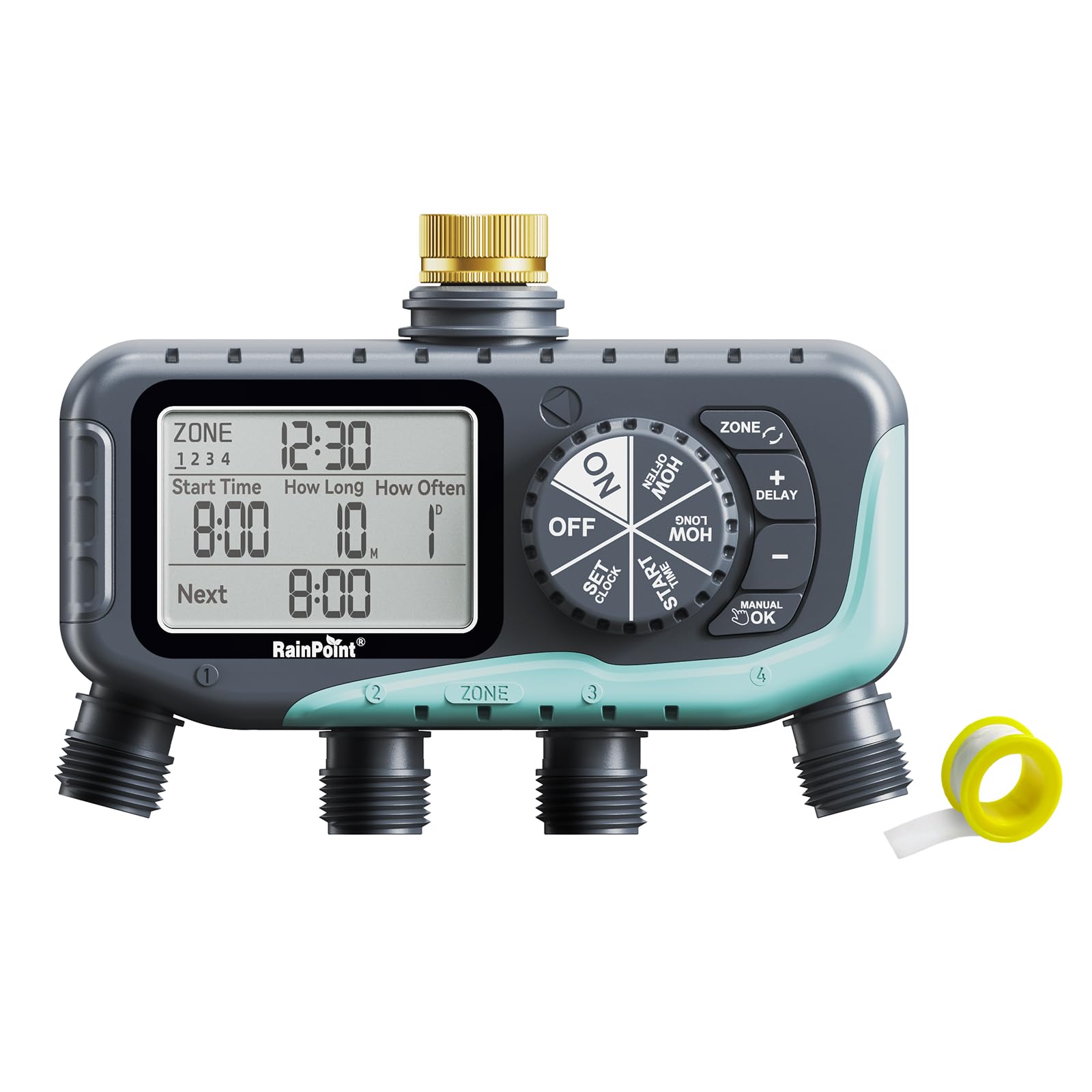
2. RAINPOINT 4 Outlets Hose Timer with Brass Inlet
Four zones, a big readable dial, and no app to set up — the easiest first timer to hand to someone who hates menus.
If you want to be watering this afternoon without installing anything, this is the one. Two dial-and-button timers meet here: a 3.4-inch LCD with a large dial and four clear buttons, designed so a first-timer can program it without the manual. Each of the four zones gets its own start time, duration from 1 minute to 3 hours 59 minutes, and frequency every 8 hours, every 12 hours, or every 1 to 7 days. You set it in 12-hour or 24-hour format and walk away.
The build is more serious than the friendly face suggests. The inlet is brass with a reinforced column, rated to hold pressure up to 116 PSI (pounds per square inch, a measure of water pressure) — a real number that matters if your household pressure runs high and you have been blowing fittings on cheaper units. It fits 3/4″ faucets and standard 3/4″ garden hoses. Rain delay skips 24, 48 or 72 hours, and Manual Watering runs 1 minute to 6 hours without disturbing your saved automatic schedule — exactly what you want when washing the car or topping off the flower bed.
The honest caveat is consistency. While plenty of owners get seasons of clean service — one runs 80 spray heads across all four channels from a single unit — the mixed reports center on a zone or two failing to open. RAINPOINT support has a track record of replacing faulty units, and the practical move is to test all four outlets in your first week so a dud shows up while you are still covered. One buyer did report fittings blowing off and the unit eventually going dead after starting out fine, which is the version of this story to know about before you buy.
Where it shines: the programming experience. A big dial and clear LCD beat any app for speed on day one.
The honest catch: zone reliability is the recurring gripe. Test all four outlets early and keep your proof of purchase close.
Best for: the gardener who wants four zones working today and does not want a WiFi pairing ritual.
Not the pick if: you need app control or you want to monitor the timer remotely while away.
3. RAINPOINT 3 Zone Water Timer with Brass Inlet & Outlet
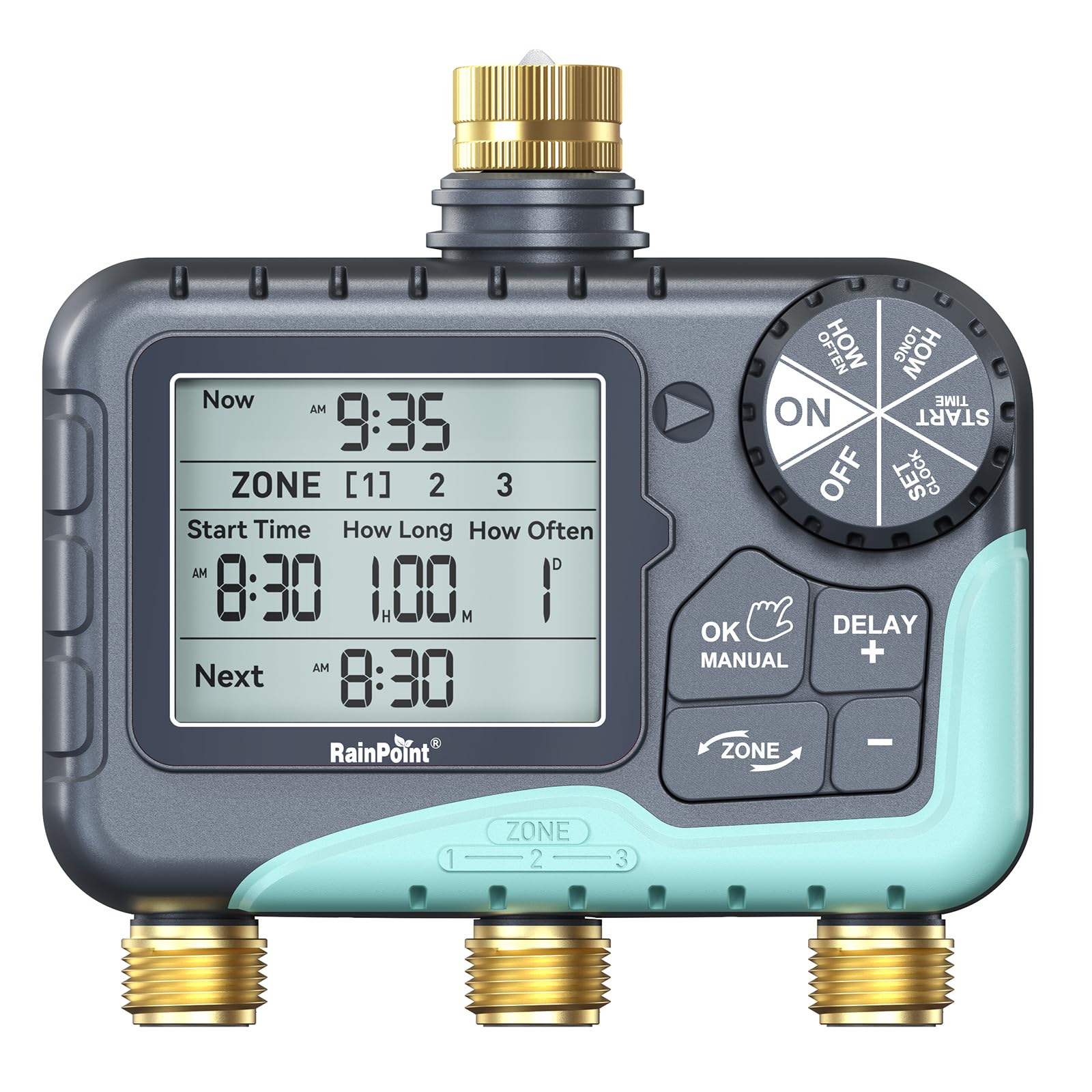
Three zones with brass on both ends and an 8-hour run time — the cheapest way to give a lawn a real deep soak.
Three zones instead of four is not a downgrade here; it is the reason the price stays low without cutting the metal. Both the inlet and the outlet are brass, and the coil valve is built to hold a stable flow with less leakage. For anyone who has watched a plastic thread crack off mid-season, brass on both ends is the spec that decides the purchase. It handles three separate schedules, each with a run time from 1 minute up to 8 hours and a frequency from every hour up to every 7 days.
That 8-hour ceiling is the longest per-zone run of any timer on this list, and it is what a deep-root lawn soak or a slow drip irrigation line actually wants. The IP65 rating (a score for dust-tight and protected against water jets) covers the body, and the ABS shell is UV-resistant for sun exposure. Rain delay skips 24, 48 or 72 hours, and Manual Watering runs 1 minute to 8 hours. It mounts tool-free on standard 3/4″ faucets, and the sunlight-readable LCD plus a low battery indicator means you will see a dying cell before your plants do.
Here is the part you need to weigh. This is the most-reported durability risk in this lineup: the internal valves can stop opening after a season. One owner’s unit ran fine from late April into September, then all three valves refused to open even though the display worked, and the 30-day return window had already closed. That is not everyone’s experience — plenty run clean and leak-free — but if you buy this one, watch it through your first full season and keep the receipt. Setup itself is painless, and the dial-plus-instructions combination clears up any confusion.
Why the cheap one earns a spot
- Brass threads on both the inlet and outlet
- Up to 8 hours per zone — the longest single run on this list
- IP65 weather protection and a UV-resistant ABS shell
- Tool-free fit on standard 3/4″ faucets with a low-battery indicator
The risk you accept
- Valve failures after a season are a documented pattern, not a one-off
- Only three zones — not enough for four separate beds
- No app or WiFi control
Pick this when: three watering areas is genuinely all you have and you want brass and long run times without a premium outlay.
The trade-off: budget-tier internals. Buy it, test it hard for a month, and hold onto the packaging.
4. DEWENWILS 2-Zone Outdoor Hose Timer

A two-zone timer for yards that only need front and back — simple, brass-inlet, dial-driven.
If your yard does not have four watering areas, buying four zones you will never use wastes money. This DEWENWILS unit splits one faucet into Zone 1 and Zone 2, each independently scheduled for start time, a duration of 1 to 120 minutes, and a frequency of every 1 to 12 hours or every 1 to 7 days. A large clear LCD (liquid-crystal display, the screen) shows the current time, the next watering time, and the battery state, and setup is tool-free with a rotate-the-dial interface.
The inlet is pure brass, and the body carries an IP55 rating (protected against dust and low-pressure water jets) with a UV coating. There is a sealed rubber ring on the battery cover specifically to keep moisture off the electronics, which is the sort of detail that matters when a unit sits outside through a wet spring. Manual mode handles 1 to 240 minutes without disturbing your preset schedule, and rain delay postpones watering for 24, 48 or 72 hours. It runs on 2 AA alkaline batteries, which are not included.
The catch is longevity, and it is the loudest pattern in this data. Long-term owners exist — one is three years into reliable service with batteries that last a season — but there are also units that misbehave after a month and stop watering all zones on schedule. It is a smaller sample than the four-zone timers, so read it as a fit note rather than a verdict: shade the unit, pull the batteries before winter, and you improve your odds. The rain-delay control is also fiddly to reach, to the point that some owners just switch the timer off instead.
Small yard, real brass: pure brass inlet, IP55 protection and a sealed battery compartment in a compact two-zone package.
Set expectations on lifespan: a two-season service life is realistic; treat it as a consumable rather than a permanent fixture.
Worth it for: two-bed gardens, patio pots, and anyone who wants dial simplicity without a fourth outlet to program.
Look elsewhere if: you need four zones, app control, or a timer you expect to last many seasons.
5. Diivoo 4 Zone Sprinkler Timer with IP68 Waterproof
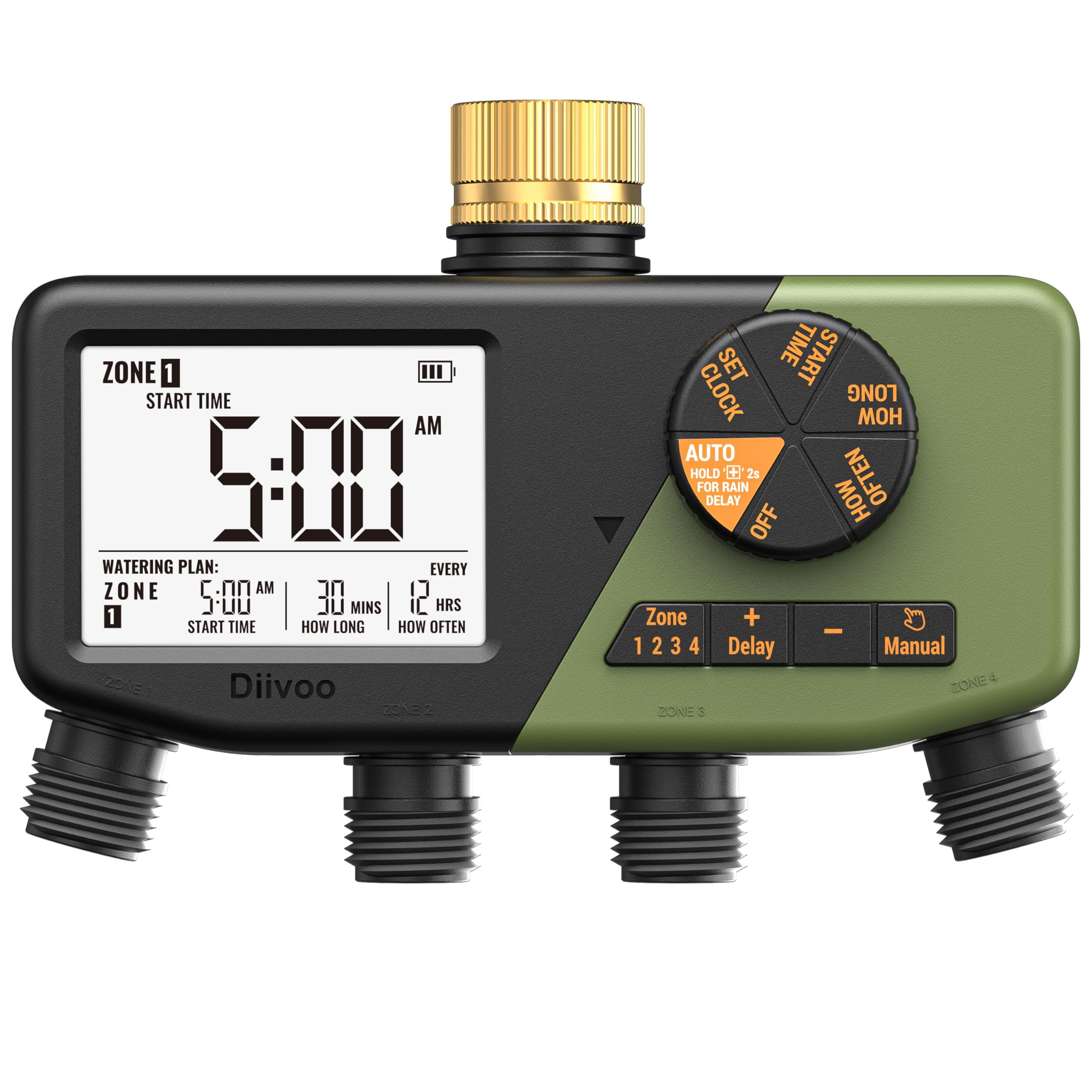
IP68 is the highest waterproof rating here — this timer is built for the wet, exposed corner of your yard.
If your spigot sits somewhere water collects or gets full afternoon rain, this is the spec to buy around. The IP68 rating means it is built to survive heavy rain, splashes, and brief immersion — and there is a sealing ring on the battery compartment secured with screws so water cannot sneak in past the cover. That is not a marketing flourish; it is the difference between a working unit in September and a dead one.
Four zones each get fully independent scheduling with a start time, a duration from 0 to 240 minutes, and a frequency of every 6 hours, every 12 hours, or every 1 to 7 days. The large screen shows your whole schedule laid out so you can see what is coming rather than just what is running now. The brass inlets are rated for 7.25–116 PSI, so high household pressure is handled without cracking. Rain delay stretches up to 7 days, and manual watering runs up to 240 minutes without interrupting your saved programs. At 1.6 pounds it is lighter on the faucet than the WiFi version.
Two things to plan around. This is a dial-and-screen timer, not a smart one — no app, no voice control, no remote check-in, so you program it at the unit. And there is a recurring note about the connector where the metal hose fitting meets the plastic body underneath, which can break or strip over a season or two. Treat that joint gently when you attach and detach hoses, and it should serve well. Leave the batteries in over winter and you risk the corrosion that ends these units early.
The case for it
- IP68 waterproofing — the strongest water protection on this list
- Independent 0–240 minute run times across four zones
- Brass inlets rated 7.25–116 PSI
- Screw-secured sealing ring on the battery compartment
Where it asks you to adapt
- No WiFi or app — programming happens at the unit
- The connector joint under the hose fitting can break under rough handling
- Batteries need pulling before winter storage
Made for: exposed spigots, wet climates, and anyone who has lost a timer to water damage.
Pass on it if: remote scheduling matters to you more than weatherproofing.
6. RESTMO 4-Zone Sprinkler Timer with Brass Inlet

Four outlets that behave like four separate timers, plus a rain delay you can set to 0 hours and turn off entirely.
The pitch here is range. Auto mode gives each zone a duration from 1 minute to 3 hours 59 minutes, and a frequency from every hour to every 12 hours — or from 1 day to 7 days. Manual mode covers 1 minute to 6 hours for a quick car wash or flower soak, and rain delay runs 0, 24, 48 or 72 hours. That 0-hour option is a small but real advantage: you can switch rain delay fully off instead of working around it. The swivel brass inlet and a max flow rate of 10GPM with pressure from 8 to 120 PSI make it a serious hauling unit, and it fits 3/4″ hose and faucet threads.
Power comes from 4 AA alkaline batteries, not included, quoted at over a year of running. The build quality reads solid — one owner describes it as the best of five-plus timers they have owned, and the brass fittings get consistent praise. Where it gets messy is the controls: the manual-setting process is not intuitive, and working out which zone you have selected takes some fiddling with the plus and minus buttons. The knob-and-button layout rewards a patient read of the directions rather than button-mashing.
Do shield the screen. A three-outlet review makes the point plainly: “If you buy this timer, protect the screen from the sun. If you don’t, it will permanently damage it.” Longevity reports are split — some units run a season or three, others stop working within six months and develop leaks. Read this as a premium-feature timer for a buyer who will give it a shaded, sheltered mounting spot and check it regularly, rather than a set-and-forget anchor.
Schedule depth you feel: per-zone durations up to 3 hours 59 minutes and the option to kill rain delay outright.
Two things to handle: shade the LCD from direct sun and read the manual before programming — the zone selection is not obvious.
Suits the fiddler: buyers who want to fine-tune every zone and will mount the unit out of harsh sun.
Step past if: you want zero-learning-curve programming or a timer you set once and forget entirely.
Know the Specs
Water Pressure Rating (PSI)
PSI stands for pounds per square inch — how hard the water pushes against the timer’s internals. A rating like the 116 PSI on several picks here tells you the ceiling before fittings start to fail. If your household pressure runs high, a timer rated only for low pressure can crack at the threads or leak at the valve. Match the rating to your actual pressure and you remove the most common cause of a mid-season failure.
IP Waterproofing (IP65, IP68)
The IP number is a two-digit score. The first digit covers dust, the second covers water — and higher is better. IP55 means protected against low-pressure water jets; IP65 means dust-tight and protected against jets; IP68 means it can handle brief immersion. For a timer bolted to an outdoor spigot, the higher the second digit, the less you have to worry about a downpour or a splash from the hose.
Run Duration and Frequency Per Zone
Duration is how long one zone waters per cycle; frequency is how often that cycle repeats. A timer that runs 1 minute to 3 hours 59 minutes per zone can handle both pots and a deep lawn soak, while one capped at 120 minutes suits lighter watering. Frequency options like every 8 hours or every 1 to 7 days determine whether you can water twice a day in a heatwave or once a week for drought-hardy plants.
Rain Delay
Rain delay pauses your automatic watering for a set number of hours after wet weather so you are not watering a soaked lawn — most models here offer 24, 48 or 72 hours, with one stretching to 7 days. It saves water and money on your bill. Check whether delay works globally or per program, because some units make you toggle each schedule separately during a rainy week.
Common Questions
Can a 4 zone water timer run all four hoses at the same time?
Will this fit my outdoor faucet and garden hose?
Why does the WiFi timer need a 2.4GHz network?
How long do the batteries last in a hose timer?
Does rain delay erase my saved watering schedule?
Can I water manually without changing my automatic schedule?
Is a brass inlet really better than a plastic one?
What is the difference between IP55, IP65 and IP68?
Where should I mount the timer for the longest life?
Do I need to remove the timer in winter?
The Bottom Line
For most people shopping for the 4 zone water timer, the Diivoo 4 Zone WiFi Water Timer is the one worth buying — 24 independent plans, a brass inlet, and phone control you can adjust from anywhere. If you want four zones on a tighter budget and a big readable dial, the RAINPOINT 4 Outlet earns its keep. And if your spigot sits somewhere wet and exposed, the Diivoo IP68 is the one to reach for. Whichever you choose, give it a shaded mounting spot, test all your zones in the first week, and pull the batteries before winter — that routine is what separates a one-season timer from a six-season one.
How we choose
We do not accept paid placement. Every pick is matched to a real buyer and a real use-case; we do not hands-on test units.
Sources
Specifications: manufacturer listings and product documentation. Review insights: verified customer reviews, as of October 2026. Pricing: not shown on this page (it changes often); check the current price via the retailer link.
As an Amazon Associate, Aappliancez earns from qualifying purchases. This does not affect which products we feature.