Disclosure: Some links in this post are affiliate links. As an Amazon Associate I earn from qualifying purchases, at no extra cost to you. Learn more
Specs are compiled from manufacturer listings and verified buyer reviews and can change over time — please confirm the key details on the product page before buying.
If your lawn has a hill, a ditch, or a stretch that turns slick after rain, you need a mower with power going to all four wheels. Buy one whose cutting width and battery runtime match your acreage. That is the whole game. Everything else — the deck size, the remote, the app — is a detail you sort out after you have matched drive system and runtime to your ground.
This guide is built by comparing the manufacturers’ published specifications and the patterns across verified customer reviews, so you get each pick’s real strengths and trade-offs instead of marketing spin.
Below you will find ride-on tractors, remote-controlled slope climbers, and wire-free robots sorted by the job they actually do. Your search for the best 4 wheel drive lawn mower starts with your terrain instead of a spec sheet.
Quick Picks
- Mowrator S1 4WD 18Ah Remote Control Lawn Mower
- Segway Navimow X430 Robot Lawn Mower Wire Free — Top Performer
- Mammotion LUBA mini AWD 800H Robot Lawn Mower — Easiest Setup
- Husqvarna Z254 (54″) 24HP Briggs Zero Turn Lawn — Best for Rough Ground
- Greenworks 80V 42″ Riding Lawn Mower — Quietest Ride-On
- Husqvarna Z246 (46″) 22HP Briggs Zero Turn Lawn — Best Two-Acre Value
- EGO Power+ Electric Riding Lawn Mower — Most Power Headroom
- Honda HRX-BE 21-Inch Walk Behind Battery — Best Mulcher
- Segway Navimow i206 AWD Robot Lawn Mower — Best for Small Fenced Lots
- Sunseeker X7 AWD Robot Lawn Mower — Best for Shaded Yards
- ECOVACS Goat A3000 LiDAR PRO Robotic Lawn Mower — Best LiDAR Navigation
- MOVA LiDAX Pro 800 Robot Lawn Mower Wire-Free — Best Dual-Yard Robot
How To Choose The Best 4 Wheel Drive Lawn Mower
Four-wheel drive on a mower is not about speed. It is about keeping the deck level and the wheels gripping when the ground tilts, turns soft, or drops into a rut. Get that part right and the rest of the buying decision gets much easier.
Start with the slope number, not the horsepower number
Slope limits are quoted two ways — in degrees, or as a percent grade. A percent grade is the rise divided by the run, so 100% is a 45° wall of grass. Look up your steepest patch before you shop, because a mower rated to 45% and a mower rated to 37° are not the same class of machine. The Mowrator S1 climbs to 37° (75%), while the Mammotion LUBA mini AWD is rated for 80%. Match the rating to your hill and you will not be the person winching a mower out of a ditch.
Deck width decides how many laps you make
Cutting width is measured in inches across the deck. A wider deck covers more ground per pass, which matters on open lawn and matters less in a tight garden. The 21-inch deck on the Mowrator S1 and the 54-inch deck on the Husqvarna Z254 sit at opposite ends of that trade-off. Wider cuts faster in the open; narrower fits through gates and around beds.
Battery capacity versus gas tank
On a battery machine, runtime is quoted in hours or in acres per charge, and capacity is quoted in amp-hours (Ah, a measure of battery capacity) or watt-hours (Wh, a measure of energy). A 56V 18Ah pack is a big reserve; a 2.5Ah pack is a small one built for a small lot. Gas tractors list fuel capacity in gallons and simply refuel, which is why they still suit very large properties. Decide if you want to swap batteries or pour fuel.
Remote control, robot, or sit-on
These are three different jobs. A remote-controlled mower keeps you off the slope entirely — you stand on flat ground and drive it. A robot mower maps your yard and runs a schedule while you do something else, but it needs a tidy perimeter and occasional rescue. A ride-on tractor still cuts the most grass per hour and hauls a trailer. None of them replaces the other two.
Side-by-Side Comparison
| Model | Best For | Cutting Width | Slope Rating | Power Source | Amazon |
|---|---|---|---|---|---|
| Mowrator S1 4WD 18Ah | Steep, rough ground you would rather not walk | 21 inches | 37° (75%) | 56V 18Ah LiFePO4 battery | Amazon |
| Segway Navimow X430 | Up to an acre, hands-off | 17 inches | 84% (40°) | 2 × 180W motors, battery | Amazon |
| Mammotion LUBA mini AWD 800H | Smaller yards wanting no RTK base station | 7.9 inches | 80% | Battery, 88W blade motor | Amazon |
| Husqvarna Z254 54-Inch | Big open acreage, fast finish | 54 inches | — | 24HP Briggs & Stratton gas | Amazon |
| Greenworks 80V 42-Inch Rider | Quiet neighbourhood mowing with hauling duties | 42 inches | — | 80V, (4) 6.0Ah batteries | Amazon |
| Husqvarna Z246 46-Inch | Two acres, tighter gates | 46 inches | — | 22HP Briggs gas | Amazon |
| EGO Power+ TR4204 | Battery ride-on with real power headroom | 42 inches | — | Up to six 56V ARC Lithium | Amazon |
| Honda HRX-BE 21-Inch | Walk-behind mulching on a normal lawn | 21 inches | — | 12Ah lithium-ion battery | Amazon |
| Segway Navimow i206 AWD | Small fenced lot, wire-free | 7.1 inches | 45% | 2.5Ah battery | Amazon |
| Sunseeker X7 AWD | Three-quarter acre with trees and mud | 14 inches | 35° (70%) | Battery, RTK + VSLAM | Amazon |
| ECOVACS Goat A3000 LiDAR PRO | Shaded yards where GPS gives up | 12.99 inches | — | 7500 mAh battery, 189W charging | Amazon |
| MOVA LiDAX Pro 800 | Two separate yards on one machine | 7.9 inches | 45% | Battery, rear-wheel drive | Amazon |
Detailed Reviews
1. Mowrator S1 4WD Lawn Mower
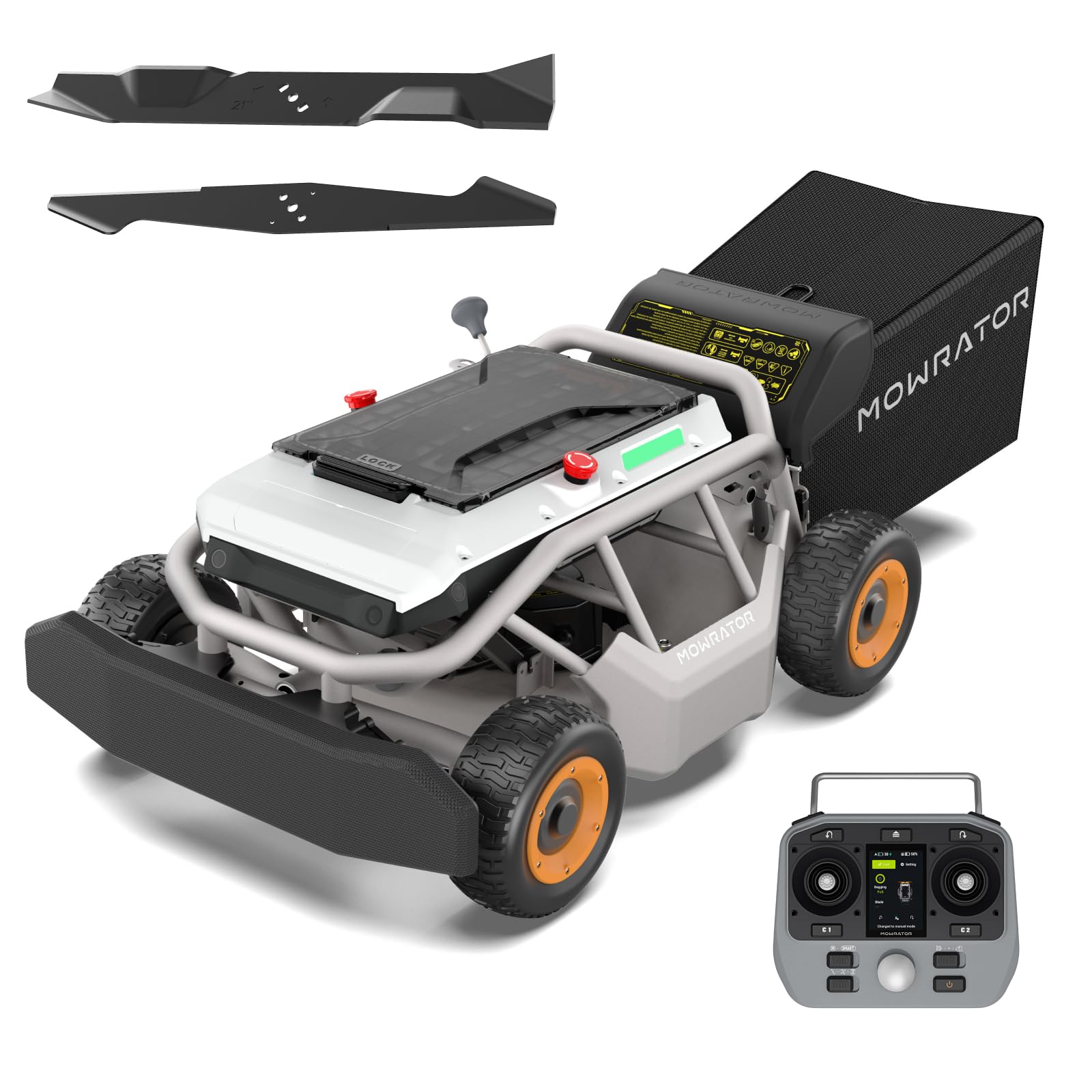
Drive it up a bank you would never push a mower across, and keep both feet on flat grass.
This is the pick for the yard that has beaten every walk-behind you have owned — a ditch, a bank, a slope that turns greasy in spring. The Mowrator S1 puts power at all four corners through a 1000W 4WD system (1000 watts of total drive effort spread across four wheels), and the blade motor peaks at 1985.6W spinning up to 3200 RPM. In real terms, that is enough torque to keep the deck turning in dense grass instead of bogging down, and the 21-inch cutting width clears ground quickly without making the machine too wide for a garden gate.
Runtime is where it earns its keep. The 56V 18Ah LiFePO4 battery (a lithium-iron-phosphate pack, which is the chemistry that tends to hold up over many charge cycles) covers up to 1.125 acres per charge with up to 2.25 hours of runtime. The included 600W charger fills it back in 90 minutes, so a long afternoon is two sessions rather than one. It runs at just 63 dB — roughly the level of a quiet conversation — so an early start will not wake the street.
You control the whole thing from a low-latency remote with response times as low as 5 ms (milliseconds, i.e. essentially instant), and there is no RTK setup or app to fight through first. Owners say it simply works — it mows banks and ditches that stop every other mower here. Owners do flag a genuine trade-off: all-wheel drive with wide tires can tear turf on tight turns and leaves less defined stripes than a lighter machine, so plan wide arcs rather than pivot turns on soft grass.
Where it pulls ahead
- 37° (75%) slope rating with a 1000W 4WD system — you mow banks standing on flat ground
- Up to 1.125 acres and 2.25 hours per charge, then 90 minutes on the 600W charger
- 63 dB operation and zero emissions — no fumes in a closed garage
- 21-inch deck with mulch, rear-discharge, and bagging modes plus an included mulching blade for leaf season
What to plan around
- Wide tires and AWD can scuff turf on sharp turns — keep turns wide on damp grass
- At 147.7 pounds it is a two-person lift if it ever needs carrying
- Snow plow, tow hitch, and FPV camera are optional extras, not in the box
Made for: anyone with a slope, ditch, or pond edge who wants to stop pushing and start steering.
Think twice if: your lawn is flat and manicured — a lighter walk-behind will stripe it better for less money.
2. Segway Navimow X430 Robot Lawn Mower
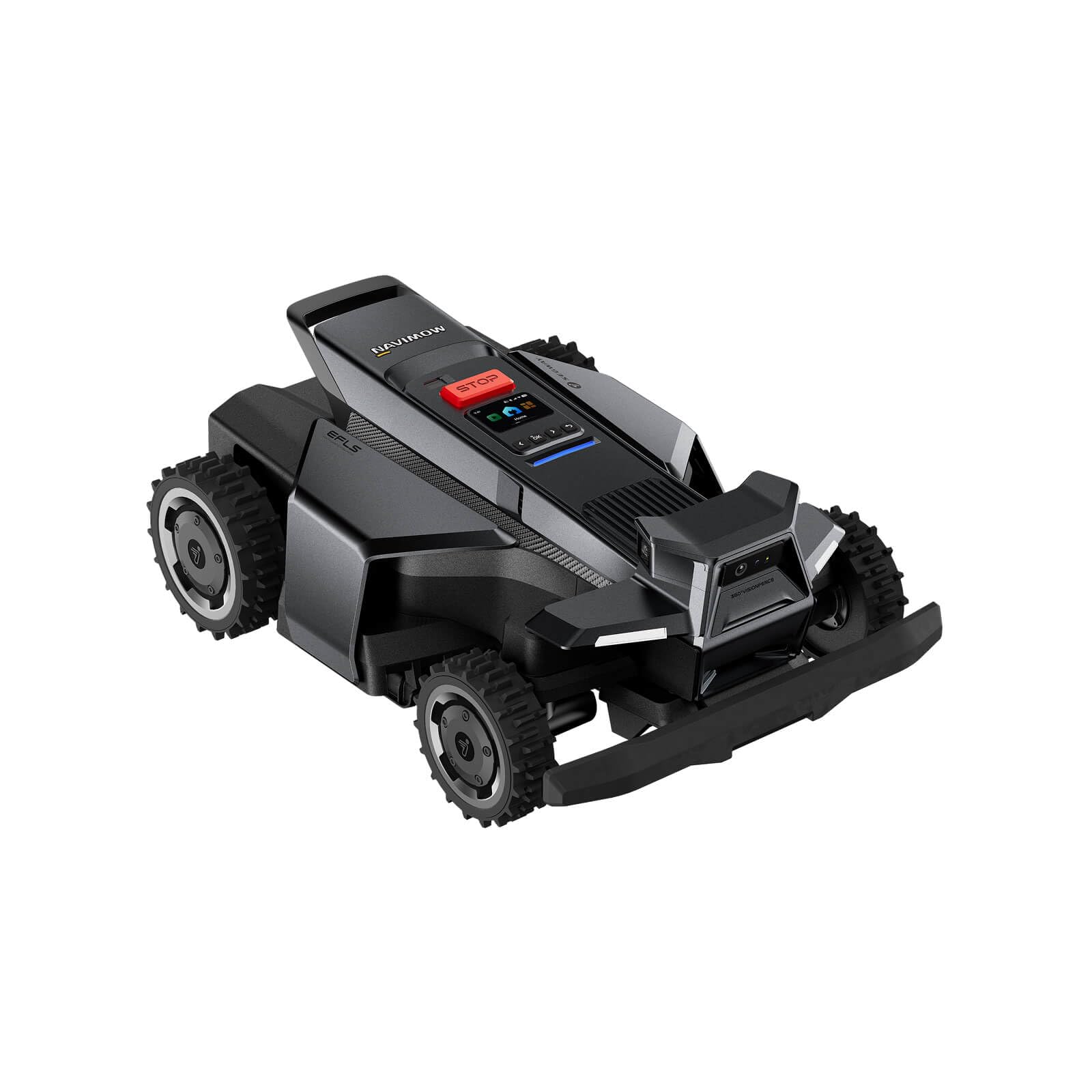
An all-wheel-drive robot that climbs an 84% grade and turns without ripping the lawn.
The X430 is the acre-sized robot in this list, and the gap between it and the remote-controlled Mowrator is dramatic in both directions. It weighs 63.7 pounds against the Mowrator’s 147.7 pounds, and measures 33.5″D x 24″W x 13.8″H against 60.4″D x 26.2″W x 20.5″H — a far smaller footprint for a machine rated to handle more ground. Its 17-inch cutting width is narrower than the Mowrator’s 21 inches, which is why it needs more passes but fits through tighter gaps.
The drive system is the headline: an ORV-tuned dual suspension (off-road-vehicle style, meaning the body floats over bumps) climbs slopes to 84% (40°) and crosses obstacles up to 2.8 inches. Xero-Turn AWD with eccentric front-wheel steering is designed to pivot without scuffing — that eccentric front wheel is offset from its pivot, so it rolls through a turn instead of dragging. Dual 180W motors drive dual cutting discs with 12 blades, and EdgeSense pulls the trim margin to under 2 inches so there is less string-trimming left over.
Setup is genuinely wire-free: one-tap Auto Mapping, no antenna, no base station, and EFLS tri-frequency Network RTK (a radio positioning correction that keeps the robot accurate to the centimetre) holds its line under trees and along fences. Owners praise its traction on wet grass, slopes, and tight corners without stalling. The honest catch is speed and finish: a full pass leaves some grass standing, so most owners schedule a second run, and above roughly 92°F it can overheat and pause. On wet grass, expect it to struggle.
The straight read: this is the most capable robot here on difficult terrain, and the most expensive to own in time — you supervise the setup, then let it work twice over the same ground.
The catch worth naming: it repeats the same perimeter path and can lay grass down along the edge, so budget a trimmer pass for the borders.
Reach for this if: you have close to an acre, awkward slopes, and you would rather check an app than push a handle.
Look elsewhere if: you want a one-pass finish — the Mowrator S1 still cuts it clean first time.
3. Mammotion LUBA mini AWD 800H Robot Lawn Mower
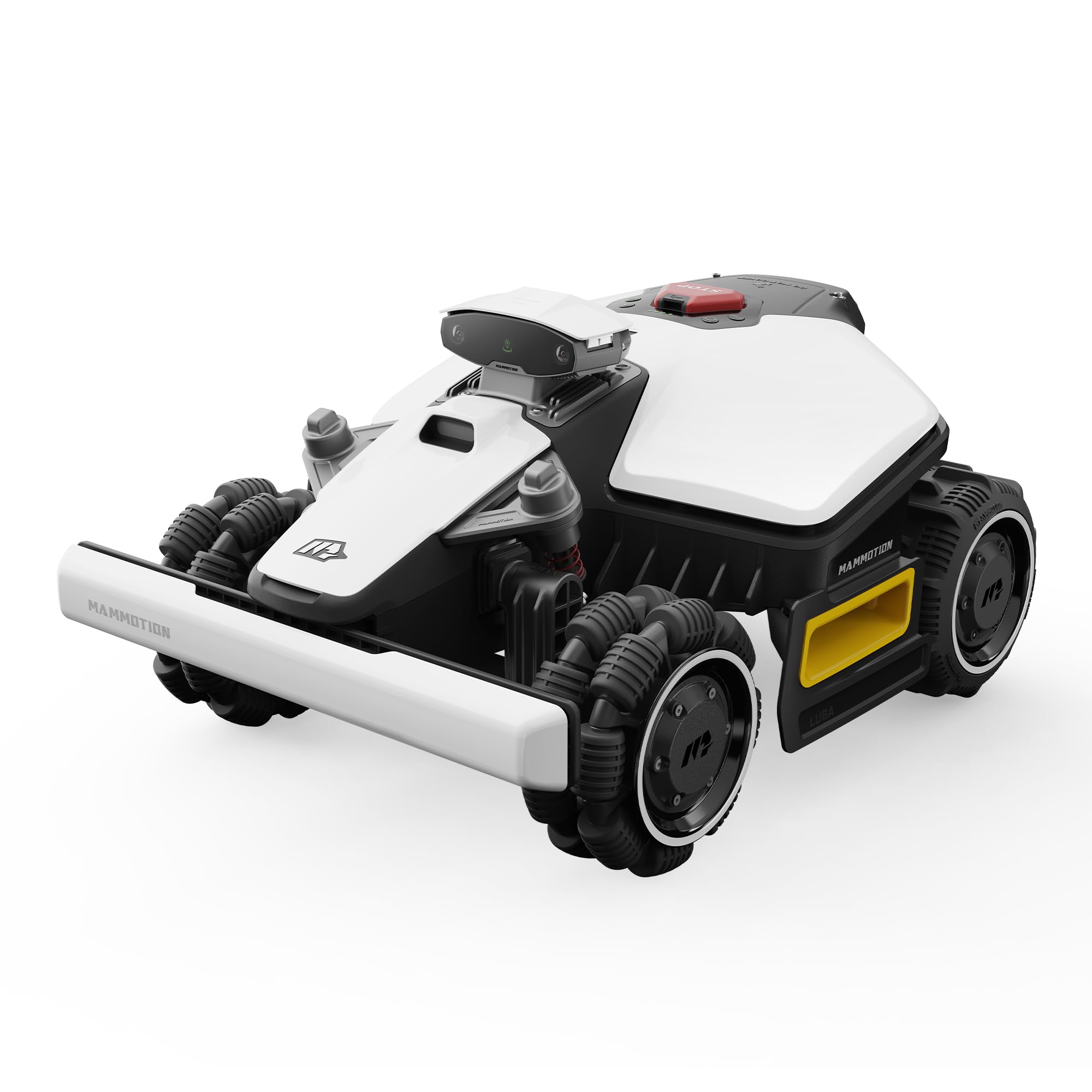
Skip the base station entirely and let AI vision draw the boundary for you.
Most robot mowers ask you to bury wire or mount a fixed antenna before they cut a single blade. The LUBA mini AWD 800H does neither — NetRTK removes the base station completely, so you connect through the app, generate virtual boundaries, and mow within minutes of unboxing. For a 0.2-acre yard, that is the difference between an afternoon of installation and a coffee break.
The off-road hardware is real. Adaptive suspension and an 88W blade motor carry it across slopes up to 80%, potholes, and tall thick grass, with omni-wheels that pivot in place rather than swinging wide. UltraSense AI Vision separates grass from non-grass surfaces, so it holds its own boundaries under trees and in signal-blocked corners, and it recognises over 200 obstacle types with a chosen avoidance path. You can manage up to 20 mowing areas across front and back yards, and it resumes where it stopped after recharging.
Owners say it handles a quarter-acre yard reliably and was worth the money. The 7.9-inch cutting width is the honest limit — this is a small-yard machine, and one buyer who upgraded noted a bigger model would mean double the cutting width. Setup can eat most of a day on a complicated plot, and it will still occasionally miss a strip near an edge, so keep a trimmer for the borders. Anti-theft GPS tracking and a “lost” lock give you some protection if it ever wanders.
Why it fits small plots: no base station, no wire, and app-driven boundaries — set it up once and let it run on a schedule.
Built for: a quarter-acre or smaller garden where installing a fixed antenna is the thing you want to avoid.
Not for: open half-acre lawns — the 7.9-inch deck will take too many laps.
4. Husqvarna Z254 Zero Turn Lawn Mower
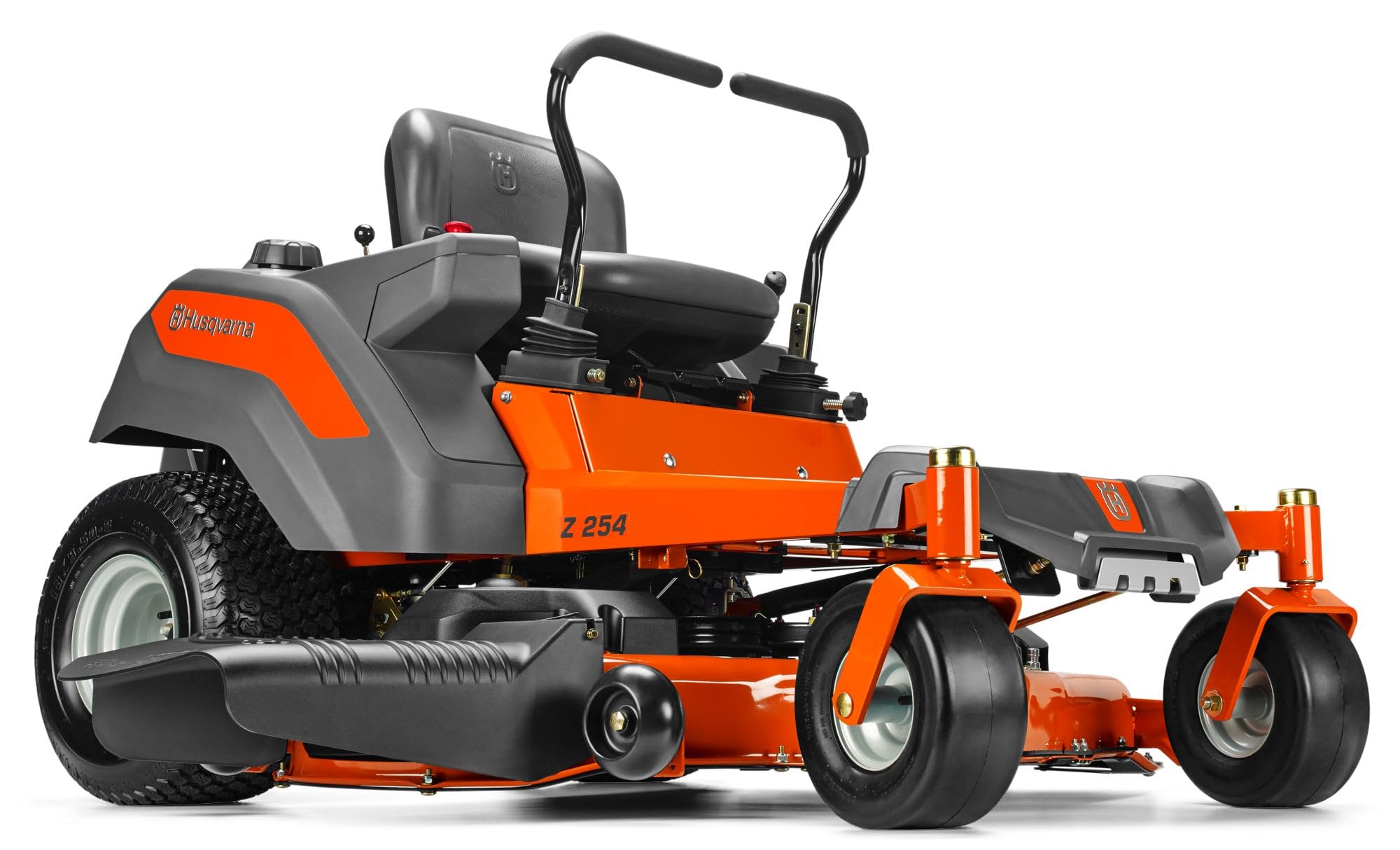
A 54-inch deck and a 24HP V-twin engine that turns a two-acre job into an errand.
When the property is genuinely big, a robot mower’s 17-inch deck and a battery machine’s recharge cycle start to feel like a joke. The Z254 cuts 54 inches per pass from a 24HP/724cc Briggs & Stratton Endurance Series V-twin OHV engine — a two-cylinder overhead-valve motor, which is the layout that keeps torque steady in long, thick grass. A 3.5-gallon fuel capacity and 6.5 mph forward speed mean a large lot gets finished in one sitting rather than three.
Steering comes from Hydro-Gear EZT transmission (a hydrostatic drive, meaning the wheels are driven by fluid pressure rather than belts and gears), paired with a zero-turn layout so you spin in place at the end of each stripe. The three-blade stamped deck with 7 cutting positions gives you the flexibility to drop low in spring and lift in summer heat.
Buyers report the 24HP V-twin is strong in thick grass and fast across open ground. Cuts that used to fill a Saturday now take a fraction of the time, and the engine starts reliably. The one recurring gripe is the speed-control lever — a lever that does not respond consistently to the position it sits in — so check that the lever moves smoothly before you commit. At 628 pounds it also needs a proper shed, not a garden corner.
Where a gas tractor still wins
- 54-inch three-blade deck — the widest cut on this list
- 24HP/724cc V-twin with 3.5 gallons of fuel, so refuelling takes seconds
- 6.5 mph forward and 3.5 mph reverse with hydrostatic zero-turn control
The practical limits
- The speed-control lever is the recurring complaint — test it on arrival
- 628 pounds and a 57-inch width mean it needs serious storage and wide gates
- Gas engine means oil changes, filters, and fuel — not a plug-in machine
Pick this if: you are cutting two-plus acres in open ground and want it done in one tank.
Look past it if: your lot is small, gated, or you want zero engine maintenance.
5. Greenworks 80V Riding Lawn Mower
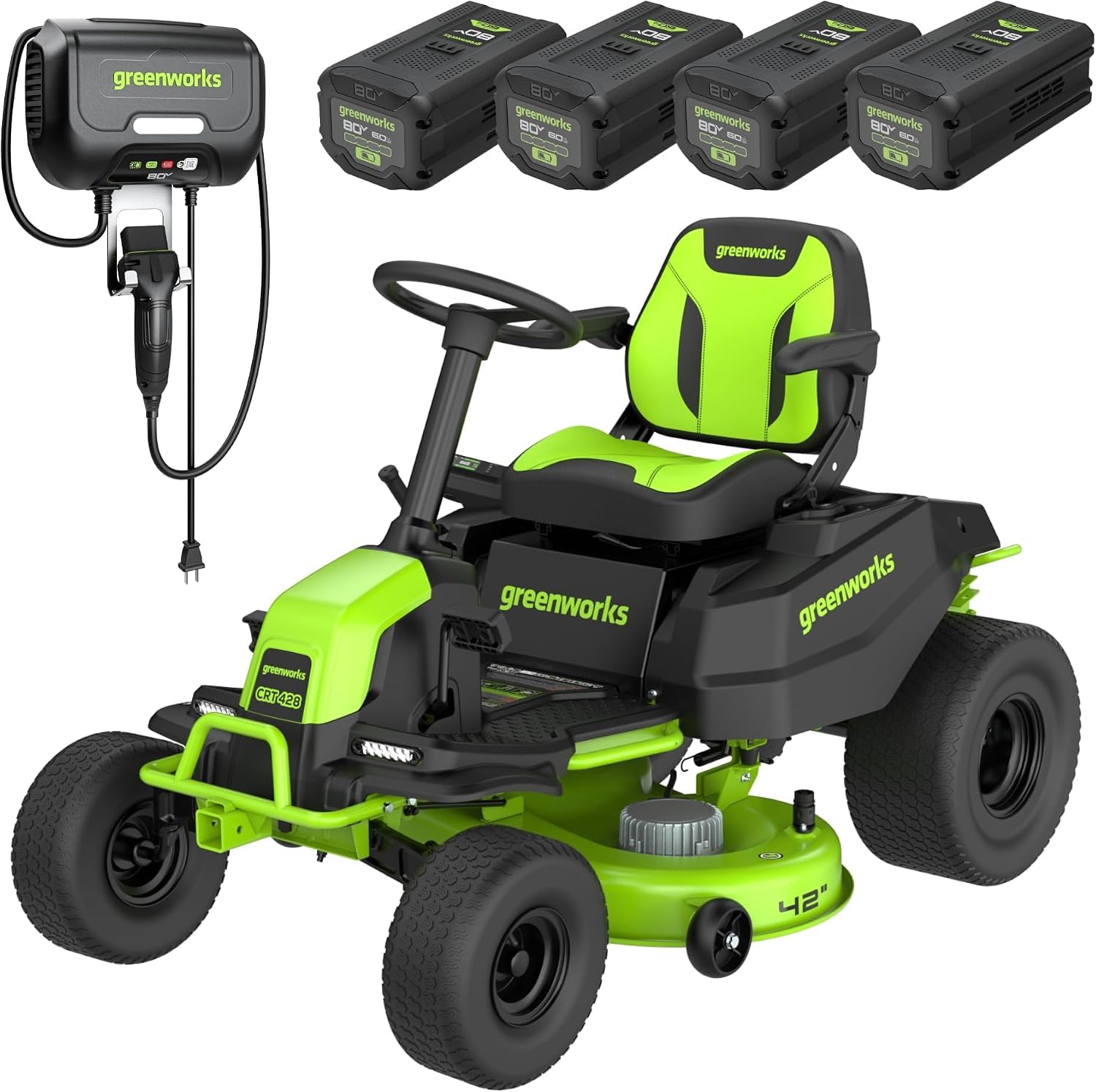
A battery tractor quiet enough to mow while the neighbours sleep in.
Here is the machine for someone who wants ride-on comfort without pulling a starter cord. The 80V TruBrushless motor (a brushless design, meaning fewer wearing parts than a traditional motor) delivers 32HP gas-equivalent power with zero emissions and no oil changes. The 42-inch stamped steel deck is 12-gauge — thicker steel than a typical homeowner deck — and SmartCut technology reads grass conditions and adds power automatically so it does not bog in tall, wet growth.
Runtime is realistic rather than optimistic. Owners typically see around 1 acre per charge in tall grass, with one reporting that mowing 1.5 acres left battery to spare. The kit includes four 80V 6.0Ah batteries and a 600W charger, and those batteries fit more than 75 other tools in the Greenworks 80V family — so the investment spreads across a trimmer and blower too.
Where it surprises people is quietness. One owner describes it as roughly a tenth as loud as their old John Deere, which changes when you can mow. There is a rear utility bin that hauls up to 200 lbs. and front/rear attachment points that tow up to 350 lbs., plus a high-back padded seat, dual LED headlights, and 7 deck positions from 1.5 to 4.5 inches. The caveat is that the bin is sold separately, so price the whole setup before you commit.
What buyers keep coming back to: the instant torque and the silence — no fumes, no fuel can, no ear defenders.
One thing to check: the cargo bin is an add-on, so factor that in if hauling matters.
Suits you if: you want tractor-sized cutting with battery convenience and you already own Greenworks 80V tools.
Think harder if: you cut more than an acre and a half per session in thick grass.
6. Husqvarna Z246 Zero Turn Lawn Mower

The 46-inch sibling that fits through the gate the 54-inch model cannot.
The Z246 is the smaller Husqvarna here, and the difference is almost entirely geometry. A 22HP Briggs EXI engine drives a 46-inch stamped two-blade deck instead of three blades across 54 inches. Hydro-Gear EZT transmission and a 6.5 mph forward speed keep it moving, and the 3.5-gallon tank matches its bigger sibling — so you refuel at the same intervals while making slightly narrower passes.
On a two-acre plot, that narrower cut has a real payoff: it slips between obstacles a wider deck would have to mow around. Owners describe it as a genuinely fast machine — one cut a two-acre lawn in under half its previous time, which is the sort of gain that justifies the switch on time alone. The learning curve is short and the deck capacity is easy to work with.
The wait is the honest part. This arrives drop-shipped on a pallet with some assembly required — connect the battery, fit the seat — and you will need a claw hammer to open the crate. One machine in the reviews lost power after twenty minutes and the owner could not reach support. That is a single bad unit rather than a pattern, but it is a reminder to register the warranty the day it lands.
Strengths that show up on day one
- 22HP Briggs EXI engine with a 46-inch two-blade stamped deck
- 3.5-gallon fuel capacity and 6.5 mph forward speed
- Crate-shipped with the engine already filled with oil
Before it lands
- Pallet delivery needs a claw hammer and some assembly time
- 654 pounds — plan where it parks before ordering
- Warranty registration is on you; support is not automatic
Go for it when: you have roughly two acres and gates or beds that a 54-inch deck would not clear.
Hold off if: tight finish quality matters more to you than mowing speed.
7. EGO Power+ TR4204 Riding Lawn Mower

Six batteries feeding up to 20,000 watts — a battery tractor with gas-engine manners.
Where the Greenworks rider uses one pack family, the EGO TR4204 stacks up to six 56V ARC Lithium batteries to deliver up to 20,000 watts of power — the maker claims that is equivalent to a 21-horsepower gas engine. In plain terms, it has the torque to keep two cutting motors spinning through tall wet grass rather than stalling out. Dual brushless cutting motors (motors without carbon brushes, so they last longer) mean there are no belts to snap or tighten. The digital LCD gives you three blade settings, three drive speeds, and cruise control at up to 6 MPH (miles per hour).
The deck is 42-inch stamped steel with twelve cutting-height positions from 1.5 to 4.5 inches, which is the widest height range on any ride-on here. A rear tow hitch lets it haul loads, and LED lights, a USB charging port, and Bluetooth come standard. Owners describe clean cuts from the dual brushless motors and simple assembly, and existing EGO 56V owners can swap batteries across their other tools.
The honest caveat is battery honesty. The 1.5-acre figure assumes ideal conditions — one owner found that just over half an acre on a slope left about 30% charge. If your ground is sloped or your grass is thick, plan a second set of packs. There is also a five-year tool warranty to lean on, and one tractor bricked repeatedly under it, so save your receipt.
What stands out: the power headroom — six packs and 20,000 watts give it the widest reserve of any battery tractor here.
The real-world number: treat 1.5 acres as best case; slope and tall grass cut it sharply.
Buy this if: you already run EGO 56V tools and want a tractor that shares the platform.
Consider otherwise if: your lot is sloped and you do not want to buy extra packs.
8. Honda HRX-BE Walk Behind Lawn Mower
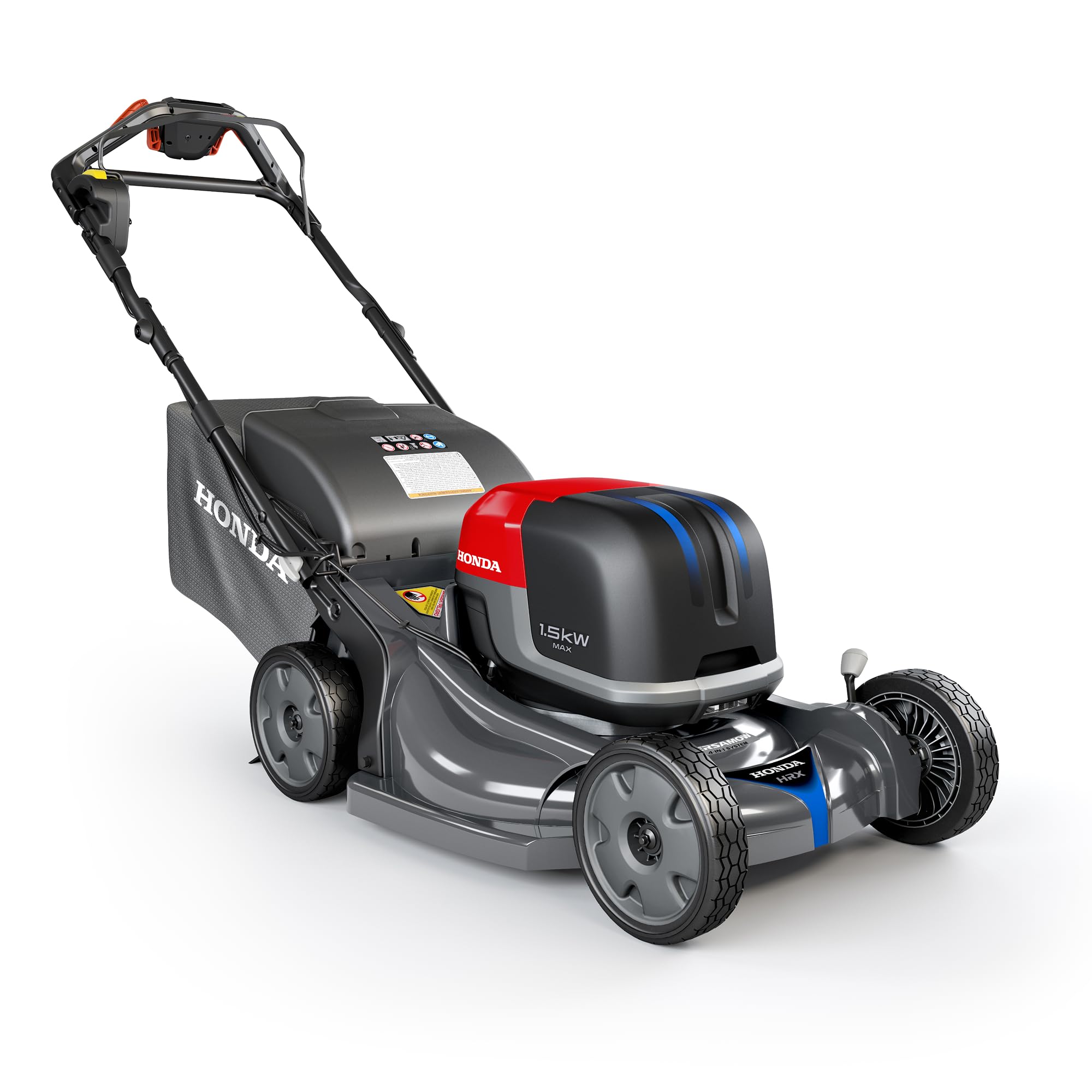
Two wheels and a Honda motor — the walk-behind that still mulches better than most robots cut.
Not every yard needs four driven wheels. If your ground is flat and your gripe is clippings, this is the machine: the 4-in-1 Versamow system with Clip Director lets you mulch, bag, discharge, and shred leaves with no attachment changes. The twin-blade MicroCut system uses four cutting surfaces (two blades, two edges each) to make finer clippings, so a 2.2-bushel bag holds more and the lawn gets a finer mulch layer.
The 12Ah lithium-ion battery runs up to 45 minutes, or about 0.37 acre, per charge, and there are two battery bays — a second 12Ah pack doubles runtime but is sold separately. The e-Select Drive transmission is adjustable from 0 to 4 mph at the touch of a button, and a dual-lever system gives you 7 cutting heights from 0.75 to 4 inches. Blade control sits on a button and lever so the blade cannot start by accident, and the motor shuts itself off after 3 minutes of blade inactivity.
The support structure is what separates it from most battery walk-behinds: a nationwide service network with parts available, plus a 5-year residential warranty. Owners praise the MicroCut mulching and the quiet — it cuts like a gas Honda should. The trade-off is simply that it has two wheels: on a slope, you walk it. And a battery mower with a 2.2-bushel bag (about 2.2 large laundry baskets) full of wet clippings is heavier than it looks.
Why the cut is the sell
- 4-in-1 Versamow with twin-blade MicroCut — mulch, bag, discharge, shred with no attachments
- 7 heights from 0.75 to 4 inches and self-propel from 0 to 4 mph
- 5-year residential warranty with nationwide parts and service
Limits to know
- About 0.37 acre per charge — bigger lawns need the second battery
- Two-wheel drive, so slopes mean walking behind it
- 99 pounds, plus a full 2.2-bushel bag, is a real push up a ramp
Right choice for: a flat lawn where clipping quality and warranty backup beat four driven wheels.
Wrong choice for: banks and ditches — that is what the Mowrator above is for.
9. Segway Navimow i206 AWD Robot Lawn Mower
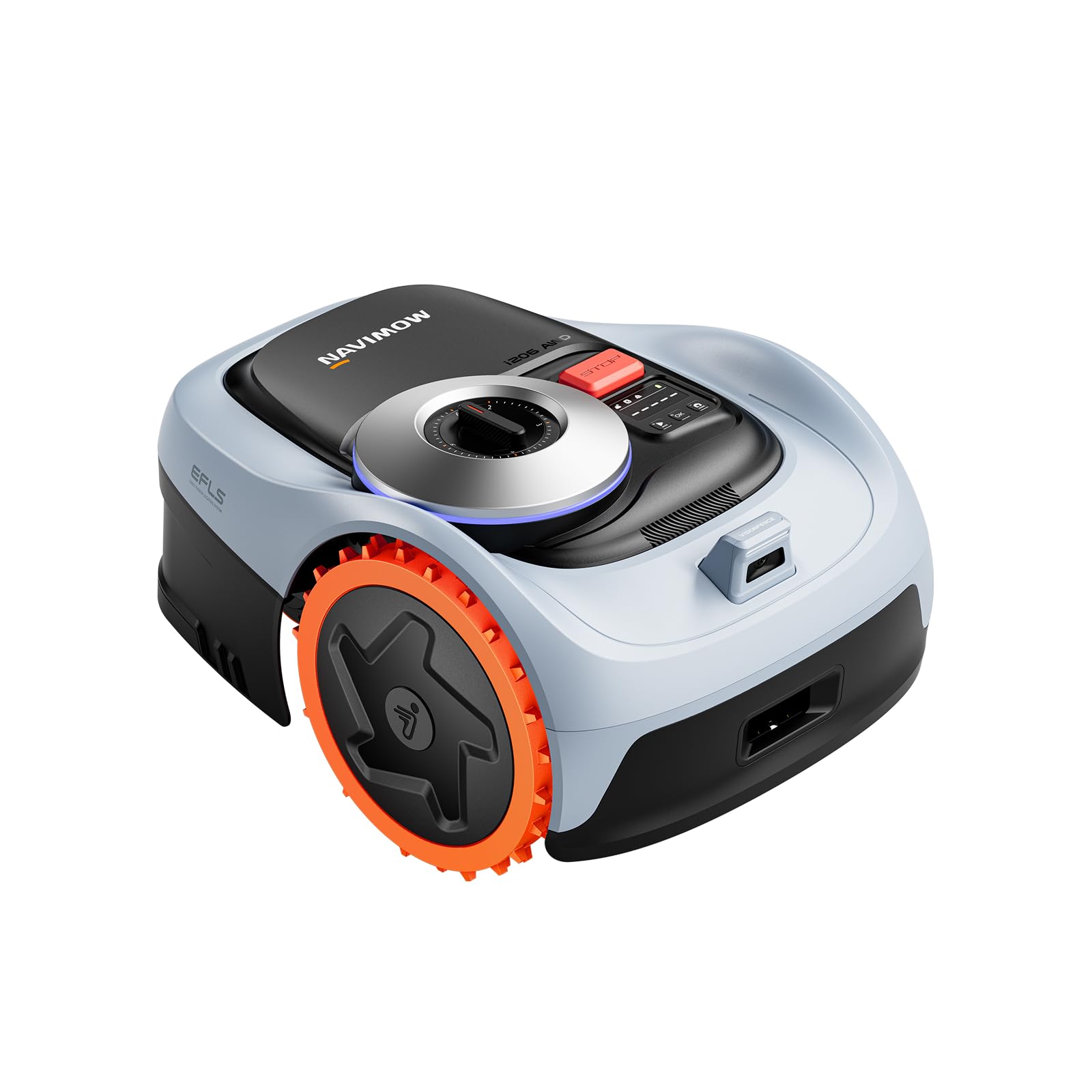
A small-lot robot that mows a fenced backyard without a single buried wire.
Think of the i206 as the entry point to all-wheel-drive robot mowing. It climbs slopes up to 45% with automotive-grade stability control (the same idea as traction control in a car — it cuts power to a slipping wheel), and the zero-turn steering pivots without scraping turf. The 7.1-inch deck and adjustable 2–3.6 inch height suit a tidy suburban yard rather than open acreage.
Runtime is sized for the job: a 2.5Ah battery covers up to 1,350 sq ft per charge, which matches a 0.15-acre lot in one or two sessions. EFLS Network RTK and Vision handle one-tap auto mapping with centimetre-level accuracy, and you can manage up to 20 zones with auto-resume charging. Real-time GPS alerts ping you if it is lifted or wanders off course.
Owners praise the cut itself — they report it getting at least 98% of the grass, missing only stray blades. The weak spot is mapping reliability: a few owners mention maps failing to save after repeated manual passes, and one unit wandered into a mulch bed. Fixes usually come through the app, and support has resolved tricky cases, so expect some setup patience on an irregular plot.
The honest picture: a well-built small-lot robot with a genuine mapping learning curve.
Fits your yard if: you have a fenced quarter-acre or less and want to stop pushing a mower entirely.
Not the one for: complicated multi-zone plots where map stability matters more than price.
10. Sunseeker X7 AWD Robot Lawn Mower
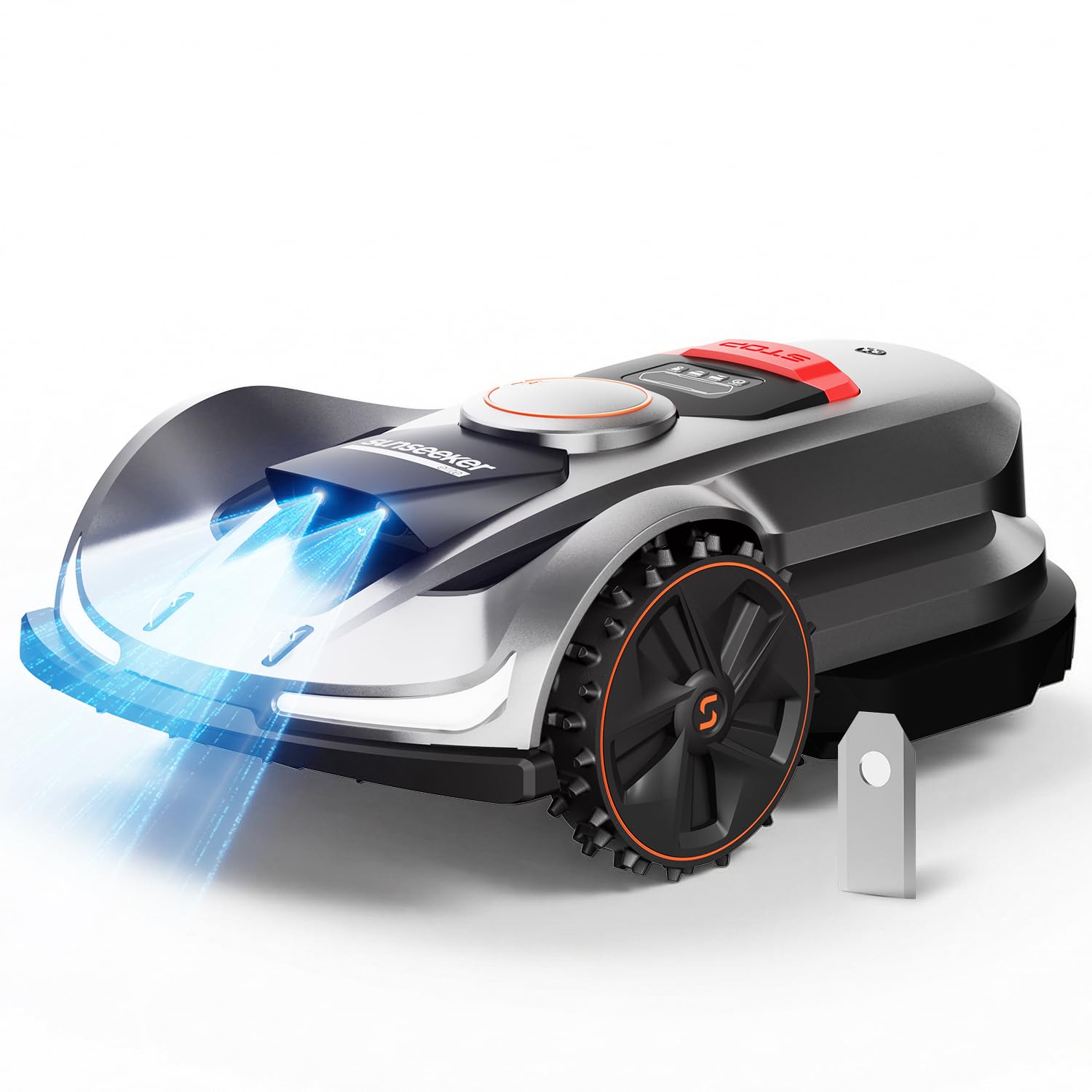
A three-quarter-acre robot built for mud, roots, and slopes up to 35°.
The AWD version of the X7 exists for the yard that is not a manicured rectangle. Deep-tread tires grip slopes up to 35° (70%), and binocular 3D vision — two cameras reading depth the way your eyes do — estimates distance to obstacles and adjusts the route to limit turf damage. A 14-inch dual-blade floating deck follows contours across a 0.8 to 4.0 inch height range and returns fine clippings as you go.
Navigation pairs RTK with VSLAM, which means satellite positioning backed by visual mapping, so coverage holds up when trees or weather weaken the satellite signal, day or night. You get wire-free virtual boundaries, up to 10 maps, and app control of zones and schedules. The whole unit weighs 30.5 pounds — light enough that carrying it back to the dock is a one-person job rather than a two-person one.
This is where you have to read the fine print honestly. When it grips, it grips — it climbs sloped sections and tight passages without slipping and keeps a stable satellite lock. But mowing performance is the most-discussed topic in its reviews and it splits both ways: some report a clean, even cut, while others describe getting stuck in deep grass or losing connection and having to carry it home.
Built for awkward ground
- 35° (70%) slope rating with deep-tread tires
- RTK + VSLAM visual mapping holds coverage under trees
- 30.5 pounds and a 14-inch floating deck sized for up to 0.75 acre
Where it can stumble
- Deep grass has stopped it — keep the lawn mown low on a schedule
- Some units need remapping after a connection loss
- Finish quality is variable, so give it a second pass on rough sections
Give it a spot if: your three-quarter acre is bumpy, muddy, and full of roots and trees.
Pass if: you want robotic precision on a flat, perfect lawn.
11. ECOVACS Goat A3000 LiDAR PRO Robotic Lawn Mower

Dual LiDAR maps your yard in 2 cm accuracy — even where satellites give up.
Most robot mowers navigate by radio or satellite. The Goat A3000 LiDAR PRO navigates by light: a HoloScope 360° dual-LiDAR system (LiDAR measures distance with laser pulses, like sonar with light) maps your yard and holds 2 cm (about 0.8 inches) positioning accuracy under trees, along fences, and in deep shade where GPS-based mowers lose the plot. No perimeter wire and no RTK antenna (a GPS correction antenna) go in the ground.
The mowing hardware is built for thick American turf — Bermuda, Zoysia, Fescue, St. Augustine. A 32V high-power platform and dual-blade disc system deliver the torque to keep cutting through fast-growing grass, and a 12.99-inch cutting width covers up to 400 m²/h. A built-in TruEdge trimmer cleans the borders along sidewalks, driveways, and flower beds. The 7500 mAh battery with 189W fast charging fully recharges in roughly 70 minutes.
Owners cheer the time it gives back — one turned three hours of mowing into about ten minutes. What splits opinion is everything around the cut: handling, mapping quality, and trimming ability all draw mixed views. The rear-wheel-drive layout with small front casters can spin out on rough sidewalks, and the trimmer is a helper rather than a replacement for a string trimmer. Mowing itself, though, is consistently well regarded, and the app scheduling works.
The strongest case: dual LiDAR genuinely solves shaded, signal-blocked yards that defeat satellite robots.
Size it honestly: the battery and recharge cycle suit a lawn up to 3/4 acre — do not expect more.
Worth it for: shaded, fenced yards on up to 3/4 acre where GPS-only robots fail.
skip it if: you wantto replace a string trimmer entirely — the built-in trimmer is a helper, not a full solution.
12. MOVA LiDAX Pro 800 Robot Lawn Mower
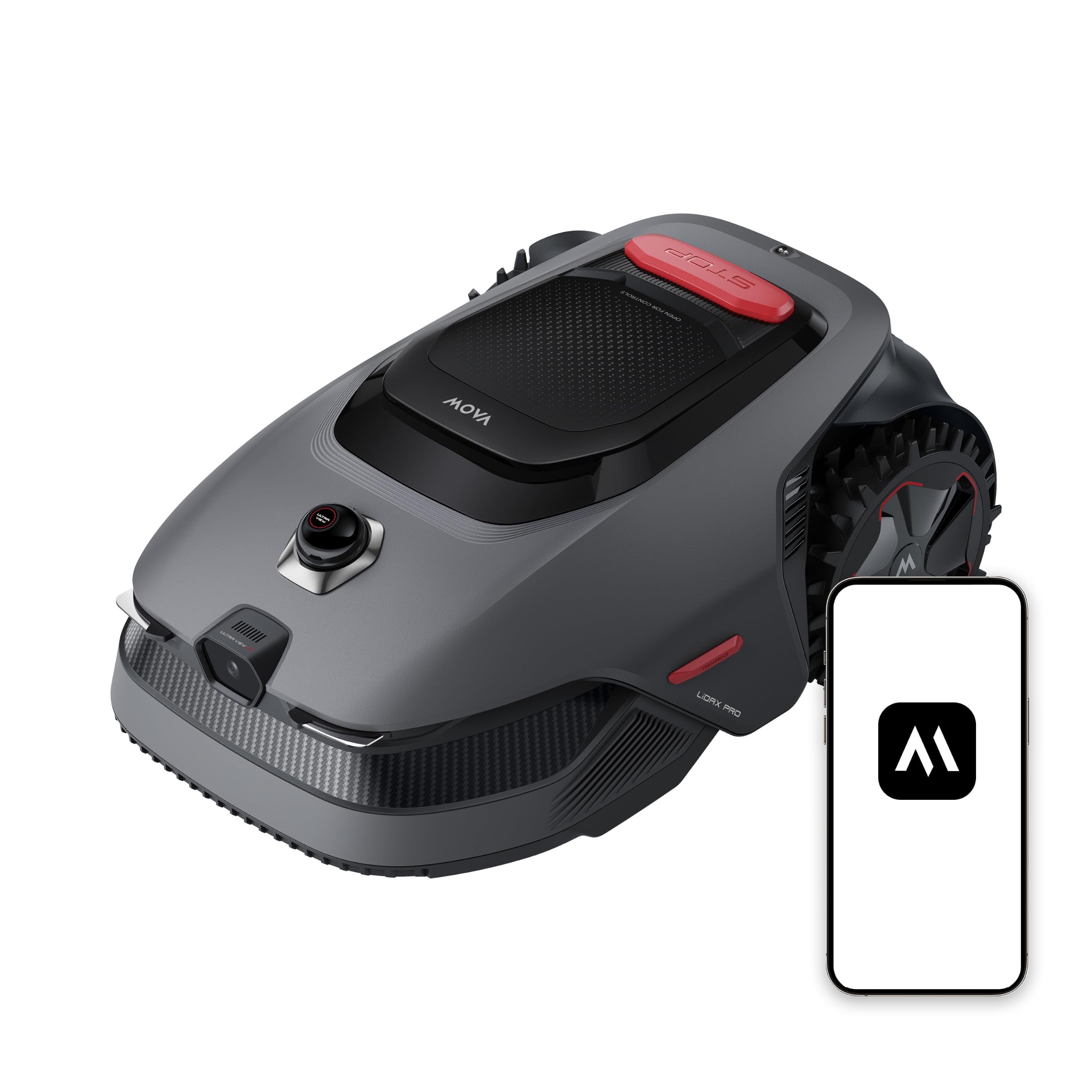
Two yards, one robot, no wire — and a LiDAR eye that copes with dim light.
If you maintain a front and a back garden that never touch, this is the machine that saves you buying two. The LiDAX Pro 800 stores up to 2 independent maps and manages up to 150 zones, so each property gets its own mowing plan. Mapping runs on 360° 3D LiDAR with AI vision — no wire, no RTK station — and it works under dim light or harsh glare, which is where camera-only systems tend to struggle.
Obstacle avoidance is the standout on paper: 3D point cloud data and AI vision detect and route around over 300 types of lawn obstacle, from outdoor furniture down to small yard items. Cutting height adjusts from 1.2 to 3.9 inches straight from the MOVAhome app, and a 7.9-inch deck with U-shaped path planning keeps coverage even. Rear-wheel drive and off-road wheels climb slopes up to 45% and clear obstacles up to 1.6 inches high, including small pits. A 3-year manufacturer warranty backs it.
It is worth being straight about the evidence here: this is a very new listing with almost no owner history behind it, so the specs are the promise and not yet a proven track record. That is the trade-off — you are buying the dual-map, LiDAR-first design early. Owners of the wider MOVA and LiDAR robot category consistently value the wire-free setup and the improved navigation over older GPS machines, and that is the direction this model clearly follows.
The appeal in one line: two independent maps and 150 managed zones mean one robot can look after both your front and back gardens.
What is unproven: a short review history — this pick earns its place on specification, not on accumulated owner experience.
A smart fit if: you own two separate plots and want a single wire-free robot to handle both.
Hesitate if: you would rather buy a model with a long, proven owner record behind it.
Know the Specs
Slope Rating: Degrees vs Percent Grade
A slope rating tells you the steepest ground the mower can climb while keeping traction and staying upright. It is quoted two ways, and the two are easy to mix up. A degree figure measures the angle of the hill — 37° is a steep bank. A percent figure is rise over run, so 75% is the same hill, and 100% would be a 45° wall. When you compare picks, convert both into the same unit before deciding. The Mowrator S1 is rated 37° (75%) while the Mammotion LUBA mini AWD is rated 80% — they are close in real terms, but quoted in different units on the spec sheet. Always measure your own steepest patch before you buy.
Battery Capacity in Ah and Runtime in Hours
Battery capacity is the size of the fuel tank — the amp-hour (Ah) figure tells you how much charge the pack stores, and the voltage tells you how hard it pushes. A 56V 18Ah pack on the Mowrator S1 is a large reserve that covers up to 1.125 acres; a 2.5Ah pack on the Segway Navimow i206 is sized for a much smaller lawn. Runtime in hours and coverage in acres per charge are the numbers that matter day to day. Fast charging also matters — a 600W charger that refills in 90 minutes keeps a big job moving, and a 70-minute full charge on the ECOVACS Goat A3000 keeps a robot working through the afternoon. Match Ah and acres to your own lot, not to the best-case claim.
Common Questions
How steep a hill can a four wheel drive lawn mower actually climb?
Does a zero-turn mower count as four wheel drive?
Can a robot lawn mower handle slopes as well as a ride-on tractor?
How long does a battery riding mower run on one charge?
Do wire-free robot mowers need an RTK base station?
Will a wide deck cut faster than a narrow one?
Do I still need a string trimmer if I buy a robot mower?
Can a four wheel drive mower tear up my lawn?
What size battery do I need for a one-acre lawn?
Is gas or battery better for a large sloped property?
The Bottom Line
For most people with a slope, ditch, or rough patch to tame, the 4 wheel drive lawn mower that earns the top spot is the Mowrator S1 4WD — a 1000W all-wheel-drive system, a 21-inch deck, and up to 1.125 acres per charge on an 18Ah LiFePO4 pack (a lithium battery type). You drive it from a low-latency remote you can use standing on flat ground. If you want the hands-off version and your acreage supports a robot, the Segway Navimow X430 climbs an 84% grade with wire-free mapping and covers close to an acre. And for a big property where time is the whole problem, the Husqvarna Z254 cuts 54 inches per pass with a 24HP V-twin (a two-cylinder engine) and a 3.5-gallon tank — no recharging, no mapping, just a wider stripe every lap.
One honest nudge before you decide: the Mowrator S1 carries the strongest combination of slope rating, cutting width, and per-charge acreage in this group. It is the one pick that handles the ground where every other machine here has to stop and think. If your lawn has a bank, that single fact is worth more than any spec sheet comparison.
How we choose
We do not accept paid placement. Every pick is matched to a real buyer and a real use-case; we do not hands-on test units.
Sources
Specifications: manufacturer listings and product documentation. Review insights: verified customer reviews, as of October 2026. Pricing: not shown on this page (it changes often); check the current price via the retailer link.
As an Amazon Associate, Aappliancez earns from qualifying purchases. This does not affect which products we feature.